
Microbial ToxinBIOC 422 Lecture4 1 Bacterial Toxins How
Microbial Toxin-BIOC 422 Lecture-4
1 - Bacterial Toxins
How Bacterial Toxins damage the host cells? 4 - Production of toxins (Toxigenicity) • Many bacterial pathogens generate toxins that act inside host cells, as a mechanism for remodeling the host environment. • The potency of intracellularly acting toxins is derived, in part, from their mode of action; most are enzymes that catalyze the covalent modification of specific molecular targets. • To be successful, however, intracellularly acting toxins must access their substrates inside target cells. • This is no small feat, as the eukaryotic plasma membrane is a challenging gatekeeper that effectively restricts macromolecules such as toxins from passing freely into cells.
How Bacterial Toxins damage the host cells? 4 - Production of toxins (Toxigenicity) How do toxins make it into target cells? ØTo overcome the membrane barrier, intracellularly acting toxins are either injected directly into host cells by pathogenic microbes or, alternatively, enter cells in a manner that is microbe-independent ØThere at least two mechanisms of toxin entry into target cells: >> pathogens directly inject toxins into host cells (pathogen-dependent entry) >> alternatively, release AB toxins, which must then enter host cells independent of the bacterium (pathogen-independent entry)

How do toxins make it into target cells? RELEASE AB TOXINS DIRECTLY INJECT TOXINS
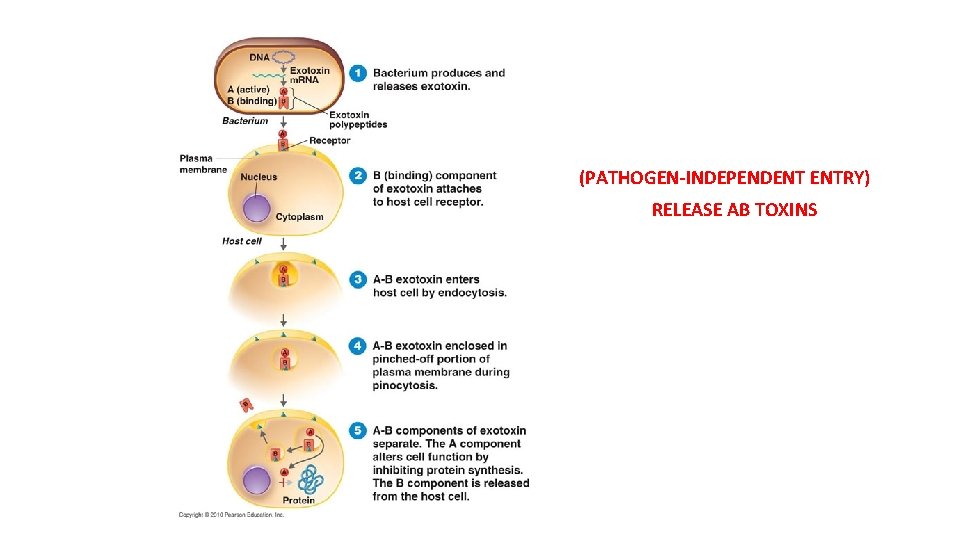
(PATHOGEN-INDEPENDENT ENTRY) RELEASE AB TOXINS
4 - Production of toxins (Toxigenicity) Intercellular bacterial survival: 1. Ability of Pathogens to Avoid or Overcome Phagocytes >> remain confined in regions inaccessible to phagocytes >> Some pathogens can cover the surface of the bacterial cell with a component which is seen as "self" by the host phagocytes and immune system. 2. Inhibition of Phagocytic Engulfment >> Many important pathogenic bacteria bear on their surfaces substances that inhibit phagocytic adsorption or engulfment. >> Resistance to phagocytic ingestion is usually due to a component of the bacterial cell surface (cell wall, or fimbriae, or a capsule)
4 - Production of toxins (Toxigenicity) Intercellular bacterial survival (Cont. ): 3. Survival Inside of phagocytes >> Inhibition of fusion of the phagocytic lysosomes (granules) with the phagosome (The bacteria survive inside of phagosomes because they prevent the discharge of lysosomal contents into the phagosome environment) 4. Products of Bacteria that Kill or Damage Phagocytes >> One obvious strategy in defense against phagocytosis is direct attack by the bacteria upon the professional phagocytes. >> Any of the substances that pathogens produce that cause damage to phagocytes have been referred to as aggressins. >> Phagocytes may be killed by a pathogen before or after ingestion.
4 - Production of toxins (Toxigenicity) • Some important definitions: Pathogenicity: the ability of an organism to cause disease by overcoming the defense mechanism. Virulence: the degree of pathogenicity. Antitoxin: antibodies produced against toxins (exotoxins!).
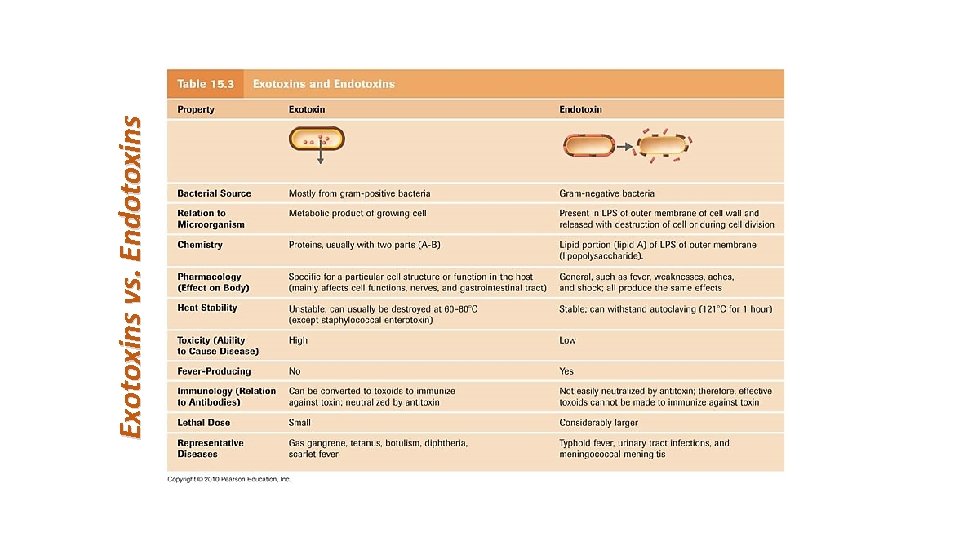
Exotoxins vs. Endotoxins
4 - Production of toxins (Toxigenicity) I. Exotoxins ØMain Characteristics: • They are poisonous proteins produced inside pathogenic bacteria as part of their growth and metabolism and released into host tissue. >> Produced mainly by gram-positive bacteria. >> Proteins: Enzymes that carry out specific reactions. • Soluble in body fluids, rapidly transported throughout body in blood or lymph. • Work by destroying particular parts of the host’s cells or by inhibiting certain metabolic functions.
4 - Production of toxins (Toxigenicity) I. Exotoxins ØExotoxin classification: There are different systems for classifying or identifying toxins including: • By organism generating the toxin • By organism susceptible to the toxin • By tissue target type susceptible to the toxin (neurotoxins affect the nervous system, cardiotoxins affect the heart, etc. ) • By structure (for example, AB 5 toxin) • By a letter, such as "A", "B", or "C", to communicate the order in which they were identified ØTherefore: the same exotoxin may have different names, depending of the field of research.
4 - Production of toxins (Toxigenicity) I. Exotoxins Ø Exotoxin Types (General classifications): Types of Exotoxins 1. Cytotoxins : Kill cellse. g. shigella, vibrio 1. Neurotoxins: Neurotoxins exotoxins that affect nerve transmission of the nerve system and interfere with nerve impulses. e. g. Clostridium botulinum, Clostridium tetani 3. Enterotoxins: Enterotoxins Effect cells lining of the G. I. Tract e. g. E. coli , cholera, Shigella, Salmonella
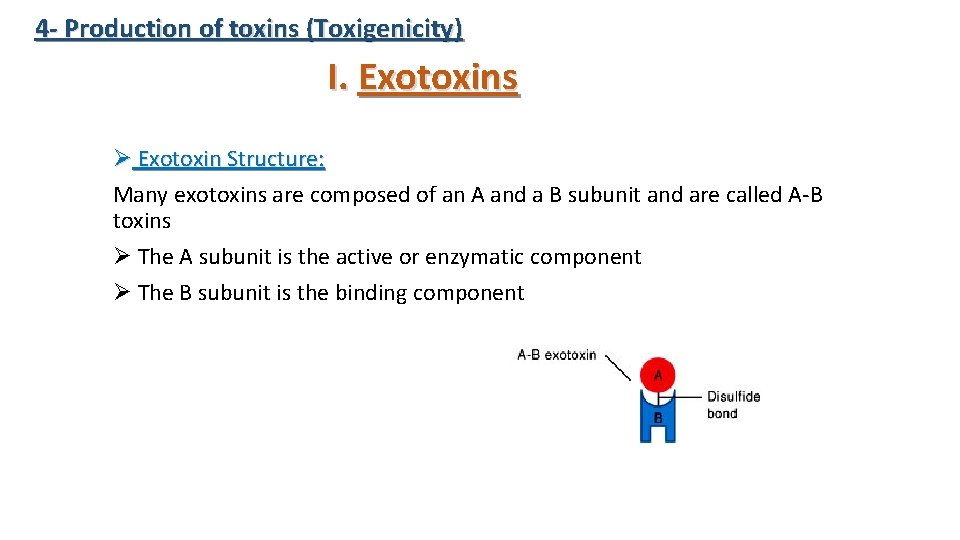
4 - Production of toxins (Toxigenicity) I. Exotoxins Ø Exotoxin Structure: Many exotoxins are composed of an A and a B subunit and are called A-B toxins Ø The A subunit is the active or enzymatic component Ø The B subunit is the binding component
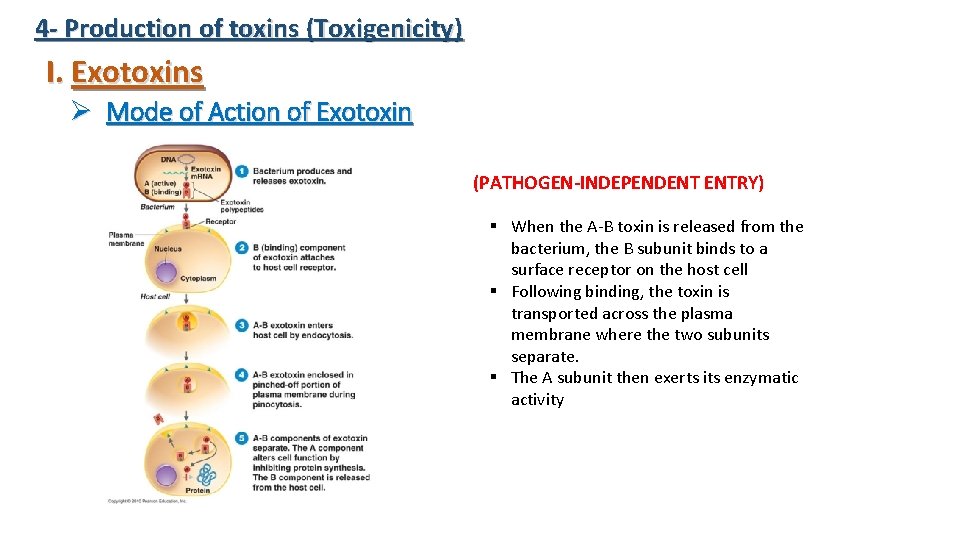
4 - Production of toxins (Toxigenicity) I. Exotoxins Ø Mode of Action of Exotoxin (PATHOGEN-INDEPENDENT ENTRY) § When the A-B toxin is released from the bacterium, the B subunit binds to a surface receptor on the host cell § Following binding, the toxin is transported across the plasma membrane where the two subunits separate. § The A subunit then exerts its enzymatic activity
- Slides: 15