
MICROBIAL RISK ASSESSMENT AND MITIGATION WORKSHOP TOWARDS A
MICROBIAL RISK ASSESSMENT AND MITIGATION WORKSHOP: TOWARDS A QUANTITATIVE HACCP APPROACH Moez SANAA & Ewen Todd 7 th Dubai International Food Safety Conference & st IAFP’s 1 Middle East Symposium on Food Safety
GENERAL INTRODUCTION TO RISK ASSESSMENT IN FOOD SAFETY Ewen Todd 7 th Dubai International Food Safety Conference & st IAFP’s 1 Middle East Symposium on Food Safety
DEFINITIONS OF RISK Risk: a function of the probability of an adverse health effect and the severity of that effect, consequential to a hazard(s) in food Risk Analysis: a process consisting of three components: risk assessment, risk management and risk communication
PURPOSE OF RISK ANALYSIS – CODEX ALIMENTARIUS To identify methods to address food safety more effectively To introduce appropriate food control measures Risk analysis has become the cornerstone in developing food control measures by linking epidemiological and laboratory findings with modeling procedures to estimate risks and their mitigation
DIFFERENCE BETWEEN RISK ANALYSIS AND HAZARD ANALYSIS CODEX ALIMENTARIUS Hazard analysis - addresses hazards within a narrow context, such as the potential for the hazard to enter a food at a plant/processing level. A hazard analysis is usually conducted at the plant/process level to establish a HACCP plan Risk analysis –also deals with hazards, as well as the condition of a food; however, it does so on a broader scale by examining the potential impact of a hazard that is introduced into the food supply, taking into account exposure from other sources
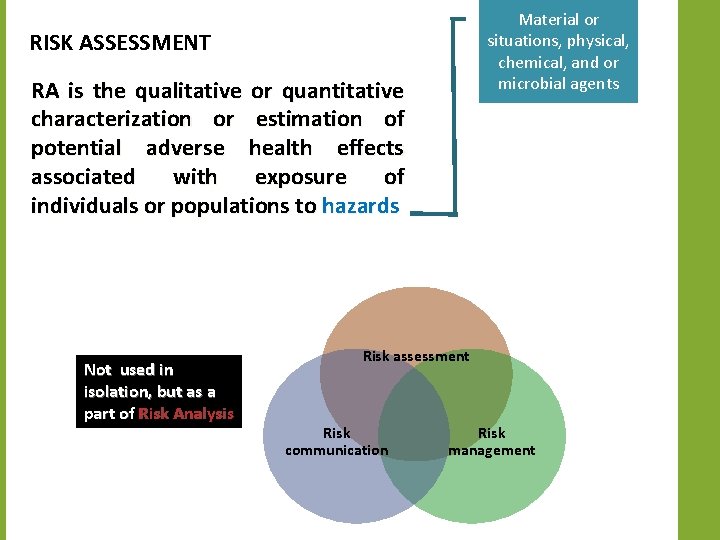
Material or situations, physical, chemical, and or microbial agents RISK ASSESSMENT RA is the qualitative or quantitative characterization or estimation of potential adverse health effects associated with exposure of individuals or populations to hazards Not used in isolation, but as a part of Risk Analysis Risk assessment Risk communication Risk management
PURPOSE OF RISK ASSESSMENT A systematic examination of an issue to help make better risk management decisions The risk manager should request the assessment to respond to specific questions
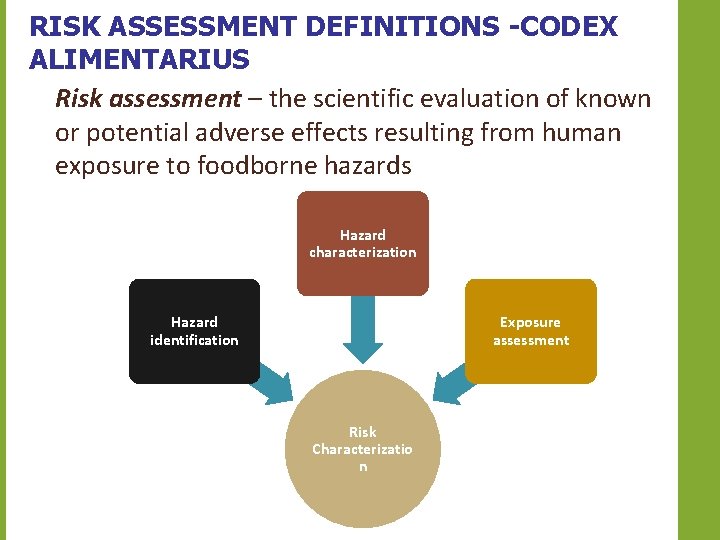
RISK ASSESSMENT DEFINITIONS -CODEX ALIMENTARIUS Risk assessment – the scientific evaluation of known or potential adverse effects resulting from human exposure to foodborne hazards Hazard characterization Hazard identification Exposure assessment Risk Characterizatio n
RISK ASSESSMENT DEFINITIONS -CODEX ALIMENTARIUS Hazard identification – The identification of biological, chemical and physical agents capable of causing adverse health effects and which may be present in a particular food or group of foods Hazard characterization – The qualitative and/or quantitative evaluation of the nature of the adverse health effects associated with biological, chemical, and physical agents which may be present in food For chemical agents, a dose-response assessment should be performed For biological and physical agents, a dose-response assessment should be performed if the data are available
RISK ASSESSMENT DEFINITIONS -CODEX ALIMENTARIUS Exposure assessment – The qualitative and/or quantitative evaluation of the likely intake of biological, chemical, and physical agents via food as well as exposures from other sources if relevant Risk characterization – The qualitative and/or quantitative estimation, including attendant uncertainties, of the probability of occurrence and severity of known or potential adverse health effects in a given population based on hazard identification, hazard characterization and exposure assessment

DEFINITIONS -CODEX ALIMENTARIUS Risk management – The process, distinct from risk assessment, of weighing policy alternatives, in consultation with all interested parties, considering risk assessment and other factors relevant for the health protection of consumers and for the promotion of fair trade practices and, if needed, selecting appropriate prevention and control options Risk communication – The interactive exchange of information and opinions throughout the risk analysis process concerning risks, risk-related factors and risk perception, among risk assessors, risk managers, consumers, industry, the academic community and other interested parties, including the explanation of risk assessment findings and the basis of risk management decisions
RISK COMMUNICATION POINTERS - CODEX ALIMENTARIUS l. Know the audience l Involve the scientific experts l Establish expertise in communication l Be a credible source of information l Share responsibility l Differentiate between science and value judgement l Assure transparency and put the risk in perspective Effective communication is an integral component of the risk analysis process and is often the least well done
WHAT RISK ANALYSIS TRIES TO ADDRESS Risk Communication questions (science plus economical, social and ethical values): • Who are the stakeholders? • What are we trying to communicate - information out or input in? • What level of technicality should be discussed assessors to managers/managers to other managers/managers to the industry and public? • How much time do we allow for this process? • What degree of dialog do we allow? • How much does risk perception of an issue affect the communication process?
EXAMPLES IF RISK ASSESSMENT AND RISK MANAGEMENT QUESTIONS Risk Assessment questions (science): What could go wrong? How likely is it to happen? Who would be affected? How severe would the consequences be? What populations are affected? What can we do that will reduce risk? Risk Management questions (science plus policy issues): What are the most effective and acceptable policies to reduce risk to acceptable levels - choosing management options which may include doing nothing? When instituted, how well have these policies worked – implement an evaluation and review process?
RISK ASSESSMENT IN RISK-BASED DECISION-MAKING To support decisions, the objectives of RA are: • • Estimate the probability of a given consequence, event, or effect; Understand how and when such consequences may occur; Estimate the impact of the various consequences; and Evaluate the potential outcomes or consequences of selected management options Risk assessment is a tool to inform risk managers and policy makers about risk management…
WHAT IS NEEDED? • Timely, broadly based and • Well informed, founded on the most reliable data, accurate in the interpretation of data, and • Transparent in the communication of results to interested parties. • With consideration and recognition of socio-political context in which activities and decisions are undertaken.
RISK ASSESSMENT CHALLENGES Transparency: Transparency Characteristics of a process where the rationale, the logic of development, constraints, assumptions, value judgements, decisions, limitations and uncertainties of the expressed determination are fully and systematically stated, documented, and accessible for review Many risk assessors offer their peers a draft assessment for comment before it is finally given to the risk manager or for publication Uncertainty Analysis: Analysis a method to estimate the uncertainty associated with model inputs, assumptions and structure/form Data Variability: Variability Assessments also include data that are generated with small to large variability
RISK MANAGERS VS. RISK ASSESSORS The risk manager determines the need for the assessment but leaves the process to the scientific assessors However, certain interactive elements are essential for a systematic risk assessment process include ranking of hazards in the hazard identification step and consideration of possible management options
LIMITATIONS OF RISK ASSESSMENTS Although a risk assessment must be soundly based upon science, the amount of data available are often very limited, and may they be conflicting, including variability and uncertainty Assumptions then may have to be made on the best, informed judgements to the assessors Good quality quantitative information is preferable to qualitative data but there is often less of it
TYPE OF RISK ASSESSMENTS Quantitative Risk Assessment (QRA): a risk assessment that provides numerical expressions of risk and indication of the attendant uncertainties Qualitative Risk Assessment: Assessment a risk assessment based on data, which, while forming an inadequate basis for numerical risk estimations, nonetheless, when conditioned by prior expert knowledge and identification of attendant uncertainties permits risk ranking or separation into descriptive categories of risk
MICROBIAL RISK ASSESSMENT
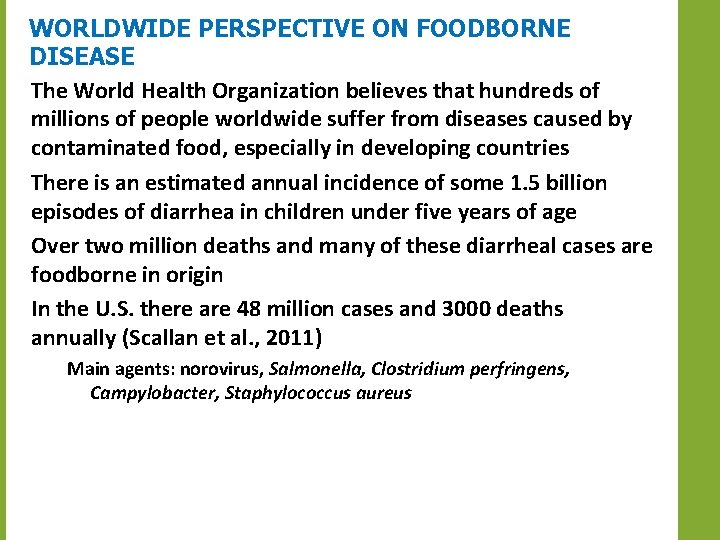
WORLDWIDE PERSPECTIVE ON FOODBORNE DISEASE The World Health Organization believes that hundreds of millions of people worldwide suffer from diseases caused by contaminated food, especially in developing countries There is an estimated annual incidence of some 1. 5 billion episodes of diarrhea in children under five years of age Over two million deaths and many of these diarrheal cases are foodborne in origin In the U. S. there are 48 million cases and 3000 deaths annually (Scallan et al. , 2011) Main agents: norovirus, Salmonella, Clostridium perfringens, Campylobacter, Staphylococcus aureus
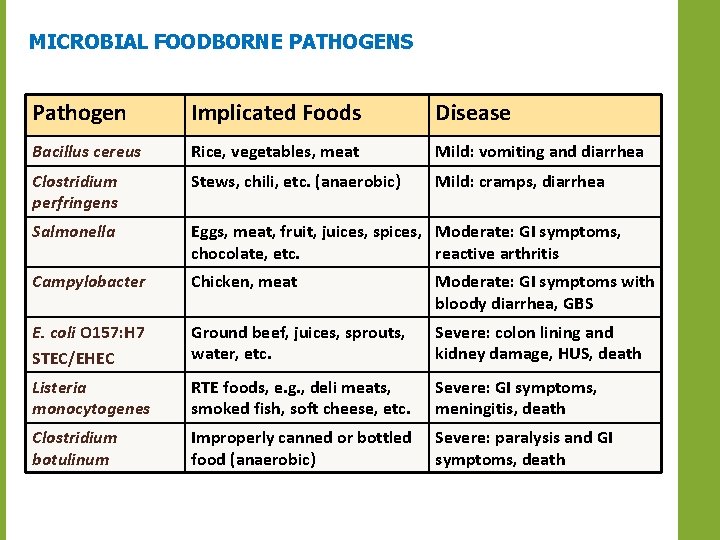
MICROBIAL FOODBORNE PATHOGENS Pathogen Implicated Foods Disease Bacillus cereus Rice, vegetables, meat Mild: vomiting and diarrhea Clostridium perfringens Stews, chili, etc. (anaerobic) Mild: cramps, diarrhea Salmonella Eggs, meat, fruit, juices, spices, Moderate: GI symptoms, chocolate, etc. reactive arthritis Campylobacter Chicken, meat Moderate: GI symptoms with bloody diarrhea, GBS E. coli O 157: H 7 STEC/EHEC Ground beef, juices, sprouts, water, etc. Severe: colon lining and kidney damage, HUS, death Listeria monocytogenes RTE foods, e. g. , deli meats, smoked fish, soft cheese, etc. Severe: GI symptoms, meningitis, death Clostridium botulinum Improperly canned or bottled food (anaerobic) Severe: paralysis and GI symptoms, death
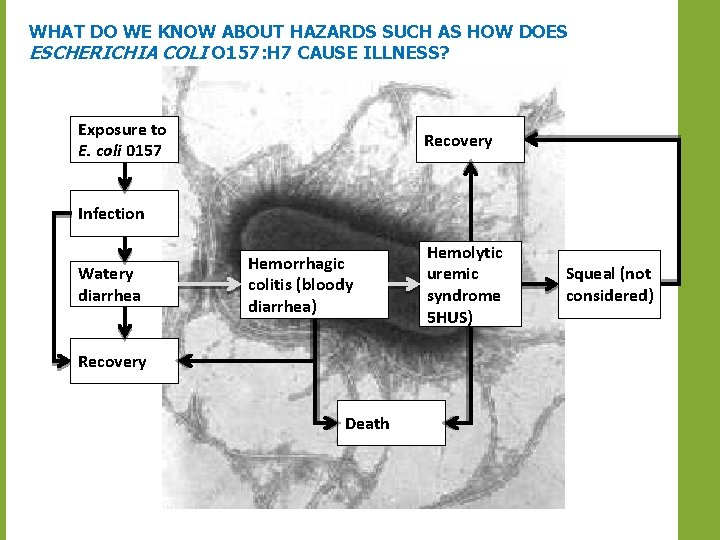
WHAT DO WE KNOW ABOUT HAZARDS SUCH AS HOW DOES ESCHERICHIA COLI O 157: H 7 CAUSE ILLNESS? Exposure to E. coli 0157 Recovery Infection Watery diarrhea Hemorrhagic colitis (bloody diarrhea) Recovery Death Hemolytic uremic syndrome 5 HUS) Squeal (not considered)
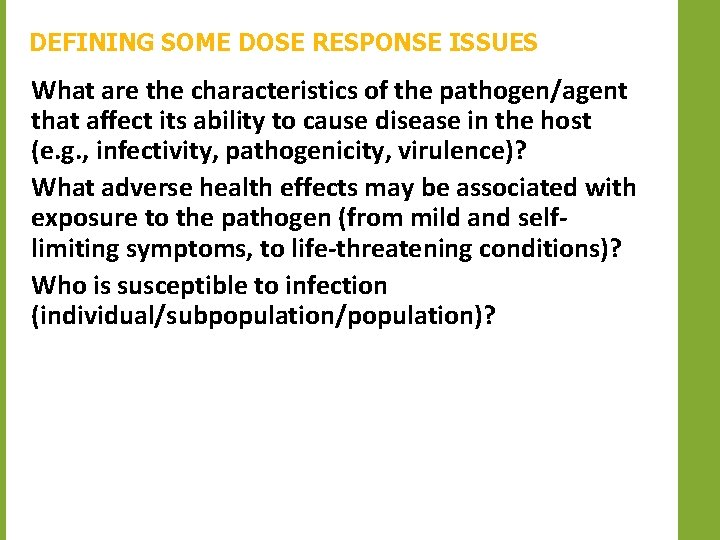
DEFINING SOME DOSE RESPONSE ISSUES What are the characteristics of the pathogen/agent that affect its ability to cause disease in the host (e. g. , infectivity, pathogenicity, virulence)? What adverse health effects may be associated with exposure to the pathogen (from mild and selflimiting symptoms, to life-threatening conditions)? Who is susceptible to infection (individual/subpopulation/population)?
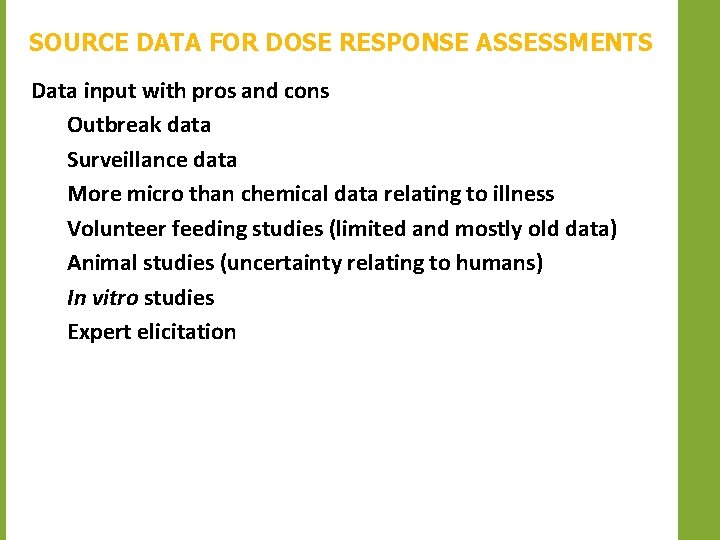
SOURCE DATA FOR DOSE RESPONSE ASSESSMENTS Data input with pros and cons Outbreak data Surveillance data More micro than chemical data relating to illness Volunteer feeding studies (limited and mostly old data) Animal studies (uncertainty relating to humans) In vitro studies Expert elicitation
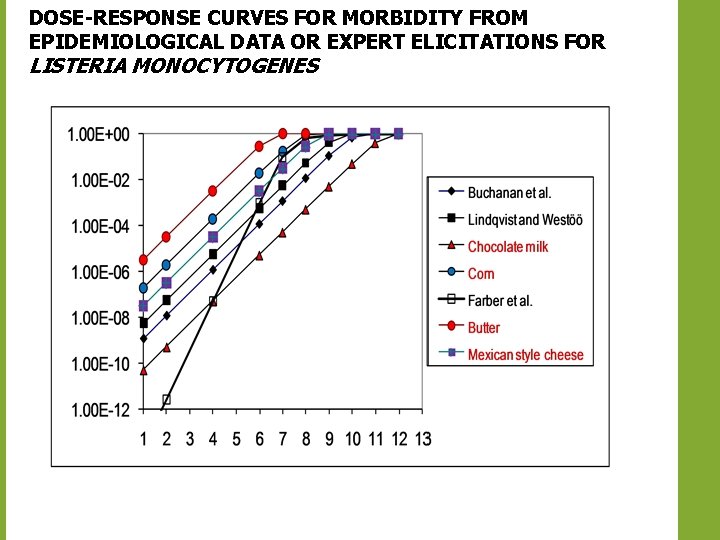
DOSE-RESPONSE CURVES FOR MORBIDITY FROM EPIDEMIOLOGICAL DATA OR EXPERT ELICITATIONS FOR LISTERIA MONOCYTOGENES
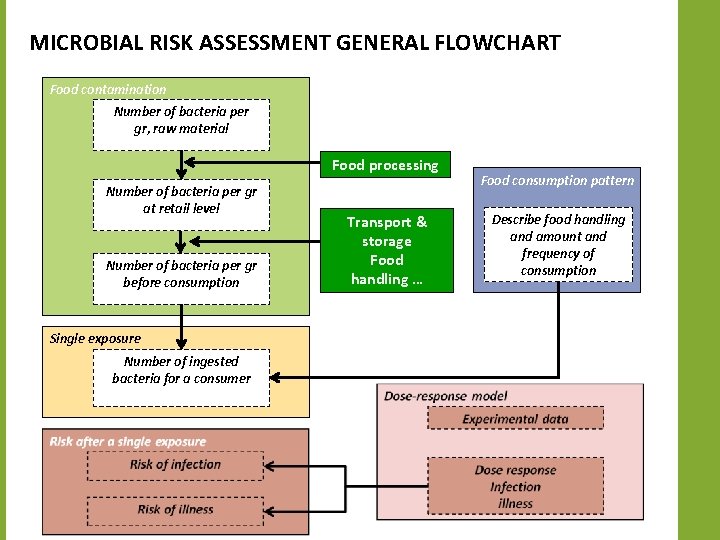
MICROBIAL RISK ASSESSMENT GENERAL FLOWCHART Food contamination Number of bacteria per gr, raw material Food processing Number of bacteria per gr at retail level Number of bacteria per gr before consumption Single exposure Number of ingested bacteria for a consumer Transport & storage Food handling … Food consumption pattern Describe food handling and amount and frequency of consumption
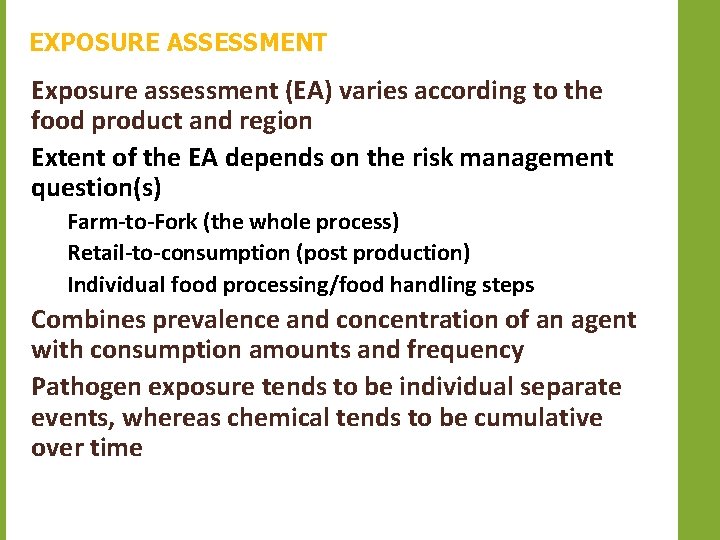
EXPOSURE ASSESSMENT Exposure assessment (EA) varies according to the food product and region Extent of the EA depends on the risk management question(s) Farm-to-Fork (the whole process) Retail-to-consumption (post production) Individual food processing/food handling steps Combines prevalence and concentration of an agent with consumption amounts and frequency Pathogen exposure tends to be individual separate events, whereas chemical tends to be cumulative over time
EXPOSURE ASSESSMENT Usually we want frequency and level of an agent (typically a pathogen) ingested by consumer but difficult to get data at the final stage of a food consumed, so we estimate by modeling: Identify initial and subsequent sources, frequency and level of contamination Try and model from various environmental knowns (p. H, a. W, time, temperature, etc. ) at earlier stages what the frequency and level of a pathogen will be at consumption
MATHEMATICAL MODELS • Models are meant to capture the essential elements of a process in a simplistic form • The intention is not to create a perfect and exact duplicate of reality • Rather to create a tool that will provide insight into the system • Modular approach to describe a complex system where there are several steps
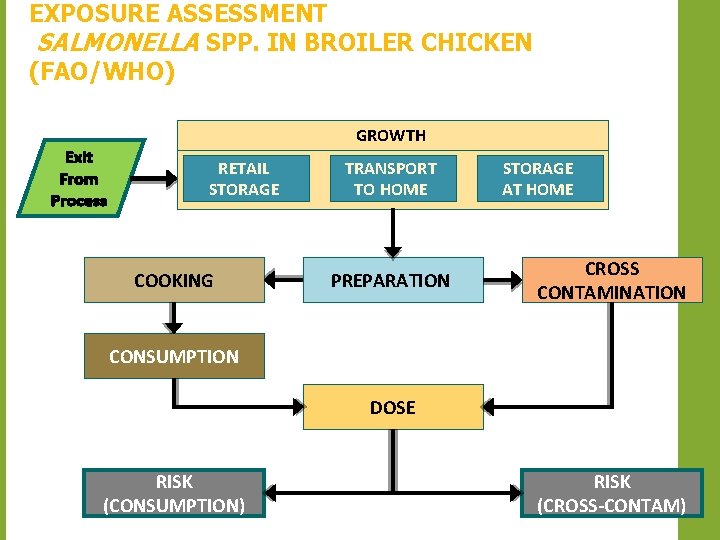
EXPOSURE ASSESSMENT SALMONELLA SPP. IN BROILER CHICKEN (FAO/WHO) Exit From Process GROWTH RETAIL STORAGE COOKING TRANSPORT TO HOME PREPARATION STORAGE AT HOME CROSS CONTAMINATION CONSUMPTION DOSE RISK (CONSUMPTION) RISK (CROSS-CONTAM)
RISK CHARACTERIZATION • Provides a model that estimates the probability of illness due to the ingestion of a pathogen in a food with or without cooking, e. g. , Salmonella in chicken or E. coli O 157: H 7 in hamburgers • For most chemicals it is the total exposure not one food • Risk measure is the probability of illness 1) by estimating the predicted number of cases per 100, 000 population based on contaminated servings eaten [differences reflect different exposure pathways] 2) the total number of cases in population, e. g. , USA, France, UAE or elsewhere [differences reflect different population sizes]
CHALLENGES FOR THE RISK ASSESSMENT PROCESS
QUESTIONS ON A SCIENCE-BASED POLICY Dilemma • If science based policy is the ideal, why go beyond the experts who should know best • However, rarely are polices based purely on science Fundamental questions: • Should regulations and policy be based on science or values or a combination of the two • Why do some science-based policies not work?
CONSUMER CHOICES Is there an increase in today’s society allowing consumer choices, and if so does it increase the risk of spread of pathogens? • Almonds can be pasteurized with heat, steam or propylene oxide to reduce risk of contamination but some groups want to stay with the raw almonds • Bagged spinach or lettuce or neither - is irradiation acceptable? • Raw milk (cheeses) vs. pasteurized milk (cheeses)? • Steak tartar vs. well cooked ground beef? • Raw or cooked oysters? Do we know the risks vs. benefits well enough to communicate meaningfully with consumers and other stakeholders? Danisch and Mudry (2008) reviewed FDA’s Vibrio in oyster risk assessment and found the analysis too complicated and it left out values such as liking fresh raw oysters, i. e. , partly a communications issue
IS THE RISK ANALYSIS PARADIGM STILL VALID? Thus, the classical food risk analysis model (risk assessment, risk management, and risk communication) may not be addressing consumers’ concerns on challenging food safety issues Perception • EU consumers appear slightly more concerned about external risk factors that are beyond their control, e. g. , less worried about personal factors such as food allergies and those linked to their own behavior, such as food preparation, hygiene and weight gain • Women tend to be more worried about food safety than men • Over 40% of people either ignore stories about food safety or do nothing despite being worried So, how does perception affect communication?
SAFE FOOD – EU FUNDED PROJECT "This Integrated Project addresses the issue of how consumer confidence in consumer protection and risk analysis can be restored and strengthened. “ Increased transparency = increased credibility? Incorporation of societal “values” to create an integrated framework
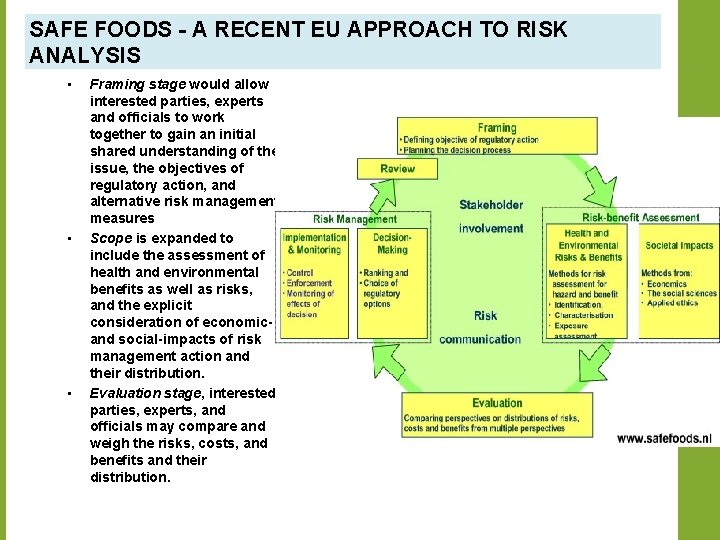
SAFE FOODS - A RECENT EU APPROACH TO RISK ANALYSIS • • • Framing stage would allow interested parties, experts and officials to work together to gain an initial shared understanding of the issue, the objectives of regulatory action, and alternative risk management measures Scope is expanded to include the assessment of health and environmental benefits as well as risks, and the explicit consideration of economicand social-impacts of risk management action and their distribution. Evaluation stage, interested parties, experts, and officials may compare and weigh the risks, costs, and benefits and their distribution.
FRANCIS BACON “THE ADVANCEMENT OF LEARNING”, 1605 • “If a man will begin with certainties he shall end in doubts, but if he will be content to begin with doubts, he shall end in certainties. ” • Bacon identified both observation of nature and formal experimentation as necessary to test a hypothesis properly • This concept still holds true today, scientific theories are examined from a number of different angles and must be reliably repeated before they become the accepted wisdom to the day • Risk assessments are estimates and are never the complete truth – value for making management decisions
QUESTIONS?
- Slides: 41