
Microbial physiology and metabolism These are lecture notes
Microbial physiology and metabolism These are lecture notes from a series of lectures given in the Virology department of Sri Venkateshwara University in Tirupati, Andhra Pradesh, South India. I was the guest of Professor Sai Gopal Funded by Society for General Microbiology (UK) and SVU
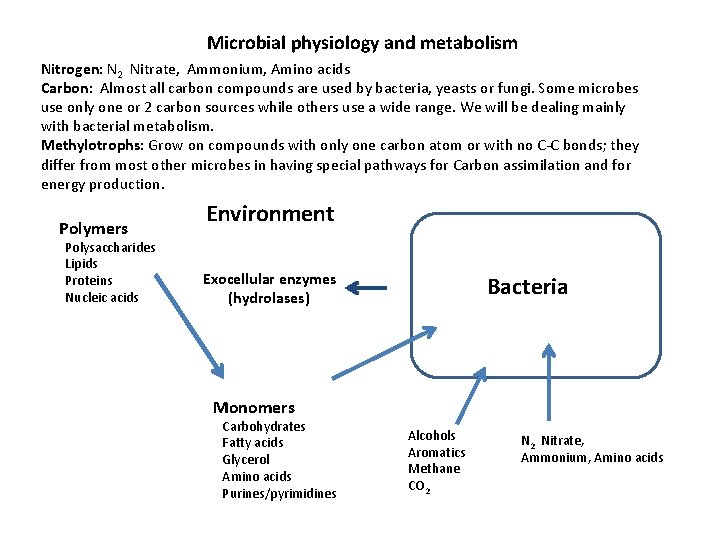
Microbial physiology and metabolism Nitrogen: N 2 Nitrate, Ammonium, Amino acids Carbon: Almost all carbon compounds are used by bacteria, yeasts or fungi. Some microbes use only one or 2 carbon sources while others use a wide range. We will be dealing mainly with bacterial metabolism. Methylotrophs: Grow on compounds with only one carbon atom or with no C-C bonds; they differ from most other microbes in having special pathways for Carbon assimilation and for energy production. Polymers Polysaccharides Lipids Proteins Nucleic acids Environment Exocellular enzymes (hydrolases) Bacteria Monomers Carbohydrates Fatty acids Glycerol Amino acids Purines/pyrimidines Alcohols Aromatics Methane CO 2 Nitrate, Ammonium, Amino acids
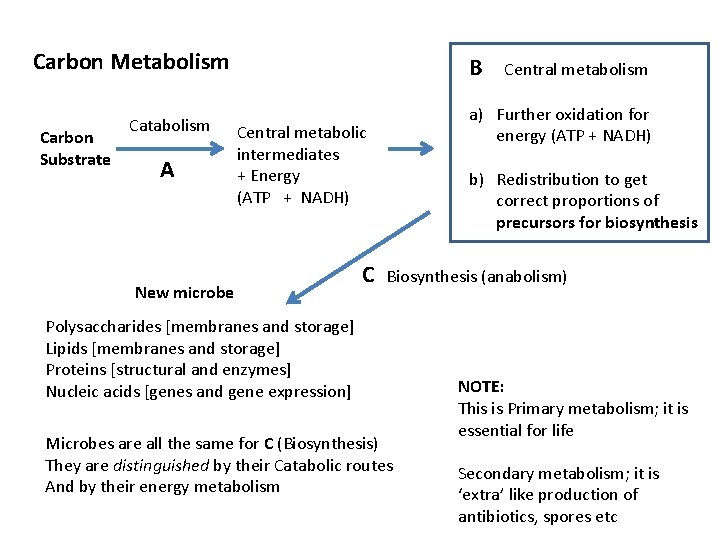
Carbon Metabolism Carbon Substrate Catabolism A B Central metabolic intermediates + Energy (ATP + NADH) New microbe Central metabolism a) Further oxidation for energy (ATP + NADH) b) Redistribution to get correct proportions of precursors for biosynthesis C Biosynthesis (anabolism) Polysaccharides [membranes and storage] Lipids [membranes and storage] Proteins [structural and enzymes] Nucleic acids [genes and gene expression] Microbes are all the same for C (Biosynthesis) They are distinguished by their Catabolic routes And by their energy metabolism NOTE: This is Primary metabolism; it is essential for life Secondary metabolism; it is ‘extra’ like production of antibiotics, spores etc
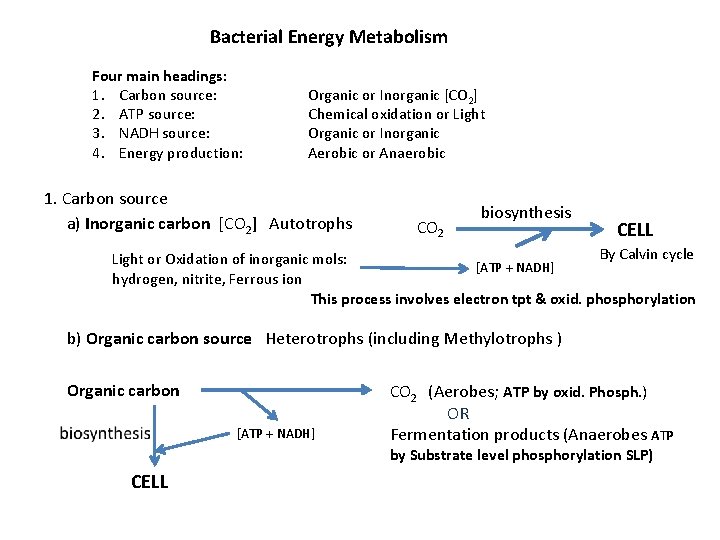
Bacterial Energy Metabolism Four main headings: 1. Carbon source: 2. ATP source: 3. NADH source: 4. Energy production: Organic or Inorganic [CO 2] Chemical oxidation or Light Organic or Inorganic Aerobic or Anaerobic 1. Carbon source a) Inorganic carbon [CO 2] Autotrophs CO 2 biosynthesis CELL By Calvin cycle Light or Oxidation of inorganic mols: [ATP + NADH] hydrogen, nitrite, Ferrous ion This process involves electron tpt & oxid. phosphorylation b) Organic carbon source Heterotrophs (including Methylotrophs ) Organic carbon [ATP + NADH] CO 2 (Aerobes; ATP by oxid. Phosph. ) OR Fermentation products (Anaerobes ATP by Substrate level phosphorylation SLP) CELL
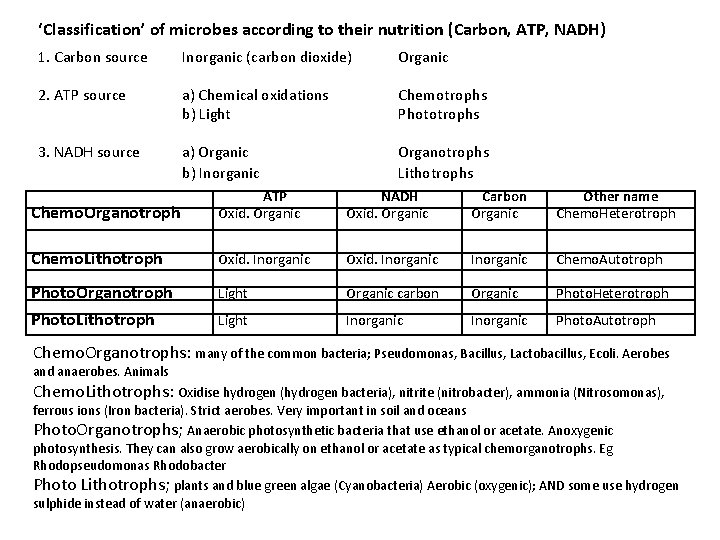
‘Classification’ of microbes according to their nutrition (Carbon, ATP, NADH) 1. Carbon source Inorganic (carbon dioxide) Organic 2. ATP source a) Chemical oxidations b) Light Chemotrophs Phototrophs 3. NADH source a) Organic b) Inorganic Organotrophs Lithotrophs Chemo. Organotroph ATP Oxid. Organic NADH Oxid. Organic Carbon Organic Other name Chemo. Heterotroph Chemo. Lithotroph Oxid. Inorganic Chemo. Autotroph Photo. Organotroph Light Organic carbon Organic Photo. Heterotroph Photo. Lithotroph Light Inorganic Photo. Autotroph Chemo. Organotrophs: many of the common bacteria; Pseudomonas, Bacillus, Lactobacillus, Ecoli. Aerobes and anaerobes. Animals Chemo. Lithotrophs: Oxidise hydrogen (hydrogen bacteria), nitrite (nitrobacter), ammonia (Nitrosomonas), ferrous ions (Iron bacteria). Strict aerobes. Very important in soil and oceans Photo. Organotrophs; Anaerobic photosynthetic bacteria that use ethanol or acetate. Anoxygenic photosynthesis. They can also grow aerobically on ethanol or acetate as typical chemorganotrophs. Eg Rhodopseudomonas Rhodobacter Photo Lithotrophs; plants and blue green algae (Cyanobacteria) Aerobic (oxygenic); AND some use hydrogen sulphide instead of water (anaerobic)
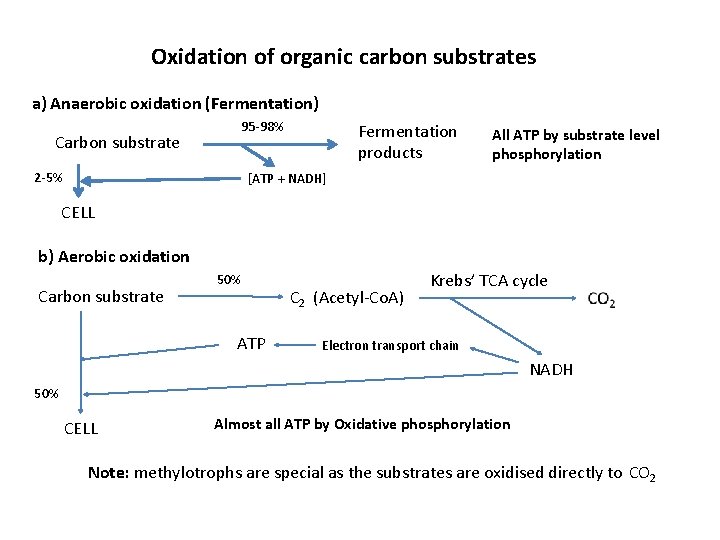
Oxidation of organic carbon substrates a) Anaerobic oxidation (Fermentation) 95 -98% Carbon substrate 2 -5% Fermentation products All ATP by substrate level phosphorylation [ATP + NADH] CELL b) Aerobic oxidation Carbon substrate 50% ATP C 2 (Acetyl-Co. A) Krebs’ TCA cycle Electron transport chain NADH 50% CELL Almost all ATP by Oxidative phosphorylation Note: methylotrophs are special as the substrates are oxidised directly to CO 2
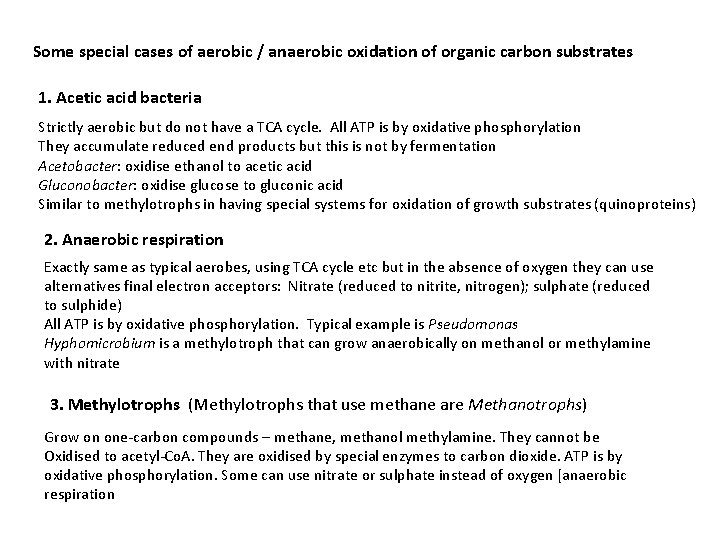
Some special cases of aerobic / anaerobic oxidation of organic carbon substrates 1. Acetic acid bacteria Strictly aerobic but do not have a TCA cycle. All ATP is by oxidative phosphorylation They accumulate reduced end products but this is not by fermentation Acetobacter: oxidise ethanol to acetic acid Gluconobacter: oxidise glucose to gluconic acid Similar to methylotrophs in having special systems for oxidation of growth substrates (quinoproteins) 2. Anaerobic respiration Exactly same as typical aerobes, using TCA cycle etc but in the absence of oxygen they can use alternatives final electron acceptors: Nitrate (reduced to nitrite, nitrogen); sulphate (reduced to sulphide) All ATP is by oxidative phosphorylation. Typical example is Pseudomonas Hyphomicrobium is a methylotroph that can grow anaerobically on methanol or methylamine with nitrate 3. Methylotrophs (Methylotrophs that use methane are Methanotrophs) Grow on one-carbon compounds – methane, methanol methylamine. They cannot be Oxidised to acetyl-Co. A. They are oxidised by special enzymes to carbon dioxide. ATP is by oxidative phosphorylation. Some can use nitrate or sulphate instead of oxygen [anaerobic respiration
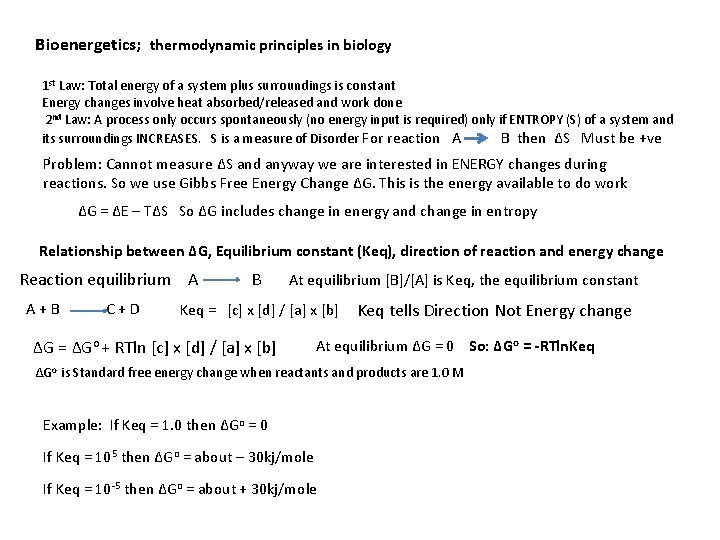
Bioenergetics; thermodynamic principles in biology 1 st Law: Total energy of a system plus surroundings is constant Energy changes involve heat absorbed/released and work done 2 nd Law: A process only occurs spontaneously (no energy input is required) only if ENTROPY (S) of a system and its surroundings INCREASES. S is a measure of Disorder For reaction A B then ΔS Must be +ve . Problem: Cannot measure ΔS and anyway we are interested in ENERGY changes during reactions. So we use Gibbs Free Energy Change ΔG. This is the energy available to do work ΔG = ΔE – TΔS So ΔG includes change in energy and change in entropy Relationship between ΔG, Equilibrium constant (Keq), direction of reaction and energy change Reaction equilibrium A B A + B C + D At equilibrium [B]/[A] is Keq, the equilibrium constant Keq = [c] x [d] / [a] x [b] Keq tells Direction Not Energy change ΔG = ΔGo + RTln [c] x [d] / [a] x [b] At equilibrium ΔG = 0 So: ΔGo = -RTln. Keq ΔGo is Standard free energy change when reactants and products are 1. 0 M Example: If Keq = 1. 0 then ΔGo = 0 If Keq = 105 then ΔGo = about – 30 kj/mole If Keq = 10 -5 then ΔGo = about + 30 kj/mole
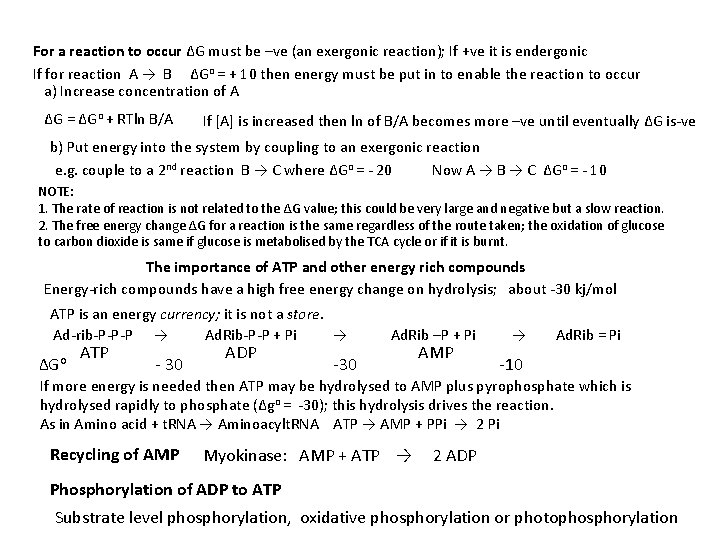
For a reaction to occur ΔG must be –ve (an exergonic reaction); If +ve it is endergonic If for reaction A → B ΔGo = + 10 then energy must be put in to enable the reaction to occur a) Increase concentration of A ΔG = ΔGo + RTln B/A If [A] is increased then ln of B/A becomes more –ve until eventually ΔG is-ve b) Put energy into the system by coupling to an exergonic reaction e. g. couple to a 2 nd reaction B → C where ΔGo = - 20 Now A → B → C ΔGo = - 10 NOTE: 1. The rate of reaction is not related to the ΔG value; this could be very large and negative but a slow reaction. 2. The free energy change ΔG for a reaction is the same regardless of the route taken; the oxidation of glucose to carbon dioxide is same if glucose is metabolised by the TCA cycle or if it is burnt. The importance of ATP and other energy rich compounds Energy-rich compounds have a high free energy change on hydrolysis; about -30 kj/mol ATP is an energy currency; it is not a store. Ad-rib-P-P-P → Ad. Rib-P-P + Pi → Ad. Rib –P + Pi → Ad. Rib = Pi ADP ATP AMP ΔGo - 30 -30 -10 If more energy is needed then ATP may be hydrolysed to AMP plus pyrophosphate which is hydrolysed rapidly to phosphate (Δgo = -30); this hydrolysis drives the reaction. As in Amino acid + t. RNA → Aminoacylt. RNA ATP → AMP + PPi → 2 Pi Recycling of AMP Myokinase: AMP + ATP → 2 ADP Phosphorylation of ADP to ATP Substrate level phosphorylation, oxidative phosphorylation or photophosphorylation
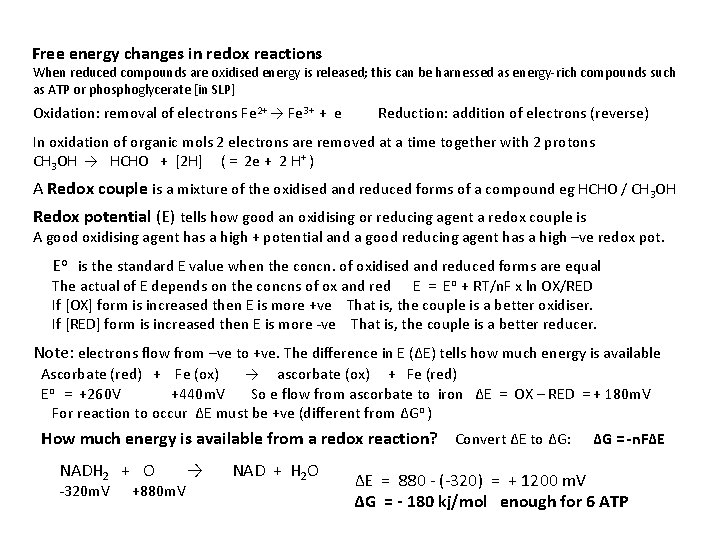
Free energy changes in redox reactions When reduced compounds are oxidised energy is released; this can be harnessed as energy-rich compounds such as ATP or phosphoglycerate [in SLP] Oxidation: removal of electrons Fe 2+ → Fe 3+ + e Reduction: addition of electrons (reverse) In oxidation of organic mols 2 electrons are removed at a time together with 2 protons CH 3 OH → HCHO + [2 H] ( = 2 e + 2 H+ ) A Redox couple is a mixture of the oxidised and reduced forms of a compound eg HCHO / CH 3 OH Redox potential (E) tells how good an oxidising or reducing agent a redox couple is A good oxidising agent has a high + potential and a good reducing agent has a high –ve redox pot. Eo is the standard E value when the concn. of oxidised and reduced forms are equal The actual of E depends on the concns of ox and red E = Eo + RT/n. F x ln OX/RED If [OX] form is increased then E is more +ve That is, the couple is a better oxidiser. If [RED] form is increased then E is more -ve That is, the couple is a better reducer. Note: electrons flow from –ve to +ve. The difference in E (ΔE) tells how much energy is available Ascorbate (red) + Fe (ox) → ascorbate (ox) + Fe (red) Eo = +260 V +440 m. V So e flow from ascorbate to iron ΔE = OX – RED = + 180 m. V For reaction to occur ΔE must be +ve (different from ΔGo ) How much energy is available from a redox reaction? Convert ΔE to ΔG: ΔG = -n. FΔE NADH 2 + O → NAD + H 2 O -320 m. V +880 m. V ΔE = 880 - (-320) = + 1200 m. V ΔG = - 180 kj/mol enough for 6 ATP
- Slides: 10