
Microbial pellet formation Shown by culture of filamentousmycelial

Microbial pellet formation Shown by culture of filamentous/mycelial organisms such as molds and fungi • Mycelial organisms which show apical growth • Also grow exponentially. • Filamentous fungi have a 'growth unit‘ – is composed of the apex of the hypha and – a short length of supporting hypha.
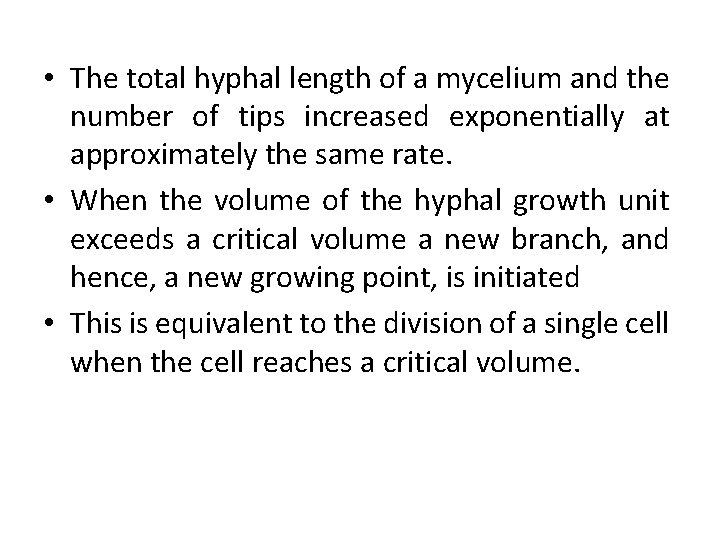
• The total hyphal length of a mycelium and the number of tips increased exponentially at approximately the same rate. • When the volume of the hyphal growth unit exceeds a critical volume a new branch, and hence, a new growing point, is initiated • This is equivalent to the division of a single cell when the cell reaches a critical volume.
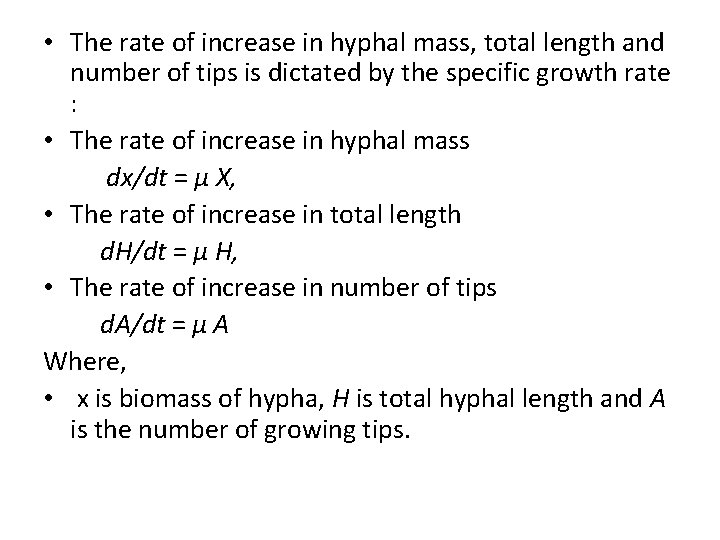
• The rate of increase in hyphal mass, total length and number of tips is dictated by the specific growth rate : • The rate of increase in hyphal mass dx/dt = μ X, • The rate of increase in total length d. H/dt = μ H, • The rate of increase in number of tips d. A/dt = μ A Where, • x is biomass of hypha, H is total hyphal length and A is the number of growing tips.
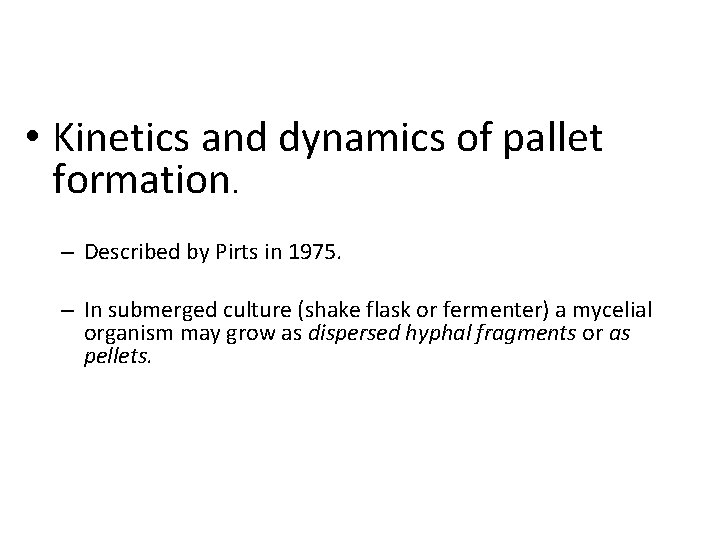
• Kinetics and dynamics of pallet formation. – Described by Pirts in 1975. – In submerged culture (shake flask or fermenter) a mycelial organism may grow as dispersed hyphal fragments or as pellets.
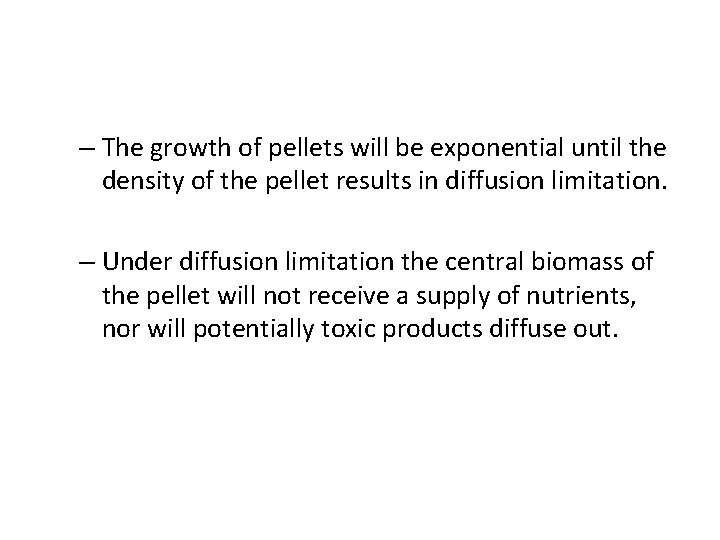
– The growth of pellets will be exponential until the density of the pellet results in diffusion limitation. – Under diffusion limitation the central biomass of the pellet will not receive a supply of nutrients, nor will potentially toxic products diffuse out.
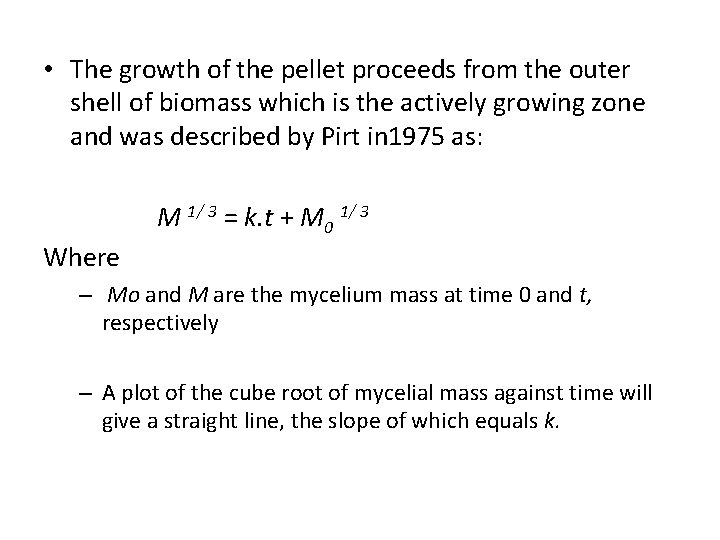
• The growth of the pellet proceeds from the outer shell of biomass which is the actively growing zone and was described by Pirt in 1975 as: M 1/ 3 = k. t + M 0 1/ 3 Where – Mo and M are the mycelium mass at time 0 and t, respectively – A plot of the cube root of mycelial mass against time will give a straight line, the slope of which equals k.
- Slides: 6