
Microbial Growth When microbes are provided with nutrients

. Microbial Growth When microbes are provided with nutrients & required environmental factors, they become metabolically active and grow 1
Chapter contents: � 1 - Bacterial Division/reproduction � 2 - Stages of Bacterial growth curve � 3 - Measurement of Microbial growth � 4 - Environmental factors effect microbial growth 2
� � What is Microbial growth? involves an increase in the number of cells rather than in the size of individual cells. � 2 levels 1. 2. of growth: A cell synthesizes new components, increase its size Increase number of cells in the population 3
� increase in cellular constituents that may result in: � increase in cell number � e. g. , when microorganisms reproduce by budding or binary fission � increase in cell size � e. g. , some microorganisms have nuclear divisions that are not accompanied by cell divisions � microbiologists usually study population growth rather than growth of individual cells 4

1 - The Bacterial division/reproduction � Bacteria normally reproduce by a method called binary fission � What is Binary Fission. ? � Binary Fission is the process of bacteria reproduction where one cell become two 5
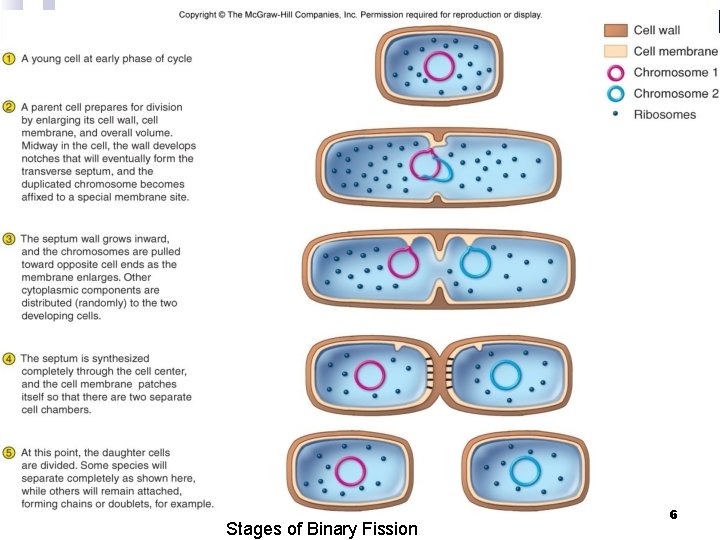
Stages of Binary Fission 6
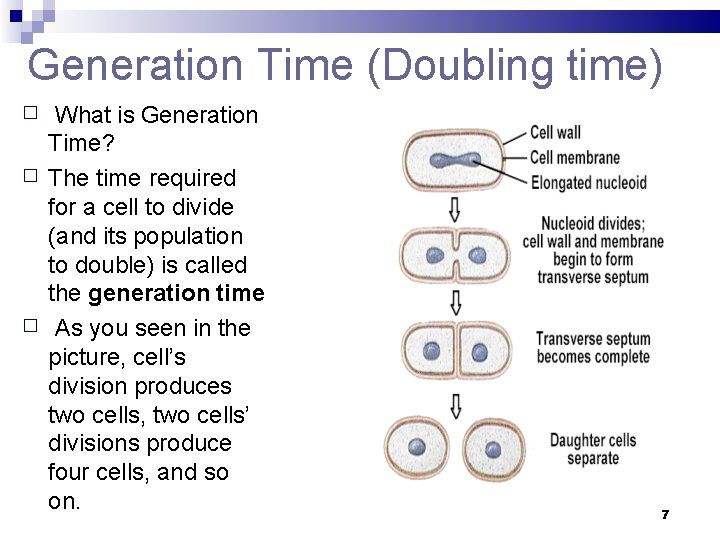
Generation Time (Doubling time) � � � What is Generation Time? The time required for a cell to divide (and its population to double) is called the generation time As you seen in the picture, cell’s division produces two cells, two cells’ divisions produce four cells, and so on. 7
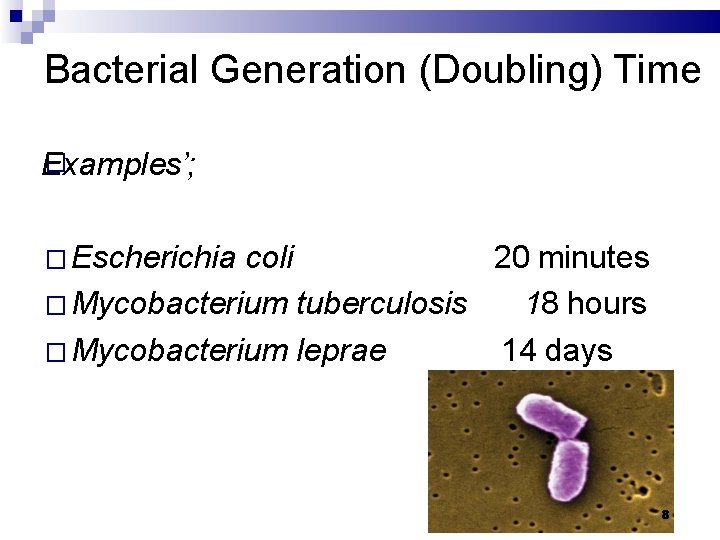
Bacterial Generation (Doubling) Time � Examples’; � Escherichia coli 20 minutes � Mycobacterium tuberculosis 18 hours � Mycobacterium leprae 14 days 8
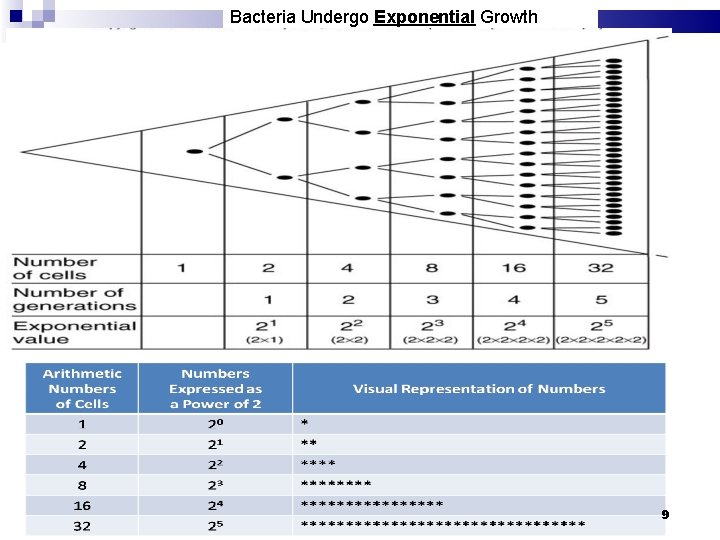
Bacteria Undergo Exponential Growth 9
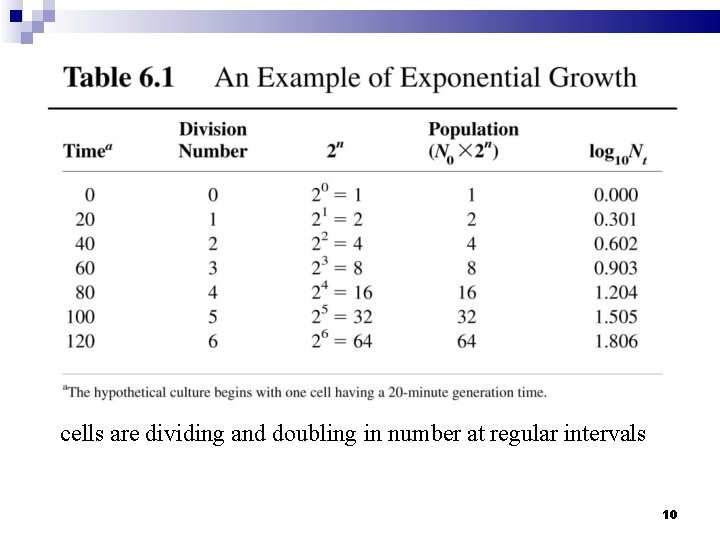
cells are dividing and doubling in number at regular intervals 10
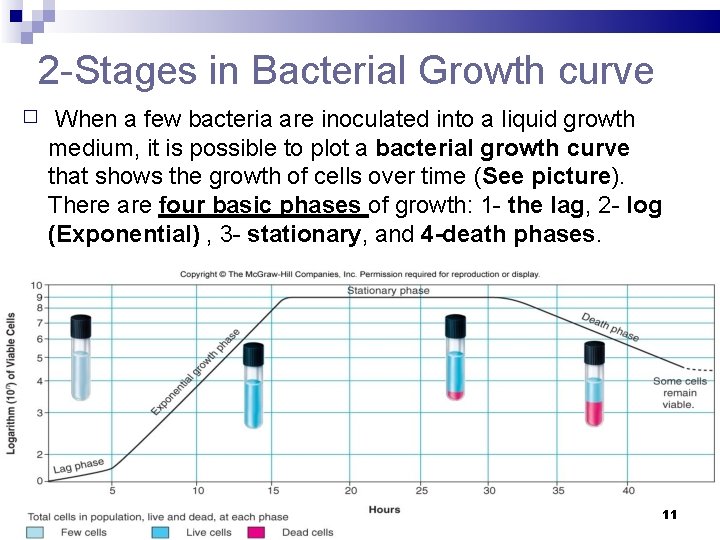
2 -Stages in Bacterial Growth curve � When a few bacteria are inoculated into a liquid growth medium, it is possible to plot a bacterial growth curve that shows the growth of cells over time (See picture). There are four basic phases of growth: 1 - the lag, 2 - log (Exponential) , 3 - stationary, and 4 -death phases. 11
Stages of Bacterial growth curve � Bacterial populations follow a sequential series of growth phases: the lag, log, stationary, and death phases. � Knowledge of the bacterial growth curve is critical to understanding population dynamics and population control in the course of infectious diseases, and in food preservation. 12

4 Stages of Bacterial growth Curve population growth ceases maximal rate of division and population growth decline in population size no increase 13
Stages of Bacteria growth Curve a) Lag Phase � Bacteria are first introduced into an environment or media culture. � Bacteria are trying to adapt to nutrients � Lag phase-preparing to grow in size and synthesize enzymes etc. � varies � in in length some cases can be very short or even absent 14
b) Log (Exponential) Phase � also called log phase � rate of growth is constant � Population number of cells undergoing binary fission doubles at a constant interval called generation time � Continue as long as cells have adequate nutrients & good environment 15
c) Stationary Phase � If exponential growth continued unchecked, startlingly large numbers of cells could arise. � In this stage microbial death is equal to microbial growth e-g Death=growth. 16
Possible reasons for entry into stationary phase �nutrient limitation �limited oxygen availability �toxic waste accumulation �critical population density reached 17
d) Death Phase � Decline in the number of viable cells � cells dying, usually at exponential rate � Death; loss of ability to reproduce � in some cases, death rate slows due to accumulation of resistant cells � Slower than log phase 18
3 - Measurement of Microbial Growth � can measure changes in number of cells in a population � can measure changes in mass of population 19
Measurement of Cell Numbers � What are the lab equipment's used to measure bacteria cell numbers? � There are two types : � 1 - Direct cell counts: counting chambers b) electronic counters c) on membrane filters a) � 2 - Viable cell counts plating methods (spread, pour plate) � membrane filtration methods � 20
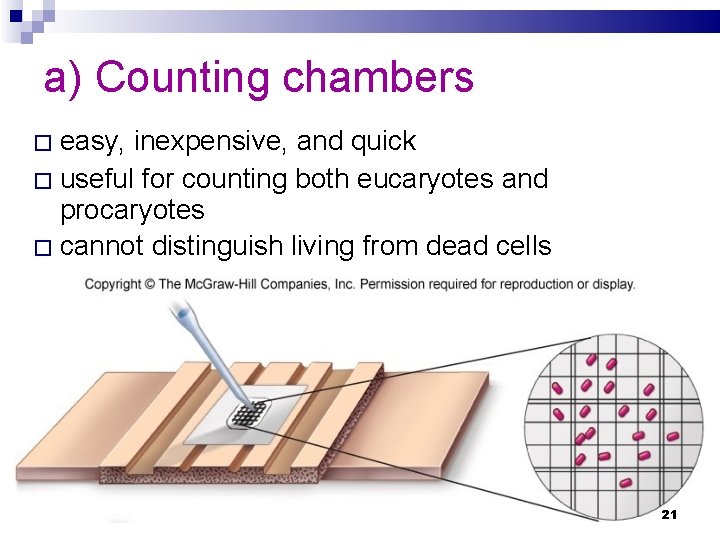
a) Counting chambers � easy, inexpensive, and quick � useful for counting both eucaryotes and procaryotes � cannot distinguish living from dead cells 21
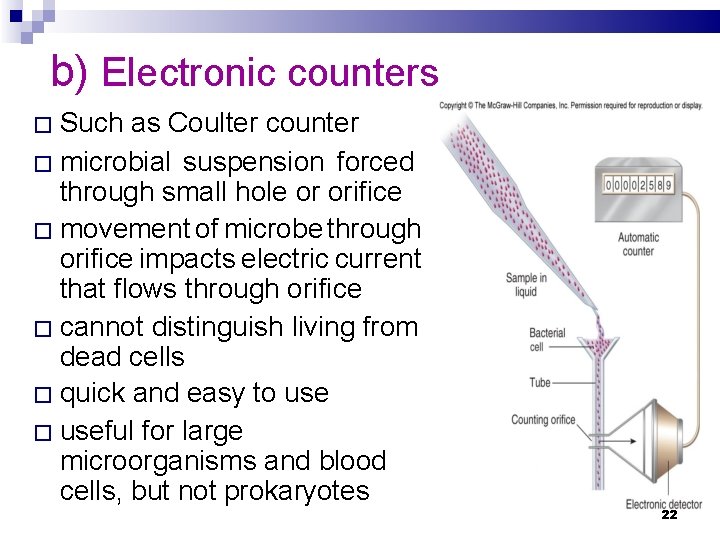
b) Electronic counters � Such as Coulter counter � microbial suspension forced through small hole or orifice � movement of microbe through orifice impacts electric current that flows through orifice � cannot distinguish living from dead cells � quick and easy to use � useful for large microorganisms and blood cells, but not prokaryotes 22
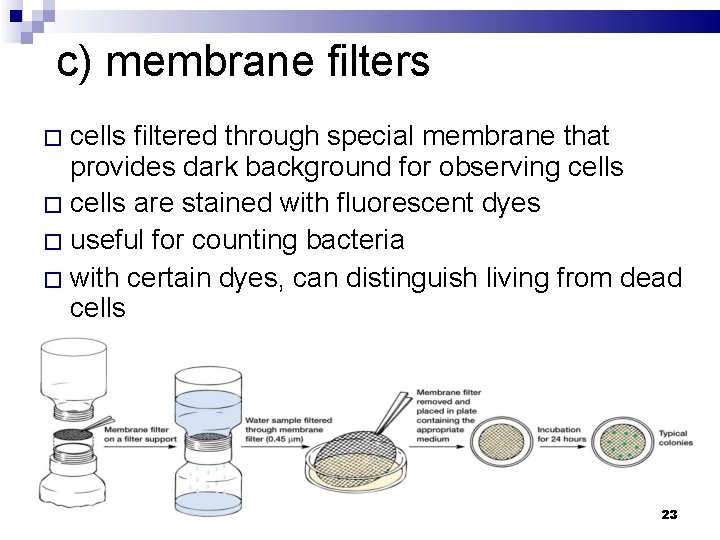
c) membrane filters � cells filtered through special membrane that provides dark background for observing cells � cells are stained with fluorescent dyes � useful for counting bacteria � with certain dyes, can distinguish living from dead cells 23
4 - Important environmental factors affect microbial growth 1. p. H 2. Temperature 3. Gas requirement 4. Pressure 5. And other environmental factors e-g radiation, water activities etc. 24
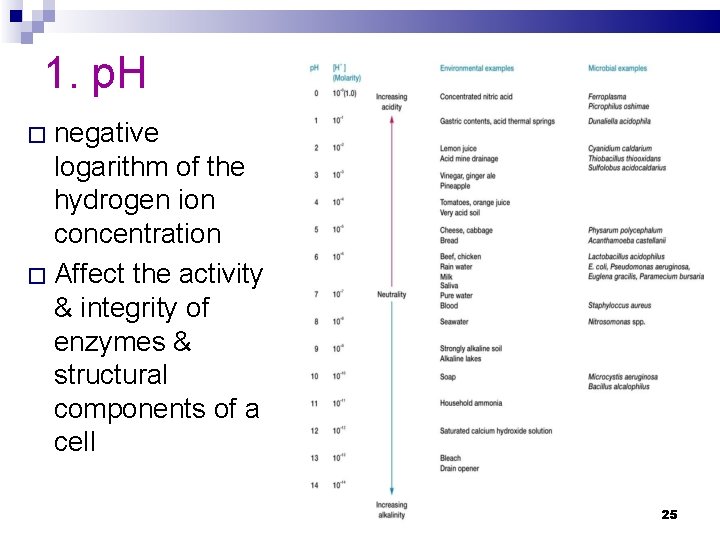
1. p. H � negative logarithm of the hydrogen ion concentration � Affect the activity & integrity of enzymes & structural components of a cell 25
p. H � Optimum p. H for most microbes ranges approximately from 6 to 8 � acidophiles � growth optimum between p. H 0 and p. H 5. 5 � neutrophiles � growth optimum between p. H 5. 5 and p. H 7 � alkalophiles � growth optimum between p. H 8. 5 and p. H 11. 5 26
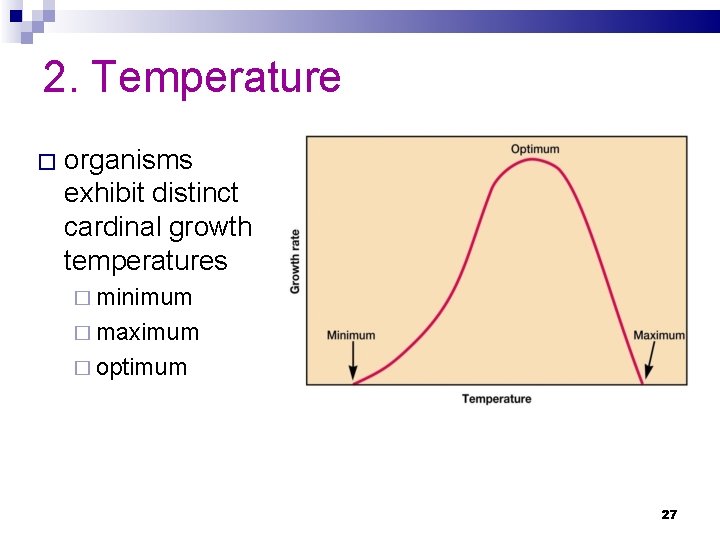
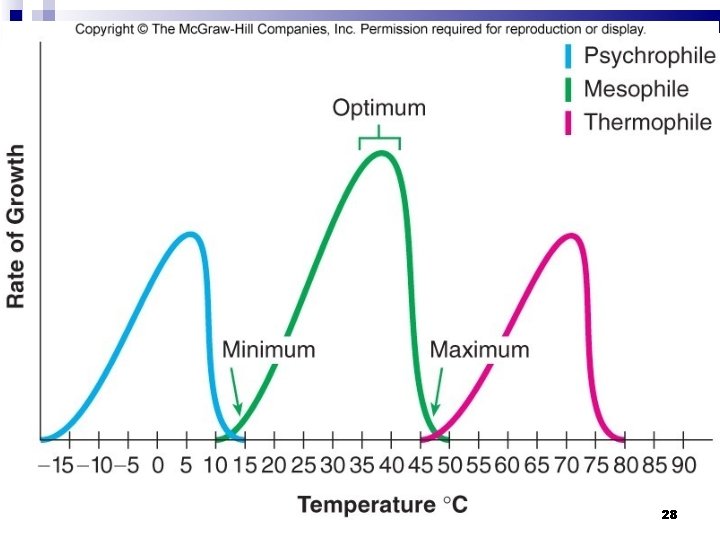
2. Temperature � organisms exhibit distinct cardinal growth temperatures � minimum � maximum � optimum 27
28
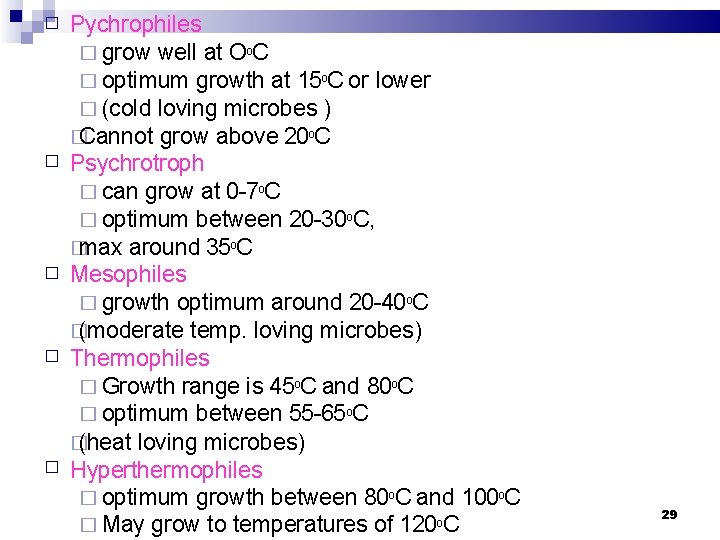
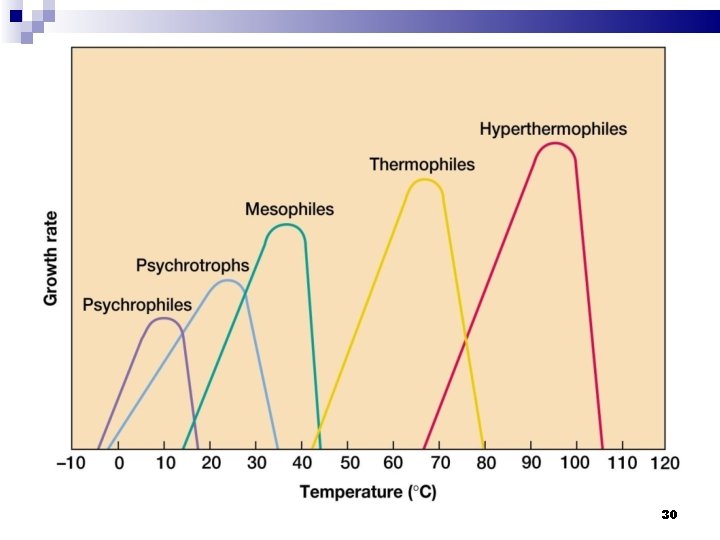
� � � Pychrophiles � grow well at Oo. C � optimum growth at 15 o. C or lower � (cold loving microbes ) � Cannot grow above 20 o. C Psychrotroph � can grow at 0 -7 o. C � optimum between 20 -30 o. C, � max around 35 o. C Mesophiles � growth optimum around 20 -40 o. C � (moderate temp. loving microbes) Thermophiles � Growth range is 45 o. C and 80 o. C � optimum between 55 -65 o. C � (heat loving microbes) Hyperthermophiles � optimum growth between 80 o. C and 100 o. C � May grow to temperatures of 120 o. C 29
30
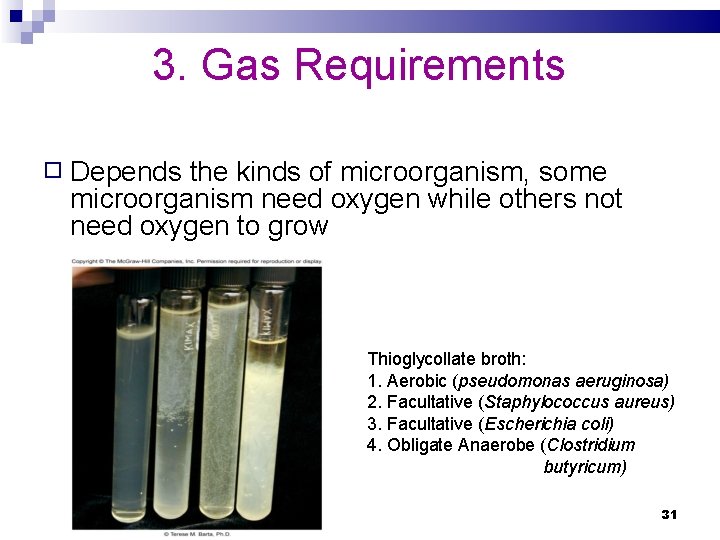
3. Gas Requirements � Depends the kinds of microorganism, some microorganism need oxygen while others not need oxygen to grow Thioglycollate broth: 1. Aerobic (pseudomonas aeruginosa) 2. Facultative (Staphylococcus aureus) 3. Facultative (Escherichia coli) 4. Obligate Anaerobe (Clostridium butyricum) 31
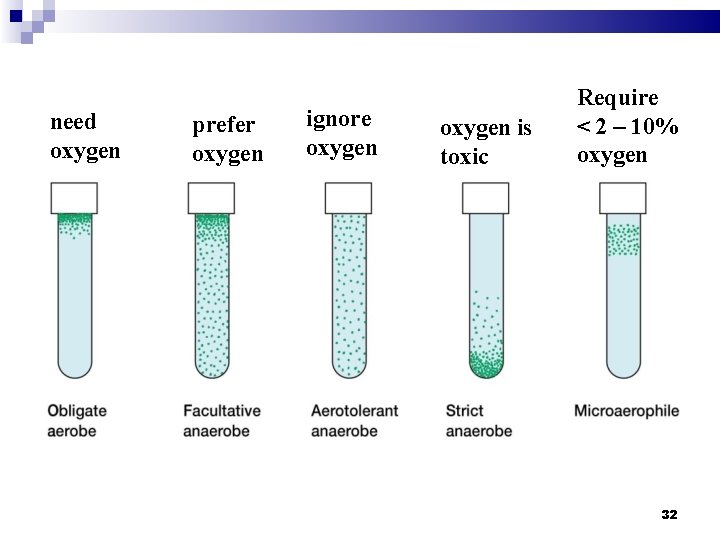
need oxygen prefer oxygen ignore oxygen is toxic Require < 2 – 10% oxygen 32
4. Pressure � Microbes obtain almost all their nutrients in solution from surrounding water � barophile organisms � Adapted to life under high pressure � require or grow more rapidly in the presence of increased pressure � Example : bottom dwellers in the ocean 33
Review Questions 1) 2) 3) 4) 5) 6) 7) 8) 9) What are the four stages of microbial growth? Explain what happens each phase? Name 3 direct methods use to measure microbial cell numbers? Name 2 methods used measure viable cell counts What are the four environmental factors effect microbial growth? What is binary fission? What is generation (doubling time)? State 4 possible reasons why bacterial growth curve entry into stationary phase? How does p. H effect microbial growth? 34 What is microbial growth?
- Slides: 34