
MICROBIAL GROWTH KINETICS By Dr Zaryab Khalid Class
MICROBIAL GROWTH KINETICS By Dr. Zaryab Khalid Class: MS Botany Semester: II Subject: Environmental Biotechnology 1

INTRODUCTION • Microbial growth is the result of both cell division and change in cell size • Growth – variety of physical, chemical and nutritional conditions • Conversion of nutrients into biological compounds which are used for energy production and also for biosynthesis and product formation • Good example for autocatalytic reaction 2
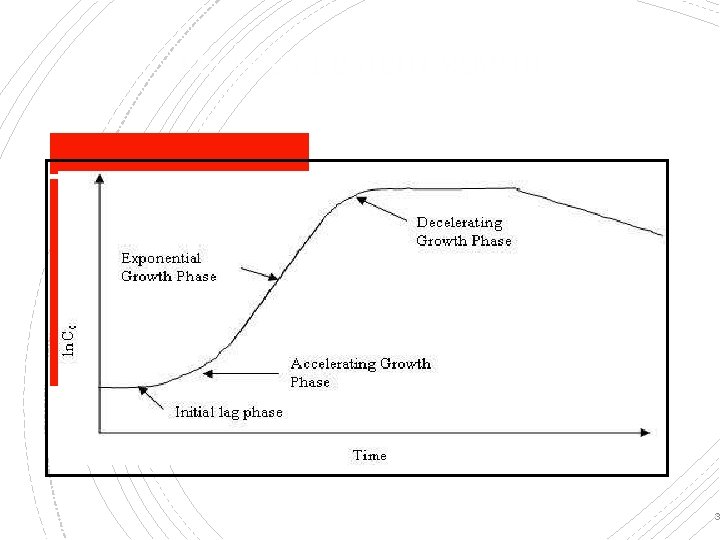
MICROBIAL BATCH GROWTH 3
Phases of Growth Lag phase: • No increase in cell number • Period of adaptation of cells to a new environment • No change in number, but an increase in mass • Multiple lag phases may sometimes be observed more than one carbon source (Diauxic growth)…. why? • Length of the lag phase – characteristics of microbial species and in part by the media conditions 4
Cont. … Log Phase: • Growth rate is higher • Increase in cell mass and cell number with time exponentially • This phase results in straight line… why? • Hence, it is also known as Exponential phase. • Period of balanced growth, in which all the components of a cell grow at the same rate • Composition of biomass remains constant 5
Cont. … • The exponential phase is followed by deceleration phase, period of unbalanced growth. • In this phase, the growth decelerates due to either depletion of one or more essential nutrients or the accumulation of toxic by products of growth Stationary phase: • It starts, when the net growth rate is zero Growth rate = Death rate • Even though the net growth rate is zero during the stationary phase, cells are metabolically active and produce secondary metabolites Death phase Number of cells multiplying = number of cells dying 6
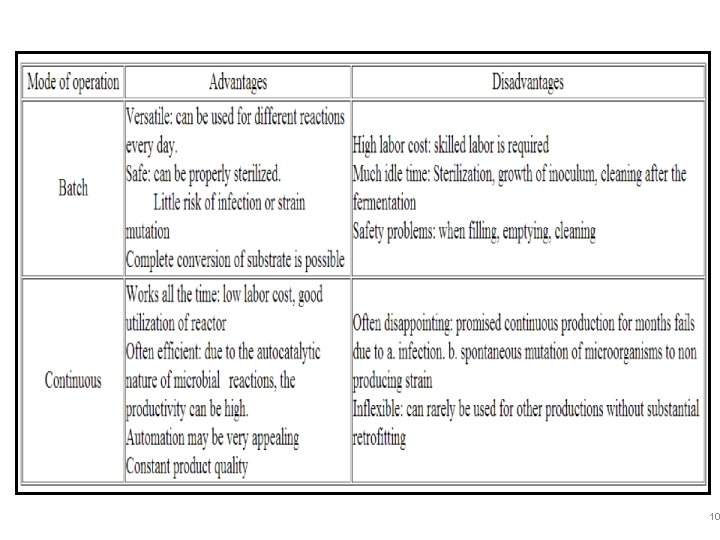
CONTINUOUS CULTURE • Substrate concentration and other conditions remain constant, and the cells grow at a constant, fully acclimatised exponential rate on the effluent. • Defining characteristic of continuous culture is a perpetual feeding process. • The reaction variables and control parameters remain consistent, establishing a time-constant state within the reactor. 7

CONTINUOUS GROWTH KINETICS • The actual growth rate depends not only on the volumetric flow rate of the medium into the reactor, but also on the dilution rate(D) D = F/V 8
Cont. …. • Thus growth is controlled by the availability of a rate-limiting nutrient • Chemostat – system where the concentration of the ratelimiting nutrient entering the system is fixed. • Turbidostat – nutrients in the medium are not limited, cell concentration is held constant(? ) 9
10
SOLID-STATE FERMENTATION FOR THE SYNTHESIS OF CITRIC ACID BY ASPERGILLUS NIGER Abstract • Solid-state fermentation was carried out to evaluate three different agro-industrial wastes, sugar cane bagasse, coffee husk and cassava bagasse for their efficiency in production of citric acid by a culture of Aspergillus niger. Cassava bagasse best supported the mould's growth, giving the highest yield of citric acid among the tested substrates. Results showed the fungal strain had good adaptation to the substrate (cassava bagasse) and increased the protein content (23 g/kg) in the fermented matter. Citric acid production reached a maximum (88 -g/kg dry matter) when fermentation was carried out with cassava bagasse having initial moisture of 62% at 26°C for 120 h. 11
- Slides: 11