
Microbial genetics Mutations in Bacteria Mutations arise in
Microbial genetics

Mutations in Bacteria • Mutations arise in bacterial populations – Induced – Spontaneous • Rare mutations are expressed – Bacteria are haploid – Rapid growth rate • Selective advantage enriches for mutants • Gene transfer occurs in bacteria
General Features of Gene Transfer in Bacteria • Unidirectional – Donor to recipient • Donor does not give an entire chromosome – Merozygotes • Gene transfer can occur between species
Transformation • Definition: Gene transfer resulting from the uptake of DNA from a donor. • Factors affecting transformation – DNA size and state • Sensitive to nucleases – Competence of the recipient (Bacillus, Haemophilus, Neisseria, Streptococcus) • Competence factors • Induced competence

Transformation • Steps – Uptake of DNA • Gram + • Gram - – Recombination • Legitimate, homologous or general • rec. A, rec. B and rec. C genes • Significance Phase variation in Neiseseria – Recombinant DNA technology –
Transduction • Definition: Gene transfer from a donor to a recipient by way of a bacteriophage • Bacteriophage (phage): A virus that infects bacteria
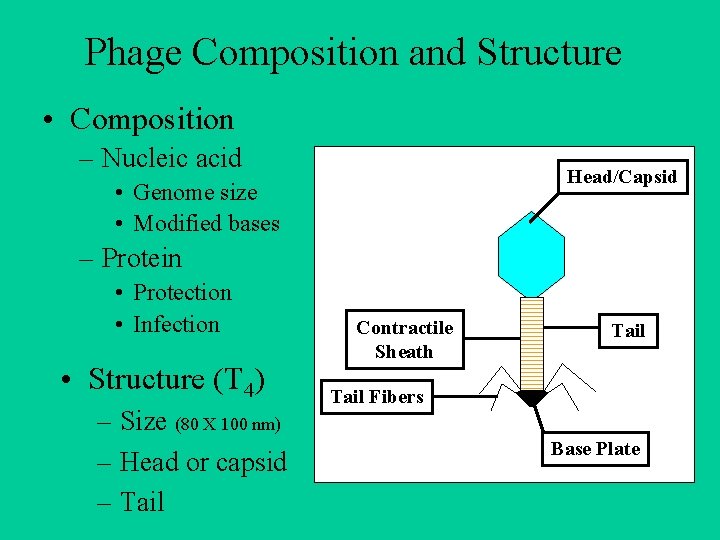
Phage Composition and Structure • Composition – Nucleic acid Head/Capsid • Genome size • Modified bases – Protein • Protection • Infection • Structure (T 4) – Size (80 X 100 nm) – Head or capsid – Tail Contractile Sheath Tail Fibers Base Plate
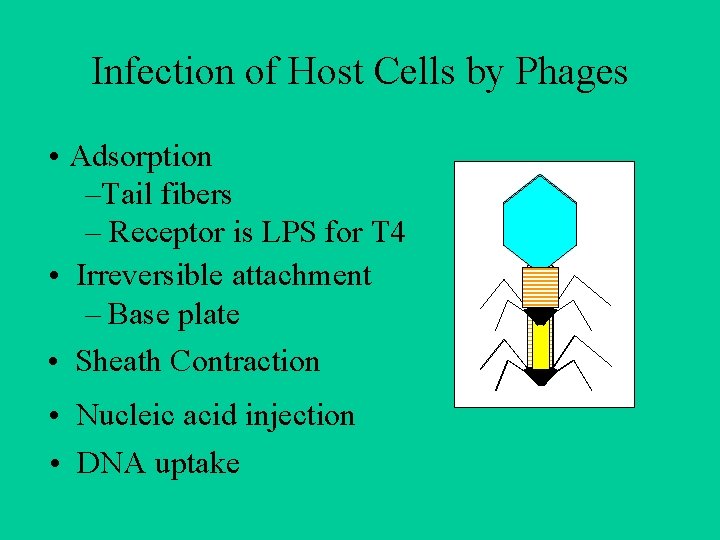
Infection of Host Cells by Phages • Adsorption –Tail fibers – Receptor is LPS for T 4 • Irreversible attachment – Base plate • Sheath Contraction • Nucleic acid injection • DNA uptake
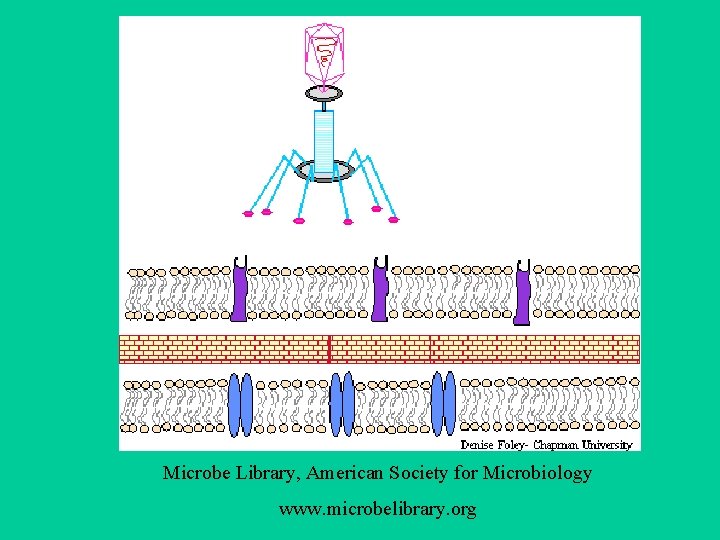
Microbe Library, American Society for Microbiology www. microbelibrary. org
Types of Bacteriophage • Lytic or virulent – Phage that multiply within the host cell, lyse the cell and release progeny phage (e. g. T 4) • Lysogenic or temperate phage: Phage that can either multiply via the lytic cycle or enter a quiescent state in the bacterial cell. (e. g. , ) – Expression of most phage genes repressed – Prophage – Phage DNA in the quiescent state – Lysogen – Bacteria harboring a prophage
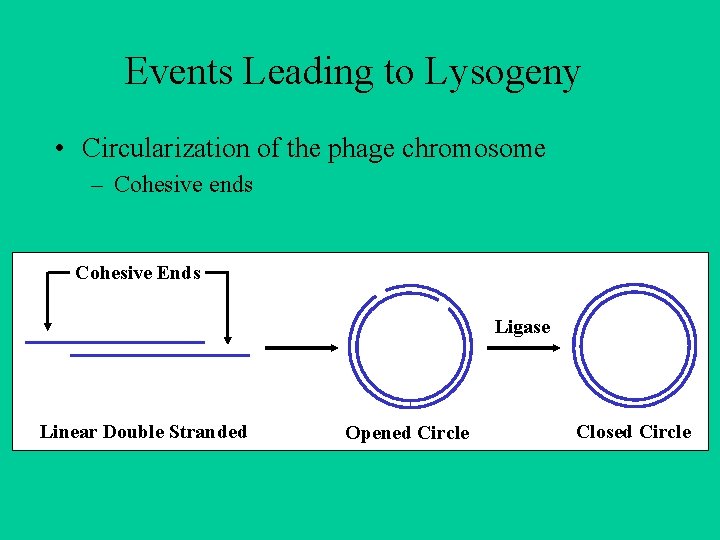
Events Leading to Lysogeny • Circularization of the phage chromosome – Cohesive ends Cohesive Ends Ligase Linear Double Stranded Opened Circle Closed Circle
Transduction • Definition: Gene transfer from a donor to a recipient by way of a bacteriophage • Resistant to environmental nucleases
Transduction • Types of transduction – Generalized - Transduction in which potentially any donor bacterial gene can be transferred
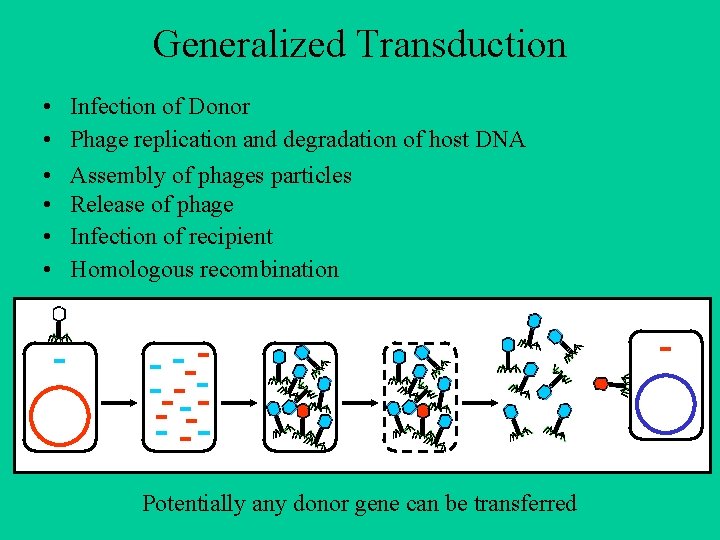
Generalized Transduction • • • Infection of Donor Phage replication and degradation of host DNA Assembly of phages particles Release of phage Infection of recipient Homologous recombination Potentially any donor gene can be transferred
Transduction • Types of transduction – Generalized - Transduction in which potentially any dornor bacterial gene can be transferred. – Specialized - Transduction in which only certain donor genes can be transferred
Transduction • Definition • Types of transduction • Significance – Common in Gram+ bacteria – Lysogenic (phage) conversion • e. g. Corynebacterium diptheriae toxin – Toxin derived from lysogenic phage
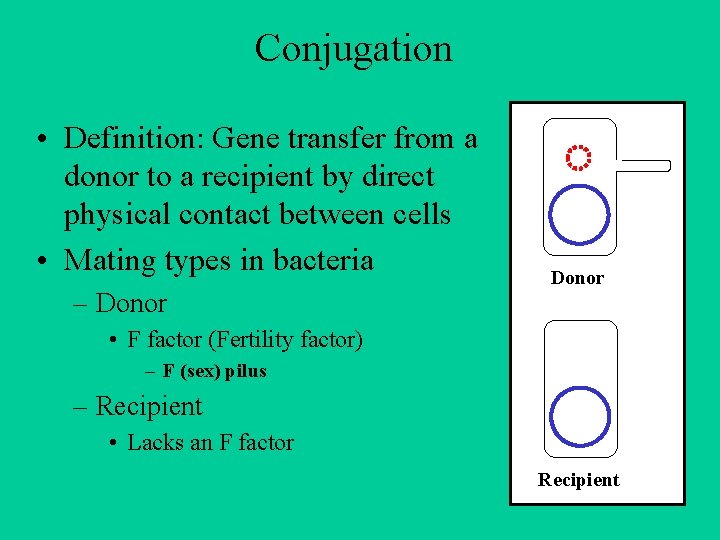
Conjugation • Definition: Gene transfer from a donor to a recipient by direct physical contact between cells • Mating types in bacteria – Donor • F factor (Fertility factor) – F (sex) pilus – Recipient • Lacks an F factor Recipient
Conjugation • Significance – Gram - bacteria • Antibiotic resistance • Exponential increase under selective pressure – Gram + bacteria • Production of adhesive material by donor cells
Transposable Genetic Elements • Definition: Segments of DNA that are able to move from one location to another • Properties – “Random” movement – Not capable of self replication (not a replicon) – Transposition mediated by site-specific recombination • Transposase – Transposition may be accompanied by duplication
Conjugation • Significance – Gram - bacteria • Antibiotic resistance • Exponential increase under selective pressure – Gram + bacteria • Production of adhesive material by donor cells
Transposable Genetic Elements • Definition: Segments of DNA that are able to move from one location to another • Properties – “Random” movement – Not capable of self replication (not a replicon) – Transposition mediated by site-specific recombination • Transposase – Transposition may be accompanied by duplication
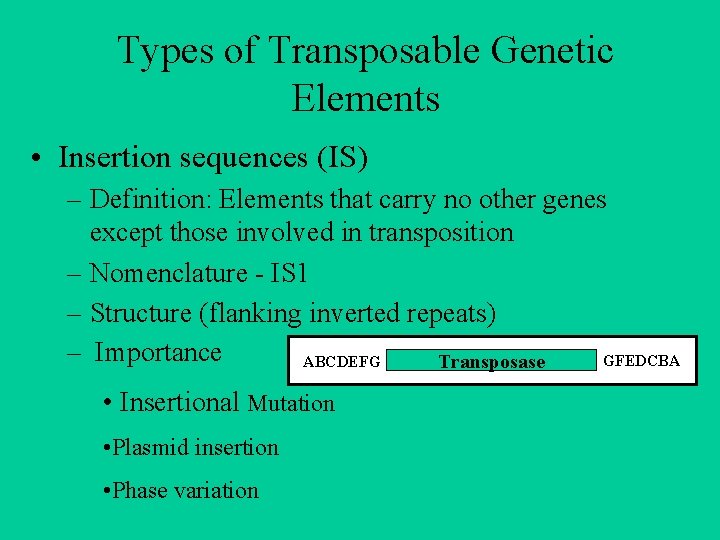
Types of Transposable Genetic Elements • Insertion sequences (IS) – Definition: Elements that carry no other genes except those involved in transposition – Nomenclature - IS 1 – Structure (flanking inverted repeats) – Importance GFEDCBA ABCDEFG Transposase • Insertional Mutation • Plasmid insertion • Phase variation
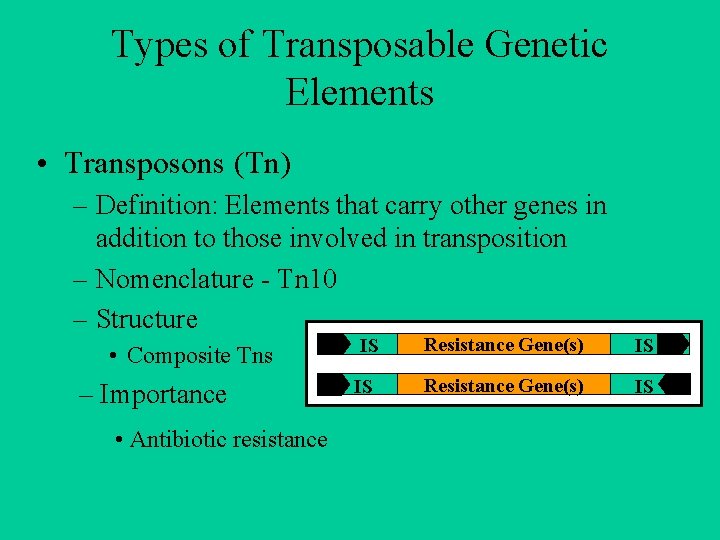
Types of Transposable Genetic Elements • Transposons (Tn) – Definition: Elements that carry other genes in addition to those involved in transposition – Nomenclature - Tn 10 – Structure • Composite Tns – Importance • Antibiotic resistance IS IS Resistance Gene(s) IS
Plasmids • Definition: Extrachromosomal genetic elements that are capable of autonomous replication (replicon) • Episome - a plasmid that can integrate into the chromosome
Classification of Plasmids • Transfer properties – Conjugative – Nonconjugative • Phenotypic effects – Fertility – Bacteriocinogenic plasmid – Resistance plasmid (R factors)
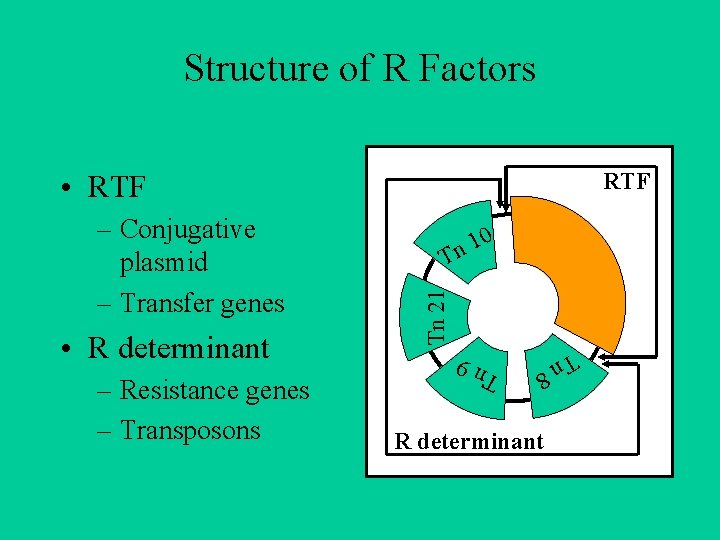
Structure of R Factors RTF • RTF Tn 21 T n 9 – Resistance genes – Transposons 0 8 • R determinant 1 n T R determinant Tn – Conjugative plasmid – Transfer genes
- Slides: 26