
Microbial Genetics Genetic Information Flow in Bacteria DNA
Microbial Genetics
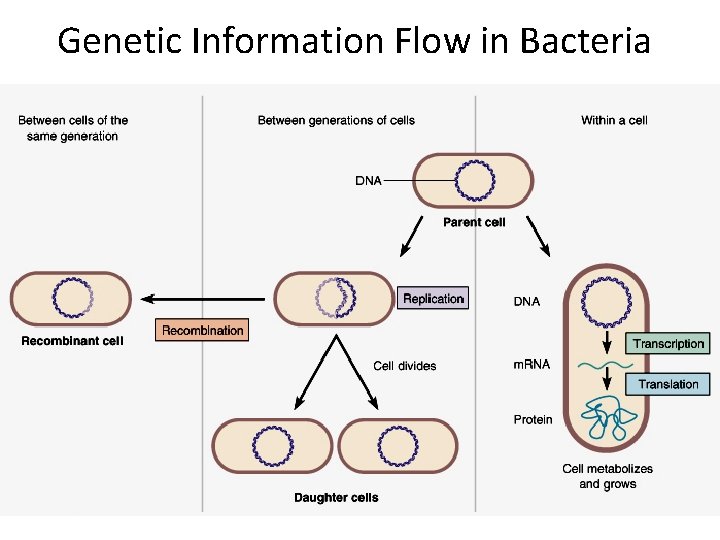
Genetic Information Flow in Bacteria
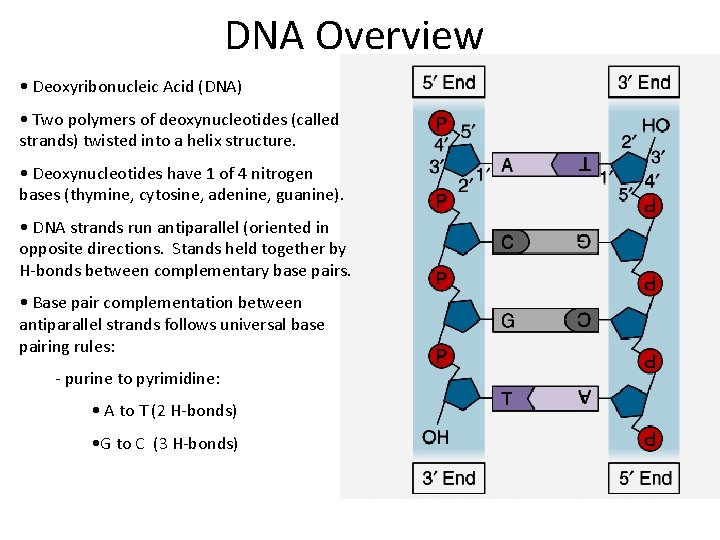
DNA Overview • Deoxyribonucleic Acid (DNA) • Two polymers of deoxynucleotides (called strands) twisted into a helix structure. • Deoxynucleotides have 1 of 4 nitrogen bases (thymine, cytosine, adenine, guanine). • DNA strands run antiparallel (oriented in opposite directions. Stands held together by H-bonds between complementary base pairs. • Base pair complementation between antiparallel strands follows universal base pairing rules: - purine to pyrimidine: • A to T (2 H-bonds) • G to C (3 H-bonds)
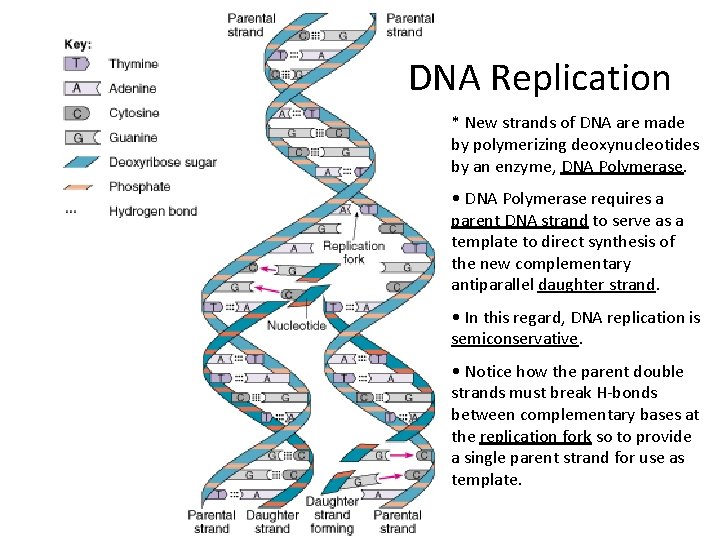
DNA Replication * New strands of DNA are made by polymerizing deoxynucleotides by an enzyme, DNA Polymerase. • DNA Polymerase requires a parent DNA strand to serve as a template to direct synthesis of the new complementary antiparallel daughter strand. • In this regard, DNA replication is semiconservative. • Notice how the parent double strands must break H-bonds between complementary bases at the replication fork so to provide a single parent strand for use as template.
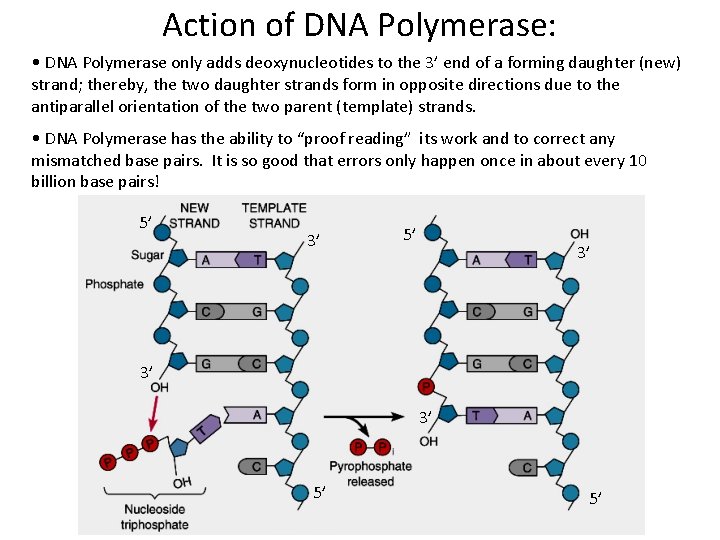
Action of DNA Polymerase: • DNA Polymerase only adds deoxynucleotides to the 3’ end of a forming daughter (new) strand; thereby, the two daughter strands form in opposite directions due to the antiparallel orientation of the two parent (template) strands. • DNA Polymerase has the ability to “proof reading” its work and to correct any mismatched base pairs. It is so good that errors only happen once in about every 10 billion base pairs! 5’ 3’ 3’ 3’ 5’ 5’
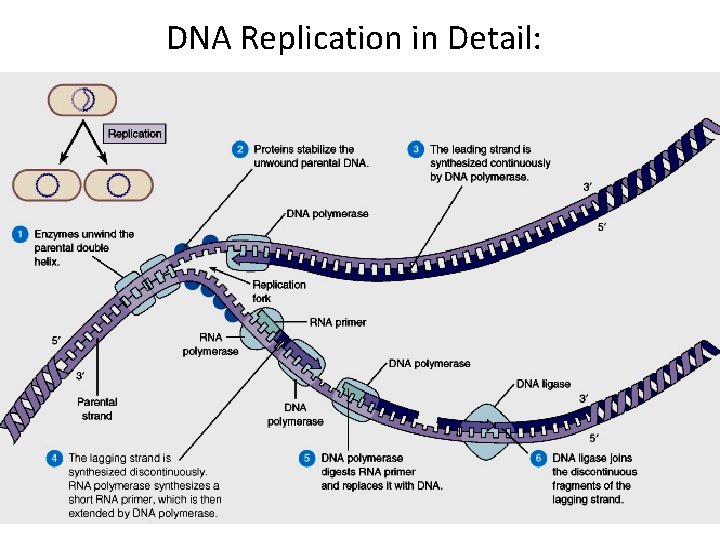
DNA Replication in Detail:
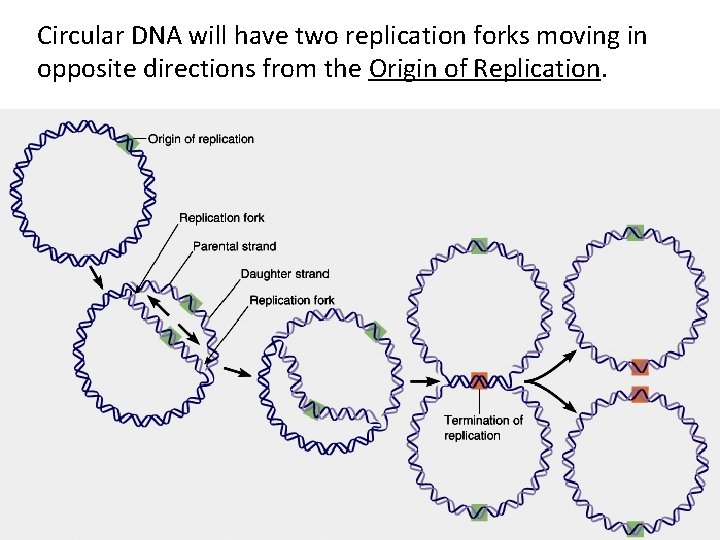
Circular DNA will have two replication forks moving in opposite directions from the Origin of Replication.
• Genetic recombination - transfer of DNA from one organism (donor) to another recipient. The transferred donor DNA may then be integrated into the recipient's nucleoid by various mechanisms (homologous, non-homologous). • Homologous recombination- homologous DNA sequences having nearly the same nucleotide sequences are exchanged by means of Rec A proteins. This involves breakage and reunion of paired DNA segments as seen in (Natural mechanisms of genetic recombination in bacteria include: a. transformation b. transduction c. conjungation Transposons
Gene transfer • Horizontal gene transfer is the transfer of genes between two different species • Vertical gene transfer is the transfer of genes from mother to daughter cell or from parents to offspring • A sizable fraction of bacterial genes are derived from horizontal gene transfer – Roughly 17% of E. coli and S. typhimurium genes during the past 100 million years
Horizontal Gene transfer • The types of genes acquired through horizontal gene transfer are quite varied and include – Genes that confer the ability to cause disease – Genes that confer antibiotic resistance • Horizontal gene transfer has dramatically contributed to the phenomenon of acquired antibiotic resistance – Bacterial resistance to antibiotics is a serious problem worldwide • In many countries, nearly 50% of Streptococcus pneumoniae strains are resistant to penicillin
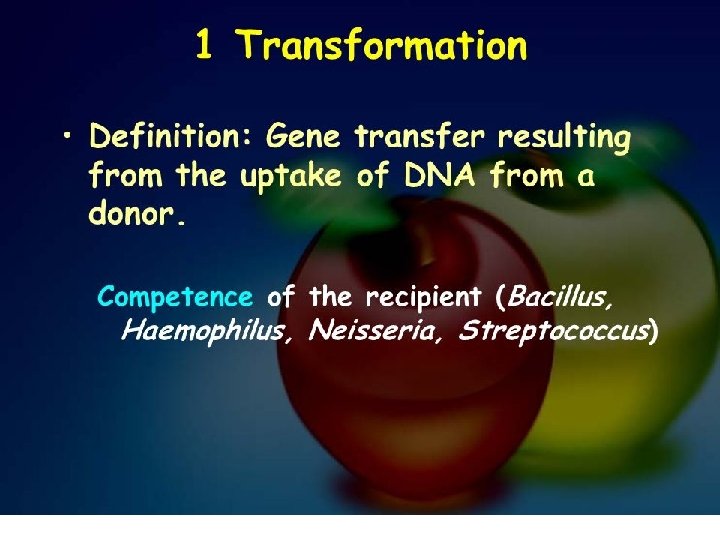
Mechanisms of DNA transfer • Conjugation – Physical interaction between cells • Transduction – Virus mediated transfer of DNA between bacteria • Transformation – Requires release of DNA into environment, and the taking up of DNA by bacteria

Mechanisms of bacterial gene transfer Mc. Graw Hill
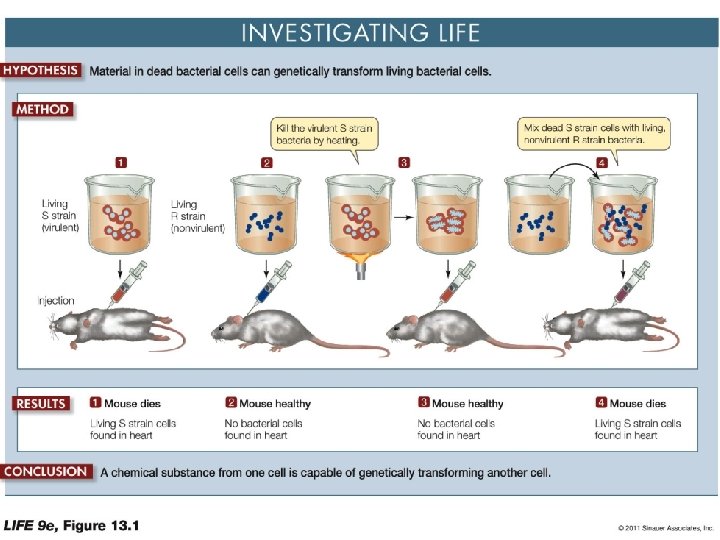
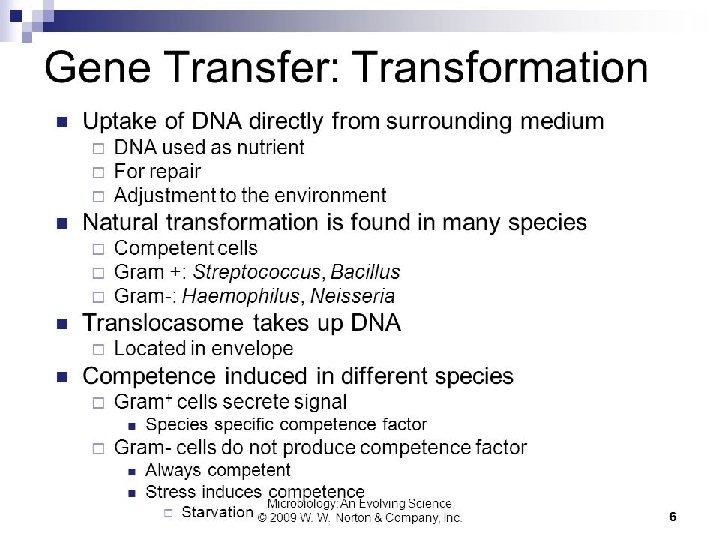
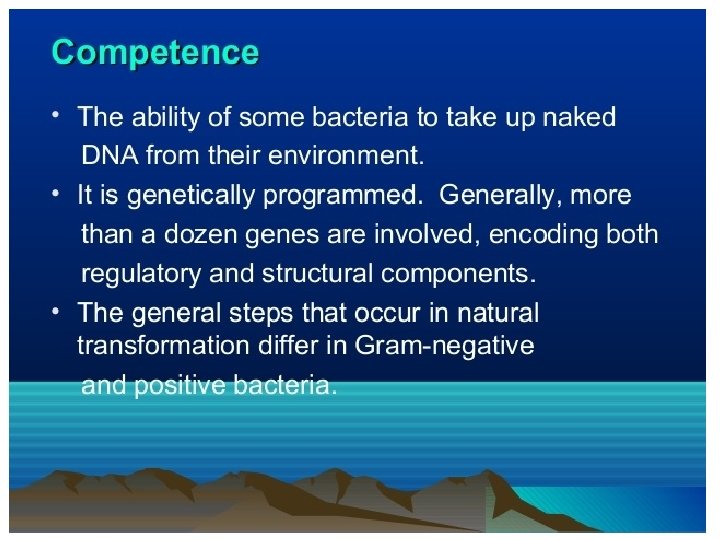
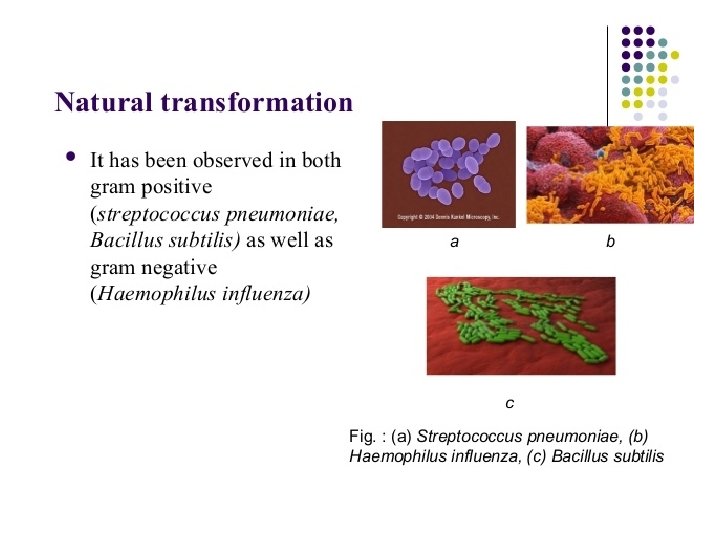
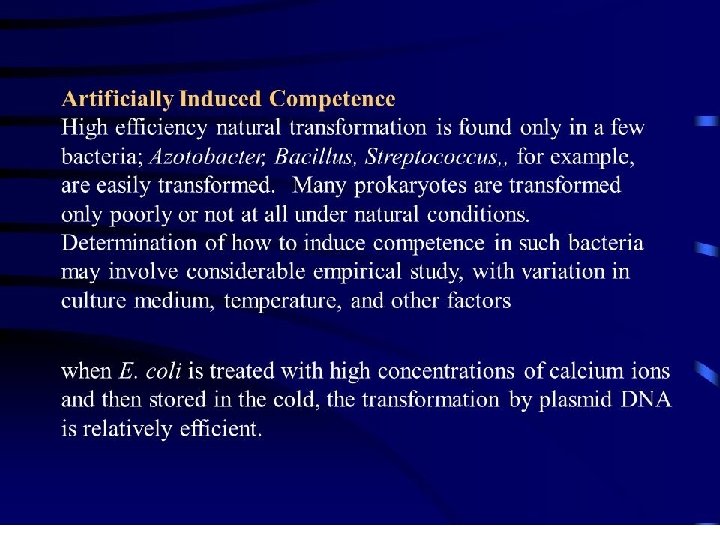
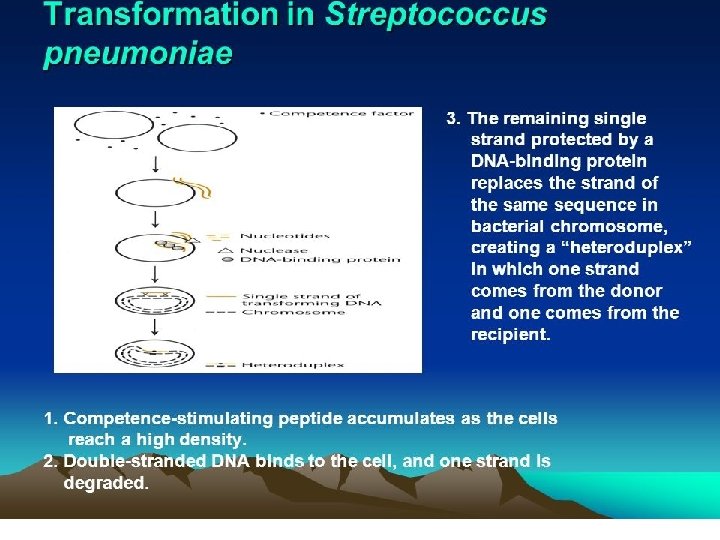
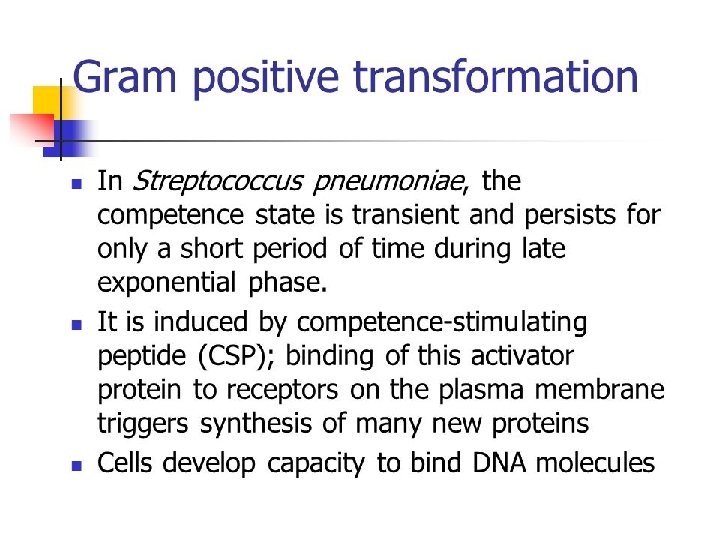
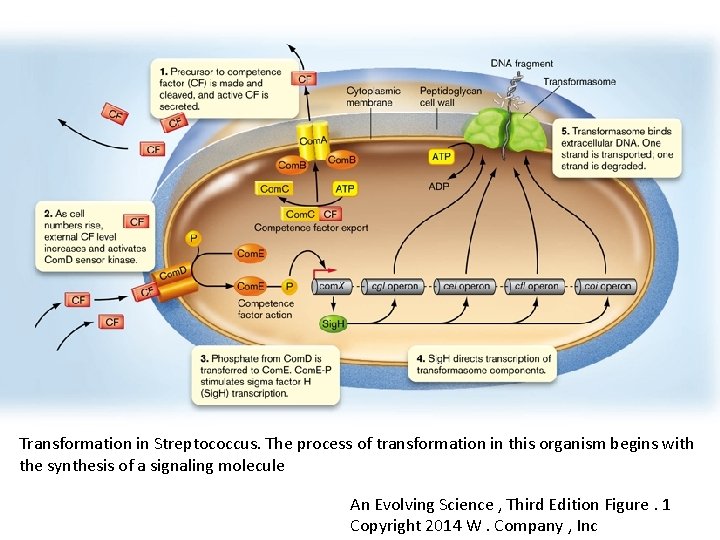
Transformation in Streptococcus. The process of transformation in this organism begins with the synthesis of a signaling molecule An Evolving Science , Third Edition Figure. 1 Copyright 2014 W. Company , Inc
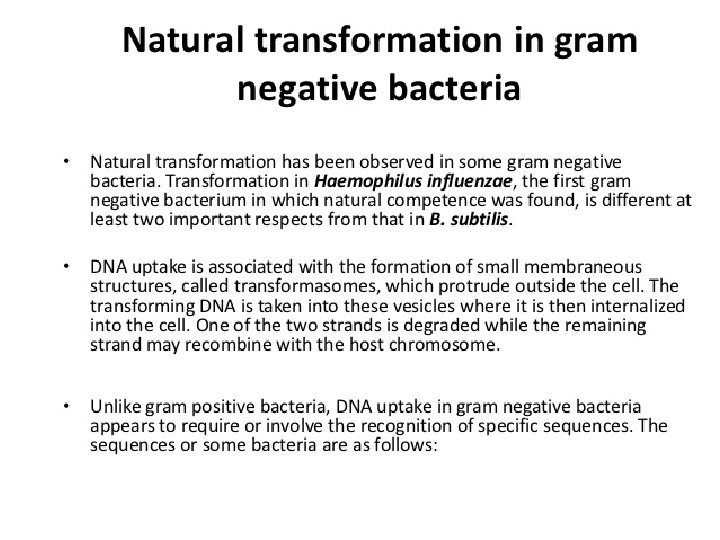
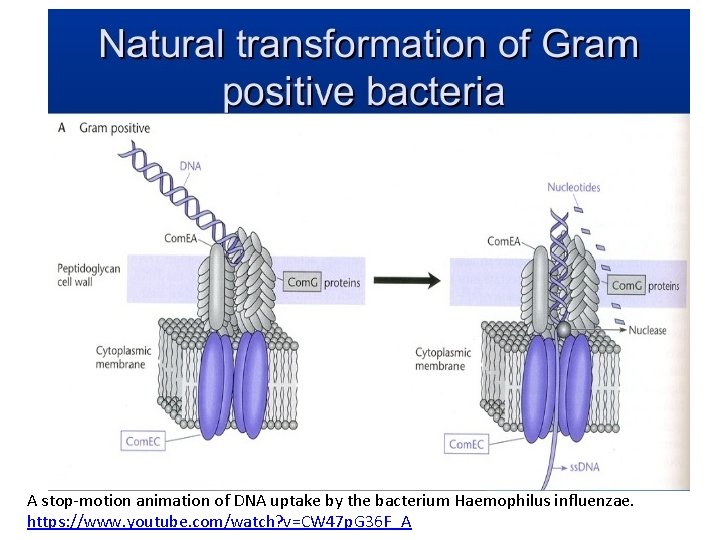
A stop-motion animation of DNA uptake by the bacterium Haemophilus influenzae. https: //www. youtube. com/watch? v=CW 47 p. G 36 F_A
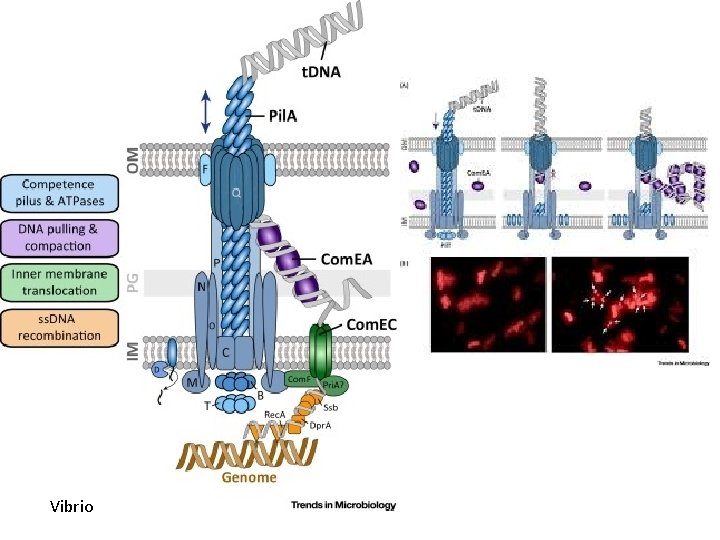
Vibrio
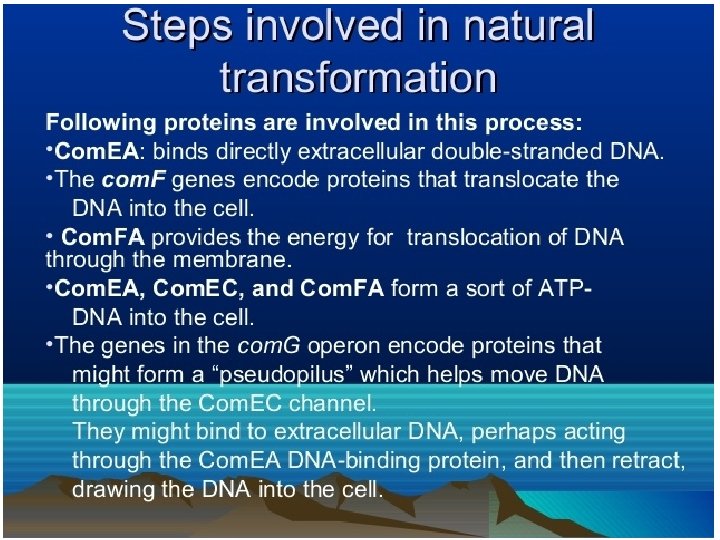
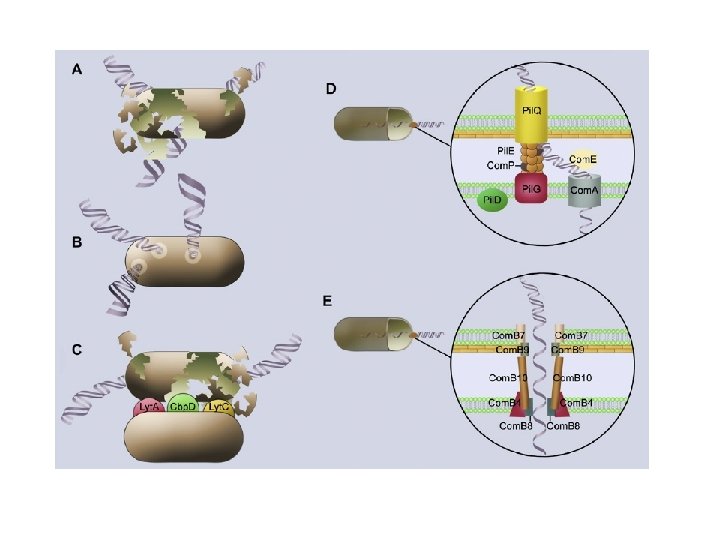
ØThe sophisticated DNA-uptake machinery used during natural transformation in Gram-negative bacteria where the transforming DNA has to cross two membranes as well as the peptidoglycan layer before entering the cytoplasm. ØThe DNA-uptake machinery was hypothesized to take the form of a pseudopilus, which, upon repeated cycles of extension and retraction, would pull external DNA towards the cell surface or into the periplasmic space, followed by translocation across the cytoplasmic membrane. ØThe core component of the DNA-uptake machinery in V. cholerae is a type IV pilus structure that extends beyond the outer membrane. ØThe conserved DNA-binding protein Com. EA potentially drives DNA import through a ratcheting mechanism, followed by DNA compaction
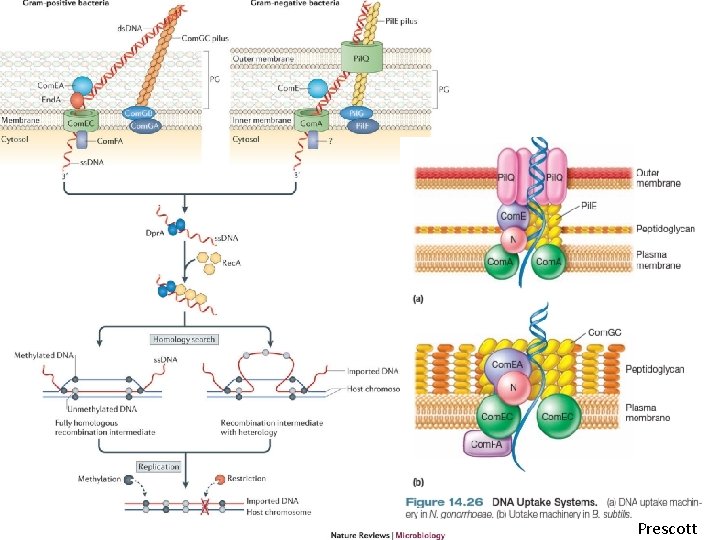
Prescott
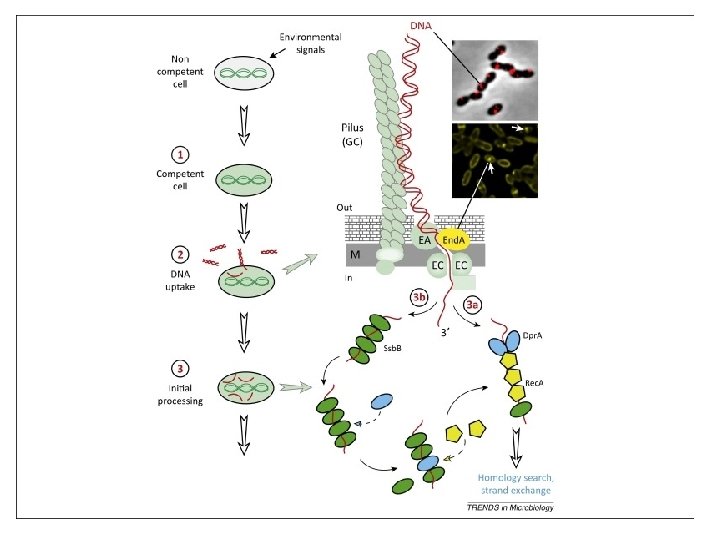
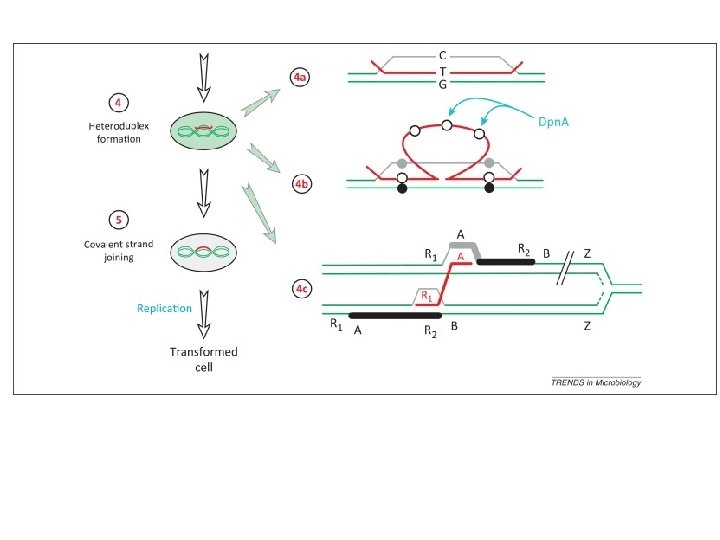
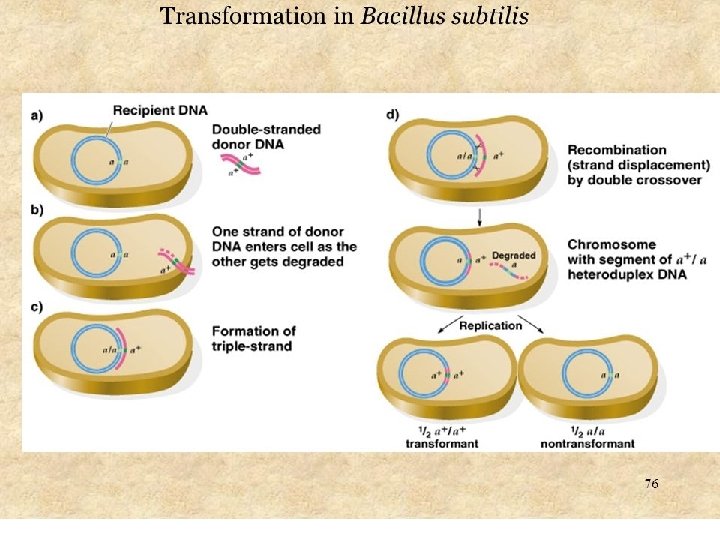
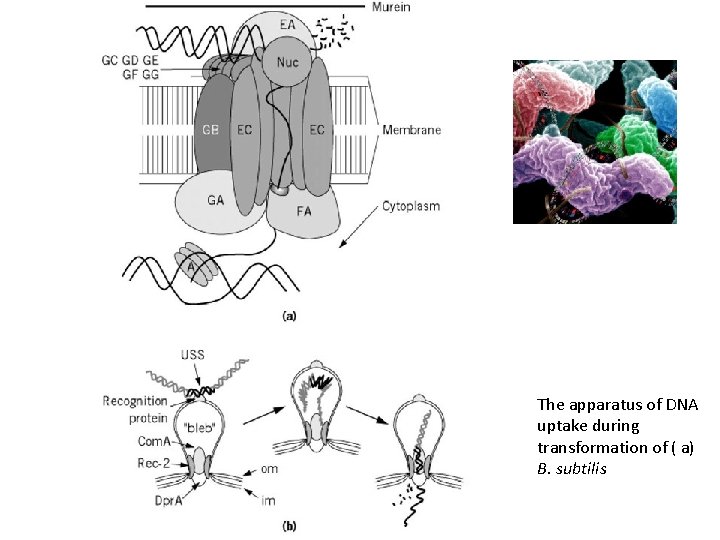
The apparatus of DNA uptake during transformation of ( a) B. subtilis
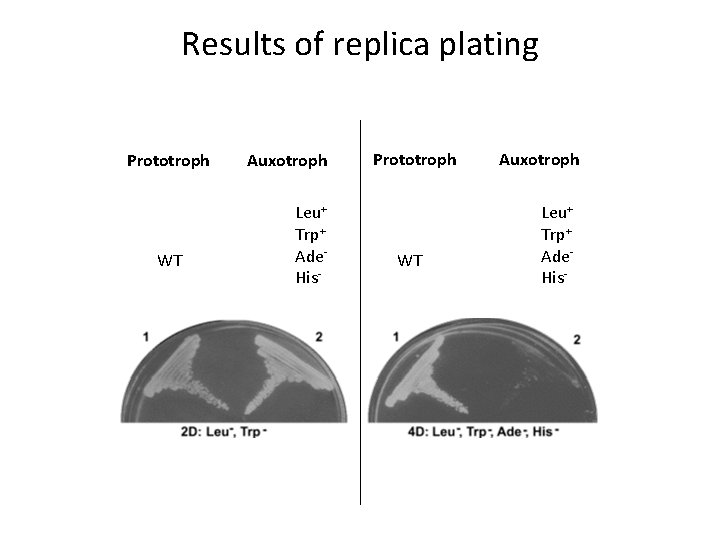
Results of replica plating Prototroph WT Auxotroph Leu+ Trp+ Ade. His-
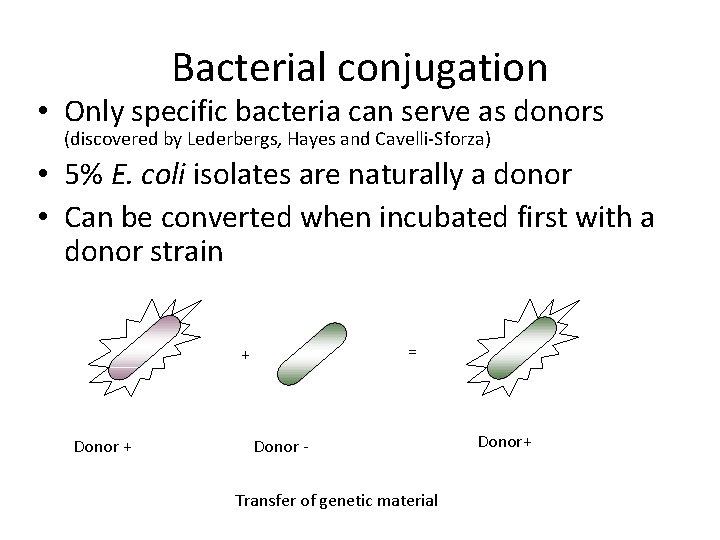
Bacterial conjugation • Only specific bacteria can serve as donors (discovered by Lederbergs, Hayes and Cavelli-Sforza) • 5% E. coli isolates are naturally a donor • Can be converted when incubated first with a donor strain = + Donor Transfer of genetic material Donor+
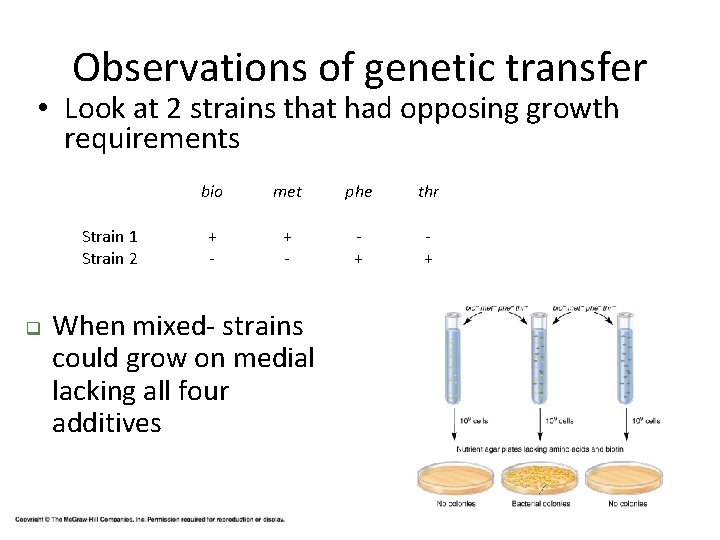
Observations of genetic transfer • Look at 2 strains that had opposing growth requirements Strain 1 Strain 2 q bio met phe thr + - + + When mixed- strains could grow on medial lacking all four additives
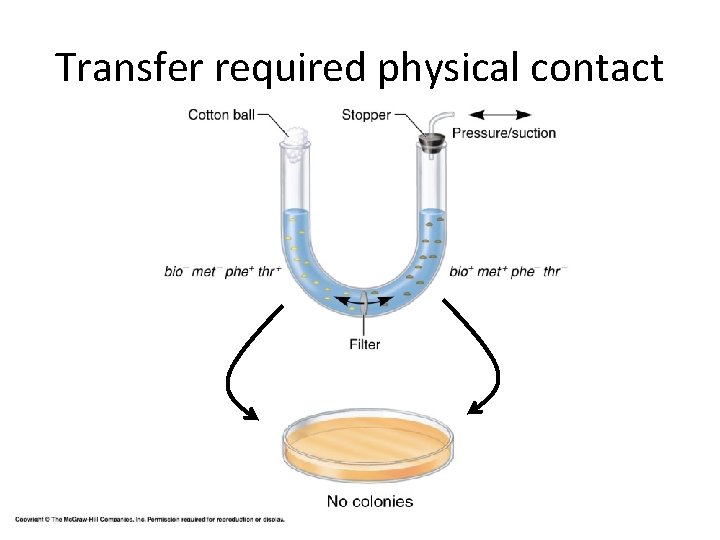
Transfer required physical contact
Conjugation mechanism • Material called fertility factor (F factor), and is encoded on a plasmid (extrachomosomal DNA) • Strains called F+ or F- to describe whether it harbors plasmid • Plasmids that are transmitted in this fashion: conjugative plasmids – Have genes that code for proteins required for this transfer to occur
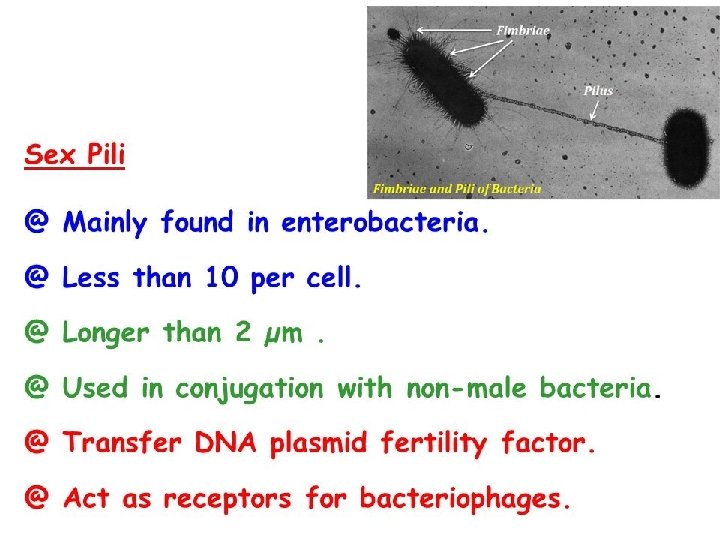
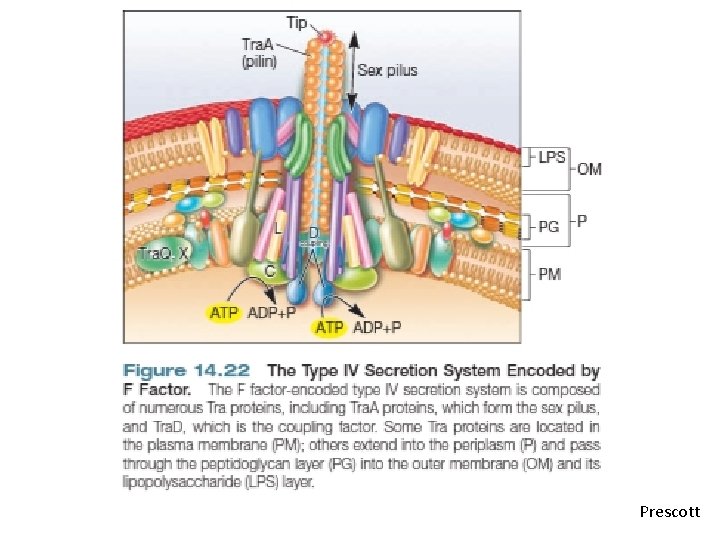
Prescott
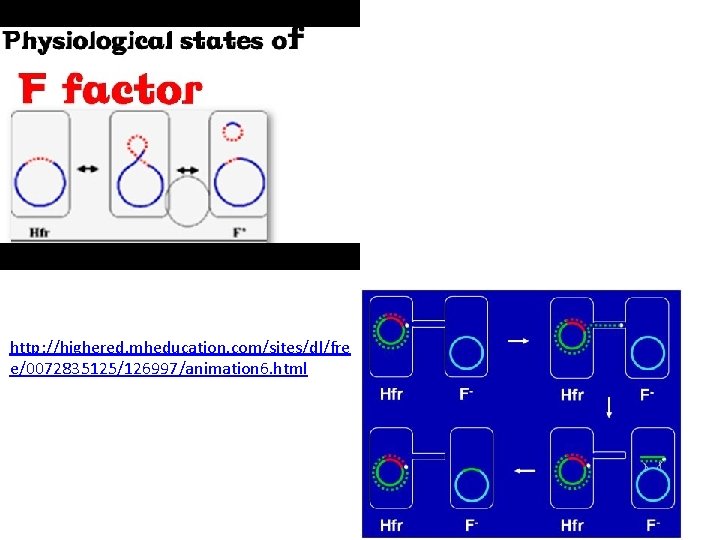
http: //highered. mheducation. com/sites/dl/fre e/0072835125/126997/animation 6. html
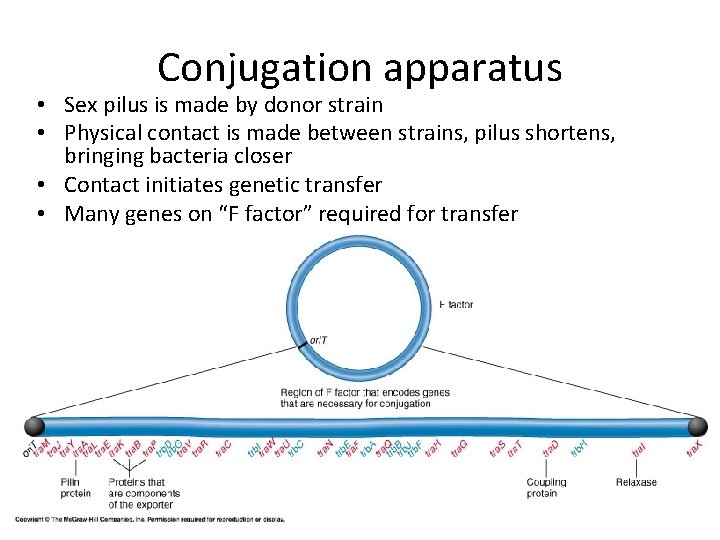
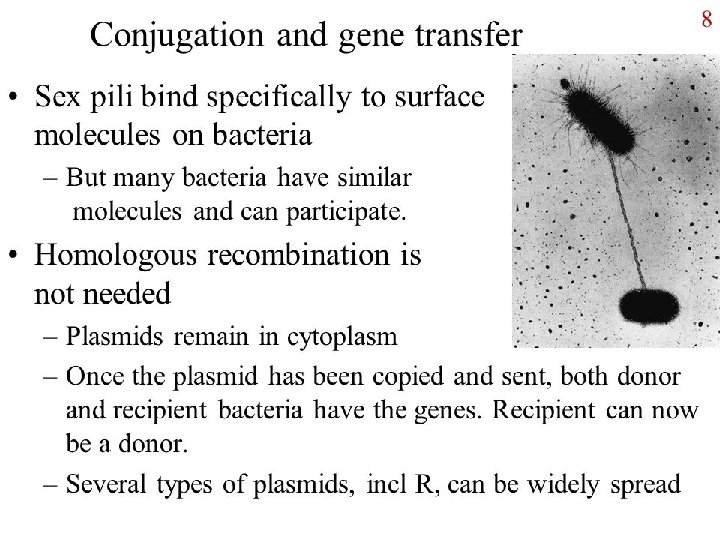
Conjugation apparatus • Sex pilus is made by donor strain • Physical contact is made between strains, pilus shortens, bringing bacteria closer • Contact initiates genetic transfer • Many genes on “F factor” required for transfer
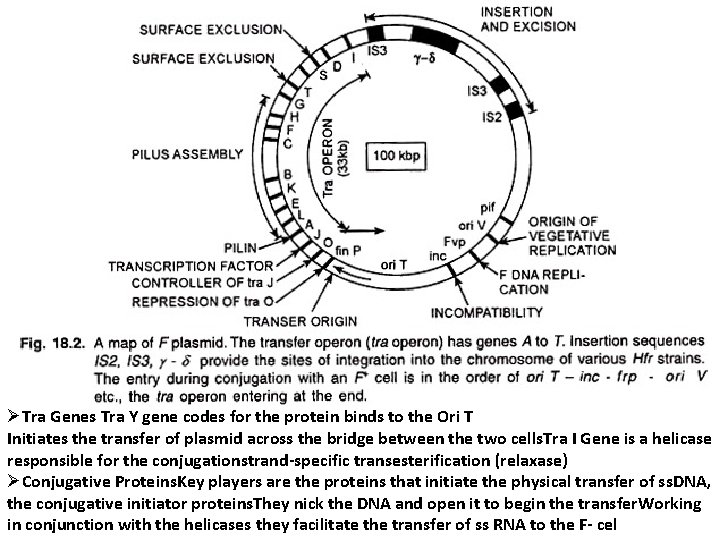
ØTra Genes Tra Y gene codes for the protein binds to the Ori T Initiates the transfer of plasmid across the bridge between the two cells. Tra I Gene is a helicase responsible for the conjugationstrand-specific transesterification (relaxase) ØConjugative Proteins. Key players are the proteins that initiate the physical transfer of ss. DNA, the conjugative initiator proteins. They nick the DNA and open it to begin the transfer. Working in conjunction with the helicases they facilitate the transfer of ss RNA to the F- cel
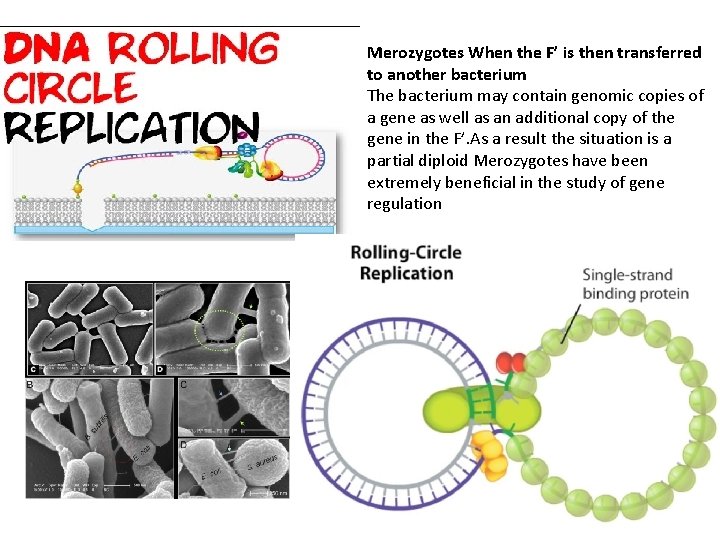
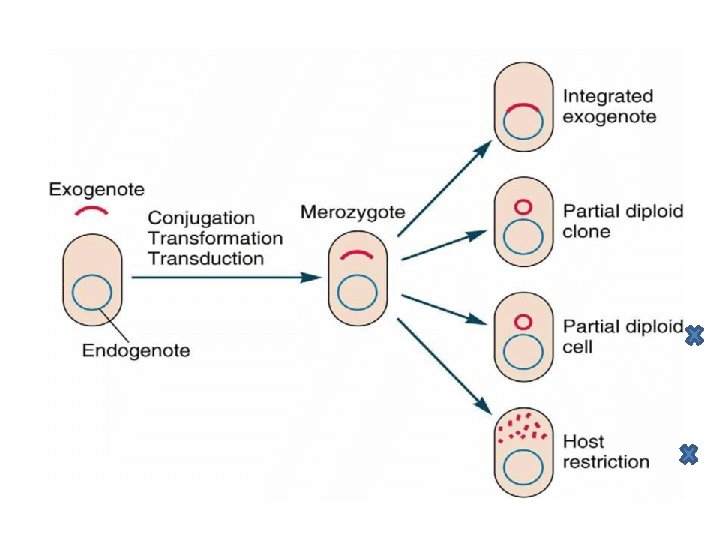
Merozygotes When the F’ is then transferred to another bacterium The bacterium may contain genomic copies of a gene as well as an additional copy of the gene in the F’. As a result the situation is a partial diploid Merozygotes have been extremely beneficial in the study of gene regulation
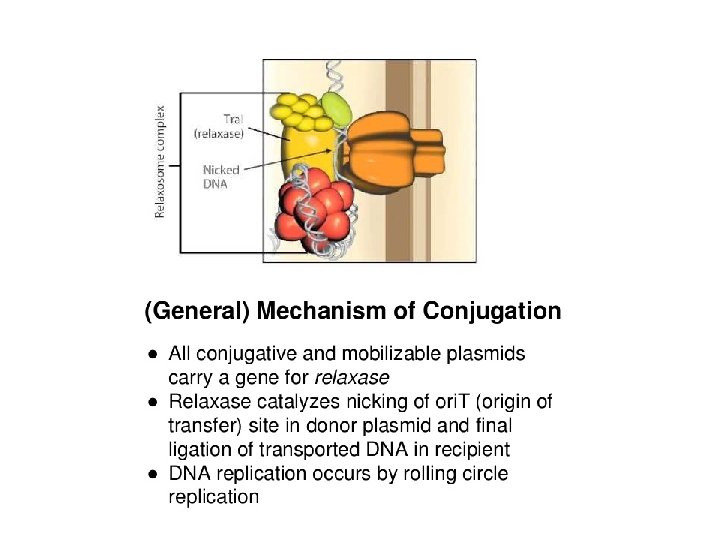
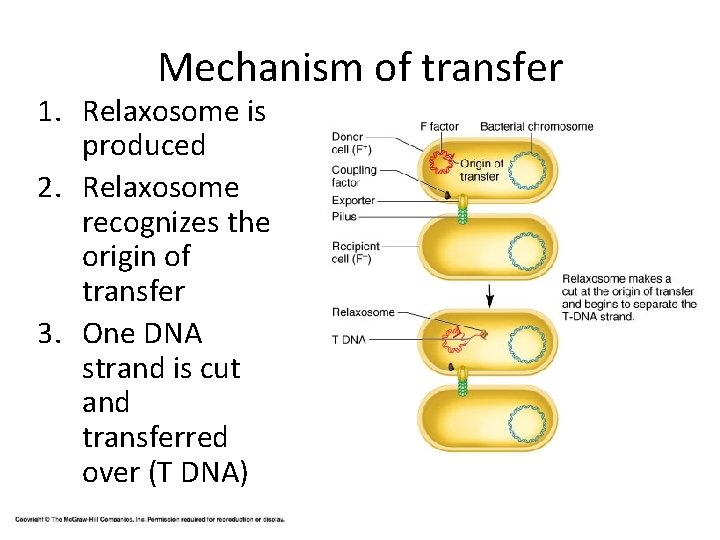
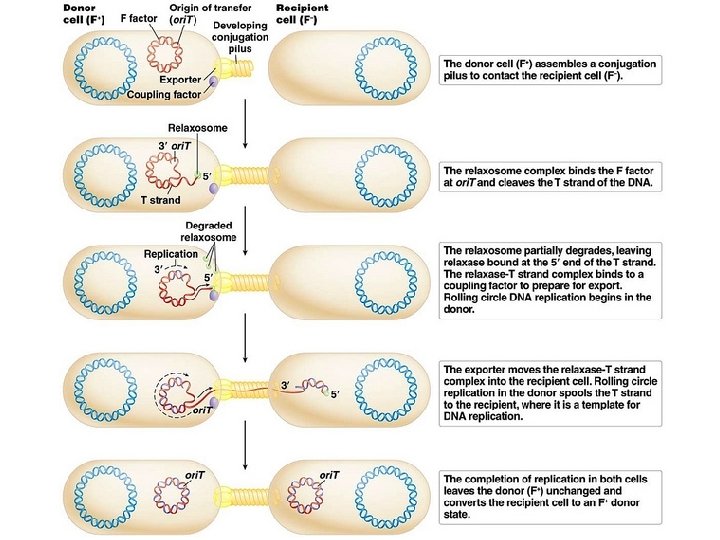
Mechanism of transfer 1. Relaxosome is produced 2. Relaxosome recognizes the origin of transfer 3. One DNA strand is cut and transferred over (T DNA)
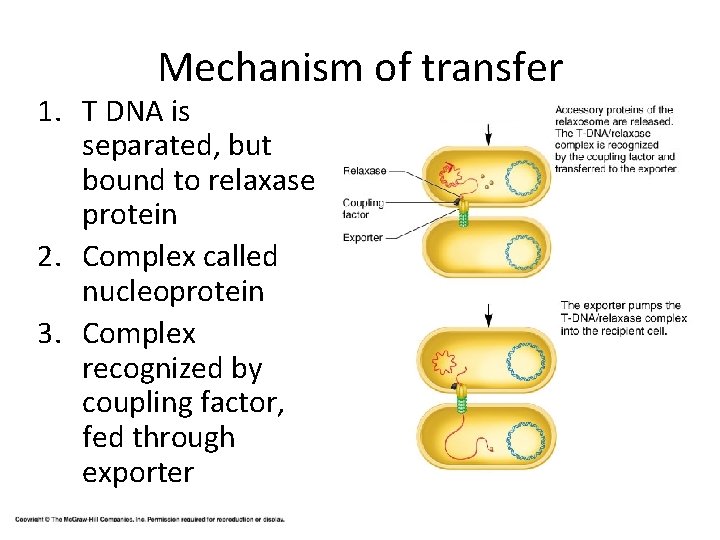
Mechanism of transfer 1. T DNA is separated, but bound to relaxase protein 2. Complex called nucleoprotein 3. Complex recognized by coupling factor, fed through exporter
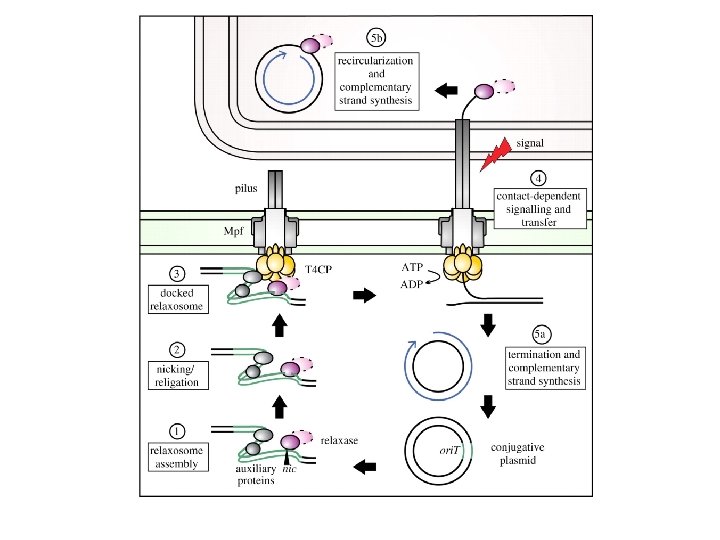
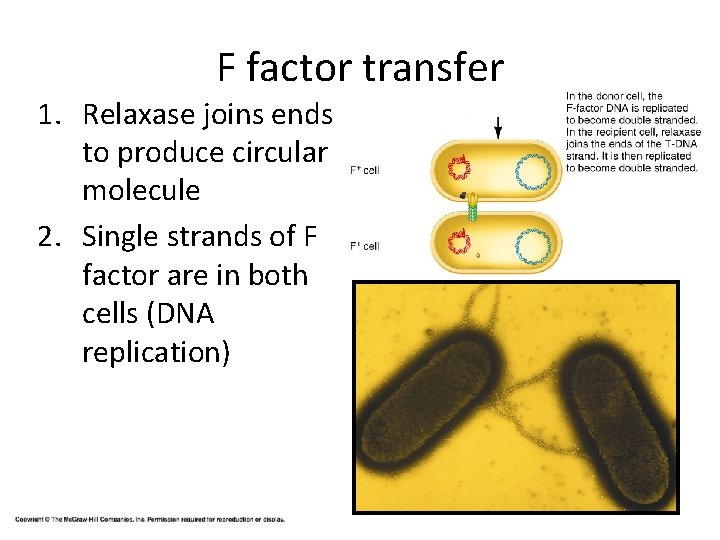
F factor transfer 1. Relaxase joins ends to produce circular molecule 2. Single strands of F factor are in both cells (DNA replication)
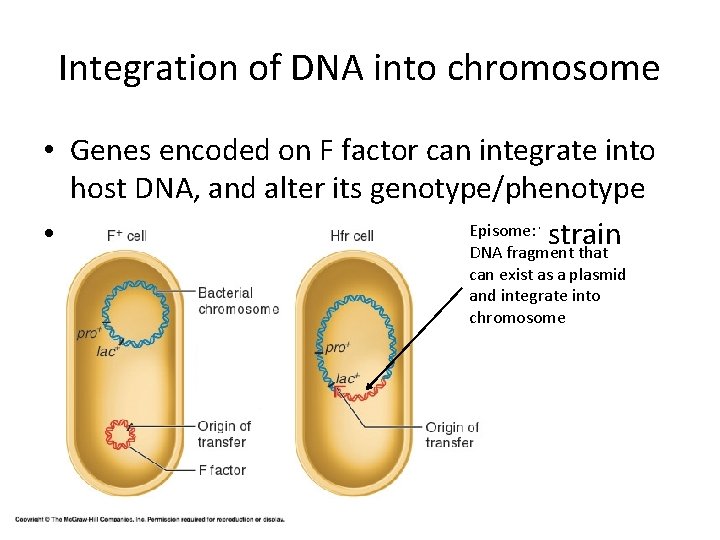
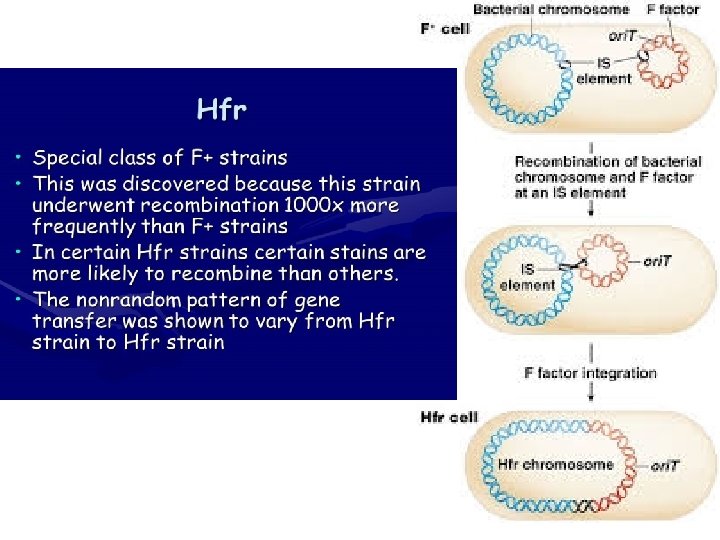
Integration of DNA into chromosome • Genes encoded on F factor can integrate into host DNA, and alter its genotype/phenotype + strain • An Hfr strain was derived from. Episome: an F DNA fragment that can exist as a plasmid and integrate into chromosome
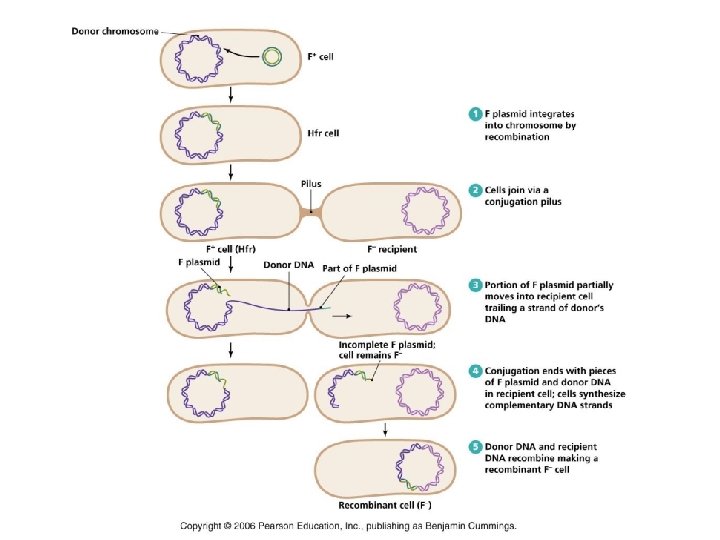
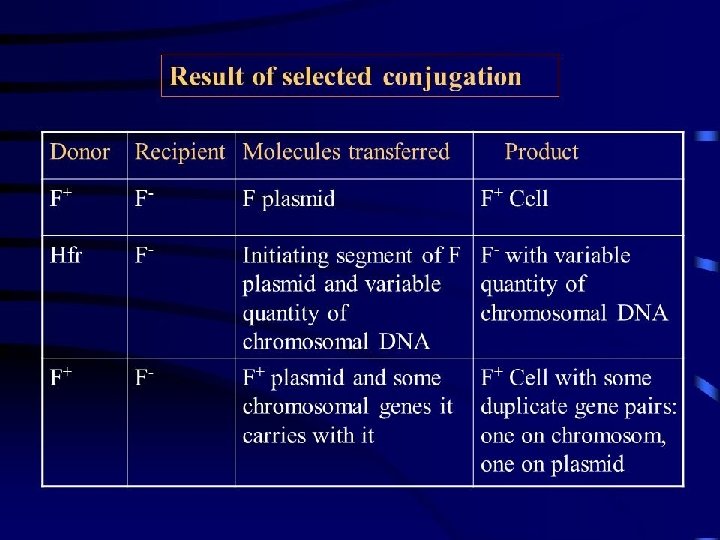
Hfr strain • E. coli strain discovered as Hfr (high frequency of recombination) • Hfr strain transfers chromosomal DNA to Fstrains • This transfer begins at the origin of transfer • The amount of DNA transferred depends on the time of conjugation • Endogenote: chromosomal and exogenote: transferred DNA
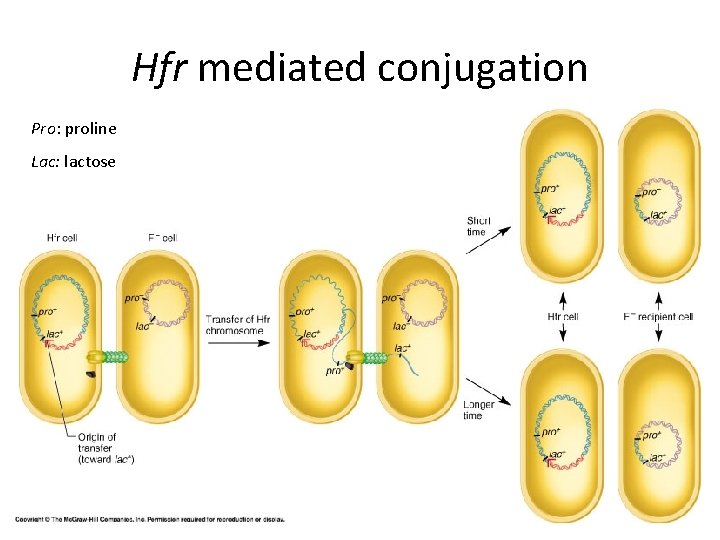
Hfr mediated conjugation Pro: proline Lac: lactose
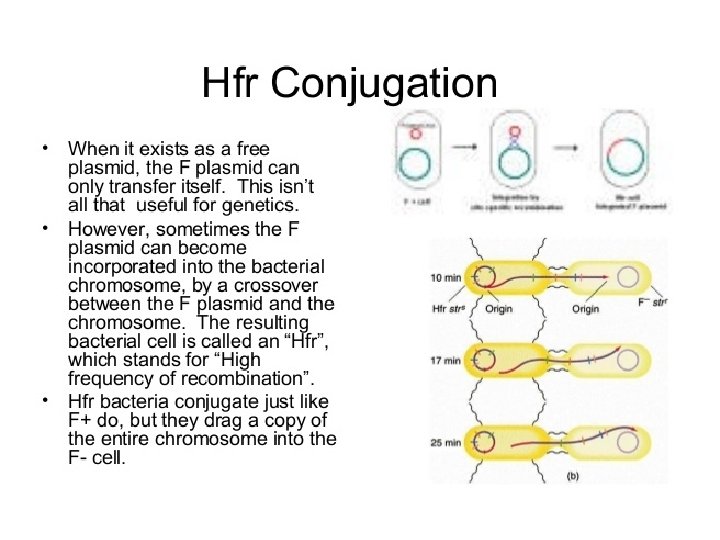
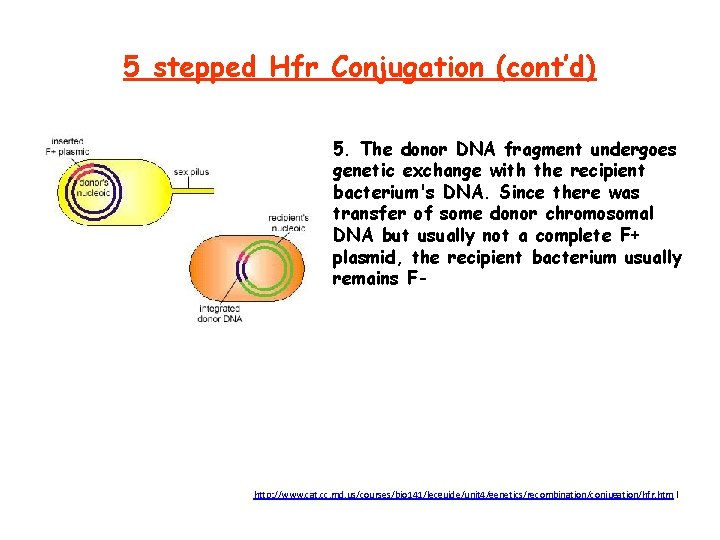
5 stepped Hfr Conjugation (cont’d) 5. The donor DNA fragment undergoes genetic exchange with the recipient bacterium's DNA. Since there was transfer of some donor chromosomal DNA but usually not a complete F+ plasmid, the recipient bacterium usually remains F- http: //www. cat. cc. md. us/courses/bio 141/lecguide/unit 4/genetics/recombination/conjugation/hfr. htm l
III. Resistant Plasmid Conjugation Genetic recombination in which there is a transfer of an R plasmid (a plasmid coding for multiple antibiotic resistance and often a sex pilus) from a male donor bacterium to a female recipient bacterium. Involves a sex (conjugation) pilus
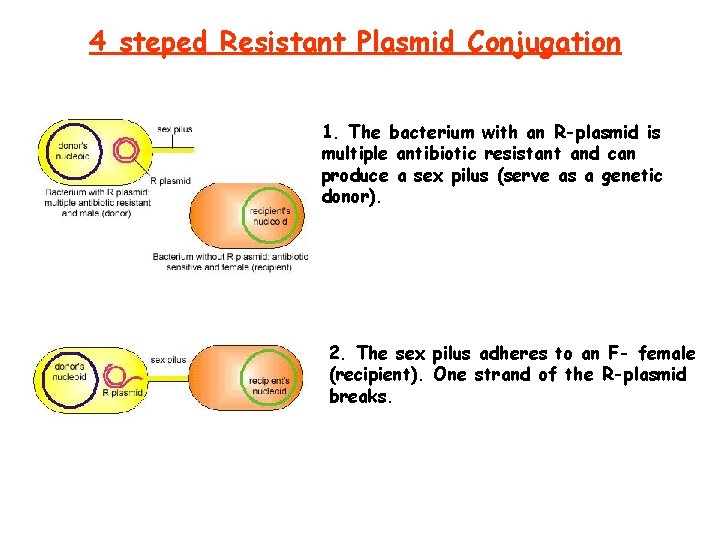
4 steped Resistant Plasmid Conjugation 1. The bacterium with an R-plasmid is multiple antibiotic resistant and can produce a sex pilus (serve as a genetic donor). 2. The sex pilus adheres to an F- female (recipient). One strand of the R-plasmid breaks.
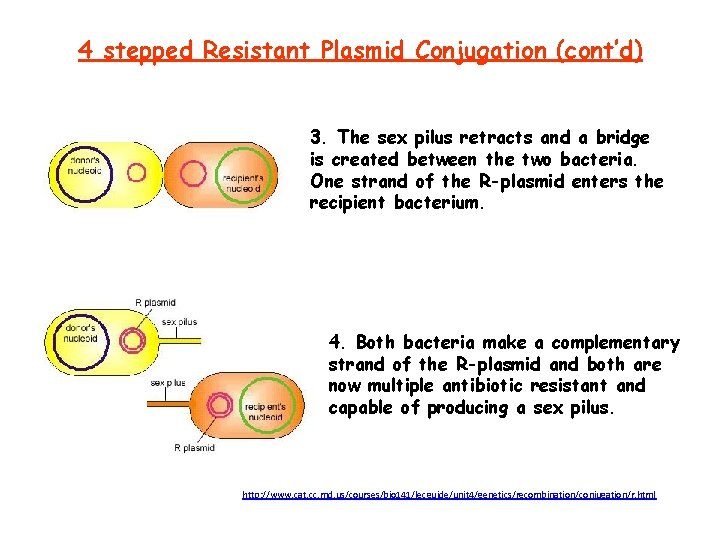
4 stepped Resistant Plasmid Conjugation (cont’d) 3. The sex pilus retracts and a bridge is created between the two bacteria. One strand of the R-plasmid enters the recipient bacterium. 4. Both bacteria make a complementary strand of the R-plasmid and both are now multiple antibiotic resistant and capable of producing a sex pilus. http: //www. cat. cc. md. us/courses/bio 141/lecguide/unit 4/genetics/recombination/conjugation/r. html
Interrupted mating • The length of time a mating occurs, the more DNA is transferred • The Hfr DNA is transferred in a linear manner • By mating for different times, you can get DNA of several sizes, and determine the order of the genes, and how far apart they are (minutes)
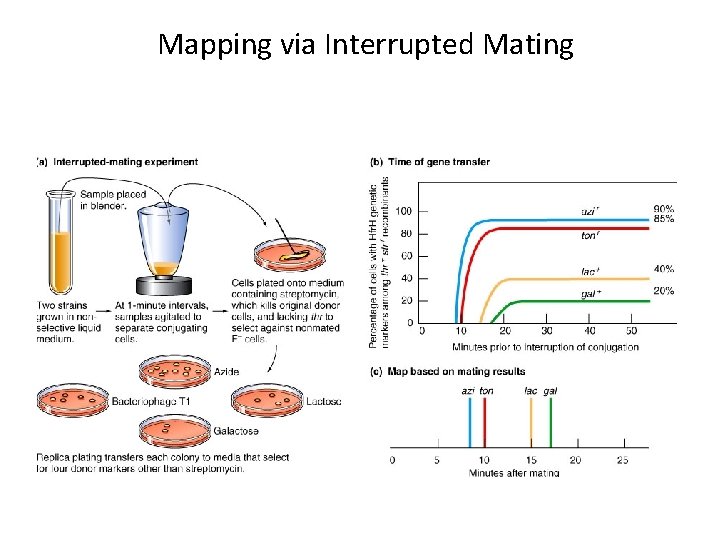
Mapping via Interrupted Mating
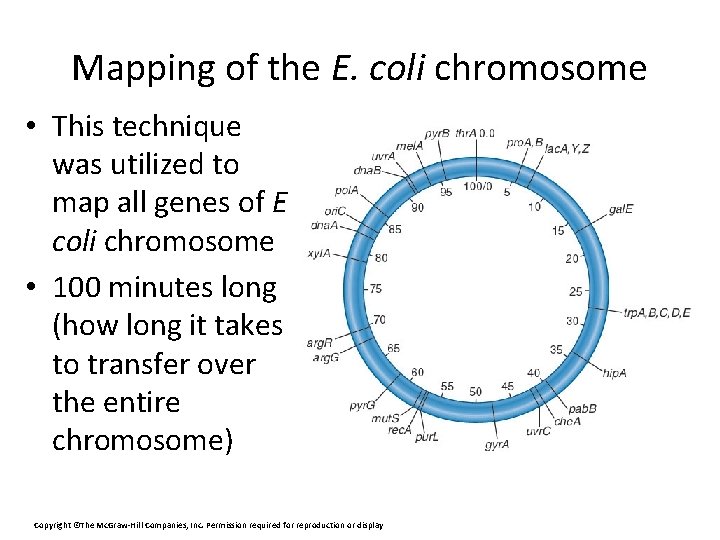
Mapping of the E. coli chromosome • This technique was utilized to map all genes of E. coli chromosome • 100 minutes long (how long it takes to transfer over the entire chromosome) Copyright ©The Mc. Graw-Hill Companies, Inc. Permission required for reproduction or display
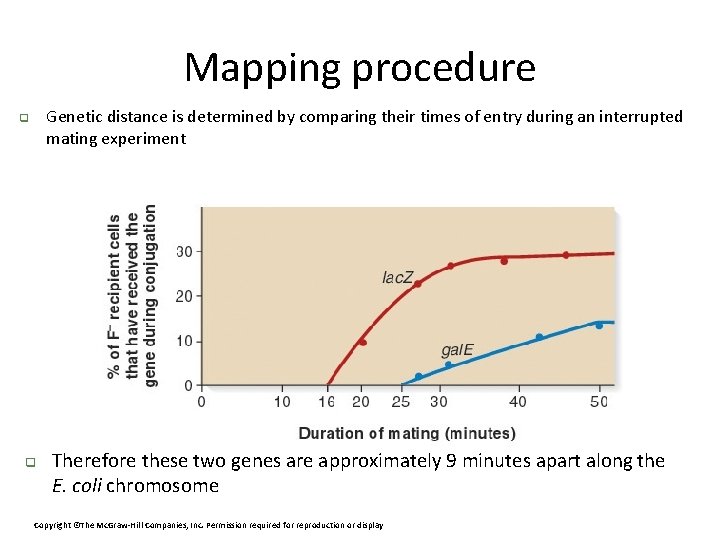
Mapping procedure Genetic distance is determined by comparing their times of entry during an interrupted mating experiment q q Therefore these two genes are approximately 9 minutes apart along the E. coli chromosome Copyright ©The Mc. Graw-Hill Companies, Inc. Permission required for reproduction or display
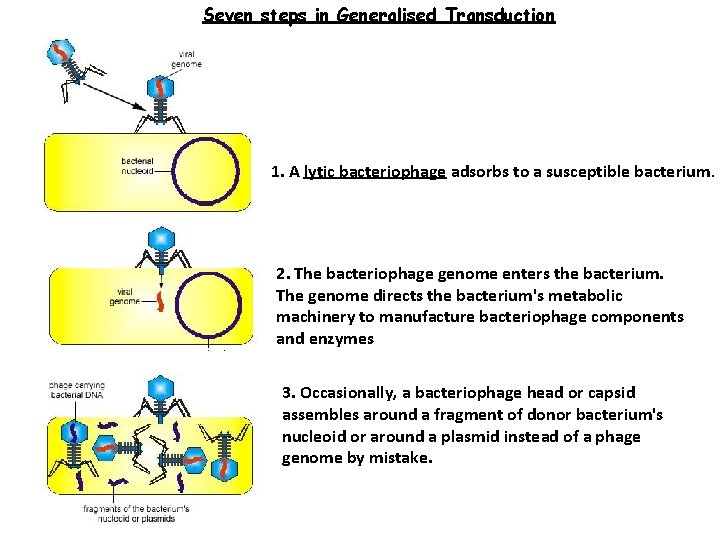
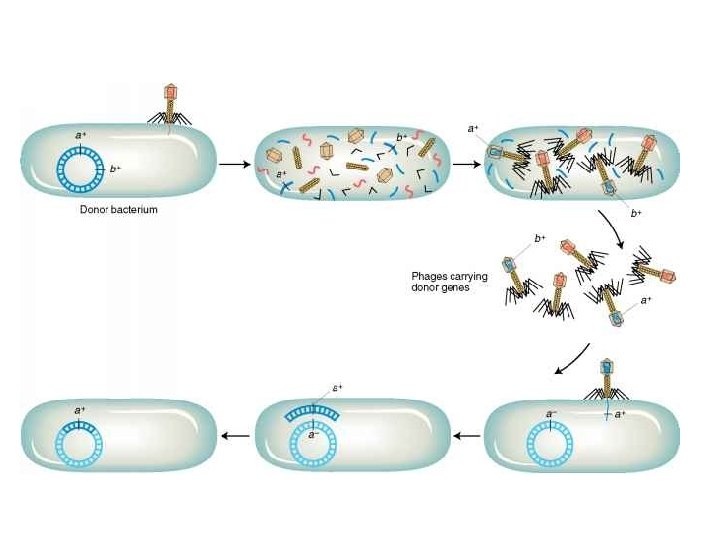
Seven steps in Generalised Transduction 1. A lytic bacteriophage adsorbs to a susceptible bacterium. 2. The bacteriophage genome enters the bacterium. The genome directs the bacterium's metabolic machinery to manufacture bacteriophage components and enzymes 3. Occasionally, a bacteriophage head or capsid assembles around a fragment of donor bacterium's nucleoid or around a plasmid instead of a phage genome by mistake.
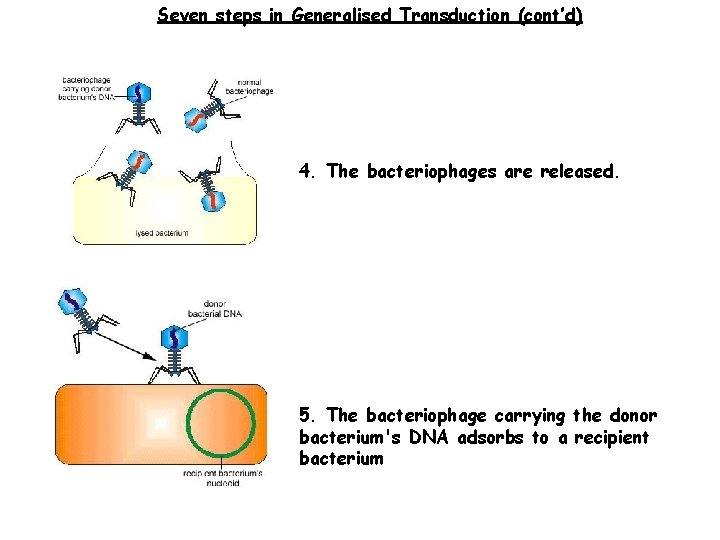
Seven steps in Generalised Transduction (cont’d) 4. The bacteriophages are released. 5. The bacteriophage carrying the donor bacterium's DNA adsorbs to a recipient bacterium
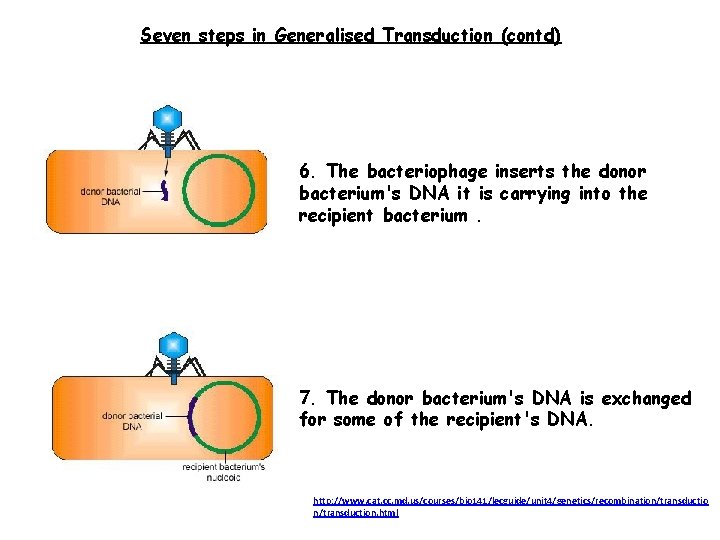
Seven steps in Generalised Transduction (contd) 6. The bacteriophage inserts the donor bacterium's DNA it is carrying into the recipient bacterium. 7. The donor bacterium's DNA is exchanged for some of the recipient's DNA. http: //www. cat. cc. md. us/courses/bio 141/lecguide/unit 4/genetics/recombination/transduction. html
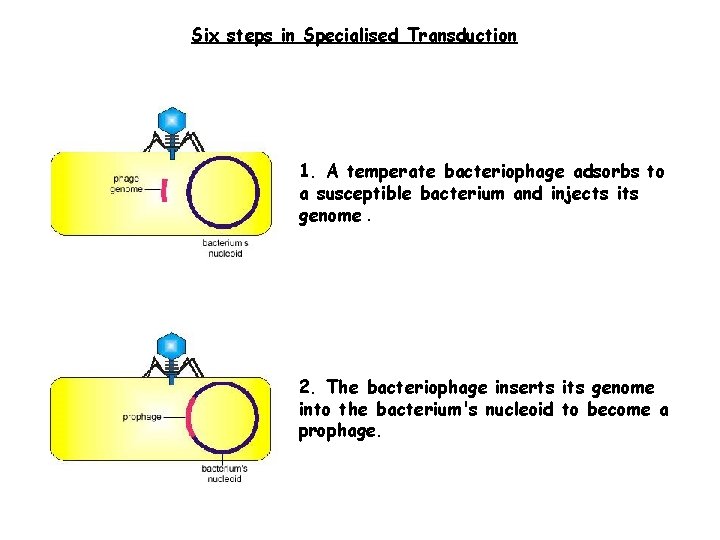
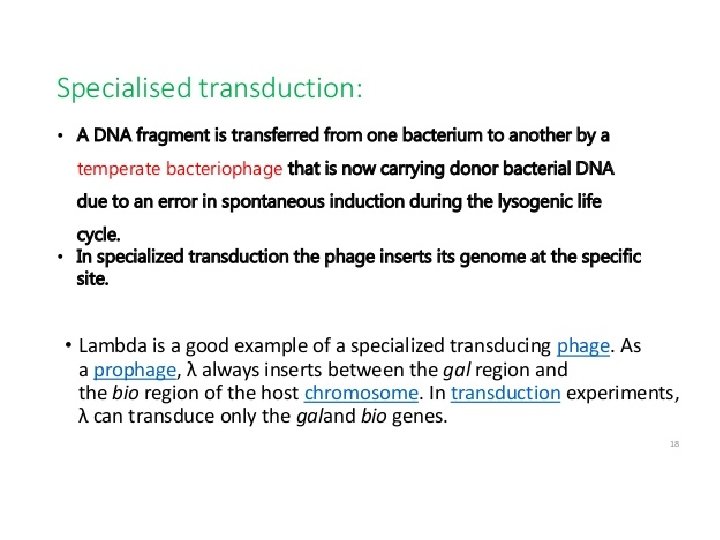
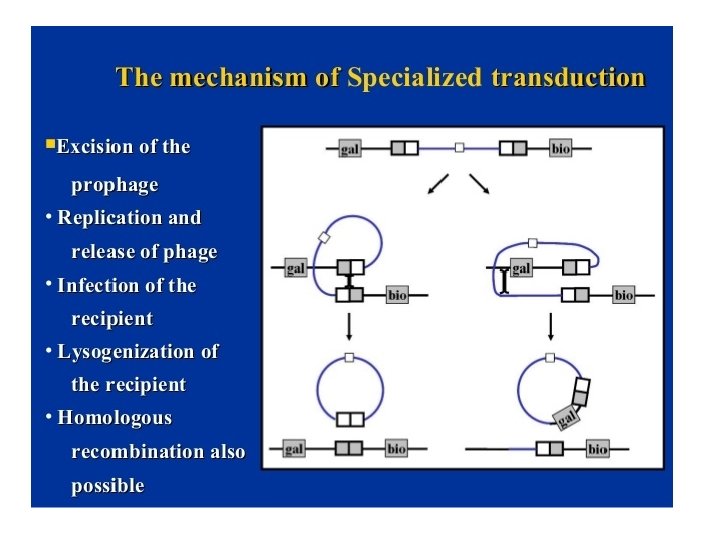
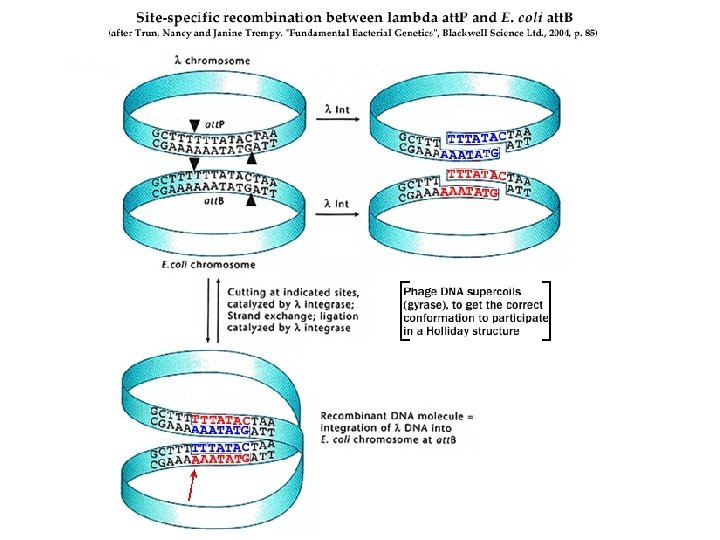
Six steps in Specialised Transduction 1. A temperate bacteriophage adsorbs to a susceptible bacterium and injects its genome. 2. The bacteriophage inserts its genome into the bacterium's nucleoid to become a prophage.
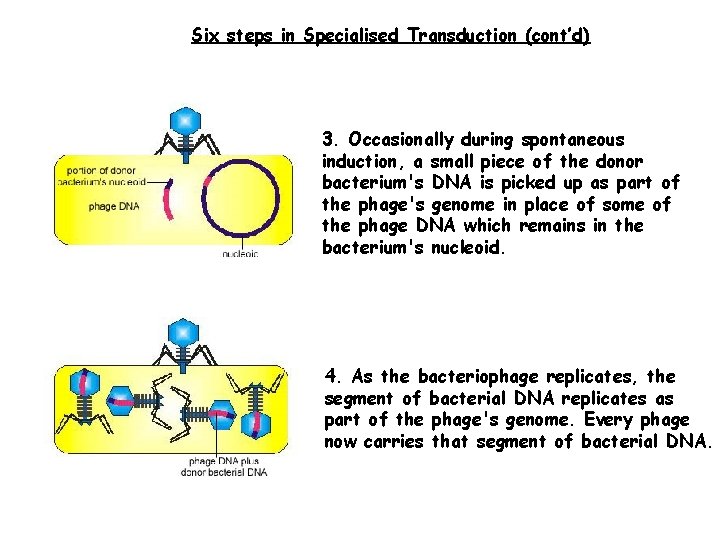
Six steps in Specialised Transduction (cont’d) 3. Occasionally during spontaneous induction, a small piece of the donor bacterium's DNA is picked up as part of the phage's genome in place of some of the phage DNA which remains in the bacterium's nucleoid. 4. As the bacteriophage replicates, the segment of bacterial DNA replicates as part of the phage's genome. Every phage now carries that segment of bacterial DNA.
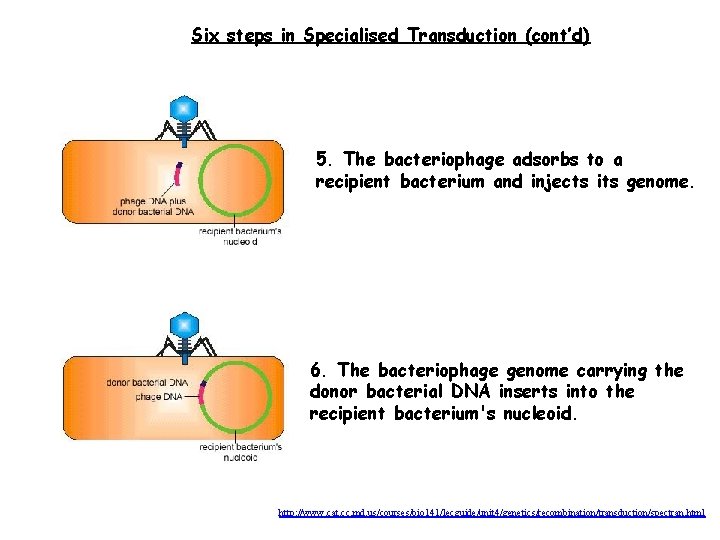
Six steps in Specialised Transduction (cont’d) 5. The bacteriophage adsorbs to a recipient bacterium and injects its genome. 6. The bacteriophage genome carrying the donor bacterial DNA inserts into the recipient bacterium's nucleoid. http: //www. cat. cc. md. us/courses/bio 141/lecguide/unit 4/genetics/recombination/transduction/spectran. html
Bacteriophages have been classified into two types on the basis of their interaction with a bactria cell. 1. Virulent phages. 2. Temperate phages. • Virulent – always multiply & lyse the host cell after infection. • Temperate phage: That have a choice between two life-style after infection. 1. Lytic cycle 2. lysogenic cycle • 1. Lytic cycle = they reproduce & lyse their host cell just like virulent phages. • Lysogenic cycle = their chromosome are integrated in to the chromosome of the host. .
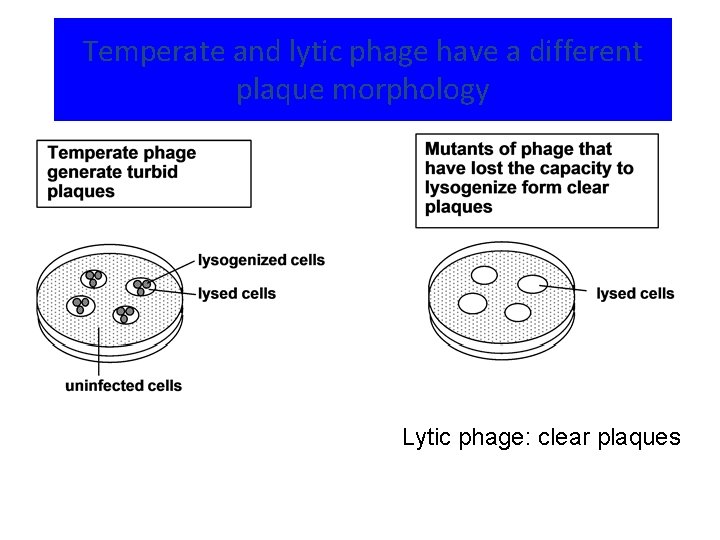
Temperate and lytic phage have a different plaque morphology Lytic phage: clear plaques
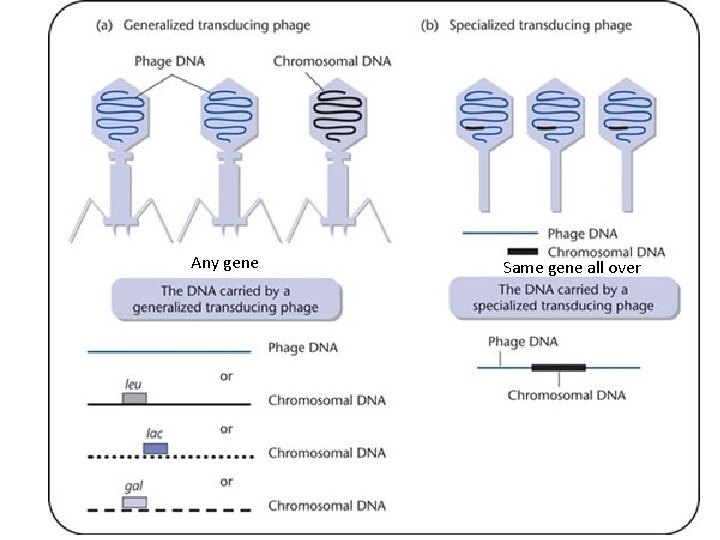
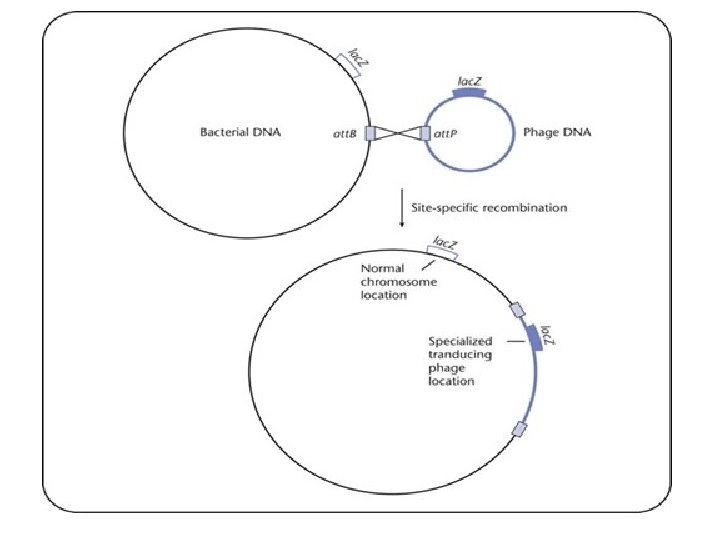
Types of transduction 1. Generalized - Transduction in which potentially any donor bacterial gene can be transferred. 2. 2. Specialized- Transduction in which only certain donor genes can be transferred Generalized transduction • Starts with the LYTIC CYCLE where a T- even phage infects E. coli killing the host cell, and synthesizing >100 copies of itself. • The T-even phage randomly packages bacterial DNA in a few defective phages. • Once a T – even phage infects another E. coli, this genetic information can be recombined into the host cell without causing the lytic cycle. • New genetic information is thereby transduced from one bacteria to another. Specialized Transduction • In specialized transducing particle carries only specific portions of the bacterial genome. • Specialized transduction by a temperate bacteriophages which chromosome are able to integrate at a specific attachment site on host chromosome. • Phages chromosome & bacterial chromosome is a attach specific attachment site by a covalently in prophages. • The gal transducing phage (lambda) makes ~ 2, 000 copies of itself with the gal gene, and infects other E. coli. • When gal integrates into the nucleoid of other E. coli, it may provide these bacteria with a new capacity to metabolize galactose. • The best-studied example of specialized transduction is the lambda phage. The lambda genome inserts into the host chromosome at specific locations known as attachment or att sites. • The phage att sites and bacterial att sites are similar and can complex with each other
Any gene Same gene all over
Bacteriophage lambda (l) Transcriptional switches can regulate cellular decisions
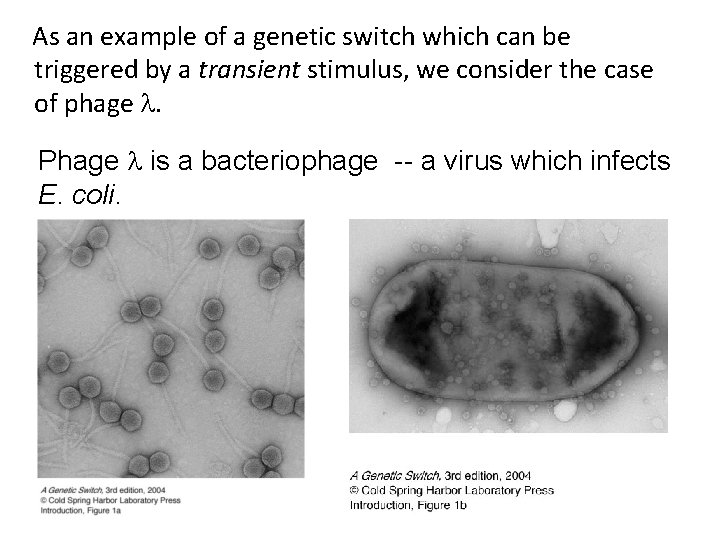
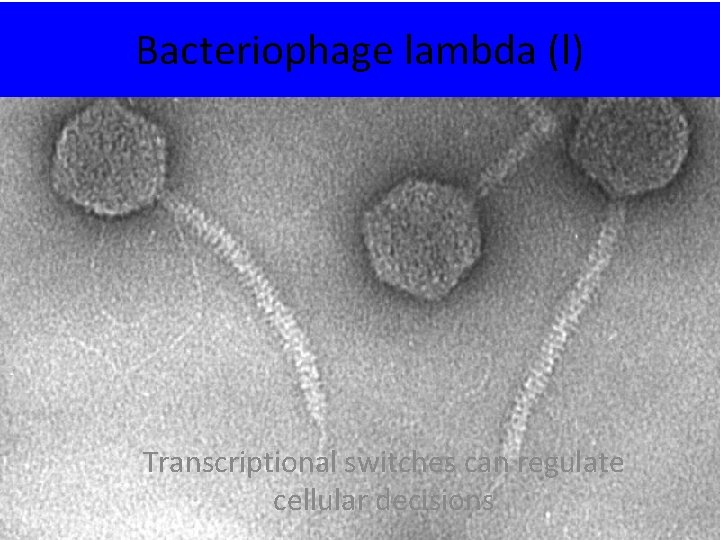
As an example of a genetic switch which can be triggered by a transient stimulus, we consider the case of phage . Phage is a bacteriophage -- a virus which infects E. coli.
Lysis or Lysogeny • Lysis: Infection by phage produces many progeny and breaks open (lyses) the host bacterium • Lysogeny: After infection, the phage DNA integrates into the host genome and resides there passively – No progeny – No lysis of the host – Can subsequently lyse (lysogeny) • Bacteriophage lambda can do either.
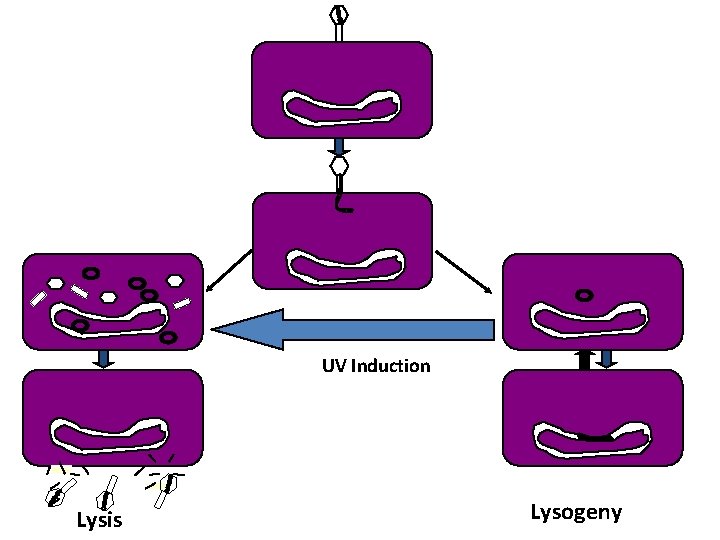
UV Induction Lysis Lysogeny
Elements of lysogeny • The phage genome integrated into the host bacterial genome is a prophage. • Bacterium carrying the prophage is a lysogen. • Lysogens are immune to further infection by similar phage because the phage functions are repressed in trans. • Induction of the lysogen leads to excision of the prophage, replication of the phage DNA, and lysis of the host bacterium.
The phage “chooses” between these two mechanisms based on a “reading” of the host’s behaviour. If the host is growing well the phage lysogenizes the host and subsequently infects all of its progeny. If the host is not growing well (e. g. starving), the phage grows lytically - an 'abandon ship' response. This “decision” is based on a genetic switch. Lambda phage: a complex of operons
- Slides: 91