
Microbial Food Safety Risk Assessment Judy D Greig
Microbial Food Safety Risk Assessment Judy D. Greig Microbial Food Safety Risk Assessment Health Canada, Guelph, Ontario Principles of Food Safety & Quality Assurance University of Guelph May 27 th, 2002
Overview: l Definition of Risk Analysis l Reasons to do a Risk Assessment l Steps in Risk Assessment l Different approaches to Risk Assessment l Choosing the “right” approach l Risk Management l Risk Communication
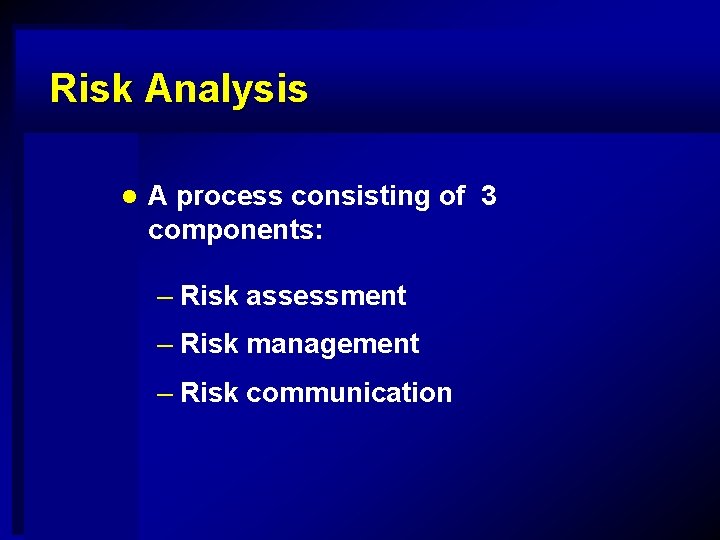
Risk Analysis l A process consisting of 3 components: – Risk assessment – Risk management – Risk communication
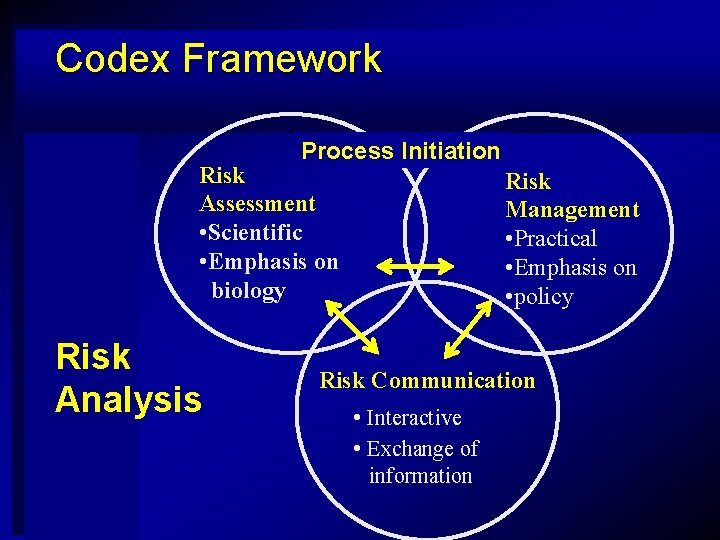
Codex Framework Process Initiation Risk Assessment • Scientific • Emphasis on biology Risk Analysis Risk Management • Practical • Emphasis on • policy Risk Communication • Interactive • Exchange of information
Risk Assessment: A systematic process to collect and evaluate relevant information in order to estimate the probability AND impact of adverse outcomes….
Risk Assessment A scientifically based process consisting of – Hazard Identification – Exposure Assessment – Hazard Characterization – Risk Characterization
Risk Management The process of weighing policy alternatives, in consultation with all interested parties, considering risk assessment & other factors relevant for the health protection of consumers & the promotion of fair trade practices & if needed, selecting appropriate prevention & control options.
Risk Communication The interactive exchange of information & opinions throughout the risk analysis process concerning risk, risk-related factors & risk perceptions, among risk assessors, risk managers, consumers, industry, the academic community & other interested parties, including the explanation of risk assessment findings & the basis of risk management decisions.

Reasons to do Risk Assessment l Provides a systematic process to organize & evaluate information & knowledge l Helps to identify important data gaps l Provides a scientific basis for discussion/debate l A means to communicate about risk a shared understanding of the issue
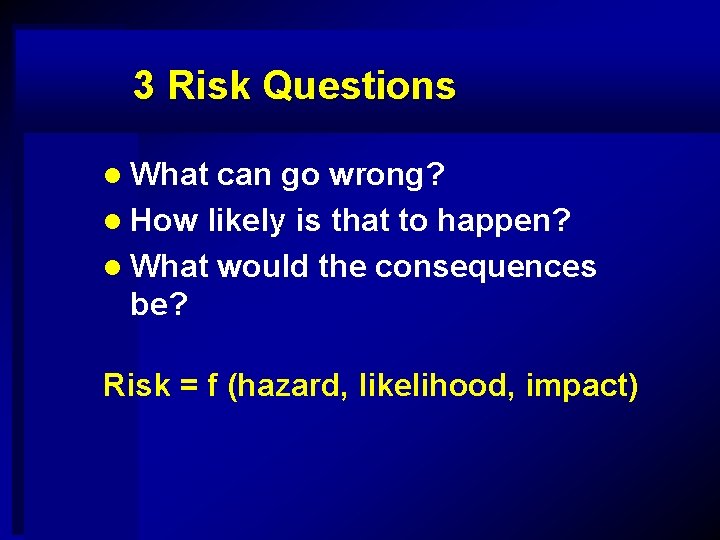
3 Risk Questions l What can go wrong? l How likely: is that to happen? l What would the consequences be? Risk = f (hazard, likelihood, impact)
![Risk Assessment Framework Hazard Identification Hazard Characterisation [Dose-Response] Exposure Analysis Risk Characterisation](http://slidetodoc.com/presentation_image_h2/2f8a2f746a59c634d63ec53909d20753/image-11.jpg "Risk Assessment Framework Hazard Identification Hazard Characterisation [Dose-Response] Exposure Analysis Risk Characterisation")
Risk Assessment Framework Hazard Identification Hazard Characterisation [Dose-Response] Exposure Analysis Risk Characterisation
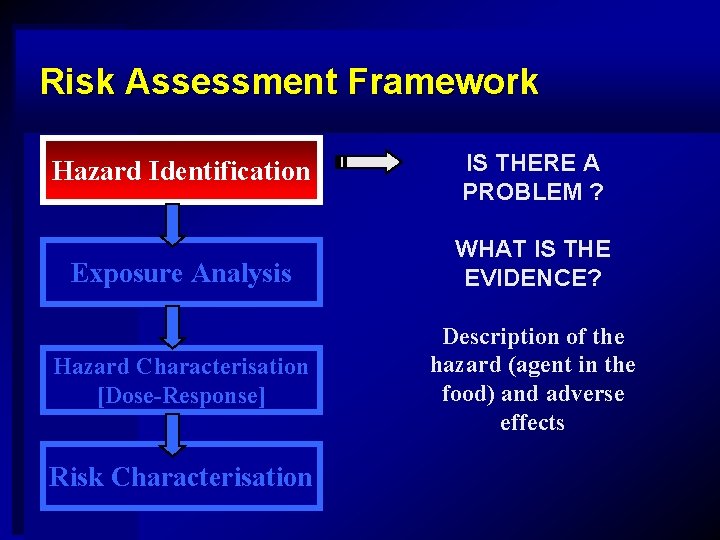
Risk Assessment Framework Hazard Identification IS THERE A PROBLEM ? Exposure Analysis WHAT IS THE EVIDENCE? Hazard Characterisation [Dose-Response] Description of the hazard (agent in the food) and adverse effects Risk Characterisation
![Risk Assessment Framework Hazard Identification Exposure Analysis Hazard Characterisation [Dose-Response] Risk Characterisation What is](http://slidetodoc.com/presentation_image_h2/2f8a2f746a59c634d63ec53909d20753/image-13.jpg "Risk Assessment Framework Hazard Identification Exposure Analysis Hazard Characterisation [Dose-Response] Risk Characterisation What is")
Risk Assessment Framework Hazard Identification Exposure Analysis Hazard Characterisation [Dose-Response] Risk Characterisation What is the probability of consumption of a food contaminated with the pathogen AND what are the likely numbers of a pathogen in the food at the time of consumption?
![Risk Assessment Framework Hazard Identification Exposure Analysis Hazard Characterisation [Dose-Response] Risk Characterisation How much](http://slidetodoc.com/presentation_image_h2/2f8a2f746a59c634d63ec53909d20753/image-14.jpg "Risk Assessment Framework Hazard Identification Exposure Analysis Hazard Characterisation [Dose-Response] Risk Characterisation How much")
Risk Assessment Framework Hazard Identification Exposure Analysis Hazard Characterisation [Dose-Response] Risk Characterisation How much of the pathogen will make you sick, and how sick will you be? The Dose-Response assessment is a mathematical model which predicts the probability of an adverse effect from a given dose.
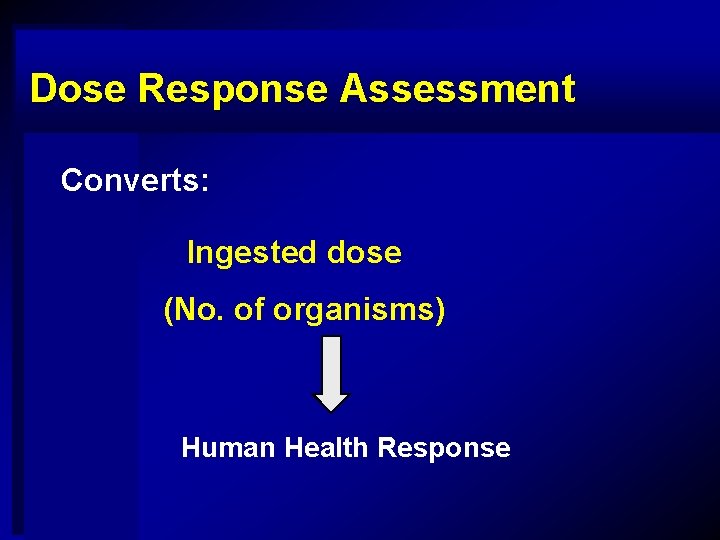
Dose Response Assessment Converts: Ingested dose (No. of organisms) Human Health Response
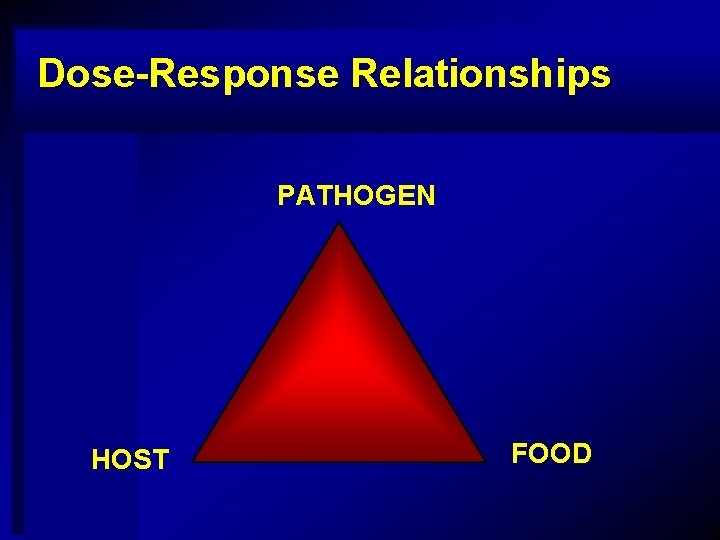
Dose-Response Relationships PATHOGEN HOST FOOD
![Risk Assessment Framework Hazard Identification Exposure Analysis Hazard Characterisation [Dose-Response] Risk Characterisation Integrates exposure](http://slidetodoc.com/presentation_image_h2/2f8a2f746a59c634d63ec53909d20753/image-17.jpg "Risk Assessment Framework Hazard Identification Exposure Analysis Hazard Characterisation [Dose-Response] Risk Characterisation Integrates exposure")
Risk Assessment Framework Hazard Identification Exposure Analysis Hazard Characterisation [Dose-Response] Risk Characterisation Integrates exposure and dose-response information to provide an estimation of adverse effects likely to occur in a given population. - a Risk Estimate
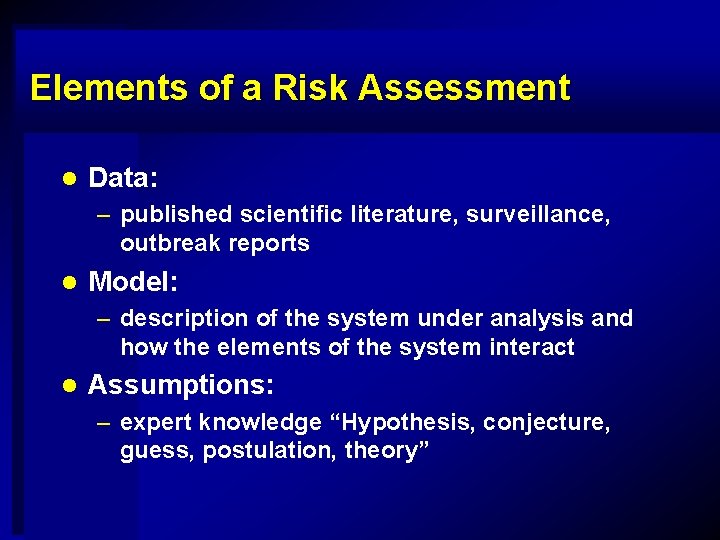
Elements of a Risk Assessment l Data: – published scientific literature, surveillance, outbreak reports l Model: – description of the system under analysis and how the elements of the system interact l Assumptions: – expert knowledge “Hypothesis, conjecture, guess, postulation, theory”
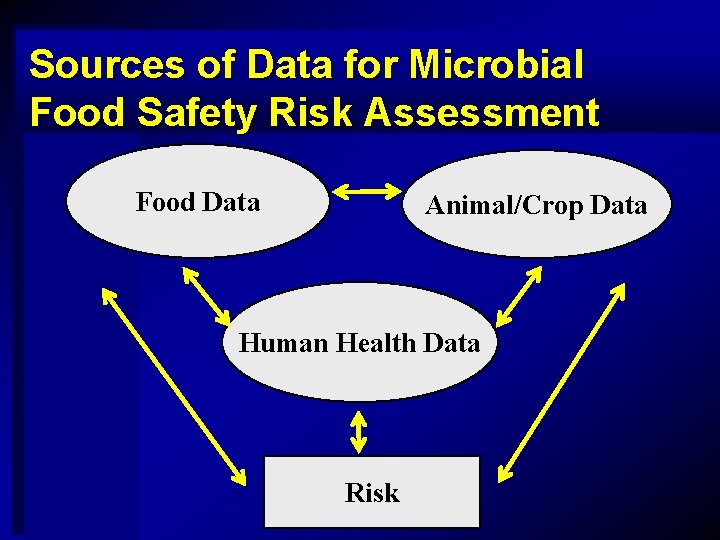
Sources of Data for Microbial Food Safety Risk Assessment Food Data Animal/Crop Data Human Health Data Risk
Risk Distribution: Influenced by: l Variability: – property of nature – diversity – defined by average, standard deviation l Uncertainty is our ignorance
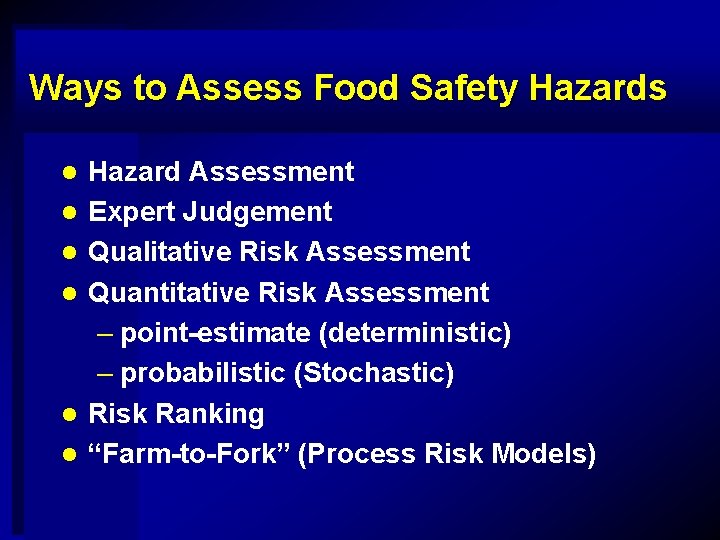
Ways to Assess Food Safety Hazards l l l Hazard Assessment Expert Judgement Qualitative Risk Assessment Quantitative Risk Assessment – point-estimate (deterministic) – probabilistic (Stochastic) Risk Ranking “Farm-to-Fork” (Process Risk Models)
Hazard Assessment: l Descriptive narrative l Typical format for evaluating foodand-waterborne hazards in the past l Can be done quickly if necessary
Hazard Analysis Critical Control Point (HACCP) This is a risk management strategy to ensure hazards are prevented, eliminated or reduced to an acceptable level.
Risk Assessment & HACCP Risk Assessment: – provides a measure of the human health risk associated with specific hazards in a food – measures the outcome of HACCP in terms of human health risk to allow comparison with other HACCP plans for the same product – validates Critical Control Points
Expert Judgement The opinions of knowledgeable individuals about the risk issue – can be useful, informative & insightful OR – can be subjective, biased
Qualitative Risk Assessment Descriptive, categories of information: – probability or likelihood: remote, rare, occasional, frequent – consequences: negligible, low, medium, high, catastrophic
Qualitative Risk Assessment – should describe the uncertainty: low, medium, high – should clearly present the reasons for assumptions, rankings l Currently, no useful formats have been fully developed or standardized l Area for further development
Quantitative Risk Assessment l Numerical representations of exposure and dose-response l. A numerical estimation of risk l Relationships between the components are described mathematically
Quantitative Risk Assessment Point-estimates (deterministic) – usingle numbers, e. g. the average of a set of data, to calculate risk – simple or complex models – can be done quickly – can be used effectively in screening risks or to indicate that a potential risk is not significant
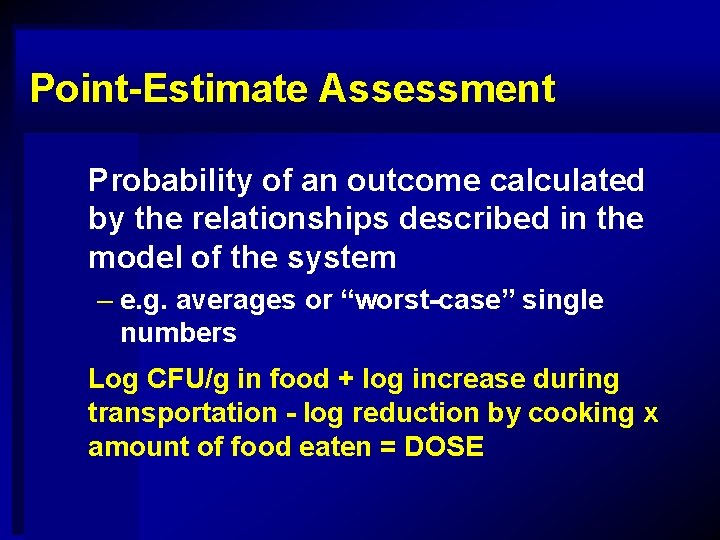
Point-Estimate Assessment Probability of an outcome calculated by the relationships described in the model of the system – e. g. averages or “worst-case” single numbers Log CFU/g in food + log increase during transportation - log reduction by cooking x amount of food eaten = DOSE
Point Estimate l Using the mean value: – quite likely to occur – doses higher than this frequently occur l Using the conservative estimates – not very likely to occur – doses higher than this will very rarely occur
Quantitative Risk Assessment Probabilistic assessment (stochastic) – range of possible values – probability of each value within the range is represented by a probability distribution – useful for complex models – includes the variability of the data, and allows quantitative analysis of uncertainty
Probabilistic Risk Assessment Monte Carlo Method (simulation): – uses probability distributions for inputs – can be solved analytically, but only for very simple models – computer software available
Quantitative Risk Assessment Software Monte Carlo simulation software – Spreadsheet (Excel) - based • @Risk - www. palisade. com • Crystal Ball - www. decisioneering. com – Stand-alone • Analytica - www. lumina. com – Provides a visual modelling environment, friendly “interface” – More easily reviewed/shared by others
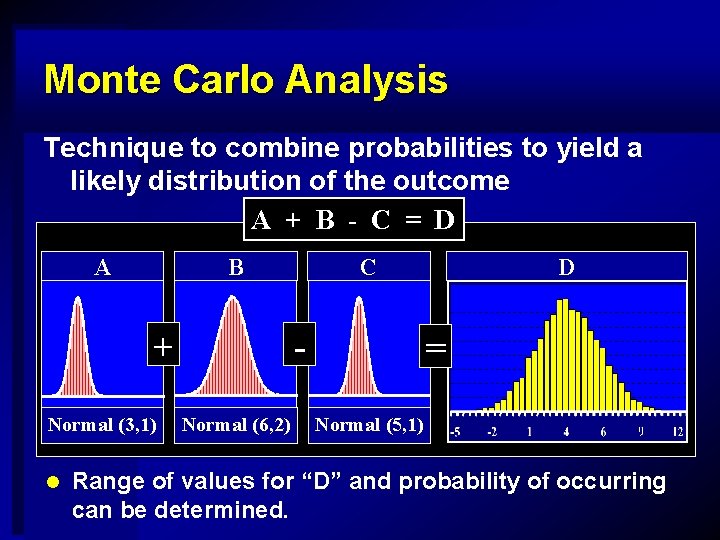
Monte Carlo Analysis Technique to combine probabilities to yield a likely distribution of the outcome A + B - C = D A B + Normal (3, 1) l C Normal (6, 2) D = Normal (5, 1) Range of values for “D” and probability of occurring can be determined.
Probabilistic Analysis l Evaluates almost all the possibilities l Recognizes the variation that exists in the real world l Allows the uncertainty associated with our knowledge of the real world to be accounted for
Probabilistic Assessment: Importance Analysis l. A technique that measures the correlation of outputs & inputs l Identifies factors that are strongly associated with increased or decreased risk l Interpretation requires understanding the system, the data sources, & the data itself
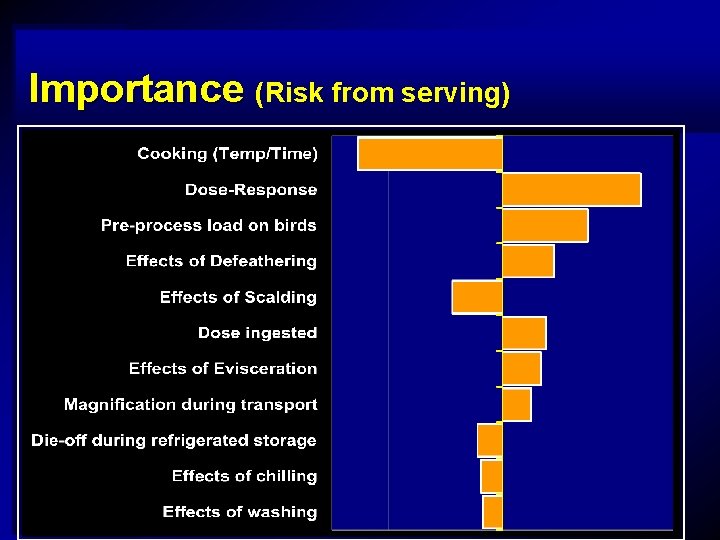
Importance (Risk from serving)
Risk Ranking Assessment l Ideally quantitative l Purpose: – provide Risk Estimates to compare relative risk – identify foods that pose increased risk – identify priorities: • for risk management • further assessment and/or target research
Farm-to-Fork Assessments Process Risk Models l Quantitative, ideally probabilistic l Scientific analysis of entire system l Purpose: – provide a Risk Estimate – identify where controls may be implemented most effectively l Allows testing hypothetical scenarios by changing model inputs
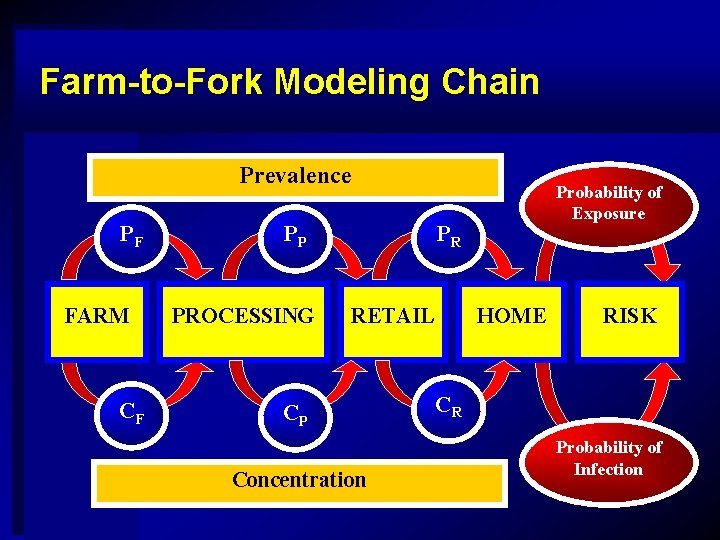
Farm-to-Fork Modeling Chain Prevalence PF FARM CF PR PP PROCESSING Probability of Exposure RETAIL CP Concentration HOME RISK CR Probability of Infection
Advantages of “Farm-to-Fork” Risk Assessment l Provides information to understand how microbial contamination & foodborne disease are influenced by factors at each step of the food chain l Allows the study of the broadest range of management strategies l Helps to identify information & research needs
What is the right approach? l The “right” approach captures the essentials of the risk issue to answer the risk management question. l Too much detail complicates, too little detail misses the essentials. “Things should be made as simple as possible, but no simpler” (Einstein)
What is the right approach? Scope & level of detail: – dependent on the risk management question – may be “Farm-to-Fork” – final product before consumption – individual food processing/food handling steps – general population – susceptible population only
What is the right approach? Don’t need detailed analysis if: – a screening-level calculation indicates that the risk is very low – a crisis situation – the cost of reducing exposure costs less than doing a detailed risk assessment – there is little debate about the issue, or the risk management options
What is the right approach? Don’t need detailed analysis if: – know nothing – when there is little variability and/or uncertainty
What is the right approach? Should use detailed analysis if: – screening-level assessment indicates the problem may be significant – consequences of making the wrong risk management decision are high
What is the right approach? Should use detailed analyses if: – highly variable information – conflicting opinions about nature of risk – possible to reduce risk at more than one step of the food chain – need to identify key research areas for long-term risk management goals
Risk Assessment Provides: la risk estimate l a systematic process to organize & evaluate information & knowledge l a scientific basis for discussion l an objective basis for management decisions It is essential for trade.
International Trade GATT/WTO’s “Agreement on Sanitary and Phytosanitary Measures” (SPS): – Barriers to trade must be based on scientific evaluation of risk to human health. – A rigorous scientific process is required for the establishment of rational harmonized regulations & standards for food in international trade.
International Trade “Members shall ensure that their SPS measures are based on an assessment, as appropriate to the circumstances, of the risks to human, animal or plant life, taking into account risk assessment techniques developed by the relevant international organizations”.
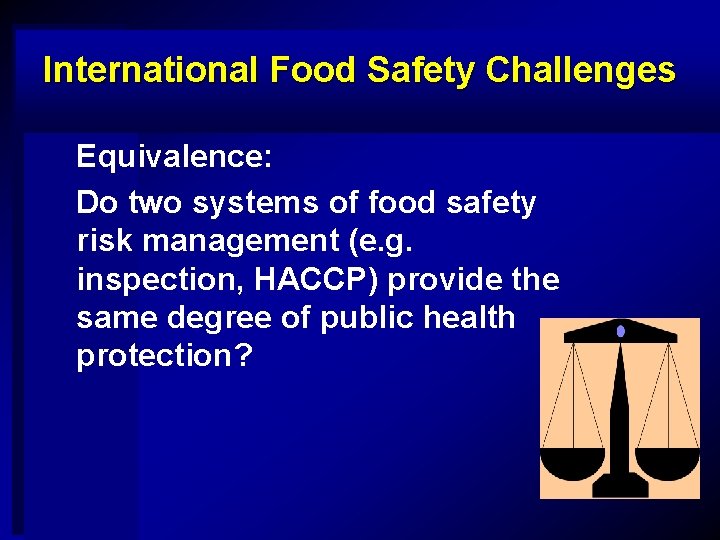
International Food Safety Challenges Equivalence: Do two systems of food safety risk management (e. g. inspection, HACCP) provide the same degree of public health protection?
Codex Alimentarius Commission Provides standards, guidelines & recommendations for global protection of consumers’ health, economic interests, and to ensure fair practices in the trade of safe food.
Joint FAO/WHO Expert Consultations l l l Application of Risk Analysis to Food Standards Issues, 1995 Risk Management and Food Safety, 1997 Risk Communication and Food Safety, 1998 Microbiological Risk Assessment, 1999 Expert Consultation on Risk Assessment of Microbiological Hazards, 2000 http: //www. fao. org/WAICENT/FAOINFO/ECONOMICS/ESN/control. htm
Goal of Food Risk Management The primary goal of the management of risks associated with food is to protect public health by controlling such risks as effectively as possible through the selection and implementation of appropriate measures 1995 FAO/WHO Consultation
Risk Management l Not necessarily to eliminate risk l Balance level of risk vs. – cost of risk reduction – competing risks – benefits/risks of interventions l Differentiate trivial, “tolerable” risk vs. significant, “non-tolerable” risk
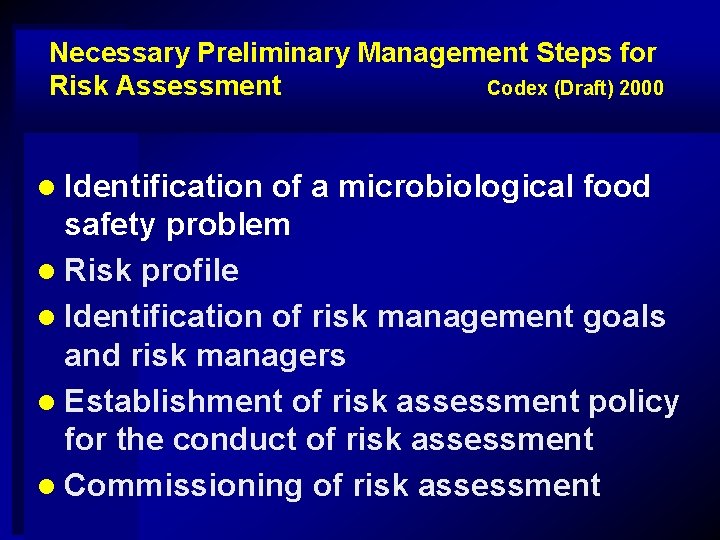
Necessary Preliminary Management Steps for Risk Assessment Codex (Draft) 2000 l Identification of a microbiological food safety problem l Risk profile l Identification of risk management goals and risk managers l Establishment of risk assessment policy for the conduct of risk assessment l Commissioning of risk assessment
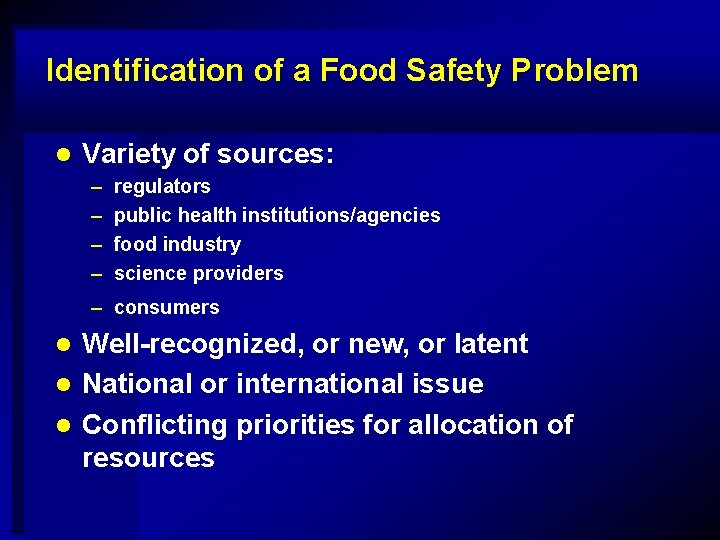
Identification of a Food Safety Problem l Variety of sources: – – regulators public health institutions/agencies food industry science providers – consumers Well-recognized, or new, or latent l National or international issue l Conflicting priorities for allocation of resources l
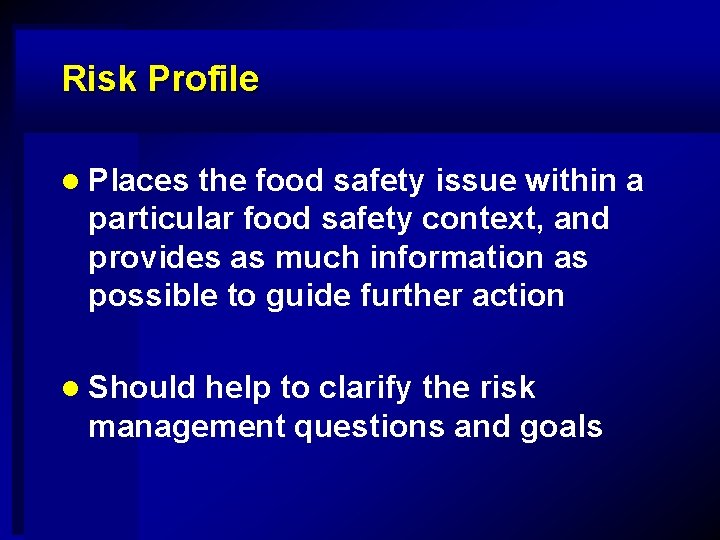
Risk Profile l Places the food safety issue within a particular food safety context, and provides as much information as possible to guide further action l Should help to clarify the risk management questions and goals
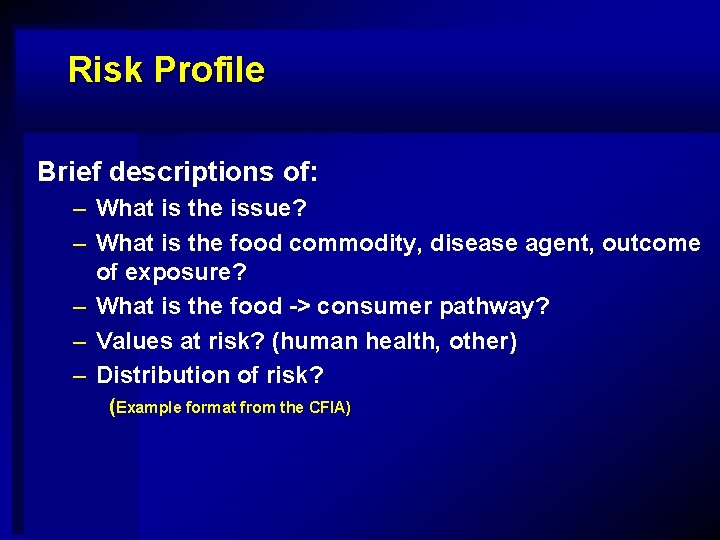
Risk Profile Brief descriptions of: – What is the issue? – What is the food commodity, disease agent, outcome of exposure? – What is the food -> consumer pathway? – Values at risk? (human health, other) – Distribution of risk? (Example format from the CFIA)
Risk Profile Brief descriptions of: – Characteristics of the food and/or the organism that may affect management options? – What are the known risk management characteristics of the risk producer? – Public perceptions? – Familiarity with problem? – International (trade) aspects? (Example format from the CFIA)
Establish Risk Management Goals Ranking of the food safety issue – Risk assessment and risk management activities require - time, money, personnel – Risk manager must decide on criteria to judge what is important – Usually requires some (qualitative) estimation of the magnitude
Establish Risk Management Goals l Priorities – Protect and improve public health – Prudent distribution of resources – Fair trade practices Specific national goals l What does the risk manager want to know, and what action is being considered, about the specific risk issue? l
Establish Risk Assessment Policy To minimize biases in selection of data, information or models by risk assessors – What are the essential elements to be answered by the assessment? – Guidelines for dealing with uncertainty, value judgements or policy choices – Ensure adequate resources – Iterative: Two-way communication between assessors and managers
Commissioning the Risk Assessment l Ideally, a core multi-disciplinary team, with input from research scientists, industry experts, others l Review goals: can the risk management question be answered by the risk assessors, with the given resources, data, and/or timeframe? l During the conduct of the assessment, managers and assessors need to frequently discuss progress, direction, problems that may arise
Consideration of risk assessment results: l l · l l Narratives should accompany risk characterizations and be fully communicated to users. Managers should be fully informed of the strengths & limitations of the risk assessment. All assumptions should be fully acknowledged & their impact thoroughly considered or recognized. All risk characterizations should explicitly address sources of variability & uncertainty. Estimates should be a range of risk estimates rather a single risk estimate.
Consideration of Risk Assessment Results l Risk characterization should address both the present situation and the range of reasonable options or possible alternatives. l Risk characterization should include discussion on how the specific microbiological risk under consideration compares with other health risks.
Next steps in Risk Management l l l Identification of available management options Selection of preferred management options Final management decision Implementation of decision Monitoring and review Consider updating the risk assessment
What is Risk Communication? l The interactive exchange of information & opinions concerning risk l Should be done with the objective of managing or controlling risks l Media relations are only one part of risk communication
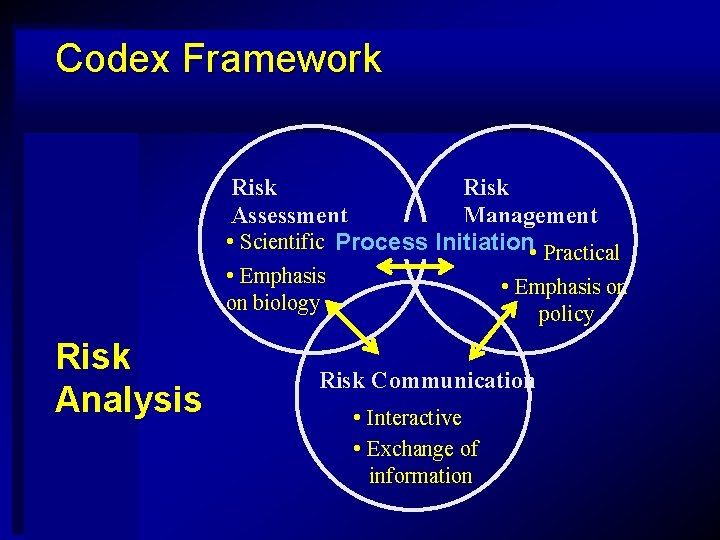
Codex Framework Risk Assessment Management • Scientific Process Initiation • Practical • Emphasis on on biology Risk Analysis policy Risk Communication • Interactive • Exchange of information
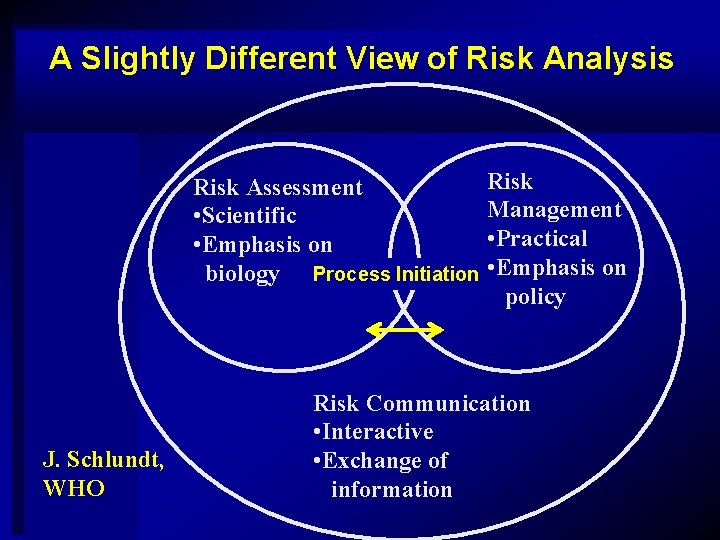
A Slightly Different View of Risk Analysis Risk Assessment • Scientific • Emphasis on biology Process Initiation J. Schlundt, WHO Risk Management • Practical • Emphasis on policy Risk Communication • Interactive • Exchange of information
Who is Involved in Risk Analysis? l Decision-makers – Risk managers, communicators, policymakers l Risk assessor or risk assessment team l Interdisciplinary external experts l Stakeholders – Public, industry, NGO’s, trading partners, other authorities
Effective Risk Communication l Is on-going throughout the risk management process l Is proactive l Includes all legitimate stakeholders l Accounts for different priorities and perspectives of stakeholders l Requires the commitment and support of all stakeholders
Effective Risk Communication l Enlarges the information base l Promotes greater stakeholder understanding of risk issues l Builds effective stakeholder networks l Provides managers with a broader perspective & the potential for better long-term control of risk
Risk Communication Will Not: l Resolve all differences among stakeholders l Make up for poor risk management programs l Eliminate criticism of risk management programs
Communications & Interactions Between Risk Assessors and Risk Managers Risk managers & risk assessors must frequently & effectively interact – to understand the risk issue from both sides – to understand limitations of risk assessment – to communicate clearly the risk assessment results
Risk Perception Refers to the way that people intuitively understand or process information about risk
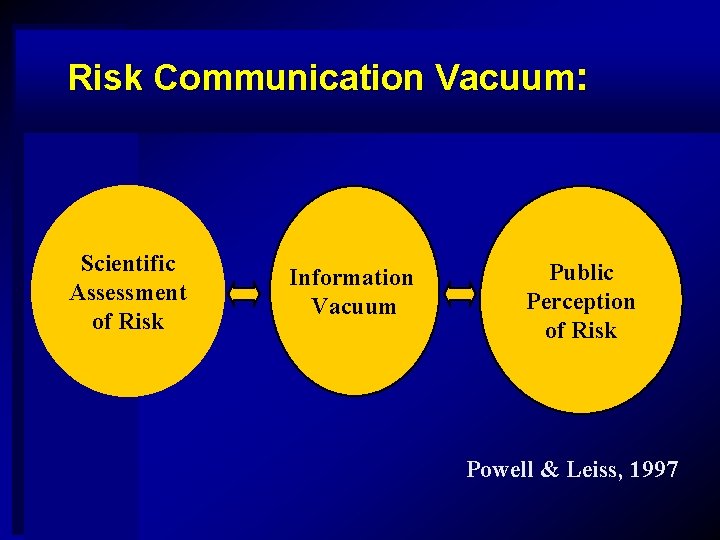
Risk Communication Vacuum: Scientific Assessment of Risk Information Vacuum Public Perception of Risk Powell & Leiss, 1997
Risk Communication Wisdom Prof. Doug Powell, University of Guelph l Risk Communication is serious business l Risk messages should address directly the “contest of opinion” in society l Both regulators and industry are responsible for effective risk communication
Risk Communication Wisdom Prof. Doug Powell, University of Guelph l l l Always more to a risk issue than what science says Always put science in a policy context “Educating” the public about science is no substitute for good risk communication practices Banish “no-risk” messages Communicating well has benefits for good risk management
Risk Communication Risk communication messages may contain the following information: – the nature of the risk – the nature of the benefits – uncertainties in risk assessment – risk management options
Words of Wisdom for Risk Assessment (NRC, 1996) l Choose the right science l Get the science right l Choose the right participation l Get the participation right l Develop an accurate, balanced and informative synthesis
- Slides: 83