
Microbial Ecology and Practice DQ Zheng Knowledge points

Microbial Ecology and Practice DQ Zheng
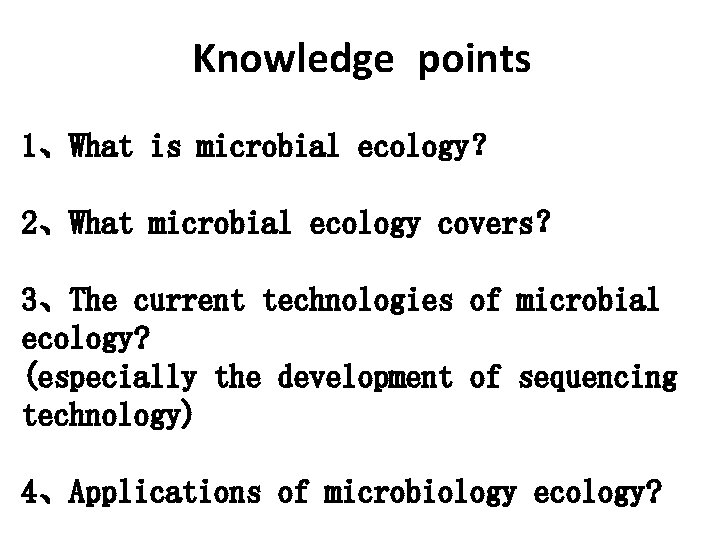
Knowledge points 1、What is microbial ecology? 2、What microbial ecology covers? 3、The current technologies of microbial ecology? (especially the development of sequencing technology) 4、Applications of microbiology ecology?
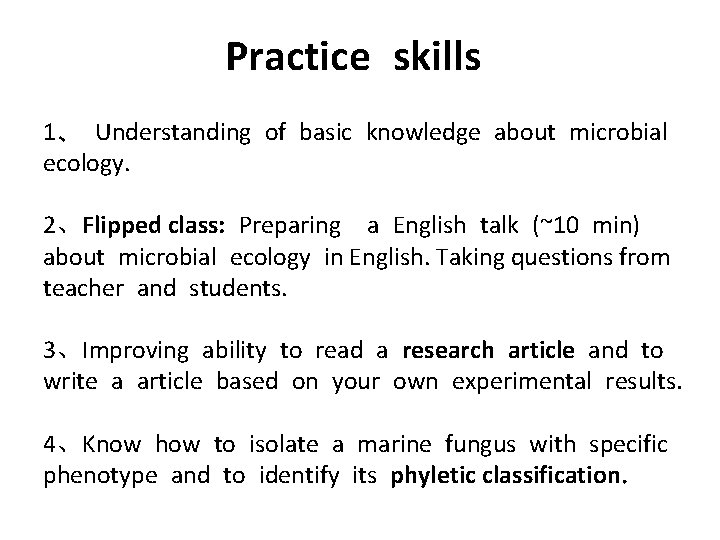
Practice skills 1、 Understanding of basic knowledge about microbial ecology. 2、Flipped class: Preparing a English talk (~10 min) about microbial ecology in English. Taking questions from teacher and students. 3、Improving ability to read a research article and to write a article based on your own experimental results. 4、Know how to isolate a marine fungus with specific phenotype and to identify its phyletic classification.
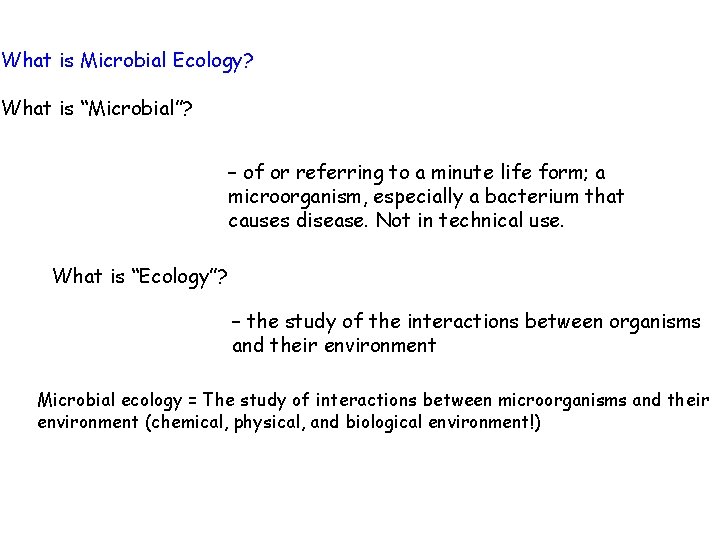
What is Microbial Ecology? What is “Microbial”? – of or referring to a minute life form; a microorganism, especially a bacterium that causes disease. Not in technical use. What is “Ecology”? – the study of the interactions between organisms and their environment Microbial ecology = The study of interactions between microorganisms and their environment (chemical, physical, and biological environment!)


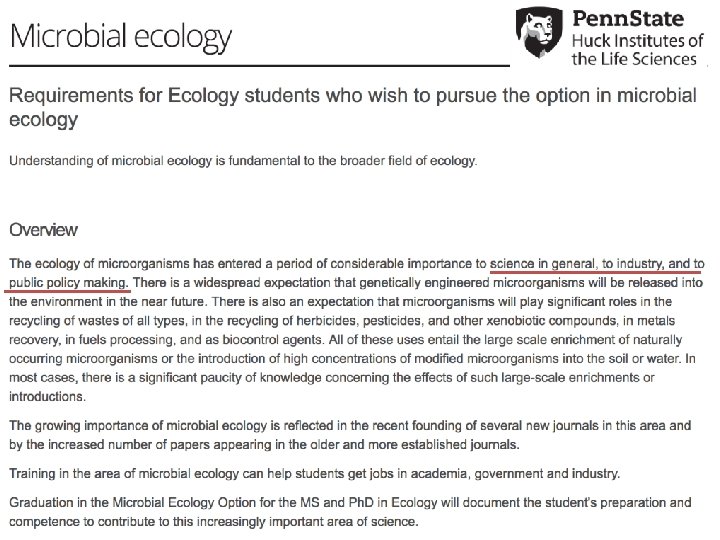
Contents and interests in microbial ecolog
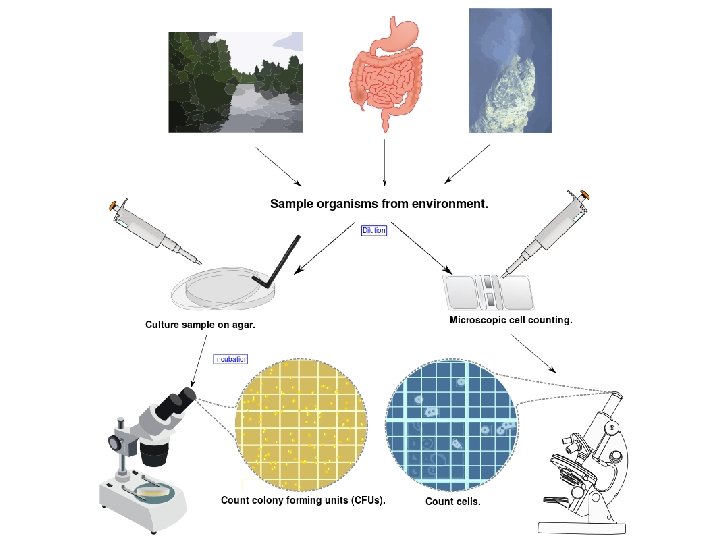
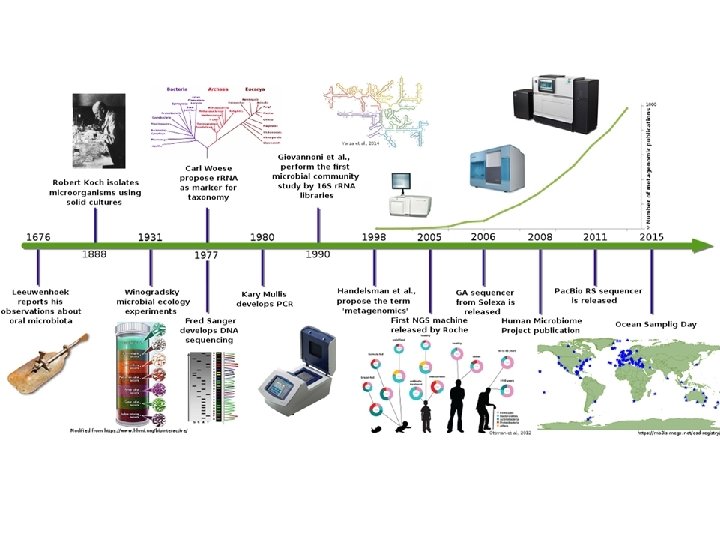
The term “microbial ecology” really wasn’t in common use until the late 1960 s • Why? Microbial ecology has its roots in microbiology, rather than ecology The history of the field is largely a transition from laboratory pure cultures to studying organisms in nature…
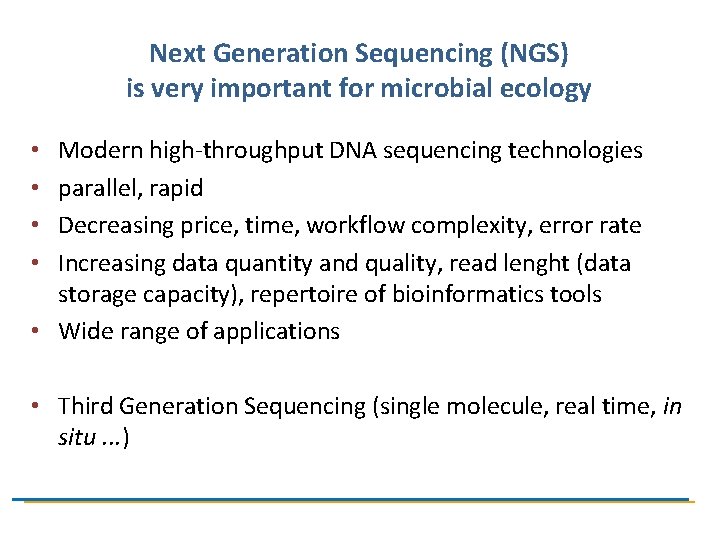
Next Generation Sequencing (NGS) is very important for microbial ecology Modern high-throughput DNA sequencing technologies parallel, rapid Decreasing price, time, workflow complexity, error rate Increasing data quantity and quality, read lenght (data storage capacity), repertoire of bioinformatics tools • Wide range of applications • • • Third Generation Sequencing (single molecule, real time, in situ. . . )
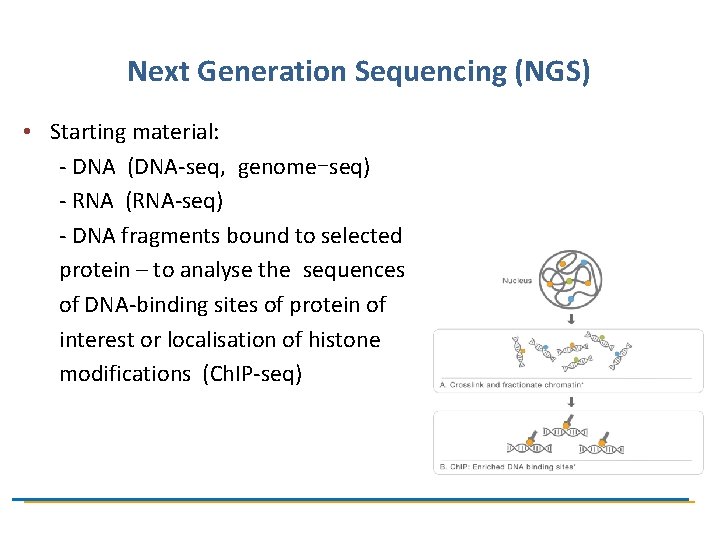
Next Generation Sequencing (NGS) • Starting material: - DNA (DNA-seq, genome-seq) - RNA (RNA-seq) - DNA fragments bound to selected protein – to analyse the sequences of DNA-binding sites of protein of interest or localisation of histone modifications (Ch. IP-seq)

DNA sequencing • De novo genome sequencing ( resequencing) and assembly viral prokaryotic l chromosome eukaryotic + regular updates 2000 – draft human genome sequence 2003 – completed (kind of) Ensembl genomes: - 69 higher animals + other model animals - 55 insects and lower metazoans - 39 plants - 563 fungi - Over 200 protist species and subspecies - Over 20 000 bacteria species and subspecies
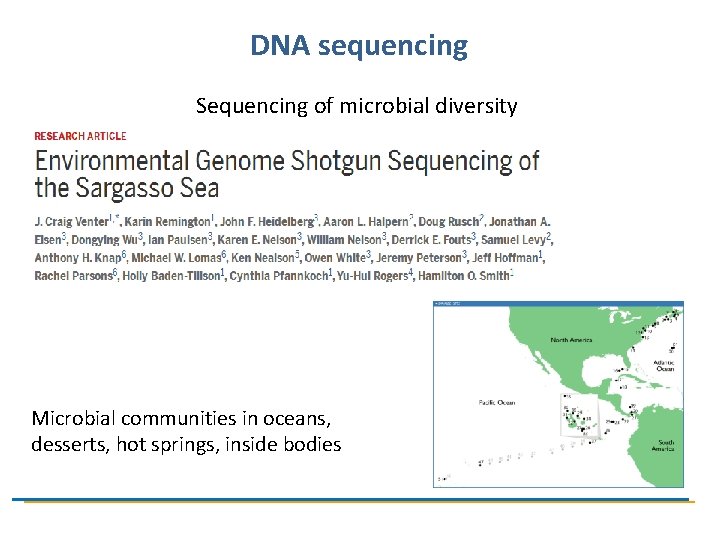
DNA sequencing Sequencing of microbial diversity Microbial communities in oceans, desserts, hot springs, inside bodies
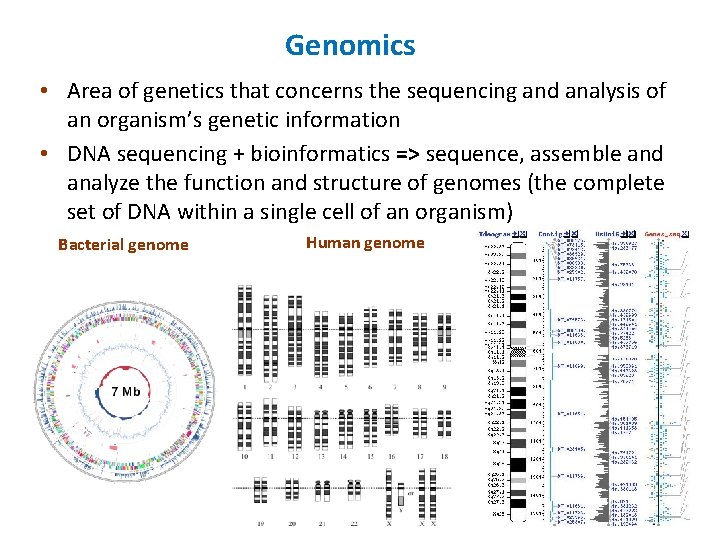
Genomics • Area of genetics that concerns the sequencing and analysis of an organism’s genetic information • DNA sequencing + bioinformatics => sequence, assemble and analyze the function and structure of genomes (the complete set of DNA within a single cell of an organism) Bacterial genome Human genome
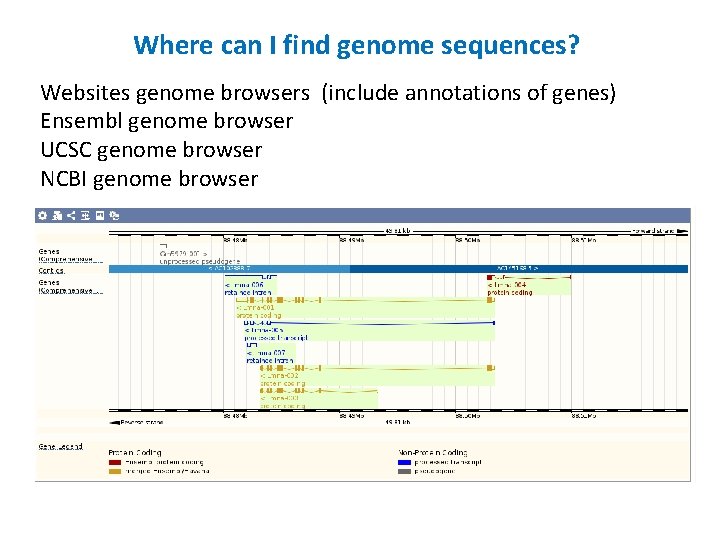
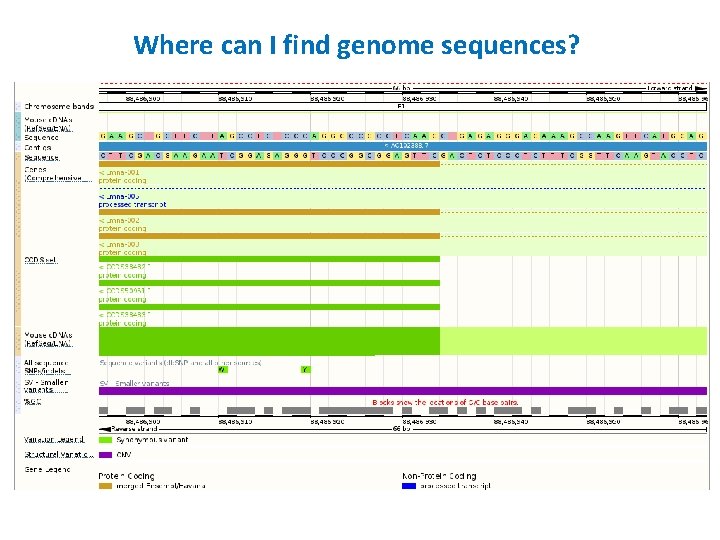
Where can I find genome sequences? Websites genome browsers (include annotations of genes) Ensembl genome browser UCSC genome browser NCBI genome browser
Where can I find genome sequences?
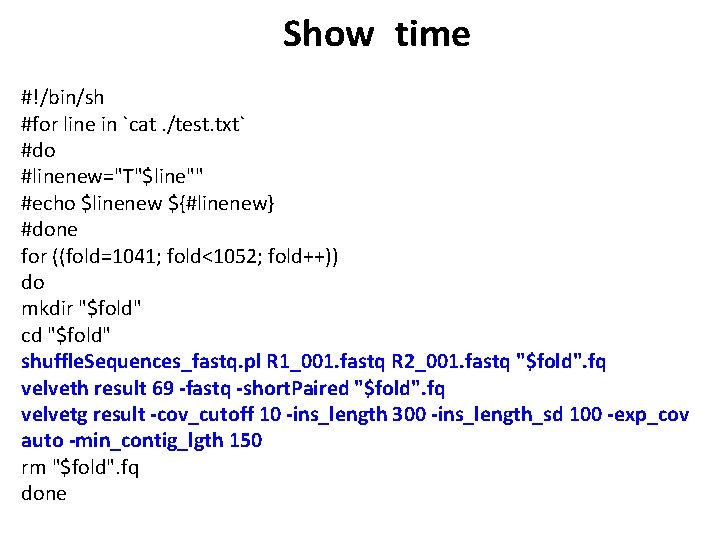
Show time #!/bin/sh #for line in `cat. /test. txt` #do #linenew="T"$line"" #echo $linenew ${#linenew} #done for ((fold=1041; fold<1052; fold++)) do mkdir "$fold" cd "$fold" shuffle. Sequences_fastq. pl R 1_001. fastq R 2_001. fastq "$fold". fq velveth result 69 -fastq -short. Paired "$fold". fq velvetg result -cov_cutoff 10 -ins_length 300 -ins_length_sd 100 -exp_cov auto -min_contig_lgth 150 rm "$fold". fq done
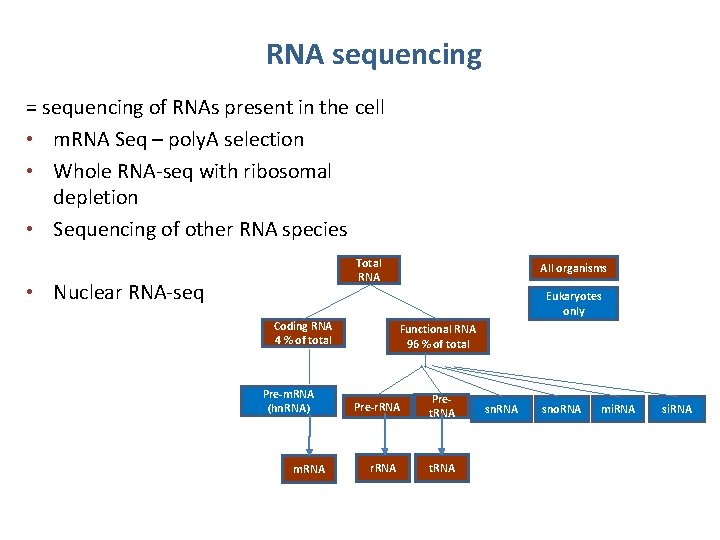
RNA sequencing = sequencing of RNAs present in the cell • m. RNA Seq – poly. A selection • Whole RNA-seq with ribosomal depletion • Sequencing of other RNA species Total RNA • Nuclear RNA-seq All organisms Eukaryotes only Coding RNA 4 % of total Pre-m. RNA (hn. RNA) m. RNA Functional RNA 96 % of total Pre-r. RNA Pret. RNA sno. RNA mi. RNA si. RNA
Transcriptomics • Study of the transcriptome - the complete set of RNA transcripts produced from the genome, under specific circumstances at particular place and time • Methods: Microarrays, RNA seq • Comparison of gene expression under different conditions (before/after treatment, during development, fresh water vs sea water, …. ) • Transcriptome assembly – discoveries of novel genes, non-coding RNAs, nove splicing variants of known genes • an alternative to genome sequencing and assembly of a species with unknown genome, when we are interested only in expressed genes
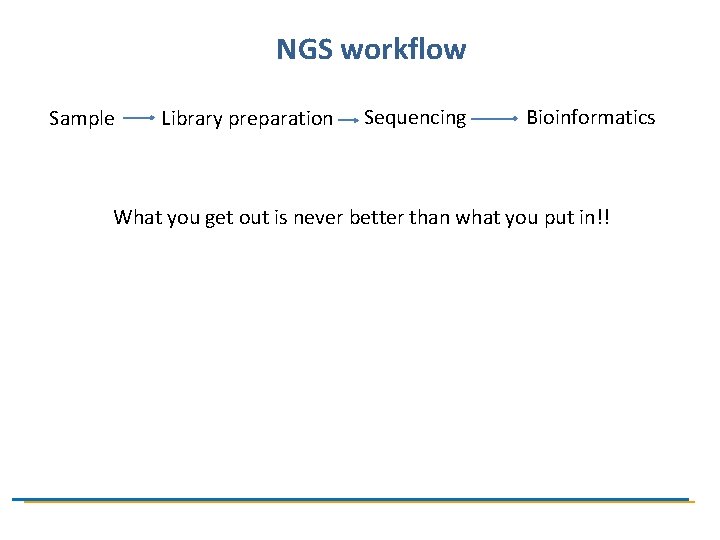
NGS workflow Sample Library preparation Sequencing Bioinformatics What you get out is never better than what you put in!!
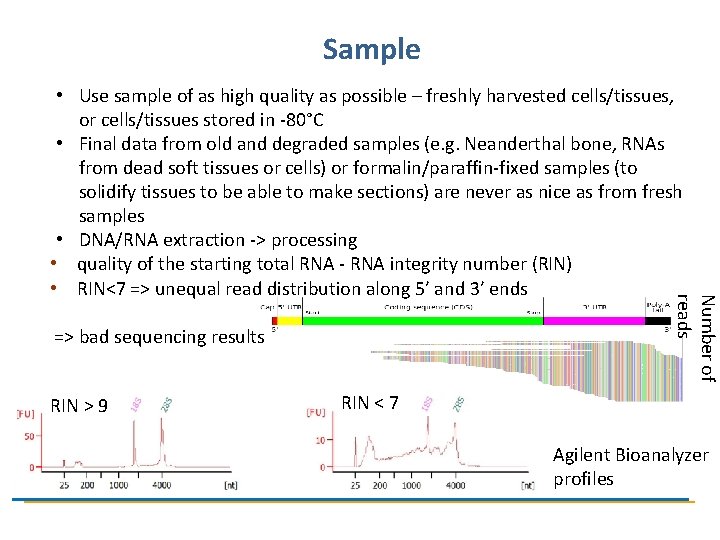
Sample Number of reads • Use sample of as high quality as possible – freshly harvested cells/tissues, or cells/tissues stored in -80°C • Final data from old and degraded samples (e. g. Neanderthal bone, RNAs from dead soft tissues or cells) or formalin/paraffin-fixed samples (to solidify tissues to be able to make sections) are never as nice as from fresh samples • DNA/RNA extraction -> processing • quality of the starting total RNA - RNA integrity number (RIN) • RIN<7 => unequal read distribution along 5’ and 3’ ends => bad sequencing results RIN > 9 RIN < 7 Agilent Bioanalyzer profiles
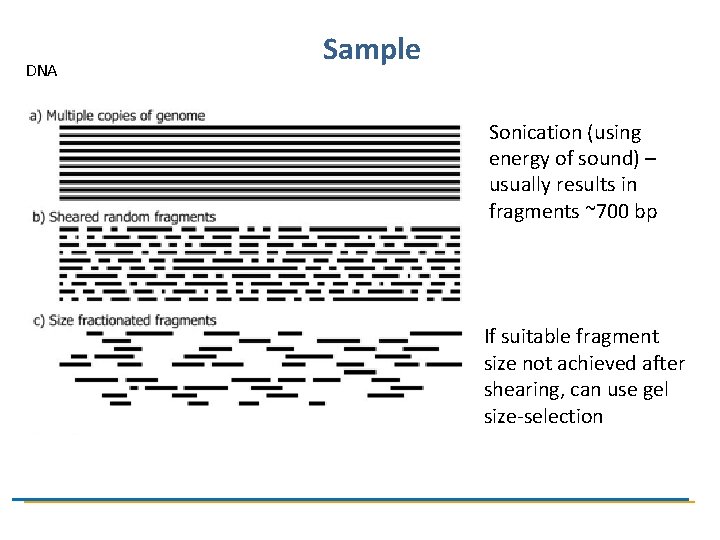
DNA Sample Sonication (using energy of sound) – usually results in fragments ~700 bp If suitable fragment size not achieved after shearing, can use gel size-selection
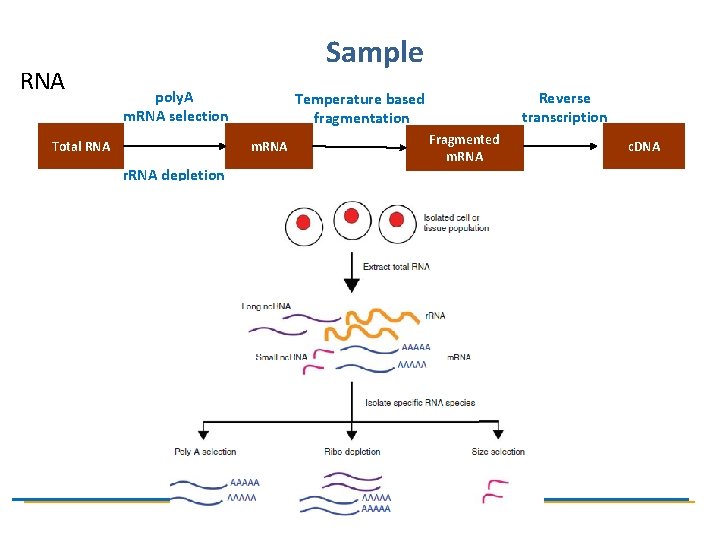
RNA Sample poly. A m. RNA selection Total RNA m. RNA r. RNA depletion Reverse transcription Temperature based fragmentation Fragmented m. RNA c. DNA
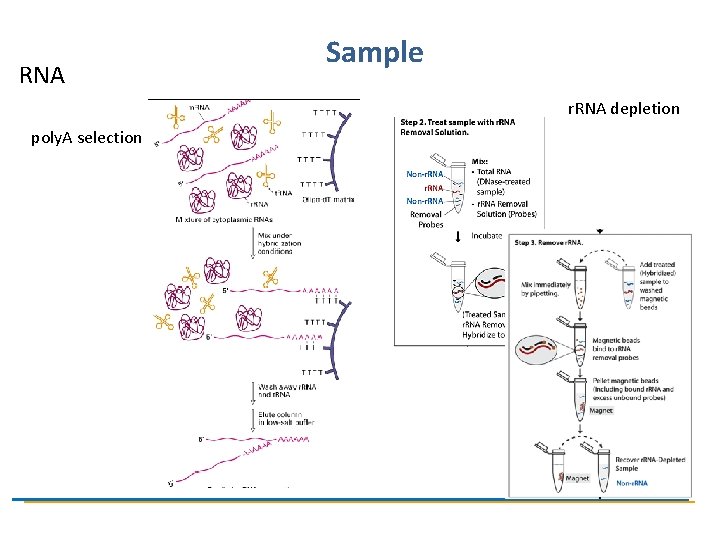
RNA Sample r. RNA depletion poly. A selection
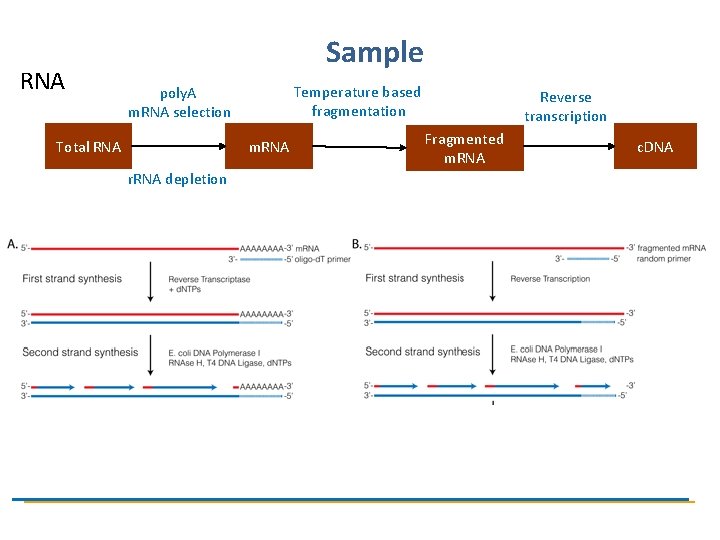
RNA Sample Temperature based fragmentation poly. A m. RNA selection Total RNA m. RNA r. RNA depletion Reverse transcription Fragmented m. RNA c. DNA
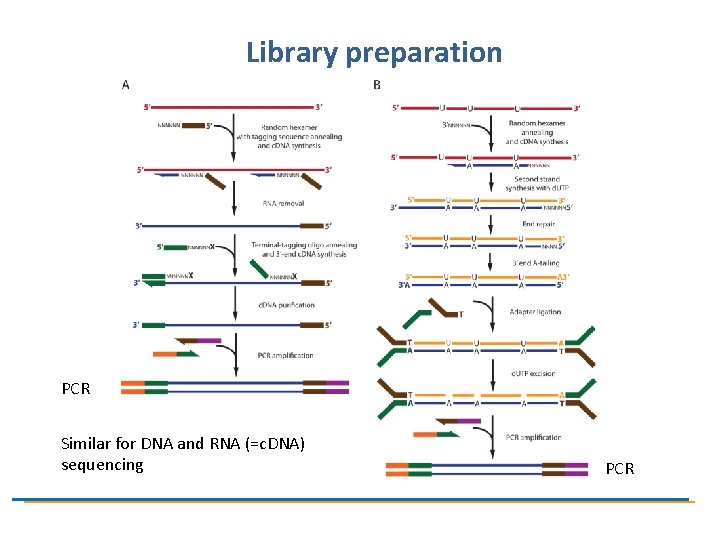
Library preparation PCR Similar for DNA and RNA (=c. DNA) sequencing PCR
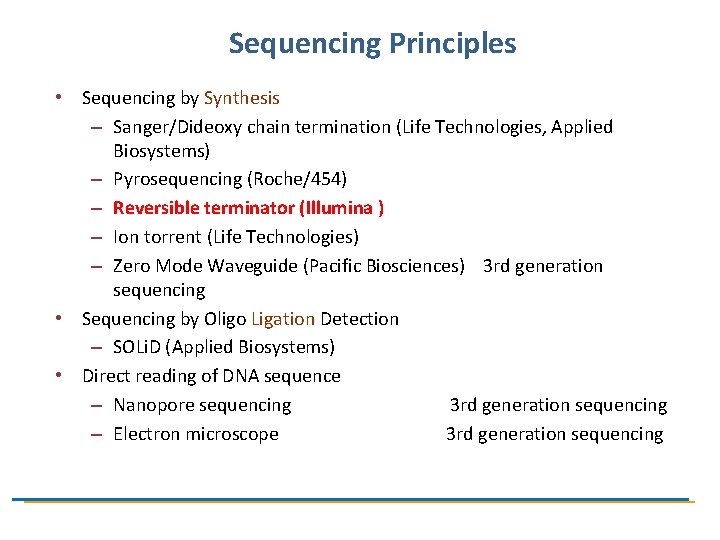
Sequencing Principles • Sequencing by Synthesis – Sanger/Dideoxy chain termination (Life Technologies, Applied Biosystems) – Pyrosequencing (Roche/454) – Reversible terminator (Illumina ) – Ion torrent (Life Technologies) – Zero Mode Waveguide (Pacific Biosciences) 3 rd generation sequencing • Sequencing by Oligo Ligation Detection – SOLi. D (Applied Biosystems) • Direct reading of DNA sequence – Nanopore sequencing 3 rd generation sequencing – Electron microscope 3 rd generation sequencing
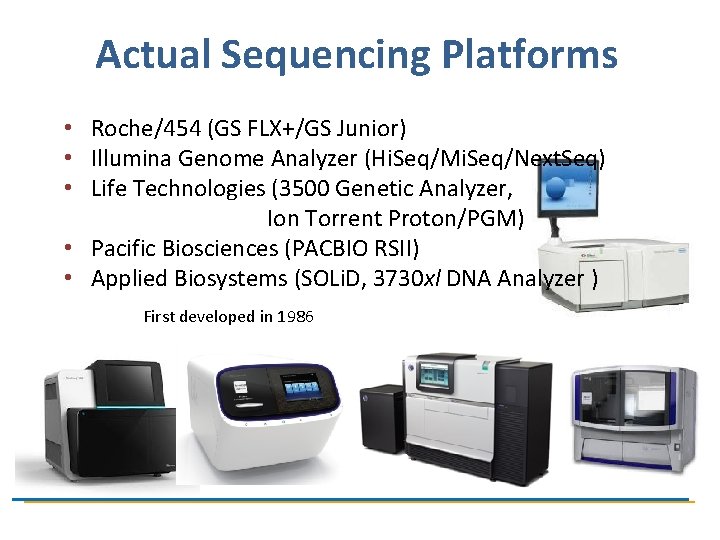
Actual Sequencing Platforms • Roche/454 (GS FLX+/GS Junior) • Illumina Genome Analyzer (Hi. Seq/Mi. Seq/Next. Seq) • Life Technologies (3500 Genetic Analyzer, Ion Torrent Proton/PGM) • Pacific Biosciences (PACBIO RSII) • Applied Biosystems (SOLi. D, 3730 xl DNA Analyzer ) First developed in 1986
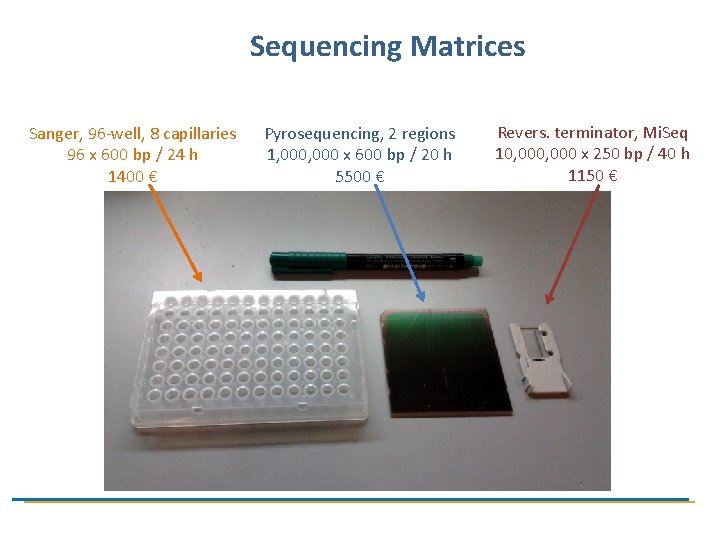
Sequencing Matrices Sanger, 96 -well, 8 capillaries 96 x 600 bp / 24 h 1400 € Pyrosequencing, 2 regions 1, 000 x 600 bp / 20 h 5500 € Revers. terminator, Mi. Seq 10, 000 x 250 bp / 40 h 1150 €
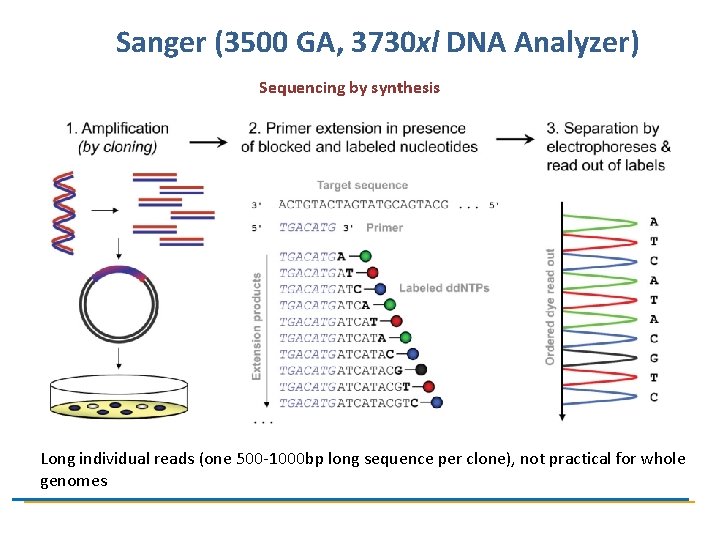
Sanger (3500 GA, 3730 xl DNA Analyzer) Sequencing by synthesis Long individual reads (one 500 -1000 bp long sequence per clone), not practical for whole genomes
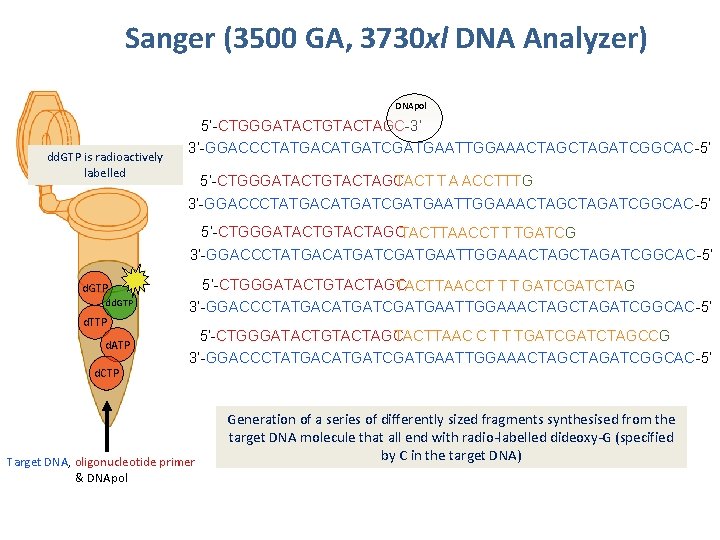
Sanger (3500 GA, 3730 xl DNA Analyzer) DNApol dd. GTP is radioactively labelled 5’-CTGGGATACTGTACTAGC-3’ 3’-GGACCCTATGACATGATCGATGAATTGGAAACTAGATCGGCAC-5’ 5’-CTGGGATACTGTACTAGC TACT T A ACCTTTG 3’-GGACCCTATGACATGATCGATGAATTGGAAACTAGATCGGCAC-5’ 5’-CTGGGATACTGTACTAGCTACTTAACCT T TGATCG 3’-GGACCCTATGACATGATCGATGAATTGGAAACTAGATCGGCAC-5’ d. GTP d. TTP d. ATP d. CTP 5’-CTGGGATACTGTACTAGC TACTTAACCT T T GATCTAG 3’-GGACCCTATGACATGATCGATGAATTGGAAACTAGATCGGCAC-5’ 5’-CTGGGATACTGTACTAGC TACTTAAC C T T TGATCTAGCCG 3’-GGACCCTATGACATGATCGATGAATTGGAAACTAGATCGGCAC-5’ Target DNA, oligonucleotide primer & DNApol Generation of a series of differently sized fragments synthesised from the target DNA molecule that all end with radio-labelled dideoxy-G (specified by C in the target DNA)
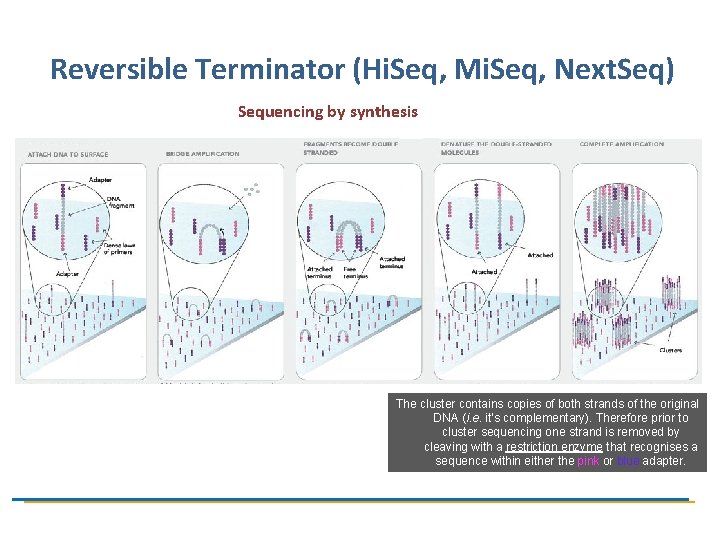
Reversible Terminator (Hi. Seq, Mi. Seq, Next. Seq) Sequencing by synthesis The cluster contains copies of both strands of the original DNA (i. e. it’s complementary). Therefore prior to cluster sequencing one strand is removed by cleaving with a restriction enzyme that recognises a sequence within either the pink or blue adapter.
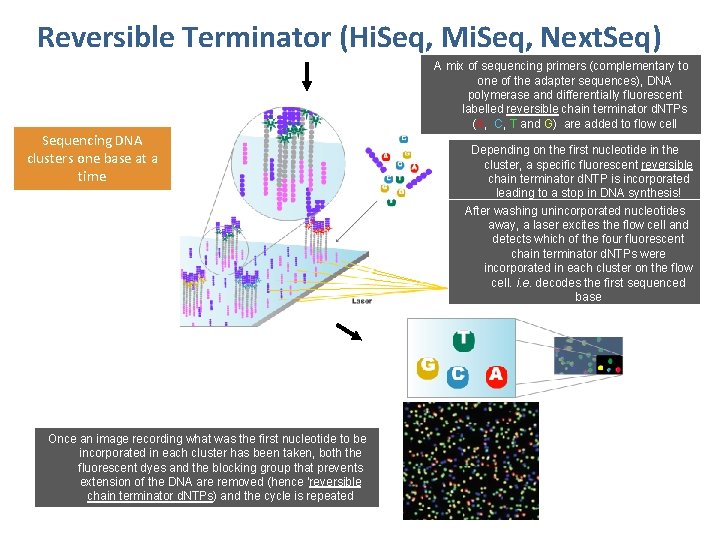
Reversible Terminator (Hi. Seq, Mi. Seq, Next. Seq) A mix of sequencing primers (complementary to one of the adapter sequences), DNA polymerase and differentially fluorescent labelled reversible chain terminator d. NTPs (A, C, T and G) are added to flow cell Sequencing DNA clusters one base at a time Once an image recording what was the first nucleotide to be incorporated in each cluster has been taken, both the fluorescent dyes and the blocking group that prevents extension of the DNA are removed (hence ‘reversible chain terminator d. NTPs) and the cycle is repeated Depending on the first nucleotide in the cluster, a specific fluorescent reversible chain terminator d. NTP is incorporated leading to a stop in DNA synthesis! After washing unincorporated nucleotides away, a laser excites the flow cell and detects which of the four fluorescent chain terminator d. NTPs were incorporated in each cluster on the flow cell. i. e. decodes the first sequenced base
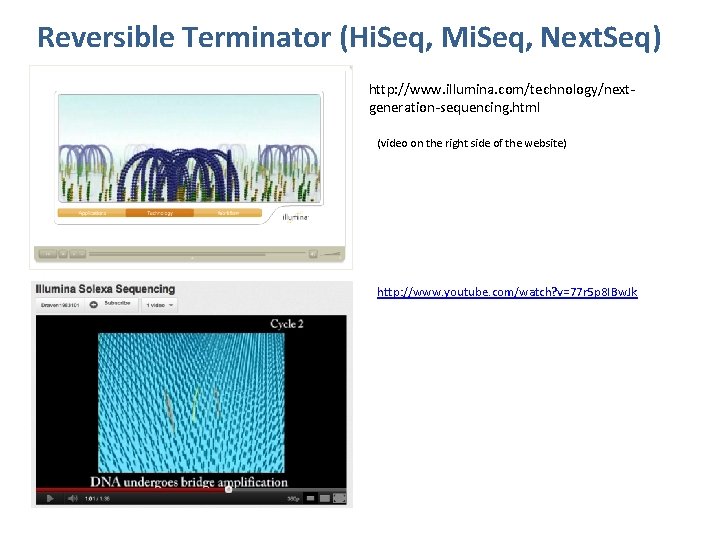
Reversible Terminator (Hi. Seq, Mi. Seq, Next. Seq) http: //www. illumina. com/technology/nextgeneration-sequencing. html (video on the right side of the website) http: //www. youtube. com/watch? v=77 r 5 p 8 IBw. Jk
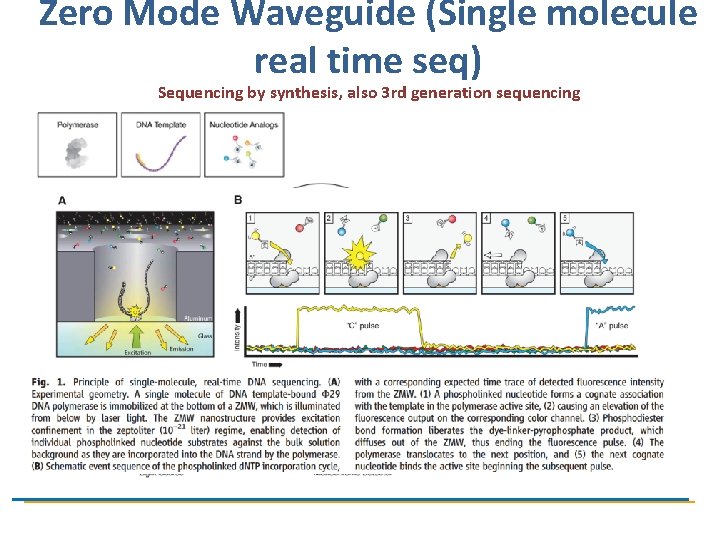
Zero Mode Waveguide (Single molecule real time seq) Sequencing by synthesis, also 3 rd generation sequencing
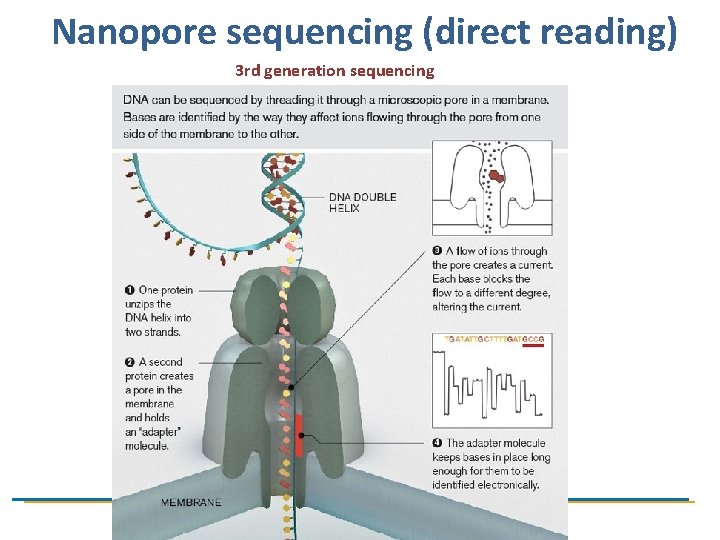
Nanopore sequencing (direct reading) 3 rd generation sequencing
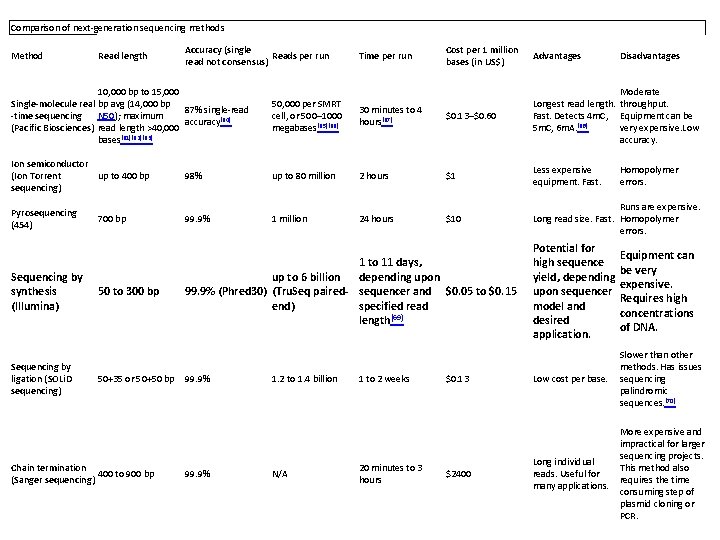
Comparison of next-generation sequencing methods Method Read length Accuracy (single Reads per run read not consensus) Time per run Cost per 1 million bases (in US$) Advantages Disadvantages 10, 000 bp to 15, 000 Single-molecule real bp avg (14, 000 bp 87% single-read -time sequencing N 50); maximum accuracy[64] (Pacific Biosciences) read length >40, 000 bases[61][62][63] 50, 000 per SMRT cell, or 500– 1000 megabases[65][66] 30 minutes to 4 hours[67] $0. 13–$0. 60 Moderate Longest read length. throughput. Fast. Detects 4 m. C, Equipment can be 5 m. C, 6 m. A. [68] very expensive. Low accuracy. Ion semiconductor up to 400 bp (Ion Torrent sequencing) 98% up to 80 million 2 hours $1 Less expensive equipment. Fast. Pyrosequencing (454) 700 bp 99. 9% 1 million 24 hours $10 Runs are expensive. Long read size. Fast. Homopolymer errors. 50 to 300 bp 1 to 11 days, depending upon up to 6 billion 99. 9% (Phred 30) (Tru. Seq paired- sequencer and $0. 05 to $0. 15 end) specified read length[69] Sequencing by synthesis (Illumina) Sequencing by ligation (SOLi. D sequencing) 50+35 or 50+50 bp Chain termination 400 to 900 bp (Sanger sequencing) 99. 9% 1. 2 to 1. 4 billion N/A 1 to 2 weeks 20 minutes to 3 hours $0. 13 $2400 Homopolymer errors. Potential for high sequence yield, depending upon sequencer model and desired application. Equipment can be very expensive. Requires high concentrations of DNA. Low cost per base. Slower than other methods. Has issues sequencing palindromic sequences. [70] Long individual reads. Useful for many applications. More expensive and impractical for larger sequencing projects. This method also requires the time consuming step of plasmid cloning or PCR.
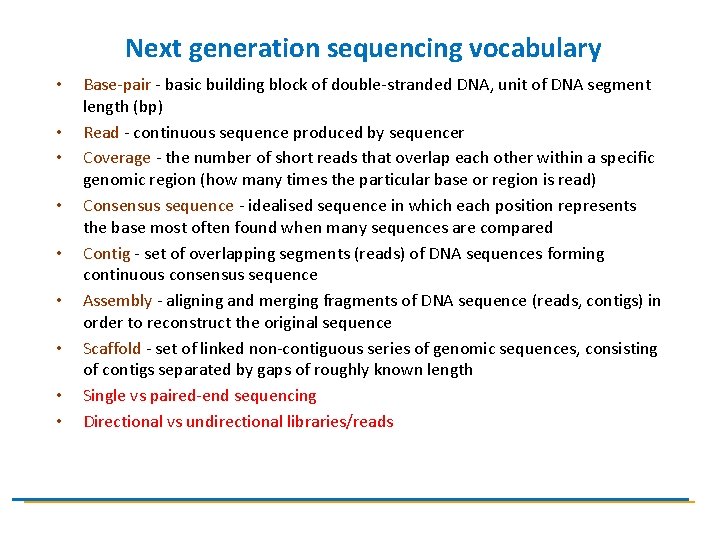
Next generation sequencing vocabulary • • • Base-pair - basic building block of double-stranded DNA, unit of DNA segment length (bp) Read - continuous sequence produced by sequencer Coverage - the number of short reads that overlap each other within a specific genomic region (how many times the particular base or region is read) Consensus sequence - idealised sequence in which each position represents the base most often found when many sequences are compared Contig - set of overlapping segments (reads) of DNA sequences forming continuous consensus sequence Assembly - aligning and merging fragments of DNA sequence (reads, contigs) in order to reconstruct the original sequence Scaffold - set of linked non-contiguous series of genomic sequences, consisting of contigs separated by gaps of roughly known length Single vs paired-end sequencing Directional vs undirectional libraries/reads

Bioinformatics Analysis of direct sequencing output (e. g. image analysis) to obtain read sequences De novo genome (or transcriptome) assembly Mapping of reads to the known genome sequence (RNA-seq data, Ch. IP-seq, DNAseq when looking for polymorphisms etc)
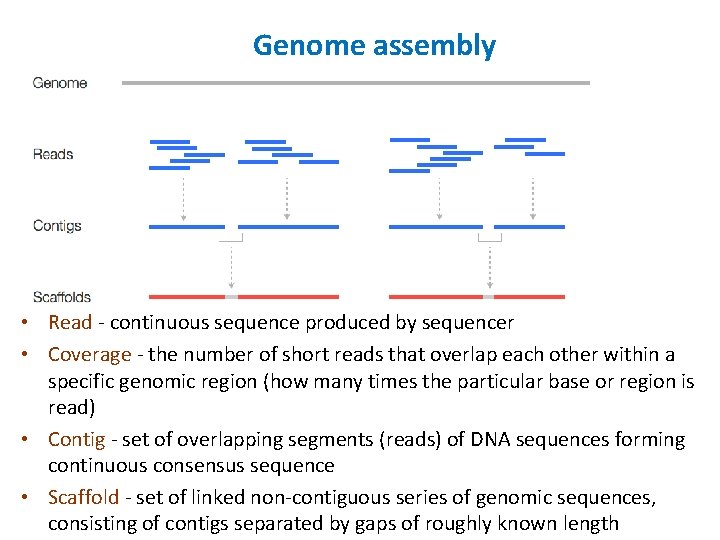
Genome assembly • Read - continuous sequence produced by sequencer • Coverage - the number of short reads that overlap each other within a specific genomic region (how many times the particular base or region is read) • Contig - set of overlapping segments (reads) of DNA sequences forming continuous consensus sequence • Scaffold - set of linked non-contiguous series of genomic sequences, consisting of contigs separated by gaps of roughly known length
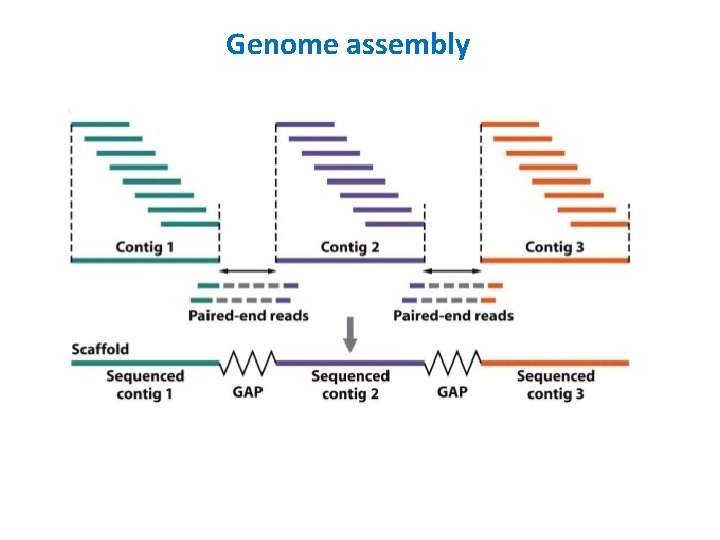
Genome assembly

Paired-end x Mate-pair • Paired-end – sequencing from both fragment ends (< 1 kb) • Mate-pair – longer (3 -20 kb) molecules circularized via internal adapter x
RNA-seq analysis
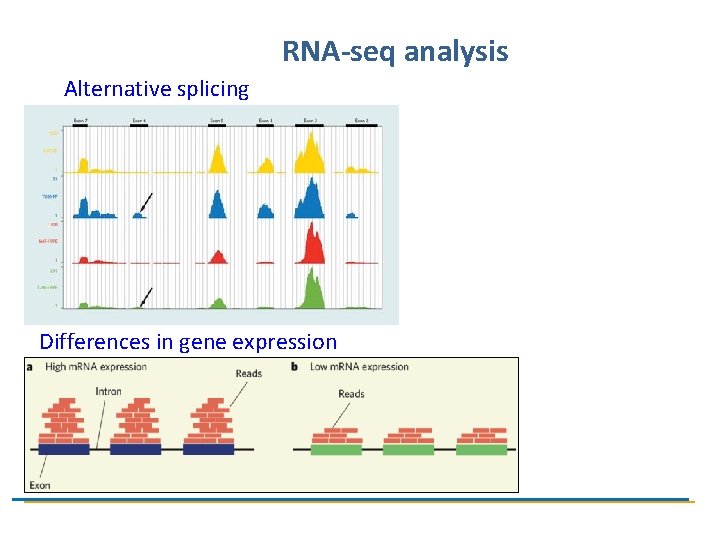
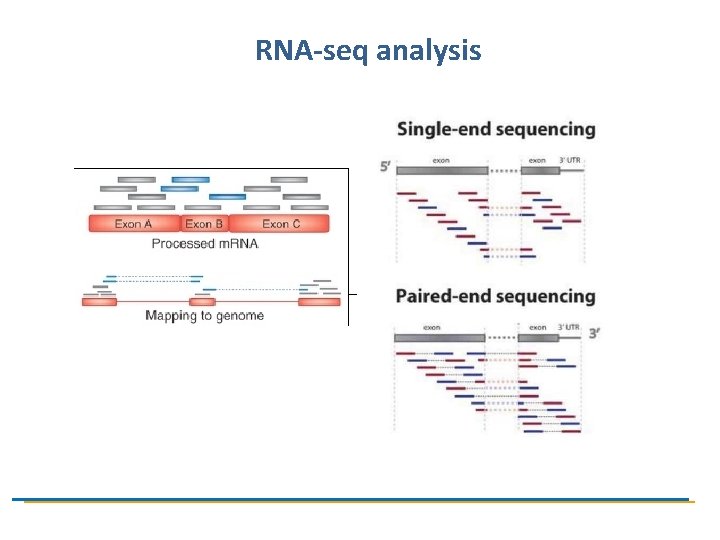
RNA-seq analysis Alternative splicing Differences in gene expression

Take-home message • NGS - high-throughput, parallel, rapid DNA sequencing • Third generation – single molecule, real time, long reads, reduced chemistry • Basic NGS principles – synthesis, ligation • Basic workflow sample - fragmentation - library prep - seq run - data analysis • Applications – de novo DNA seq, RNA seq Choose the right one application and prepare sample appropriately • Basic data analysis pipeline image acquisition, quality metrics - filtering –mapping/contig building - annotation
- Slides: 48