
MicroArcsecond Imaging Mission Pathfinder MAXIMPF Final Version Data
- Slides: 32
Micro-Arcsecond Imaging Mission, Pathfinder (MAXIM-PF) Final Version Data Systems ¨ Frank Stocklin ¨ Ron Vento ¨ Bob Summers ¨ May 17 2002
Data Systems Topics Final Version ¨ Ops Concept ¨ Driving Requirements and Assumptions ¨ Selected Configuration and Rationale ¨ Signal Margin Summary ¨ Component Power/Mass/Cost Summary ¨ Risk Assessment ¨ LASER option ¨ Backup LAI-Maxim-PF May 17. 2002 Goddard Space Flight Center 2
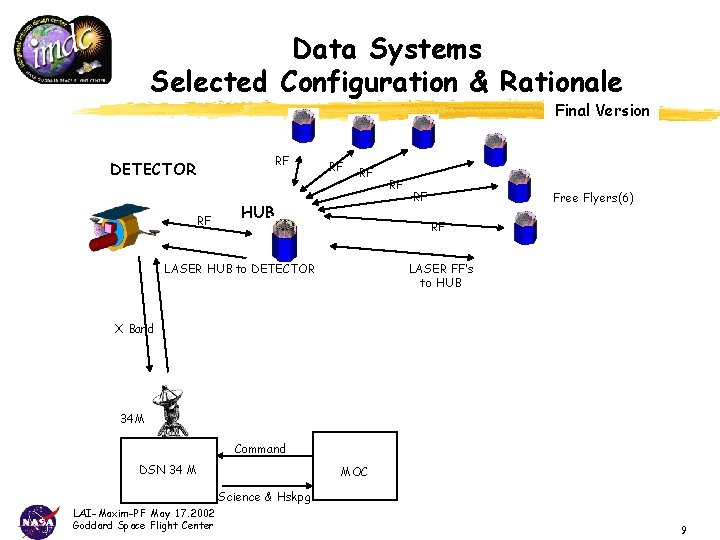
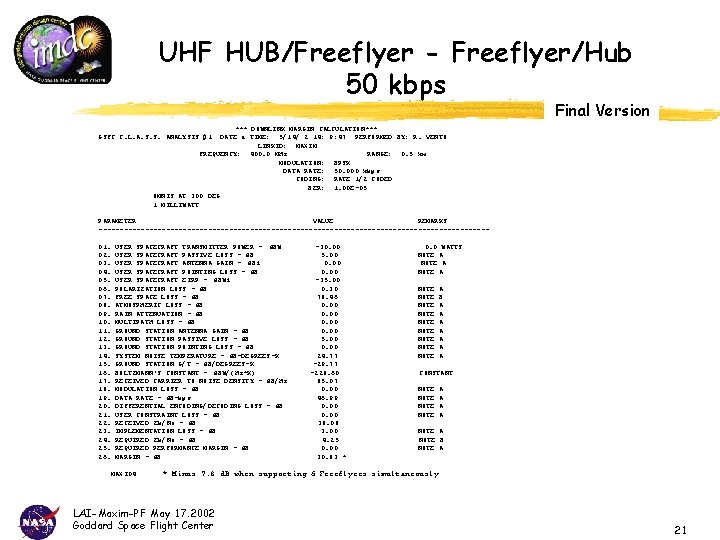
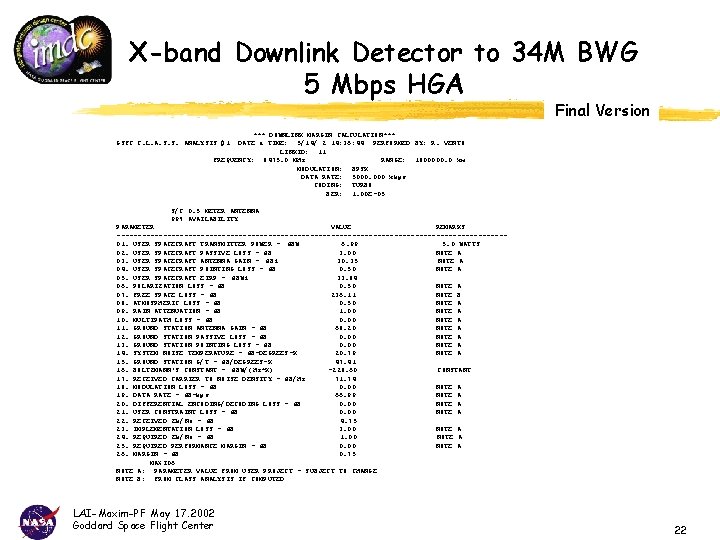
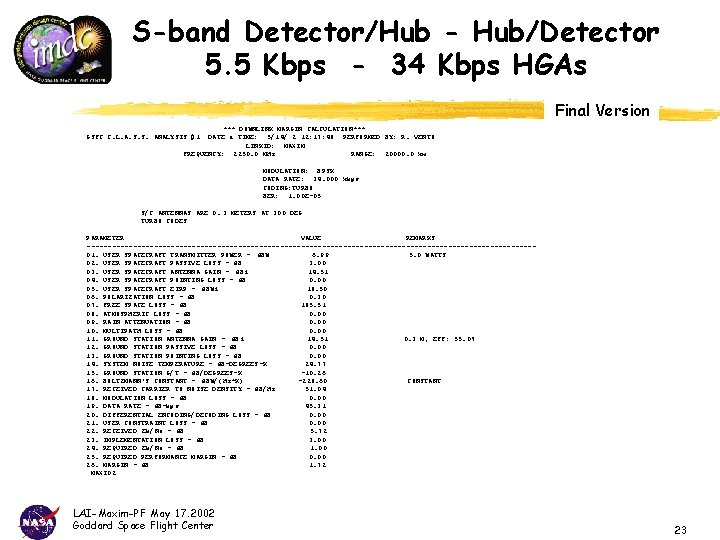
OPS CONCEPT Final Version ¨ HUB to Free Flyers(FF) · UHF · Coherent for ranging/ 60 Kbps duplex data transfer · CDMA · simultaneous receive of 6 FF’s · Time share transmits to 6 FF’s · may also be able to simultaneous transmit to FF’s if necessary-needs some NRE · LASER reflector FF to HUB to determine relative position ¨ HUB to Detector · S-Band · 34 kbps/5. 5 Kbps using HGA’s w/omni backup · · Simultaneous receive/transmit with HUB to FF LASER reflector to determine relative position ¨ Detector to Ground · X Band to DSN · 5 Mbps/5 Kbps · 15 minute dump/day LAI-Maxim-PF May 17. 2002 Goddard Space Flight Center 3
Data Systems Driving Requirements & Assumptions Final Version ¨ Launch Date: August 2015 ¨ Mission Life: 4 years required/5 year goal ¨ Nominal Orbit: L 2 Location ¨ Stellar pointing ¨ One HUB S/C & 6 identical Free Flyers located in a spherical arc forming a radius of 100 -500 m · 50 Kbps to/from ¨ One Detector S/C located at 20 KKM from HUB · 34/5. 5 Kbps to/from ¨ Distance from HUB to FF’s must be determined · RF ranging will be course & LASER will be fine ¨ Distance from HUB to Detector must be determined · RF ranging will be course & LASER will be fine ¨ Formation flying · Maintained by continuous RF & LASER LAI-Maxim-PF May 17. 2002 Goddard Space Flight Center 4
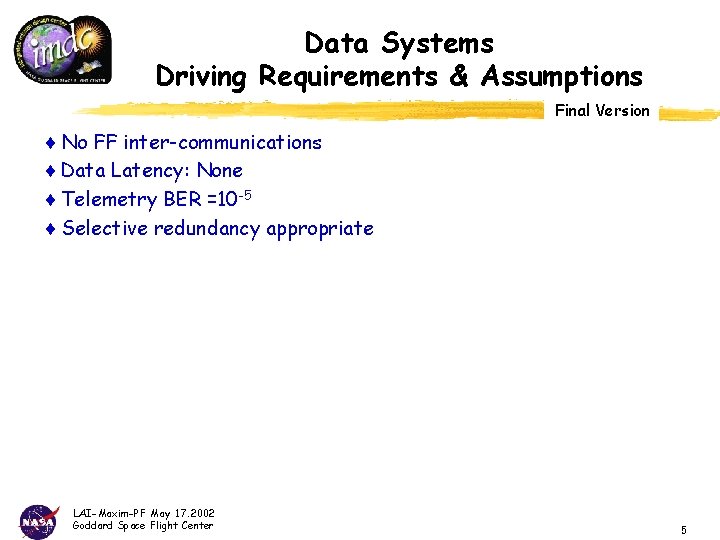
Data Systems Driving Requirements & Assumptions Final Version ¨ No FF inter-communications ¨ Data Latency: None ¨ Telemetry BER =10 -5 ¨ Selective redundancy appropriate LAI-Maxim-PF May 17. 2002 Goddard Space Flight Center 5
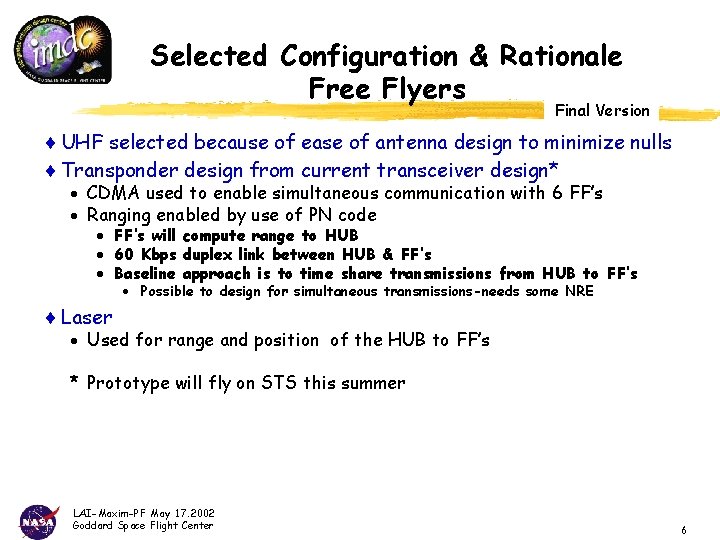
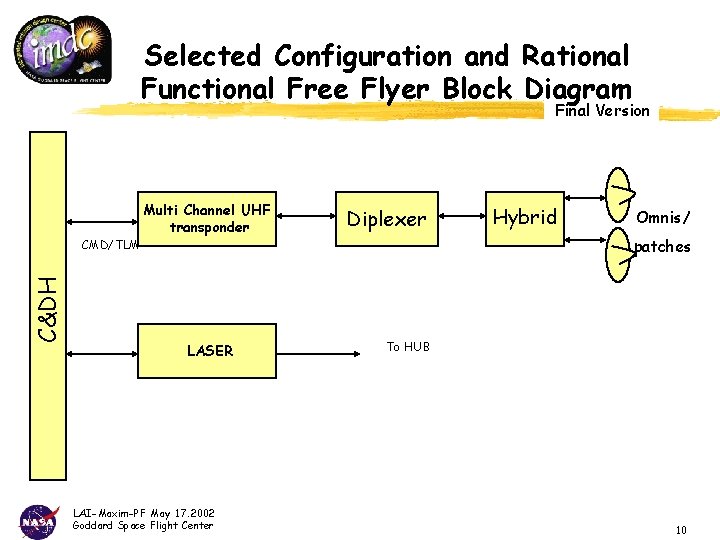
Selected Configuration & Rationale Free Flyers Final Version ¨ UHF selected because of ease of antenna design to minimize nulls ¨ Transponder design from current transceiver design* · CDMA used to enable simultaneous communication with 6 FF’s · Ranging enabled by use of PN code · FF’s will compute range to HUB · 60 Kbps duplex link between HUB & FF’s · Baseline approach is to time share transmissions from HUB to FF’s · Possible to design for simultaneous transmissions-needs some NRE ¨ Laser · Used for range and position of the HUB to FF’s * Prototype will fly on STS this summer LAI-Maxim-PF May 17. 2002 Goddard Space Flight Center 6
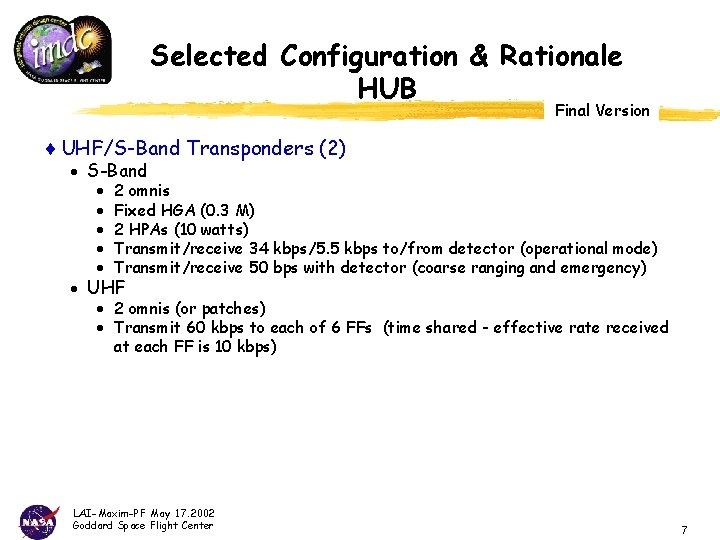
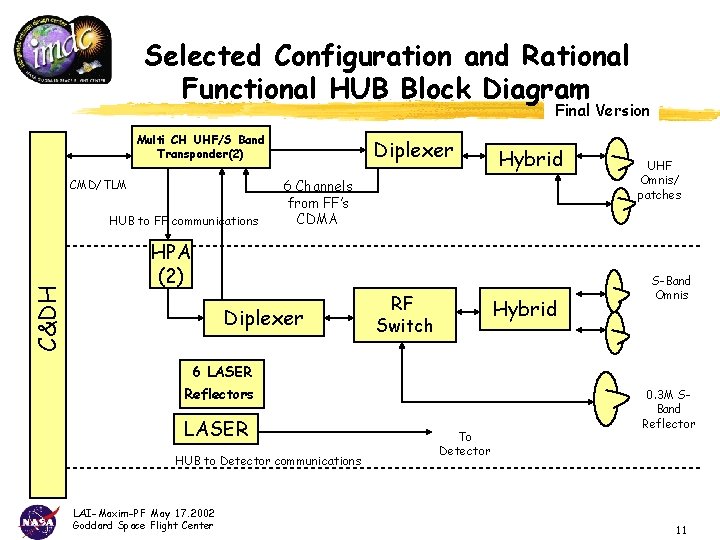
Selected Configuration & Rationale HUB Final Version ¨ UHF/S-Band Transponders (2) · S-Band · · · 2 omnis Fixed HGA (0. 3 M) 2 HPAs (10 watts) Transmit/receive 34 kbps/5. 5 kbps to/from detector (operational mode) Transmit/receive 50 bps with detector (coarse ranging and emergency) · UHF · 2 omnis (or patches) · Transmit 60 kbps to each of 6 FFs (time shared - effective rate received at each FF is 10 kbps) LAI-Maxim-PF May 17. 2002 Goddard Space Flight Center 7
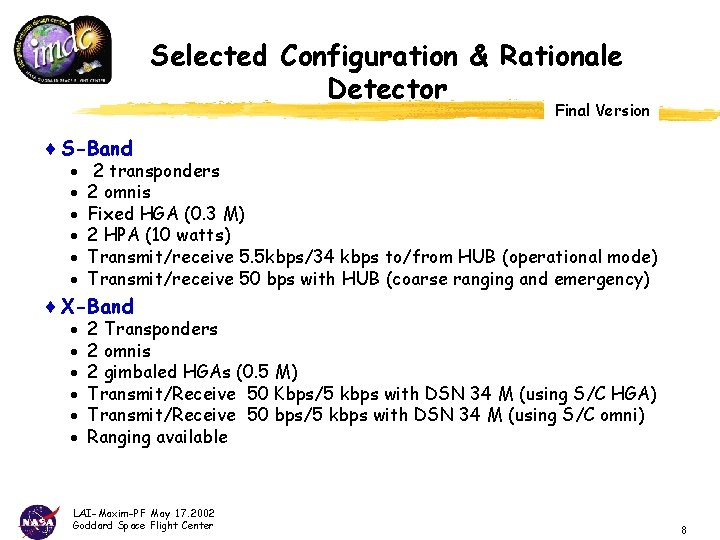
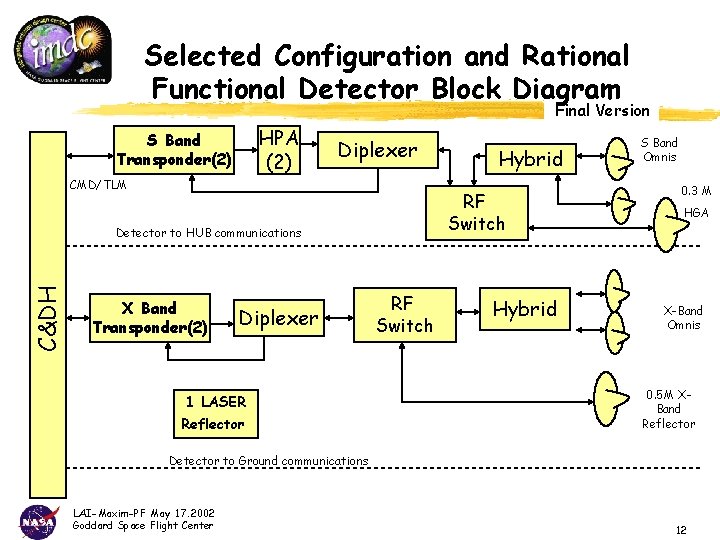
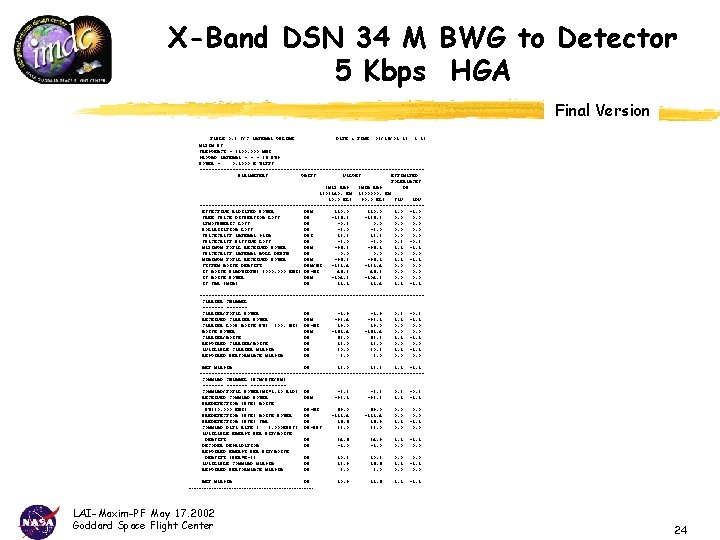
Selected Configuration & Rationale Detector Final Version ¨ S-Band · · · 2 transponders 2 omnis Fixed HGA (0. 3 M) 2 HPA (10 watts) Transmit/receive 5. 5 kbps/34 kbps to/from HUB (operational mode) Transmit/receive 50 bps with HUB (coarse ranging and emergency) ¨ X-Band · · · 2 Transponders 2 omnis 2 gimbaled HGAs (0. 5 M) Transmit/Receive 50 Kbps/5 kbps with DSN 34 M (using S/C HGA) Transmit/Receive 50 bps/5 kbps with DSN 34 M (using S/C omni) Ranging available LAI-Maxim-PF May 17. 2002 Goddard Space Flight Center 8
Data Systems Selected Configuration & Rationale Final Version RF DETECTOR RF RF RF HUB RF RF Free Flyers(6) RF LASER HUB to DETECTOR LASER FF’s to HUB X Band 34 M Command DSN 34 M MOC Science & Hskpg LAI-Maxim-PF May 17. 2002 Goddard Space Flight Center 9
Selected Configuration and Rational Functional Free Flyer Block Diagram Final Version C&DH CMD/TLM Multi Channel UHF transponder LASER LAI-Maxim-PF May 17. 2002 Goddard Space Flight Center Diplexer Hybrid Omnis/ patches To HUB 10
Selected Configuration and Rational Functional HUB Block Diagram Final Version Multi CH UHF/S Band Transponder(2) CMD/TLM C&DH HUB to FF communications Diplexer Hybrid 6 Channels from FF’s CDMA HPA (2) Diplexer RF Switch Hybrid UHF Omnis/ patches S-Band Omnis 6 LASER Reflectors LASER HUB to Detector communications LAI-Maxim-PF May 17. 2002 Goddard Space Flight Center To Detector 0. 3 M SBand Reflector 11
Selected Configuration and Rational Functional Detector Block Diagram Final Version HPA (2) S Band Transponder(2) Diplexer CMD/TLM RF Switch C&DH Detector to HUB communications X Band Transponder(2) Diplexer 1 LASER Reflector Hybrid RF Switch Hybrid S Band Omnis 0. 3 M HGA X-Band Omnis 0. 5 M XBand Reflector Detector to Ground communications LAI-Maxim-PF May 17. 2002 Goddard Space Flight Center 12
Maxim_PF Signal Margins Final Version LAI-Maxim-PF May 17. 2002 Goddard Space Flight Center 13
Power/Mass/Cost Summary Free Flyer Final Version LAI-Maxim-PF May 17. 2002 Goddard Space Flight Center 14
Mass/Cost/Power Summary HUB Final Version LAI-Maxim-PF May 17. 2002 Goddard Space Flight Center 15
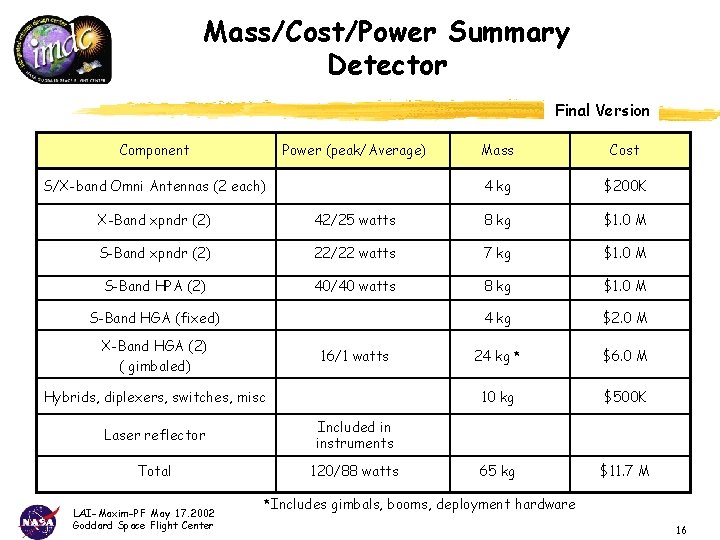
Mass/Cost/Power Summary Detector Final Version Component Power (peak/Average) S/X-band Omni Antennas (2 each) Mass Cost 4 kg $200 K X-Band xpndr (2) 42/25 watts 8 kg $1. 0 M S-Band xpndr (2) 22/22 watts 7 kg $1. 0 M S-Band HPA (2) 40/40 watts 8 kg $1. 0 M 4 kg $2. 0 M 24 kg * $6. 0 M 10 kg $500 K 65 kg $11. 7 M S-Band HGA (fixed) X-Band HGA (2) ( gimbaled) 16/1 watts Hybrids, diplexers, switches, misc Laser reflector Included in instruments Total 120/88 watts LAI-Maxim-PF May 17. 2002 Goddard Space Flight Center *Includes gimbals, booms, deployment hardware 16
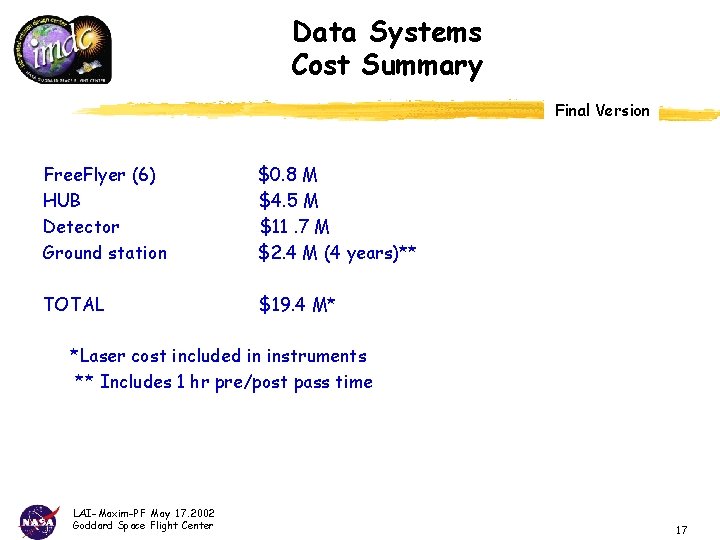
Data Systems Cost Summary Final Version Free. Flyer (6) HUB Detector Ground station $0. 8 M $4. 5 M $11. 7 M $2. 4 M (4 years)** TOTAL $19. 4 M* *Laser cost included in instruments ** Includes 1 hr pre/post pass time LAI-Maxim-PF May 17. 2002 Goddard Space Flight Center 17
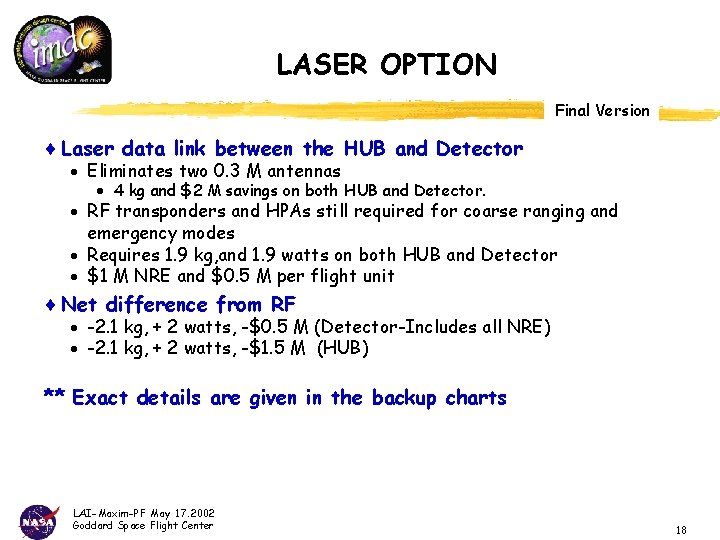
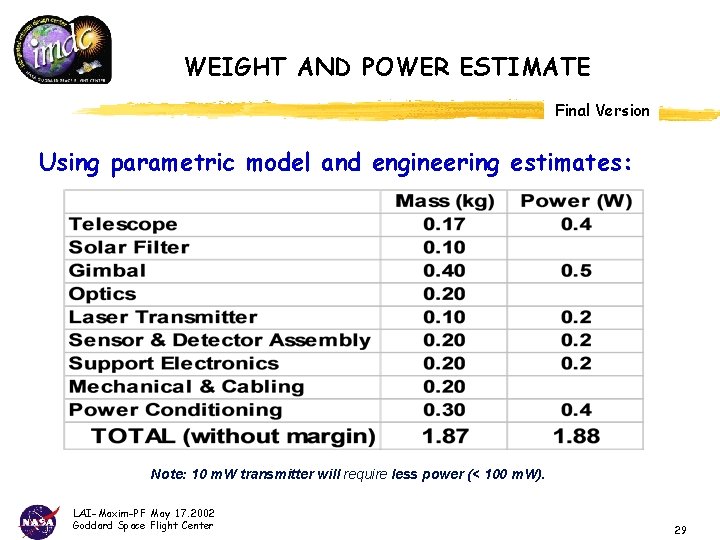
LASER OPTION Final Version ¨ Laser data link between the HUB and Detector · Eliminates two 0. 3 M antennas · 4 kg and $2 M savings on both HUB and Detector. · RF transponders and HPAs still required for coarse ranging and emergency modes · Requires 1. 9 kg, and 1. 9 watts on both HUB and Detector · $1 M NRE and $0. 5 M per flight unit ¨ Net difference from RF · -2. 1 kg, + 2 watts, -$0. 5 M (Detector-Includes all NRE) · -2. 1 kg, + 2 watts, -$1. 5 M (HUB) ** Exact details are given in the backup charts LAI-Maxim-PF May 17. 2002 Goddard Space Flight Center 18
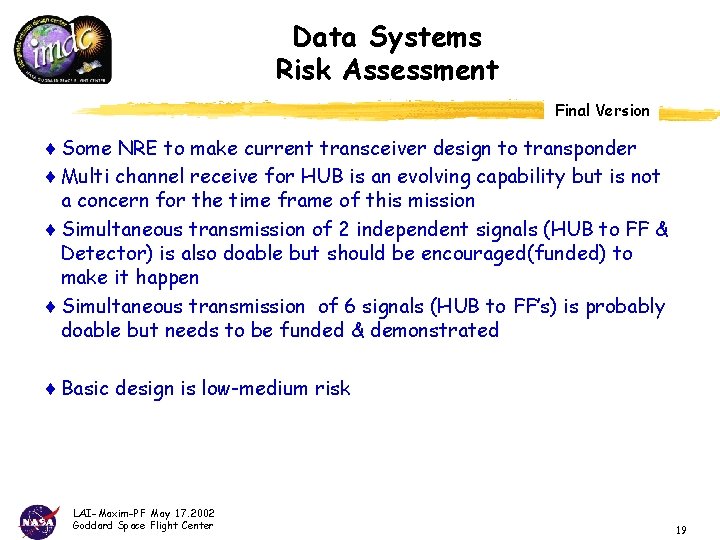
Data Systems Risk Assessment Final Version ¨ Some NRE to make current transceiver design to transponder ¨ Multi channel receive for HUB is an evolving capability but is not a concern for the time frame of this mission ¨ Simultaneous transmission of 2 independent signals (HUB to FF & Detector) is also doable but should be encouraged(funded) to make it happen ¨ Simultaneous transmission of 6 signals (HUB to FF’s) is probably doable but needs to be funded & demonstrated ¨ Basic design is low-medium risk LAI-Maxim-PF May 17. 2002 Goddard Space Flight Center 19
Final Version Back-Up Charts LAI-Maxim-PF May 17. 2002 Goddard Space Flight Center 20
UHF HUB/Freeflyer - Freeflyer/Hub 50 kbps Final Version *** DOWNLINK MARGIN CALCULATION*** GSFC C. L. A. S. S. ANALYSIS #1 DATE & TIME: 5/14/ 2 14: 9: 47 PERFORMED BY: R. VENTO LINKID: MAXIM FREQUENCY: 400. 0 MHz RANGE: 0. 5 km MODULATION: BPSK DATA RATE: 50. 000 kbps CODING: RATE 1/2 CODED BER: 1. 00 E-05 OMNIS AT 300 DEG 1 MILLIWATT PARAMETER VALUE REMARKS ----------------------------------------------01. 02. 03. 04. 05. 06. 07. 08. 09. 10. 11. 12. 13. 14. 15. 16. 17. 18. 19. 20. 21. 22. 23. 24. 25. 26. USER SPACECRAFT TRANSMITTER POWER - d. BW USER SPACECRAFT PASSIVE LOSS - d. B USER SPACECRAFT ANTENNA GAIN - d. Bi USER SPACECRAFT POINTING LOSS - d. B USER SPACECRAFT EIRP - d. BWi POLARIZATION LOSS - d. B FREE SPACE LOSS - d. B ATMOSPHERIC LOSS - d. B RAIN ATTENUATION - d. B MULTIPATH LOSS - d. B GROUND STATION ANTENNA GAIN - d. B GROUND STATION PASSIVE LOSS - d. B GROUND STATION POINTING LOSS - d. B SYSTEM NOISE TEMPERATURE - d. B-DEGREES-K GROUND STATION G/T - d. B/DEGREES-K BOLTZMANN'S CONSTANT - d. BW/(Hz*K) RECEIVED CARRIER TO NOISE DENSITY - d. B/Hz MODULATION LOSS - d. B DATA RATE - d. B-bps DIFFERENTIAL ENCODING/DECODING LOSS - d. B USER CONSTRAINT LOSS - d. B RECEIVED Eb/No - d. B IMPLEMENTATION LOSS - d. B REQUIRED Eb/No - d. B REQUIRED PERFORMANCE MARGIN - d. B MAXI 04 -30. 00 5. 00 0. 00 -35. 00 0. 30 78. 46 0. 00 5. 00 0. 00 24. 77 -29. 77 -228. 60 85. 07 0. 00 46. 99 0. 00 38. 08 3. 00 4. 25 0. 00 30. 83 * 0. 0 WATTS NOTE A NOTE NOTE NOTE A B A A A A CONSTANT NOTE A A NOTE B NOTE A * Minus 7. 8 d. B when supporting 6 Freeflyers simultaneously LAI-Maxim-PF May 17. 2002 Goddard Space Flight Center 21
X-band Downlink Detector to 34 M BWG 5 Mbps HGA Final Version *** DOWNLINK MARGIN CALCULATION*** DATE & TIME: 5/14/ 2 14: 36: 44 PERFORMED BY: R. VENTO LINKID: 11 FREQUENCY: 8475. 0 MHz RANGE: 1800000. 0 km MODULATION: BPSK DATA RATE: 5000. 000 kbps CODING: TURBO BER: 1. 00 E-05 GSFC C. L. A. S. S. ANALYSIS #1 S/C 0. 5 METER ANTENNA 99% AVAILABILITY PARAMETER VALUE REMARKS ----------------------------------------------01. USER SPACECRAFT TRANSMITTER POWER - d. BW 6. 99 5. 0 WATTS 02. USER SPACECRAFT PASSIVE LOSS - d. B 3. 00 NOTE A 03. USER SPACECRAFT ANTENNA GAIN - d. Bi 30. 35 NOTE A 04. USER SPACECRAFT POINTING LOSS - d. B 0. 50 NOTE A 05. USER SPACECRAFT EIRP - d. BWi 33. 84 06. POLARIZATION LOSS - d. B 0. 50 NOTE A 07. FREE SPACE LOSS - d. B 236. 11 NOTE B 08. ATMOSPHERIC LOSS - d. B 0. 50 NOTE A 09. RAIN ATTENUATION - d. B 1. 00 NOTE A 10. MULTIPATH LOSS - d. B 0. 00 NOTE A 11. GROUND STATION ANTENNA GAIN - d. B 68. 20 NOTE A 12. GROUND STATION PASSIVE LOSS - d. B 0. 00 NOTE A 13. GROUND STATION POINTING LOSS - d. B 0. 00 NOTE A 14. SYSTEM NOISE TEMPERATURE - d. B-DEGREES-K 20. 79 NOTE A 15. GROUND STATION G/T - d. B/DEGREES-K 47. 41 16. BOLTZMANN'S CONSTANT - d. BW/(Hz*K) -228. 60 CONSTANT 17. RECEIVED CARRIER TO NOISE DENSITY - d. B/Hz 71. 74 18. MODULATION LOSS - d. B 0. 00 NOTE A 19. DATA RATE - d. B-bps 66. 99 NOTE A 20. DIFFERENTIAL ENCODING/DECODING LOSS - d. B 0. 00 NOTE A 21. USER CONSTRAINT LOSS - d. B 0. 00 NOTE A 22. RECEIVED Eb/No - d. B 4. 75 23. IMPLEMENTATION LOSS - d. B 3. 00 NOTE A 24. REQUIRED Eb/No - d. B 1. 00 NOTE A 25. REQUIRED PERFORMANCE MARGIN - d. B 0. 00 NOTE A 26. MARGIN - d. B 0. 75 MAXI 06 NOTE A: PARAMETER VALUE FROM USER PROJECT - SUBJECT TO CHANGE NOTE B: FROM CLASS ANALYSIS IF COMPUTED LAI-Maxim-PF May 17. 2002 Goddard Space Flight Center 22
S-band Detector/Hub - Hub/Detector 5. 5 Kbps - 34 Kbps HGAs Final Version *** DOWNLINK MARGIN CALCULATION*** GSFC C. L. A. S. S. ANALYSIS #1 DATE & TIME: 5/14/ 2 12: 17: 48 PERFORMED BY: R. VENTO LINKID: MAXIM FREQUENCY: 2250. 0 MHz RANGE: 20000. 0 km MODULATION: BPSK DATA RATE: 34. 000 kbps CODING: TURBO BER: 1. 00 E-05 S/C ANTENNAS ARE 0. 3 METERS AT 300 DEG TURBO CODES PARAMETER VALUE REMARKS -----------------------------------------------------01. USER SPACECRAFT TRANSMITTER POWER - d. BW 6. 99 5. 0 WATTS 02. USER SPACECRAFT PASSIVE LOSS - d. B 3. 00 03. USER SPACECRAFT ANTENNA GAIN - d. Bi 14. 51 04. USER SPACECRAFT POINTING LOSS - d. B 0. 00 05. USER SPACECRAFT EIRP - d. BWi 18. 50 06. POLARIZATION LOSS - d. B 0. 30 07. FREE SPACE LOSS - d. B 185. 51 08. ATMOSPHERIC LOSS - d. B 0. 00 09. RAIN ATTENUATION - d. B 0. 00 10. MULTIPATH LOSS - d. B 0. 00 11. GROUND STATION ANTENNA GAIN - d. Bi 14. 51 0. 3 M, EFF: 55. 0% 12. GROUND STATION PASSIVE LOSS - d. B 0. 00 13. GROUND STATION POINTING LOSS - d. B 0. 00 14. SYSTEM NOISE TEMPERATURE - d. B-DEGREES-K 24. 77 15. GROUND STATION G/T - d. B/DEGREES-K -10. 26 16. BOLTZMANN'S CONSTANT - d. BW/(Hz*K) -228. 60 CONSTANT 17. RECEIVED CARRIER TO NOISE DENSITY - d. B/Hz 51. 04 18. MODULATION LOSS - d. B 0. 00 19. DATA RATE - d. B-bps 45. 31 20. DIFFERENTIAL ENCODING/DECODING LOSS - d. B 0. 00 21. USER CONSTRAINT LOSS - d. B 0. 00 22. RECEIVED Eb/No - d. B 5. 72 23. IMPLEMENTATION LOSS - d. B 3. 00 24. REQUIRED Eb/No - d. B 1. 00 25. REQUIRED PERFORMANCE MARGIN - d. B 0. 00 26. MARGIN - d. B 1. 72 MAXI 02 LAI-Maxim-PF May 17. 2002 Goddard Space Flight Center 23
X-Band DSN 34 M BWG to Detector 5 Kbps HGA Final Version TABLE 0. 5 S/C ANTENNA UPLINK DATE & TIME: 05/14/02 15: 1: 25 MAXIM PF FREQUENCY - 7200. 000 MHZ GROUND ANTENNA - - - 34 BWG POWER 0. 2000 K WATTS -------------------------------------PARAMETERS UNITS VALUES ESTIMATED TOLERANCES (MAX RNG: (MIN RNG: DB 1805260. KM 1800000. KM 10. 0 EL) 90. 0 EL) FAV ADV -------------------------------------EFFECTIVE RADIATED POWER DBM 120. 0 1. 0 -1. 0 FREE SPACE DISPERSION LOSS DB -234. 7 0. 0 ATMOSPHERIC LOSS DB -0. 5 0. 0 POLARIZATION LOSS DB -3. 0 0. 0 SPACECRAFT ANTENNA GAIN DBI 28. 5 0. 0 SPACECRAFT PASSIVE LOSS DB -5. 0 0. 5 -0. 5 MAXIMUM TOTAL RECEIVED POWER DBM -94. 7 -94. 2 1. 1 -1. 1 SPACECRAFT ANTENNA NULL DEPTH DB 0. 0 MINIMUM TOTAL RECEIVED POWER DBM -94. 7 -94. 2 1. 1 -1. 1 SYSTEM NOISE DENSITY DBM/HZ -171. 6 0. 0 IF NOISE BANDWIDTH( 3000. 000 KHZ) DB-HZ 64. 8 0. 0 IF NOISE POWER DBM -106. 8 0. 0 IF SNR (MIN) DB 12. 1 12. 6 1. 1 --------------------------------------CARRIER CHANNEL -------CARRIER/TOTAL POWER DB -2. 9 0. 3 -0. 3 RECEIVED CARRIER POWER DBM -97. 6 -97. 1 1. 2 -1. 2 CARRIER LOOP NOISE BW( 800. HZ) DB-HZ 29. 0 0. 0 NOISE POWER DBM -142. 6 0. 0 CARRIER/NOISE DB 45. 0 45. 5 1. 2 -1. 2 REQUIRED CARRIER/NOISE DB 15. 0 0. 0 AVAILABLE CARRIER MARGIN DB 30. 0 30. 5 1. 2 -1. 2 REQUIRED PERFORMANCE MARGIN DB 3. 0 0. 0 NET MARGIN DB 27. 0 27. 5 1. 2 --------------------------------------COMMAND CHANNEL (PCM/PSK/PM) -------COMMAND/TOTAL POWER(MI=1. 10 RAD) DB -3. 5 0. 3 -0. 3 RECEIVED COMMAND POWER DBM -98. 2 -97. 7 1. 2 -1. 2 PREDETECTION (PSK) NOISE BW(80. 000 KHZ) DB-HZ 49. 0 0. 0 PREDETECTION (PSK) NOISE POWER DB -122. 6 0. 0 PREDETECTION (PSK) SNR DB 24. 4 24. 9 1. 2 -1. 2 COMMAND DATA RATE ( 5. 000 KBPS) DB-BPS 37. 0 0. 0 AVAILABLE ENERGY PER BIT/NOISE DENSITY DB 36. 4 36. 9 1. 2 -1. 2 DECODER DEGRADATION DB -2. 0 0. 0 REQUIRED ENERGY PER BIT/NOISE DENSITY (BER=E-5) DB 10. 5 0. 0 AVAILABLE COMMAND MARGIN DB 23. 9 24. 4 1. 2 -1. 2 REQUIRED PERFORMANCE MARGIN DB 3. 0 0. 0 NET MARGIN DB -------------------------------------- LAI-Maxim-PF May 17. 2002 Goddard Space Flight Center 20. 9 21. 4 1. 2 -1. 2 24
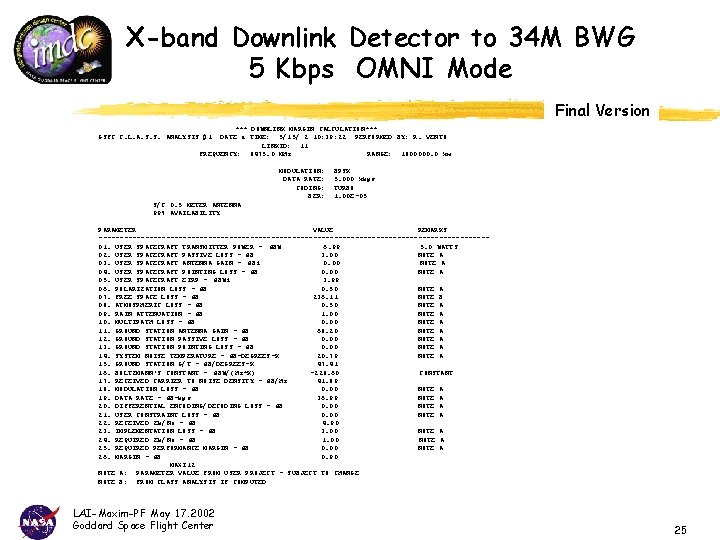
X-band Downlink Detector to 34 M BWG 5 Kbps OMNI Mode Final Version *** DOWNLINK MARGIN CALCULATION*** GSFC C. L. A. S. S. ANALYSIS #1 DATE & TIME: 5/15/ 2 10: 39: 22 PERFORMED BY: R. VENTO LINKID: 11 FREQUENCY: 8475. 0 MHz RANGE: 1800000. 0 km MODULATION: DATA RATE: CODING: BER: BPSK 5. 000 kbps TURBO 1. 00 E-05 S/C 0. 5 METER ANTENNA 99% AVAILABILITY PARAMETER VALUE REMARKS ----------------------------------------------01. USER SPACECRAFT TRANSMITTER POWER - d. BW 6. 99 5. 0 WATTS 02. USER SPACECRAFT PASSIVE LOSS - d. B 3. 00 NOTE A 03. USER SPACECRAFT ANTENNA GAIN - d. Bi 0. 00 NOTE A 04. USER SPACECRAFT POINTING LOSS - d. B 0. 00 NOTE A 05. USER SPACECRAFT EIRP - d. BWi 3. 99 06. POLARIZATION LOSS - d. B 0. 50 NOTE A 07. FREE SPACE LOSS - d. B 236. 11 NOTE B 08. ATMOSPHERIC LOSS - d. B 0. 50 NOTE A 09. RAIN ATTENUATION - d. B 1. 00 NOTE A 10. MULTIPATH LOSS - d. B 0. 00 NOTE A 11. GROUND STATION ANTENNA GAIN - d. B 68. 20 NOTE A 12. GROUND STATION PASSIVE LOSS - d. B 0. 00 NOTE A 13. GROUND STATION POINTING LOSS - d. B 0. 00 NOTE A 14. SYSTEM NOISE TEMPERATURE - d. B-DEGREES-K 20. 79 NOTE A 15. GROUND STATION G/T - d. B/DEGREES-K 47. 41 16. BOLTZMANN'S CONSTANT - d. BW/(Hz*K) -228. 60 CONSTANT 17. RECEIVED CARRIER TO NOISE DENSITY - d. B/Hz 41. 89 18. MODULATION LOSS - d. B 0. 00 NOTE A 19. DATA RATE - d. B-bps 36. 99 NOTE A 20. DIFFERENTIAL ENCODING/DECODING LOSS - d. B 0. 00 NOTE A 21. USER CONSTRAINT LOSS - d. B 0. 00 NOTE A 22. RECEIVED Eb/No - d. B 4. 90 23. IMPLEMENTATION LOSS - d. B 3. 00 NOTE A 24. REQUIRED Eb/No - d. B 1. 00 NOTE A 25. REQUIRED PERFORMANCE MARGIN - d. B 0. 00 NOTE A 26. MARGIN - d. B 0. 90 MAXI 12 NOTE A: PARAMETER VALUE FROM USER PROJECT - SUBJECT TO CHANGE NOTE B: FROM CLASS ANALYSIS IF COMPUTED LAI-Maxim-PF May 17. 2002 Goddard Space Flight Center 25
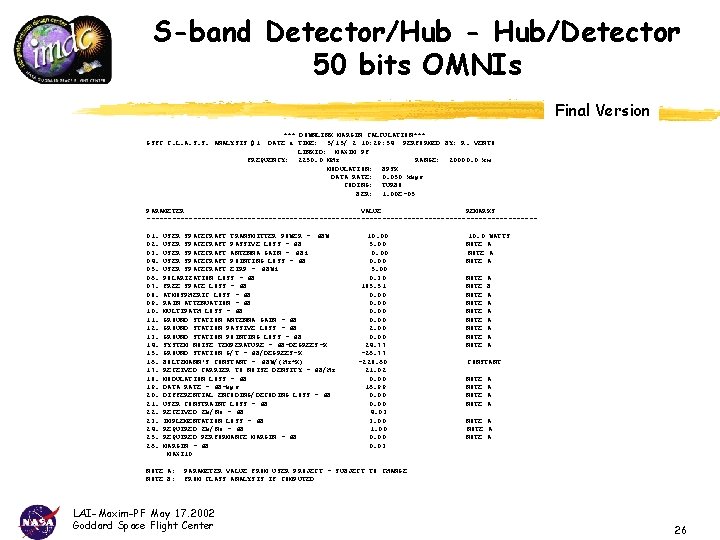
S-band Detector/Hub - Hub/Detector 50 bits OMNIs Final Version *** DOWNLINK MARGIN CALCULATION*** DATE & TIME: 5/15/ 2 10: 29: 54 PERFORMED BY: R. VENTO LINKID: MAXIM PF FREQUENCY: 2250. 0 MHz RANGE: 20000. 0 km MODULATION: BPSK DATA RATE: 0. 050 kbps CODING: TURBO BER: 1. 00 E-05 GSFC C. L. A. S. S. ANALYSIS #1 PARAMETER VALUE REMARKS ----------------------------------------------01. 02. 03. 04. 05. 06. 07. 08. 09. 10. 11. 12. 13. 14. 15. 16. 17. 18. 19. 20. 21. 22. 23. 24. 25. 26. USER SPACECRAFT TRANSMITTER POWER - d. BW USER SPACECRAFT PASSIVE LOSS - d. B USER SPACECRAFT ANTENNA GAIN - d. Bi USER SPACECRAFT POINTING LOSS - d. B USER SPACECRAFT EIRP - d. BWi POLARIZATION LOSS - d. B FREE SPACE LOSS - d. B ATMOSPHERIC LOSS - d. B RAIN ATTENUATION - d. B MULTIPATH LOSS - d. B GROUND STATION ANTENNA GAIN - d. B GROUND STATION PASSIVE LOSS - d. B GROUND STATION POINTING LOSS - d. B SYSTEM NOISE TEMPERATURE - d. B-DEGREES-K GROUND STATION G/T - d. B/DEGREES-K BOLTZMANN'S CONSTANT - d. BW/(Hz*K) RECEIVED CARRIER TO NOISE DENSITY - d. B/Hz MODULATION LOSS - d. B DATA RATE - d. B-bps DIFFERENTIAL ENCODING/DECODING LOSS - d. B USER CONSTRAINT LOSS - d. B RECEIVED Eb/No - d. B IMPLEMENTATION LOSS - d. B REQUIRED Eb/No - d. B REQUIRED PERFORMANCE MARGIN - d. B MAXI 10 NOTE A: NOTE B: 10. 00 5. 00 0. 30 185. 51 0. 00 24. 77 -26. 77 -228. 60 21. 02 0. 00 16. 99 0. 00 4. 03 3. 00 1. 00 0. 03 10. 0 WATTS NOTE A NOTE NOTE NOTE A B A A A A CONSTANT NOTE A A NOTE A PARAMETER VALUE FROM USER PROJECT - SUBJECT TO CHANGE FROM CLASS ANALYSIS IF COMPUTED LAI-Maxim-PF May 17. 2002 Goddard Space Flight Center 26
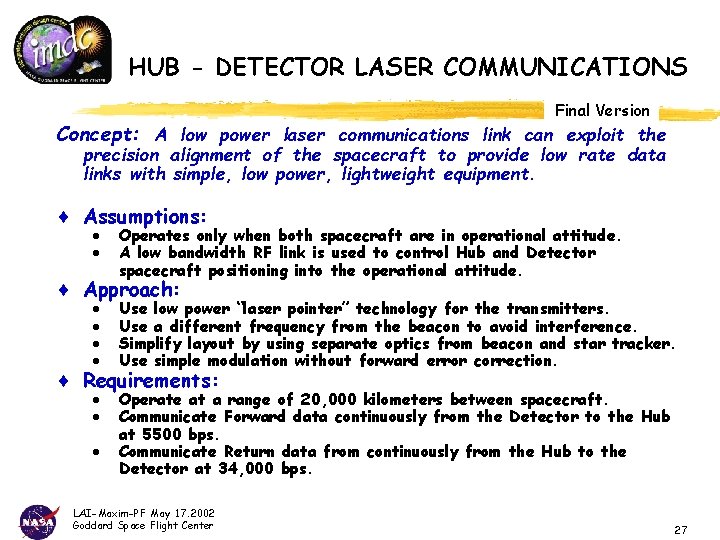
HUB - DETECTOR LASER COMMUNICATIONS Final Version Concept: A low power laser communications link can exploit the precision alignment of the spacecraft to provide low rate data links with simple, low power, lightweight equipment. ¨ Assumptions: · · Operates only when both spacecraft are in operational attitude. A low bandwidth RF link is used to control Hub and Detector spacecraft positioning into the operational attitude. ¨ Approach: · · Use low power “laser pointer” technology for the transmitters. Use a different frequency from the beacon to avoid interference. Simplify layout by using separate optics from beacon and star tracker. Use simple modulation without forward error correction. · · Operate at a range of 20, 000 kilometers between spacecraft. Communicate Forward data continuously from the Detector to the Hub at 5500 bps. Communicate Return data from continuously from the Hub to the Detector at 34, 000 bps. ¨ Requirements: · LAI-Maxim-PF May 17. 2002 Goddard Space Flight Center 27
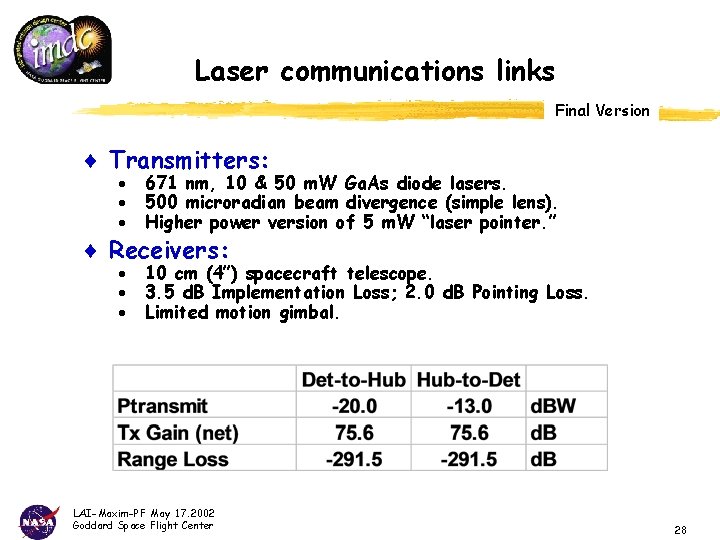
Laser communications links Final Version ¨ Transmitters: · · · 671 nm, 10 & 50 m. W Ga. As diode lasers. 500 microradian beam divergence (simple lens). Higher power version of 5 m. W “laser pointer. ” · · · 10 cm (4”) spacecraft telescope. 3. 5 d. B Implementation Loss; 2. 0 d. B Pointing Loss. Limited motion gimbal. ¨ Receivers: LAI-Maxim-PF May 17. 2002 Goddard Space Flight Center 28
WEIGHT AND POWER ESTIMATE Final Version Using parametric model and engineering estimates: Note: 10 m. W transmitter will require less power (< 100 m. W). LAI-Maxim-PF May 17. 2002 Goddard Space Flight Center 29
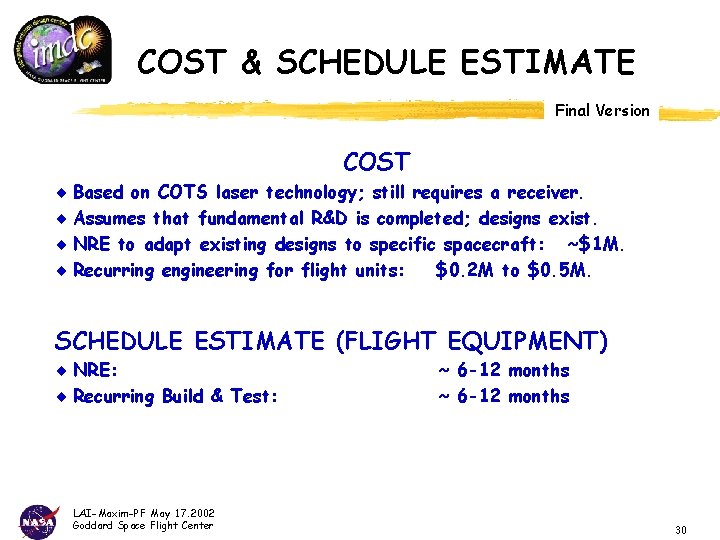
COST & SCHEDULE ESTIMATE Final Version COST ¨ Based on COTS laser technology; still requires a receiver. ¨ Assumes that fundamental R&D is completed; designs exist. ¨ NRE to adapt existing designs to specific spacecraft: ~$1 M. ¨ Recurring engineering for flight units: $0. 2 M to $0. 5 M. SCHEDULE ESTIMATE (FLIGHT EQUIPMENT) ¨ NRE: ¨ Recurring Build & Test: LAI-Maxim-PF May 17. 2002 Goddard Space Flight Center ~ 6 -12 months 30
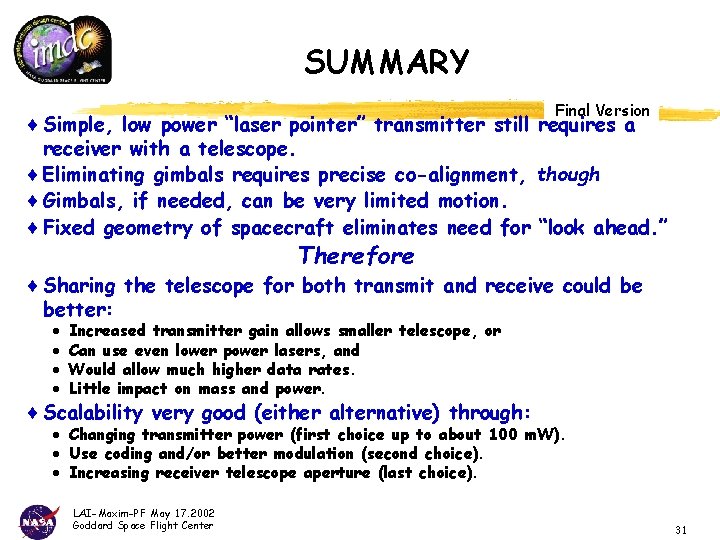
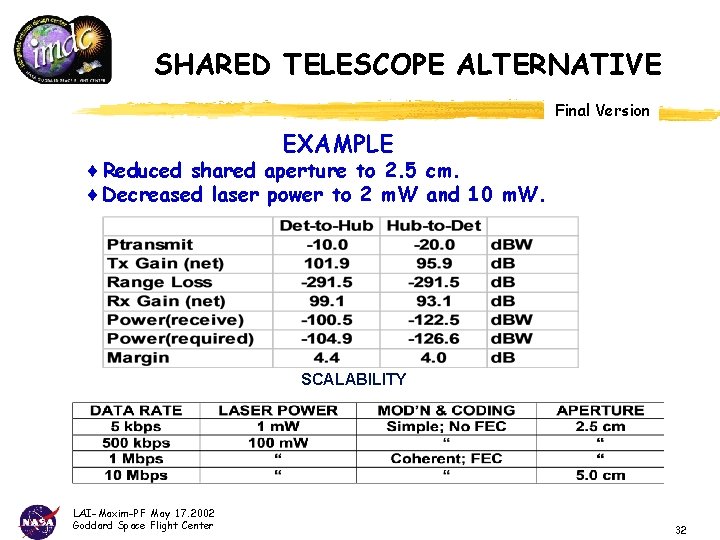
SUMMARY Final Version ¨ Simple, low power “laser pointer” transmitter still requires a receiver with a telescope. ¨ Eliminating gimbals requires precise co-alignment, though ¨ Gimbals, if needed, can be very limited motion. ¨ Fixed geometry of spacecraft eliminates need for “look ahead. ” Therefore ¨ Sharing the telescope for both transmit and receive could be better: · · Increased transmitter gain allows smaller telescope, or Can use even lower power lasers, and Would allow much higher data rates. Little impact on mass and power. ¨ Scalability very good (either alternative) through: · Changing transmitter power (first choice up to about 100 m. W). · Use coding and/or better modulation (second choice). · Increasing receiver telescope aperture (last choice). LAI-Maxim-PF May 17. 2002 Goddard Space Flight Center 31
SHARED TELESCOPE ALTERNATIVE Final Version EXAMPLE ¨ Reduced shared aperture to 2. 5 cm. ¨ Decreased laser power to 2 m. W and 10 m. W. SCALABILITY LAI-Maxim-PF May 17. 2002 Goddard Space Flight Center 32