
Microaggressions in The Classroom Dr Lyndsey Benharris and
Microaggressions in The Classroom Dr. Lyndsey Benharris and Dr. Danette Day Assistant Professors, Education Department
Learning Goals for this session. . . 1. Discuss racial/gender consciousness 2. Define and name some microaggressions in the classroom 3. Determine one’s role in the communication of microaggressions a. Perpetrators b. Targets c. Bystanders 4. Develop skills to combat microaggressions a. Make the ‘Invisible Visible’ b. Facilitate Discussion c. Create Safe Spaces for Marginalized Groups d. Share Power and Undue Privilege e. Promote Equity and Social Justice within your ‘Sphere of Influence’
Racial Consciousness Use the index card provided to answer the following question. Given the following racial identities, which one would you choose if given the opportunity to change your current identity? List three reasons for your choice. Asian American/Pacific Islander Black/African American Latinx/Hispanic American Native American White *If you choose to maintain your current identity, indicate three reasons why.
Microaggressions. . . ● Have you ever heard of microaggressions? ● Have you ever been involved in communication that you would label as microaggressions? If so, what role did you play in the microaggressions? ● When involved in a microaggression did you feel equipped to effectively respond? Why or why not?
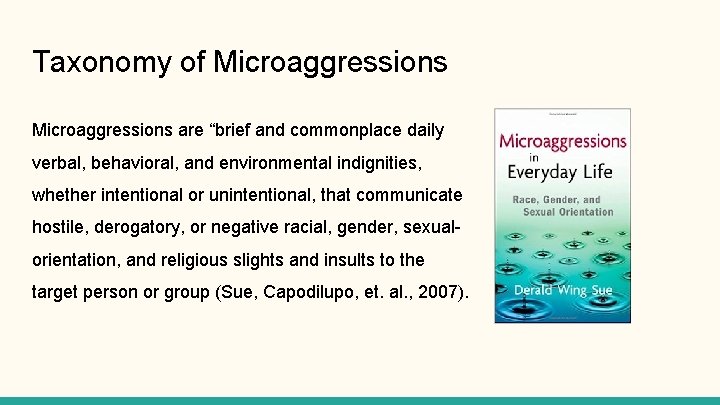
Taxonomy of Microaggressions are “brief and commonplace daily verbal, behavioral, and environmental indignities, whether intentional or unintentional, that communicate hostile, derogatory, or negative racial, gender, sexualorientation, and religious slights and insults to the target person or group (Sue, Capodilupo, et. al. , 2007).

Types of Microaggressions ● Microassaults - Conscious, deliberate, subtle or explicit attitudes, beliefs, or behaviors toward marginalized groups through cues, words or behaviors. ● Microinsults - Often unconscious communications that convey rudeness and insensitivity and demean a person’s racial heritage. ● Microinvalidations - Often unconscious communications that exclude, negate, or nullify the psychological thoughts, feelings, or experiential reality of a person of color. Sue, Capodilupo, et. al. , (2007)
Microaggressions in the Classroom
Unpacking Cambridge’s Minority Report 1. Write down one experience a student described that resonated with you and/or offended you. 2. What type of microaggression would you label the experience? 3. Discuss with a partner the following: ● ● ● What resonated with you? Why were you offended? After learning of these students’ experiences, in what ways might you acknowledge, influence, and improve their experiences? If one of these situations happened in your classroom, what would you do? What might you be afraid to do? Why?
Combating Microaggressions. . . Make the Invisible Visible: If microaggressions remain hidden, invisible, unspoken and excused as innocent slights with minimal harm, we will continue to insult, demean, alienate, and oppress marginalized groups. We must be aware of our own values, biases, and assumptions about our students and ourselves. According to Sue (2010) we must constantly ask ourselves the following questions: What does it mean to be White, Black/African American, Asian American/Pacific Islander, Latinx/Hispanic American, or Native American? Facilitate Dialogue: We must reach a working level of critical consciousness. We must possess a working definition and enlightened understanding of the cases, manifestations, and dynamics of racial microaggressions to engage in difficult dialogues on race. Create Safe Spaces: Be open with your students about your intentions to interrupt microaggressions so all students may feel safe and comfortable enough to learn in your classroom. Be honest about the work being difficult. Share the Power: Be humble tell students of your insecurities and fear. Encourage students to teach you and to teach one another. Find the Courage to Promote Social Justice and Equity: Spend your Privilege: Use your Sphere of Influence
Classroom Scenario: Control The Process Not The Content How would you respond if these statements were made during a heated debate in your classroom? Before class a student declares: “We Italians experienced severe discrimination when we arrived here. Did my family harp on the prejudice? We excelled despite the prejudice. Why? Because the basic founding principles of this country made it possible!” 1. Acknowledge the accuracy of statements when appropriate. 2. Intervene in the process rather than the content. 3. Help students see the difference between intention and impact. 4. Move to the feeling tone level of the communication.
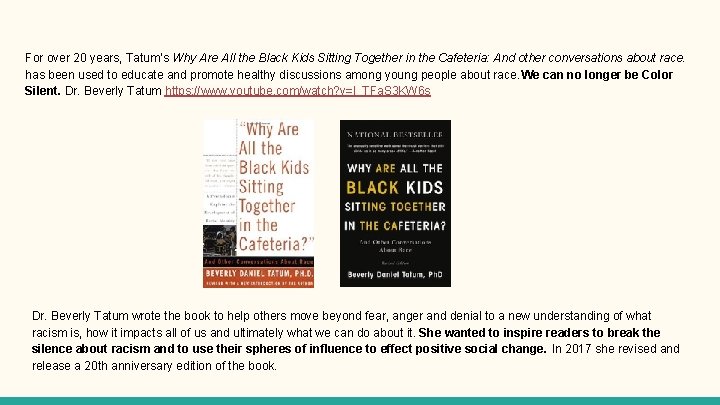
For over 20 years, Tatum’s Why Are All the Black Kids Sitting Together in the Cafeteria: And other conversations about race. has been used to educate and promote healthy discussions among young people about race. We can no longer be Color Silent. Dr. Beverly Tatum https: //www. youtube. com/watch? v=l_TFa. S 3 KW 6 s Dr. Beverly Tatum wrote the book to help others move beyond fear, anger and denial to a new understanding of what racism is, how it impacts all of us and ultimately what we can do about it. She wanted to inspire readers to break the silence about racism and to use their spheres of influence to effect positive social change. In 2017 she revised and release a 20 th anniversary edition of the book.
The Impacts “Countless examples of microaggressions are delivered daily without awareness of perpetrators. And while these actions may appear harmless or innocent in nature, they are nevertheless detrimental to recipients because they result in harmful psychological consequences and create disparities. Microaggressions sap the spiritual energies of recipients (Pierce, 1995), lead to low self-esteem (Franklin, 2004), and deplete or divert energy for adaptive functioning and problem solving (Dovidio & Gaertner, 2000). https: //www. youtube. com/watch? v=C 3 LFB 4 m. J 0 DI
Thank you! Any Questions? Brief Exit Ticket 1. What did you know about microaggressions prior to this session? 2. What new information did you learn today? 3. What additional information would like to learn? 4. What, if any, new strategies did you learn that you can apply to address microaggressions in the classroom?
- Slides: 13