
Micro Unit 4 Imperfect Competition Chapter 10 Pure
- Slides: 41
Micro Unit 4: Imperfect Competition Chapter 10 Pure Monopoly Characteristics of pure monopoly How a pure monopoly sets its profit-maximizing output and price Economic effects of monopoly Dilemma of regulation Price discrimination
Characteristics of Pure Monopoly Single seller—one firm industry; firm and industry are synonymous No close substitutes—buyers have no alternatives; unique product Price Maker—the monopolistic firm controls total supply. Monopolies can manipulate output to its advantage Blocked entry—economic, technological, legal Nonprice competition—sometimes done to increase demand What are some examples of monopolies? ?
Barriers to Entry Economies of Scale protect the monopolist from competition ◦ Financial obstacles and risks of “starting big” are prohibitive in such industries ◦ In a natural monopoly economies of scale are so great the product can be produced by one firm at a lower ATC than if the product were produced by more than one firm ◦ Most natural monopolies would set price above minimum ATC to max profit. As a result, govt. regulates price/output.
Barriers to Entry—con’t Legal barriers to entry ◦ Patents— 20 years on most products ◦ Licenses Ownership or control of essential resources— a firm owning or controlling a resource essential to the production process can prohibit the creation of rival firms. Strategic barriers—price cutting to drive out competition, distribution, technology. Bottom line: barriers are seldom complete, so pure monopolies are rare. (And sometimes, monopolies are desirable. )
Monopoly Demand Simplifying assumptions: ◦ The firm is not regulated. ◦ The firm is a single price monopolist—it charges the same price for all units of output. Marginal Revenue must be less than price! ◦ The monopolist faces a downward sloping demand curve. (Its demand curve is the market demand curve. ) ◦ Figure it out and graph it:
Because the monopolist must set a lower price to obtain greater sales, MR is less than Price for every level of output except the first. Each additional unit of output sold increases TR by an amount equal to its own price minus the sum of the price cuts which apply to all prior units of output. Key Idea: By controlling output (Q), the monopolist can indirectly control price. The monopolist always sets price in the elastic region of the D curve. The total revenue test explains why…
Output and Price Determination Profit Max: MR = MC ◦ Like the purely competitive firm, the monopoly will produce one more unit of output as long as that unit adds more to total revenue than to total cost. No supply curve for the monopoly. ◦ As a price maker, it sets price when it decides how much to produce. There’s no single, unique P associated with each level of Q. Losses are possible. ◦ Pure monopoly does not guarantee profit. ◦ Same shutdown point as pure competition.
Economic Effects of Monopoly Efficiency: Monopolies are neither productively efficient nor allocatively efficient. Monopolies produce less than society wants. ◦ Always where P > MC Monopolies are not incented to produce at min. ATC; P > min. ATC
More Economic Effects… Income Distribution: ◦ A monopoly contributes to inequality in income distribution. Think of the monopolist’s economic profit as a “private tax” on consumers (the many) which is then distributed to the firm’s owners/shareholders (the few. ) ◦ Consumers “overpay” and owners receive the windfall profits. ◦ Critical thinking check: what if the consumers are wealthier than the owners?
Cost complications—costs are not the same for monopolies and purely competitive firms. Benefits of economies of scale of the natural monopoly rarely offset society’s cost of the monopolist’s higher price and reduced output. Monopolist’s actual cost is greater then the lowest possible cost of production (they lack incentives. ) This is called X-inefficiency. ◦ Rent-seeking expenditures—costs of obtaining govt. approval or license to capture economic rent. ◦ little incentive to adopt cost-saving technology
Regulated Monopoly Natural monopolies are subject to government regulation (i. e. New York Public Service Commission—electric, gas, water, telecommunications, cable) The unregulated monopoly will produce at MR=MC, which results in an underallocation of resources to the product and a higher price. Dilemma of regulation: Which price should regulators impose? . . . (where to set price ceiling? )
Dilemma of regulation Socially Optimal Price: P=MC ◦ Allocative Efficiency ◦ Achieved with a Price Ceiling ◦ But what if this price ceiling is set below ATC? Fair Return Price: P=ATC ◦ Most regulatory commissions use this because the Supreme Court has ruled that regulators must permit a fair return to utility owners. ◦ At this price, the firm will realize a normal profit.
Price Discrimination Definition: the practice of selling a specific product at more than one price when the price differences are not justified by cost differences. Conditions necessary for price discrimination: ◦ A. Monopoly power—seller has some ability to control output and prices. ◦ B. Market segregation—seller must be able to divide buyers into different categories (often based on elasticities. ) ◦ C. No resale (which would result in competition)
Price Discrimination (con’t) Graph: Consequences of price discrimination: ◦ A. More profit! ◦ B. More production! ◦ C. For the perfectly discriminating monopolist, D = MR, so this type of monopolist is allocatively efficient (just like pure competition)
Chapter 11 Monopolistic Competition & Oligopoly Characteristics of Monopolistic Competition S/R and L/R models Oligopoly and Game Theory
What is monopolistic competition? Relatively large number of sellers ◦ Each seller has a small market share and minimal control of market price ◦ No collusion—output restriction and price setting don’t occur ◦ Independent action—each firm’s pricing policy has minimal influence on rivals.
Differentiated Products ◦ “unique” attributes—features, materials, design, workmanship ◦ Service ◦ Location (minimarts, gas stations, hotels) ◦ Branding and packaging ◦ Some control over price—sellers of favorable products may command slightly higher price
Easy Entry and Exit ◦ Not as easy as pure competition (brand names, patents, trademarks) ◦ Most monopolistic competitors are small; economies of scale are few
Nonprice Competition and Advertising ◦ The goal of nonprice competition is to make price less of a factor in consumer purchases ◦ If successful, nonprice competition shifts a demand curve to the right and makes it less (elastic/inelastic? ) ◦ Which market structure does the most advertising? ◦ Examples of monopolistic competition?
Monopolistic Competition: Price and Output Demand curve is between monopoly and pure competition and the degree of price elasticity depends on the number of rivals and degree of differentiation. (More rivals, less differentiation—close to pure competition. ) One educated guess as to where the firm will maximize profits? ?
MR = MC !! Profits or losses are possible in the short run, but in the long run… Only a normal profit! ◦ Economic profits lead to entry of new firms. As new firms enter, the demand curve faced by the typical firm will shift to the left (more close substitutes. ) ◦ Economic Losses lead to exit of firms.
Long Run Equilibrium: ATC tangent to the demand curve at output where MR=MC. ◦ Real world complications: firms do consistently earn economic profits. Rivals can’t duplicate the differentiation Differentiation acts as a barrier (financial/legal) to entry.
Economic Efficiency—NO! Monopolistic competition is neither productively nor allocatively efficient. ◦ P>min. ATC ◦ P>MC
Excess Productive Capacity—plant and equipment underused when firms produce at less than min. ATC. Result: many monopolistically competitive industries are overcrowded with firms producing below optimal capacity (retail, hotel vacancies, restaurants, barber chairs. )
Nonprice Competition ◦ In order to differentiate, firms advertise. Fixed cost: increases ATC Increases demand ◦ Differentiation provides consumers variety and satisfies diverse tastes. ◦ Differentiation may lead to product improvements and innovation.
Can you guess the industry? The largest firm in the industry has 42. 0% market share. Top 3 firms control 89% of market. Most consumers are brand loyal. It’s the “real thing” and “open happiness”
Which industry? The top firm controls 42% of the market, top 3 total 98% The previously ranked 3 rd & 4 th largest firms merged to become #2 Significant nonprice and price comp
Which industry? 3 firms control 81% of market; top 2 control 63% Large profit margins Lots of nonprice competition No single dominant firm Huge barriers to entry Lots of consumer choice
Last one… Since 1990, less oligopolistic Top 4 firms now control 58% compared to nearly 70% ten years ago Huge barriers to entry Huge advertisers You can easily name 10 companies.
Oligopoly Characteristics Rule of Thumb: 4 large firms control 70 -80% of market. Key Understanding: Some price control, but mutual interdependence & strategic behavior are key characteristics. ◦ Each firm sets its price, but must consider how its rivals will react to its strategy. Considerable nonprice competition.
Typically Huge Barriers to Entry: ◦ ◦ Economies of scale (aircraft, autos, ) Control of raw materials (mining, towers) Patents/technology (cell phones, copiers) Predatory practices (airlines, soft drinks) “Urge to merge” to gain economies of scale: Exxon+Mobil, Sears+Kmart, AT&T+Cingular, AT&T+Direct. TV, JPMorgan+Chase, USAirways+American, Sprint+T-Mobile, Disney+Fox, Tiffany+LVMH
Modeling Oligopolies Mutual interdependence creates complications for modeling this market structure. Without being able to predict actions of rivals, oligopolists can’t estimate D and MR. “Governing Dynamics: ” was Adam Smith wrong?
Game Theory: the study of how people behave in strategic situations Required: ◦ Players (we use two) ◦ Strategies (choices) available to each player (we use two) ◦ The payoffs each player receives Setting up the game—using a payoff matrix.
Finding a dominant strategy and/or Nash Equilibrium Dominant strategy—an option that is better than any alternative option regardless of what the other player does. Nash Equilibrium—an outcome from which neither player wants to deviate. The best choice given the action of the other player.
Find the dominant strategy CASE #1: Airbus and Boeing can both produce either 3 or 4 planes each week. If they both produce 4, they both earn $32 mil. If they both produce 3, they both earn $36 mil. If one produces 3 and the other produces 4, the one who produced 4 earns $40 mil. and the one who produced only 3 earns $30 mil.
CASE #2: Kimberly Clark and Proctor & Gamble can choose to spend on R&D or not. If both spend, PG will earn $45 mil. while KMB will earn $5 mil. If neither spends, PG earns $70 and KMB earns $30. If one spends and the other doesn’t, the spender earns $85 and the non-spender loses $10.
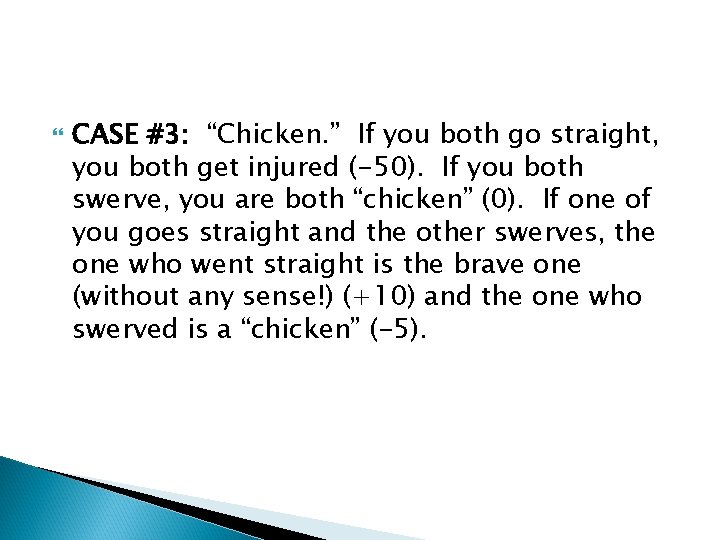
CASE #3: “Chicken. ” If you both go straight, you both get injured (-50). If you both swerve, you are both “chicken” (0). If one of you goes straight and the other swerves, the one who went straight is the brave one (without any sense!) (+10) and the one who swerved is a “chicken” (-5).
Cartels and Collusion Attempts to act as monopolies Collusion—firms reach agreement to fix prices, divide market, restrict competition (illegal!) Cartel—formal agreement among producers to limit production and control price (OPEC) ◦ Problem: incentive to cheat (cheater will earn more economic profit. )
Oligopoly Pricing In a stable economy, oligopolist prices are generally stable. ◦ Price, if it does change, tends to move “in concert. ” Kinked Demand Theory explains why prices are generally stable (not on AP exam) ◦ Rivals match or ignore price changes (steep vs. flat demand curves), which leads to the likely outcome that rivals will match price cuts and ignore price increases (key graph p. 229)
Kinked Demand Curve Price Inflexibility: ◦ Raising price results in losing customers (yikes!) ◦ Lowering price results in only small sales increases (so why bother? ) ◦ Changes in costs may not even cause a firm to change price (MR is vertical. )
Price Leadership Model One firm, usually the largest, initiates price changes and others follow. ◦ Infrequent price changes ◦ Limit Pricing—price may not be the profit maximizing price because that price may entice firms to enter the market ◦ Potential problem: price wars