
Micro Economics Part I Unit 2 Slide 1
- Slides: 26
Micro Economics Part I Unit 2 Slide 1 The desire for food is limited in every man by the narrow capacity of the human stomach; but the desire for the conveniences and ornaments of building, dress, equipage, and household furniture, seem to have no limit or boundary . Adam Smith, 1776 Created: 10/31/2021 by Jim Luke.
2 The Economic Problem Unlimited Wants but Scarce Resources 2005 -Aug-31
3 Key Definitions* Goods Anything that satisfies a human want Resources Land, Labor, Capital Consumption Use Goods to satisfy wants Production Combine resources to create goods 2005 -Aug-31
4 Nine Principles 2005 -Aug-31 4 Principles of Individual Choice 5 Principles of Markets
5 Individual Choice Principle: Scarcity Result of Economic Problem Both Resources & Time are Scarce 2005 -Aug-31
6 Individual Choice Principle: Opportunity Cost 2005 -Aug-31 Measured by value of best alternative givenup What could have been if this choice were not made
7 Individual Choice Principle: Marginal Decisions Marginal: the next unit, or the incremental unit Quantities are chosen marginally by comparing marginal benefits vs. marginal costs 2005 -Aug-31
8 Individual Choice Principle: Rational Decisions “Self-Interest” Individuals try to maximize the expected benefit, given constraints Assumed Rationality Voluntary, not Coerced 2005 -Aug-31
9 Market Principle: Trade is Win-Win Diversity creates opportunities for “gains from trade” Voluntary trade ONLY occurs if both parties gain 2005 -Aug-31
10 Market Principle: Equilibrium Given conditions, everybody is doing the best they can No incentive to change more precise definition later 2005 -Aug-31
11 Market Principle: Social Goal: Efficiency Making the most of limited resources Economic Efficiency “Pareto Optimal” “Allocation” efficiency Efficient Production Max Output, Given Current Resources 2005 -Aug-31 What about Equity?
12 Market Principle: Markets are Efficient Competitive markets achieve greatest efficiency Exceptions: monopoly externalities public goods 2005 -Aug-31
13 Market Principle: Government Role Sets the “rules” Enforce Contracts Public goods Correct market “failures” 2005 -Aug-31
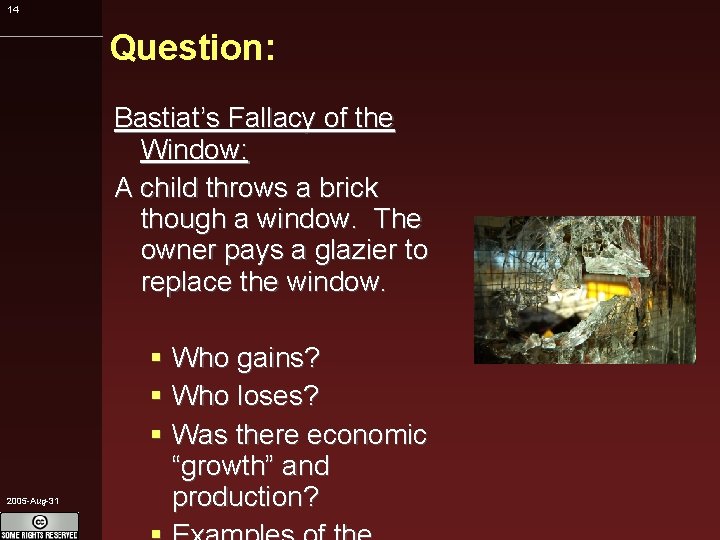
14 Question: Bastiat’s Fallacy of the Window: A child throws a brick though a window. The owner pays a glazier to replace the window. 2005 -Aug-31 Who gains? Who loses? Was there economic “growth” and production?
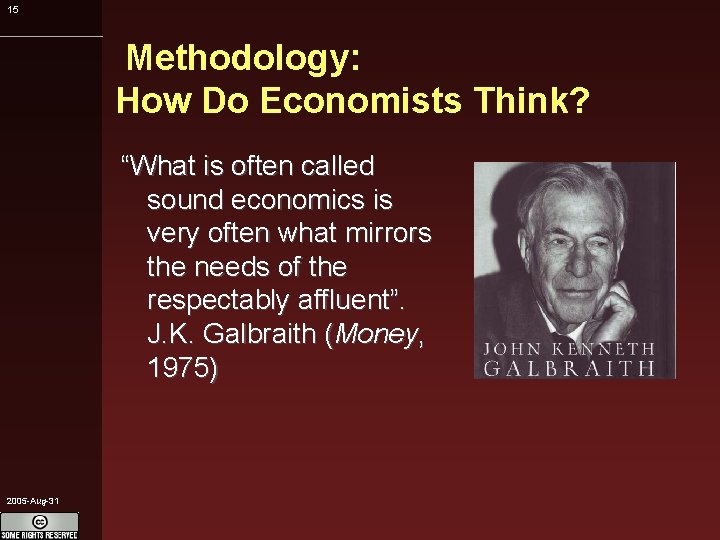
15 Methodology: How Do Economists Think? “What is often called sound economics is very often what mirrors the needs of the respectably affluent”. J. K. Galbraith (Money, 1975) 2005 -Aug-31
16 Economic Theories: Models Simplied “If…. . then…. ” Predict Behavior Key Factors Only Too Many Details Unwieldy Aim to Explain Stories, Graphs, Data, Math 2005 -Aug-31
17 Economic Activities & Interactions Economic Agents: Households Firms Where they interact: Markets for goods and services Markets for factors of production
18 Positive vs. Normative Economics Theory & Positive Economics Evidence Supports/Denies Conditional Forecasts “ceteris paribus” How things work/ What “is” Policy & Normative Economics Change Rules What to do / What “should” 2005 -Aug-31
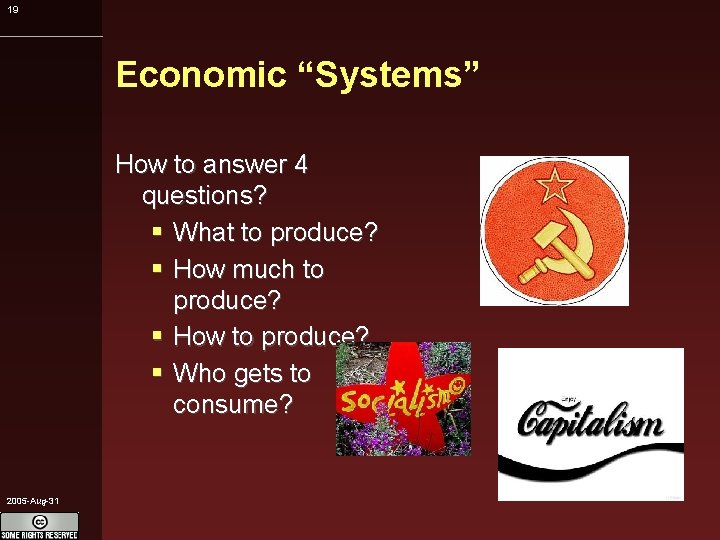
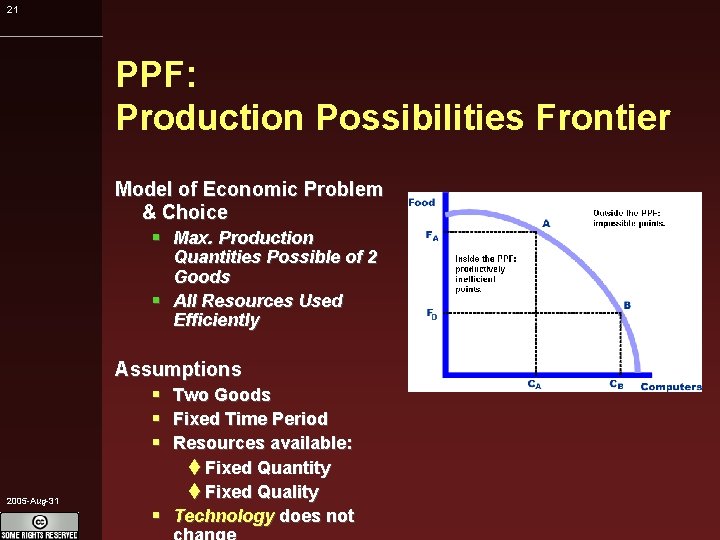
19 Economic “Systems” How to answer 4 questions? What to produce? How much to produce? How to produce? Who gets to consume? 2005 -Aug-31
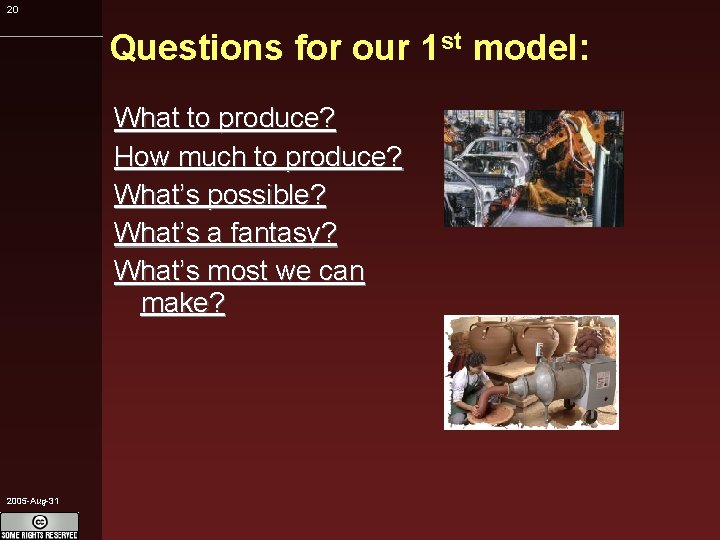
20 Questions for our 1 st model: What to produce? How much to produce? What’s possible? What’s a fantasy? What’s most we can make? 2005 -Aug-31
21 PPF: Production Possibilities Frontier Model of Economic Problem & Choice Max. Production Quantities Possible of 2 Goods All Resources Used Efficiently 2005 -Aug-31 Assumptions Two Goods Fixed Time Period Resources available: Fixed Quantity Fixed Quality Technology does not
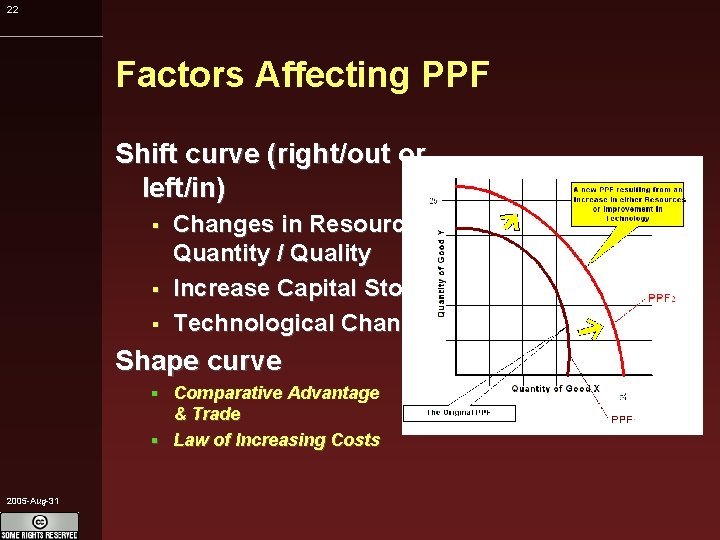
22 Factors Affecting PPF Shift curve (right/out or left/in) Changes in Resource Quantity / Quality Increase Capital Stock Technological Change Shape curve Comparative Advantage & Trade Law of Increasing Costs 2005 -Aug-31
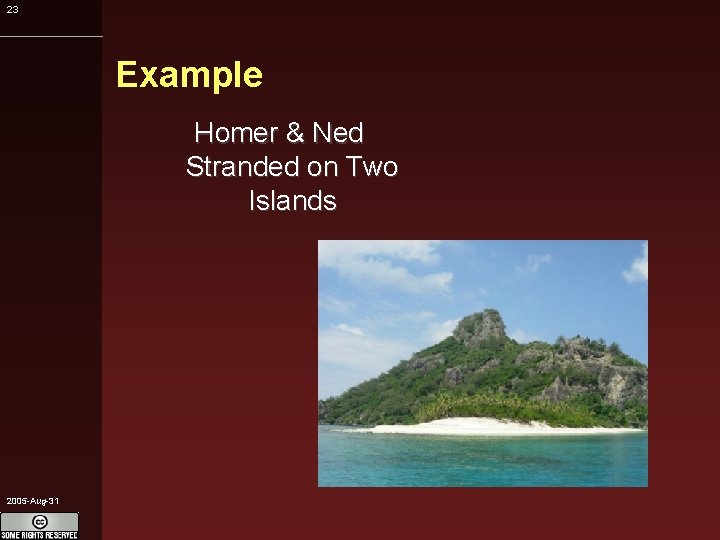
23 Example Homer & Ned Stranded on Two Islands 2005 -Aug-31
24 PPF Model Illustrates Opportunity Costs Gains from Trade and Specialization 2005 -Aug-31
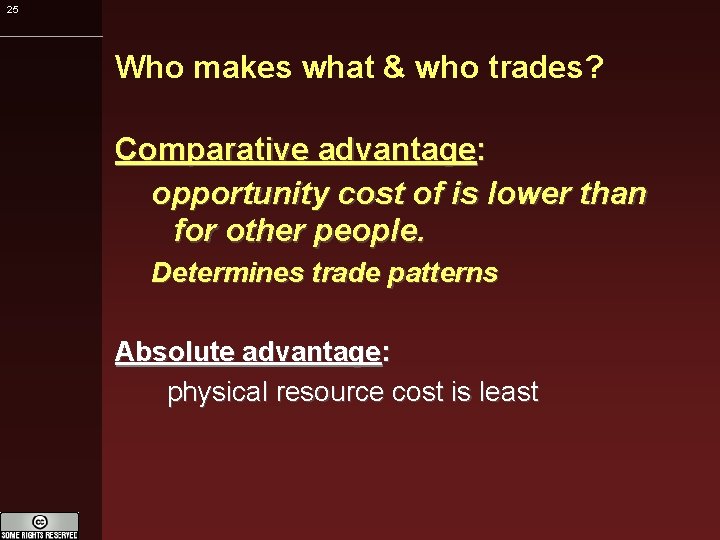
25 Who makes what & who trades? Comparative advantage: opportunity cost of is lower than for other people. Determines trade patterns Absolute advantage: physical resource cost is least
26 In the next unit: When trade happens…. How is price determined? How is the quantity traded determined?