
Michigan State University Budget Finance Basics September 10
Michigan State University Budget & Finance Basics September 10, 2020 Brent Johnston University Budget Officer Office of Budget, Planning, and Analysis 1

Table of Contents Introduction Summary and Overview Financial Structure Budget Planning Endowment & Endowment Spending Resources & Contacts 2
Introduction Purpose & Agenda To provide an overview of the financial structure, policies, processes, and language as you assume financial responsibility for your unit 1) 2) 3) 4) 5) 6) 7) Fund account structure Sub-funds/object codes Some specifics on the general fund Object codes Budget and planning Endowment spending Resources and contacts Budget & Finance Basics Administrative and Finance Functions 3
Introduction Who Can Help? David Byelich Associate Vice President and Director Office of Planning and Budgets 517 -355 -9271 Byelich@msu. edu Brent Johnston University Budget Officer Budget Planning and Analysis Office of Planning and Budgets 517 -353 -5519 john 1096@msu. edu Barbara Kranz Director Facilities Planning and Space Management Office of Planning and Budgets 517 -355 -9271 kranzb@opb. msu. edu Bethan Cantwell Director Institutional Studies Office of Planning and Budgets 517 -355 -9273 cantwellb@msu. edu Budget & Finance Basics Greg Deppong University Controller Office of the Controller 517 -355 -5020 deppong@msu. edu Debbie Gulliver University Travel Manager Officer of the Controller 517 -355 -5000 gullive 5@cltr. msu. edu Valerie Noel Assistant Budget Officer PA, OCCI, RBI, RFA 517 -432 -0219 thebeau@msu. edu John Thelen Assistant Controller Financial Analysis 517 -884 -4197 thelen 43@ctlr. msu. edu Kara Yermak Assistant Director AP/AVP for Academic Human Resources 517 -884 -0185 burtkara@provost. msu. edu Bill Buddle Assistant Budget Officer Planning Analytics Operations 517 -432 -5319 buddlewi@msu. edu Lee Hunter Chief Accountant & Manager of Financial Reporting Office of the Controller 517 -355 -9271 hunerti@msu. edu Katie Cook Director Office of Sponsored Programs 517 -884 -4237 farrkat 1@osp. msu. edu Evo Pedawi Director Contracts and Grants Post Award 517 -884 -4234 pedawi@cga. msu. edu Rebecca Yauch Assistant Director Human Resources 517 -884 -0115 ryauch@hr. msu. edu Charmaine Shellman Assistant Budget Officer Allocations & Resource Management 517 -355 -4503 cshellma@msu. edu Rati Walther Financial Analyst Budget, Planning, and Analysis 517 -353 -0864 walthe 19@msu. edu 4
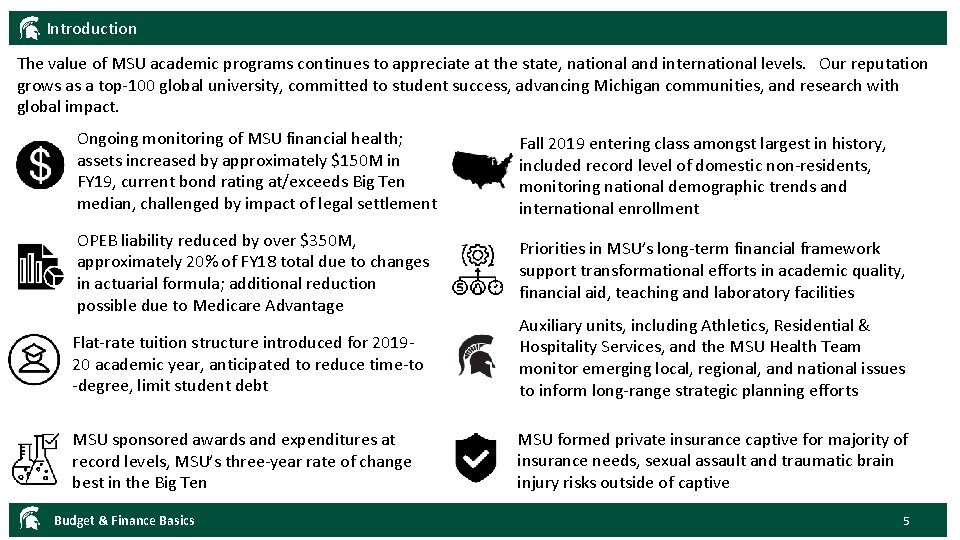
Introduction The value of MSU academic programs continues to appreciate at the state, national and international levels. Our reputation grows as a top-100 global university, committed to student success, advancing Michigan communities, and research with global impact. Ongoing monitoring of MSU financial health; assets increased by approximately $150 M in FY 19, current bond rating at/exceeds Big Ten median, challenged by impact of legal settlement Fall 2019 entering class amongst largest in history, included record level of domestic non-residents, monitoring national demographic trends and international enrollment OPEB liability reduced by over $350 M, approximately 20% of FY 18 total due to changes in actuarial formula; additional reduction possible due to Medicare Advantage Priorities in MSU’s long-term financial framework support transformational efforts in academic quality, financial aid, teaching and laboratory facilities Flat-rate tuition structure introduced for 201920 academic year, anticipated to reduce time-to -degree, limit student debt Auxiliary units, including Athletics, Residential & Hospitality Services, and the MSU Health Team monitor emerging local, regional, and national issues to inform long-range strategic planning efforts MSU sponsored awards and expenditures at record levels, MSU’s three-year rate of change best in the Big Ten MSU formed private insurance captive for majority of insurance needs, sexual assault and traumatic brain injury risks outside of captive Budget & Finance Basics 5

Table of Contents Introduction Financial Structure Budget Planning Endowment & Endowment Spending Resources & Contacts 6
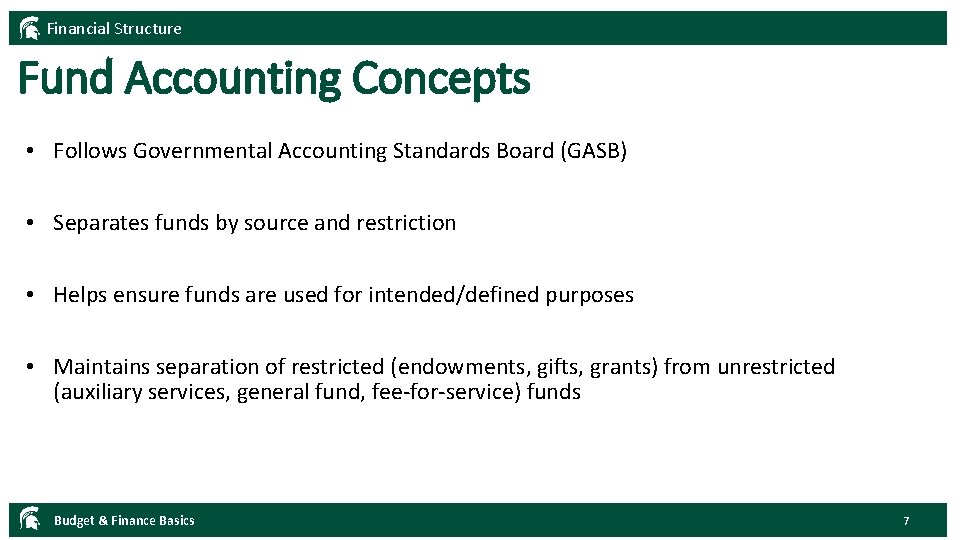
Financial Structure Fund Accounting Concepts • Follows Governmental Accounting Standards Board (GASB) • Separates funds by source and restriction • Helps ensure funds are used for intended/defined purposes • Maintains separation of restricted (endowments, gifts, grants) from unrestricted (auxiliary services, general fund, fee-for-service) funds Budget & Finance Basics 7
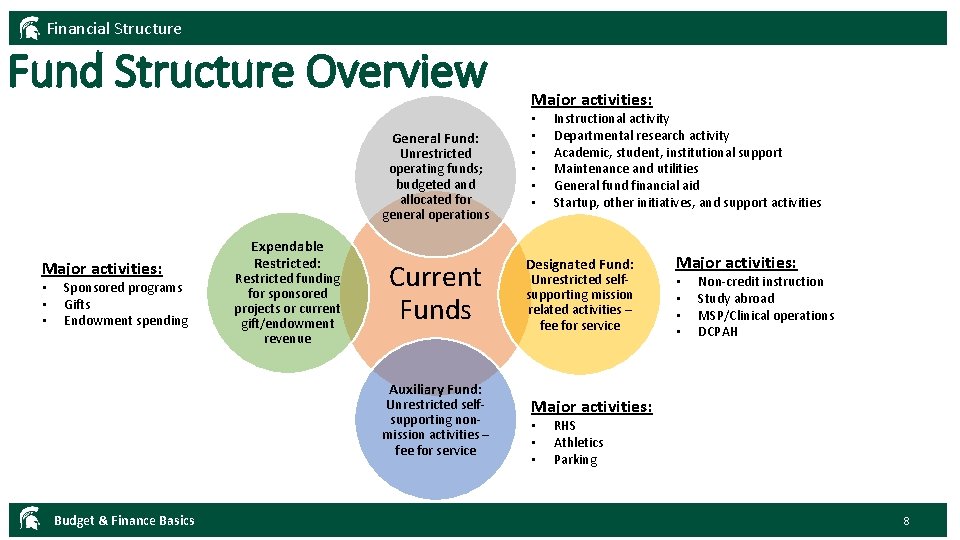
Financial Structure Fund Structure Overview General Fund: Unrestricted operating funds; budgeted and allocated for general operations Major activities: • • • Sponsored programs Gifts Endowment spending Expendable Restricted: Restricted funding for sponsored projects or current gift/endowment revenue Current Funds Auxiliary Fund: Unrestricted selfsupporting nonmission activities – fee for service Budget & Finance Basics Major activities: • • • Instructional activity Departmental research activity Academic, student, institutional support Maintenance and utilities General fund financial aid Startup, other initiatives, and support activities Designated Fund: Unrestricted selfsupporting mission related activities – fee for service Major activities: • • Non-credit instruction Study abroad MSP/Clinical operations DCPAH Major activities: • • • RHS Athletics Parking 8
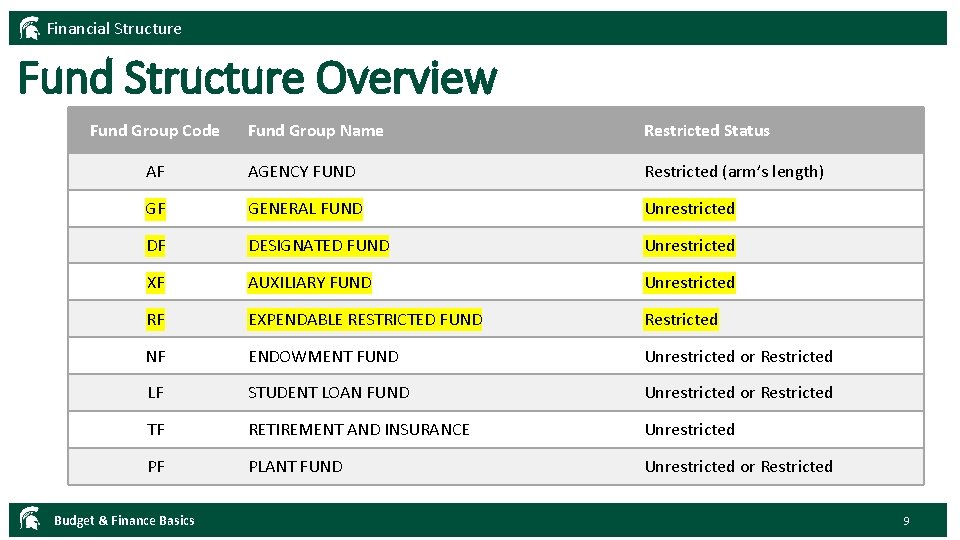
Financial Structure Fund Structure Overview Fund Group Code Fund Group Name Restricted Status AF AGENCY FUND Restricted (arm’s length) GF GENERAL FUND Unrestricted DF DESIGNATED FUND Unrestricted XF AUXILIARY FUND Unrestricted RF EXPENDABLE RESTRICTED FUND Restricted NF ENDOWMENT FUND Unrestricted or Restricted LF STUDENT LOAN FUND Unrestricted or Restricted TF RETIREMENT AND INSURANCE Unrestricted PF PLANT FUND Unrestricted or Restricted Budget & Finance Basics 9
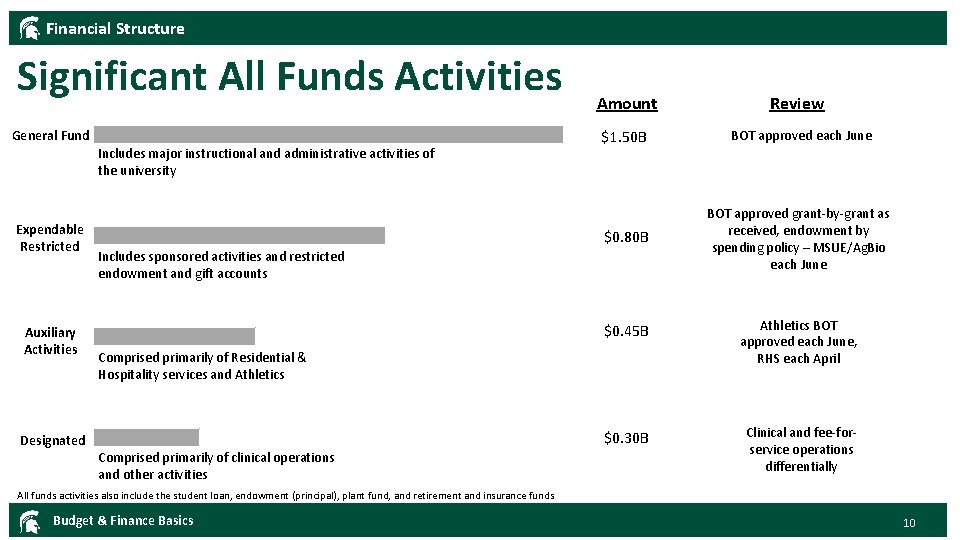
Financial Structure Significant All Funds Activities General Fund Includes major instructional and administrative activities of the university Expendable Restricted Auxiliary Activities Designated Amount $1. 50 B BOT approved each June $0. 80 B BOT approved grant-by-grant as received, endowment by spending policy – MSUE/Ag. Bio each June Includes sponsored activities and restricted endowment and gift accounts $0. 45 B Athletics BOT approved each June, RHS each April $0. 30 B Clinical and fee-forservice operations differentially Comprised primarily of Residential & Hospitality services and Athletics Comprised primarily of clinical operations and other activities Review All funds activities also include the student loan, endowment (principal), plant fund, and retirement and insurance funds Budget & Finance Basics 10
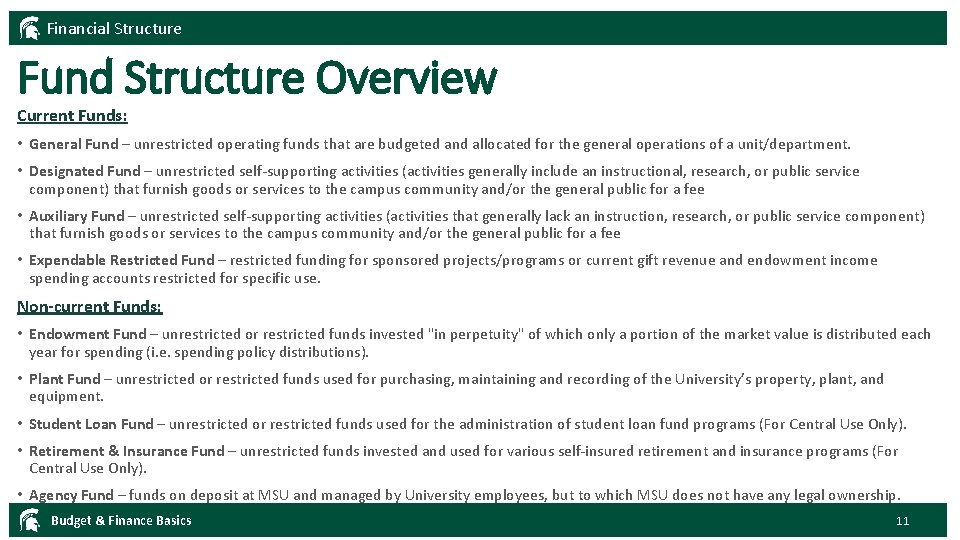
Financial Structure Fund Structure Overview Current Funds: • General Fund – unrestricted operating funds that are budgeted and allocated for the general operations of a unit/department. • Designated Fund – unrestricted self-supporting activities (activities generally include an instructional, research, or public service component) that furnish goods or services to the campus community and/or the general public for a fee • Auxiliary Fund – unrestricted self-supporting activities (activities that generally lack an instruction, research, or public service component) that furnish goods or services to the campus community and/or the general public for a fee • Expendable Restricted Fund – restricted funding for sponsored projects/programs or current gift revenue and endowment income spending accounts restricted for specific use. Non-current Funds: • Endowment Fund – unrestricted or restricted funds invested "in perpetuity" of which only a portion of the market value is distributed each year for spending (i. e. spending policy distributions). • Plant Fund – unrestricted or restricted funds used for purchasing, maintaining and recording of the University’s property, plant, and equipment. • Student Loan Fund – unrestricted or restricted funds used for the administration of student loan fund programs (For Central Use Only). • Retirement & Insurance Fund – unrestricted funds invested and used for various self-insured retirement and insurance programs (For Central Use Only). • Agency Fund – funds on deposit at MSU and managed by University employees, but to which MSU does not have any legal ownership. Budget & Finance Basics 11
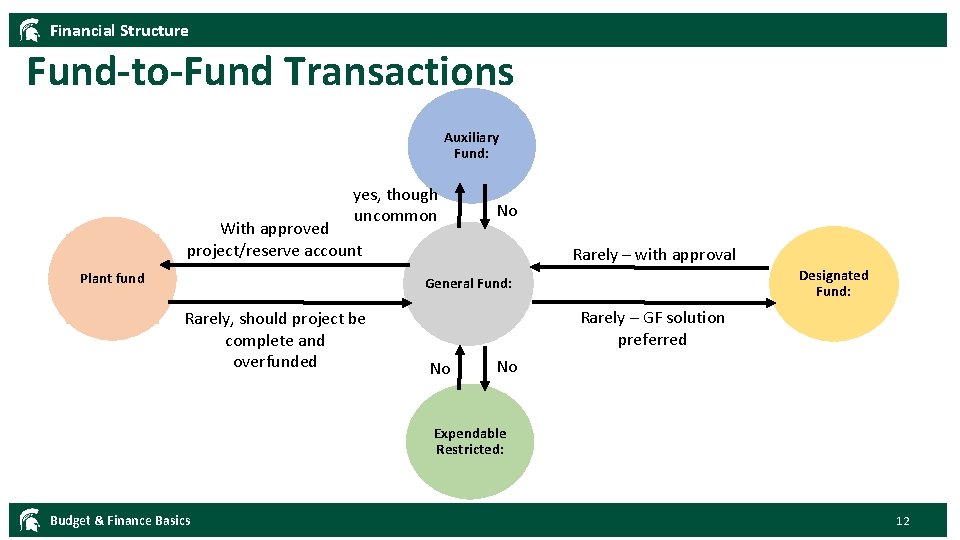
Financial Structure Fund-to-Fund Transactions Auxiliary Fund: yes, though uncommon With approved project/reserve account Plant fund No Rarely – with approval Designated Fund: General Fund: Rarely, should project be complete and overfunded Rarely – GF solution preferred No No Expendable Restricted: Budget & Finance Basics 12 12
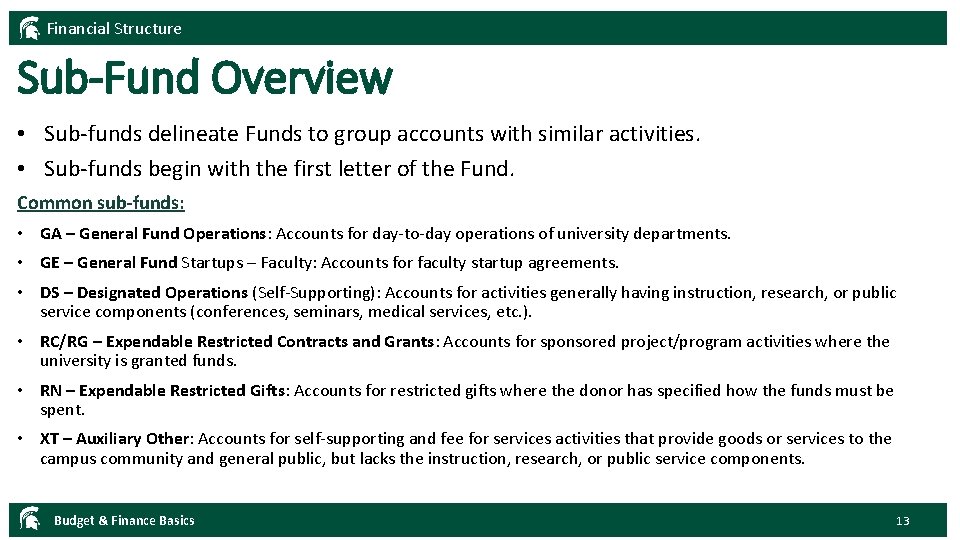
Financial Structure Sub-Fund Overview • Sub-funds delineate Funds to group accounts with similar activities. • Sub-funds begin with the first letter of the Fund. Common sub-funds: • GA – General Fund Operations: Accounts for day-to-day operations of university departments. • GE – General Fund Startups – Faculty: Accounts for faculty startup agreements. • DS – Designated Operations (Self-Supporting): Accounts for activities generally having instruction, research, or public service components (conferences, seminars, medical services, etc. ). • RC/RG – Expendable Restricted Contracts and Grants: Accounts for sponsored project/program activities where the university is granted funds. • RN – Expendable Restricted Gifts: Accounts for restricted gifts where the donor has specified how the funds must be spent. • XT – Auxiliary Other: Accounts for self-supporting and fee for services activities that provide goods or services to the campus community and general public, but lacks the instruction, research, or public service components. Budget & Finance Basics 13
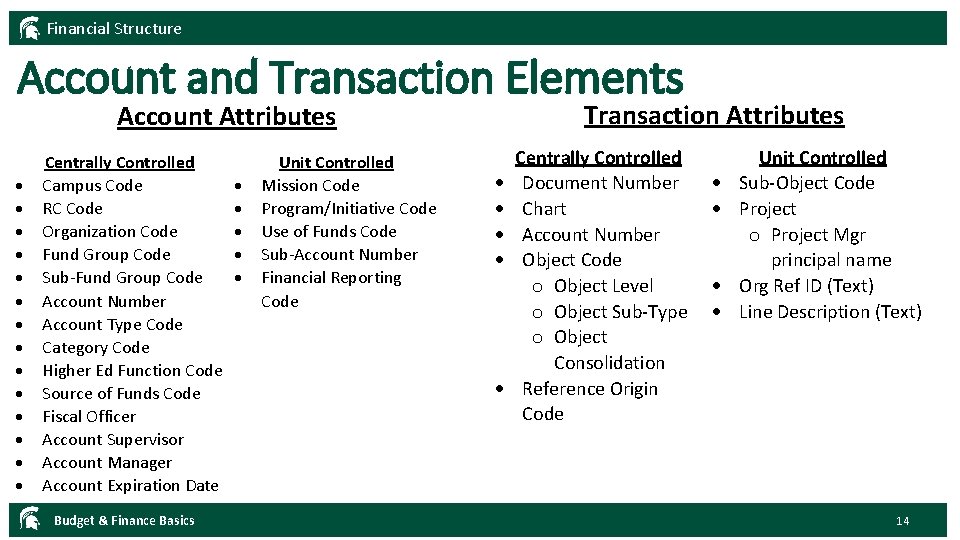
Financial Structure Account and Transaction Elements Transaction Attributes Account Attributes Centrally Controlled Campus Code RC Code Organization Code Fund Group Code Sub-Fund Group Code Account Number Account Type Code Category Code Higher Ed Function Code Source of Funds Code Fiscal Officer Account Supervisor Account Manager Account Expiration Date Budget & Finance Basics Unit Controlled Mission Code Program/Initiative Code Use of Funds Code Sub-Account Number Financial Reporting Code Centrally Controlled Document Number Chart Account Number Object Code o Object Level o Object Sub-Type o Object Consolidation Reference Origin Code Unit Controlled Sub-Object Code Project o Project Mgr principal name Org Ref ID (Text) Line Description (Text) 14
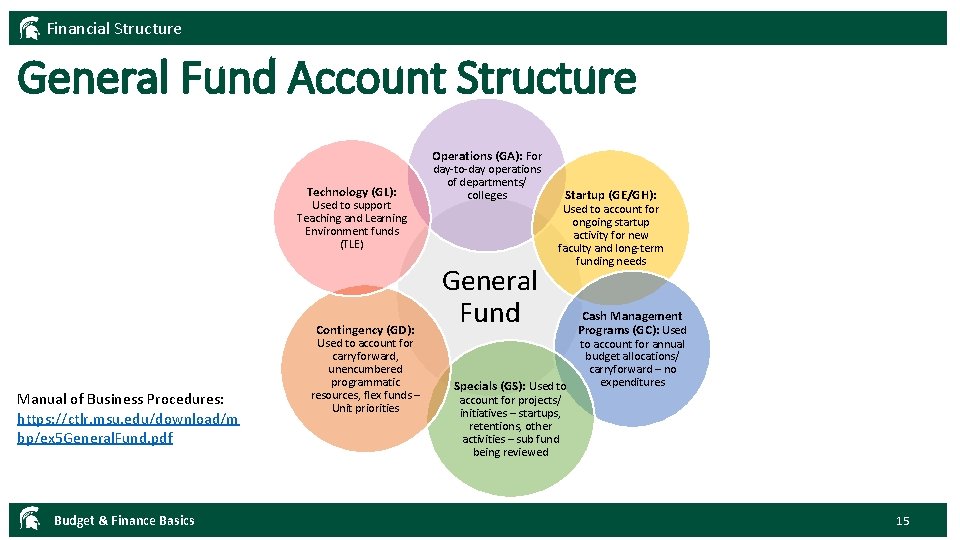
Financial Structure General Fund Account Structure Operations (GA): For Technology (GL): Used to support Teaching and Learning Environment funds (TLE) Contingency (GD): Manual of Business Procedures: https: //ctlr. msu. edu/download/m bp/ex 5 General. Fund. pdf Budget & Finance Basics Used to account for carryforward, unencumbered programmatic resources, flex funds – Unit priorities day-to-day operations of departments/ colleges General Fund Startup (GE/GH): Used to account for ongoing startup activity for new faculty and long-term funding needs Specials (GS): Used to Cash Management Programs (GC): Used to account for annual budget allocations/ carryforward – no expenditures account for projects/ initiatives – startups, retentions, other activities – sub fund being reviewed 15
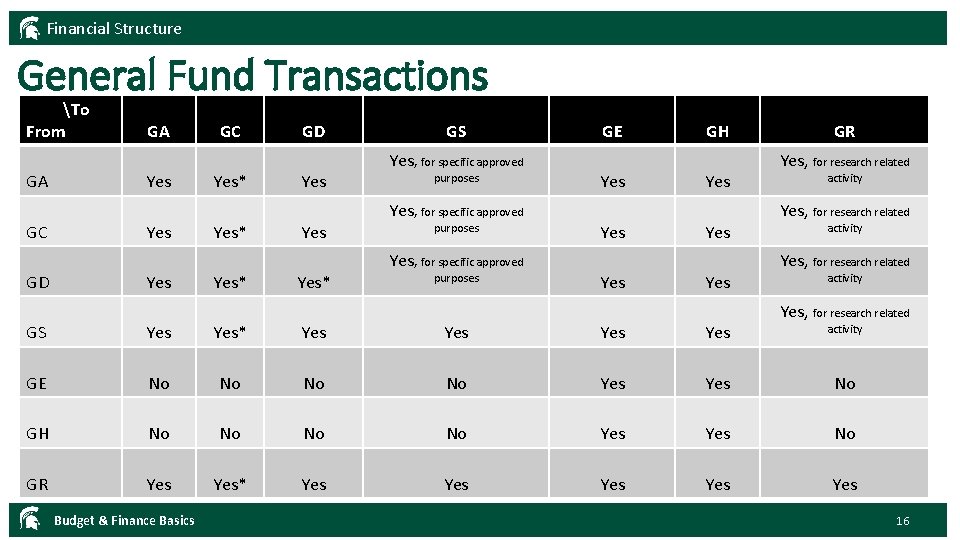
Financial Structure General Fund Transactions To From GA GC GD GA Yes Yes GC Yes* GD Yes Yes* GS Yes, for specific approved purposes GE Yes Yes GH Yes Yes GR Yes, for research related activity Yes, for research related GS Yes* Yes Yes GE No No Yes No GH No No Yes No GR Yes* Yes Yes Yes Budget & Finance Basics activity 16
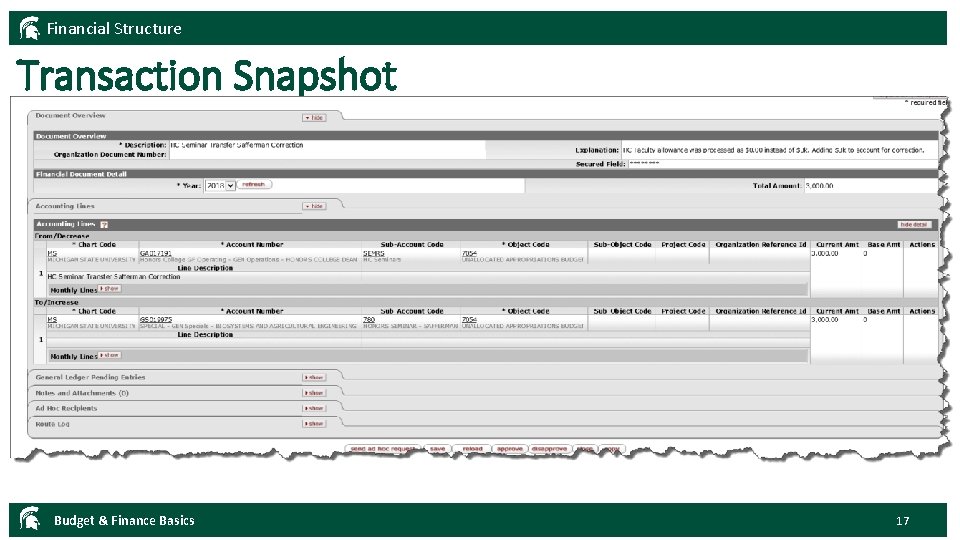
Financial Structure Transaction Snapshot Budget & Finance Basics 17
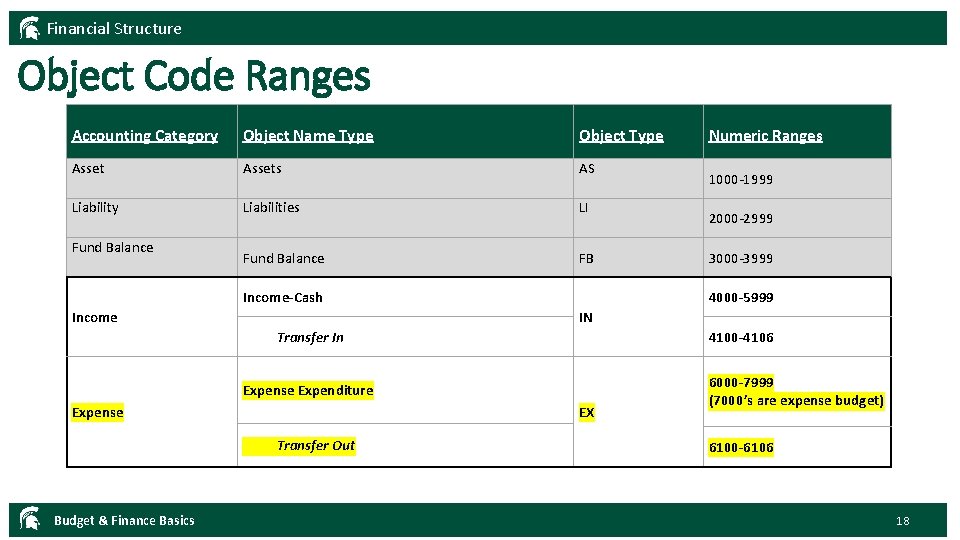
Financial Structure Object Code Ranges Accounting Category Object Name Type Object Type Assets AS Liability Liabilities LI Fund Balance FB Fund Balance Income-Cash Income 1000 -1999 2000 -2999 3000 -3999 4000 -5999 IN Transfer In 4100 -4106 Expense Expenditure Expense EX Transfer Out Budget & Finance Basics Numeric Ranges 6000 -7999 (7000’s are expense budget) 6100 -6106 18
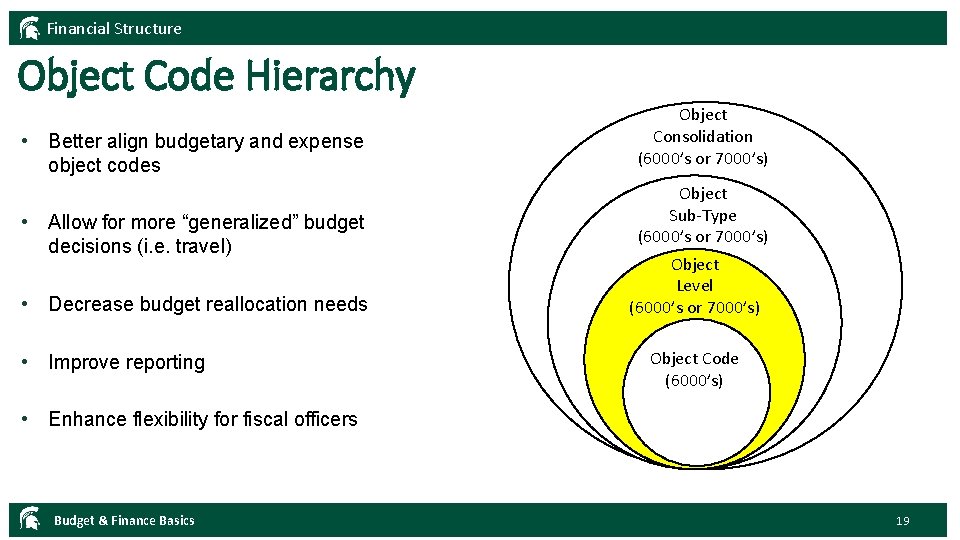
Financial Structure Object Code Hierarchy • Better align budgetary and expense object codes • Allow for more “generalized” budget decisions (i. e. travel) • Decrease budget reallocation needs • Improve reporting Object Consolidation (6000’s or 7000’s) Object Sub-Type (6000’s or 7000’s) Object Level (6000’s or 7000’s) Object Code (6000’s) • Enhance flexibility for fiscal officers Budget & Finance Basics 19

Table of Contents Introduction Financial Structure Budget Planning Endowment & Endowment Spending Resources & Contacts 20
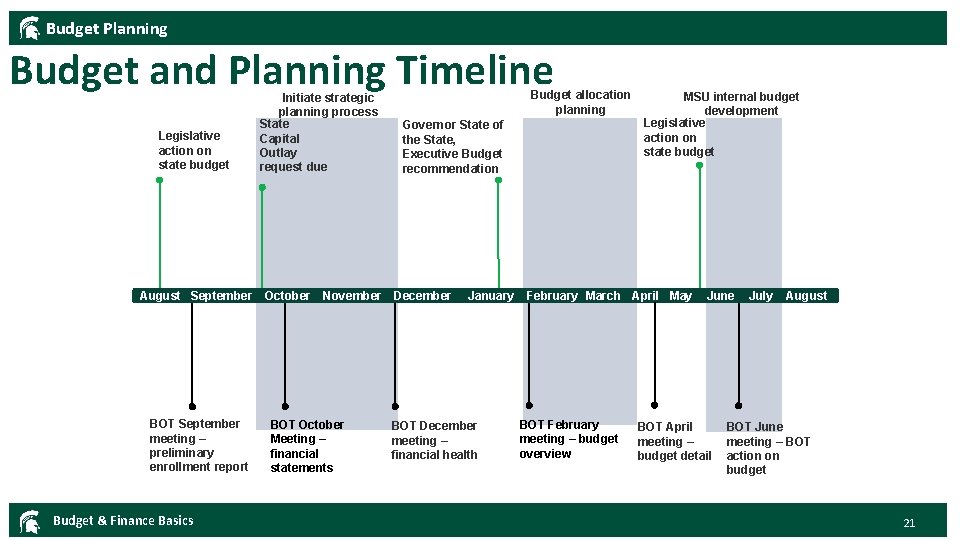
Budget Planning Budget and Planning Timeline Legislative action on state budget August September BOT September meeting – preliminary enrollment report Budget & Finance Basics Initiate strategic planning process State Capital Outlay request due October November BOT October Meeting – financial statements Budget allocation planning Governor State of the State, Executive Budget recommendation December January BOT December meeting – financial health MSU internal budget development Legislative action on state budget February March April May BOT February meeting – budget overview June BOT April meeting – budget detail July August BOT June meeting – BOT action on budget 21
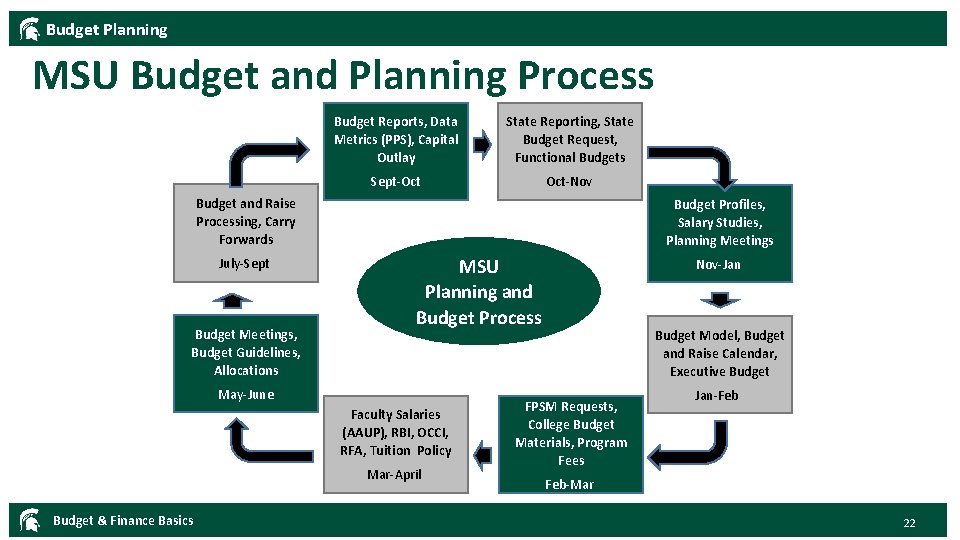
Budget Planning MSU Budget and Planning Process Budget Reports, Data Metrics (PPS), Capital Outlay State Reporting, State Budget Request, Functional Budgets Sept-Oct Oct-Nov Budget and Raise Processing, Carry Forwards July-Sept Budget Meetings, Budget Guidelines, Allocations Budget Profiles, Salary Studies, Planning Meetings MSU Planning and Budget Process May-June Faculty Salaries (AAUP), RBI, OCCI, RFA, Tuition Policy Mar-April Budget & Finance Basics Nov-Jan Budget Model, Budget and Raise Calendar, Executive Budget FPSM Requests, College Budget Materials, Program Fees Jan-Feb Feb-Mar 22
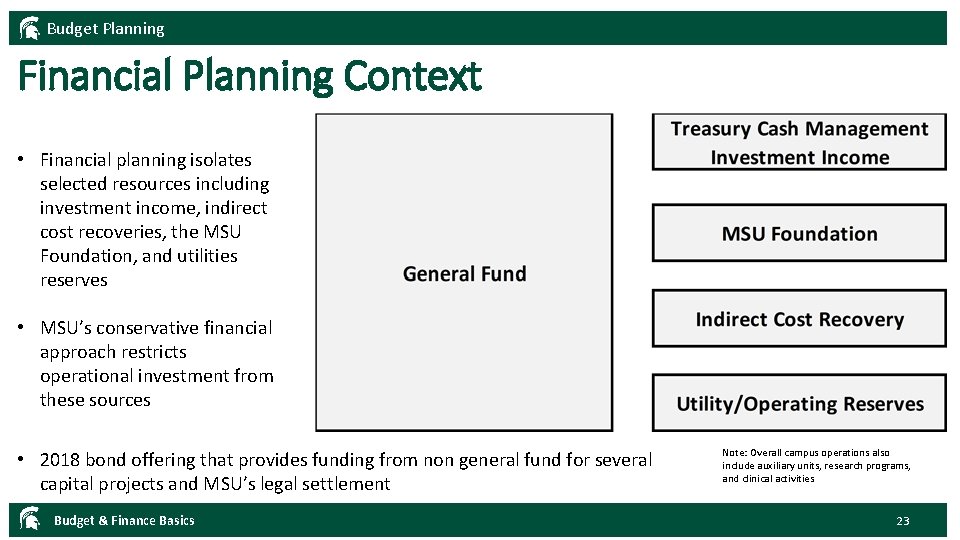
Budget Planning Financial Planning Context • Financial planning isolates selected resources including investment income, indirect cost recoveries, the MSU Foundation, and utilities reserves • MSU’s conservative financial approach restricts operational investment from these sources • 2018 bond offering that provides funding from non general fund for several capital projects and MSU’s legal settlement Budget & Finance Basics Note: Overall campus operations also include auxiliary units, research programs, and clinical activities 23
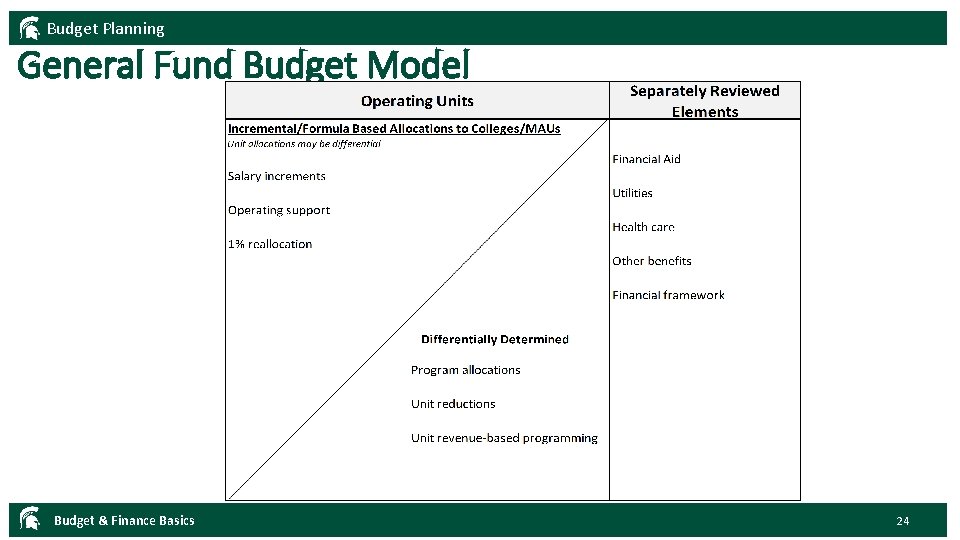
Budget Planning General Fund Budget Model Budget & Finance Basics 24
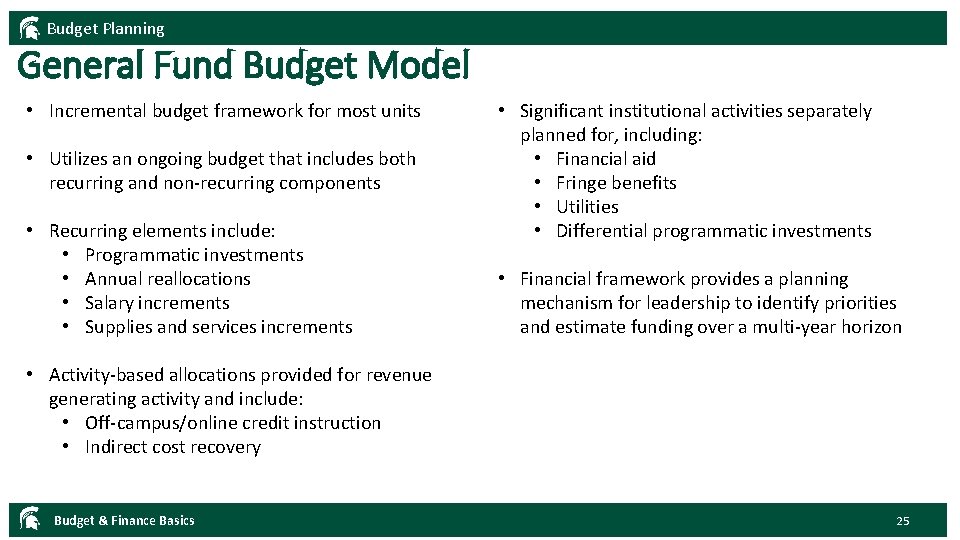
Budget Planning General Fund Budget Model • Incremental budget framework for most units • Utilizes an ongoing budget that includes both recurring and non-recurring components • Recurring elements include: • Programmatic investments • Annual reallocations • Salary increments • Supplies and services increments • Significant institutional activities separately planned for, including: • Financial aid • Fringe benefits • Utilities • Differential programmatic investments • Financial framework provides a planning mechanism for leadership to identify priorities and estimate funding over a multi-year horizon • Activity-based allocations provided for revenue generating activity and include: • Off-campus/online credit instruction • Indirect cost recovery Budget & Finance Basics 25
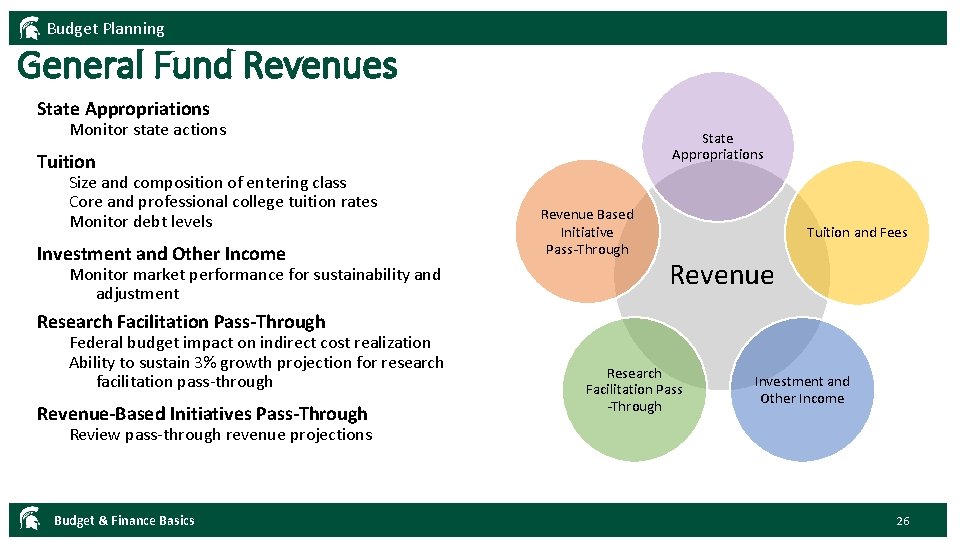
Budget Planning General Fund Revenues State Appropriations Monitor state actions State Appropriations Tuition Size and composition of entering class Core and professional college tuition rates Monitor debt levels Investment and Other Income Monitor market performance for sustainability and adjustment Revenue Based Initiative Pass-Through Tuition and Fees Revenue Research Facilitation Pass-Through Federal budget impact on indirect cost realization Ability to sustain 3% growth projection for research facilitation pass-through Revenue-Based Initiatives Pass-Through Research Facilitation Pass -Through Investment and Other Income Review pass-through revenue projections Budget & Finance Basics 26
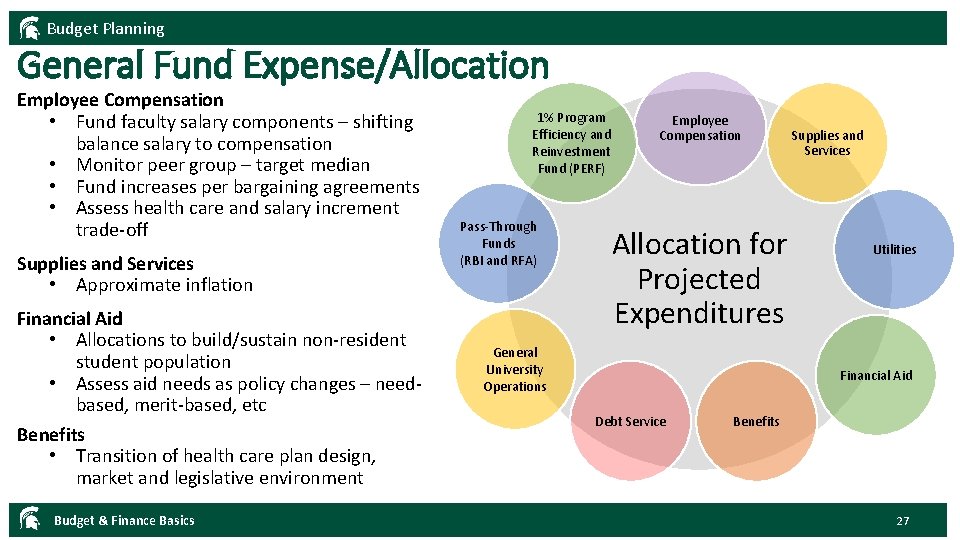
Budget Planning General Fund Expense/Allocation Employee Compensation • Fund faculty salary components – shifting balance salary to compensation • Monitor peer group – target median • Fund increases per bargaining agreements • Assess health care and salary increment trade-off Supplies and Services • Approximate inflation Financial Aid • Allocations to build/sustain non-resident student population • Assess aid needs as policy changes – needbased, merit-based, etc Benefits • Transition of health care plan design, market and legislative environment Budget & Finance Basics 1% Program Efficiency and Reinvestment Fund (PERF) Pass-Through Funds (RBI and RFA) Employee Compensation Allocation for Projected Expenditures General University Operations Supplies and Services Utilities Financial Aid Debt Service Benefits 27
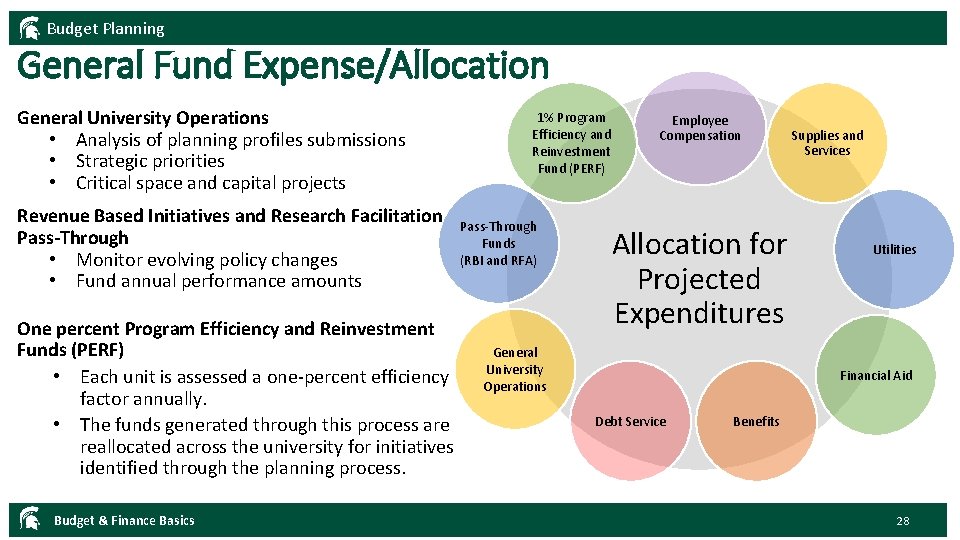
Budget Planning General Fund Expense/Allocation General University Operations • Analysis of planning profiles submissions • Strategic priorities • Critical space and capital projects Revenue Based Initiatives and Research Facilitation Pass-Through • Monitor evolving policy changes • Fund annual performance amounts One percent Program Efficiency and Reinvestment Funds (PERF) • Each unit is assessed a one-percent efficiency factor annually. • The funds generated through this process are reallocated across the university for initiatives identified through the planning process. Budget & Finance Basics 1% Program Efficiency and Reinvestment Fund (PERF) Pass-Through Funds (RBI and RFA) Employee Compensation Allocation for Projected Expenditures General University Operations Supplies and Services Utilities Financial Aid Debt Service Benefits 28
Budget Planning Fringe Benefits • MSU recovers costs related to fringe benefits through Specific Identification • Covers four significant fringe cost categories 1) Retirement – 10% of salary (if participating, mandatory after five years, age 35) 2) FICA – 7. 65% (portion capped at specific salary) 3) Healthcare, dental, prescription drugs - $15, 480 4) Other/misc - 1. 4% - life insurance, workers comp, other misc benefits • Graduate assistant fringe benefits charged where incurred • GA specific identification varies from above – assessed bi-weekly https: //www. cga. msu. edu/PL/Portal/95/20192020 Fringe. Benefitsfor. Sponsored. Projects Budget & Finance Basics 29
Budget Planning OCCI/RBI Policy Update • For activity up to FY 18 allocation amount: • Allocation parameters honor existing practice • FY 18 allocation threshold modified for OCCI to RBI conversions • For activity beyond FY 18 allocation amount: • Credit hour and revenue-share parameters unchanged for initial analysis • FY 18 OCCI allocation totals modified for total growth in undergraduate credit hours • Revised FY 18 totals create maximum allocation level for FY 20 • Allocations lesser of actual OCCI allocation or FY 18 ceiling https: //opb. msu. edu/functions/budget/documents/OCCIpolicy. pdf Budget & Finance Basics 30
Budget Planning Research Facilitation (IDC Pass-Through) • Indirect cost recoveries related to contract and grant overhead allocated to Colleges and Units on the following basis • 10% at the college level: • Based solely on the relative commitment and academic appointment of the investigators • 10% at the department level: • Allocates 25% of the departmental increment to the unit providing the post-award administration • Allocates 75% of the departmental increment based upon relative commitment and academic appointment of the investigators • Modified allocation formula for instances when space assignment varies from PI academic appointment https: //opb. msu. edu/functions/budget/documents/IDCpolicy. pdf Budget & Finance Basics 31
Budget Planning General Fund Carryforward • University policy for assessing year-end balances • Pertinent to the GF only, other funds roll-forward automatically • Most GF sub-funds now carryforward automatically • GF operational funds (GA, GC, GD sub-funds) assessed against a percentage of GF budget (10% in FY 20) • Operational balances in excess of threshold require written memo to OPB/CFO for carryforward • Most requests approved as submitted Budget & Finance Basics 32
Budget Planning “Typical” Planning Priorities • Programmatic stability and prominence – 32 programs in the top-25 nationally, top-100 in the world, AAU membership -- Increasing prominence and cost of active learning and STEM disciplines • Increased competition to recruit and retain top faculty including salary as well as start-up requirements • Growing accountability for student success, student safety, and Title IX objectives • MSU increasingly competitive for federal support. However, federal R&D spending lags inflation, longer term Federal outlook unclear • Intensifying focus on competitive tuition rates, financial hardship and related student debt and completion • Threats to non-resident enrollment targets and composition – falling State and regional demographics, increasing institutional competition – offset by rising college-going rates • Need to prioritize programmatic and capital improvements • Insurance and other operational cost pressures – focus on productivity and efficiency • Opportunities to reach different student markets – online education, Kaplan, etc Budget & Finance Basics 33
Budget Planning Toward FY 2021 • COVID-19 Realities and Remaining Uncertainties • • Michigan, national picture Testing options and opportunities Vaccine prospects and timing Implications to Fall on campus • Continuing Uncertainties • • • Return to campus planning continues Hybrid instructional model announced for Fall 2020 -21 tuition and fee rates frozen at 2019 -20 levels; increase to financial aid planned State appropriations – possible 15% reduction Auxiliary duration and depth – furloughs, reductions, reserves Intense focus on enrollment – level and mix (knowns and unknowns) Budget & Finance Basics 34
Budget Planning Our Approach FY 21 Planning • Preserve academic program quality; maintain instructional and research efforts; minimize disruption to campus students, faculty and staff where possible • Include university-wide and unit reductions to align with revenue disruptions • Planned use of $90 M in deferred projects and reserves to mitigate near-term disruptions and provide additional lead-time for further planning • Proposed FY 21 budget represents best known assumptions after considering multiple cases • Identified contingencies for responding to budget assumption variances • Recognize continuing uncertainties – return with updates Budget & Finance Basics 35
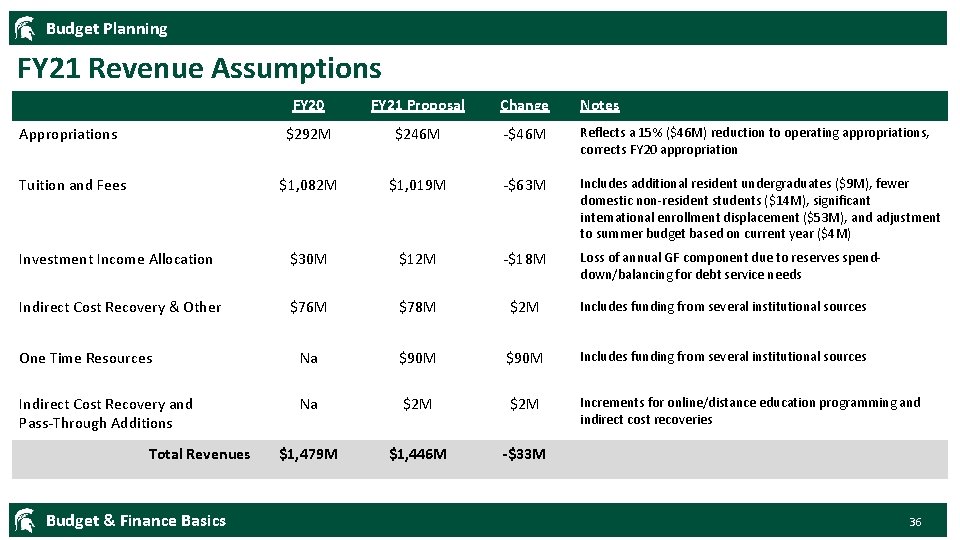
Budget Planning FY 21 Revenue Assumptions FY 20 FY 21 Proposal Change Notes Appropriations $292 M $246 M -$46 M Reflects a 15% ($46 M) reduction to operating appropriations, corrects FY 20 appropriation Tuition and Fees $1, 082 M $1, 019 M -$63 M Includes additional resident undergraduates ($9 M), fewer domestic non-resident students ($14 M), significant international enrollment displacement ($53 M), and adjustment to summer budget based on current year ($4 M) Investment Income Allocation $30 M $12 M -$18 M Loss of annual GF component due to reserves spenddown/balancing for debt service needs Indirect Cost Recovery & Other $76 M $78 M $2 M Includes funding from several institutional sources One Time Resources Na $90 M Includes funding from several institutional sources Indirect Cost Recovery and Pass-Through Additions Na $2 M Increments for online/distance education programming and indirect cost recoveries $1, 479 M $1, 446 M -$33 M Total Revenues Budget & Finance Basics 36
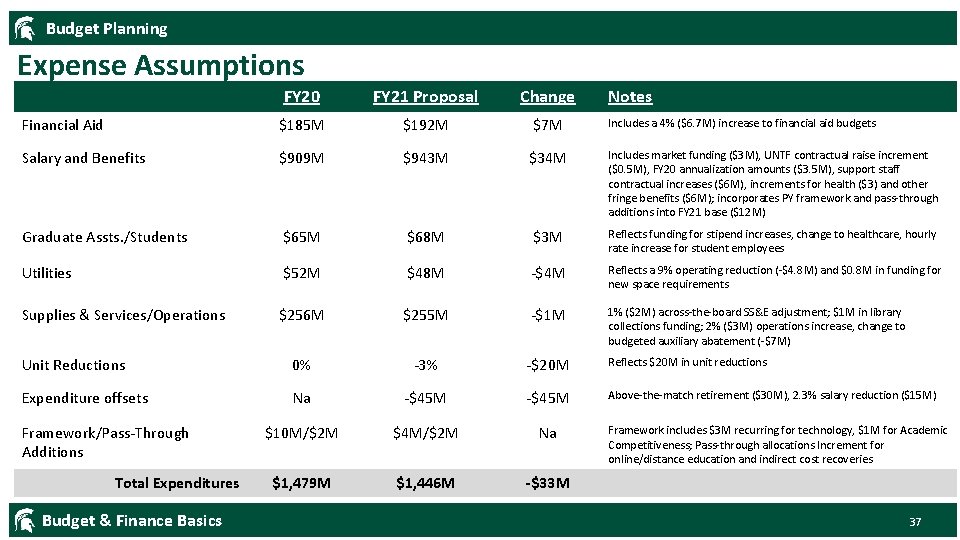
Budget Planning Expense Assumptions FY 20 FY 21 Proposal Change Financial Aid $185 M $192 M $7 M Salary and Benefits $909 M $943 M $34 M Includes market funding ($3 M), UNTF contractual raise increment ($0. 5 M), FY 20 annualization amounts ($3. 5 M), support staff contractual increases ($6 M), increments for health ($3) and other fringe benefits ($6 M); incorporates PY framework and pass-through additions into FY 21 base ($12 M) Graduate Assts. /Students $65 M $68 M $3 M Reflects funding for stipend increases, change to healthcare, hourly rate increase for student employees Utilities $52 M $48 M -$4 M Reflects a 9% operating reduction (-$4. 8 M) and $0. 8 M in funding for new space requirements Supplies & Services/Operations $256 M $255 M -$1 M 1% ($2 M) across-the-board SS&E adjustment; $1 M in library collections funding; 2% ($3 M) operations increase, change to budgeted auxiliary abatement (-$7 M) Unit Reductions 0% -3% -$20 M Reflects $20 M in unit reductions Expenditure offsets Na -$45 M Above-the-match retirement ($30 M), 2. 3% salary reduction ($15 M) $10 M/$2 M $4 M/$2 M Na $1, 479 M $1, 446 M -$33 M Framework/Pass-Through Additions Total Expenditures Budget & Finance Basics Notes Includes a 4% ($6. 7 M) increase to financial aid budgets Framework includes $3 M recurring for technology, $1 M for Academic Competitiveness; Pass-through allocations Increment for online/distance education and indirect cost recoveries 37
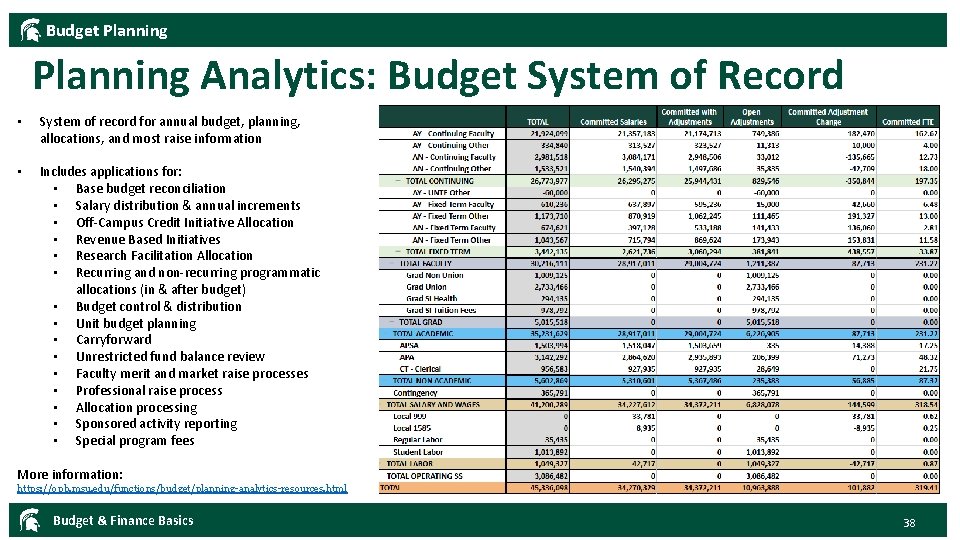
Budget Planning Analytics: Budget System of Record • System of record for annual budget, planning, allocations, and most raise information • Includes applications for: • Base budget reconciliation • Salary distribution & annual increments • Off-Campus Credit Initiative Allocation • Revenue Based Initiatives • Research Facilitation Allocation • Recurring and non-recurring programmatic allocations (in & after budget) • Budget control & distribution • Unit budget planning • Carryforward • Unrestricted fund balance review • Faculty merit and market raise processes • Professional raise process • Allocation processing • Sponsored activity reporting • Special program fees More information: https: //opb. msu. edu/functions/budget/planning-analytics-resources. html Budget & Finance Basics 38
Budget Planning Building New Tools for Units § Improving planning and reporting capabilities across Cognos platform § Leveraging emerging analytics environment correlated with disciplined approach to account and transaction structure § Planning Analytics replaced Enterprise Planning application, replacing many manual processes with value-added approaches § Increasing departmental need to develop long-term budget plans across fund types § Improved ability to review departmental metrics conveniently across contexts § Leverage available data to inform long-range plans § Allow high level scenario development to quickly assess order of magnitude Budget & Finance Basics 39

Table of Contents Introduction Financial Structure Budget Planning Endowment & Endowment Spending Endowment and Endowment Spending Resources & Contacts 40
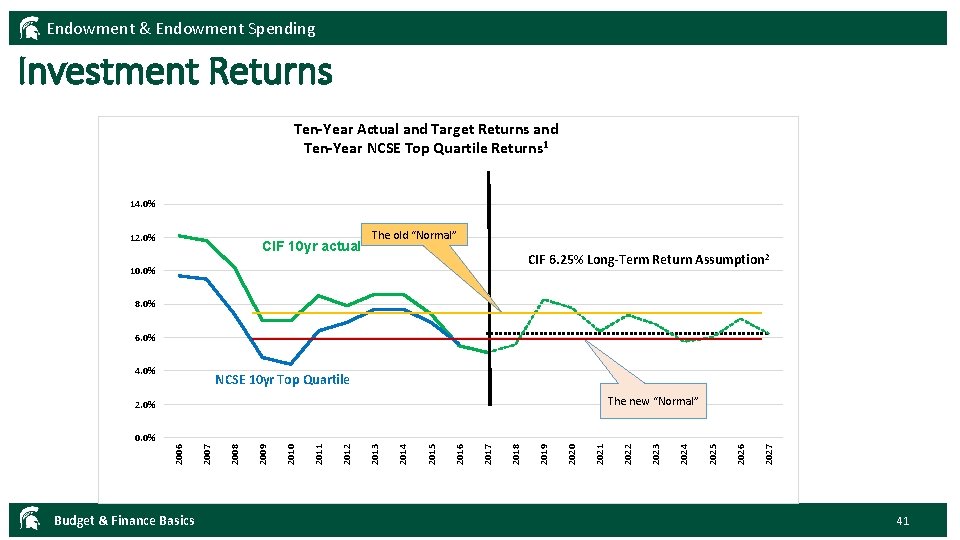
Endowment & Endowment Spending Investment Returns Ten-Year Actual and Target Returns and Ten-Year NCSE Top Quartile Returns 1 14. 0% 12. 0% CIF 10 yr actual The old “Normal” CIF 6. 25% Long-Term Return Assumption 2 10. 0% 8. 0% 6. 0% 4. 0% NCSE 10 yr Top Quartile The new “Normal” 2. 0% Budget & Finance Basics 2027 2026 2025 2024 2023 2022 2021 2020 2019 2018 2017 2016 2015 2014 2013 2012 2011 2010 2009 2008 2007 2006 0. 0% 41
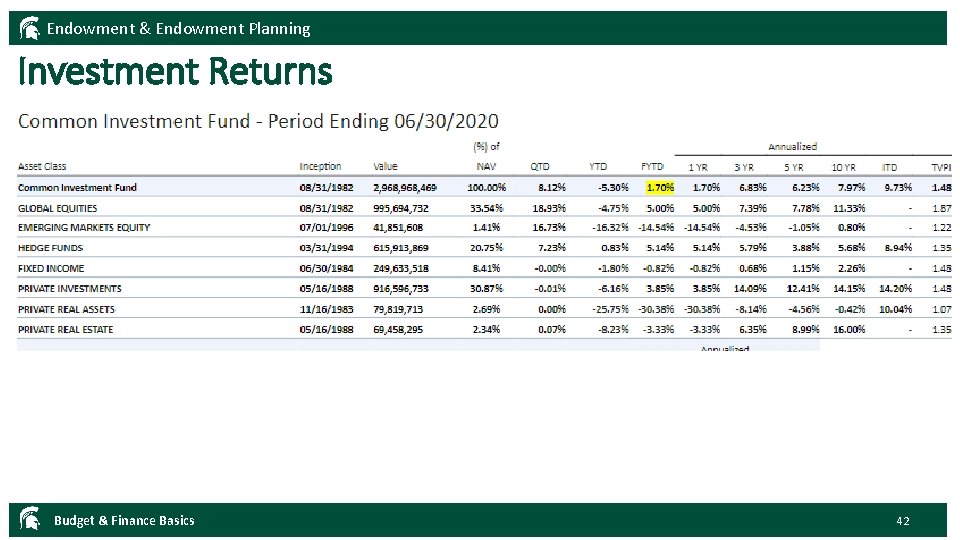
Endowment & Endowment Planning Investment Returns Budget & Finance Basics 42
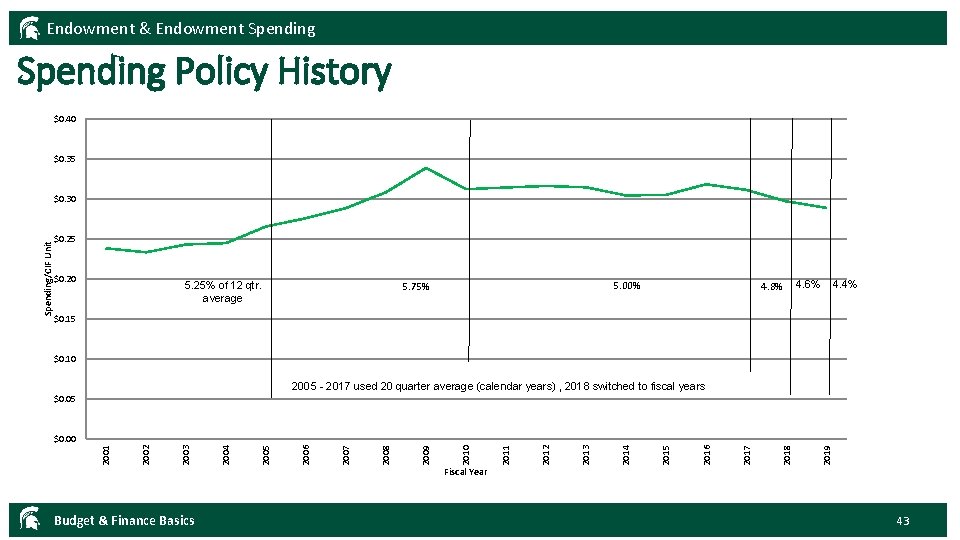
Endowment & Endowment Spending Policy History $0. 40 $0. 35 $0. 30 Spending/CIF Unit $0. 25 $0. 20 5. 25% of 12 qtr. average 5. 00% 5. 75% 4. 8% 4. 6% 4. 4% $0. 15 $0. 10 2005 - 2017 used 20 quarter average (calendar years) , 2018 switched to fiscal years $0. 05 Budget & Finance Basics 2019 2018 2017 2016 2015 2014 2013 2012 Fiscal Year 2011 2010 2009 2008 2007 2006 2005 2004 2003 2002 2001 $0. 00 43
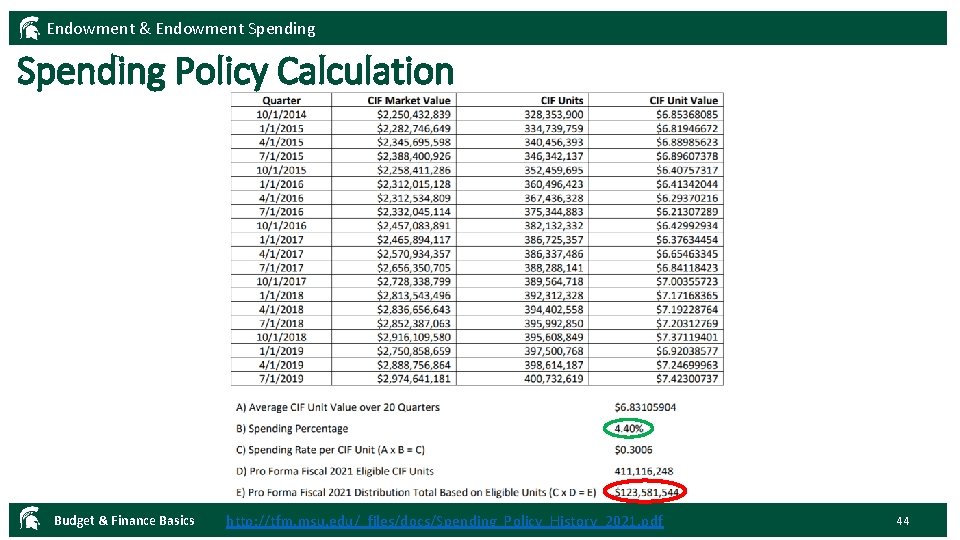
Endowment & Endowment Spending Policy Calculation Budget & Finance Basics http: //tfm. msu. edu/_files/docs/Spending_Policy_History_2021. pdf 44

Table of Contents Introduction Financial Structure Budget Planning Endowment & Endowment Spending Resources & Contacts 45
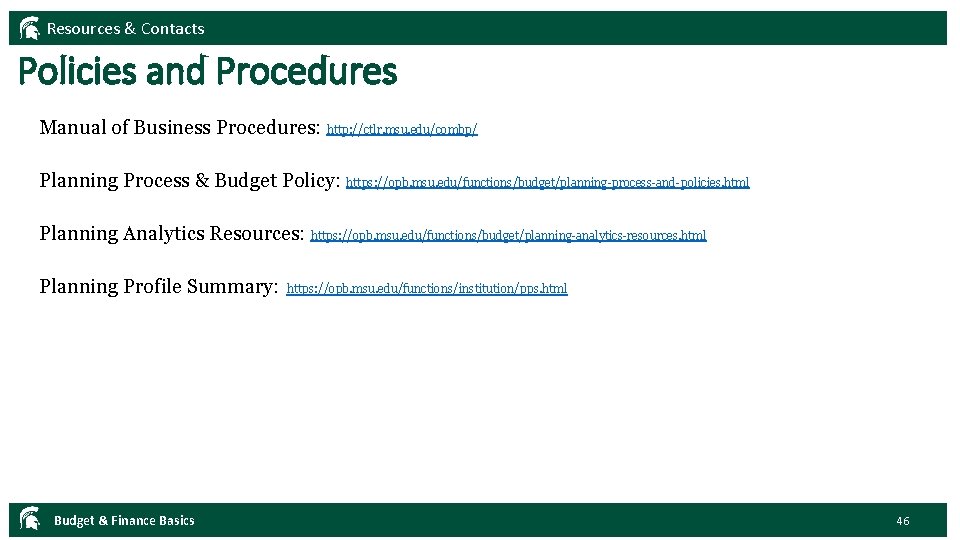
Resources & Contacts Policies and Procedures Manual of Business Procedures: http: //ctlr. msu. edu/combp/ Planning Process & Budget Policy: https: //opb. msu. edu/functions/budget/planning-process-and-policies. html Planning Analytics Resources: https: //opb. msu. edu/functions/budget/planning-analytics-resources. html Planning Profile Summary: Budget & Finance Basics https: //opb. msu. edu/functions/institution/pps. html 46
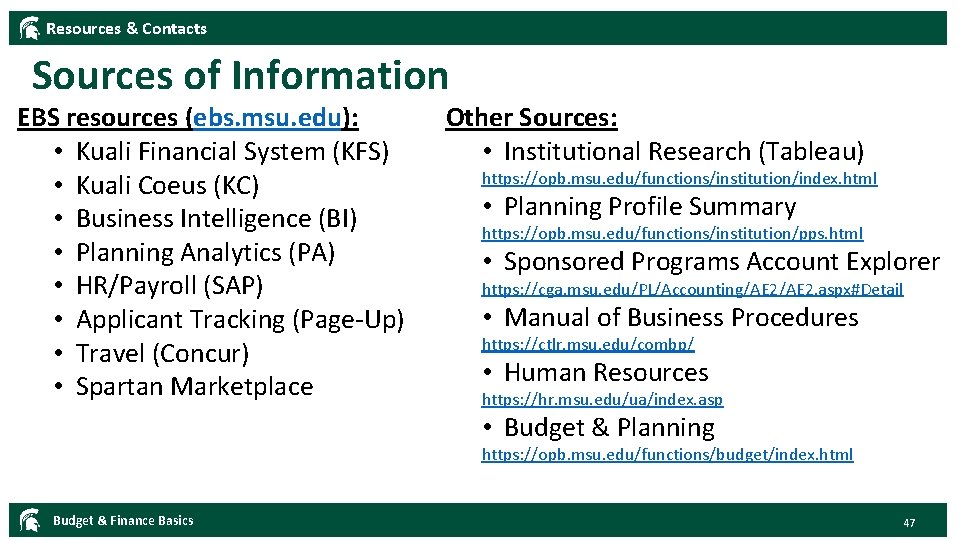
Resources & Contacts Sources of Information EBS resources (ebs. msu. edu): • Kuali Financial System (KFS) • Kuali Coeus (KC) • Business Intelligence (BI) • Planning Analytics (PA) • HR/Payroll (SAP) • Applicant Tracking (Page-Up) • Travel (Concur) • Spartan Marketplace Other Sources: • Institutional Research (Tableau) https: //opb. msu. edu/functions/institution/index. html • Planning Profile Summary https: //opb. msu. edu/functions/institution/pps. html • Sponsored Programs Account Explorer https: //cga. msu. edu/PL/Accounting/AE 2. aspx#Detail • Manual of Business Procedures https: //ctlr. msu. edu/combp/ • Human Resources https: //hr. msu. edu/ua/index. asp • Budget & Planning https: //opb. msu. edu/functions/budget/index. html Budget & Finance Basics 47
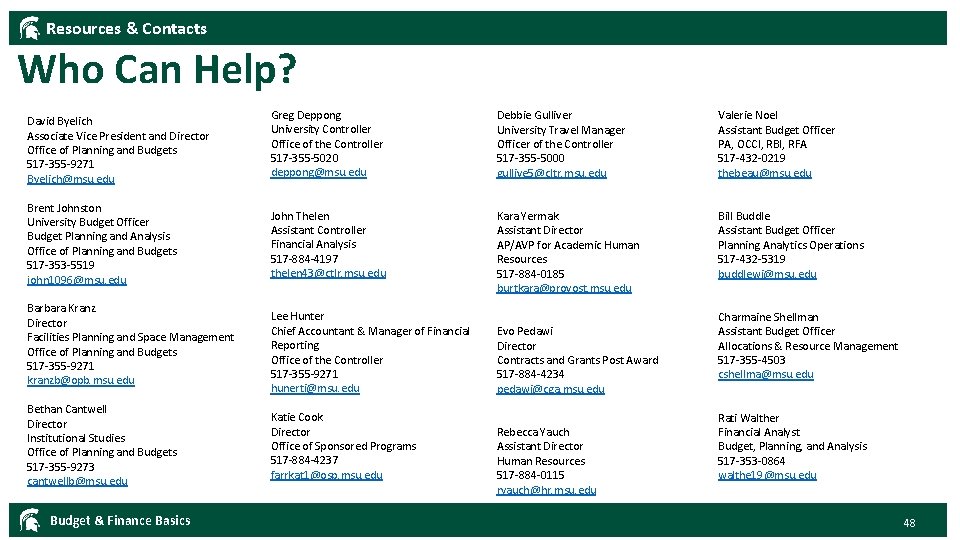
Resources & Contacts Who Can Help? David Byelich Associate Vice President and Director Office of Planning and Budgets 517 -355 -9271 Byelich@msu. edu Brent Johnston University Budget Officer Budget Planning and Analysis Office of Planning and Budgets 517 -353 -5519 john 1096@msu. edu Barbara Kranz Director Facilities Planning and Space Management Office of Planning and Budgets 517 -355 -9271 kranzb@opb. msu. edu Bethan Cantwell Director Institutional Studies Office of Planning and Budgets 517 -355 -9273 cantwellb@msu. edu Budget & Finance Basics Greg Deppong University Controller Office of the Controller 517 -355 -5020 deppong@msu. edu Debbie Gulliver University Travel Manager Officer of the Controller 517 -355 -5000 gullive 5@cltr. msu. edu Valerie Noel Assistant Budget Officer PA, OCCI, RBI, RFA 517 -432 -0219 thebeau@msu. edu John Thelen Assistant Controller Financial Analysis 517 -884 -4197 thelen 43@ctlr. msu. edu Kara Yermak Assistant Director AP/AVP for Academic Human Resources 517 -884 -0185 burtkara@provost. msu. edu Bill Buddle Assistant Budget Officer Planning Analytics Operations 517 -432 -5319 buddlewi@msu. edu Lee Hunter Chief Accountant & Manager of Financial Reporting Office of the Controller 517 -355 -9271 hunerti@msu. edu Katie Cook Director Office of Sponsored Programs 517 -884 -4237 farrkat 1@osp. msu. edu Evo Pedawi Director Contracts and Grants Post Award 517 -884 -4234 pedawi@cga. msu. edu Rebecca Yauch Assistant Director Human Resources 517 -884 -0115 ryauch@hr. msu. edu Charmaine Shellman Assistant Budget Officer Allocations & Resource Management 517 -355 -4503 cshellma@msu. edu Rati Walther Financial Analyst Budget, Planning, and Analysis 517 -353 -0864 walthe 19@msu. edu 48

Thank You Good luck Feel free to be in touch 49
- Slides: 49