
MICHIGAN ODYSSEY OF THE MIND COACHES TRAINING Based
MICHIGAN ODYSSEY OF THE MIND COACHES’ TRAINING Based on The “Unofficial” On-Line Coaches’ Training - by T. Perkins (VT), J. Otte (NY), & S. Riggs (TX) & Wisconsin Odyssey of the Mind Coaches Training - wi. odysseyofthemind. org/Documents/Coaches. Training. ppt
Before We Begin Two main references in today’s presentation PG 5 CM 1
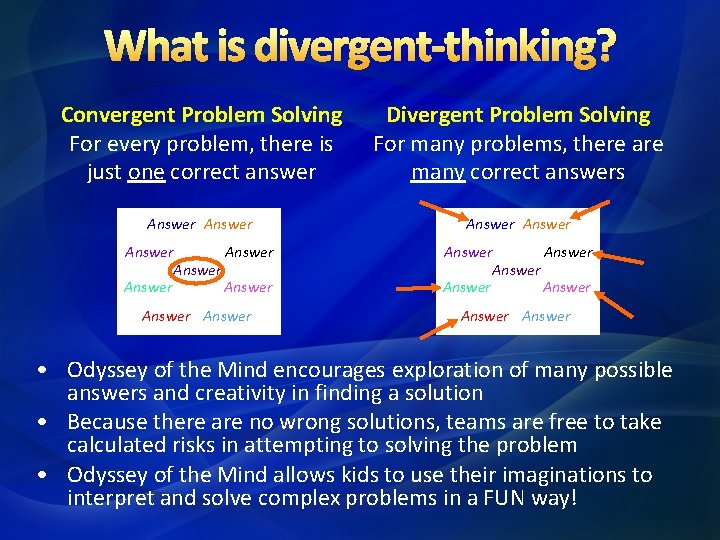
What is divergent-thinking? Convergent Problem Solving For every problem, there is just one correct answer Divergent Problem Solving For many problems, there are many correct answers Answer Answer Answer Answer Answer • Odyssey of the Mind encourages exploration of many possible answers and creativity in finding a solution • Because there are no wrong solutions, teams are free to take calculated risks in attempting to solving the problem • Odyssey of the Mind allows kids to use their imaginations to interpret and solve complex problems in a FUN way!
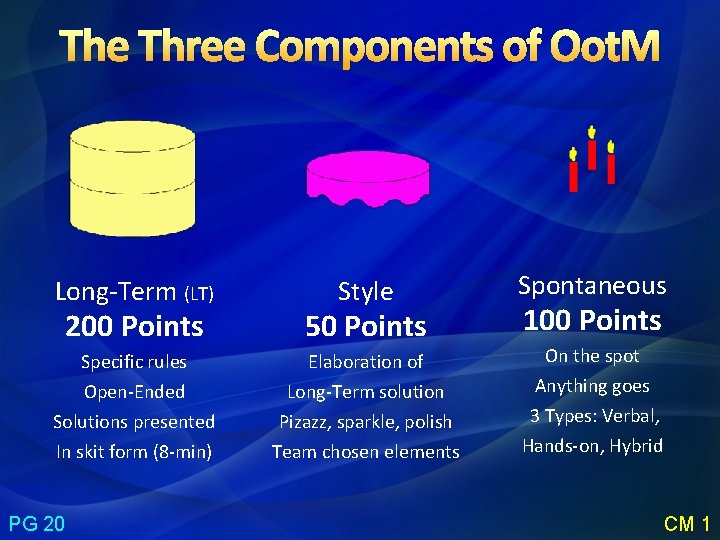
The Three Components of Oot. M Spontaneous 200 Points Style 50 Points Specific rules Open-Ended Elaboration of Long-Term solution On the spot Anything goes Solutions presented In skit form (8 -min) Pizazz, sparkle, polish Team chosen elements Long-Term (LT) PG 20 100 Points 3 Types: Verbal, Hands-on, Hybrid CM 1
The Three Components of Oot. M Long-Term + Style + Spontaneous = Total Score
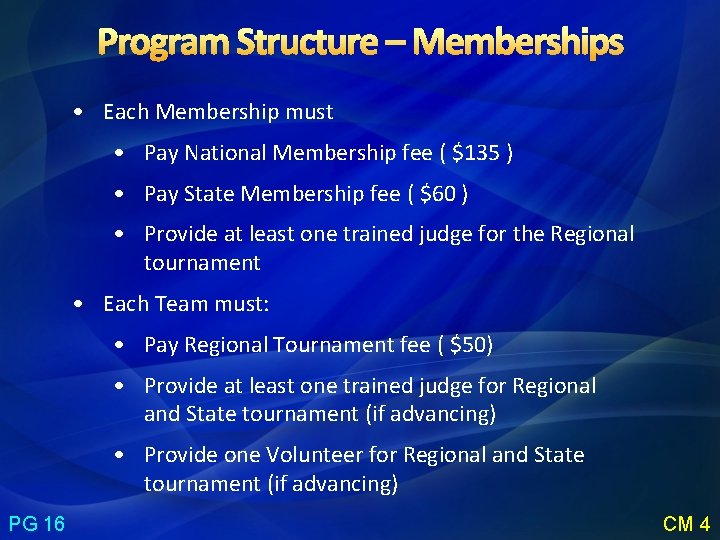
Program Structure – Memberships • Each Membership must • Pay National Membership fee ( $135 ) • Pay State Membership fee ( $60 ) • Provide at least one trained judge for the Regional tournament • Each Team must: • Pay Regional Tournament fee ( $50) • Provide at least one trained judge for Regional and State tournament (if advancing) • Provide one Volunteer for Regional and State tournament (if advancing) PG 16 CM 4
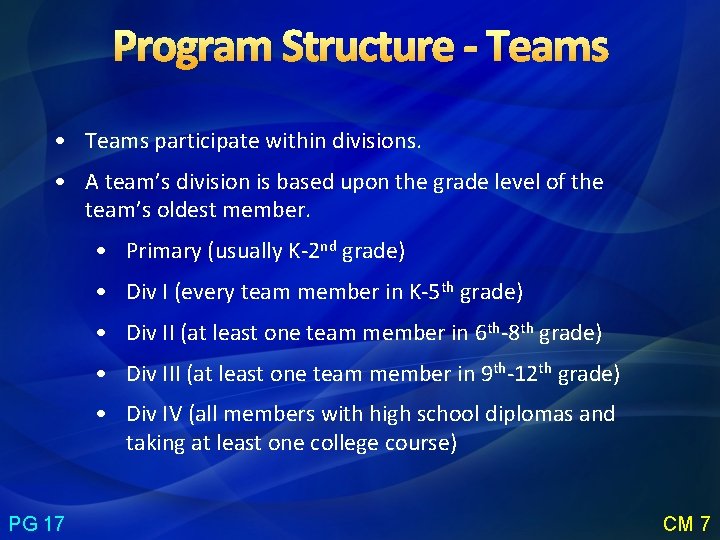
Program Structure - Teams • Teams participate within divisions. • A team’s division is based upon the grade level of the team’s oldest member. • Primary (usually K-2 nd grade) • Div I (every team member in K-5 th grade) • Div II (at least one team member in 6 th-8 th grade) • Div III (at least one team member in 9 th-12 th grade) • Div IV (all members with high school diplomas and taking at least one college course) PG 17 CM 7
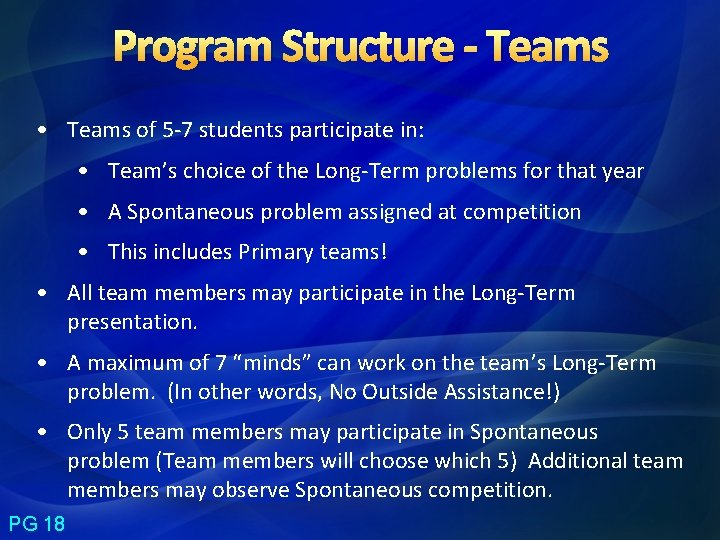
Program Structure - Teams • Teams of 5 -7 students participate in: • Team’s choice of the Long-Term problems for that year • A Spontaneous problem assigned at competition • This includes Primary teams! • All team members may participate in the Long-Term presentation. • A maximum of 7 “minds” can work on the team’s Long-Term problem. (In other words, No Outside Assistance!) • Only 5 team members may participate in Spontaneous problem (Team members will choose which 5) Additional team members may observe Spontaneous competition. PG 18
Getting Started • Generating Interest • Forming Teams • Finding team members • Adding team members • Parent Meeting • • • Calendar Expectations Coaches Bill of Rights Judges and Volunteers Outside Assistance
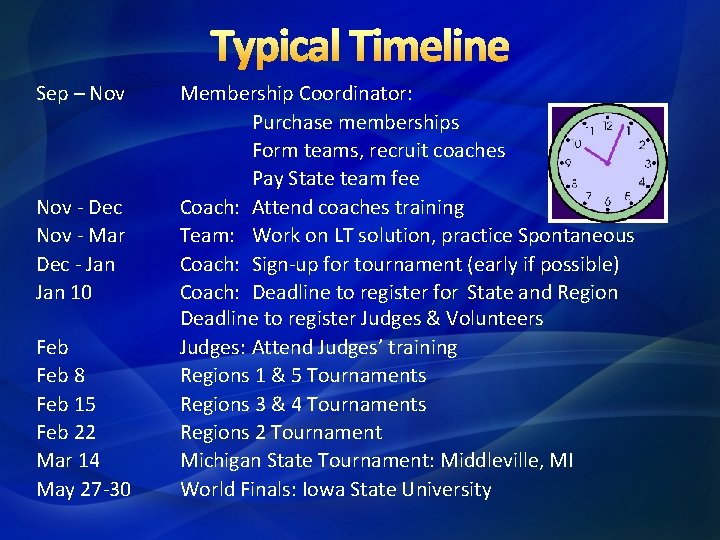
Typical Timeline Sep – Nov - Dec Nov - Mar Dec - Jan 10 Feb 8 Feb 15 Feb 22 Mar 14 May 27 -30 Membership Coordinator: Purchase memberships Form teams, recruit coaches Pay State team fee Coach: Attend coaches training Team: Work on LT solution, practice Spontaneous Coach: Sign-up for tournament (early if possible) Coach: Deadline to register for State and Region Deadline to register Judges & Volunteers Judges: Attend Judges’ training Regions 1 & 5 Tournaments Regions 3 & 4 Tournaments Regions 2 Tournament Michigan State Tournament: Middleville, MI World Finals: Iowa State University
What is the role of the coach? PG 7 • Schedule meetings & Organize snacks – Busy minds need fuel • Facilitator – help team to: • Set goals, develop a timeline, track tasks & deadlines • Understand problem including scoring and clarifications • Take notes - without making suggestions or directing • Lead brainstorming sessions - without injecting ideas • Bring in “experts” to discuss and teach skills • Teach basic skills - Sewing, carpentry, painting, make-up, etc … • Ask open-ended QUESTIONS (to help team focus) • Guide team in Spontaneous practice at every meeting • Guide team through forms • All Around Go-fer & field trip coordinator CM 9
Tips and Advice • Arrange for a Co-Coach or back up person for the team. • Have the team develop a timeline and stick to it. • Learn to recognize burnout and when to lighten up. • Know the Oot. M Long-Term problem and the Oot. M Program Guide inside out, upside down and backwards. • Plan on mistakes, disappointments, and disagreements. Decide early how you, as a team, will handle them. • Always answer a question with a question. • Learn how to ask questions. Become an expert at this skill. • Be a real resource person. Take the team on “field trips” • Teach skills and attitudes to help anticipate problems. CM 9
Tips and Advice • Look at the answer or solution. Have team members ask: • Is it of high quality? • How original is it? • Is it the first thing you think of? • Is it the first thing others will think of? • If so, is it creative? • Remember that it is the team’s attention to details that will differentiate good solutions from great solutions.
Coaching Do’s • Do help students to see and recognize the abilities of each team member and encourage team members to capitalize on the individual strengths of ALL. • Do help students to understand that winning is not the goal. The process of getting there is the most important thing -- not the competition. • Do help them give and take constructive criticism of IDEAS and avoid insulting remarks. • Do relax and enjoy seeing these young, creative minds at work!! CM 11
Coaching Don’ts • Don't tell them how to solve the problem, but rather ask questions which help them think it through. • Don't limit creativity by setting restrictions which are too tight or which reflect your own, perhaps limited, vision. • Don't get disturbed when teams make mistakes along the way. This is part of the OM learning process. • Don't allow any criticism of teammates' personalities or physical attributes -- no cutting remarks. CM 12
Team Meetings • How often? • Meeting Structure • • • Team Building Brainstorm Work on Problem Solution Spontaneous Snack
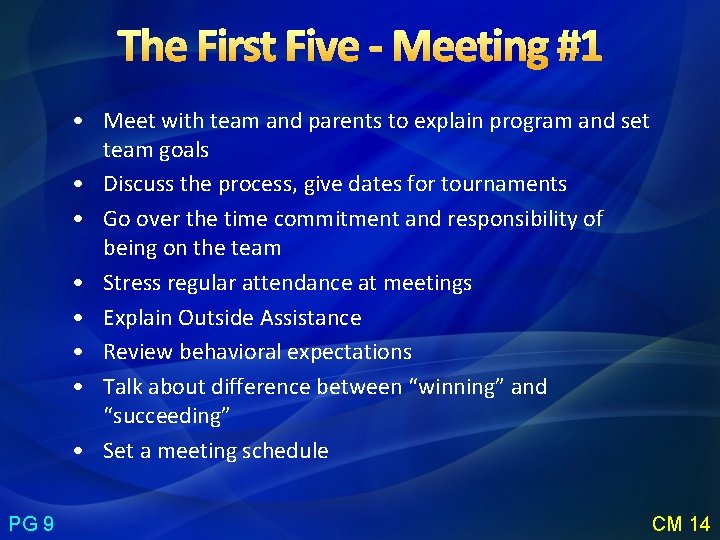
The First Five - Meeting #1 • Meet with team and parents to explain program and set team goals • Discuss the process, give dates for tournaments • Go over the time commitment and responsibility of being on the team • Stress regular attendance at meetings • Explain Outside Assistance • Review behavioral expectations • Talk about difference between “winning” and “succeeding” • Set a meeting schedule PG 9 CM 14
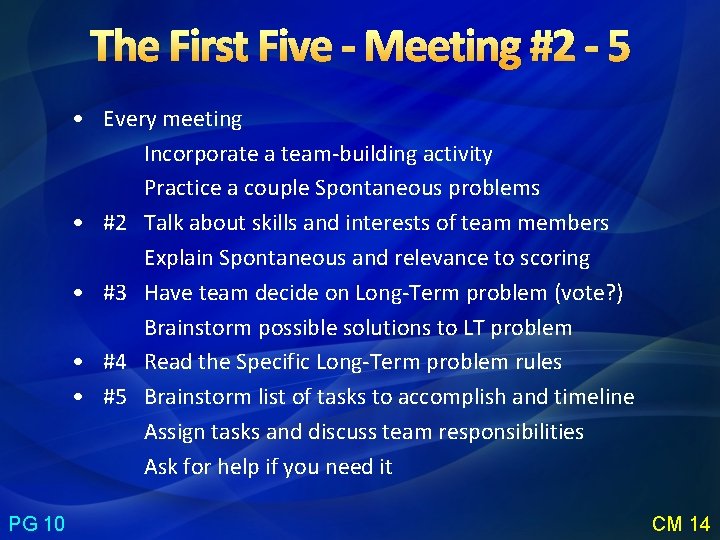
The First Five - Meeting #2 - 5 • Every meeting Incorporate a team-building activity Practice a couple Spontaneous problems • #2 Talk about skills and interests of team members Explain Spontaneous and relevance to scoring • #3 Have team decide on Long-Term problem (vote? ) Brainstorm possible solutions to LT problem • #4 Read the Specific Long-Term problem rules • #5 Brainstorm list of tasks to accomplish and timeline Assign tasks and discuss team responsibilities Ask for help if you need it PG 10 CM 14
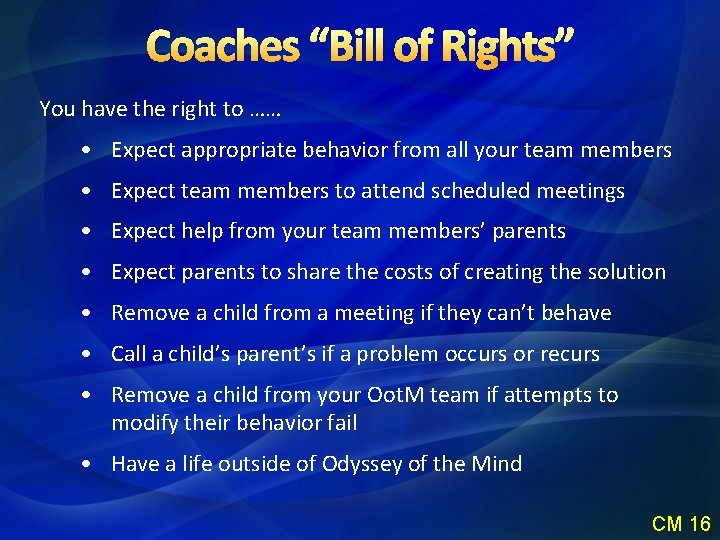
Coaches “Bill of Rights” You have the right to …… • Expect appropriate behavior from all your team members • Expect team members to attend scheduled meetings • Expect help from your team members’ parents • Expect parents to share the costs of creating the solution • Remove a child from a meeting if they can’t behave • Call a child’s parent’s if a problem occurs or recurs • Remove a child from your Oot. M team if attempts to modify their behavior fail • Have a life outside of Odyssey of the Mind CM 16
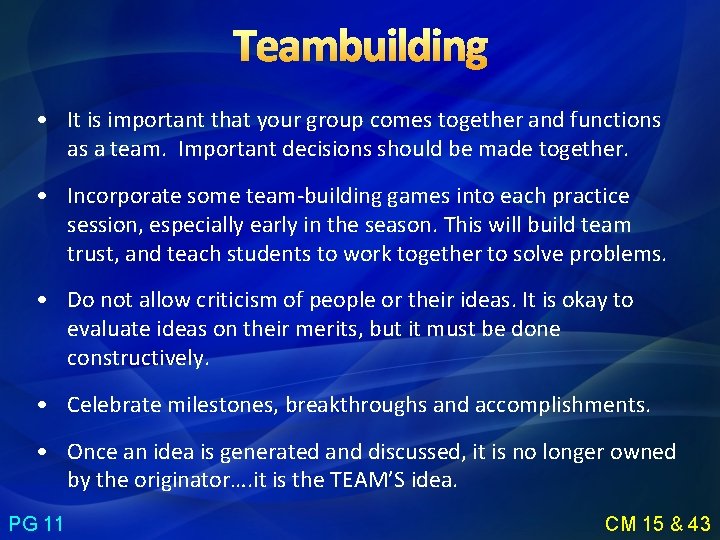
Teambuilding • It is important that your group comes together and functions as a team. Important decisions should be made together. • Incorporate some team-building games into each practice session, especially early in the season. This will build team trust, and teach students to work together to solve problems. • Do not allow criticism of people or their ideas. It is okay to evaluate ideas on their merits, but it must be done constructively. • Celebrate milestones, breakthroughs and accomplishments. • Once an idea is generated and discussed, it is no longer owned by the originator…. it is the TEAM’S idea. PG 11 CM 15 & 43
What's needed to get started with our Long-Term problem? There are 3 major information resources that are available to you as a coach of an Odyssey of the Mind team • Program Guide (available on the official website or through your membership coordinator) • Long-Term Problem (available from your membership coordinator or the official website ) • Clarifications general and team (available on the Odyssey of the Mind website, through your coordinator, or through your State Association; released throughout the season)
The Long-Term Problems • Six new Long-Term problems are written by Creative Competitions, Inc. each year. • There is a cost limit to each problem (usually ~ $125 - $145) • Solutions cannot be “bought”, they must be designed and built by the team • Only the materials used in competition are included in the cost • Duct tape & cardboard, garage-sale value, scavenging • Some “standard” and safety items are exempt from cost, these are listed in the Program Guide. • All have a theme with a skit and are performed in 8 minutes PG 20 CM 1
The Long-Term Problems Continued… • Participation requires a commitment from: • • • Team members Coaches Membership Coordinators Volunteer Judges Volunteer Officials
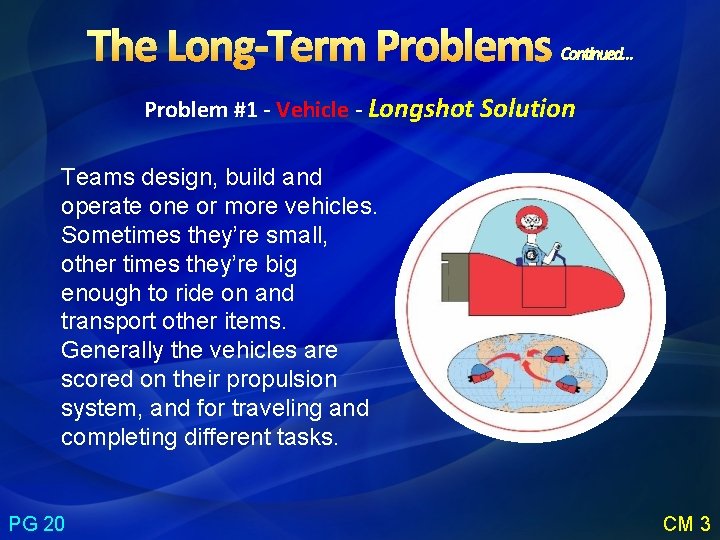
The Long-Term Problems Continued… Problem #1 - Vehicle - Longshot Solution Teams design, build and operate one or more vehicles. Sometimes they’re small, other times they’re big enough to ride on and transport other items. Generally the vehicles are scored on their propulsion system, and for traveling and completing different tasks. PG 20 CM 3
The Long-Term Problems Continued… Problem #2 - Technical - Net Working Teams are scored for performance elements as well as for some type of technical achievement. Usually, this problem requires the team to create one or more devices that perform certain functions or tasks. PG 20 CM 3
The Long-Term Problems Continued… Problem #3 - Classics… The Effective Detective This is a performance problem based on something “classical. ” It could involve mythology, art, music, archaeology, or anything else that is classical in nature. PG 20 CM 3
The Long-Term Problems Continued… Problem #4 - Structure - Balsa Limbo Teams design and build a structure out of only balsa wood and glue. They test the structure by adding Olympic-size weights until it breaks. Each year there is an element of the problem that sets it apart from other years, for example, having the structure endure the impact of a ball propelled down a ramp. PG 20 CM 3
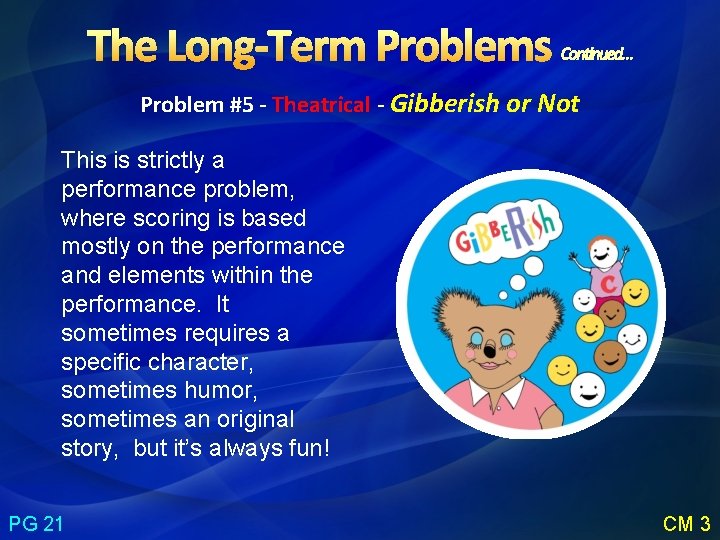
The Long-Term Problems Continued… Problem #5 - Theatrical - Gibberish or Not This is strictly a performance problem, where scoring is based mostly on the performance and elements within the performance. It sometimes requires a specific character, sometimes humor, sometimes an original story, but it’s always fun! PG 21 CM 3
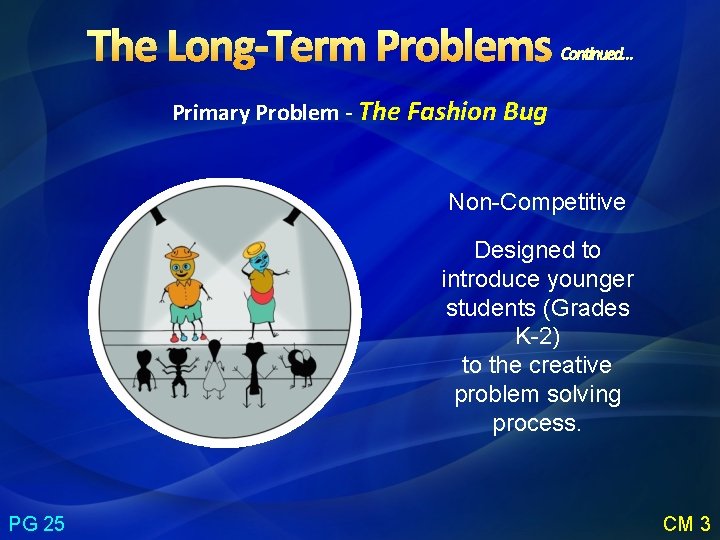
The Long-Term Problems Continued… Primary Problem - The Fashion Bug Non-Competitive Designed to introduce younger students (Grades K-2) to the creative problem solving process. PG 25 CM 3
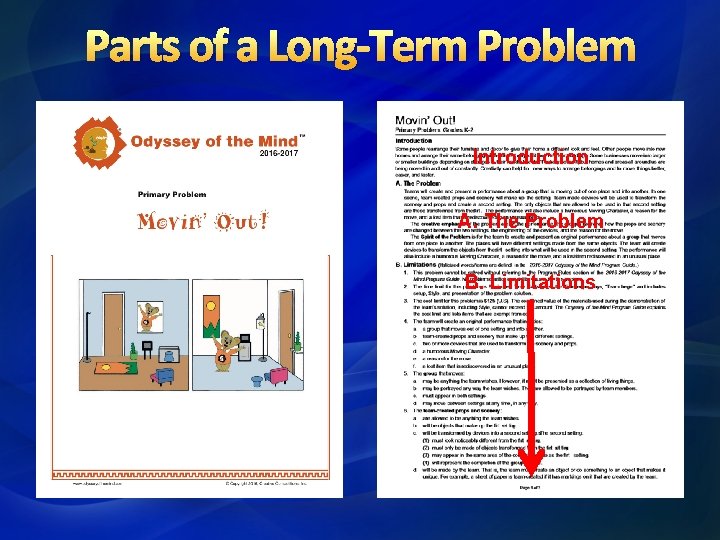
Parts of a Long-Term Problem Introduction A. The Problem B. Limitations
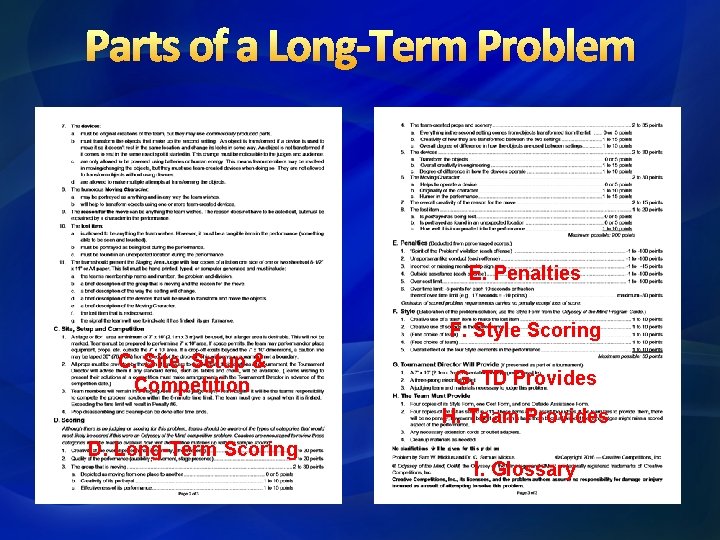
Parts of a Long-Term Problem E. Penalties F. Style Scoring C. Site, Setup & Competition G. TD Provides H. Team Provides D. Long-Term Scoring I. Glossary
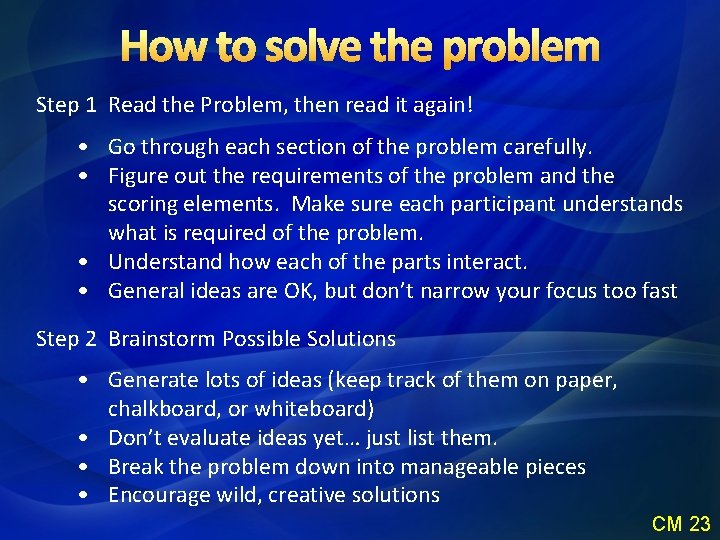
How to solve the problem Step 1 Read the Problem, then read it again! • Go through each section of the problem carefully. • Figure out the requirements of the problem and the scoring elements. Make sure each participant understands what is required of the problem. • Understand how each of the parts interact. • General ideas are OK, but don’t narrow your focus too fast Step 2 Brainstorm Possible Solutions • Generate lots of ideas (keep track of them on paper, chalkboard, or whiteboard) • Don’t evaluate ideas yet… just list them. • Break the problem down into manageable pieces • Encourage wild, creative solutions CM 23
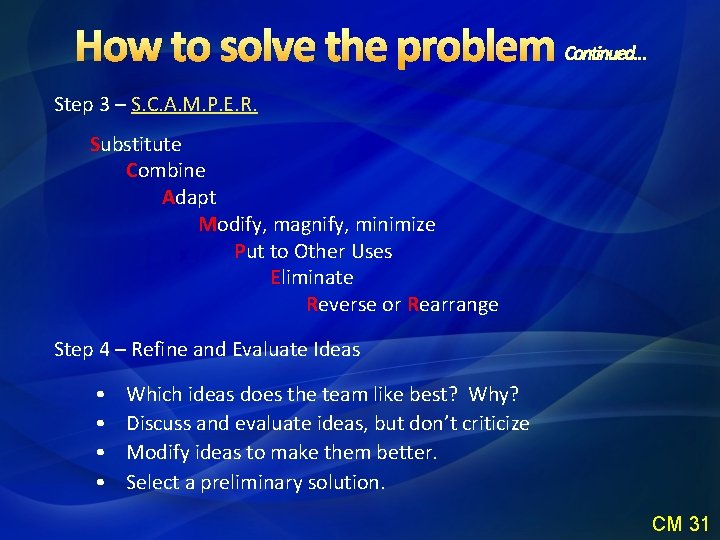
How to solve the problem Continued… Step 3 – S. C. A. M. P. E. R. Substitute Combine Adapt Modify, magnify, minimize Put to Other Uses Eliminate Reverse or Rearrange Step 4 – Refine and Evaluate Ideas • • Which ideas does the team like best? Why? Discuss and evaluate ideas, but don’t criticize Modify ideas to make them better. Select a preliminary solution. CM 31
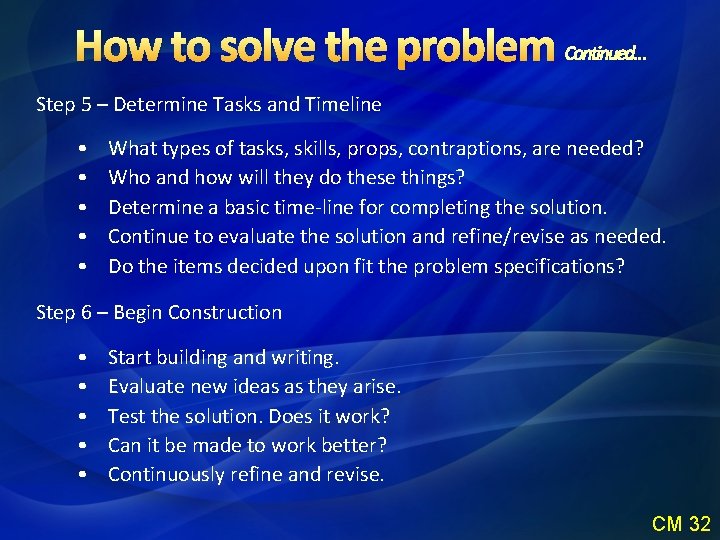
How to solve the problem Continued… Step 5 – Determine Tasks and Timeline • • • What types of tasks, skills, props, contraptions, are needed? Who and how will they do these things? Determine a basic time-line for completing the solution. Continue to evaluate the solution and refine/revise as needed. Do the items decided upon fit the problem specifications? Step 6 – Begin Construction • • • Start building and writing. Evaluate new ideas as they arise. Test the solution. Does it work? Can it be made to work better? Continuously refine and revise. CM 32
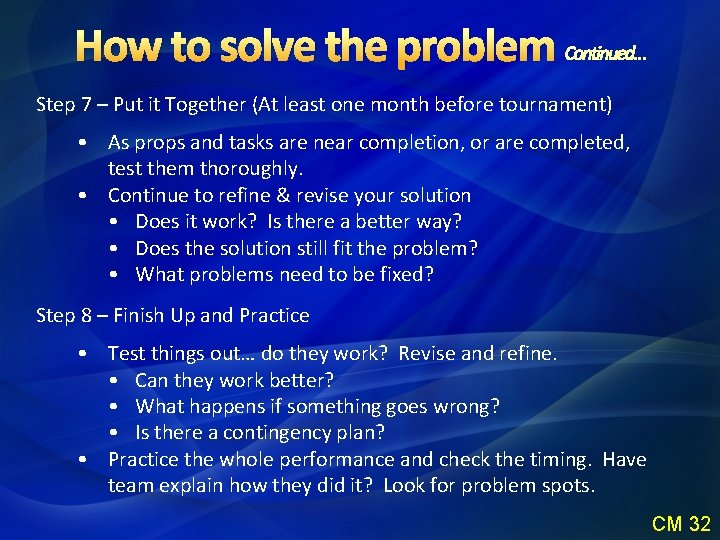
How to solve the problem Continued… Step 7 – Put it Together (At least one month before tournament) • As props and tasks are near completion, or are completed, test them thoroughly. • Continue to refine & revise your solution • Does it work? Is there a better way? • Does the solution still fit the problem? • What problems need to be fixed? Step 8 – Finish Up and Practice • Test things out… do they work? Revise and refine. • Can they work better? • What happens if something goes wrong? • Is there a contingency plan? • Practice the whole performance and check the timing. Have team explain how they did it? Look for problem spots. CM 32

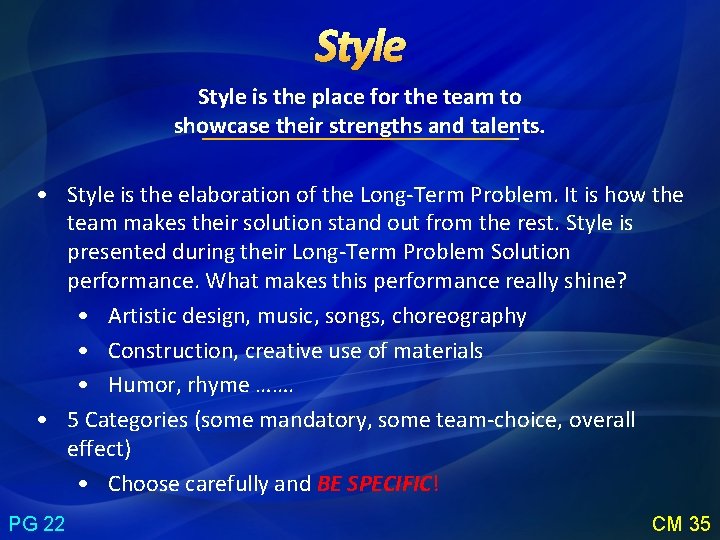
Style is the place for the team to showcase their strengths and talents. • Style is the elaboration of the Long-Term Problem. It is how the team makes their solution stand out from the rest. Style is presented during their Long-Term Problem Solution performance. What makes this performance really shine? • Artistic design, music, songs, choreography • Construction, creative use of materials • Humor, rhyme ……. • 5 Categories (some mandatory, some team-choice, overall effect) • Choose carefully and BE SPECIFIC! PG 22 CM 35
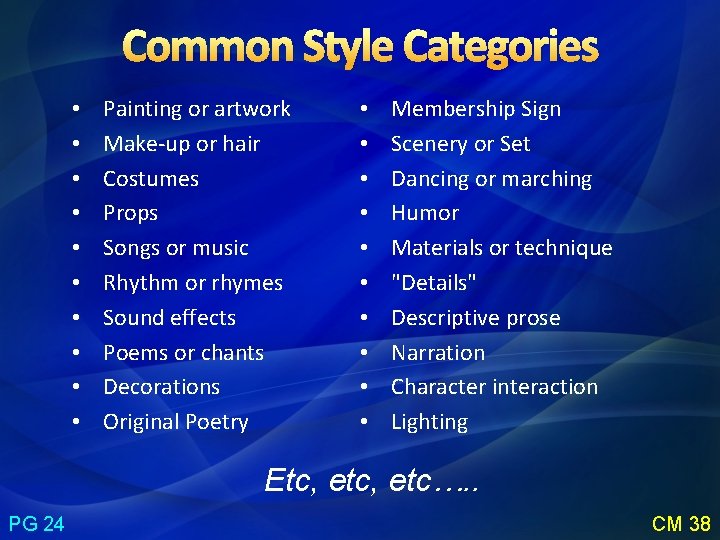
Common Style Categories • • • Painting or artwork Make-up or hair Costumes Props Songs or music Rhythm or rhymes Sound effects Poems or chants Decorations Original Poetry • • • Membership Sign Scenery or Set Dancing or marching Humor Materials or technique "Details" Descriptive prose Narration Character interaction Lighting Etc, etc…. . PG 24 CM 38
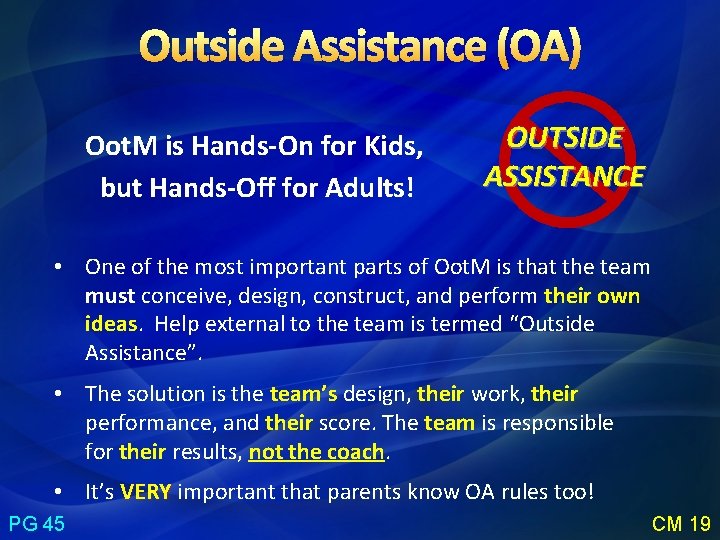
Outside Assistance (OA) Oot. M is Hands-On for Kids, but Hands-Off for Adults! OUTSIDE ASSISTANCE • One of the most important parts of Oot. M is that the team must conceive, design, construct, and perform their own ideas. Help external to the team is termed “Outside Assistance”. • The solution is the team’s design, their work, their performance, and their score. The team is responsible for their results, not the coach. • It’s VERY important that parents know OA rules too! PG 45 CM 19
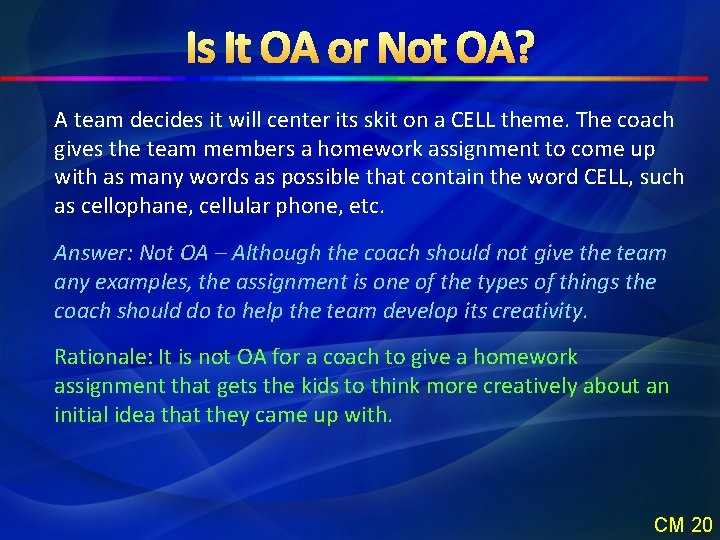
O u t s i d e A s s i s t a n c e Is It OA or Not OA? A team decides it will center its skit on a CELL theme. The coach gives the team members a homework assignment to come up with as many words as possible that contain the word CELL, such as cellophane, cellular phone, etc. Answer: Not OA – Although the coach should not give the team any examples, the assignment is one of the types of things the coach should do to help the team develop its creativity. Rationale: It is not OA for a coach to give a homework assignment that gets the kids to think more creatively about an initial idea that they came up with. CM 20
O u t s i d e A s s i s t a n c e Is It OA or Not OA? A Division I team is spray-painting a prop and the coach holds a team member’s hand for about 2 seconds (out of a 30 -minute job). Answer: It is OA – The coach may not help spray paint anything used in the solution. However, the coach may teach the team member how to spray paint by using something that is not part of the solution such as a scrap piece of wood. Rationale: It is not OA for the coach to teach a team member the proper way to spray paint on a practice/scrap piece CM 20
Outside Assistance (OA) Oot. M is Hands-On for Kids, but Hands-Off for Adults! Team’s design Team’s work Take two … OUTSIDE ASSISTANCE Team’s words Team’s performance Team’s score Team’s results
Penalties are designed to prevent teams from bending or breaking the rules, creating a safety hazard, interfering with other teams, delaying competition or misbehaving. • Spirit of the Problem – Aimed at preventing teams from circumventing the intention of the rules in either Long-Term or Spontaneous Penalty between 1 to 100 points • Unsportsmanlike Conduct – For intentionally (or even unintentionally) impairing another team’s solution, disruptive behavior, inappropriate language, damage to facilities. Penalties can be applied retroactively. Penalty between 1 to 100 points PG 44
Penalties Continued… • Outside Assistance – If team receives help from anyone. This applies to audience as well. Thus teams shouldn’t encourage audience participation Penalty between 1 to 100 points • Incorrect / Missing Membership Sign Penalty between 1 to 15 points • Over Cost Limit – Materials over cost limit Penalty between 1 to 100 points • Over Time Limit – For each 10 seconds or fraction Penalty 5 points • Individual problems may have other penalties PG 44
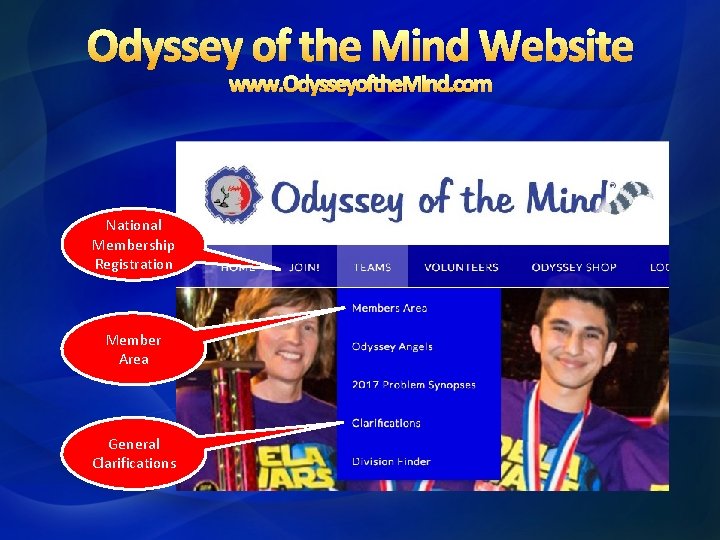
Odyssey of the Mind Website www. Odysseyofthe. Mind. com National Membership Registration Member Area General Clarifications
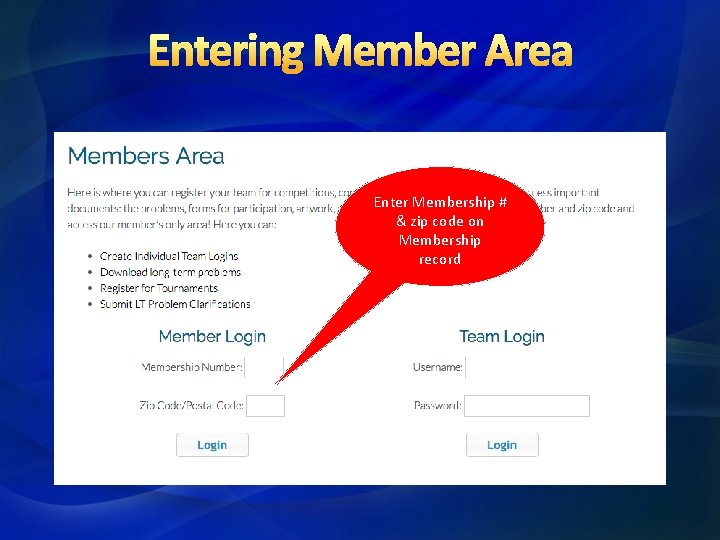
Entering Member Area Enter Membership # & zip code on Membership record
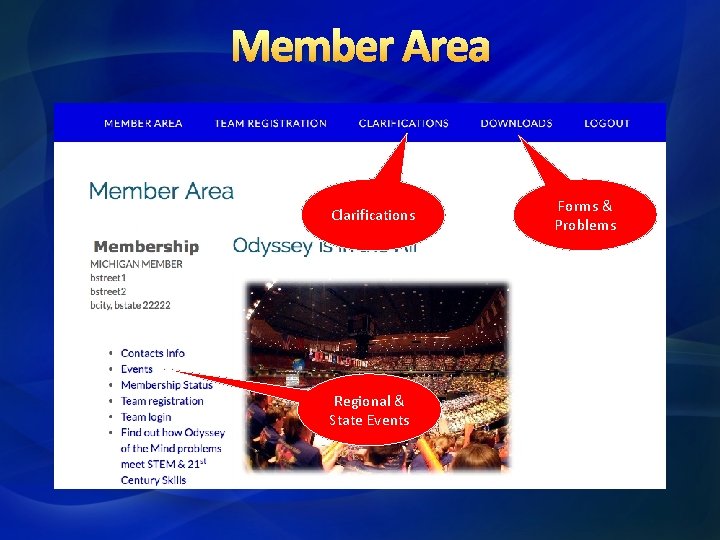
Member Area Clarifications Regional & State Events Forms & Problems
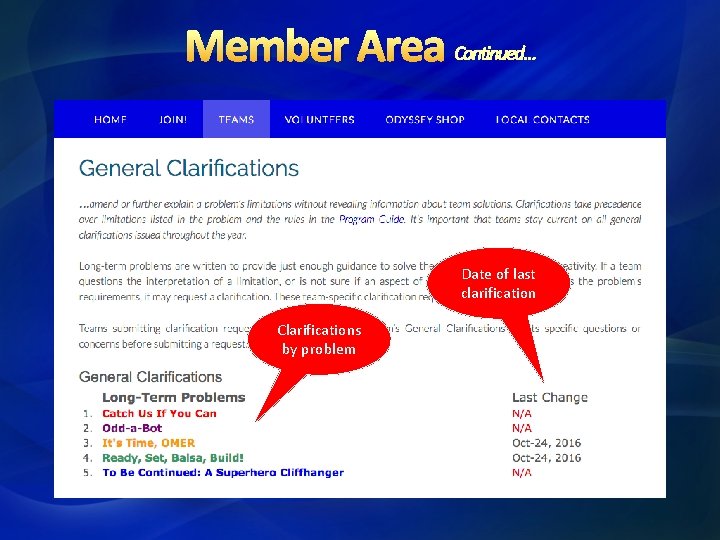
Member Area Continued… Date of last clarification Clarifications by problem
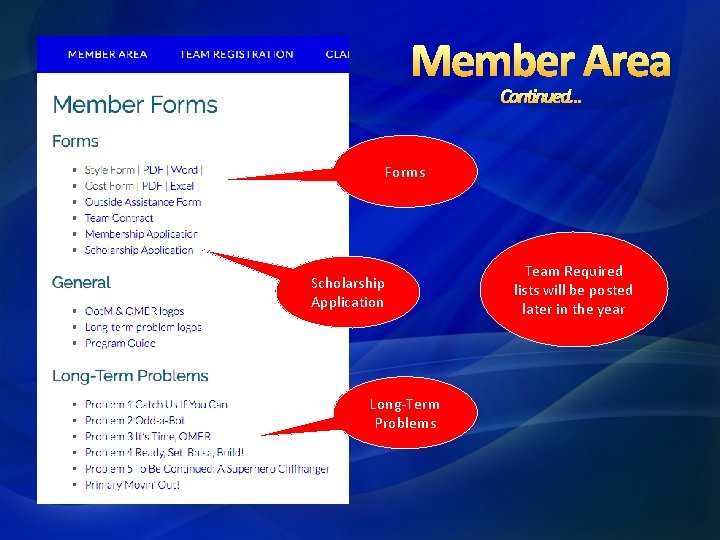
Member Area Continued… Forms Scholarship Application Long-Term Problems Team Required lists will be posted later in the year
More Resources Other helpful resources: • Other Coaches • Membership Coordinator • Printed Materials • Websites • Local Association • Association & Regional Directors • International Program Headquarters • General info, videos, books • Problem Procedures • Usually released in late February Newsletter PG 54
Contact Us For more information, or to register: Michigan website: http: //www. miodyssey. com Association Director: Pamela Gombert Email: Director@Michigan. Odyssey. com International site http: //www. odysseyofthemind. org Odyssey of the Mind Headquarters Email: info@odysseyofthemind. org
Odyssey of the Mind
- Slides: 53