
Michigan Literacy THE NEXT CHAPTER An update to



- Slides: 42
Michigan Literacy: THE NEXT CHAPTER An update to MLPP K-3 and MLPP 4 -5 Barbara Mick (COOR ISD) Jacqueline Fry (COP ESD)
Introduction Goals for Michigan Literacy: THE NEXT CHAPTER 1. Understand the MLPP (Michigan Literacy Progress Profile) and improve our use of formative assessment to guide our instruction. 2. Improve our understanding of literacy. 3. Learn what is new in the research on teaching reading and writing. 4. Build our literacy teaching skills.
Goals for Session 1: Here We Go! Gain a better understanding of yourself as a reader and writer and as a teacher of reading and writing Understand the importance of motivation and engagement Review the gradual release of responsibility and the developmental sequence of reading and writing Gain a better understanding of Formative Assessment Review the Common Core State Standards for Reading and Writing Understand how to chose a case study student and what will be expected for you to do with the students you choose
A Short History of Reading in Michigan 1997: Congress takes steps to form the National Reading Panel January 30, 1998: Governor Engler puts Reading Plan for Michigan in place to ensure all students can read by 4 th grade. February 1999: Progress Report of National Reading Panel submitted to Congress August 1999: Michigan Literacy Progress Profile (MLPP) began/readiness kits developed. Summer 2000: Summer reading program begins
Michigan’s Literacy History con’t December 2000: National Reading Panel Report published. January 2001: President Bush announces the No Child Left Behind educational initiative August 2003: Michigan becomes one of the first states to implement Reading First. 2005: Thirty-five thousand teachers trained in MLPP/ MLPP revisions begin September 2009: President Obama announces Race to the Top as part of the AARA; Michigan applies but does not receive the grant
Michigan’s Literacy History con’t May 2010: A group convened to create the Michigan Literacy Plan (Mi. Lit), which addressed one of the requirements for future RTTT grant applications; Regional Literacy Teams continue to develop Comprehensive Literacy Plans June 2010: Michigan’s Legislature adopts the Common Core State Standards July 2012: Michigan applies for and receives a Flexibility Waiver related to requirements of NCLB
Michigan’s Literacy History con’t Details of the Flexibility Waiver Principal 1: College- and Career-Ready Expectations for All Students • Adopt college- and career-ready standards • Transition to college- and career-ready standards • Develop and administer annual, statewide, aligned, high-quality assessments that measure student growth
Michigan’s Literacy History con’t Details of the Flexibility Waiver State-Developed Differentiated Recognition, Accountability, and Support Principal 2: • Develop and implement a State-based system of differentiated recognition, accountability, and support • Set ambitious but achievable annual measurable objectives • Rewards schools • Priority schools • Focus schools • Provide incentives and supports for other Title I schools • Build SEA, LEA, and school capacity to improve student learning
Michigan’s Literacy History con’t Details of the Flexibility Waiver Principal 3: Supporting Effective Instruction and Leadership • Develop and adopt guidelines for local teacher and principal evaluation and support systems • Ensure LEAs implement teacher and principal evaluation and support systems
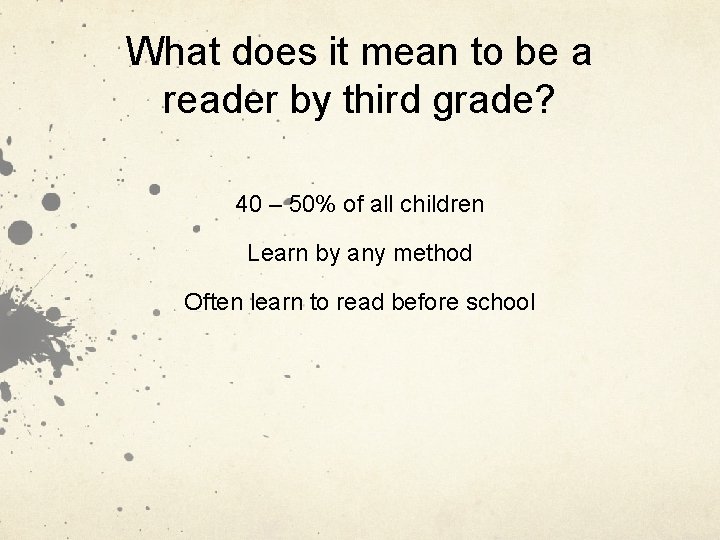
What does it mean to be a reader by third grade? 40 – 50% of all children Learn by any method Often learn to read before school
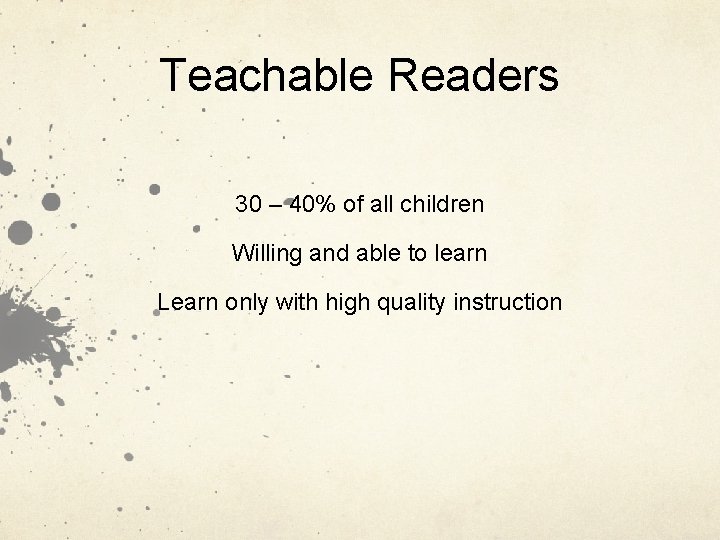
Teachable Readers 30 – 40% of all children Willing and able to learn Learn only with high quality instruction
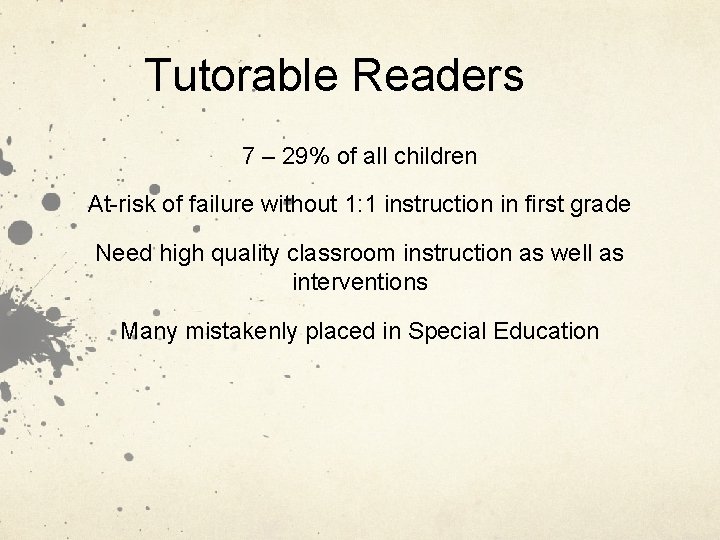
Tutorable Readers 7 – 29% of all children At-risk of failure without 1: 1 instruction in first grade Need high quality classroom instruction as well as interventions Many mistakenly placed in Special Education
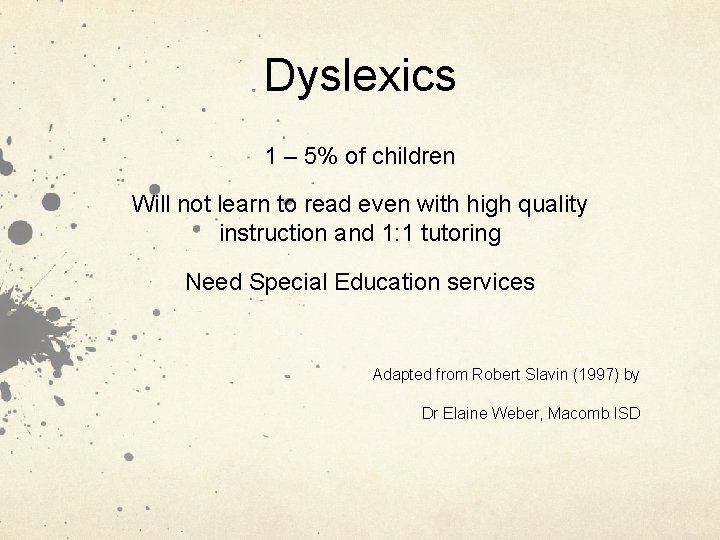
Dyslexics 1 – 5% of children Will not learn to read even with high quality instruction and 1: 1 tutoring Need Special Education services Adapted from Robert Slavin (1997) by Dr Elaine Weber, Macomb ISD
Now It’s Your Turn… Fill out your own Literacy Pre-Assessment, rating yourself on the continuum for each component. At the break, put your initials on each of the red dots you have been given. Use your red dots to place your ratings on the big chart paper for each component. Be thoughtful and honest about your responses. This information will give us a picture of the class’s overall rating of each component, and help us plan for the next nine sessions.
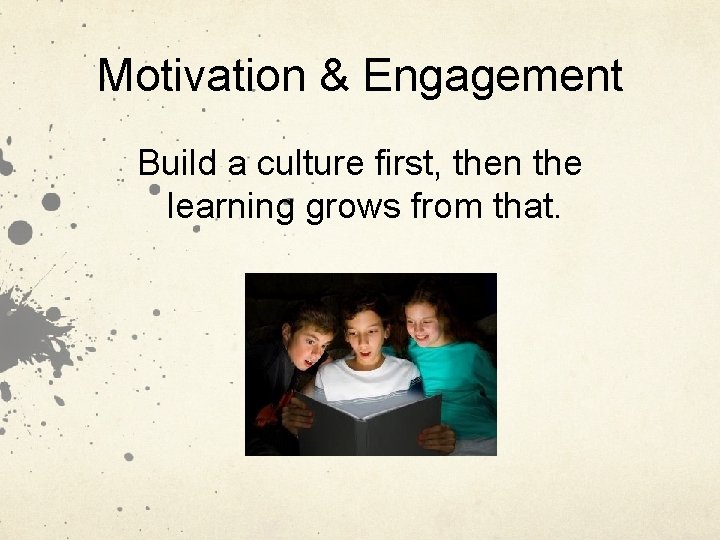
Motivation & Engagement Build a culture first, then the learning grows from that.
Happy people are better learners Fundamental human needs: - autonomy - sense of competence - belongingness - meaningfulness It’s all about building AGENCY!
Theories of Learning FIXED Theorists: the goal is PERFORMANCE GROWTH Theorists: the goal is to LEARN How do people develop these theories?
What each says when they encounter failure: FIXED: Question their ability and assign blame GROWTH: Self instruction, self-monitoring. Don’t see themselves failing, but rather learning. How do we help children take up a dynamic –learning frame rather than a fixed-performance frame?
3 Major Points of Influence: • What we choose to say when children are successful or unsuccessful – when we give children feedback or praise (It turns out to matter whether we say “Good job!” or “Good boy!”) • The way we frame activities (“Let’s see who is the • What we explicitly teach children about how their brains work (Every time we think and learn, our brains best – or quickest… at doing these problems” vs “Let’s see which of these problems is the most interesting”) grow new cells!)
Minimizing Fixed Frames Decision-making and processes, not traits, as causal narratives. Normalize change (history – trajectory) Normalize problems/errors as indicators of learning and challenge Problem solving process focus – How did you (could you) figure that out? Causal process narratives Flexibility – options – how else?
Turn and Talk… What does all of this talk of learning theory have to do with teaching reading and writing? What are the implications for special education and Rt. I?
Literacy Histories Start with your Thinking Journals. Think of your earliest literacy memory. You can either put it on a timeline or as the center of a bullseye. Now add other events you can remember, both good and bad. Choose 5 events to share. Write the “good” memories on yellow sticky notes and the “bad” memories on blue ones. Initial your sticky notes and place them on the big timeline on the wall.
Turn and Talk… Why is gathering a Literacy History an important step? What are some things you have done in your classrooms to gather Literacy Histories of your students?
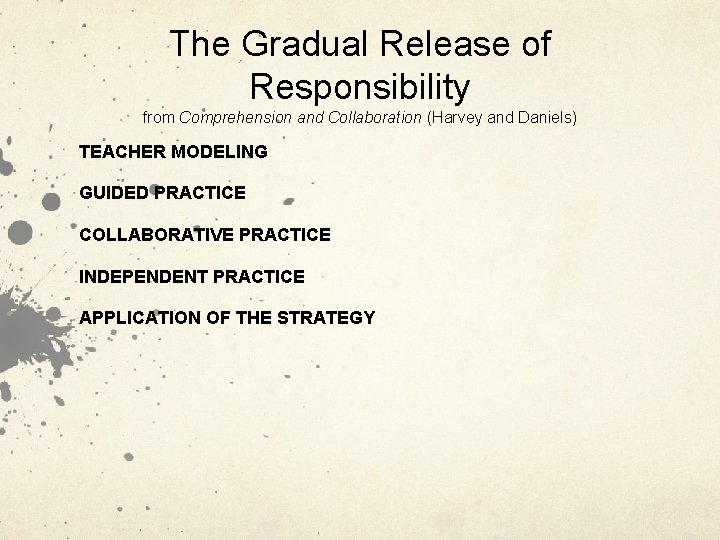
The Gradual Release of Responsibility from Comprehension and Collaboration (Harvey and Daniels) TEACHER MODELING GUIDED PRACTICE COLLABORATIVE PRACTICE INDEPENDENT PRACTICE APPLICATION OF THE STRATEGY
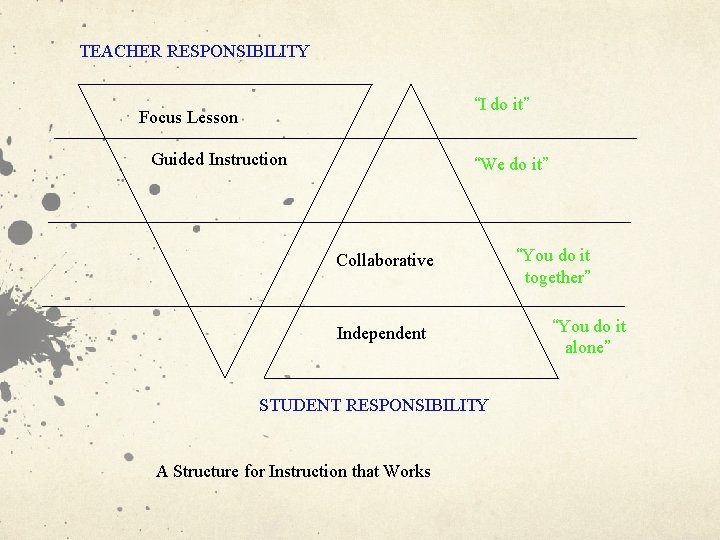
TEACHER RESPONSIBILITY “I do it” Focus Lesson Guided Instruction “We do it” Collaborative Independent STUDENT RESPONSIBILITY A Structure for Instruction that Works “You do it together” “You do it alone”
Developmentally Appropriate Practice • Daily experiences of being read to and independently reading meaningful text. • A balanced program that includes systematic code instruction along with meaningful reading and writing activities. • Daily opportunities and teacher support to write. • Writing experiences that move from invented spelling to conventional forms. • Opportunities tow work and collaborate in small groups. • A challenging curriculum that expands children’s knowledge of the world and vocabulary • Adaptation of instruction or individualized instruction if a child fails to make expected progress.
The Pre-emergent Reader • Enjoys listening to and talking about stories. • Understands that print carries a message and notices environmental print. • Uses picture cues and predictable patterns in books to retell the story. • Makes text to self connections. • Recognizes 5 - 20 familiar or high frequency words. • Identifies some letters and makes some letter-sound matches. • Uses known letters or approximations of letters to represent written language.
The Emergent Reader • Enjoys playing with language and books and wants to read. • Knows how stories and books work and has one to one correspondence. • Identifies letter names and sounds fluently and can segment and blend simple words. • Identifies 20 – 100 sight words. • Applies knowledge of cueing systems to monitor reading though often relies on one at a time. • Hears sound sequence in words and is starting to use beginning, middle, and end sounds to decode text.
The Developing Reader • Fluently reads appropriately-leveled text independently. • Recognizes 100 – 300 high frequency words. • Figures out unknown words using letter/sound knowledge, analogy, and/or other decoding strategies. • Integrates cueing systems to monitor and comprehend text. • Makes self-to-self and text-to-text connections. • Makes predictions, retells, and recall main ideas and details of narrative and expository text.
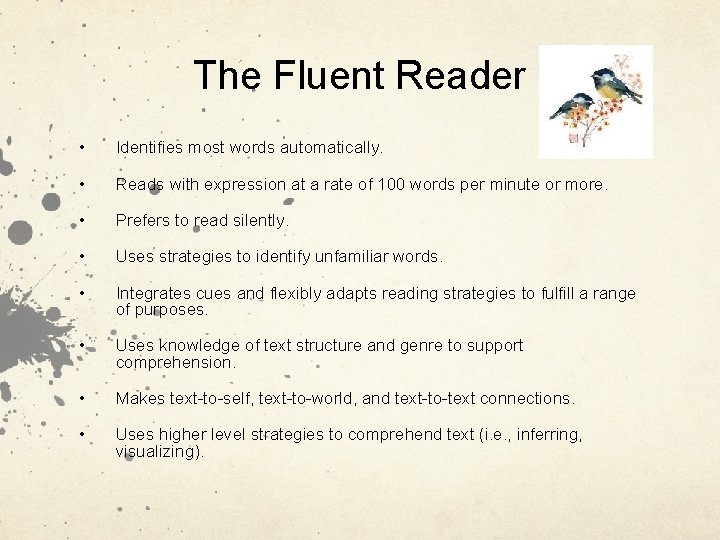
The Fluent Reader • Identifies most words automatically. • Reads with expression at a rate of 100 words per minute or more. • Prefers to read silently. • Uses strategies to identify unfamiliar words. • Integrates cues and flexibly adapts reading strategies to fulfill a range of purposes. • Uses knowledge of text structure and genre to support comprehension. • Makes text-to-self, text-to-world, and text-to-text connections. • Uses higher level strategies to comprehend text (i. e. , inferring, visualizing).
Common Core State Standards At your table, look at the Common Core Reading Standards. Note the “bump ups” from the previous grade to your grade to the grade after yours. Discuss how you are ensuring that these standards are being taught. How do you make the learning targets visible for your students?
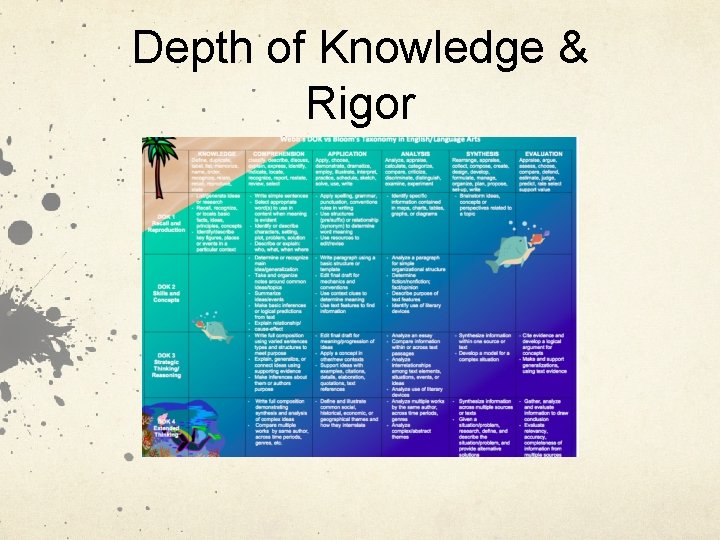
Depth of Knowledge & Rigor
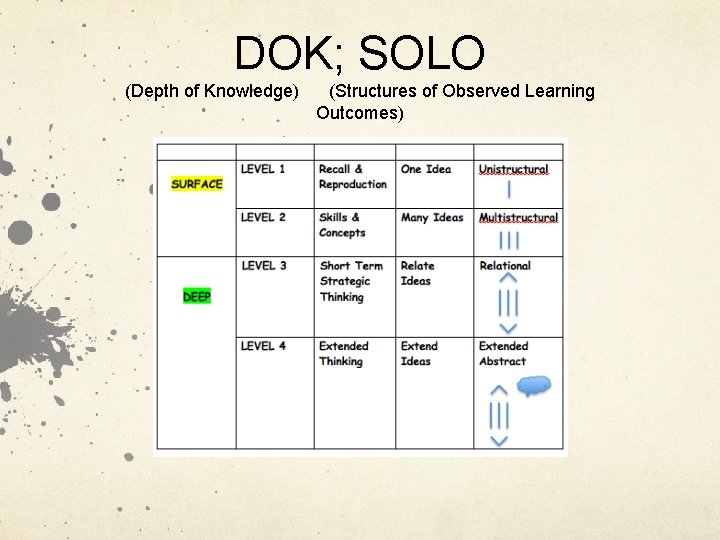
DOK; SOLO (Depth of Knowledge) (Structures of Observed Learning Outcomes)
Formative Assessment which informs instruction. The purpose of formative assessment is to reduce discrepancies between current understanding/performance and a desired goal. Turn and Talk… What other kinds of Formative Assessment do you use in your classroom? Make a list by grade at your table. Add to the grade level charts on the wall.
Feedback, when used as part of a formative assessment system, is a powerful way to improve student achievement. Where am I going? (Feed-Up) How am I doing? (Feedback) Where am I going next? (Feed-Forward) …putting the learning into the whole context Feedback alone is not enough. The problem with feedback is that it reassigns responsibility back to the learner. To be productive, this has to be well planned.
Michigan Literacy Progress Profile Who? What? Every Michigan child up through the third grade will have opportunities to show what s/he knows about reading, writing and speaking as s/he progresses toward becoming an independent reader. A collection of assessment tools to determine a child’s progress in her/his development of written and oral language. These tools tap the areas that are known to contribute to becoming literate. When? Where? When there is a need to know about the progress children are making in becoming literate. Within classrooms with trained personnel for the purpose of improving the child’s learning. Why? To ensure that all Michigan children are independent readers by the end of third grade.
2 Types of Assessments in the MLPP Milestone Assessments Digging Deeper Assessments
Milestone Assessments Writing Oral Language Comprehension Oral Reading Fluency Attitudes and Self-Perception
Digging Deeper Assessments Known Words Activity Phonemic Awareness Hearing and Recording Sounds Concepts of Print Sight Word/Decodable Word Lists Letter/Sound ID
some final thoughts from Madeline Hunter… “If you want to feel safe and secure, continue to do what you have always done. If you want to grow, go to the cutting edge of our profession. Just know that when you do, there will be a temporary loss of sanity. So when you don’t quite know what you are doing, You are probably growing!”
Expectations for “Certification” Select 3 students for your Case Study. One should be a “high” student, one a “medium” student, and one an “atrisk, striving” student from the bottom 30% of your class. You will be creating a data portfolio for each of these students, as well as recording your thoughts and observations about your work with these students throughout the school year in your Thinking Journal. You are also required to attend each of the 10 sessions, participating in the activities of each module. Upon completion of the requirements, you will be issued a passport of certification. You may take up to two years to complete certification.
Wrap Up Your TICKET OUT THE DOOR: Each person should write a comment on a large sticky note, telling us one thing you got from tonight’s session (an ah-ha, a goal you set for yourself, some new information you heard that you want to remember…) Pass your sticky note to your elbow partner, clockwise around the table. That person should write a comment in response to you, then pass it back to you. Read your partner’s comment, then post it on the door as you leave.