
Michigan Department of Community Health Real Choice Systems
- Slides: 12
Michigan Department of Community Health Real Choice Systems Change Projects Illinois Systems Change Seminar September 22, 2004 Ro. Anne Chaney Michigan Disability Rights Coalition Michael Daeschlein Michigan Department of Community Health
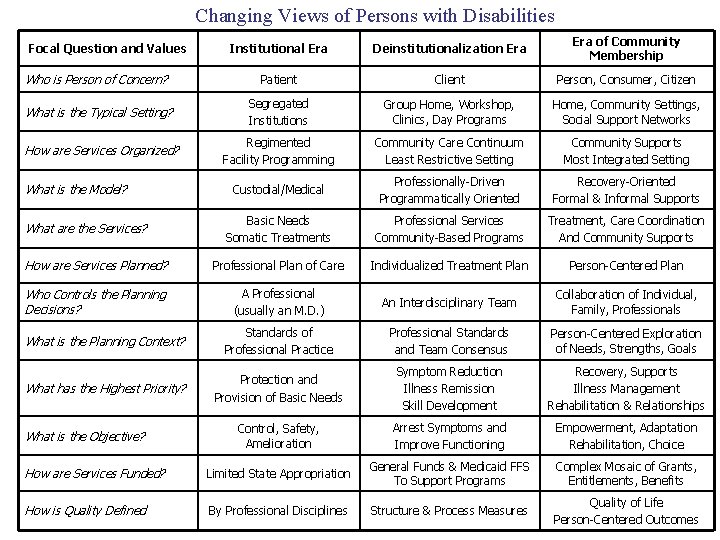
Changing Views of Persons with Disabilities Institutional Era Deinstitutionalization Era of Community Membership Who is Person of Concern? Patient Client Person, Consumer, Citizen What is the Typical Setting? Segregated Institutions Group Home, Workshop, Clinics, Day Programs Home, Community Settings, Social Support Networks How are Services Organized? Regimented Facility Programming Community Care Continuum Least Restrictive Setting Community Supports Most Integrated Setting Custodial/Medical Professionally-Driven Programmatically Oriented Recovery-Oriented Formal & Informal Supports Basic Needs Somatic Treatments Professional Services Community-Based Programs Treatment, Care Coordination And Community Supports How are Services Planned? Professional Plan of Care Individualized Treatment Plan Person-Centered Plan Who Controls the Planning Decisions? A Professional (usually an M. D. ) An Interdisciplinary Team Collaboration of Individual, Family, Professionals What is the Planning Context? Standards of Professional Practice Professional Standards and Team Consensus Person-Centered Exploration of Needs, Strengths, Goals What has the Highest Priority? Protection and Provision of Basic Needs Symptom Reduction Illness Remission Skill Development Recovery, Supports Illness Management Rehabilitation & Relationships Control, Safety, Amelioration Arrest Symptoms and Improve Functioning Empowerment, Adaptation Rehabilitation, Choice How are Services Funded? Limited State Appropriation General Funds & Medicaid FFS To Support Programs Complex Mosaic of Grants, Entitlements, Benefits How is Quality Defined By Professional Disciplines Structure & Process Measures Quality of Life Person-Centered Outcomes Focal Question and Values What is the Model? What are the Services? What is the Objective?
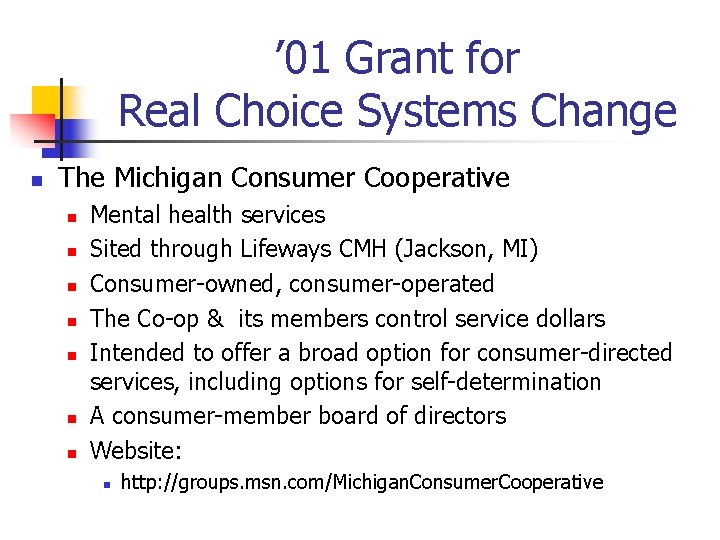
’ 01 Grant for Real Choice Systems Change n The Michigan Consumer Cooperative n n n n Mental health services Sited through Lifeways CMH (Jackson, MI) Consumer-owned, consumer-operated The Co-op & its members control service dollars Intended to offer a broad option for consumer-directed services, including options for self-determination A consumer-member board of directors Website: n http: //groups. msn. com/Michigan. Consumer. Cooperative
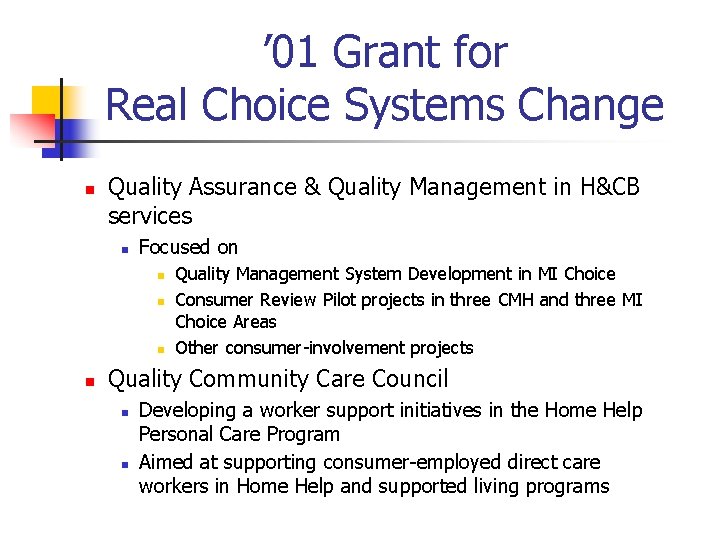
’ 01 Grant for Real Choice Systems Change n Quality Assurance & Quality Management in H&CB services n Focused on n n Quality Management System Development in MI Choice Consumer Review Pilot projects in three CMH and three MI Choice Areas Other consumer-involvement projects Quality Community Care Council n n Developing a worker support initiatives in the Home Help Personal Care Program Aimed at supporting consumer-employed direct care workers in Home Help and supported living programs
Real Choice Systems Change ‘ 03 n Money Follows the Person Rebalancing Initiative n n n Aimed at rebalancing the relative investment made in nursing care versus community care for persons who are elderly or with physical disabilities In Michigan ~ 75% of Medicaid LTC funds are spent for nursing home services “Money Follows the Person” means that people would take the funds spent on their nursing care and redirect them to community-based services
Money Follows the Person Rebalancing Initiative n Medicaid-funded Community-based LTC in Michigan: n n n n Mi Choice Waiver Home Health PACE Home Help System is fragmented No single entry process Not person-centered, consumer-driven Governor’s Medicaid Long Term Care Task Force
Money Follows the Person Rebalancing Initiative n Grant Objectives n n n Improve consumer awareness and knowledge of policy and system operations Enhance communication between consumer advocates and policy and program managers Establish local advocacy for community care Develop and initiate three local pilot single-entry systems that incorporate the principles and practices of managed care Analyze current system for changes that can be made independent of new Federal waivers (e. g. adding “transition services” to the MI Choice Waiver
Improve Consumer Awareness, Knowledge & Participation n Community Consortium for Advocacy & TA n n Michigan Disability Rights Coalition Presentations, meetings, Website: n n http: //mfp. prosynergy. org/ Statewide effort Subsequent focus on three pilot areas Community LTC Retreat n n 60 people: consumers, advocacy representatives, state officials Studied single entry point, ADRC models Examined Medicaid managed LTC models under 1915 waivers Follow-up work groups n n Build Models for local pilot single-entry projects Feed into LTC Task Force
Community Long-Term Care Roundtable n n Intent: To establish a forum for regular, ongoing dialogue between consumers and stakeholders in LTC and state agency officials involved in LTC policy and operations Specific to single-entry system reform & money follows person methods On “hold” while the Governor’s LTC Task Force is in operation Pick up where the LTC Task Force ends, within the grant objectives
Managed LTC Pilot Projects n Intended to be developed in three Michigan communities n n Local Advocacy consortiums Interested local agency base Single-entry model Managed LTC arrangement n n n Pre-paid, capitated, risk-bearing entity Access to all Medicaid funds for LTC Voluntary enrollment on the part of beneficiaries
Independence Plus Initiative n Independence Plus is the Federal Medicaid term for what is called: n n n Self-Determination or Cash & Counseling Involves consumers in developing their plan of services using a person-centered planning approach Consumer may establish an “individual budget” to be directed by the consumer, so as to choose and directly purchase needed services & supports Supported community living is the aim Full community membership is the goal
Independence Plus Initiative n Three objectives: n n n Support the system-wide implementation of Michigan’s policy on self-determination, across the community mental health system Infuse the practices of person-centered planning into the MI Choice Waiver system (Pam Werner) Develop and submit an 1115 waiver application, in order to allow a limited number of persons with known and predictable LTC support needs to instead access a true cash benefit for directly purchasing their LTC supports n n Mental health beneficiaries LTC beneficiaries