
Michigan Assessment Consortium Common Assessment Development Series Module


- Slides: 17
Michigan Assessment Consortium Common Assessment Development Series Module 15 Assembling the Assessment Instrument
Narrated By: Jim Gullen Oakland Schools 2
Assembling the Test § You have your items, it’s time to assemble the test booklets. § There are some important steps to assembling your test booklet(s) § It is important to consider how to assemble a test so that the test is not confusing to students 3
Test Blueprint § Assembling the test starts with a check of the test blueprint § Use the blueprint to decide which items to use in either a field test or the actual assessment instrument § How many items for each target? § What mix of items to use for each target? 4
Test Assembly § To assure reliability, review § § § How many standards were selected How many items will be used per standard More items = greater reliability, but fewer standards covered in the same amount of time 5
Test Assembly § To assure validity, assure two-way alignment: § All important learning targets are assessed § Every assessment item measures a target § You will need to juggle reliability and validity criteria to come up with a test that has enough items but is not too long 6
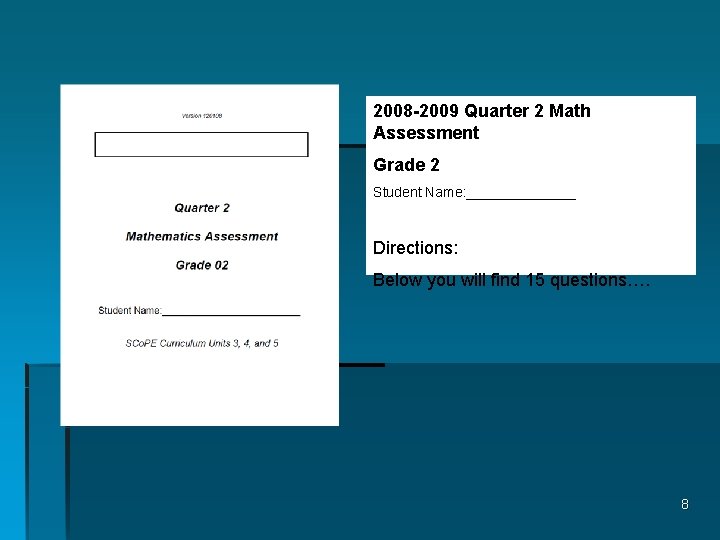
Cover Page § § § Each test should have a cover page This page should show the title of the test at the top If multiple test forms are used, make sure that each has a unique identifier so that students can mark this on their answer document § Examples are shown on the next page 7
2008 -2009 Quarter 2 Math Assessment Grade 2 Student Name: _______ Directions: Below you will find 15 questions…. 8
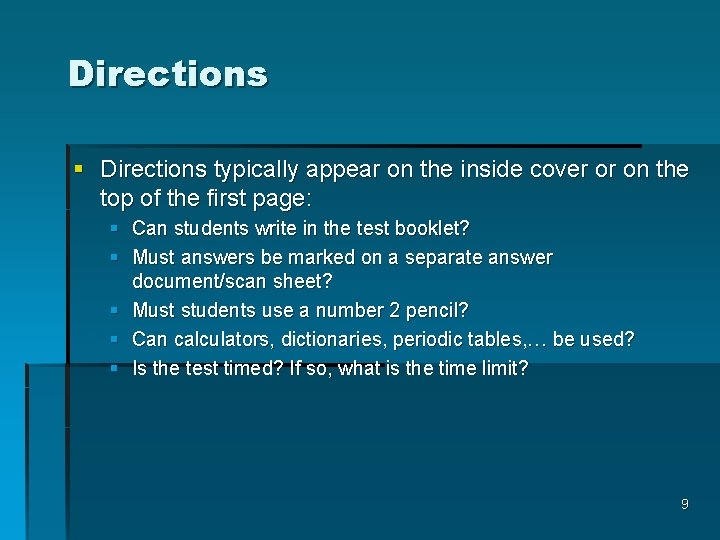
Directions § Directions typically appear on the inside cover or on the top of the first page: § Can students write in the test booklet? § Must answers be marked on a separate answer document/scan sheet? § Must students use a number 2 pencil? § Can calculators, dictionaries, periodic tables, … be used? § Is the test timed? If so, what is the time limit? 9
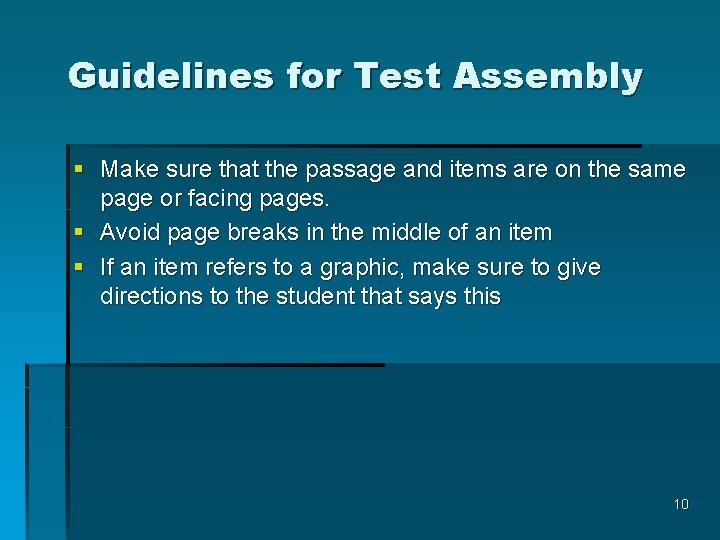
Guidelines for Test Assembly § Make sure that the passage and items are on the same page or facing pages. § Avoid page breaks in the middle of an item § If an item refers to a graphic, make sure to give directions to the student that says this 10
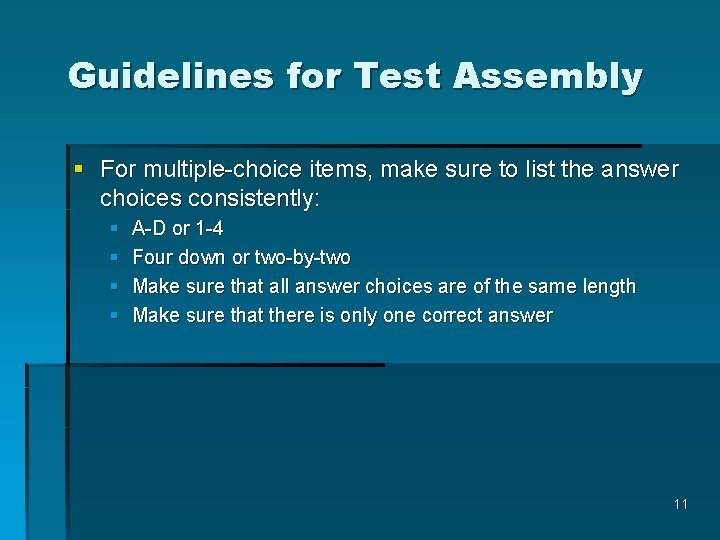
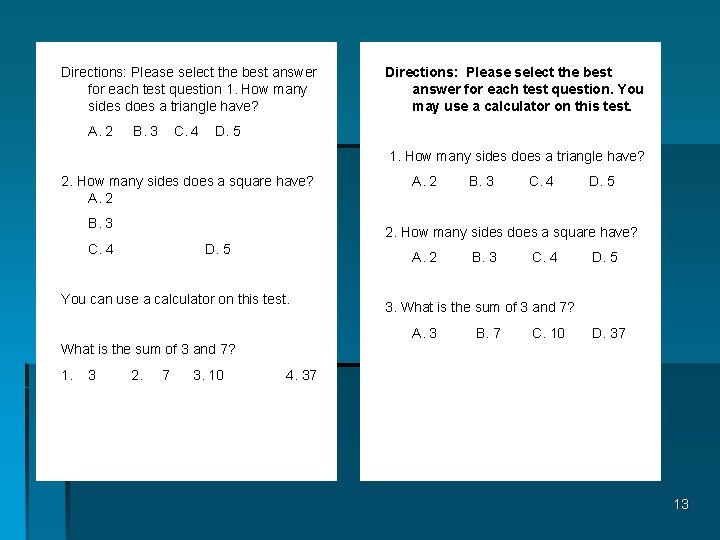
Guidelines for Test Assembly § For multiple-choice items, make sure to list the answer choices consistently: § § A-D or 1 -4 Four down or two-by-two Make sure that all answer choices are of the same length Make sure that there is only one correct answer 11
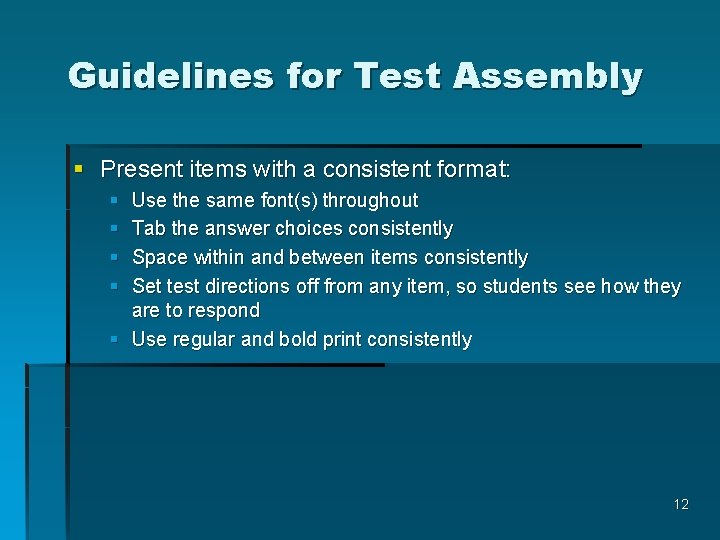
Guidelines for Test Assembly § Present items with a consistent format: § § Use the same font(s) throughout Tab the answer choices consistently Space within and between items consistently Set test directions off from any item, so students see how they are to respond § Use regular and bold print consistently 12
Directions: Please select the best answer for each test question 1. How many sides does a triangle have? A. 2 B. 3 C. 4 Directions: Please select the best answer for each test question. You may use a calculator on this test. D. 5 1. How many sides does a triangle have? 2. How many sides does a square have? A. 2 B. 3 C. 4 D. 5 2. How many sides does a square have? C. 4 D. 5 A. 2 You can use a calculator on this test. B. 3 C. 4 D. 5 3. What is the sum of 3 and 7? A. 3 B. 7 C. 10 D. 37 What is the sum of 3 and 7? 1. 3 2. 7 3. 10 4. 37 13
Summary § § § Use a clearly identifiable title Provide clear student directions Use an appropriate format § § Aids the reader in completing the test Doesn’t add complexity Promotes readability Has enough “white space, ” there’s not too much stuff on a page. 14
Summary § A carefully assembled test, based on the test blueprint, laid out in an attractive manner, will add to the validity of the test. 15
Series Developers § § § § Kathy Dewsbury White, Ingham ISD Bruce Fay, Wayne RESA Jim Gullen, Oakland Schools Julie Mc. Daniel, Oakland Schools Edward Roeber, MSU Ellen Vorenkamp, Wayne RESA Kim Young, Ionia County ISD/MDE 16
Development Support for the Assessment Series § The MAC Common Assessment Development Series is funded in part by the Michigan Association of Intermediate School Administrators § In cooperation with § § § Michigan Department of Education Ingham and Ionia ISDs, Oakland Schools, and Wayne RESA Michigan State University 17