
Michelson Interferometer An Interferometer is an instrument in
- Slides: 7
Michelson Interferometer Ø An Interferometer is an instrument in which the phenomenon of interference is used to make precise measurements of wavelength or distances , refractive indices , testing of optical components, Mechanical displacements etc. Ø The Michelson interferometer is two beam instruments.
Michelson Interferometer Principle : A beam of light from an extended source is divided into two parts of equal intensities by partial reflection and refraction. These beams travel in two mutually perpendicular directions and come together after reflection from plane mirrors. They superpose and produce interference fringes.
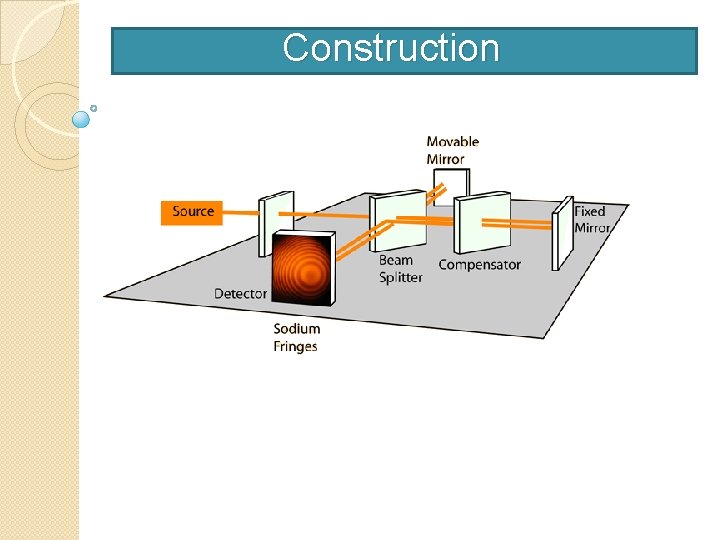
Construction
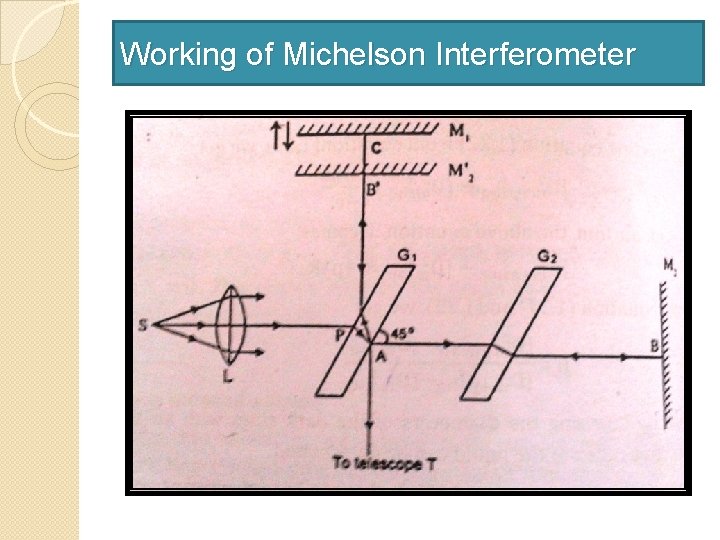
Working of Michelson Interferometer
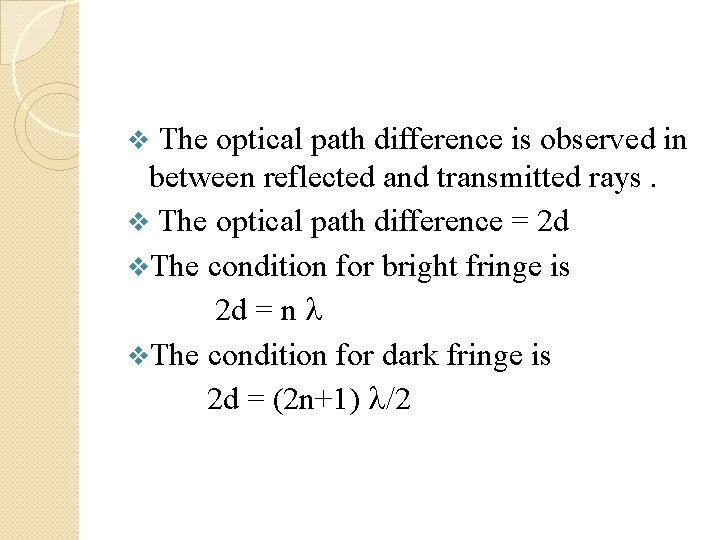
The optical path difference is observed in between reflected and transmitted rays. v The optical path difference = 2 d v. The condition for bright fringe is 2 d = n v. The condition for dark fringe is 2 d = (2 n+1) /2 v
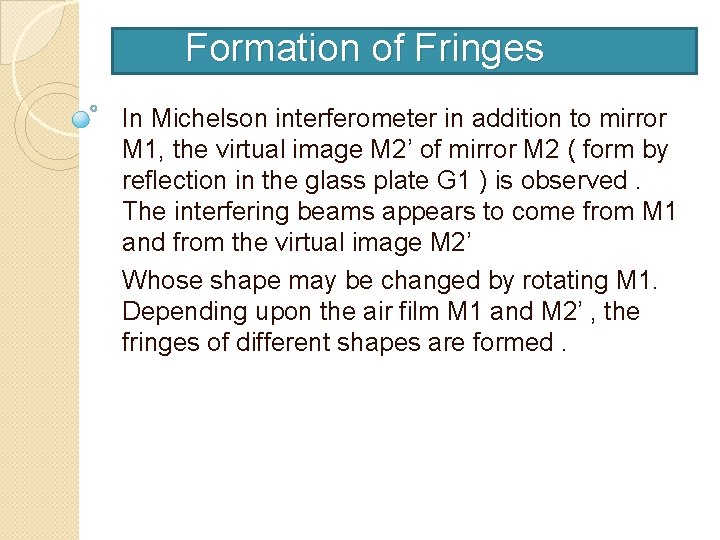
Formation of Fringes In Michelson interferometer in addition to mirror M 1, the virtual image M 2’ of mirror M 2 ( form by reflection in the glass plate G 1 ) is observed. The interfering beams appears to come from M 1 and from the virtual image M 2’ Whose shape may be changed by rotating M 1. Depending upon the air film M 1 and M 2’ , the fringes of different shapes are formed.
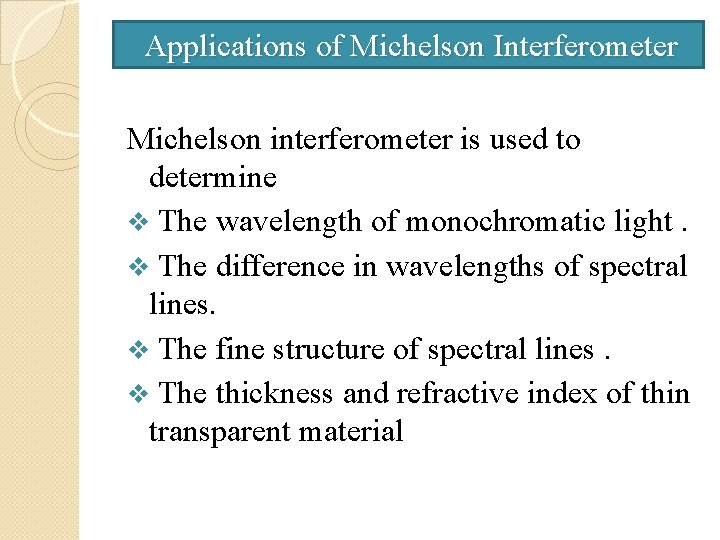
Applications of Michelson Interferometer Michelson interferometer is used to determine v The wavelength of monochromatic light. v The difference in wavelengths of spectral lines. v The fine structure of spectral lines. v The thickness and refractive index of thin transparent material