
MICHAL DROBOT 3 D UBISOFT MTL LOW LEVEL

MICHAL. DROBOT 3 D @ UBISOFT MTL

LOW LEVEL OPTIMIZATIONS FOR GCN Hacking The New Generation 2014 -05 -11

Agenda • • • GCN Architecture Instruction Set Optimizing ALU – New Ways – Ideas – Tips & Tricks • Use Cases

GCN Architecture • • • AMD Radeon HD 7 xxx R 7 x R 9 x Microsoft Xbox One Sony Playstation 4

GCN Architecture • Open documentation by AMD – ISA • Well covered basics – „Low-level Shader Optimization for Next-Gen and DX 11” – Emil Persson – „The AMD GCN Architecture: A Crash Course" - Layla Mah • Basics – Keep it Wide : Occupancy : Low Resource (VGPR) usage – Lots of ‚smart’ ALU – trade for bandwidth – GCN super good at hiding latency – but needs help
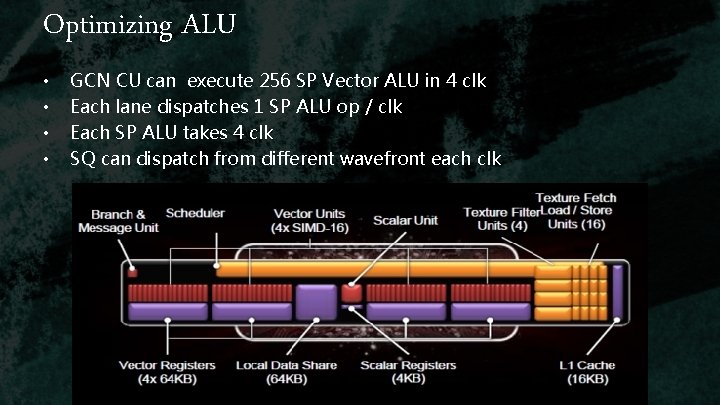
Optimizing ALU • • GCN CU can execute 256 SP Vector ALU in 4 clk Each lane dispatches 1 SP ALU op / clk Each SP ALU takes 4 clk SQ can dispatch from different wavefront each clk
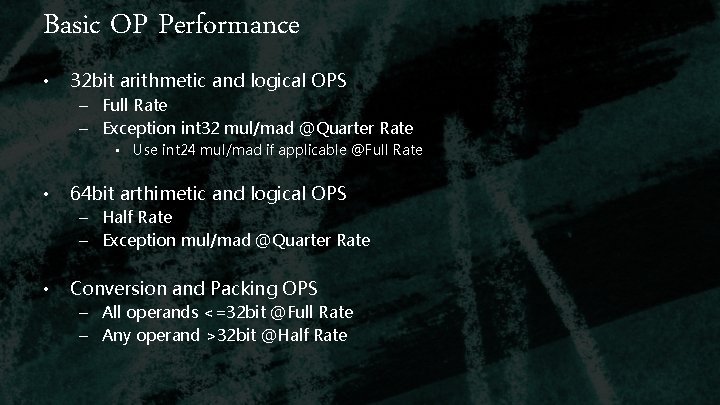
Basic OP Performance • 32 bit arithmetic and logical OPS – Full Rate – Exception int 32 mul/mad @Quarter Rate • Use int 24 mul/mad if applicable @Full Rate • 64 bit arthimetic and logical OPS – Half Rate – Exception mul/mad @Quarter Rate • Conversion and Packing OPS – All operands <=32 bit @Full Rate – Any operand >32 bit @Half Rate
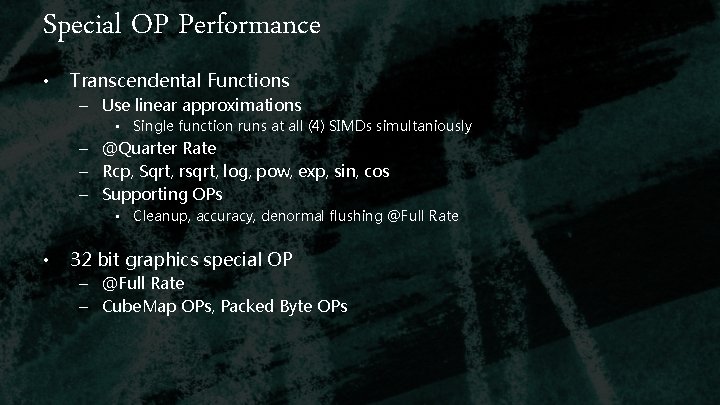
Special OP Performance • Transcendental Functions – Use linear approximations • Single function runs at all (4) SIMDs simultaniously – @Quarter Rate – Rcp, Sqrt, rsqrt, log, pow, exp, sin, cos – Supporting OPs • Cleanup, accuracy, denormal flushing @Full Rate • 32 bit graphics special OP – @Full Rate – Cube. Map OPs, Packed Byte OPs
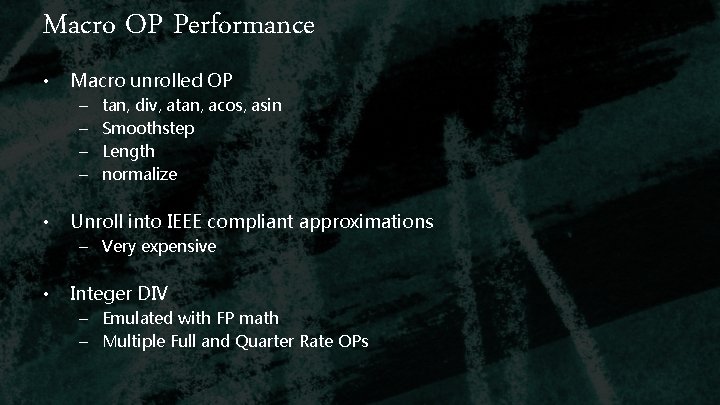
Macro OP Performance • Macro unrolled OP – – • tan, div, atan, acos, asin Smoothstep Length normalize Unroll into IEEE compliant approximations – Very expensive • Integer DIV – Emulated with FP math – Multiple Full and Quarter Rate OPs
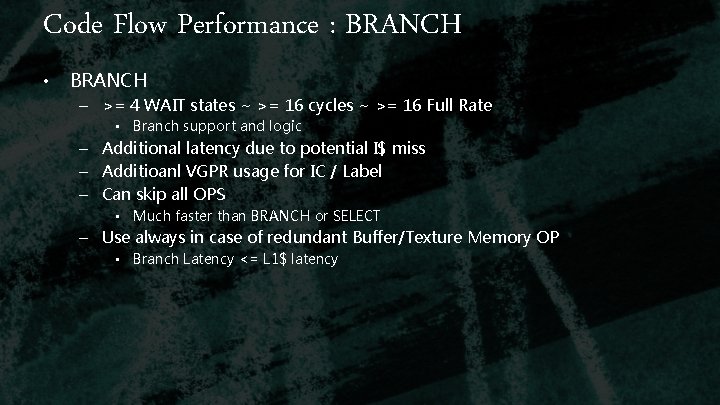
Code Flow Performance : BRANCH • BRANCH – >= 4 WAIT states ~ >= 16 cycles ~ >= 16 Full Rate • Branch support and logic – Additional latency due to potential I$ miss – Additioanl VGPR usage for IC / Label – Can skip all OPS • Much faster than BRANCH or SELECT – Use always in case of redundant Buffer/Texture Memory OP • Branch Latency <= L 1$ latency
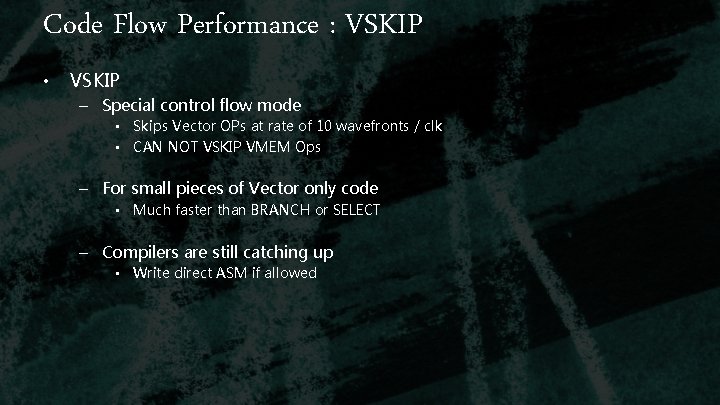
Code Flow Performance : VSKIP • VSKIP – Special control flow mode • Skips Vector OPs at rate of 10 wavefronts / clk • CAN NOT VSKIP VMEM Ops – For small pieces of Vector only code • Much faster than BRANCH or SELECT – Compilers are still catching up • Write direct ASM if allowed
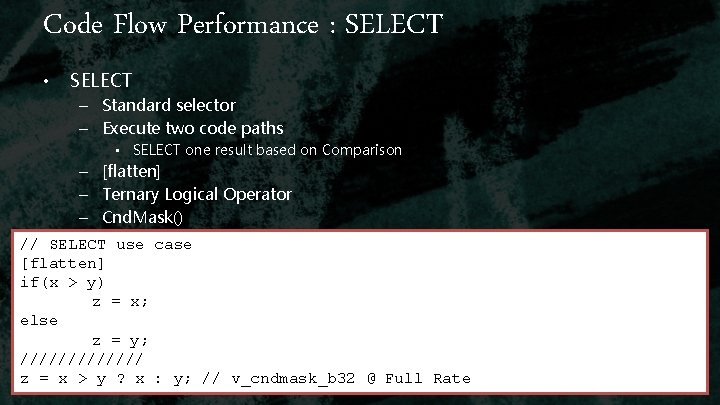
Code Flow Performance : SELECT • SELECT – Standard selector – Execute two code paths • SELECT one result based on Comparison – [flatten] – Ternary Logical Operator – Cnd. Mask() // SELECT use case [flatten] if(x > y) z = x; else z = y; /////// z = x > y ? x : y; // v_cndmask_b 32 @ Full Rate
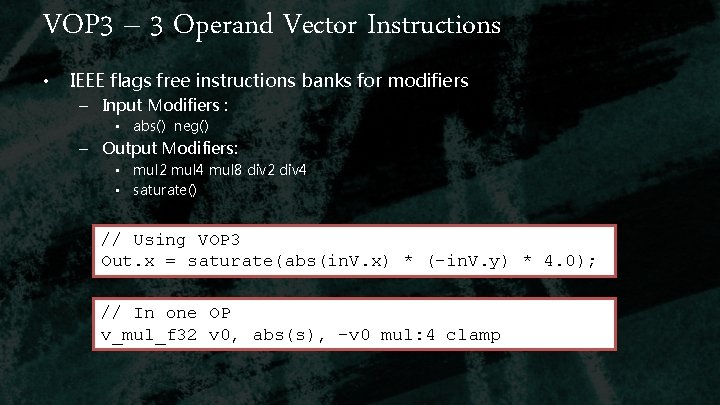
VOP 3 – 3 Operand Vector Instructions • IEEE flags free instructions banks for modifiers – Input Modifiers : • abs() neg() – Output Modifiers: • mul 2 mul 4 mul 8 div 2 div 4 • saturate() // Using VOP 3 Out. x = saturate(abs(in. V. x) * (-in. V. y) * 4. 0); // In one OP v_mul_f 32 v 0, abs(s), -v 0 mul: 4 clamp
VOP 3 – 3 Operand Vector Instructions • Most compilers will automatically use VOP 3 when – – Allowed (-fastmath –IEEEStrcit disabled) (-x) Saturate() *2. 0 *4. 0 *8. 0 *0. 5 *0. 25
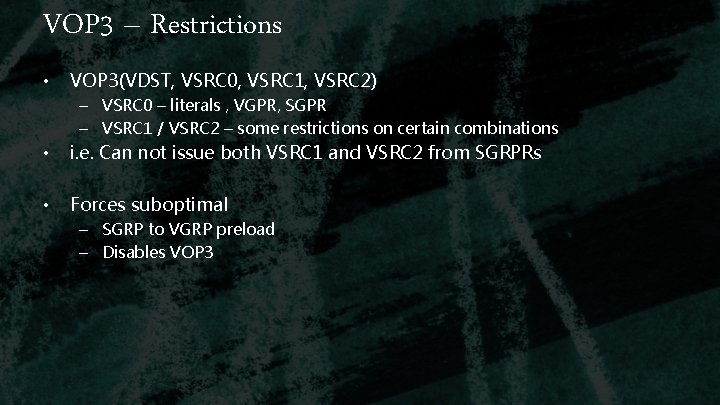
VOP 3 – Restrictions • VOP 3(VDST, VSRC 0, VSRC 1, VSRC 2) – VSRC 0 – literals , VGPR, SGPR – VSRC 1 / VSRC 2 – some restrictions on certain combinations • i. e. Can not issue both VSRC 1 and VSRC 2 from SGRPRs • Forces suboptimal – SGRP to VGRP preload – Disables VOP 3
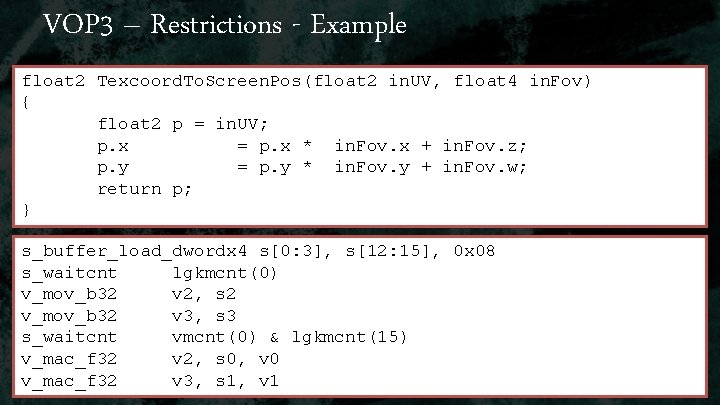
VOP 3 – Restrictions - Example float 2 Texcoord. To. Screen. Pos(float 2 in. UV, float 4 in. Fov) { float 2 p = in. UV; p. x = p. x * in. Fov. x + in. Fov. z; p. y = p. y * in. Fov. y + in. Fov. w; return p; } s_buffer_load_dwordx 4 s[0: 3], s[12: 15], 0 x 08 s_waitcnt lgkmcnt(0) v_mov_b 32 v 2, s 2 v_mov_b 32 v 3, s 3 s_waitcnt vmcnt(0) & lgkmcnt(15) v_mac_f 32 v 2, s 0, v 0 v_mac_f 32 v 3, s 1, v 1
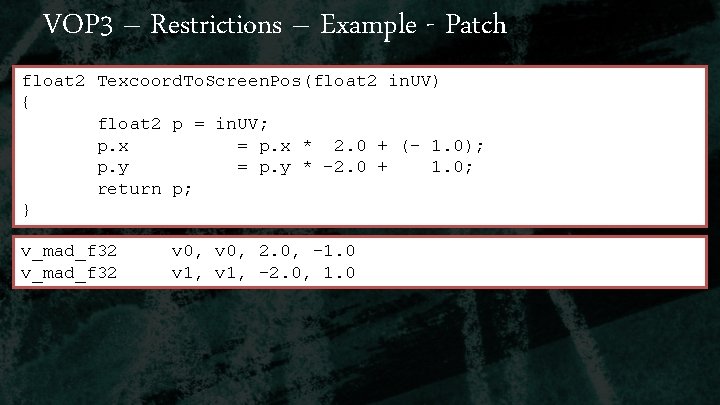
VOP 3 – Restrictions – Example - Patch float 2 Texcoord. To. Screen. Pos(float 2 in. UV) { float 2 p = in. UV; p. x = p. x * 2. 0 + (- 1. 0); p. y = p. y * -2. 0 + 1. 0; return p; } v_mad_f 32 v 0, 2. 0, -1. 0 v_mad_f 32 v 1, -2. 0, 1. 0
VOP 3 – Constant Patching • Built In Fast Literal Constants – Built in +/- 1 , 2 , 4, 8 constants - can use with all VOP 3 • Single Literal Constant support – v_madak_f 32 – v_madmk_f 32
VOP 3 – Constant Patching • Consider Uniform Patching – If uniforms are constant • Artist Generated shaders • Particle Systems • Transforms • Beneficial – Higher chance of better scheduling – Efficient tight loops (i. e. Screen Space Raymarching) • Balance unique shaders vs performance – Crucial shaders can always be patched ‚on flight’ – PS 3 style
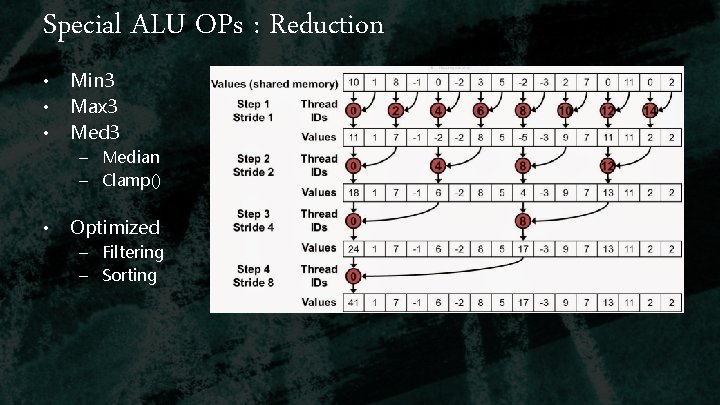
Special ALU OPs : Reduction • • • Min 3 Max 3 Med 3 – Median – Clamp() • Optimized – Filtering – Sorting
Special ALU OPs : Packing • GCN exposes multiple packing and conversion operations (used for compressed MRT) – – – • F 32 -> F 16 -> F 32 -> SNorm / UNorm. . . Also pairwise : 2 x. F 32 -> 2 x. F 16 v_cvt_* - ISA OPs Unpacking functions needs to be written manually
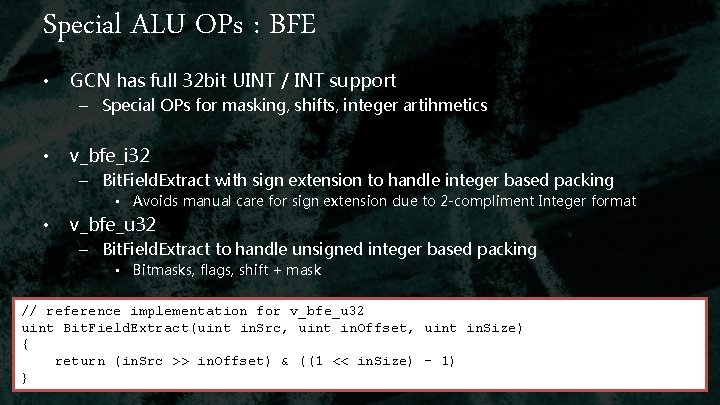
Special ALU OPs : BFE • GCN has full 32 bit UINT / INT support – Special OPs for masking, shifts, integer artihmetics • v_bfe_i 32 – Bit. Field. Extract with sign extension to handle integer based packing • Avoids manual care for sign extension due to 2 -compliment Integer format • v_bfe_u 32 – Bit. Field. Extract to handle unsigned integer based packing • Bitmasks, flags, shift + mask // reference implementation for v_bfe_u 32 uint Bit. Field. Extract(uint in. Src, uint in. Offset, uint in. Size) { return (in. Src >> in. Offset) & ((1 << in. Size) – 1) }
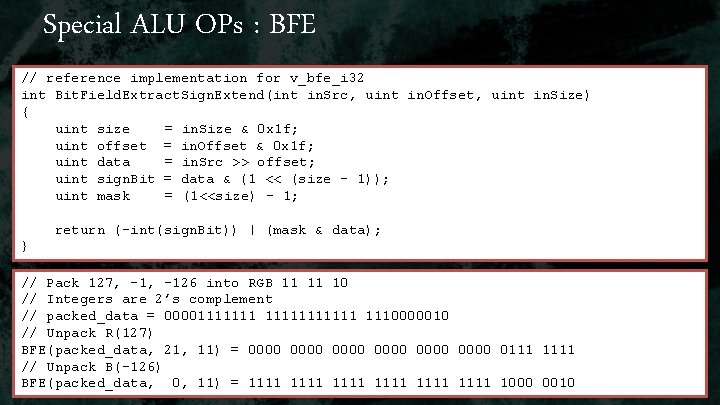
Special ALU OPs : BFE // reference implementation for v_bfe_i 32 int Bit. Field. Extract. Sign. Extend(int in. Src, uint in. Offset, uint in. Size) { uint size = in. Size & 0 x 1 f; uint offset = in. Offset & 0 x 1 f; uint data = in. Src >> offset; uint sign. Bit = data & (1 << (size - 1)); uint mask = (1<<size) - 1; return (-int(sign. Bit)) | (mask & data); } // Pack 127, -126 into RGB 11 11 10 // Integers are 2’s complement // packed_data = 00001111111 1110000010 // Unpack R(127) BFE(packed_data, 21, 11) = 0000 0000 0111 1111 // Unpack B(-126) BFE(packed_data, 0, 11) = 1111 1111 1000 0010
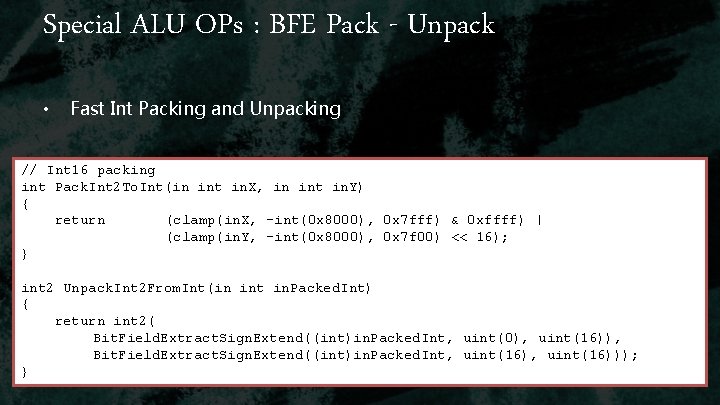
Special ALU OPs : BFE Pack - Unpack • Fast Int Packing and Unpacking // Int 16 packing int Pack. Int 2 To. Int(in int in. X, in int in. Y) { return (clamp(in. X, -int(0 x 8000), 0 x 7 fff) & 0 xffff) | (clamp(in. Y, -int(0 x 8000), 0 x 7 f 00) << 16); } int 2 Unpack. Int 2 From. Int(in int in. Packed. Int) { return int 2( Bit. Field. Extract. Sign. Extend((int)in. Packed. Int, uint(0), uint(16)), Bit. Field. Extract. Sign. Extend((int)in. Packed. Int, uint(16))); }
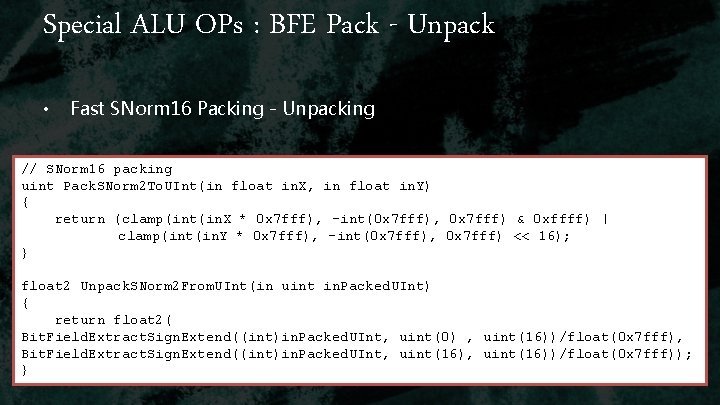
Special ALU OPs : BFE Pack - Unpack • Fast SNorm 16 Packing - Unpacking // SNorm 16 packing uint Pack. SNorm 2 To. UInt(in float in. X, in float in. Y) { return (clamp(int(in. X * 0 x 7 fff), -int(0 x 7 fff), 0 x 7 fff) & 0 xffff) | clamp(int(in. Y * 0 x 7 fff), -int(0 x 7 fff), 0 x 7 fff) << 16); } float 2 Unpack. SNorm 2 From. UInt(in uint in. Packed. UInt) { return float 2( Bit. Field. Extract. Sign. Extend((int)in. Packed. UInt, uint(0) , uint(16))/float(0 x 7 fff), Bit. Field. Extract. Sign. Extend((int)in. Packed. UInt, uint(16))/float(0 x 7 fff)); }
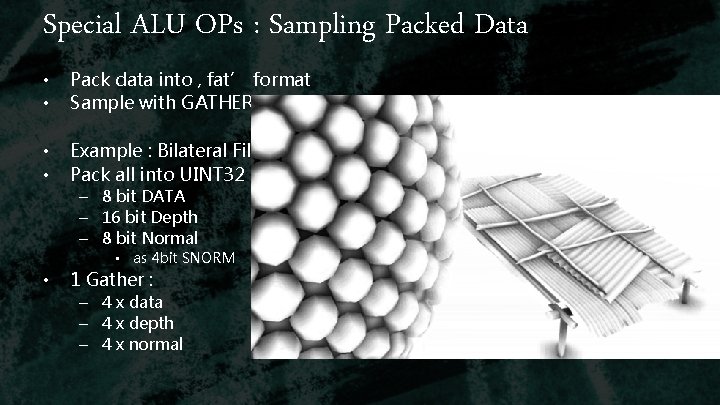
Special ALU OPs : Sampling Packed Data • • Pack data into ‚fat’ format Sample with GATHER • • Example : Bilateral Filter Pack all into UINT 32 – 8 bit DATA – 16 bit Depth – 8 bit Normal • as 4 bit SNORM • 1 Gather : – 4 x data – 4 x depth – 4 x normal
Special ALU OPs : Packing • Use Bitfields to reduce register pressure with lifetime bool flags – Countbits() – Firstbithigh() – Firstbitlow() uint Fast. Log 2(uint in. X) { return firstbithigh(in. X) – 1; }
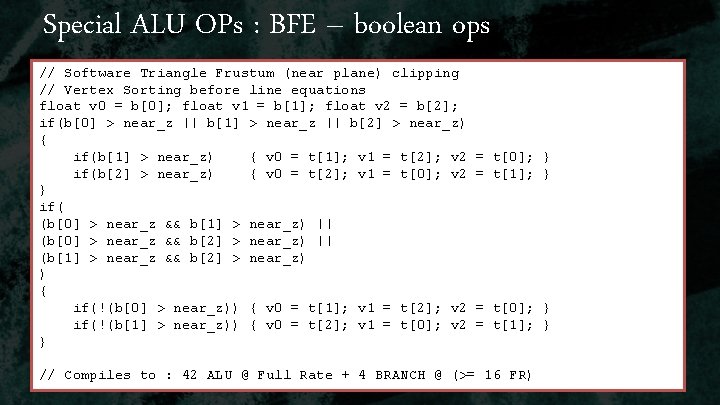
Special ALU OPs : BFE – boolean ops // Software Triangle Frustum (near plane) clipping // Vertex Sorting before line equations float v 0 = b[0]; float v 1 = b[1]; float v 2 = b[2]; if(b[0] > near_z || b[1] > near_z || b[2] > near_z) { if(b[1] > near_z) { v 0 = t[1]; v 1 = t[2]; v 2 = t[0]; } if(b[2] > near_z) { v 0 = t[2]; v 1 = t[0]; v 2 = t[1]; } } if( (b[0] > near_z && b[1] > near_z) || (b[0] > near_z && b[2] > near_z) || (b[1] > near_z && b[2] > near_z) ) { if(!(b[0] > near_z)) { v 0 = t[1]; v 1 = t[2]; v 2 = t[0]; } if(!(b[1] > near_z)) { v 0 = t[2]; v 1 = t[0]; v 2 = t[1]; } } // Compiles to : 42 ALU @ Full Rate + 4 BRANCH @ (>= 16 FR)
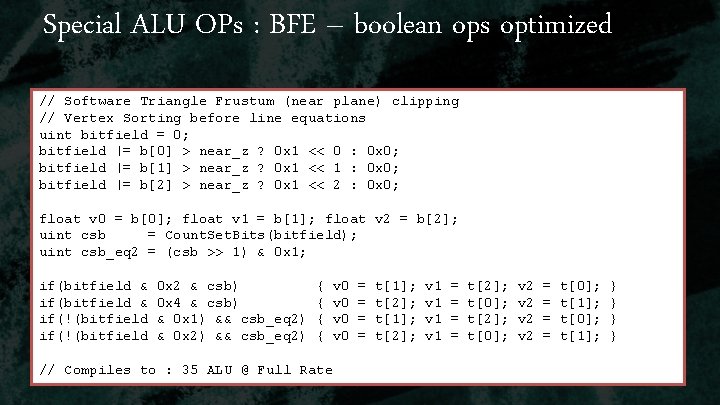
Special ALU OPs : BFE – boolean ops optimized // Software Triangle Frustum (near plane) clipping // Vertex Sorting before line equations uint bitfield = 0; bitfield |= b[0] > near_z ? 0 x 1 << 0 : 0 x 0; bitfield |= b[1] > near_z ? 0 x 1 << 1 : 0 x 0; bitfield |= b[2] > near_z ? 0 x 1 << 2 : 0 x 0; float v 0 = b[0]; float v 1 = b[1]; float v 2 = b[2]; uint csb = Count. Set. Bits(bitfield); uint csb_eq 2 = (csb >> 1) & 0 x 1; if(bitfield & 0 x 2 & csb) { v 0 = t[1]; v 1 = t[2]; v 2 = t[0]; } if(bitfield & 0 x 4 & csb) { v 0 = t[2]; v 1 = t[0]; v 2 = t[1]; } if(!(bitfield & 0 x 1) && csb_eq 2) { v 0 = t[1]; v 1 = t[2]; v 2 = t[0]; } if(!(bitfield & 0 x 2) && csb_eq 2) { v 0 = t[2]; v 1 = t[0]; v 2 = t[1]; } // Compiles to : 35 ALU @ Full Rate
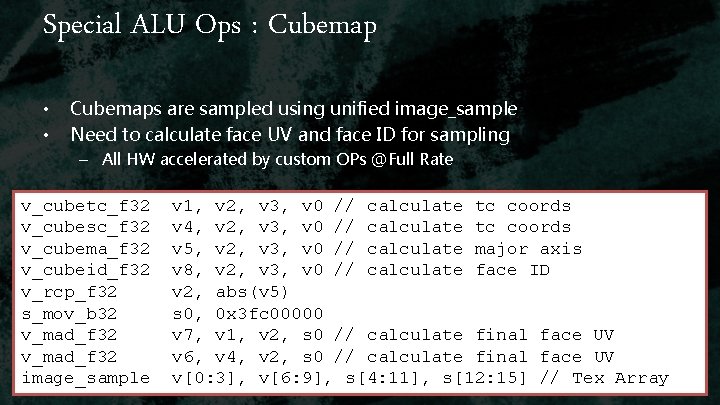
Special ALU Ops : Cubemap • • Cubemaps are sampled using unified image_sample Need to calculate face UV and face ID for sampling – All HW accelerated by custom OPs @Full Rate v_cubetc_f 32 v 1, v 2, v 3, v 0 // calculate tc coords v_cubesc_f 32 v 4, v 2, v 3, v 0 // calculate tc coords v_cubema_f 32 v 5, v 2, v 3, v 0 // calculate major axis v_cubeid_f 32 v 8, v 2, v 3, v 0 // calculate face ID v_rcp_f 32 v 2, abs(v 5) s_mov_b 32 s 0, 0 x 3 fc 00000 v_mad_f 32 v 7, v 1, v 2, s 0 // calculate final face UV v_mad_f 32 v 6, v 4, v 2, s 0 // calculate final face UV image_sample v[0: 3], v[6: 9], s[4: 11], s[12: 15] // Tex Array
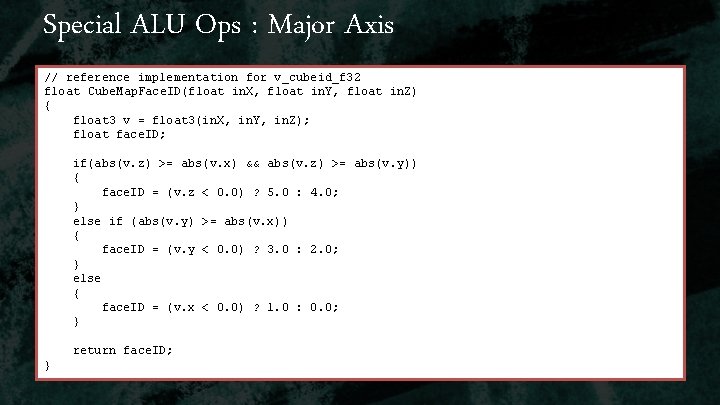
Special ALU Ops : Major Axis // reference implementation for v_cubeid_f 32 float Cube. Map. Face. ID(float in. X, float in. Y, float in. Z) { float 3 v = float 3(in. X, in. Y, in. Z); float face. ID; if(abs(v. z) >= abs(v. x) && abs(v. z) >= abs(v. y)) { face. ID = (v. z < 0. 0) ? 5. 0 : 4. 0; } else if (abs(v. y) >= abs(v. x)) { face. ID = (v. y < 0. 0) ? 3. 0 : 2. 0; } else { face. ID = (v. x < 0. 0) ? 1. 0 : 0. 0; } return face. ID; }
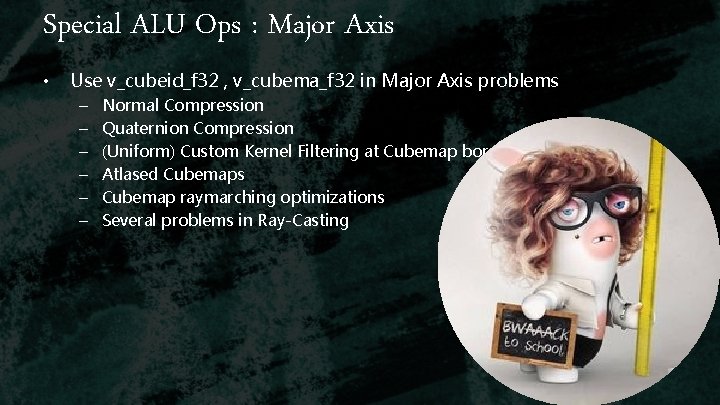
Special ALU Ops : Major Axis • Use v_cubeid_f 32 , v_cubema_f 32 in Major Axis problems – – – Normal Compression Quaternion Compression (Uniform) Custom Kernel Filtering at Cubemap borders Atlased Cubemaps Cubemap raymarching optimizations Several problems in Ray-Casting
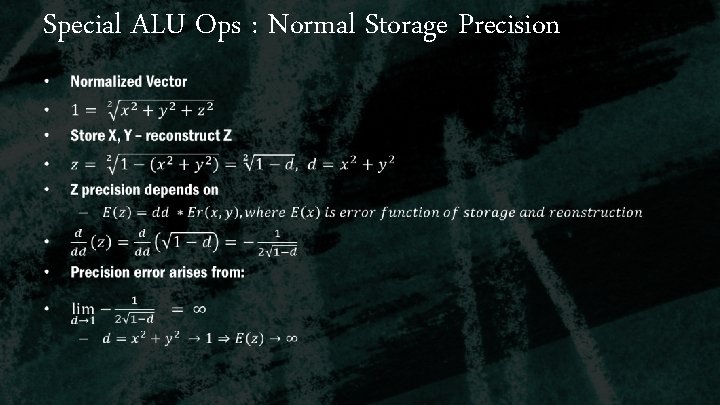
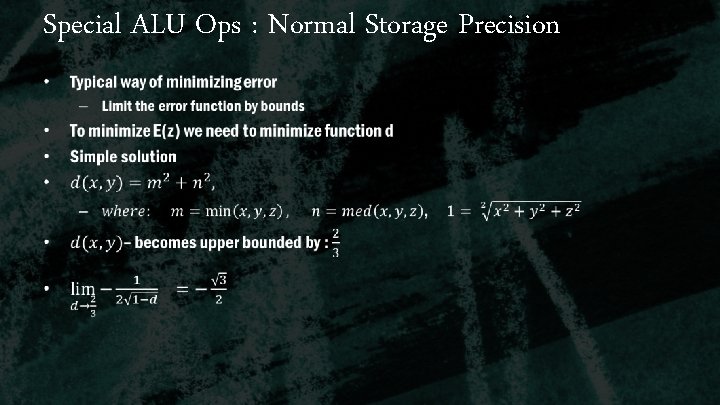
Special ALU Ops : Normal Storage Precision •
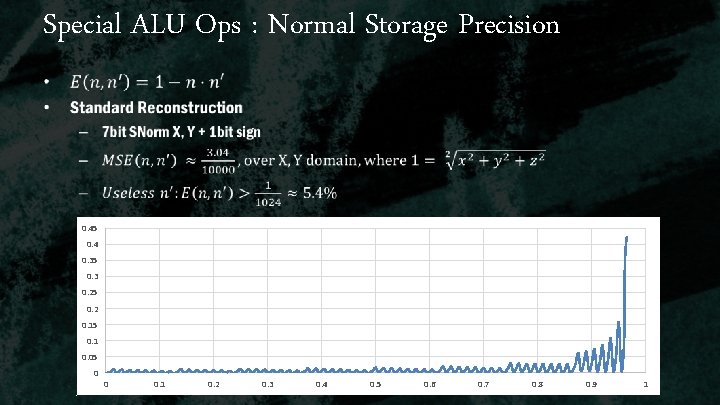
Special ALU Ops : Normal Storage Precision •
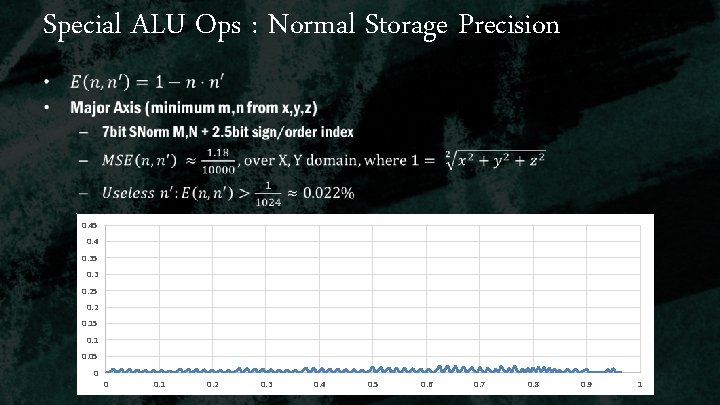
Special ALU Ops : Normal Storage Precision • 0. 45 0. 4 0. 35 0. 3 0. 25 0. 2 0. 15 0. 1 0. 05 0 0 0. 1 0. 2 0. 3 0. 4 0. 5 0. 6 0. 7 0. 8 0. 9 1
Special ALU Ops : Normal Storage Precision • 0. 45 0. 4 0. 35 0. 3 0. 25 0. 2 0. 15 0. 1 0. 05 0 0 0. 1 0. 2 0. 3 0. 4 0. 5 0. 6 0. 7 0. 8 0. 9 1
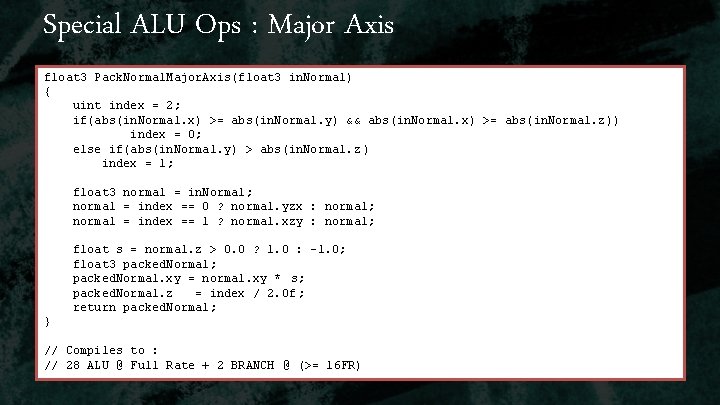
Special ALU Ops : Major Axis float 3 Pack. Normal. Major. Axis(float 3 in. Normal) { uint index = 2; if(abs(in. Normal. x) >= abs(in. Normal. y) && abs(in. Normal. x) >= abs(in. Normal. z)) index = 0; else if(abs(in. Normal. y) > abs(in. Normal. z ) index = 1; float 3 normal = in. Normal; normal = index == 0 ? normal. yzx : normal; normal = index == 1 ? normal. xzy : normal; float s = normal. z > 0. 0 ? 1. 0 : -1. 0; float 3 packed. Normal; packed. Normal. xy = normal. xy * s; packed. Normal. z = index / 2. 0 f ; return packed. Normal; } // Compiles to : // 28 ALU @ Full Rate + 2 BRANCH @ (>= 16 FR)
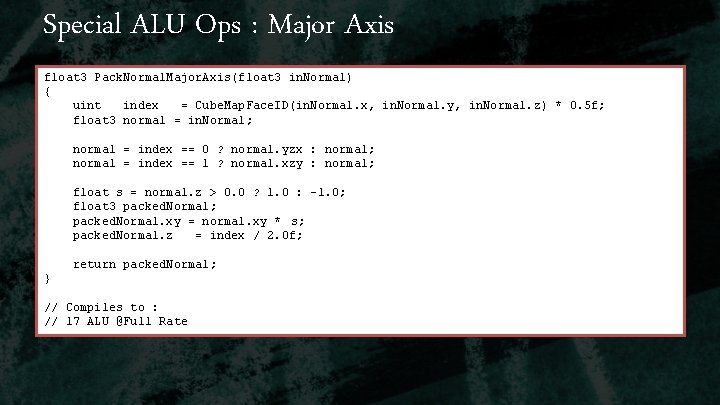
Special ALU Ops : Major Axis float 3 Pack. Normal. Major. Axis(float 3 in. Normal) { uint index = Cube. Map. Face. ID(in. Normal. x, in. Normal. y, in. Normal. z) * 0. 5 f; float 3 normal = in. Normal; normal = index == 0 ? normal. yzx : normal; normal = index == 1 ? normal. xzy : normal; float s = normal. z > 0. 0 ? 1. 0 : -1. 0; float 3 packed. Normal; packed. Normal. xy = normal. xy * s; packed. Normal. z = index / 2. 0 f; return packed. Normal; } // Compiles to : // 17 ALU @Full Rate
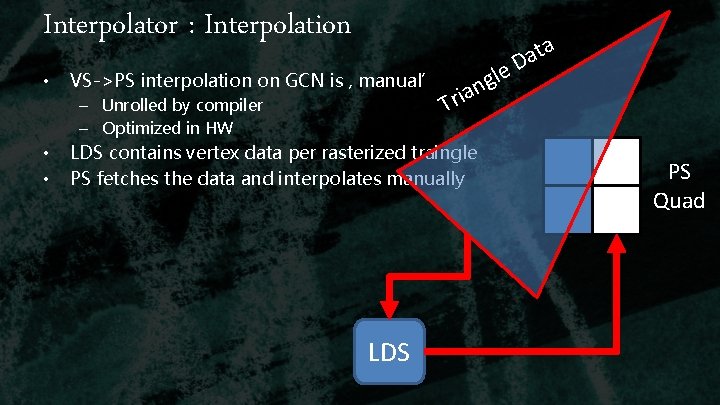
Interpolator : Interpolation • ta a D e l VS->PS interpolation on GCN is ‚manual’ ng a i – Unrolled by compiler Tr – Optimized in HW • • LDS contains vertex data per rasterized traingle PS fetches the data and interpolates manually LDS PS Quad
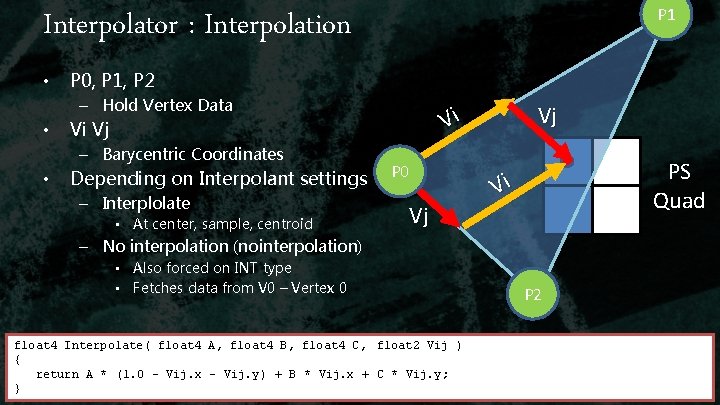
P 1 Interpolator : Interpolation • P 0, P 1, P 2 – Hold Vertex Data • Vi Vj – Barycentric Coordinates • Vi Depending on Interpolant settings – Interplolate • At center, sample, centroid P 0 Vj Vj PS Quad Vi – No interpolation (nointerpolation) • Also forced on INT type • Fetches data from V 0 – Vertex 0 float 4 Interpolate( float 4 A, float 4 B, float 4 C, float 2 Vij ) { return A * (1. 0 – Vij. x – Vij. y) + B * Vij. x + C * Vij. y; } P 2
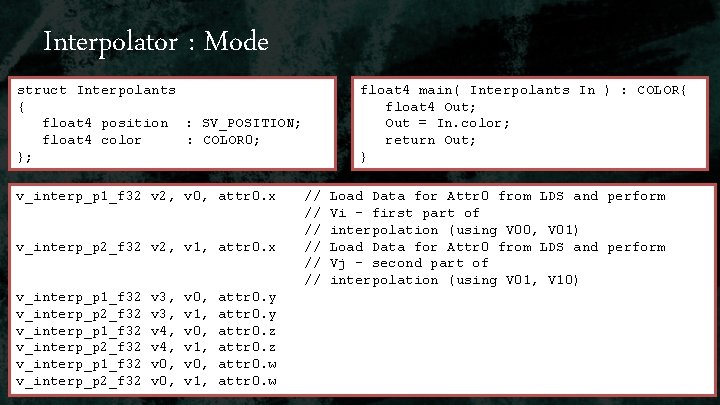
Interpolator : Mode struct Interpolants { float 4 position : SV_POSITION; float 4 color : COLOR 0; }; v_interp_p 1_f 32 v 2, v 0, attr 0. x v_interp_p 2_f 32 v 2, v 1, attr 0. x v_interp_p 1_f 32 v 3, v 0, attr 0. y v_interp_p 2_f 32 v 3, v 1, attr 0. y v_interp_p 1_f 32 v 4, v 0, attr 0. z v_interp_p 2_f 32 v 4, v 1, attr 0. z v_interp_p 1_f 32 v 0, attr 0. w v_interp_p 2_f 32 v 0, v 1, attr 0. w float 4 main( Interpolants In ) : COLOR{ float 4 Out; Out = In. color; return Out; } // Load Data for Attr 0 from LDS and perform // Vi - first part of // interpolation (using V 00, V 01) // Load Data for Attr 0 from LDS and perform // Vj - second part of // interpolation (using V 01, V 10)
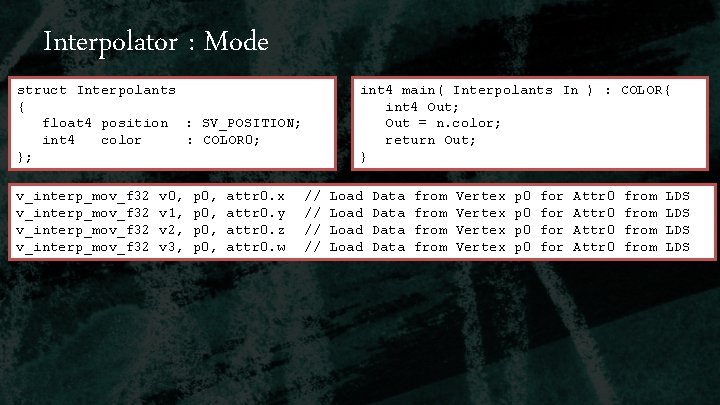
Interpolator : Mode struct Interpolants { float 4 position : SV_POSITION; int 4 color : COLOR 0; }; v_interp_mov_f 32 v 0, p 0, attr 0. x v_interp_mov_f 32 v 1, p 0, attr 0. y v_interp_mov_f 32 v 2, p 0, attr 0. z v_interp_mov_f 32 v 3, p 0, attr 0. w int 4 main( Interpolants In ) : COLOR{ int 4 Out; Out = n. color; return Out; } // Load Data from Vertex p 0 for Attr 0 from LDS
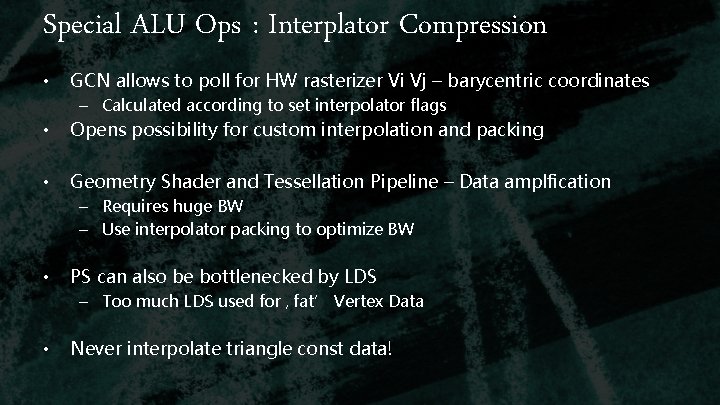
Special ALU Ops : Interplator Compression • GCN allows to poll for HW rasterizer Vi Vj – barycentric coordinates – Calculated according to set interpolator flags • Opens possibility for custom interpolation and packing • Geometry Shader and Tessellation Pipeline – Data amplfication – Requires huge BW – Use interpolator packing to optimize BW • PS can also be bottlenecked by LDS – Too much LDS used for ‚fat’ Vertex Data • Never interpolate triangle const data!
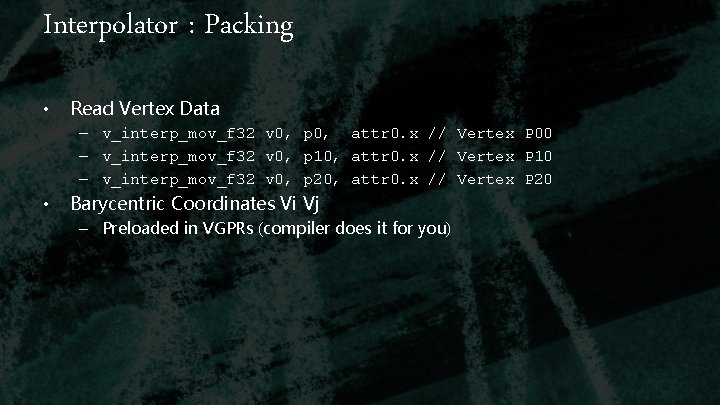
Interpolator : Packing • Read Vertex Data – v_interp_mov_f 32 v 0, p 0, attr 0. x // Vertex P 00 – v_interp_mov_f 32 v 0, p 10, attr 0. x // Vertex P 10 – v_interp_mov_f 32 v 0, p 20, attr 0. x // Vertex P 20 • Barycentric Coordinates Vi Vj – Preloaded in VGPRs (compiler does it for you)
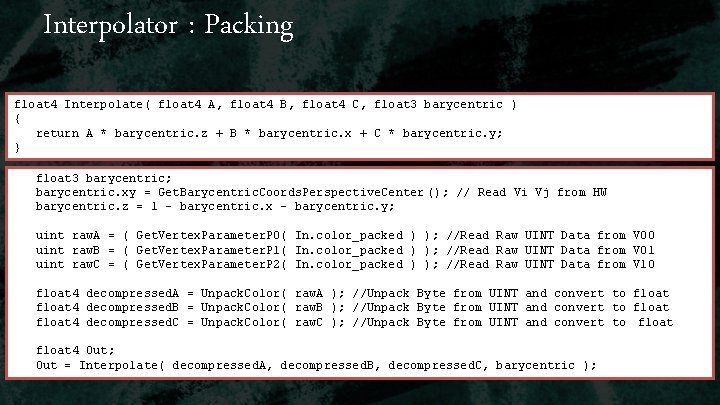
Interpolator : Packing float 4 Interpolate( float 4 A, float 4 B, float 4 C, float 3 barycentric ) { return A * barycentric. z + B * barycentric. x + C * barycentric. y; } float 3 barycentric; barycentric. xy = Get. Barycentric. Coords. Perspective. Center (); // Read Vi Vj from HW barycentric. z = 1 - barycentric. x - barycentric. y; uint raw. A = ( Get. Vertex. Parameter. P 0( In. color_packed ) ); //Read Raw UINT Data from V 00 uint raw. B = ( Get. Vertex. Parameter. P 1( In. color_packed ) ); //Read Raw UINT Data from V 01 uint raw. C = ( Get. Vertex. Parameter. P 2( In. color_packed ) ); //Read Raw UINT Data from V 10 float 4 decompressed. A = Unpack. Color( raw. A ); //Unpack Byte from UINT and convert to float 4 decompressed. B = Unpack. Color( raw. B ); //Unpack Byte from UINT and convert to float 4 decompressed. C = Unpack. Color( raw. C ); //Unpack Byte from UINT and convert to float 4 Out; Out = Interpolate( decompressed. A, decompressed. B, decompressed. C, barycentric );
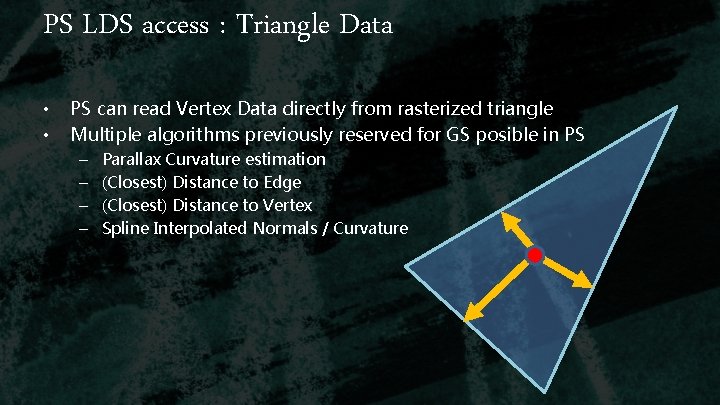
PS LDS access : Triangle Data • • PS can read Vertex Data directly from rasterized triangle Multiple algorithms previously reserved for GS posible in PS – – Parallax Curvature estimation (Closest) Distance to Edge (Closest) Distance to Vertex Spline Interpolated Normals / Curvature
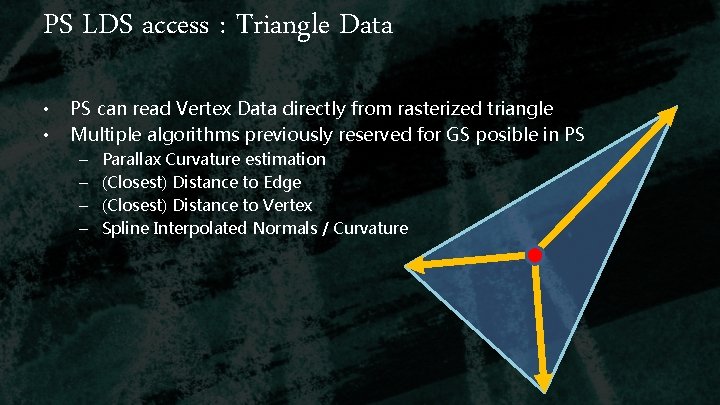
PS LDS access : Triangle Data • • PS can read Vertex Data directly from rasterized triangle Multiple algorithms previously reserved for GS posible in PS – – Parallax Curvature estimation (Closest) Distance to Edge (Closest) Distance to Vertex Spline Interpolated Normals / Curvature
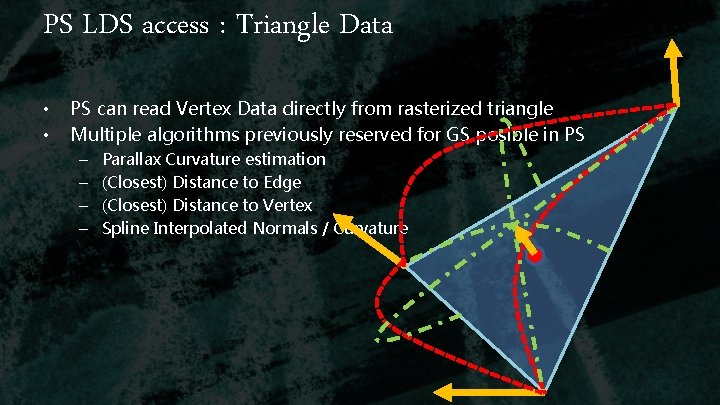
PS LDS access : Triangle Data • • PS can read Vertex Data directly from rasterized triangle Multiple algorithms previously reserved for GS posible in PS – – Parallax Curvature estimation (Closest) Distance to Edge (Closest) Distance to Vertex Spline Interpolated Normals / Curvature
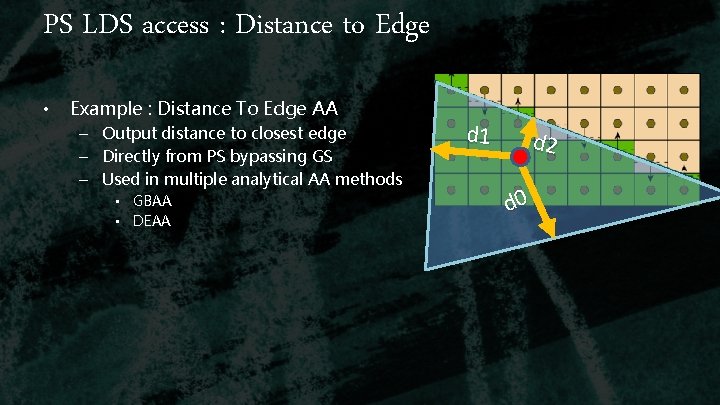
PS LDS access : Distance to Edge • Example : Distance To Edge AA – Output distance to closest edge – Directly from PS bypassing GS – Used in multiple analytical AA methods • GBAA • DEAA d 1 d 2 d 0
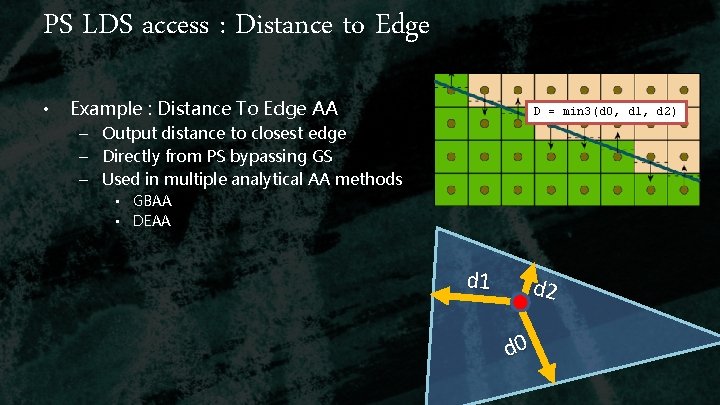
PS LDS access : Distance to Edge • Example : Distance To Edge AA D = min 3(d 0, d 1, d 2) – Output distance to closest edge – Directly from PS bypassing GS – Used in multiple analytical AA methods • GBAA • DEAA d 1 d 2 d 0
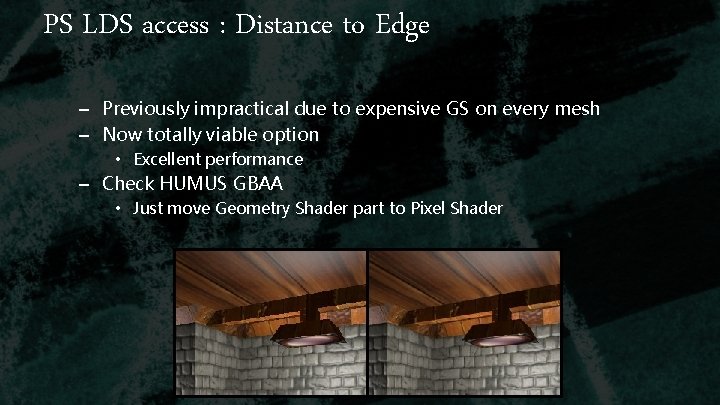
PS LDS access : Distance to Edge – Previously impractical due to expensive GS on every mesh – Now totally viable option • Excellent performance – Check HUMUS GBAA • Just move Geometry Shader part to Pixel Shader
Transcendental Functions • rcp(x), sqrt(x), rsqrt(x) – Most common transcendental functions in rendering – @Quarter Rate – 16 cycles each – Common in loops • • Light iterators SSAO Multisampling Raymarching – Used by macro • Length(x) • Normalize(x)
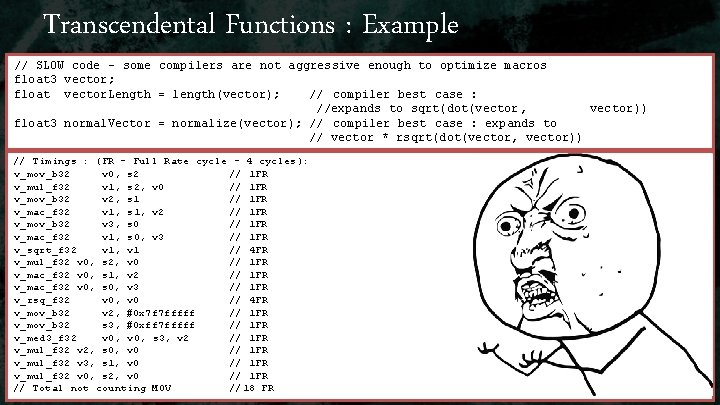
Transcendental Functions : Example // SLOW code – some compilers are not aggressive enough to optimize macros float 3 vector; float vector. Length = length(vector); // compiler best case : //expands to sqrt(dot(vector, vector)) float 3 normal. Vector = normalize(vector); // compiler best case : expands to // vector * rsqrt(dot(vector, vector)) // Timings : (FR - Full Rate cycle - 4 cycles): v_mov_b 32 v 0, s 2 // 1 FR v_mul_f 32 v 1, s 2, v 0 // 1 FR v_mov_b 32 v 2, s 1 // 1 FR v_mac_f 32 v 1, s 1, v 2 // 1 FR v_mov_b 32 v 3, s 0 // 1 FR v_mac_f 32 v 1, s 0, v 3 // 1 FR v_sqrt_f 32 v 1, v 1 // 4 FR v_mul_f 32 v 0, s 2, v 0 // 1 FR v_mac_f 32 v 0, s 1, v 2 // 1 FR v_mac_f 32 v 0, s 0, v 3 // 1 FR v_rsq_f 32 v 0, v 0 // 4 FR v_mov_b 32 v 2, #0 x 7 f 7 fffff // 1 FR v_mov_b 32 s 3, #0 xff 7 fffff // 1 FR v_med 3_f 32 v 0, s 3, v 2 // 1 FR v_mul_f 32 v 2, s 0, v 0 // 1 FR v_mul_f 32 v 3, s 1, v 0 // 1 FR v_mul_f 32 v 0, s 2, v 0 // 1 FR // Total not counting MOV //18 FR
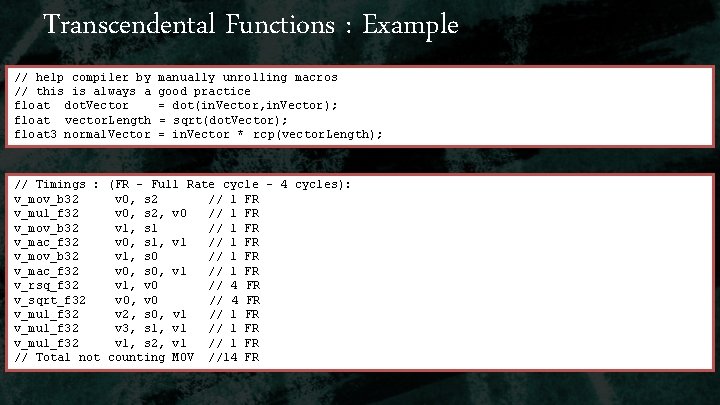
Transcendental Functions : Example // help compiler by manually unrolling macros // this is always a good practice float dot. Vector = dot(in. Vector, in. Vector); float vector. Length = sqrt(dot. Vector); float 3 normal. Vector = in. Vector * rcp(vector. Length); // Timings : (FR - Full Rate cycle - 4 cycles): v_mov_b 32 v 0, s 2 // 1 FR v_mul_f 32 v 0, s 2, v 0 // 1 FR v_mov_b 32 v 1, s 1 // 1 FR v_mac_f 32 v 0, s 1, v 1 // 1 FR v_mov_b 32 v 1, s 0 // 1 FR v_mac_f 32 v 0, s 0, v 1 // 1 FR v_rsq_f 32 v 1, v 0 // 4 FR v_sqrt_f 32 v 0, v 0 // 4 FR v_mul_f 32 v 2, s 0, v 1 // 1 FR v_mul_f 32 v 3, s 1, v 1 // 1 FR v_mul_f 32 v 1, s 2, v 1 // 1 FR // Total not counting MOV //14 FR
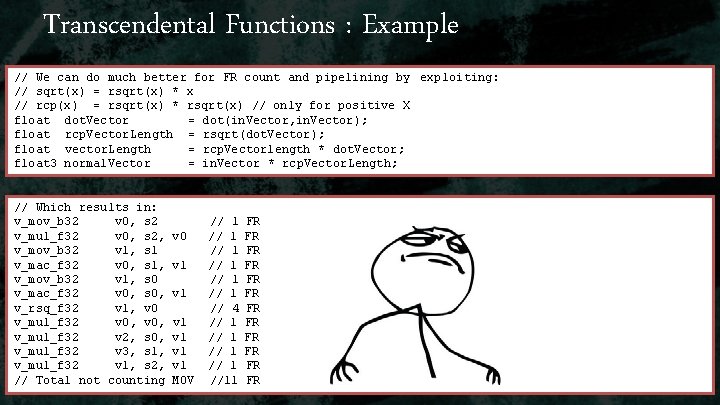
Transcendental Functions : Example // We can do much better for FR count and pipelining by exploiting: // sqrt(x) = rsqrt(x) * x // rcp(x) = rsqrt(x) * rsqrt(x) // only for positive X float dot. Vector = dot(in. Vector, in. Vector); float rcp. Vector. Length = rsqrt(dot. Vector); float vector. Length = rcp. Vectorlength * dot. Vector; float 3 normal. Vector = in. Vector * rcp. Vector. Length; // Which results in: v_mov_b 32 v 0, s 2 // 1 FR v_mul_f 32 v 0, s 2, v 0 // 1 FR v_mov_b 32 v 1, s 1 // 1 FR v_mac_f 32 v 0, s 1, v 1 // 1 FR v_mov_b 32 v 1, s 0 // 1 FR v_mac_f 32 v 0, s 0, v 1 // 1 FR v_rsq_f 32 v 1, v 0 // 4 FR v_mul_f 32 v 0, v 1 // 1 FR v_mul_f 32 v 2, s 0, v 1 // 1 FR v_mul_f 32 v 3, s 1, v 1 // 1 FR v_mul_f 32 v 1, s 2, v 1 // 1 FR // Total not counting MOV //11 FR
Approximated Transcendental Functions • • Transcendental Functions in HW provide ~1 ULP of precision We do not always need that much – Especially for F 16, F 11, UNorm 8 data • Can we do a better job than HW @ Quarter Rate?
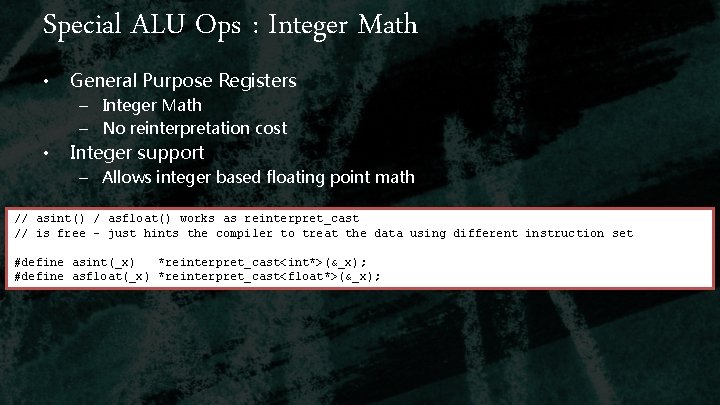
Special ALU Ops : Integer Math • General Purpose Registers – Integer Math – No reinterpretation cost • Integer support – Allows integer based floating point math // asint() / asfloat() works as reinterpret_cast // is free – just hints the compiler to treat the data using different instruction set #define asint(_x) *reinterpret_cast<int*>(&_x); #define asfloat(_x) *reinterpret_cast<float*>(&_x);
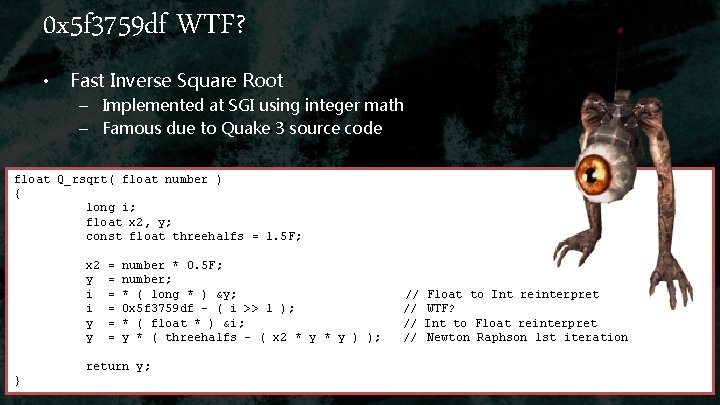
0 x 5 f 3759 df WTF? • Fast Inverse Square Root – Implemented at SGI using integer math – Famous due to Quake 3 source code float Q_rsqrt( float number ) { long i; float x 2, y; const float threehalfs = 1. 5 F; x 2 = number * 0. 5 F; y = number; i = * ( long * ) &y; // Float to Int reinterpret i = 0 x 5 f 3759 df - ( i >> 1 ); // WTF? y = * ( float * ) &i; // Int to Float reinterpret y = y * ( threehalfs - ( x 2 * y ) ); // Newton Raphson 1 st iteration return y; }
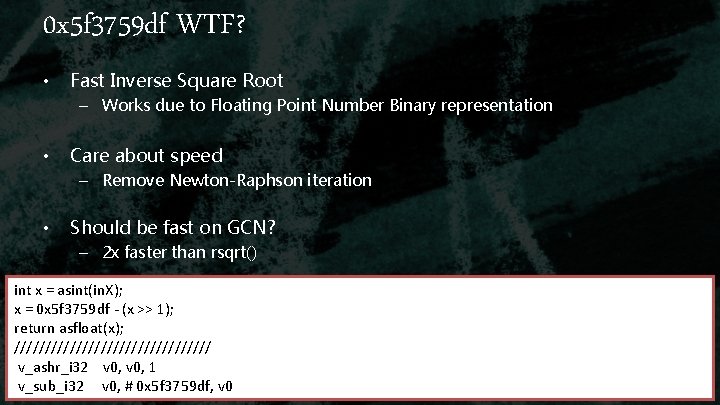
0 x 5 f 3759 df WTF? • Fast Inverse Square Root – Works due to Floating Point Number Binary representation • Care about speed – Remove Newton-Raphson iteration • Should be fast on GCN? – 2 x faster than rsqrt() int x = asint(in. X); x = 0 x 5 f 3759 df - (x >> 1); return asfloat(x); //////////////// v_ashr_i 32 v 0, 1 v_sub_i 32 v 0, # 0 x 5 f 3759 df, v 0
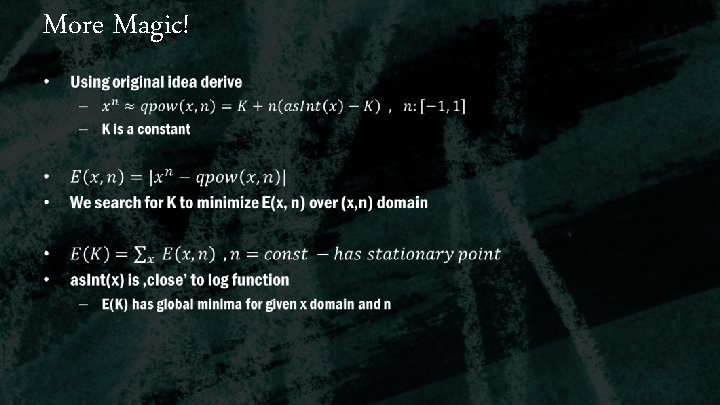
More Magic! •
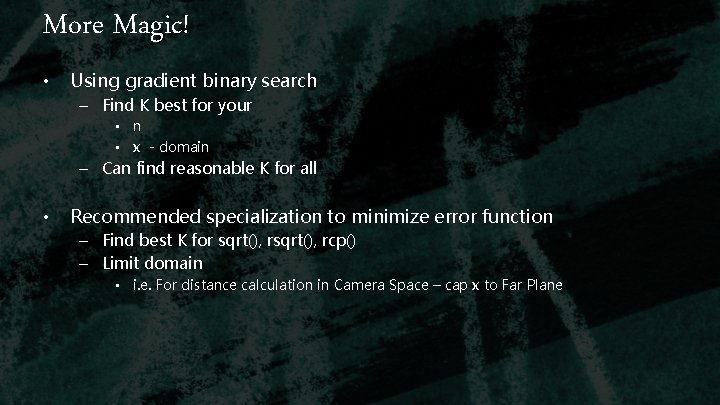
More Magic! • Using gradient binary search – Find K best for your • n • x - domain – Can find reasonable K for all • Recommended specialization to minimize error function – Find best K for sqrt(), rcp() – Limit domain • i. e. For distance calculation in Camera Space – cap x to Far Plane
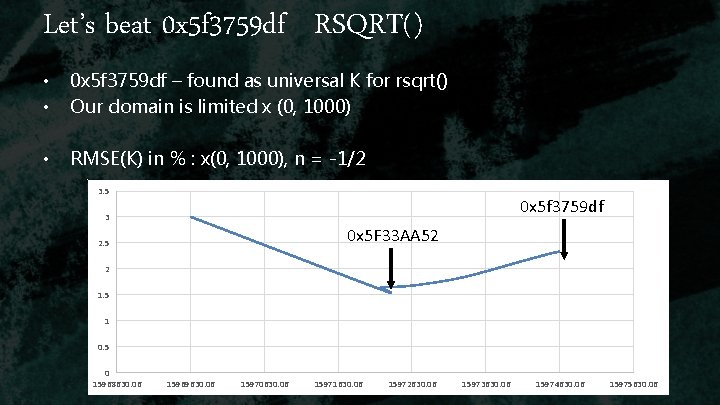
Let’s beat 0 x 5 f 3759 df RSQRT() • • 0 x 5 f 3759 df – found as universal K for rsqrt() Our domain is limited x (0, 1000) • RMSE(K) in % : x(0, 1000), n = -1/2 3. 5 0 x 5 f 3759 df 3 0 x 5 F 33 AA 52 2. 5 2 1. 5 1 0. 5 0 15968630. 06 15969630. 06 15970630. 06 15971630. 06 15972630. 06 15973630. 06 15974630. 06 15975630. 06
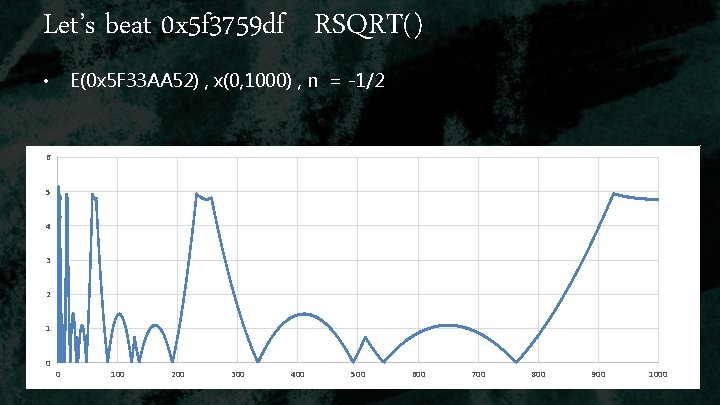
Let’s beat 0 x 5 f 3759 df RSQRT() E(0 x 5 F 33 AA 52) , x(0, 1000) , n = -1/2 • 6 5 4 3 2 1 0 0 100 200 300 400 500 600 700 800 900 1000
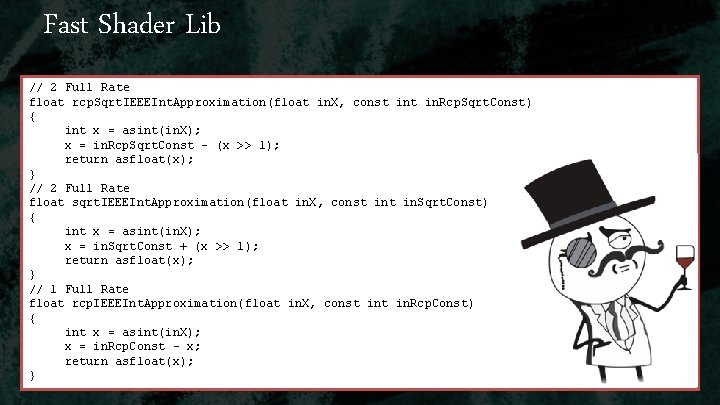
Fast Shader Lib // 2 Full Rate float rcp. Sqrt. IEEEInt. Approximation(float in. X, const in. Rcp. Sqrt. Const) { int x = asint(in. X); x = in. Rcp. Sqrt. Const - (x >> 1); return asfloat(x); } // 2 Full Rate float sqrt. IEEEInt. Approximation(float in. X, const in. Sqrt. Const) { int x = asint(in. X); x = in. Sqrt. Const + (x >> 1); return asfloat(x); } // 1 Full Rate float rcp. IEEEInt. Approximation(float in. X, const in. Rcp. Const) { int x = asint(in. X); x = in. Rcp. Const - x; return asfloat(x); }
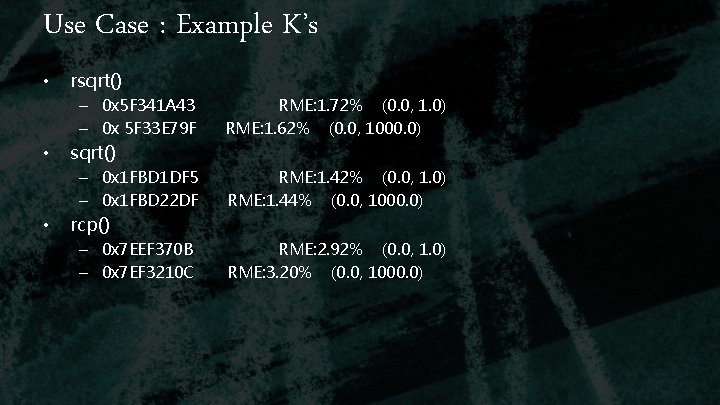
Use Case : Example K’s • rsqrt() – 0 x 5 F 341 A 43 RME: 1. 72% (0. 0, 1. 0) – 0 x 5 F 33 E 79 F RME: 1. 62% (0. 0, 1000. 0) • sqrt() – 0 x 1 FBD 1 DF 5 RME: 1. 42% (0. 0, 1. 0) – 0 x 1 FBD 22 DF RME: 1. 44% (0. 0, 1000. 0) • rcp() – 0 x 7 EEF 370 B RME: 2. 92% (0. 0, 1. 0) – 0 x 7 EF 3210 C RME: 3. 20% (0. 0, 1000. 0)
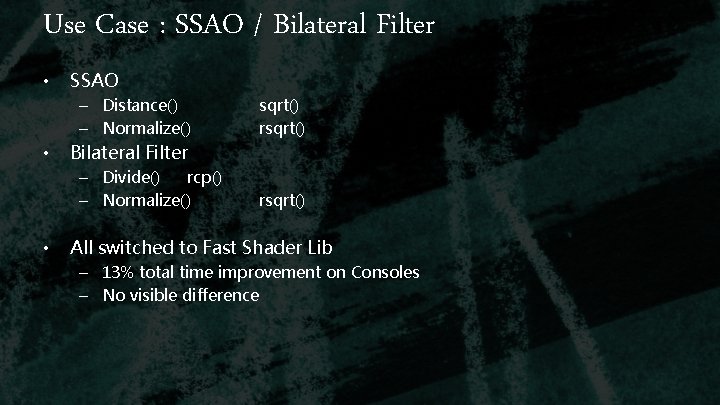
Use Case : SSAO / Bilateral Filter • SSAO – Distance() – Normalize() • Bilateral Filter – Divide() rcp() – Normalize() • sqrt() rsqrt() All switched to Fast Shader Lib – 13% total time improvement on Consoles – No visible difference
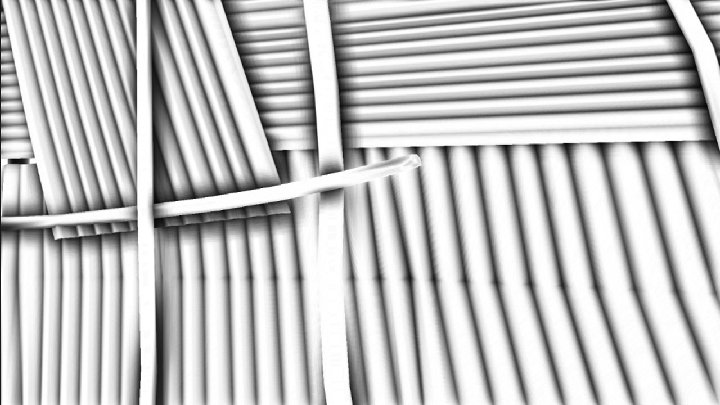
Use Case : SSAO / Bilateral Filter • PICS
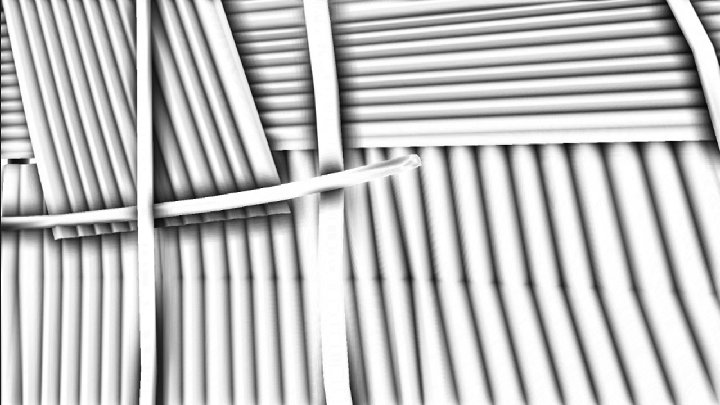
Use Case : SSAO / Bilateral Filter • PICS
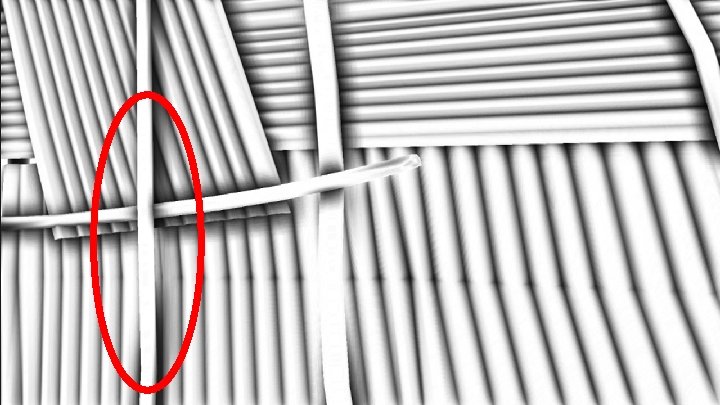
Use Case : SSAO / Bilateral Filter • PICS

Be a Creative Code Ninja! • • GPU so much closer to CPU Use your SPU / CPU Ninja Skillz! Old things might surprise you Trade ALU for BW • Tip of the iceberg – – – Scheduling Async compute Latency Hiding Caching Tons of things we don’t know yet Fun ahead!

Q&A • • More Tips & Tricks : MICHALDROBOT. COM • • Catch me on TWITTER @Michal. Drobot • • Shoot me email HELLO@DROBOT. ORG
References • GCN „Low-level Shader Optimization for Next-Gen and DX 11” – Emil Persson „The AMD GCN Architecture: A Crash Course" - Layla Mah „GCN – Two ways of latency hiding and wave occupancy” – Bart Wronski „Compute Shader Optimizations for AMD GPUs: Parallel Reduction” – Wolfgang Engel – GCN Performance Tweets – – • Inverse Sqrt – „Fast inverse Square Root” - Chris Lomont – "The Mathematics Behind the Fast Inverse Square Root Function Code” – Charles Mc. Eniry – Quake 3 Source Code - github. com/id-Software/Quake-III-Arena
Thanks! • • Ubisoft 3 D Team(s) Especially: – – • • Bart Wronski Jeremy Moore Steve Mc. Auley Stephen Hill AMD Developer Relation Team Especially: – Layla Mah – Chris Brennan

• ? Bonus Slides
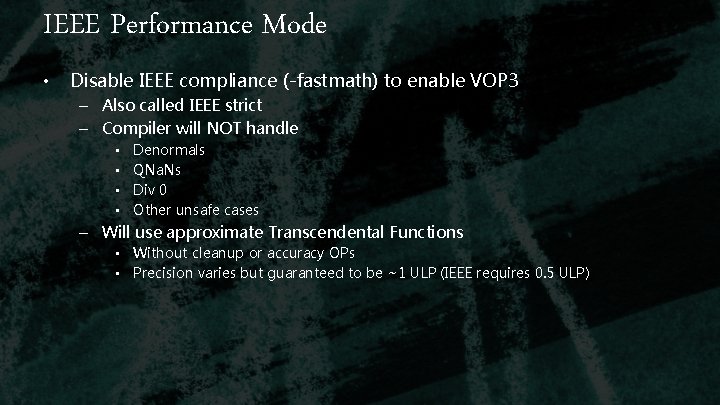
IEEE Performance Mode • Disable IEEE compliance (-fastmath) to enable VOP 3 – Also called IEEE strict – Compiler will NOT handle • • Denormals QNa. Ns Div 0 Other unsafe cases – Will use approximate Transcendental Functions • Without cleanup or accuracy OPs • Precision varies but guaranteed to be ~1 ULP (IEEE requires 0. 5 ULP)
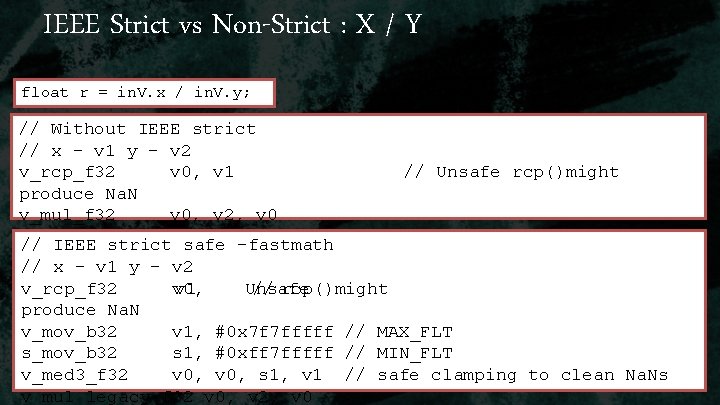
IEEE Strict vs Non-Strict : X / Y float r = in. V. x / in. V. y; // Without IEEE strict // x – v 1 y – v 2 v_rcp_f 32 v 0, v 1 produce Na. N v_mul_f 32 v 0, v 2, v 0 // Unsafe rcp()might // IEEE strict safe –fastmath // x – v 1 y – v 2 v_rcp_f 32 v 0, v 1 Unsafe // rcp()might produce Na. N v_mov_b 32 v 1, #0 x 7 f 7 fffff // MAX_FLT s_mov_b 32 s 1, #0 xff 7 fffff // MIN_FLT v_med 3_f 32 v 0, s 1, v 1 // safe clamping to clean Na. Ns v_mul_legacy_f 32 v 0, v 2, v 0
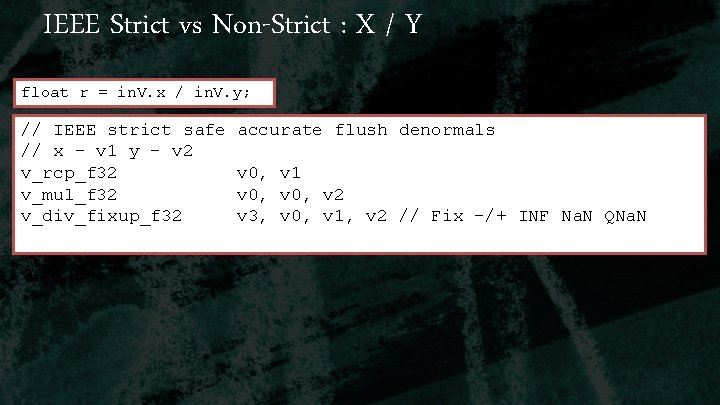
IEEE Strict vs Non-Strict : X / Y float r = in. V. x / in. V. y; // IEEE strict safe accurate flush denormals // x – v 1 y – v 2 v_rcp_f 32 v 0, v 1 v_mul_f 32 v 0, v 2 v_div_fixup_f 32 v 3, v 0, v 1, v 2 // Fix -/+ INF Na. N QNa. N
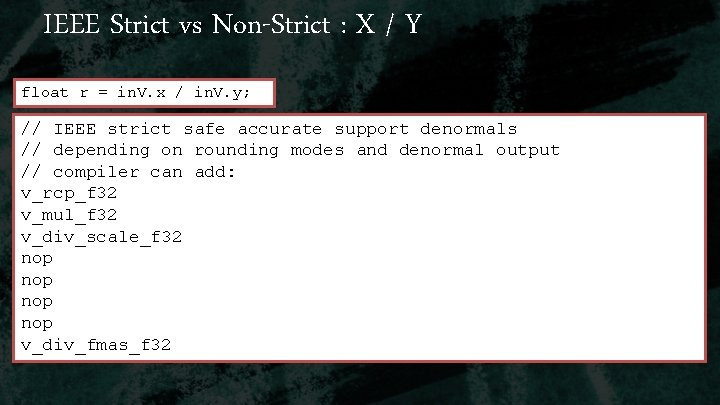
IEEE Strict vs Non-Strict : X / Y float r = in. V. x / in. V. y; // IEEE strict safe accurate support denormals // depending on rounding modes and denormal output // compiler can add: v_rcp_f 32 v_mul_f 32 v_div_scale_f 32 nop nop v_div_fmas_f 32
- Slides: 78