
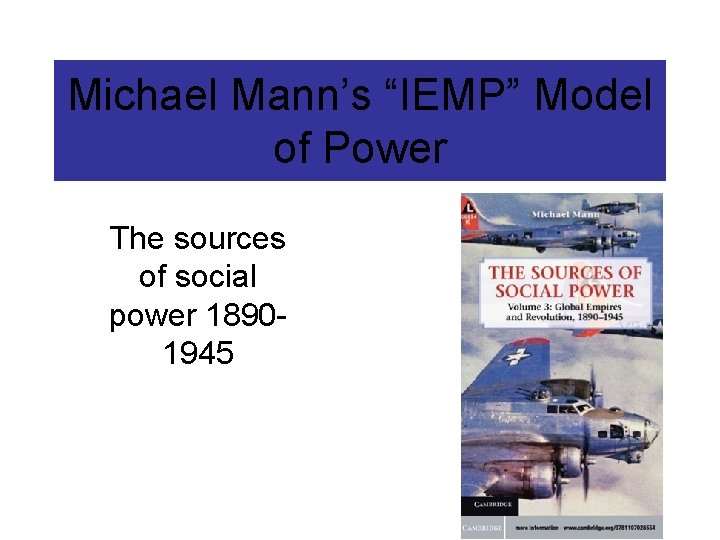
Michael Manns IEMP Model of Power The sources
- Slides: 8
Michael Mann’s “IEMP” Model of Power The sources of social power 18901945
I as Ideology • I = Ideology or ideological power derives from the human need to find ultimate meaning in life, to share norms and values, and to participate in aesthetic and ritual practices with others. Ideologies become especially necessary in crises where the old institutionalized ideologies and practices no longer seem to work and alternatives offered have no track record. This is when we are most susceptible to the power of ideologists who offer us plausible but untested theories of the world. • Transcendent and immanent ideologies. Transcendent ideologies are the most ambitious. They break inter- stitially through existing institutions, attracting converts from many different power networks and creating their own networks, such as a new religion or fascism or green environmental movements, among many others. Immanent ideologies strengthen the emotional and moral solidarity of existing power net- works. Some ideologies combine both.
E as economy • • E = Economic power derives from the human need to extract, transform, dis- tribute, and consume the produce of nature. Economic relations are powerful because they combine the intensive mobilization of labor with very extensive circuits of capital, trade, and production chains, providing a combination of intensive and extensive power and normally also of authoritative and diffused power. The first of each pair centers on production, the second on markets. Economic power relations are those that penetrate most routinely into most peoples’ lives; most of us work for about onethird of every day. The social change economies bring is rarely swift or dramatic, unlike military power. It is slow, cumulative, and eventually profound. The main organization of economic power in modern times has been industrial capitalism, Capitalism has three main properties: (1) it endows private ownership of most economic resources on a few; (2) the bulk of work- ers are separated from ownership, in command only of their own labor skills, but formally free to sell their labor on open markets; (3) capitalism treats all the means of production, including labor, as commodities, tradable on markets, and this means that all four main forms of market – capital, labor, production, and consumption – are traded against each other in markets.
M as military • M = Military power is the social organization of concentrated and lethal violence. “Concentrated” means mobilized and focused; “lethal” means deadly. Military power is most lethally wielded by the armed forces of states in interstate wars, and this has been especially true in this period. Here is an obvious overlap with political power, although militaries always remain separately organized, often as a distinct caste in society. • Military power plays a more intermittent temporal role in human societies. It can endure in the form of stable military regimes, although otherwise it comes in sudden explosive bursts, terrifying and destructive – very rarely constructive. Yet it has been curiously invisible to most social scientists.
P as political • • P = Political power is is the centralized and territorial regulation of social life. The basic function of government is the provision of order over this realm. Max Weber located political power in any organization, not just states. political scientists’ had the notion of “governance” administered by diverse entities, including cor- porations, nongovernmental organization (NGOs), and social movements. States, not NGOs or corporations, have the centralized territorial form that makes their rules authoritative over persons residing in their territories. We may distinguish between the despotic and the infrastructural powers of the state (although the distinction could be applied to any power organiza- tion). Despotic power is the ability of state elites to make arbitrary decisions without consultation with the representatives of major civil society groups. Infrastructural power is the capacity of a state (whether despotic or democratic) to actually penetrate society and implement logistically political decisions throughout the realm
Powers Intertwined • • • The four power sources do have a degree of autonomy from each other, especially in modern societies. Economic outcomes are mainly the outcome of economic causes, ideologies are outgrowths of prior ideologies, and so forth, an autonomy emphasized by Schroeder (2011). Ultimately, to my mind, the four are ideal types – they rarely exist in the world in pure form; they occur in impure mixtures. All four are necessary to social existence and to each other. Any economic organization, for example, requires some of its members to share ideological values and norms. It also needs military defense and state regulation. Thus, ideological, military, and political organizations help structure economic ones and vice versa The four power sources offer distinct organizational networks and means to humans pursuing their goals. The means chosen, and in which combinations, depends on interaction between the power configurations historically given and institutionalized and those that emerge interstitially within and between them. This is the main mechanism of social change in human societies: preventing any single power elite from clinging indefinitely onto power. Institutionalized power relations are being constantly surprised by the emergence of new interstitial power configurations.
Geopolitics • States also project military and political power externally, in what we call geopolitics. Hard geopolitics involve war, alliances, and deterrents to avoid war. Soft geopolitics involve interstate political agreements concerning non- lethal matters like law, the economy, health, education, the environment, and so forth.
Fractured Globalizations • Capitalism, empires, and nation-states also generated contending ideologies. Capitalism generated ideologies of class and class conflict, some of them revolutionary but most of them compromised by the winning by the people of civil, political, and social citizenships rights – as specified by T. H. Marshall in the 1940 s – although women lagged well behind men in this achievement, as did some ethnic/racial groups. Citizenship strengthened nation-states, capitalism became evermore global and transnational, and the contradiction between national and transnational relations intensified. Empires generated ideologies of imperialism, antiimperialism, and racism. Nation-states generated ideolo- gies of nationalism, some of which became extremely aggressive. The conflicts between some of these ideologies peaked in two world wars, after which their relations became less warlike, with most disputes resolvable by “soft” negotiation rather than by “hard” war. However, civil wars over who exactly constitutes “the nation” still dominated some swathes of the world. All these conflicts generated highly ideological global movements, in this period secular as well as religious. So globalization has never been a singular integrating process; instead, it has been a series of disparate and uneven outward thrusts into the world, generating some integration but also fractures and a series of ever-more global crises.