
MICE the Muon Ionization Cooling Experiment Emilio Radicioni
- Slides: 15
MICE the Muon Ionization Cooling Experiment Emilio Radicioni, INFN EPS-HEP Aachen 2003 HEP 2003, 17/07/2003 E. Radicioni
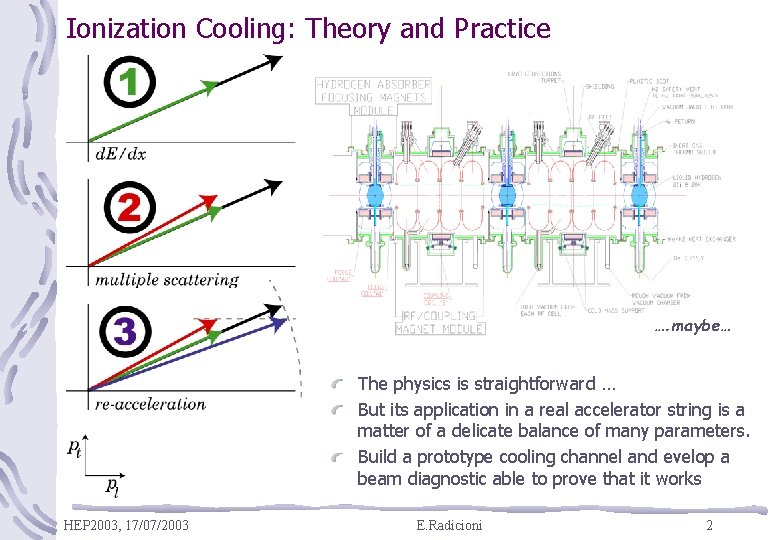
Ionization Cooling: Theory and Practice …. maybe… The physics is straightforward … But its application in a real accelerator string is a matter of a delicate balance of many parameters. Build a prototype cooling channel and evelop a beam diagnostic able to prove that it works HEP 2003, 17/07/2003 E. Radicioni 2
Motivations About 20% of the cost of a Neutrino Factory is determined by the muon cooling: the neutrino flux ultimately available for physics strongly depends on how many muons can make it in the muon accelerator section Quantitative evaluation of cost trade-off between cooling and acceleration cost optimization of a Neutrino Factory The physics is known, but the demonstration in practice still has to be done Design, build and operate a section of cooling channel capable to operate at the desired performances Place it in a muon beam and measure its performances in a variety of operating modes Show that the design tools agree with the experiment Calibrate the simulations to make more safe to extrapolate from the prototype cooling channel to the real one. HEP 2003, 17/07/2003 E. Radicioni 3
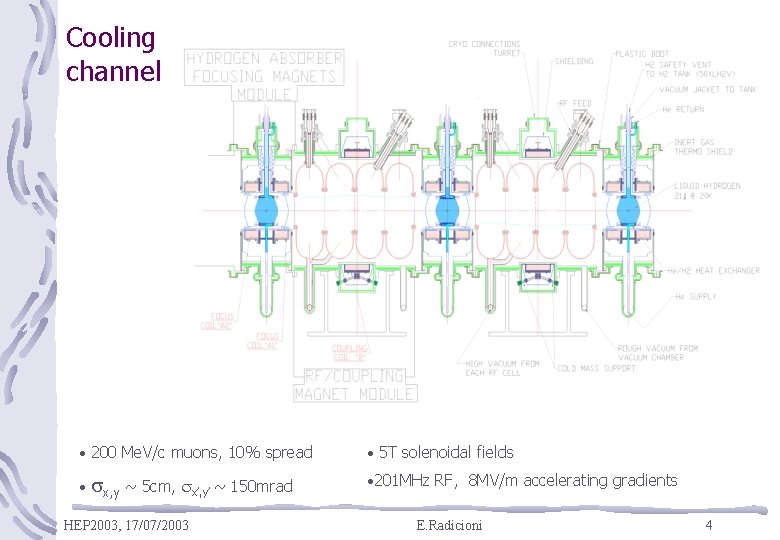
Cooling channel • 200 Me. V/c muons, 10% spread • x, y ~ 5 cm, x’, y’ ~ 150 mrad HEP 2003, 17/07/2003 • 5 T solenoidal fields • 201 MHz RF, 8 MV/m accelerating gradients E. Radicioni 4
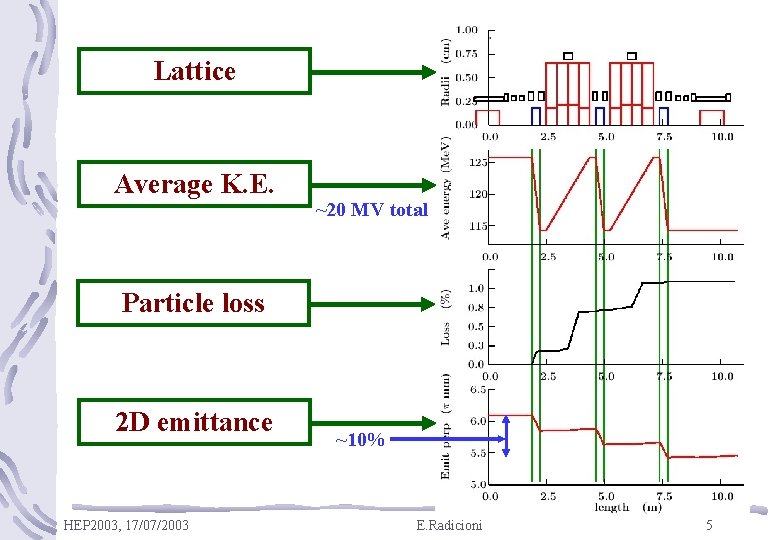
Lattice Average K. E. ~20 MV total Particle loss 2 D emittance HEP 2003, 17/07/2003 ~10% E. Radicioni 5
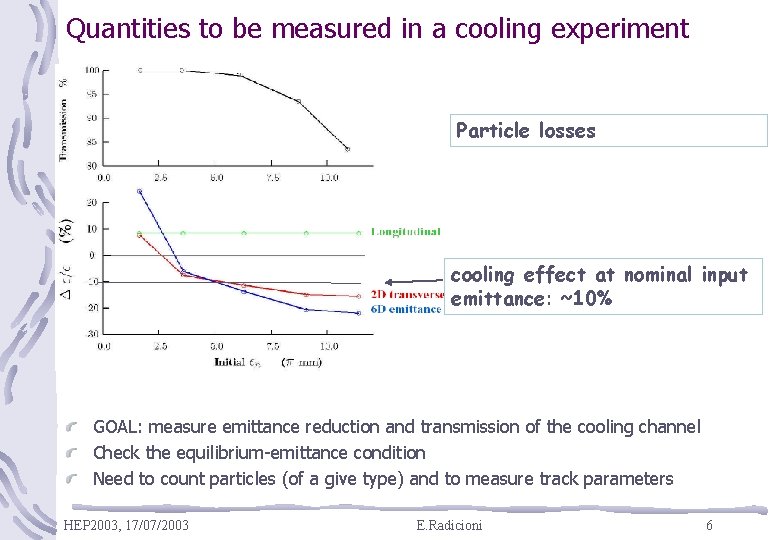
Quantities to be measured in a cooling experiment Particle losses cooling effect at nominal input emittance: ~10% GOAL: measure emittance reduction and transmission of the cooling channel Check the equilibrium-emittance condition Need to count particles (of a give type) and to measure track parameters HEP 2003, 17/07/2003 E. Radicioni 6
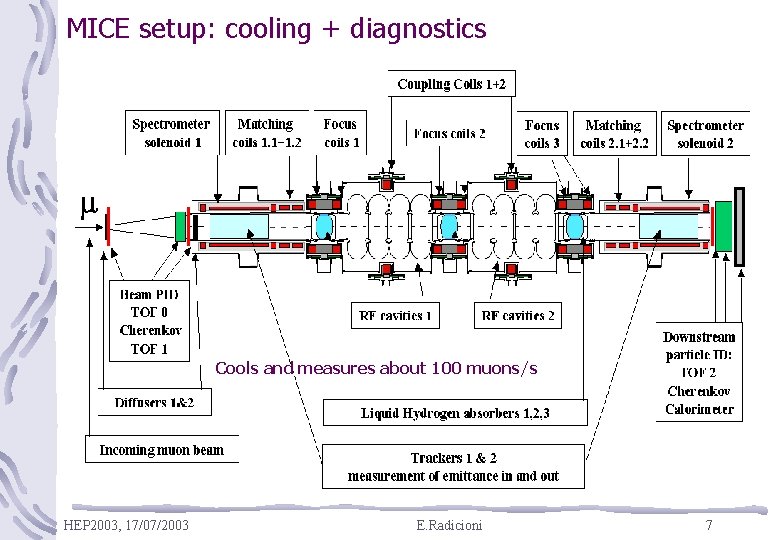
MICE setup: cooling + diagnostics Cools and measures about 100 muons/s HEP 2003, 17/07/2003 E. Radicioni 7
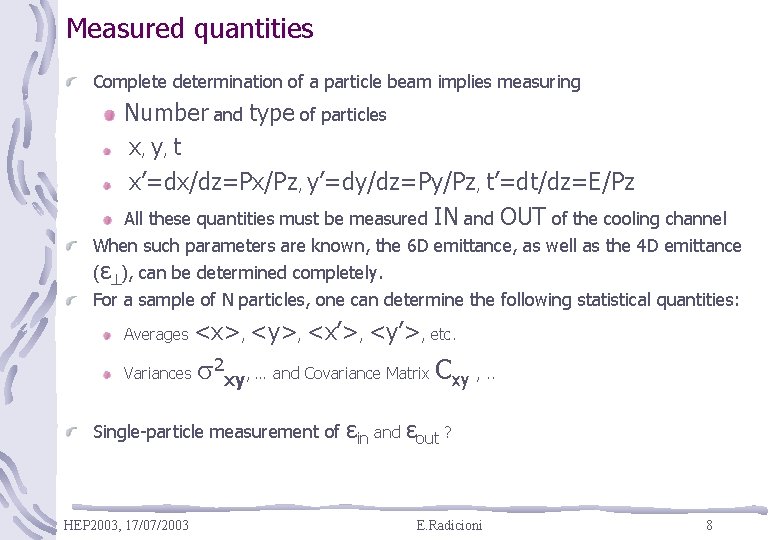
Measured quantities Complete determination of a particle beam implies measuring Number and type of particles x , y, t x’=dx/dz=Px/Pz, y’=dy/dz=Py/Pz, t’=dt/dz=E/Pz All these quantities must be measured IN and OUT of the cooling channel When such parameters are known, the 6 D emittance, as well as the 4 D emittance (ε ), can be determined completely. For a sample of N particles, one can determine the following statistical quantities: Averages <x>, <y>, <x’>, <y’>, etc. Variances 2 xy, … and Covariance Matrix Cxy , . . Single-particle measurement of εin and εout ? HEP 2003, 17/07/2003 E. Radicioni 8
Required precision and error sources Measurements 10% emittance reduction measured to 1% absolute errors <0. 1% Statistical Take 106 muons to reduce statistical error to 10 -3 on Systematic Description of apparatus: Detectors themselves must not spoil measurements by MCS Magnitude (and phase) of magnetic and RF fields Thickness/density of absorber, windows, etc. Alignment Beam energy scale Simulation of MCS and d. E/dx Systematic differences between spectrometers: Efficiency, noise differences Mis-alignment/mis-match Different fields Transport: wrong particles with different kinematics will spoil the measurements Muon in … muon out / and /e rejection at < 1% level HEP 2003, 17/07/2003 E. Radicioni 9
Particle-by-particle diagnostic? Tag and identify incoming and outgoing particles this helps in reducing the systematic error: pion and electron contamination can spoil the measurement. This is only possible in single-particle mode. Correlations between phase space parameters can be easily measured It is possible to study the effect of different beam parameters: Energy Transverse momentum Input emittance RF phase … Any desired input beam condition can be reconstructed from the data sample by cutting/slicing the population of observed particles HEP 2003, 17/07/2003 E. Radicioni 10
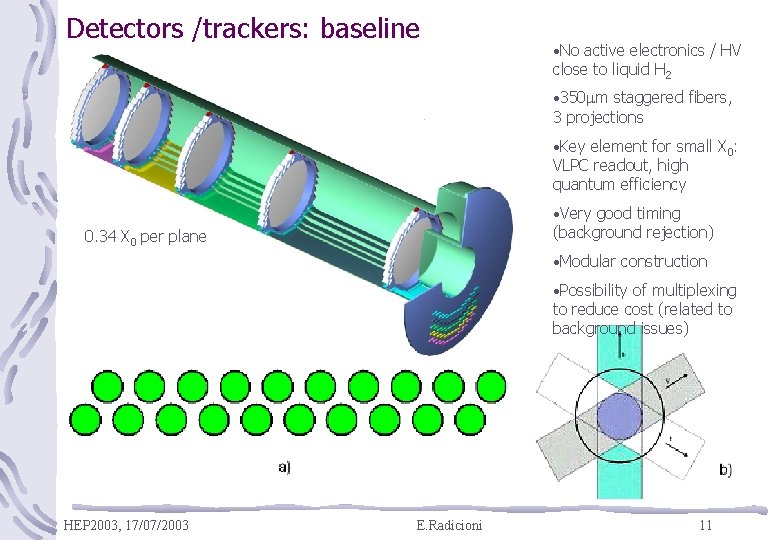
Detectors /trackers: baseline • No active electronics / HV close to liquid H 2 • 350 m staggered fibers, 3 projections • Key element for small X 0: VLPC readout, high quantum efficiency • Very good timing (background rejection) 0. 34 X 0 per plane • Modular construction • Possibility of multiplexing to reduce cost (related to background issues) HEP 2003, 17/07/2003 E. Radicioni 11
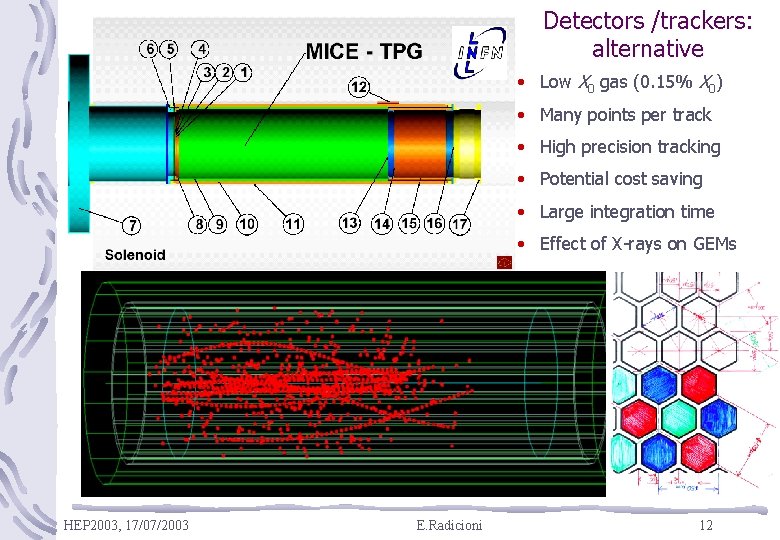
Detectors /trackers: alternative • Low X 0 gas (0. 15% X 0) • Many points per track • High precision tracking • Potential cost saving • Large integration time • Effect of X-rays on GEMs HEP 2003, 17/07/2003 E. Radicioni 12
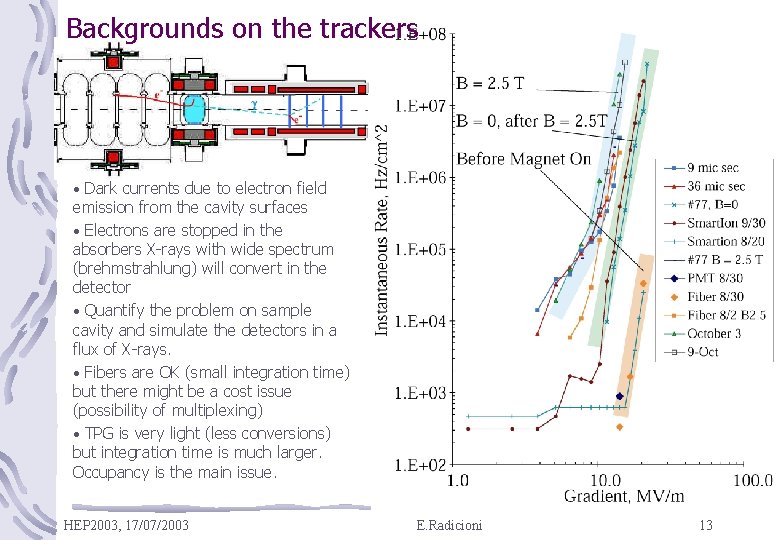
Backgrounds on the trackers • Dark currents due to electron field emission from the cavity surfaces • Electrons are stopped in the absorbers X-rays with wide spectrum (brehmstrahlung) will convert in the detector • Quantify the problem on sample cavity and simulate the detectors in a flux of X-rays. • Fibers are OK (small integration time) but there might be a cost issue (possibility of multiplexing) • TPG is very light (less conversions) but integration time is much larger. Occupancy is the main issue. HEP 2003, 17/07/2003 E. Radicioni 13
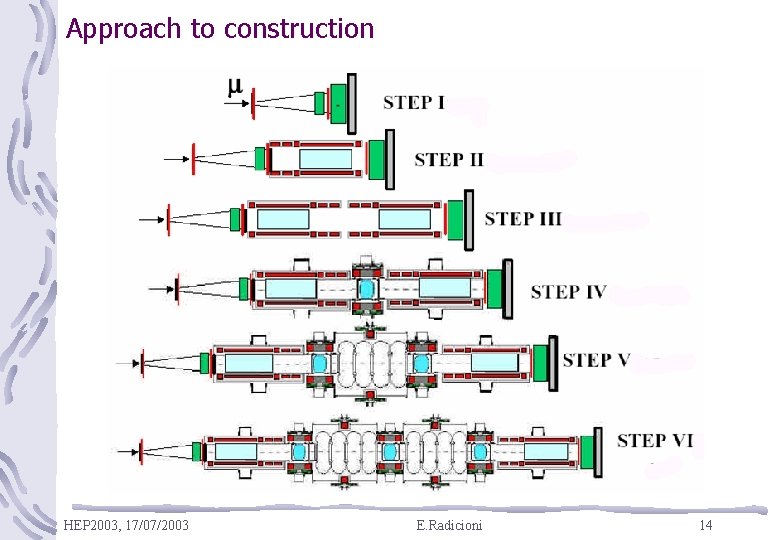
Approach to construction HEP 2003, 17/07/2003 E. Radicioni 14
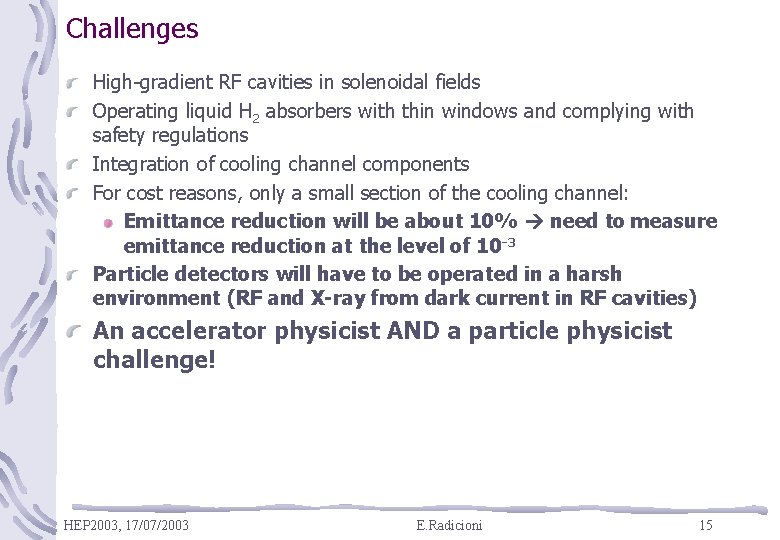
Challenges High-gradient RF cavities in solenoidal fields Operating liquid H 2 absorbers with thin windows and complying with safety regulations Integration of cooling channel components For cost reasons, only a small section of the cooling channel: Emittance reduction will be about 10% need to measure emittance reduction at the level of 10 -3 Particle detectors will have to be operated in a harsh environment (RF and X-ray from dark current in RF cavities) An accelerator physicist AND a particle physicist challenge! HEP 2003, 17/07/2003 E. Radicioni 15