
MICE Step IV Lattice Design Based on Genetic

MICE Step IV Lattice Design Based on Genetic Algorithm Optimizations Ao Liu on behalf of the MICE collaboration Fermilab
Outline • Motivation • Introduction to the simulation setup and the genetic algorithm optimizations • Optimization-guided MICE Step IV lattices and their performance • Conclusions and Q&A 1/14/16 MICE optics review – Ao Liu, FNAL 1
Motivation • MICE Step IV goals – demonstrate material physics properties – Measurement of the muon Multiple Coulomb Scattering (MCS) and energy loss in the materials; – Measurement of the transverse normalized emittance (ε⊥) reduction • In the absence of M 1 coil downstream (M 1 D) – – Lack of optics matching power; Measurement of the MCS and energy loss are largely unaffected; Can we still demonstrate ε⊥ reduction? Need: New lattice designs for all the run modes, which should have: • Decent transmission (good acceptance) • Maximized ε⊥ reduction between the reference planes with minimum ε⊥ growth, especially in the SSD. 1/14/16 MICE optics review – Ao Liu, FNAL 2
Introduction to the simulation setup • MICE Analysis User Software (MAUS) – Powerful tool developed by MICE to do tracking, analysis, reconstruction, etc. Has multiple detectors built -in, detailed construction of the geometry and tracking in materials based on Geant 4 • G 4 Beamline 2. 16 – Simulation of MICE Step IV readily available (P. Snopok); – Comparison with MAUS was done previously. – Fast, parallelized and has been tested by many cases within the muon community; Available on NERSC 1/14/16 MICE optics review – Ao Liu, FNAL 3
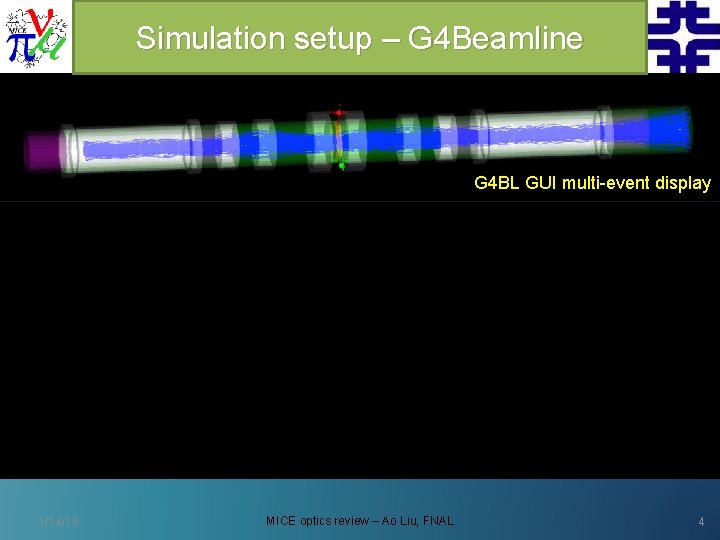
Simulation setup – G 4 Beamline G 4 BL GUI multi-event display • Current geometry of MICE channel • Materials in channel to match MAUS as accurately as possible: – Sci. Fi tracker planes (2 mm Polystyrene each), 65 mm Li. H absorber; – TOF 2 at the end of the channel (+4200 mm from the absorber); – Beam pipe to kill particles hitting it (r=258 mm); • Monte Carlo initial particle ensemble matched to the solenoid longitudinal field Bz – Beam starts at z=-3000 mm from the absorber (upstream tracker). 1/14/16 MICE optics review – Ao Liu, FNAL 4
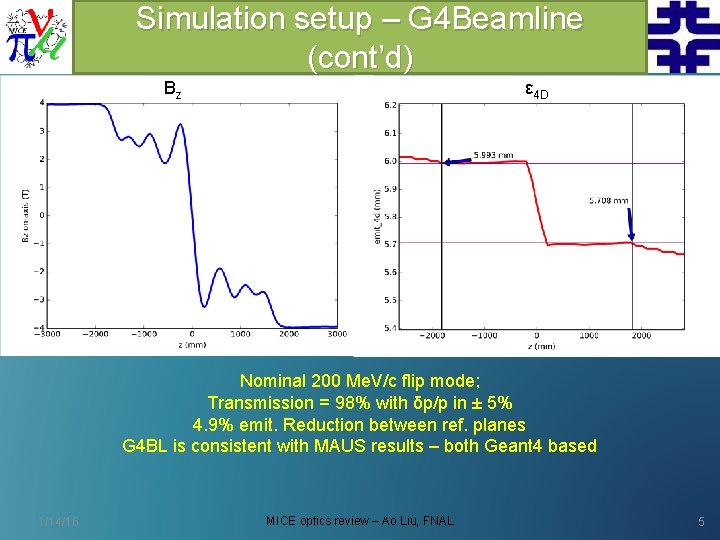
Simulation setup – G 4 Beamline (cont’d) Bz ε 4 D Nominal 200 Me. V/c flip mode; Transmission = 98% with δp/p in ± 5% 4. 9% emit. Reduction between ref. planes G 4 BL is consistent with MAUS results – both Geant 4 based 1/14/16 MICE optics review – Ao Liu, FNAL 5
Optimization setup – G 4 Beamline (cont’d) • Additional G 4 BL simulation details: – In counting the good muons/transmission, the active area of the TOF 2 (30 -by-30 cm) was used as the requirement to have a “survived/measurable” muon; – and, particles that fall out of the active area (r≤ 15 cm) at any one of the tracker station are considered lost; – The max. step size = 5 mm minimizes the simulation time, while not introducing any significant tracking errors; – 65 mm Li. H used in the following optimization studies; stochastic processes are enabled; 1/14/16 MICE optics review – Ao Liu, FNAL 6

Optimization setup – GA • Single Objective Genetic Algorithm (SOGA): – Searches the parameter space thoroughly and finds the global optimum; The more variables, the more powerful; • Objective function: – T : Transmission. T 2 guarantees a good transmission and avoids bias from scraping particles with strong MCS – εref, u , εref, d : Transverse normalized emittance at the reference planes (± 1800 mm from the absorber). The first term is what we measure; – εbound, u , εbound, d : Transverse normalized emittance at the boundaries of the upstream and downstream tracker (± 3000 mm). The second term guarantees a regulated emittance in the trackers (especially downstream). 1/14/16 MICE optics review – Ao Liu, FNAL 7
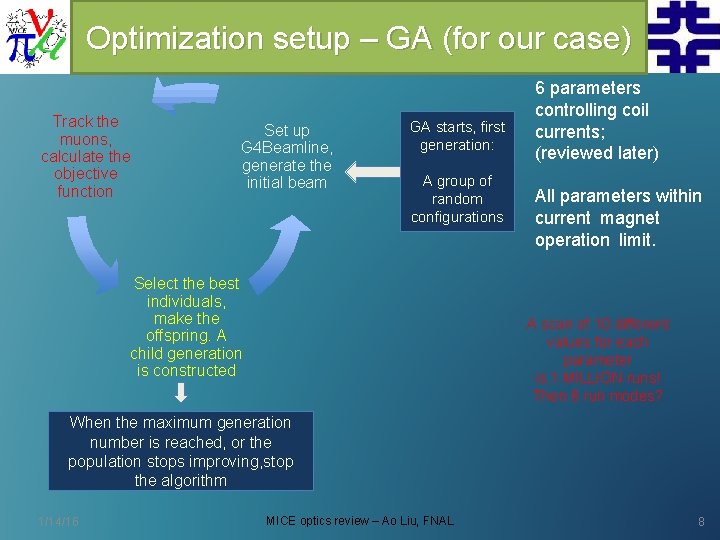
Optimization setup – GA (for our case) Track the muons, calculate the objective function Set up G 4 Beamline, generate the initial beam GA starts, first generation: A group of random configurations Select the best individuals, make the offspring. A child generation is constructed 6 parameters controlling coil currents; (reviewed later) All parameters within current magnet operation limit. A scan of 10 different values for each parameter is 1 MILLION runs! Then 6 run modes? When the maximum generation number is reached, or the population stops improving, stop the algorithm 1/14/16 MICE optics review – Ao Liu, FNAL 8
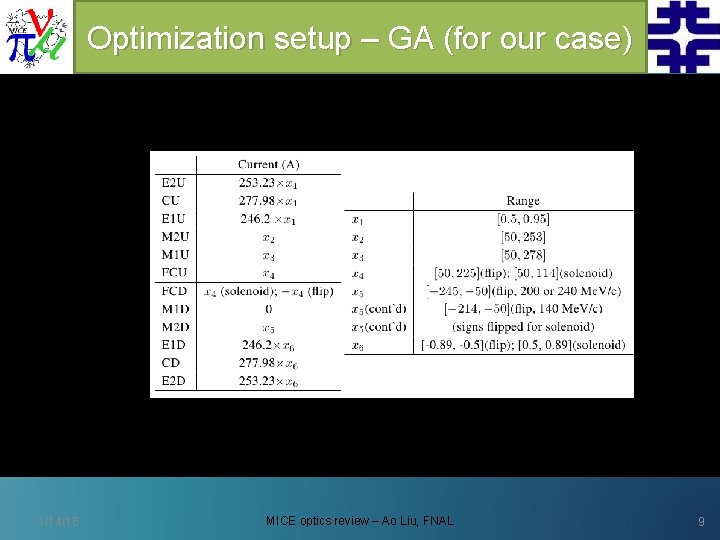
Optimization setup – GA (for our case) • A few more details: – Optimization variables (and their ranges) and the corresponding coil current: – Investigated both flip and solenoid modes at all three momentum: 140, 200 and 240 Me. V/c 1/14/16 MICE optics review – Ao Liu, FNAL 9
Optimization result – GA on NERSC • GA was set up on NERSC to run – ~ 30 generations to converge in each optimization: Fast! • Each generation has 120 individuals • Efficient optimization with GA – Easy to apply more constraints, or – Re-optimize based on a new environment (changed variable limits, input optics parameters, etc. ) • Use the “good” muons only in analyzing results 1/14/16 MICE optics review – Ao Liu, FNAL 10
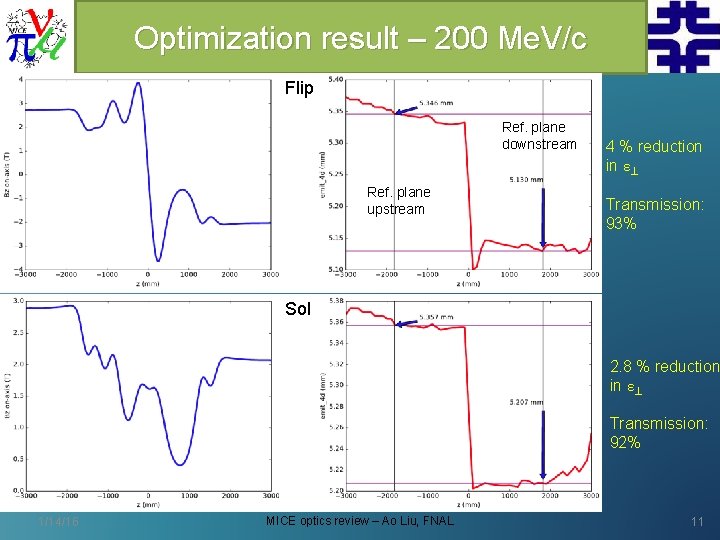
Optimization result – 200 Me. V/c Flip Ref. plane downstream Ref. plane upstream 4 % reduction in ε⊥ Transmission: 93% Sol 2. 8 % reduction in ε⊥ Transmission: 92% 1/14/16 MICE optics review – Ao Liu, FNAL 11
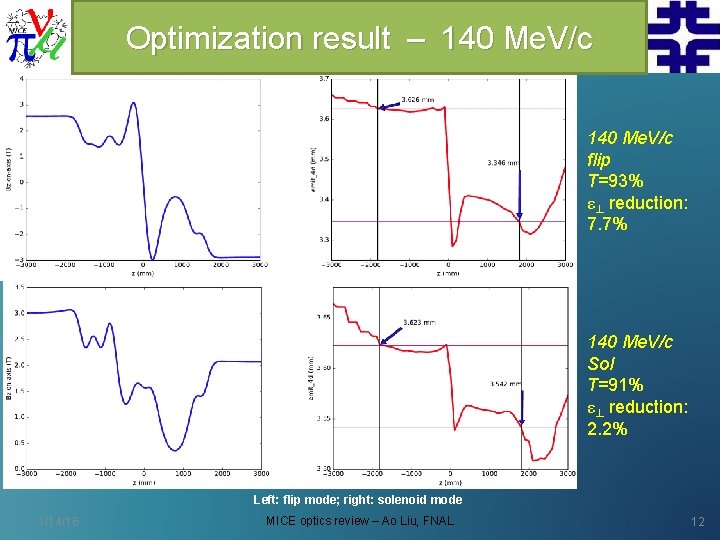
Optimization result – 140 Me. V/c flip T=93% ε⊥ reduction: 7. 7% 140 Me. V/c Sol T=91% ε⊥ reduction: 2. 2% Left: flip mode; right: solenoid mode 1/14/16 MICE optics review – Ao Liu, FNAL 12
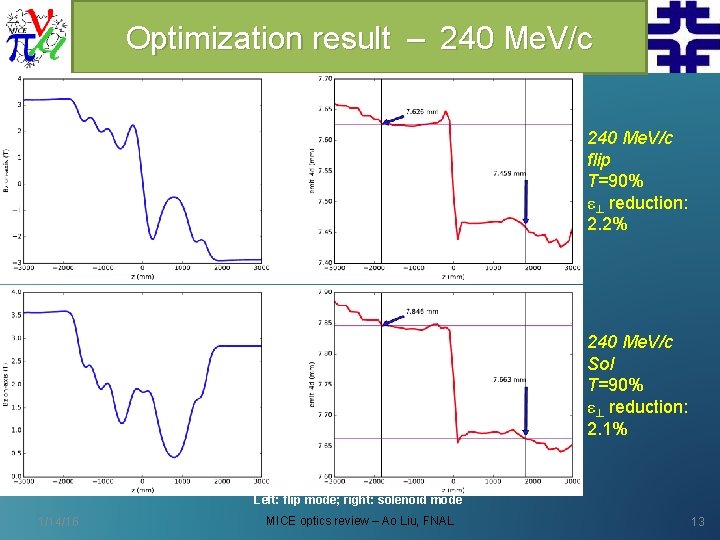
Optimization result – 240 Me. V/c flip T=90% ε⊥ reduction: 2. 2% 240 Me. V/c Sol T=90% ε⊥ reduction: 2. 1% Left: flip mode; right: solenoid mode 1/14/16 MICE optics review – Ao Liu, FNAL 13
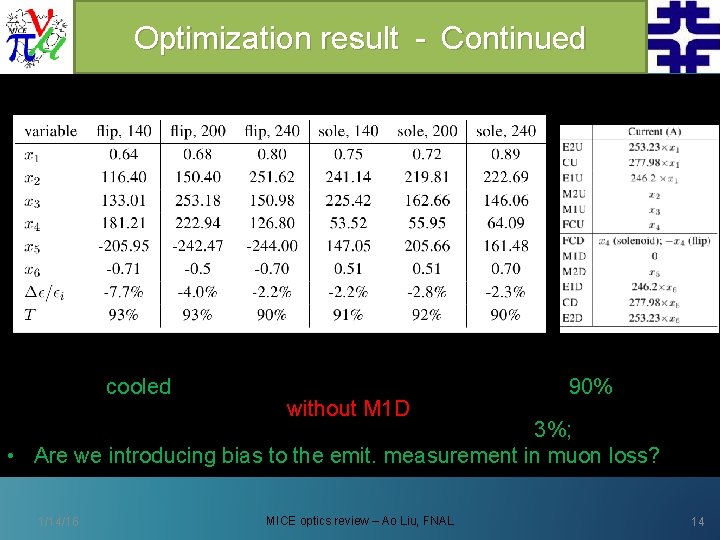
Optimization result - Continued • Variable values corresponding to the previous results: • In each run mode, we are able to deliver an ensemble of particles that can be cooled in the MICE Step IV lattice, with at least 90% transmission to the TOF 2 without M 1 D. In most of them, the normalized transverse emit. reduction is more than 3%; • Are we introducing bias to the emit. measurement in muon loss? 1/14/16 MICE optics review – Ao Liu, FNAL 14
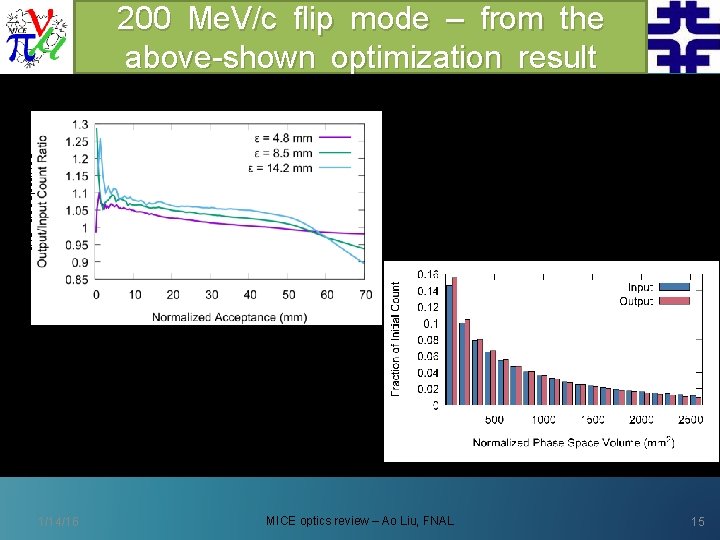
200 Me. V/c flip mode – from the above-shown optimization result • Check the phase space density at the two ref. planes: Number of muons in the acceptance A ratio that is larger than 1 shows cooling in that acceptance; J. Scott Berg, BNL =2(Jx+Jy) Loss taken into account – not fooled by losing only muons with more MCS to reduce RMS normalized emit. 1/14/16 MICE optics review – Ao Liu, FNAL 15
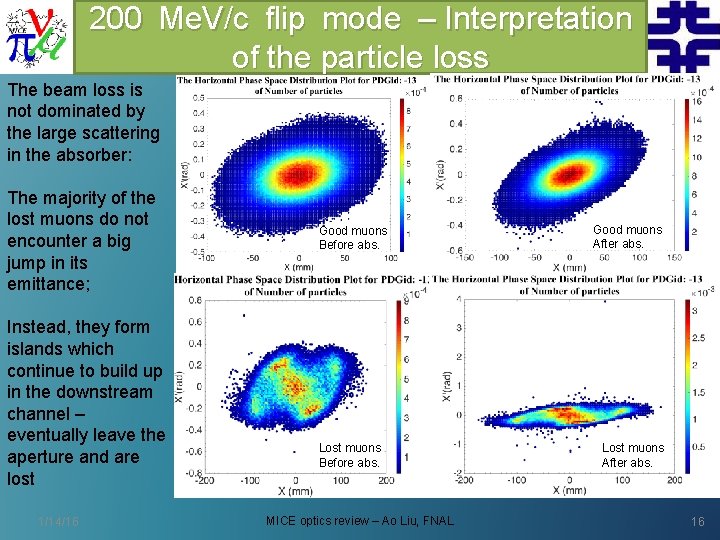
200 Me. V/c flip mode – Interpretation of the particle loss The beam loss is not dominated by the large scattering in the absorber: The majority of the lost muons do not encounter a big jump in its emittance; Instead, they form islands which continue to build up in the downstream channel – eventually leave the aperture and are lost 1/14/16 Good muons Before abs. Lost muons Before abs. MICE optics review – Ao Liu, FNAL Good muons After abs. Lost muons After abs. 16
Conclusions • GA was applied to optimize the Step IV lattice for each run mode without M 1 D. Emittance reduction can be obtained with good transmission, within the magnet operation limits – Optimizations can be re-done efficiently to adopt new running environment or constraints. • Demonstration of emittance reduction will not be biased by the lost particles; • Step IV will be a necessary step to compare experimental data with simulation models, and understand the beam optics in the cooling channel. 1/14/16 MICE optics review – Ao Liu, FNAL 17

Questions? YES OR NO, THANKS! 1/14/16 MICE optics review – Ao Liu, FNAL 18

My only backup slide – as requested 1/14/16 MICE optics review – Ao Liu, FNAL 19
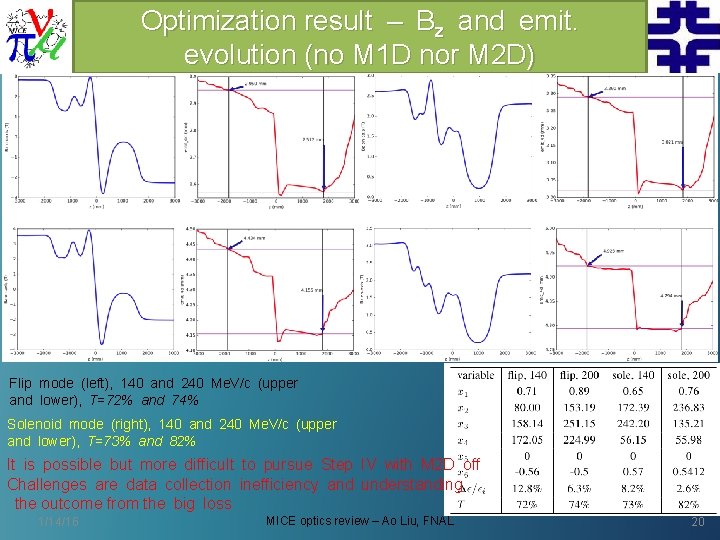
Optimization result – Bz and emit. evolution (no M 1 D nor M 2 D) Flip mode (left), 140 and 240 Me. V/c (upper and lower), T=72% and 74% Solenoid mode (right), 140 and 240 Me. V/c (upper and lower), T=73% and 82% It is possible but more difficult to pursue Step IV with M 2 D off Challenges are data collection inefficiency and understanding the outcome from the big loss 1/14/16 MICE optics review – Ao Liu, FNAL 20
- Slides: 21