
MICE RFCC Module Status RF Cavities NFMCC Collaboration
MICE RFCC Module Status: RF Cavities NFMCC Collaboration Meeting The University of Mississippi, Oxford, MS January 16, 2010 Derun Li A. De. Mello, S. Virostek, M. Zisman Lawrence Berkeley National Laboratory
Overview • First five RF cavities (one spare) are complete – Cavity fabrication awarded to Applied Fusion in February 2009 – Cavity body fabrication started in April 2009 – Welding the stiffener ring to the shell and cutting the irises – E-beam welding 10 copper shells with the stiffener rings to 5 cavities – Ports extruding – Welding the nose ring into the cavity irises – – – Welding the strut mounting posts onto the cavity Welding of the water cooling tubing onto the cavity The first 5 cavities are scheduled were delivered to LBNL on December 2009 • Coupling coil design (MICE/Mu. Cool) and fabrication are being provided by ICST of HIT, Harbin, China – Fabrication contract expects to be awarded on March 15, 2010 • MICE cavity design is heavily based on Mu. Cool 201 -MHz prototype RF cavity: fabrication techniques + post processing MICE RF Cavity Status – NFMCC Meeting, Univ. of Mississippi, Oxford, MS Derun Li - Lawrence Berkeley National Laboratory - January 16, 2010 Page 2
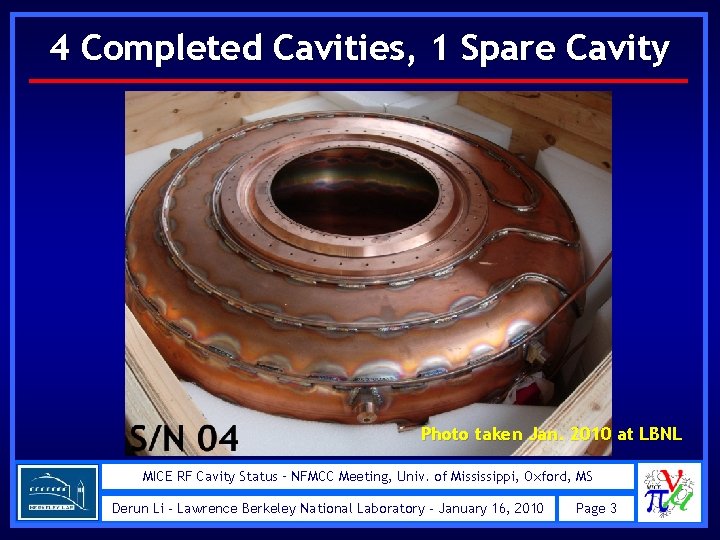
4 Completed Cavities, 1 Spare Cavity Photo taken Jan. 2010 at LBNL MICE RF Cavity Status – NFMCC Meeting, Univ. of Mississippi, Oxford, MS Derun Li - Lawrence Berkeley National Laboratory - January 16, 2010 Page 3

RFCC Module Curved Be window SC coupling Coil o y. C rs e l p u it v Ca 201 -MHz cavity Vacuum Pump MICE RF Cavity Status – NFMCC Meeting, Univ. of Mississippi, Oxford, MS Derun Li - Lawrence Berkeley National Laboratory - January 16, 2010 Page 4
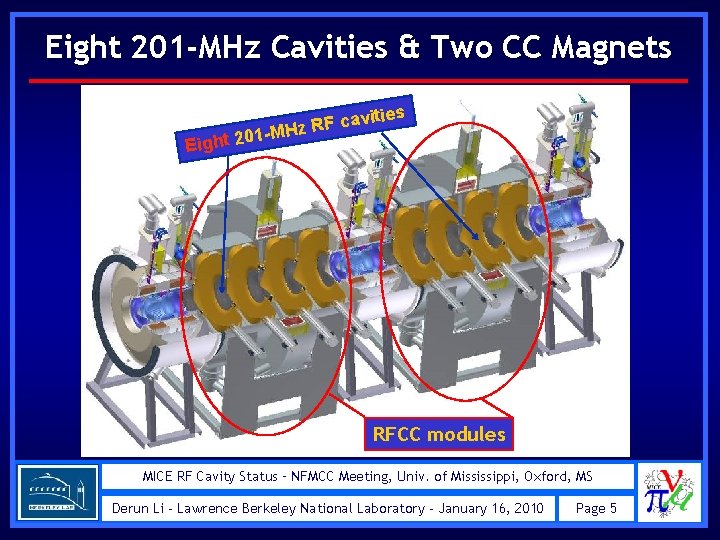
Eight 201 -MHz Cavities & Two CC Magnets es aviti c F R z MH ht 201 - Eig RFCC modules MICE RF Cavity Status – NFMCC Meeting, Univ. of Mississippi, Oxford, MS Derun Li - Lawrence Berkeley National Laboratory - January 16, 2010 Page 5
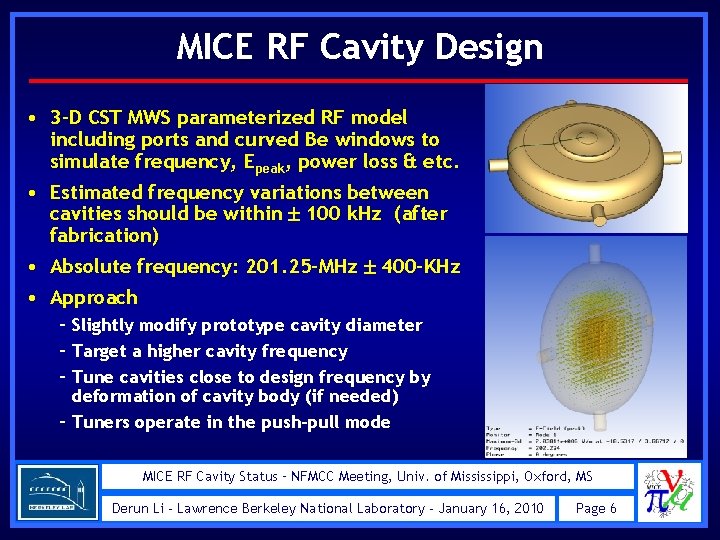
MICE RF Cavity Design • 3 -D CST MWS parameterized RF model including ports and curved Be windows to simulate frequency, Epeak, power loss & etc. • Estimated frequency variations between cavities should be within 100 k. Hz (after fabrication) • Absolute frequency: 201. 25 -MHz 400 -KHz • Approach – Slightly modify prototype cavity diameter – Target a higher cavity frequency – Tune cavities close to design frequency by deformation of cavity body (if needed) – Tuners operate in the push-pull mode MICE RF Cavity Status – NFMCC Meeting, Univ. of Mississippi, Oxford, MS Derun Li - Lawrence Berkeley National Laboratory - January 16, 2010 Page 6

Cavity Component Parts Strut Mounting Post Cavity Shells Cooling Tubing Stiffener Ring Extruded Port Flange Nose Ring MICE RF Cavity Status – NFMCC Meeting, Univ. of Mississippi, Oxford, MS Derun Li - Lawrence Berkeley National Laboratory - January 16, 2010 Page 7
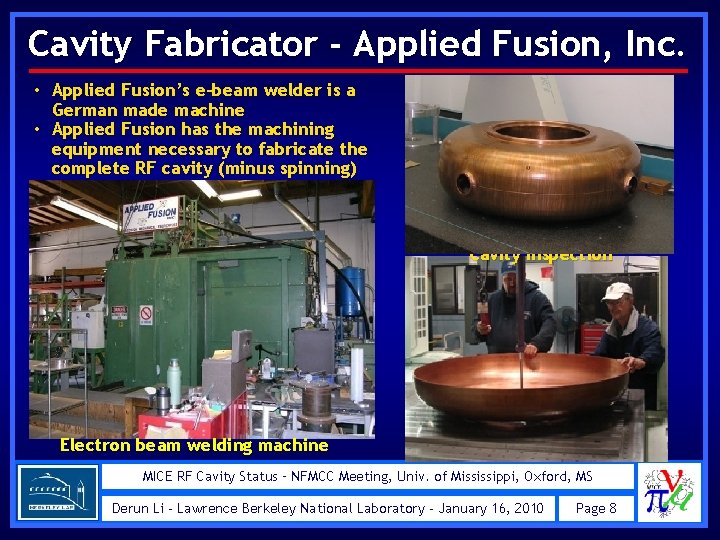
Cavity Fabricator - Applied Fusion, Inc. • Applied Fusion’s e-beam welder is a German made machine • Applied Fusion has the machining equipment necessary to fabricate the complete RF cavity (minus spinning) Cavity Inspection Electron beam welding machine MICE RF Cavity Status – NFMCC Meeting, Univ. of Mississippi, Oxford, MS Derun Li - Lawrence Berkeley National Laboratory - January 16, 2010 Page 8

Cavity Stiffener Ring Title Here 1. Spun shells from Acme, MN 2. The stiffener ring is welded on to the half shell 3. Equator welding 4. The iris is machined out MICE RF Cavity Status – NFMCC Meeting, Univ. of Mississippi, Oxford, MS Derun Li - Lawrence Berkeley National Laboratory - January 16, 2010 Page 9
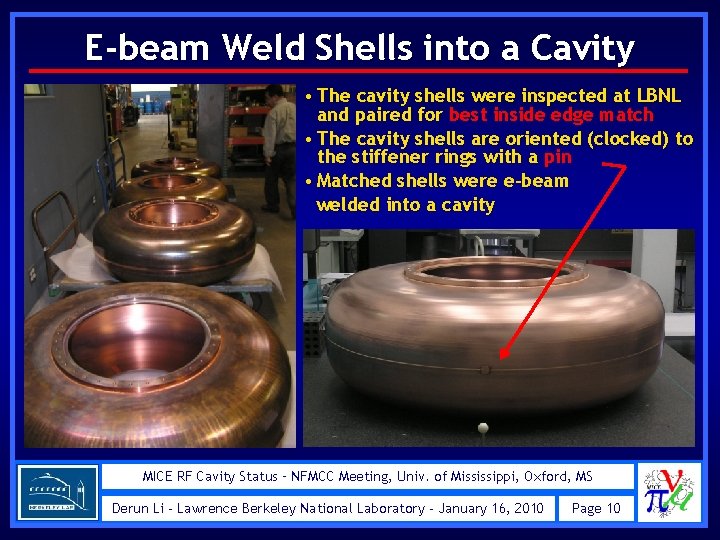
E-beam Weld Shells into a Cavity • The cavity shells were inspected at LBNL and paired for best inside edge match • The cavity shells are oriented (clocked) to the stiffener rings with a pin • Matched shells were e-beam welded into a cavity MICE RF Cavity Status – NFMCC Meeting, Univ. of Mississippi, Oxford, MS Derun Li - Lawrence Berkeley National Laboratory - January 16, 2010 Page 10
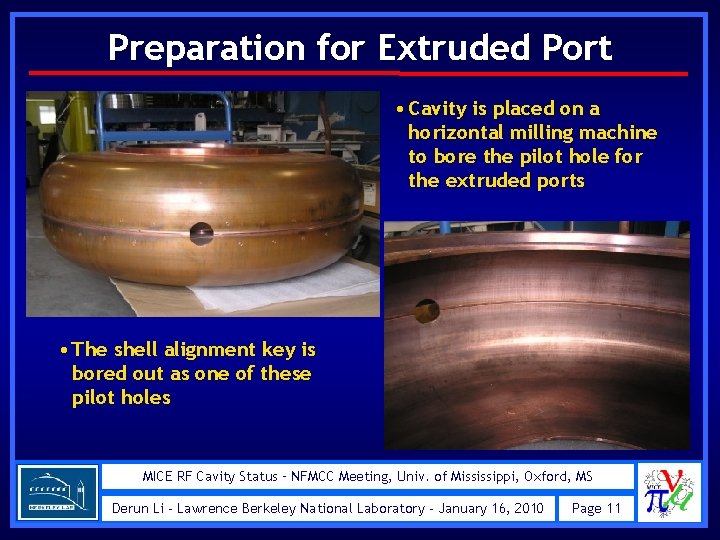
Preparation for Extruded Port • Cavity is placed on a horizontal milling machine to bore the pilot hole for the extruded ports • The shell alignment key is bored out as one of these pilot holes MICE RF Cavity Status – NFMCC Meeting, Univ. of Mississippi, Oxford, MS Derun Li - Lawrence Berkeley National Laboratory - January 16, 2010 Page 11
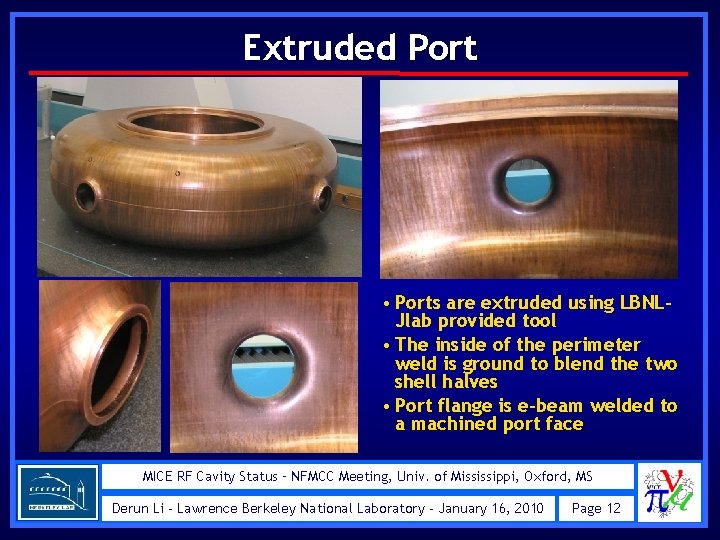
Extruded Port • Ports are extruded using LBNLJlab provided tool • The inside of the perimeter weld is ground to blend the two shell halves • Port flange is e-beam welded to a machined port face MICE RF Cavity Status – NFMCC Meeting, Univ. of Mississippi, Oxford, MS Derun Li - Lawrence Berkeley National Laboratory - January 16, 2010 Page 12
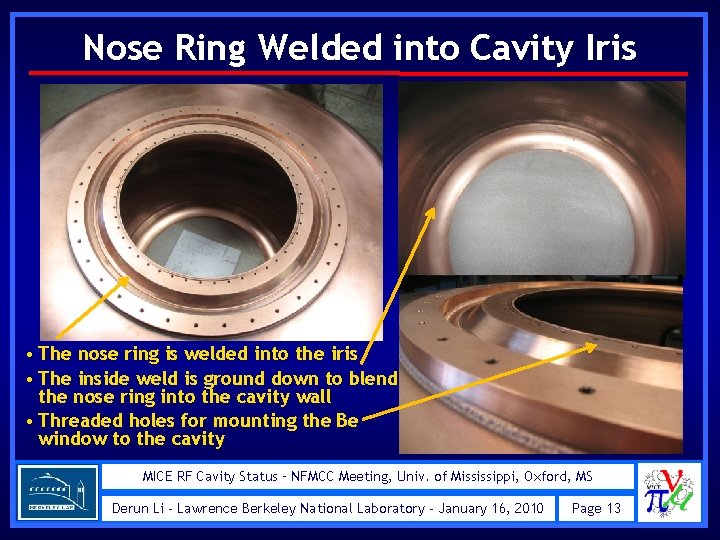
Nose Ring Welded into Cavity Iris • The nose ring is welded into the iris • The inside weld is ground down to blend the nose ring into the cavity wall • Threaded holes for mounting the Be window to the cavity MICE RF Cavity Status – NFMCC Meeting, Univ. of Mississippi, Oxford, MS Derun Li - Lawrence Berkeley National Laboratory - January 16, 2010 Page 13
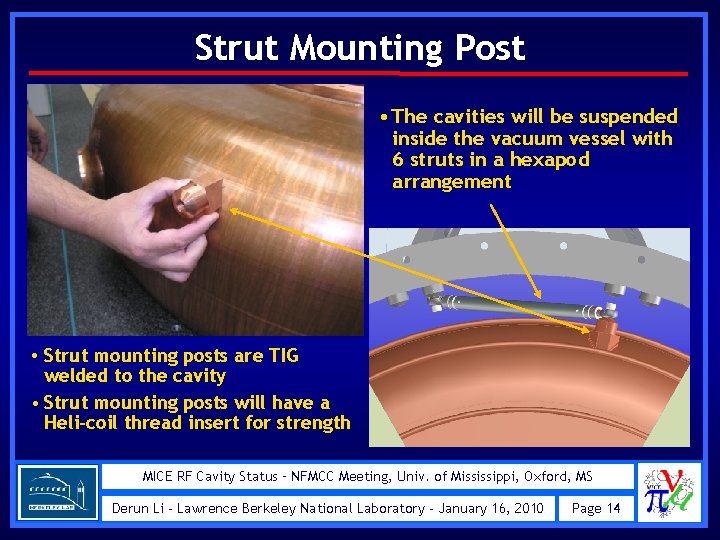
Strut Mounting Post • The cavities will be suspended inside the vacuum vessel with 6 struts in a hexapod arrangement • Strut mounting posts are TIG welded to the cavity • Strut mounting posts will have a Heli-coil thread insert for strength MICE RF Cavity Status – NFMCC Meeting, Univ. of Mississippi, Oxford, MS Derun Li - Lawrence Berkeley National Laboratory - January 16, 2010 Page 14
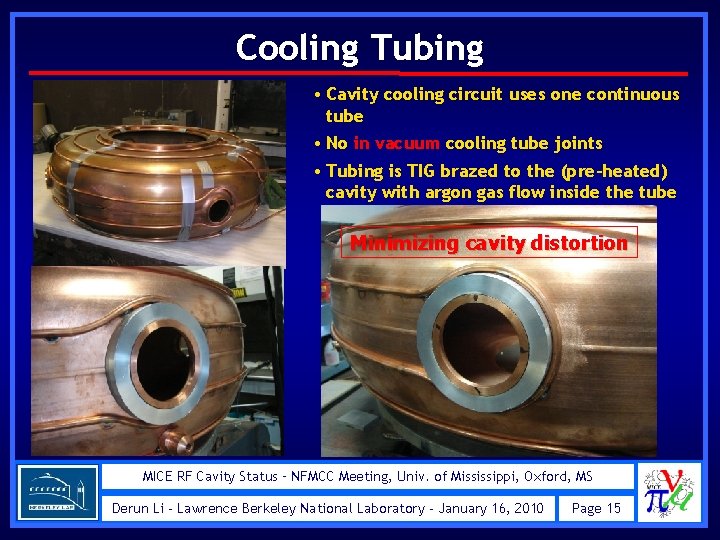
Cooling Tubing • Cavity cooling circuit uses one continuous tube • No in vacuum cooling tube joints • Tubing is TIG brazed to the (pre-heated) cavity with argon gas flow inside the tube Minimizing cavity distortion MICE RF Cavity Status – NFMCC Meeting, Univ. of Mississippi, Oxford, MS Derun Li - Lawrence Berkeley National Laboratory - January 16, 2010 Page 15
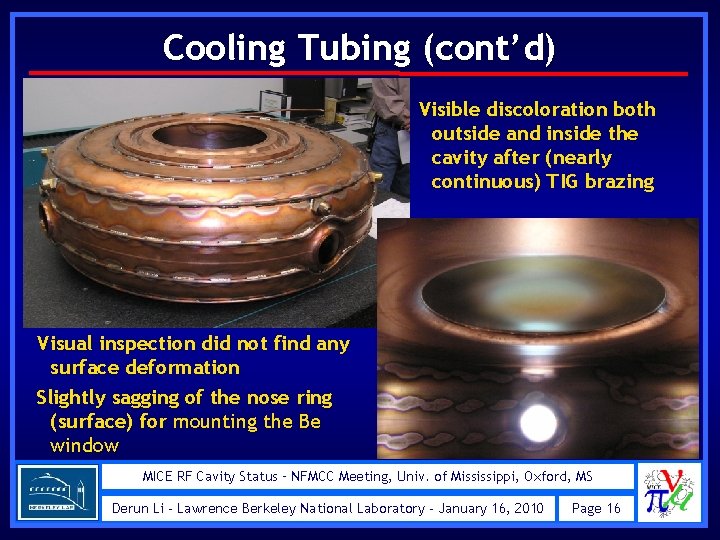
Cooling Tubing (cont’d) Visible discoloration both outside and inside the cavity after (nearly continuous) TIG brazing Visual inspection did not find any surface deformation Slightly sagging of the nose ring (surface) for mounting the Be window MICE RF Cavity Status – NFMCC Meeting, Univ. of Mississippi, Oxford, MS Derun Li - Lawrence Berkeley National Laboratory - January 16, 2010 Page 16
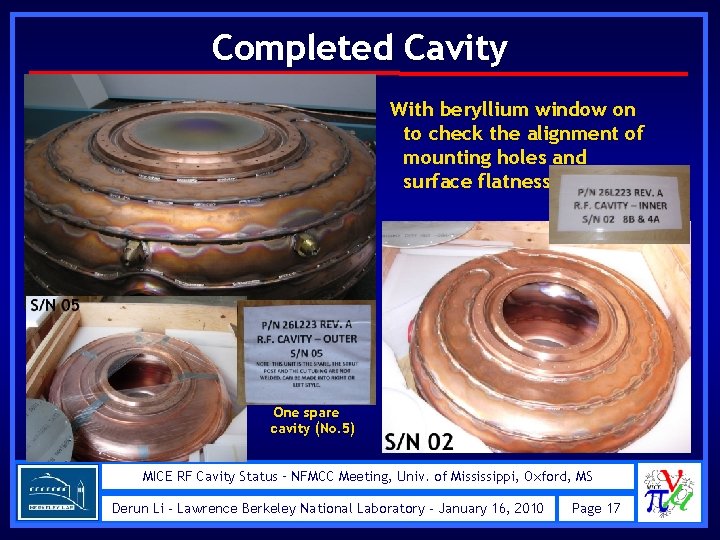
Completed Cavity With beryllium window on to check the alignment of mounting holes and surface flatness One spare cavity (No. 5) MICE RF Cavity Status – NFMCC Meeting, Univ. of Mississippi, Oxford, MS Derun Li - Lawrence Berkeley National Laboratory - January 16, 2010 Page 17
Future Plans • Cavities must be “tuned” to each other for best center frequency (four cavities) by plastic deformation (will be done at LBNL) • Measure cavity frequencies and find the average frequency (to be completed by next MICE CM) • Cavity post-processing • The inside surface of each cavity needs to be cleaned and electropolished (to be done at LBNL) • Frequency tuner system testing and verification will be conducted on a finished cavity • Prototype for tuner test is in fabrication + MTA tests • Option to order the remaining 5 cavities (four plus one spare) for the second RFCC module • Decision needs to be made soon • Continue to work on other accessory components: coupler, ceramic windows and Be windows, support structures and vacuum vessels MICE RF Cavity Status – NFMCC Meeting, Univ. of Mississippi, Oxford, MS Derun Li - Lawrence Berkeley National Laboratory - January 16, 2010 Page 18
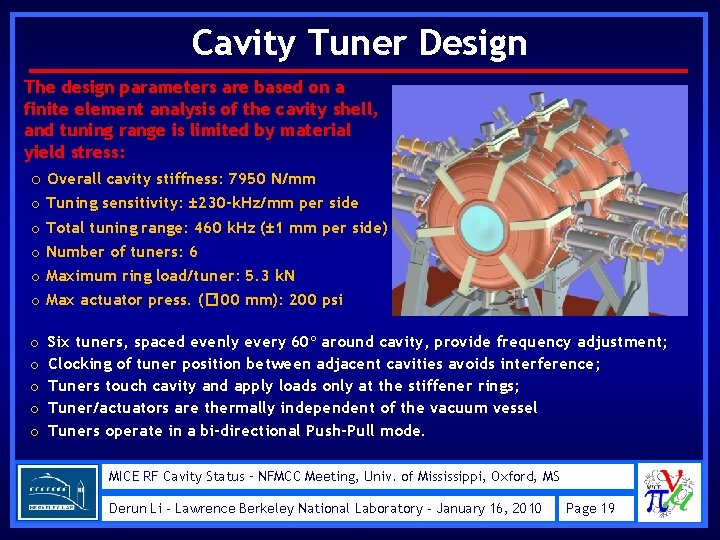
Cavity Tuner Design The design parameters are based on a finite element analysis of the cavity shell, and tuning range is limited by material yield stress: o Overall cavity stiffness: 7950 N/mm o Tuning sensitivity: ± 230 -k. Hz/mm per side o Total tuning range: 460 k. Hz (± 1 mm per side) o Number of tuners: 6 o Maximum ring load/tuner: 5. 3 k. N o Max actuator press. (� 100 mm): 200 psi o o o Six tuners, spaced evenly every 60º around cavity, provide frequency adjustment; Clocking of tuner position between adjacent cavities avoids interference; Tuners touch cavity and apply loads only at the stiffener rings; Tuner/actuators are thermally independent of the vacuum vessel Tuners operate in a bi-directional Push-Pull mode. MICE RF Cavity Status – NFMCC Meeting, Univ. of Mississippi, Oxford, MS Derun Li - Lawrence Berkeley National Laboratory - January 16, 2010 Page 19
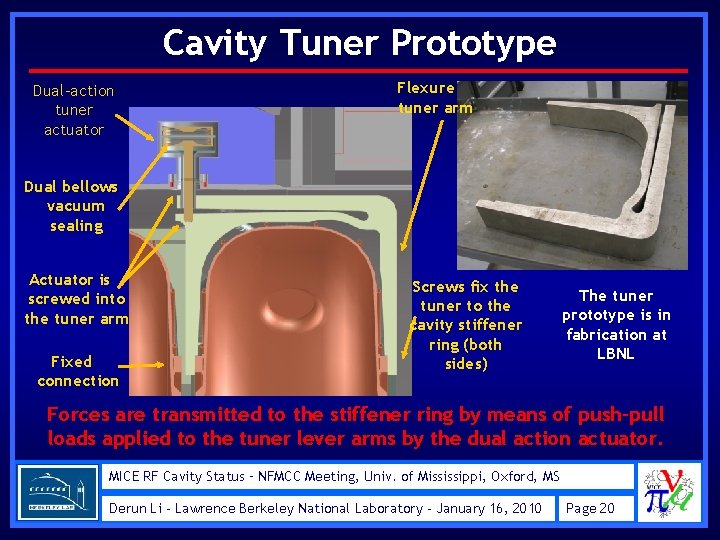
Cavity Tuner Prototype Dual–action tuner actuator Flexure tuner arm Dual bellows vacuum sealing Actuator is screwed into the tuner arm Fixed connection Screws fix the tuner to the cavity stiffener ring (both sides) The tuner prototype is in fabrication at LBNL Forces are transmitted to the stiffener ring by means of push-pull loads applied to the tuner lever arms by the dual action actuator. MICE RF Cavity Status – NFMCC Meeting, Univ. of Mississippi, Oxford, MS Derun Li - Lawrence Berkeley National Laboratory - January 16, 2010 Page 20
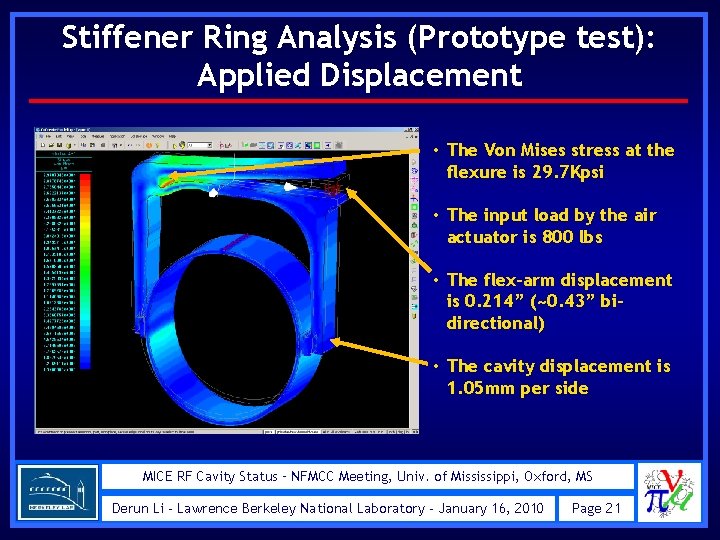
Stiffener Ring Analysis (Prototype test): Applied Displacement • The Von Mises stress at the flexure is 29. 7 Kpsi • The input load by the air actuator is 800 lbs • The flex-arm displacement is 0. 214” (~0. 43” bidirectional) • The cavity displacement is 1. 05 mm per side MICE RF Cavity Status – NFMCC Meeting, Univ. of Mississippi, Oxford, MS Derun Li - Lawrence Berkeley National Laboratory - January 16, 2010 Page 21
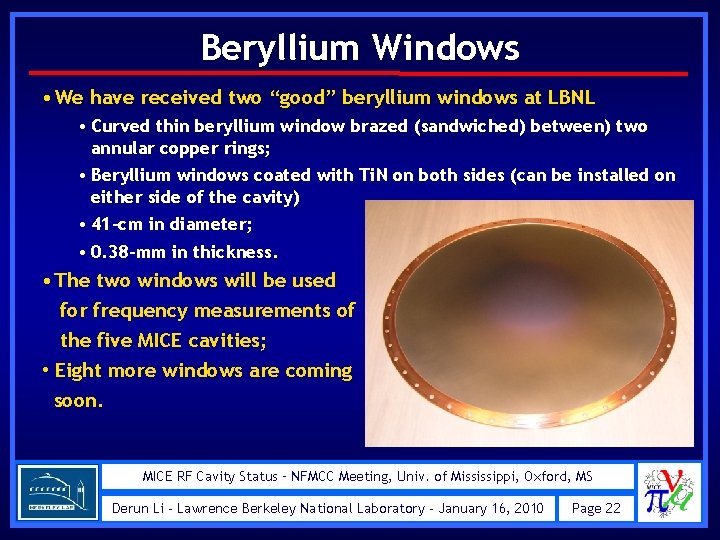
Beryllium Windows • We have received two “good” beryllium windows at LBNL • Curved thin beryllium window brazed (sandwiched) between) two annular copper rings; • Beryllium windows coated with Ti. N on both sides (can be installed on either side of the cavity) • 41 -cm in diameter; • 0. 38 -mm in thickness. • The two windows will be used for frequency measurements of the five MICE cavities; • Eight more windows are coming soon. MICE RF Cavity Status – NFMCC Meeting, Univ. of Mississippi, Oxford, MS Derun Li - Lawrence Berkeley National Laboratory - January 16, 2010 Page 22
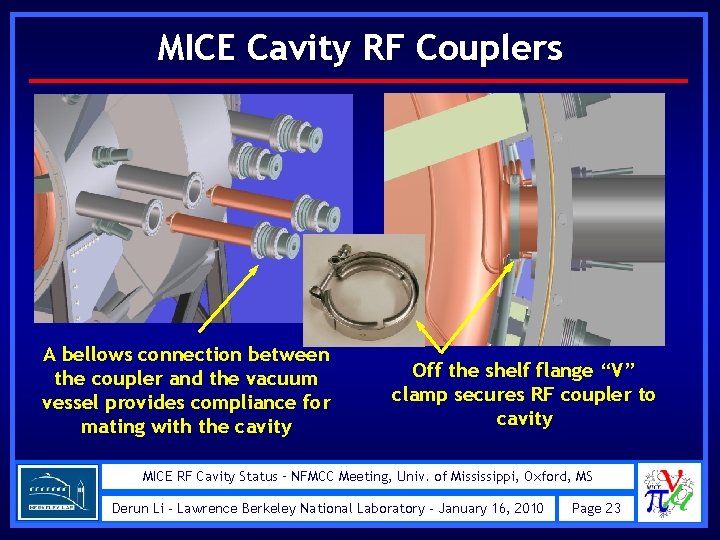
MICE Cavity RF Couplers A bellows connection between the coupler and the vacuum vessel provides compliance for mating with the cavity Off the shelf flange “V” clamp secures RF coupler to cavity MICE RF Cavity Status – NFMCC Meeting, Univ. of Mississippi, Oxford, MS Derun Li - Lawrence Berkeley National Laboratory - January 16, 2010 Page 23
Progress: Mu. Cool/MICE CC Magnets • Collaboration between LBNL and ICST of HIT, Harbin • Final design review was held in Harbin (Dec. 2008) • Little progress since the review due to personnel, funding issues and cryogenic test system • Recent visit to HIT (Dec. 2009) • New management team formed and near term plan developed • Good progress on drawing reviews and initiating contract • CC fabrication contract open for bidding: three registered vendors (deadline was Jan. 9 th 2010) • Fabrication contract to be awarded on March 15 th 2010 • Outlook • • • Cautiously optimistic on the fabrication contract Management and monitoring the contract Mu. Cool CC magnet (1 st) could be ready around end of 2010 • Three forged Al mandrels expect to arrive Qi Huan Company, Beijing in March 2010 MICE RF Cavity Status – NFMCC Meeting, Univ. of Mississippi, Oxford, MS Derun Li - Lawrence Berkeley National Laboratory - January 16, 2010 Page 24
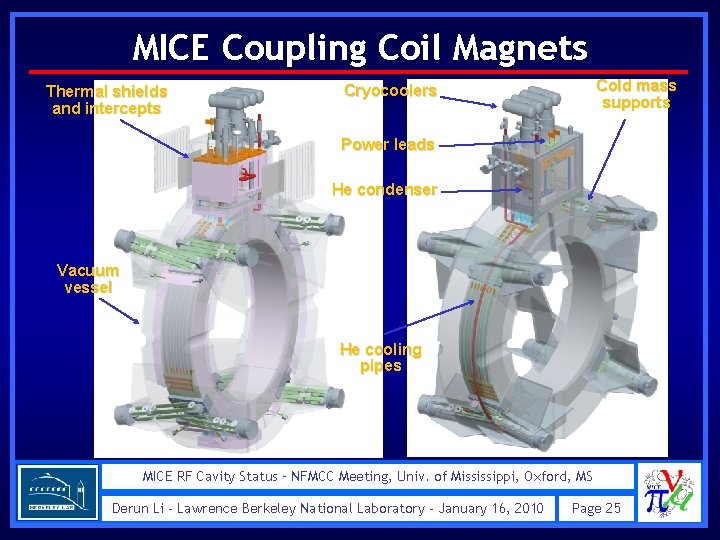
MICE Coupling Coil Magnets Thermal shields and intercepts Cold mass supports Cryocoolers Power leads He condenser Vacuum vessel He cooling pipes MICE RF Cavity Status – NFMCC Meeting, Univ. of Mississippi, Oxford, MS Derun Li - Lawrence Berkeley National Laboratory - January 16, 2010 Page 25
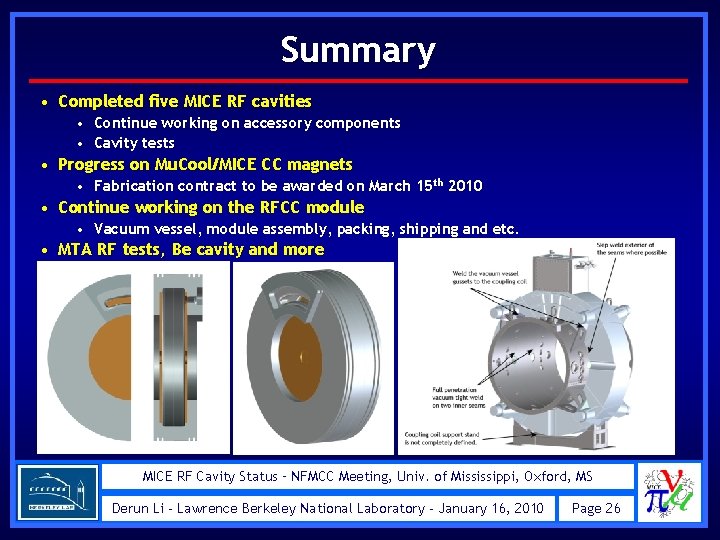
Summary • Completed five MICE RF cavities • Continue working on accessory components • Cavity tests • Progress on Mu. Cool/MICE CC magnets • Fabrication contract to be awarded on March 15 th 2010 • Continue working on the RFCC module • Vacuum vessel, module assembly, packing, shipping and etc. • MTA RF tests, Be cavity and more • MICE RF Cavity Status – NFMCC Meeting, Univ. of Mississippi, Oxford, MS Derun Li - Lawrence Berkeley National Laboratory - January 16, 2010 Page 26
- Slides: 26