
MICE Online Linda R Coney UCR MICE CM
- Slides: 9
MICE Online Linda R. Coney UCR MICE CM 30 Oxford July 2011
MICE Online 2011 • Some big changes happening • JS Graulich has gone – Yordan now in charge of DAQ • Regrouping everyone involved in the Online Effort • Weekly meetings Wed at 15: 30 RAL time • New sysadmin – Simon Fayer (Imperial)
Online Group Charter • The MICE Online Group creates, maintains, and ensures proper use of all tools (hardware, software, documentation) within the MLCR (MICE Local Control Room and Rack Room) that allow the experiment to efficiently record high quality data. • We are responsible for Data Acquisition (DAQ), Controls and Monitoring (C&M), Online Monitoring and Reconstruction, Data Transfer, Networking, and MLCR Computing. • We also interface closely with systems related to the Online sector including MICE Operations, Offline Software, and Computing.
Online Group Charter: Subgroups • DAQ – Controls taking & recording of all data from the MICE experiment, including all particle ID detectors, tracking detectors, and beam line diagnostic tools. This subgroup is responsible for all hardware within the MLCR, the DATE DAQ software, MICE trigger system, and unpacking software. • Controls & Monitoring – Controls all MICE systems including the target, all conventional and superconducting beam line magnets, particle ID detectors, tracking detectors, and cooling channel components. Monitoring of Hall environment and equipment function during data-taking is provided by the Alarm Handler, and the Archiver saves a record of all monitored systems and run conditions. C&M also provides an interface with the Configuration Database to retrieve pre-selected run configurations and to save new configurations. • Online Monitoring – Provides an immediate, low-level diagnostic monitoring capability for all DAQ hardware. Monitors DAQ performance and allows individual channel-by-channel assessment of detector behavior. • Online Reconstruction – Provides real-time physics information during data-taking, immediate feedback to experimenters, and a first look at analysis quantities. Includes a fixed set of histograms filled during data-taking for checks of data quality, beam dynamics, and detector function. Necessarily interfaces with the MICE Offline Software. • Data Transfer – Allows efficient and automatic movement of MICE data sets and associated Online Monitoring & Reconstruction plots out of the MLCR for permanent storage. • MLCR Computing and Network – Maintains all DAQ and C&M computers, both wired and wireless network in the control room, and controls access to these machines in accordance with RAL computing security guidelines.
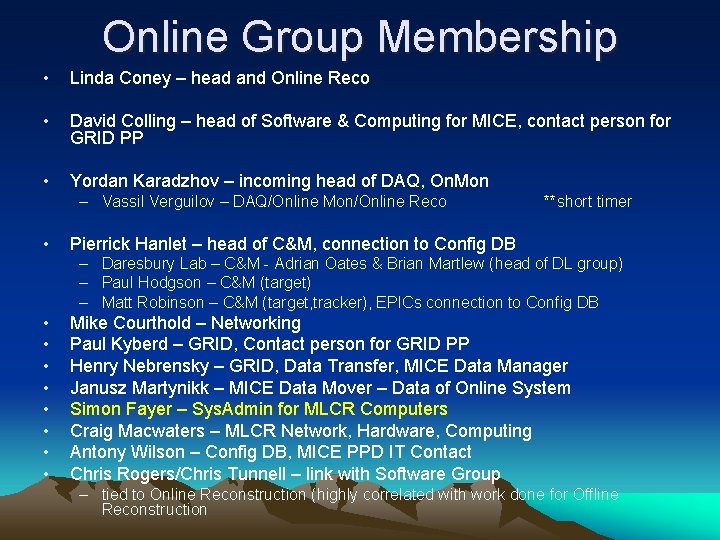
Online Group Membership • Linda Coney – head and Online Reco • David Colling – head of Software & Computing for MICE, contact person for GRID PP • Yordan Karadzhov – incoming head of DAQ, On. Mon – Vassil Verguilov – DAQ/Online Mon/Online Reco • **short timer Pierrick Hanlet – head of C&M, connection to Config DB – Daresbury Lab – C&M - Adrian Oates & Brian Martlew (head of DL group) – Paul Hodgson – C&M (target) – Matt Robinson – C&M (target, tracker), EPICs connection to Config DB • • Mike Courthold – Networking Paul Kyberd – GRID, Contact person for GRID PP Henry Nebrensky – GRID, Data Transfer, MICE Data Manager Janusz Martynikk – MICE Data Mover – Data of Online System Simon Fayer – Sys. Admin for MLCR Computers Craig Macwaters – MLCR Network, Hardware, Computing Antony Wilson – Config DB, MICE PPD IT Contact Chris Rogers/Chris Tunnell – link with Software Group – tied to Online Reconstruction (highly correlated with work done for Offline Reconstruction
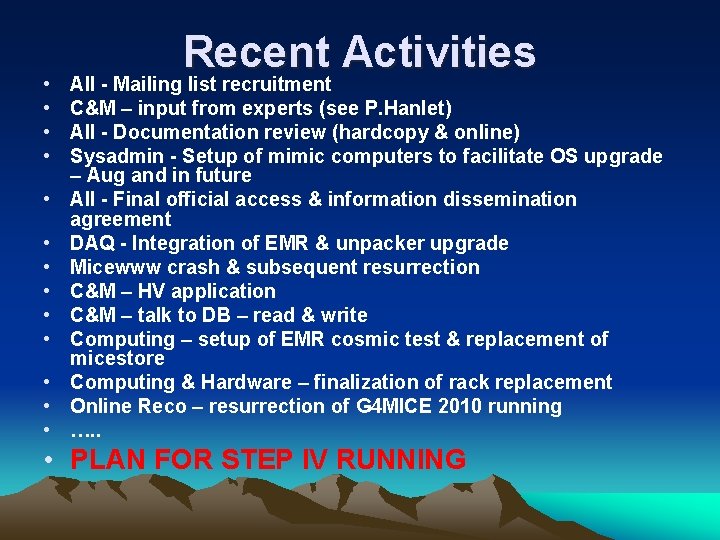
Recent Activities All - Mailing list recruitment • • C&M – input from experts (see P. Hanlet) • All - Documentation review (hardcopy & online) • Sysadmin - Setup of mimic computers to facilitate OS upgrade – Aug and in future • All - Final official access & information dissemination agreement • DAQ - Integration of EMR & unpacker upgrade • Micewww crash & subsequent resurrection • C&M – HV application • C&M – talk to DB – read & write • Computing – setup of EMR cosmic test & replacement of micestore • Computing & Hardware – finalization of rack replacement • Online Reco – resurrection of G 4 MICE 2010 running • …. . • PLAN FOR STEP IV RUNNING
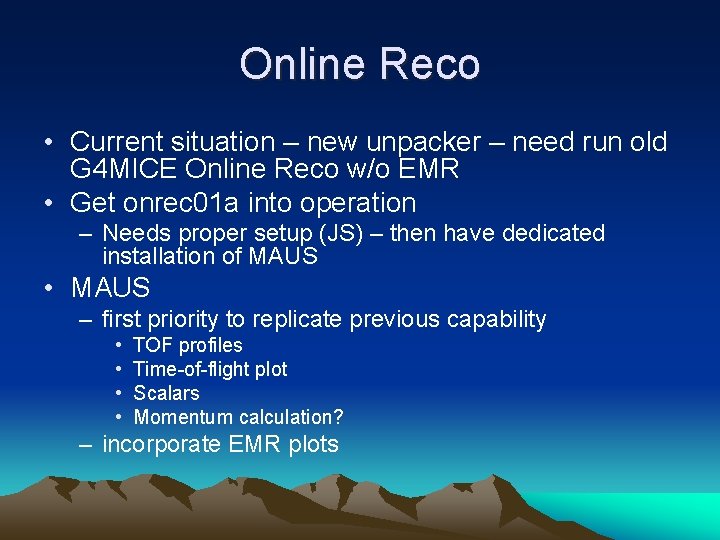
Online Reco • Current situation – new unpacker – need run old G 4 MICE Online Reco w/o EMR • Get onrec 01 a into operation – Needs proper setup (JS) – then have dedicated installation of MAUS • MAUS – first priority to replicate previous capability • • TOF profiles Time-of-flight plot Scalars Momentum calculation? – incorporate EMR plots
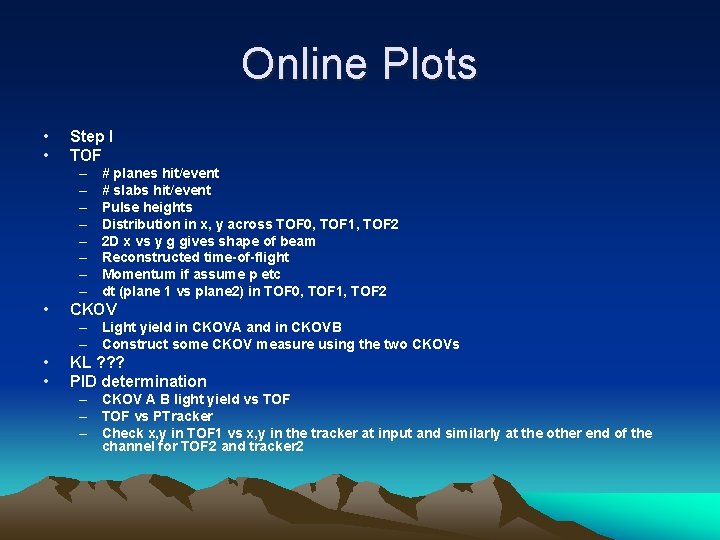
Online Plots • • Step I TOF – – – – • # planes hit/event # slabs hit/event Pulse heights Distribution in x, y across TOF 0, TOF 1, TOF 2 2 D x vs y g gives shape of beam Reconstructed time-of-flight Momentum if assume p etc dt (plane 1 vs plane 2) in TOF 0, TOF 1, TOF 2 CKOV – Light yield in CKOVA and in CKOVB – Construct some CKOV measure using the two CKOVs • • KL ? ? ? PID determination – CKOV A B light yield vs TOF – TOF vs PTracker – Check x, y in TOF 1 vs x, y in the tracker at input and similarly at the other end of the channel for TOF 2 and tracker 2
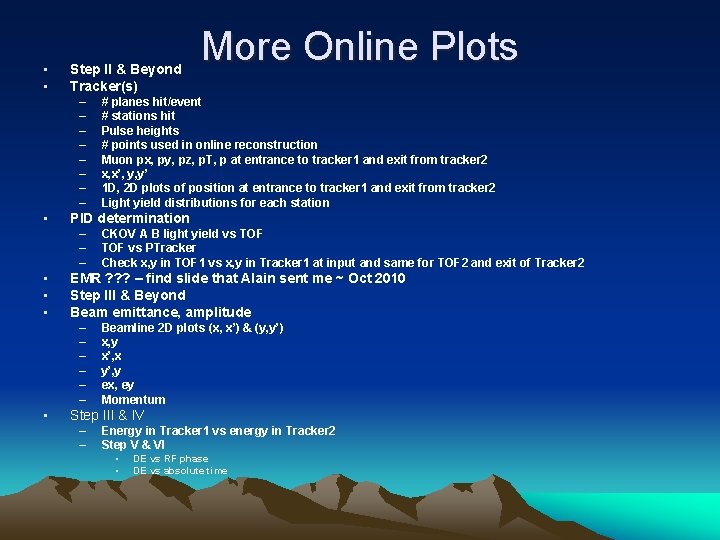
• • Step II & Beyond Tracker(s) – – – – • CKOV A B light yield vs TOF vs PTracker Check x, y in TOF 1 vs x, y in Tracker 1 at input and same for TOF 2 and exit of Tracker 2 EMR ? ? ? – find slide that Alain sent me ~ Oct 2010 Step III & Beyond Beam emittance, amplitude – – – • # planes hit/event # stations hit Pulse heights # points used in online reconstruction Muon px, py, pz, p. T, p at entrance to tracker 1 and exit from tracker 2 x, x’, y, y’ 1 D, 2 D plots of position at entrance to tracker 1 and exit from tracker 2 Light yield distributions for each station PID determination – – – • • • More Online Plots Beamline 2 D plots (x, x’) & (y, y’) x, y x’, x y’, y ex, ey Momentum Step III & IV – – Energy in Tracker 1 vs energy in Tracker 2 Step V & VI • • DE vs RF phase DE vs absolute time