
MHO CHO Guide For Training Deployment and Mobilization
MHO/ CHO Guide For Training, Deployment and Mobilization of Community Health Teams (CHTs)

Preparing for CHT Mobilization at the Municipal/City Level The Municipal Health Officer/City Health Officer will play a vital role in the Training, Deployment and Mobilization of Community Health Teams (CHTs) in his/her Local Government Unit (LGU). All of the following activities will have to be immediately initiated and implemented by the MHO/CHO prior to the undertaking of the training of the CHT Management Group and Partners at the municipal level.

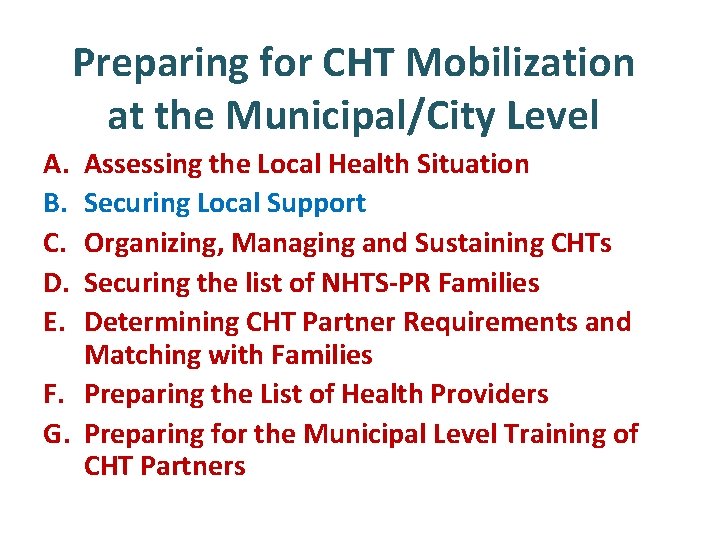
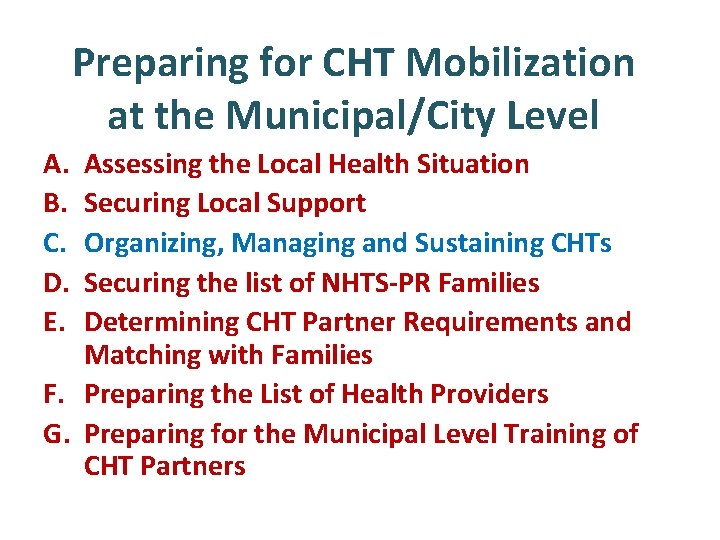
Preparing for CHT Mobilization at the Municipal/City Level A. B. C. D. E. Assessing the Local Health Situation Securing Local Support Organizing, Managing and Sustaining CHTs Securing the list of NHTS-PR Families Determining CHT Partner Requirements and Matching with Families F. Preparing the List of Health Providers G. Preparing for the Municipal Level Training of CHT Partners
Preparing for CHT Mobilization at the Municipal/City Level A. B. C. D. E. Assessing the Local Health Situation Securing Local Support Organizing, Managing and Sustaining CHTs Securing the list of NHTS-PR Families Determining CHT Partner Requirements and Matching with Families F. Preparing the List of Health Providers G. Preparing for the Municipal Level Training of CHT Partners
Assessing the Local Health Situation WHY? • To know what to prepare for in terms of what health risk assessments (HRAs), health use plans (HUPs) that CHTs will need when CHTs are deployed • To know which types of providers will need to be oriented in terms of possible patient load (Section F, Instructions on Preparing the List of Providers, Page 32) • To prepare a briefer or health situationer for presentation to the LCE in order to generate support for CHT deployment (Section B, Securing Local Support at the Municipal or City Level, Page 14)
Assessing the Local Health Situation WHAT? • top causes of morbidity and mortality; • number of maternal, infant and under-5 deaths; and • top three causes of maternal, infant and under -5 deaths. The proposed source of information is the FHSIS from 2009 to 2010. MHO/CHO and the PHN will fill up the following tables:
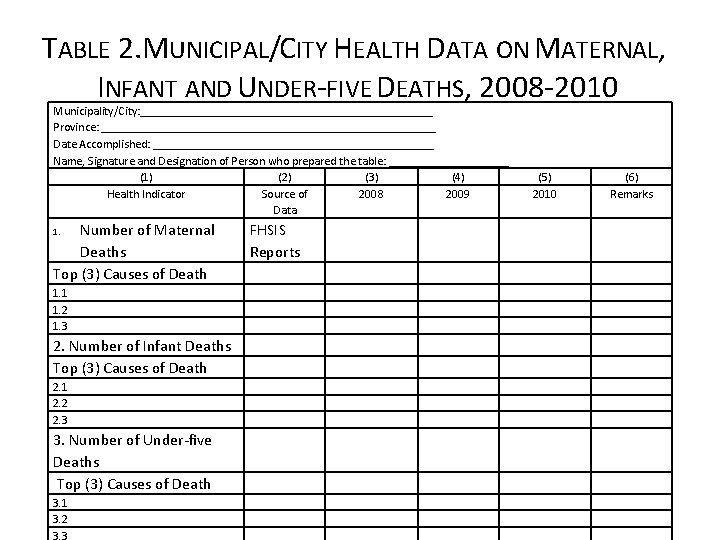
TABLE 2. MUNICIPAL/CITY HEALTH DATA ON MATERNAL, INFANT AND UNDER-FIVE DEATHS, 2008 -2010 Municipality/City: _________________________ Province: ____________________________ Date Accomplished: ________________________ Name, Signature and Designation of Person who prepared the table: __________ (1) (2) (3) (4) Health Indicator Source of 2008 2009 Data Number of Maternal Deaths Top (3) Causes of Death 1. 1 1. 2 1. 3 2. Number of Infant Deaths Top (3) Causes of Death 2. 1 2. 2 2. 3 3. Number of Under-five Deaths Top (3) Causes of Death 3. 1 3. 2 3. 3 FHSIS Reports (5) 2010 (6) Remarks
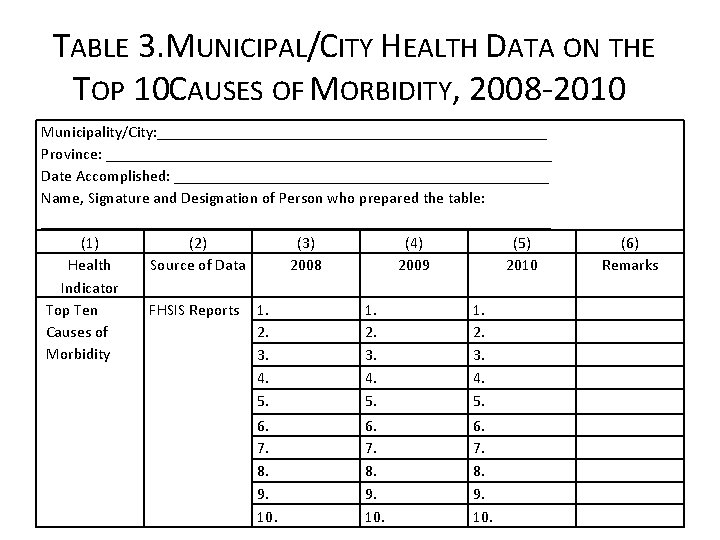
TABLE 3. MUNICIPAL/CITY HEALTH DATA ON THE TOP 10 CAUSES OF MORBIDITY, 2008 -2010. Municipality/City: _________________________ Province: ____________________________ Date Accomplished: ________________________ Name, Signature and Designation of Person who prepared the table: ________________________________ (1) (2) (3) (4) (5) Health Source of Data 2008 2009 2010 Indicator Top Ten FHSIS Reports 1. 1. 1. Causes of 2. 2. 2. Morbidity 3. 3. 3. 4. 4. 4. 5. 5. 5. 6. 7. 8. 9. 10. (6) Remarks
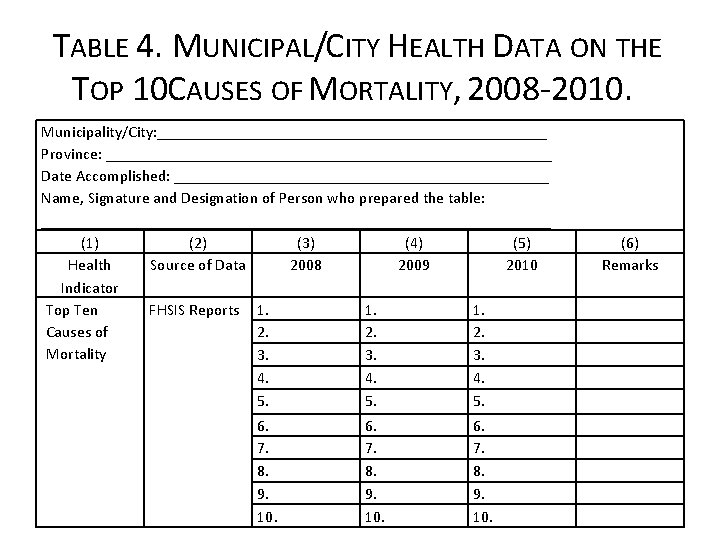
TABLE 4. MUNICIPAL/CITY HEALTH DATA ON THE TOP 10 CAUSES OF MORTALITY, 2008 -2010. Municipality/City: _________________________ Province: ____________________________ Date Accomplished: ________________________ Name, Signature and Designation of Person who prepared the table: ________________________________ (1) (2) (3) (4) (5) Health Source of Data 2008 2009 2010 Indicator Top Ten FHSIS Reports 1. 1. 1. Causes of 2. 2. 2. Mortality 3. 3. 3. 4. 4. 4. 5. 5. 5. 6. 7. 8. 9. 10. (6) Remarks
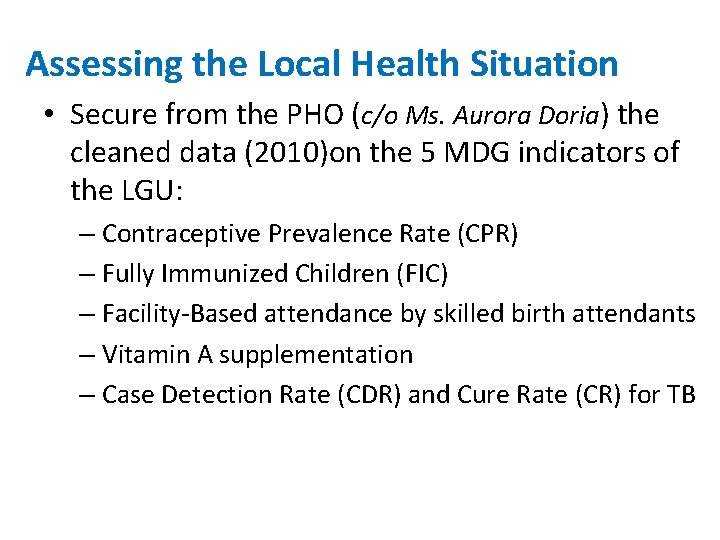
Assessing the Local Health Situation • Secure from the PHO (c/o Ms. Aurora Doria) the cleaned data (2010)on the 5 MDG indicators of the LGU: – Contraceptive Prevalence Rate (CPR) – Fully Immunized Children (FIC) – Facility-Based attendance by skilled birth attendants – Vitamin A supplementation – Case Detection Rate (CDR) and Cure Rate (CR) for TB
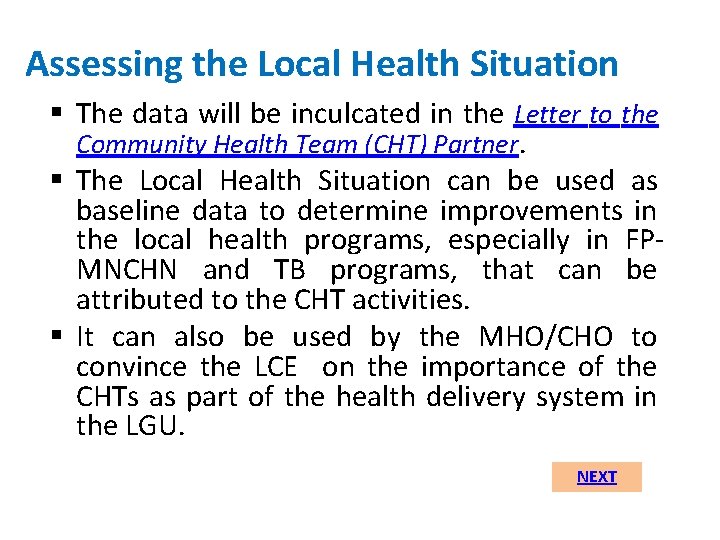
Assessing the Local Health Situation § The data will be inculcated in the Letter to the Community Health Team (CHT) Partner. § The Local Health Situation can be used as baseline data to determine improvements in the local health programs, especially in FPMNCHN and TB programs, that can be attributed to the CHT activities. § It can also be used by the MHO/CHO to convince the LCE on the importance of the CHTs as part of the health delivery system in the LGU. NEXT
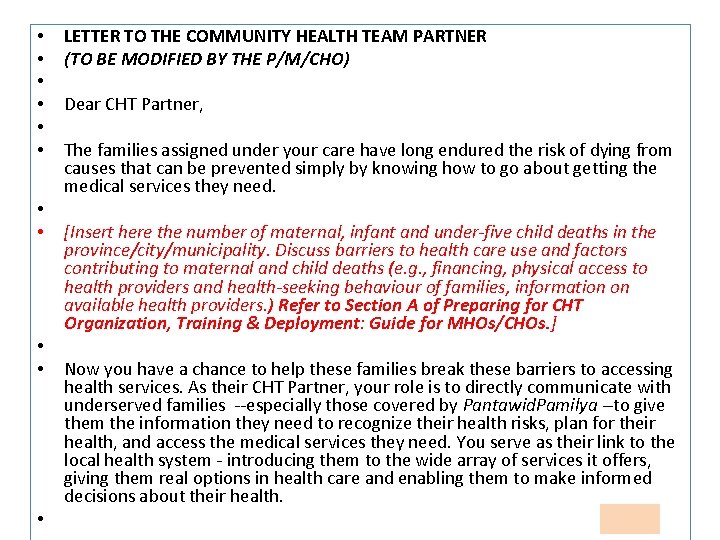
• • • LETTER TO THE COMMUNITY HEALTH TEAM PARTNER (TO BE MODIFIED BY THE P/M/CHO) Dear CHT Partner, The families assigned under your care have long endured the risk of dying from causes that can be prevented simply by knowing how to go about getting the medical services they need. [Insert here the number of maternal, infant and under-five child deaths in the province/city/municipality. Discuss barriers to health care use and factors contributing to maternal and child deaths (e. g. , financing, physical access to health providers and health-seeking behaviour of families, information on available health providers. ) Refer to Section A of Preparing for CHT Organization, Training & Deployment: Guide for MHOs/CHOs. ] Now you have a chance to help these families break these barriers to accessing health services. As their CHT Partner, your role is to directly communicate with underserved families --especially those covered by Pantawid. Pamilya --to give them the information they need to recognize their health risks, plan for their health, and access the medical services they need. You serve as their link to the local health system - introducing them to the wide array of services it offers, giving them real options in health care and enabling them to make informed decisions about their health.
Preparing for CHT Mobilization at the Municipal/City Level A. B. C. D. E. Assessing the Local Health Situation Securing Local Support Organizing, Managing and Sustaining CHTs Securing the list of NHTS-PR Families Determining CHT Partner Requirements and Matching with Families F. Preparing the List of Health Providers G. Preparing for the Municipal Level Training of CHT Partners
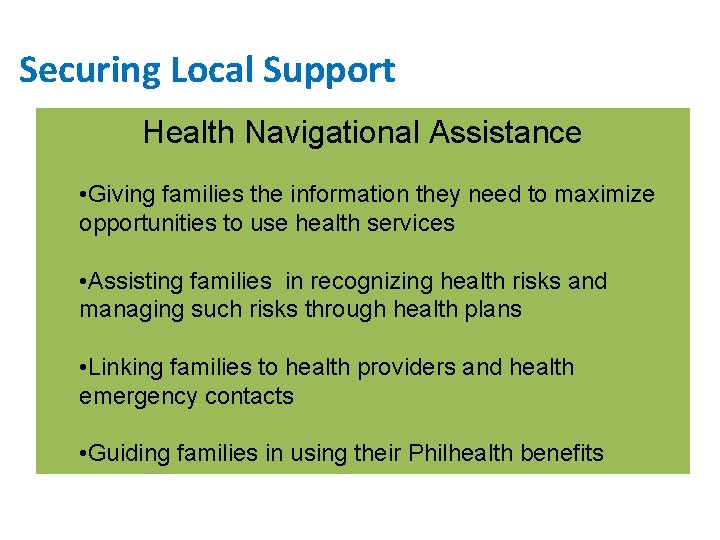
Securing Local Support 1. MHO/Health CHO will convey to Assistance the LCE and other Navigational concerned local agencies on the importance of the CHT, its navigation in • Giving specifically families the information they needfunction, to maximize opportunities to use health services improving the health status of poor families; and what the LGU can do to support their mobilization • Assisting families in recognizing health risks and or deployment. managing such riskscan through health plans a. The MHO/CHO cite the enabling statutes/policies on CHT mobilization: • Linking health providers - DILGfamilies Memoto. Circular 2011 -145 and health emergency contacts - Joint Memorandum Circular No. 2011 -0073 (DOH, DSWD, DILG, Dep. ED) • Guiding families in using their Philhealth benefits
Securing Local Support 1. The MHO/CHO will conduct advocacy meetings with the SB and the LIGA to gain support for KP-CHT and request for a resolution of support and possible funding for the sustainability of the project, at least up to 2016. 2. The MHO or CHO is responsible for ensuring that resources are available to support and sustain CHT activities in the municipality/ city.
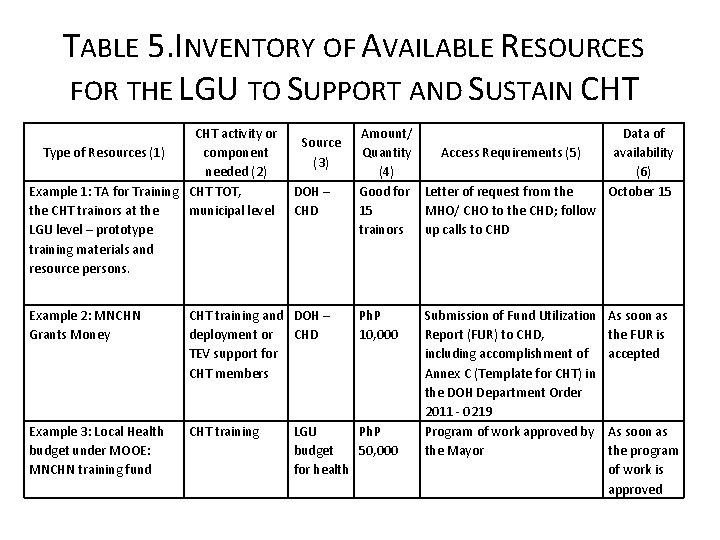
TABLE 5. INVENTORY OF AVAILABLE RESOURCES FOR THE LGU TO SUPPORT AND SUSTAIN CHT activity or Type of Resources (1) component needed (2) Example 1: TA for Training CHT TOT, the CHT trainors at the municipal level LGU level – prototype training materials and resource persons. Source (3) DOH – CHD Example 2: MNCHN Grants Money CHT training and DOH – deployment or CHD TEV support for CHT members Example 3: Local Health budget under MOOE: MNCHN training fund CHT training Amount/ Data of Quantity Access Requirements (5) availability (4) (6) Good for Letter of request from the October 15 15 MHO/ CHO to the CHD; follow trainors up calls to CHD Ph. P 10, 000 LGU Ph. P budget 50, 000 for health Submission of Fund Utilization Report (FUR) to CHD, including accomplishment of Annex C (Template for CHT) in the DOH Department Order 2011 - 0219 Program of work approved by the Mayor As soon as the FUR is accepted As soon as the program of work is approved
Preparing for CHT Mobilization at the Municipal/City Level A. B. C. D. E. Assessing the Local Health Situation Securing Local Support Organizing, Managing and Sustaining CHTs Securing the list of NHTS-PR Families Determining CHT Partner Requirements and Matching with Families F. Preparing the List of Health Providers G. Preparing for the Municipal Level Training of CHT Partners
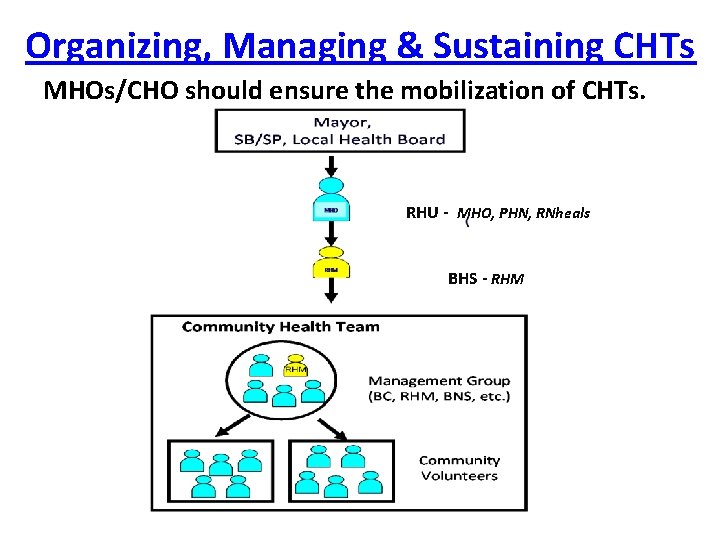
Organizing, Managing & Sustaining CHTs MHOs/CHO should ensure the mobilization of CHTs. RHU - MHO, PHN, RNheals BHS - RHM
Organizing, Managing & Sustaining CHTs The CHT Management Group: 1. Punong Barangay – Chairman 2. Rural Health Midwife – Co-chairman 3. Brgy. Chairman on Health – Member 4. Brgy. Nutrition Scholar – Member 5. Others –Purok leaders, etc. - Member The RHM is not only the co-chairman but also the frontline service provider in the BHS as well as the one responsible for collecting, recording and reporting the FHSIS data.
Preparing for CHT Mobilization at the Municipal/City Level A. B. C. D. E. Assessing the Local Health Situation Securing Local Support Organizing, Managing and Sustaining CHTs Securing the list of NHTS-PR Families Determining CHT Partner Requirements and Matching with Families F. Preparing the List of Health Providers G. Preparing for the Municipal Level Training of CHT Partners
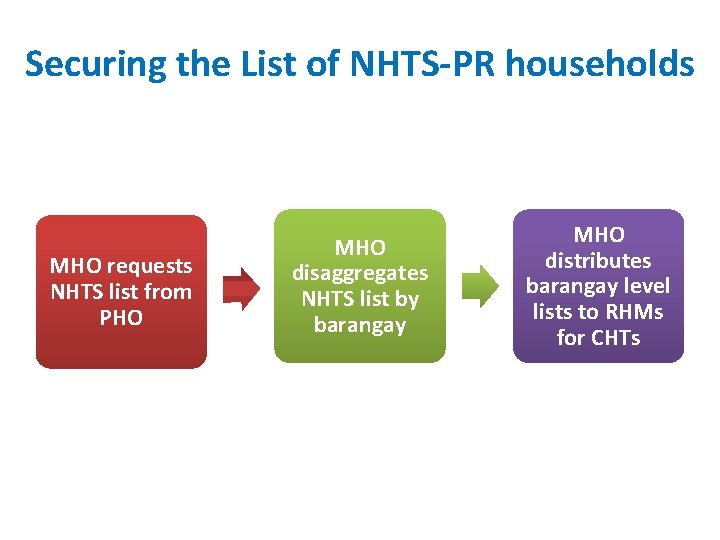
Securing the List of NHTS-PR households MHO requests NHTS list from PHO MHO disaggregates NHTS list by barangay MHO distributes barangay level lists to RHMs for CHTs
Securing the List of NHTS-PR households The list should be secured as early as possible to facilitate the identification of the families to be served by the CHTs in every barangay. The MHO/CHO should exert effort to get the list in whatever way possible and wherever the list is available.
Preparing for CHT Mobilization at the Municipal/City Level A. B. C. D. E. Assessing the Local Health Situation Securing Local Support Organizing, Managing and Sustaining CHTs Securing the list of NHTS-PR Families Determining CHT Partner Requirements and Matching with Families F. Preparing the List of Health Providers G. Preparing for the Municipal Level Training of CHT Partners
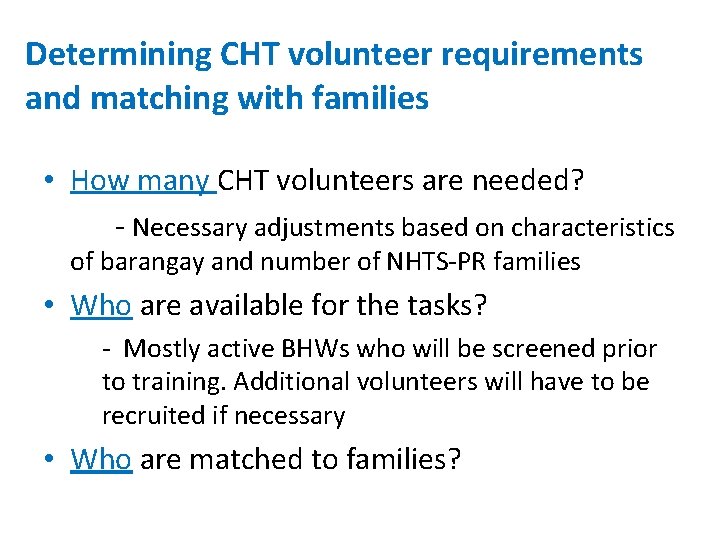
Determining CHT volunteer requirements and matching with families • How many CHT volunteers are needed? - Necessary adjustments based on characteristics of barangay and number of NHTS-PR families • Who are available for the tasks? - Mostly active BHWs who will be screened prior to training. Additional volunteers will have to be recruited if necessary • Who are matched to families?
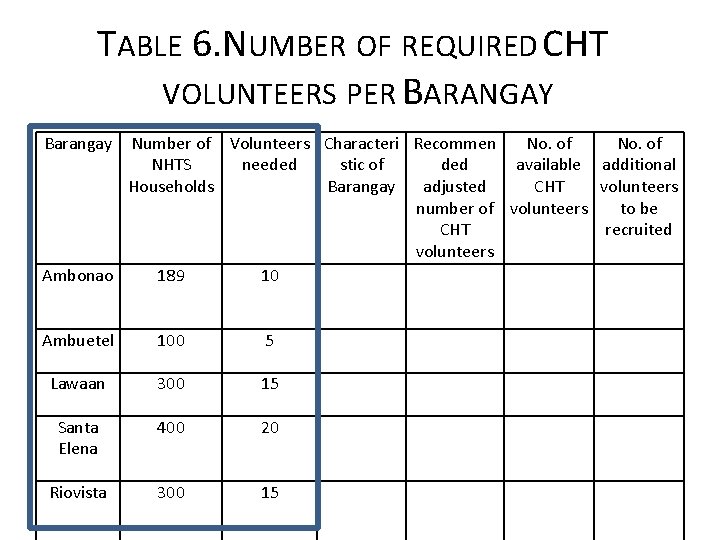
TABLE 6. NUMBER OF REQUIRED CHT VOLUNTEERS PER BARANGAY Barangay Number of Volunteers Characteri Recommen No. of NHTS needed stic of ded available additional Households Barangay adjusted CHT volunteers number of volunteers to be CHT recruited volunteers Ambonao 189 10 High 4 17 None density poblacion Ambuetel 100 5 Difficult 10 14 None terrain Lawaan 300 15 long travel 30 15 15 time Santa 400 20 With 8 12 none Elena celphone network Riovista 300 15 Has 4 Ps 6 5 1 assembly
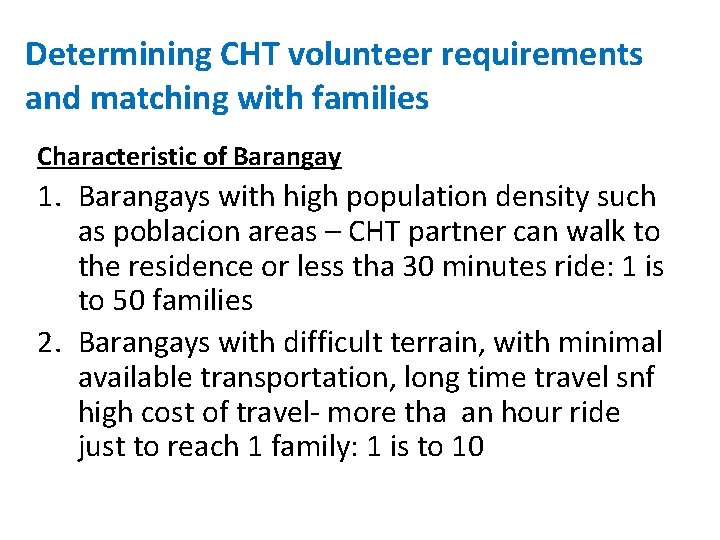
Determining CHT volunteer requirements and matching with families Characteristic of Barangay 1. Barangays with high population density such as poblacion areas – CHT partner can walk to the residence or less tha 30 minutes ride: 1 is to 50 families 2. Barangays with difficult terrain, with minimal available transportation, long time travel snf high cost of travel- more tha an hour ride just to reach 1 family: 1 is to 10
Determining CHT volunteer requirements and matching with families Characteristic of Barangay 3. Barangays with available communications (cellphones and radios) : 1 is to 50 families 4. Barangays with other venues to for monitoring the families like 4 Ps assemblies: 1 is to 50
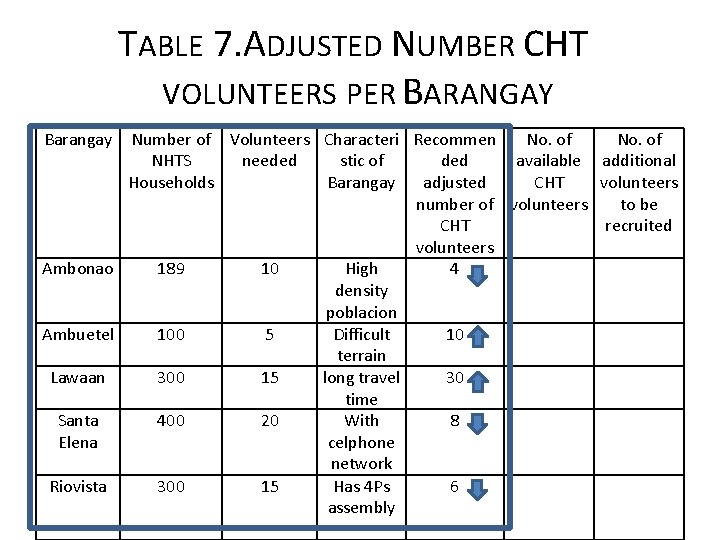
TABLE 7. ADJUSTED NUMBER CHT VOLUNTEERS PER BARANGAY Barangay Number of Volunteers Characteri Recommen No. of NHTS needed stic of ded available additional Households Barangay adjusted CHT volunteers number of volunteers to be CHT recruited volunteers Ambonao 189 10 High 4 10 None density poblacion Ambuetel 100 5 Difficult 10 30 20 terrain Lawaan 300 15 long travel 30 15 15 time Santa 400 20 With 8 12 none Elena celphone network Riovista 300 15 Has 4 Ps 6 5 1 assembly
Determining CHT volunteer requirements and matching with families Number of Available CHT Volunteers The MHO, PHN and assigned Rural Health Midwife in a barangay will have to evaluate the possible BHWs who will be trained as CHT Partners: a. Educational attainment – based on local BHW Registry (if no registry, just survey BHWs) b. Dedication to work – based on RHMs evaluation c. Age – capacity to perform required tasks * Not all the BHWs will be selected/trained except in barangays where their number is inadequate.
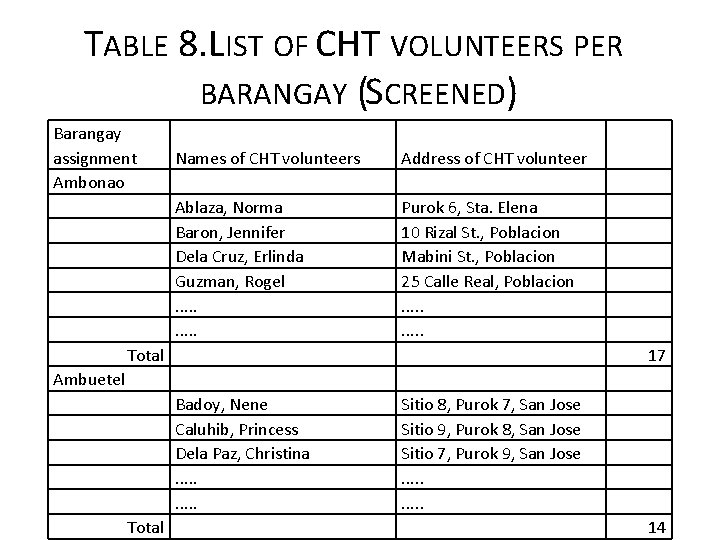
TABLE 8. LIST OF CHT VOLUNTEERS PER BARANGAY (SCREENED) Barangay assignment Ambonao Names of CHT volunteers Address of CHT volunteer Ablaza, Norma Baron, Jennifer Dela Cruz, Erlinda Guzman, Rogel. . Purok 6, Sta. Elena 10 Rizal St. , Poblacion Mabini St. , Poblacion 25 Calle Real, Poblacion. . Total 17 Ambuetel Badoy, Nene Caluhib, Princess Dela Paz, Christina. . Total Sitio 8, Purok 7, San Jose Sitio 9, Purok 8, San Jose Sitio 7, Purok 9, San Jose. . 14
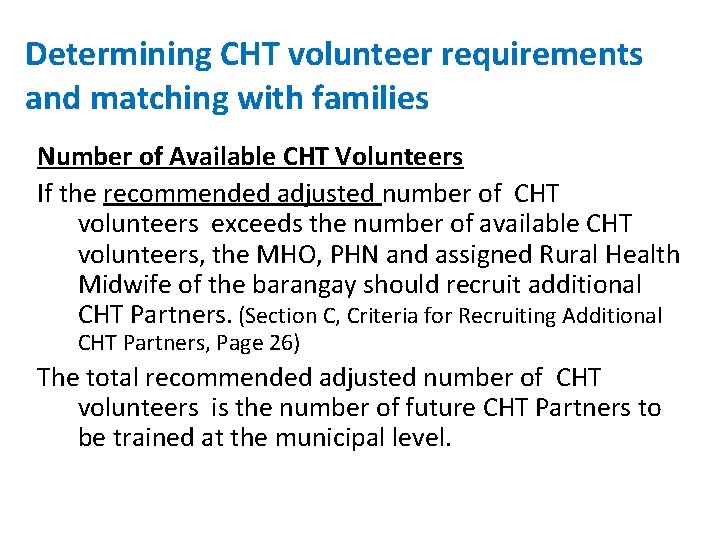
Determining CHT volunteer requirements and matching with families Number of Available CHT Volunteers If the recommended adjusted number of CHT volunteers exceeds the number of available CHT volunteers, the MHO, PHN and assigned Rural Health Midwife of the barangay should recruit additional CHT Partners. (Section C, Criteria for Recruiting Additional CHT Partners, Page 26) The total recommended adjusted number of CHT volunteers is the number of future CHT Partners to be trained at the municipal level.
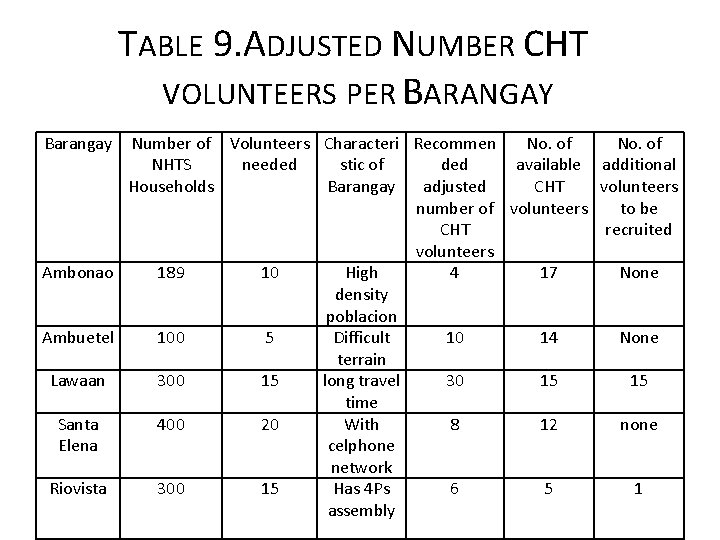
TABLE 9. ADJUSTED NUMBER CHT VOLUNTEERS PER BARANGAY Barangay Number of Volunteers Characteri Recommen No. of NHTS needed stic of ded available additional Households Barangay adjusted CHT volunteers number of volunteers to be CHT recruited volunteers Ambonao 189 10 High 4 17 None density poblacion Ambuetel 100 5 Difficult 10 14 None terrain Lawaan 300 15 long travel 30 15 15 time Santa 400 20 With 8 12 none Elena celphone network Riovista 300 15 Has 4 Ps 6 5 1 assembly
Determining CHT volunteer requirements and matching with families Matching CHT Partners to NHTS families The MHO, with the supervising midwives, should be responsible for matching CHT Partners to NHTS families, and make the necessary assignments and adjustments to ensure that the navigational functions of the CHTs are utilized properly. (Section C, Allocation of Available CHT Partners to Families, Page 27)
Preparing for CHT Mobilization at the Municipal/City Level A. B. C. D. E. Assessing the Local Health Situation Securing Local Support Organizing, Managing and Sustaining CHTs Securing the list of NHTS-PR Families Determining CHT Partner Requirements and Matching with Families F. Preparing the List of Health Providers G. Preparing for the Municipal Level Training of CHT Partners
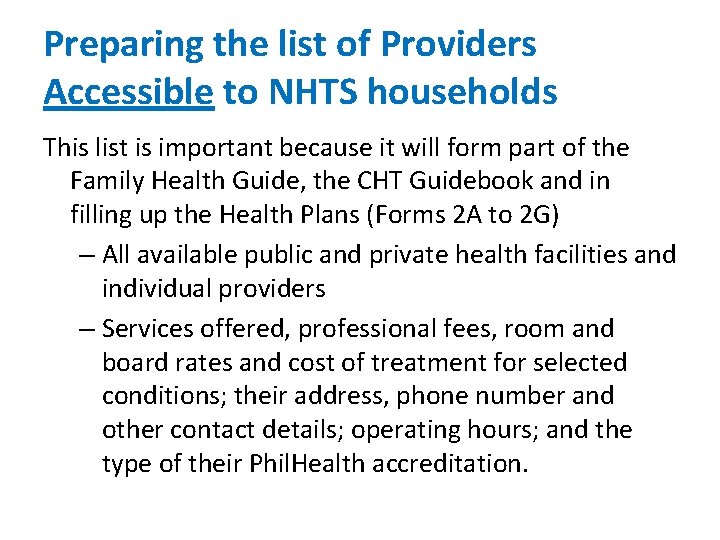
Preparing the list of Providers Accessible to NHTS households This list is important because it will form part of the Family Health Guide, the CHT Guidebook and in filling up the Health Plans (Forms 2 A to 2 G) – All available public and private health facilities and individual providers – Services offered, professional fees, room and board rates and cost of treatment for selected conditions; their address, phone number and other contact details; operating hours; and the type of their Phil. Health accreditation.
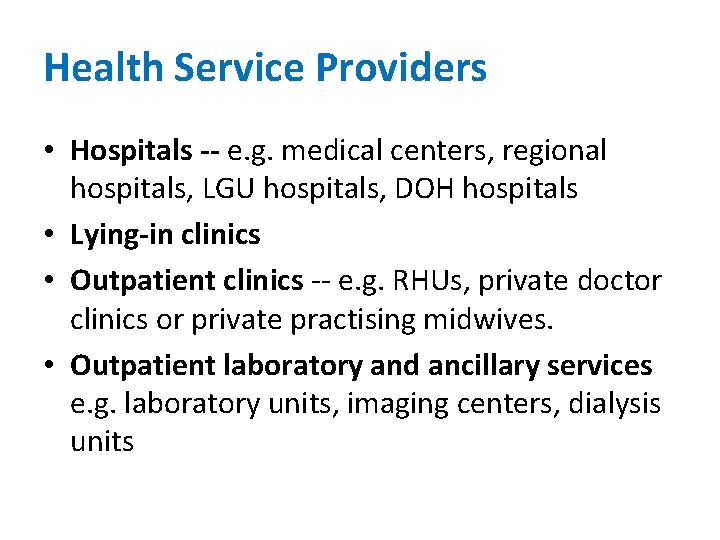
Health Service Providers • Hospitals -- e. g. medical centers, regional hospitals, LGU hospitals, DOH hospitals • Lying-in clinics • Outpatient clinics -- e. g. RHUs, private doctor clinics or private practising midwives. • Outpatient laboratory and ancillary services e. g. laboratory units, imaging centers, dialysis units
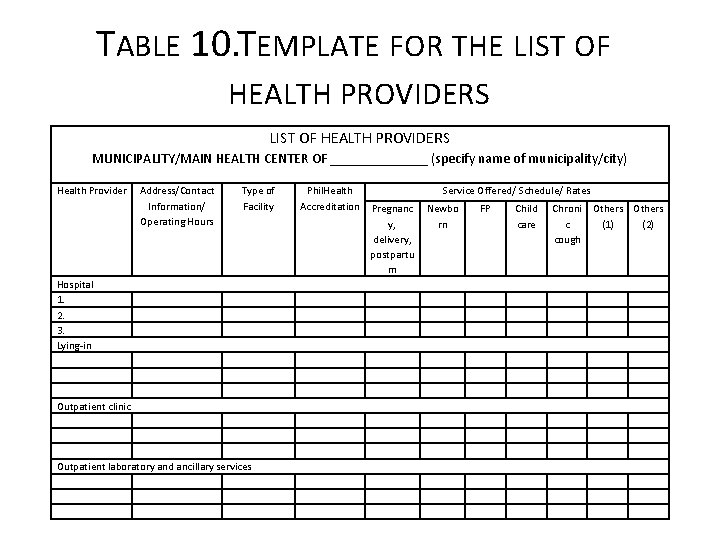
TABLE 10. TEMPLATE FOR THE LIST OF HEALTH PROVIDERS MUNICIPALITY/MAIN HEALTH CENTER OF _______ (specify name of municipality/city) Health Provider Address/Contact Information/ Operating Hours Type of Facility Hospital 1. 2. 3. Lying-in Outpatient clinic Outpatient laboratory and ancillary services Phil. Health Accreditation Service Offered/ Schedule/ Rates Pregnanc y, delivery, postpartu m Newbo rn FP Child care Chroni Others c (1) (2) cough
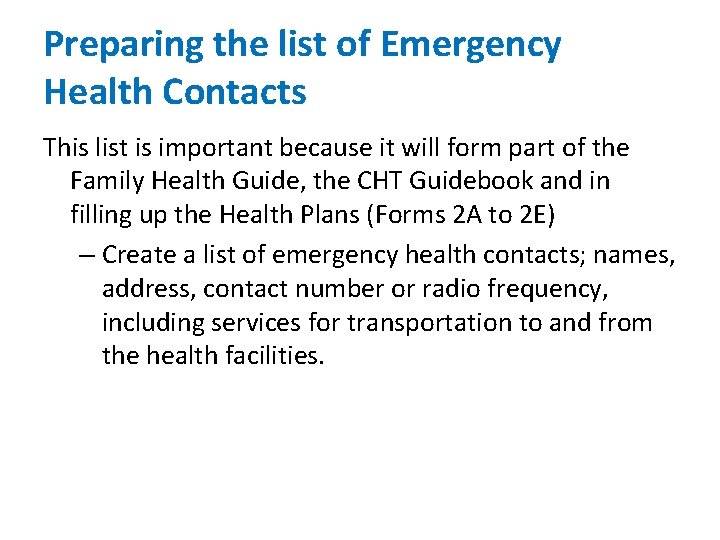
Preparing the list of Emergency Health Contacts This list is important because it will form part of the Family Health Guide, the CHT Guidebook and in filling up the Health Plans (Forms 2 A to 2 E) – Create a list of emergency health contacts; names, address, contact number or radio frequency, including services for transportation to and from the health facilities.
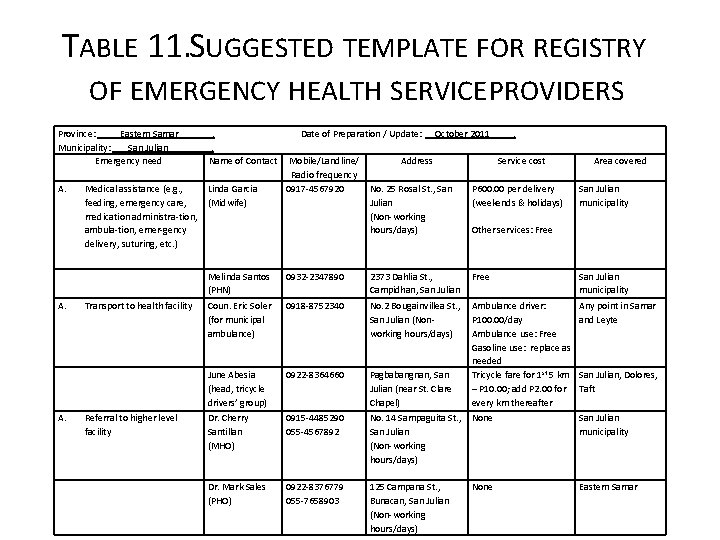
TABLE 11. SUGGESTED TEMPLATE FOR REGISTRY OF EMERGENCY HEALTH SERVICE PROVIDERS Province: Eastern Samar Municipality: San Julian Emergency need . . Name of Contact A. Linda Garcia (Midwife) A. Medical assistance (e. g. , feeding, emergency care, medication administra-tion, ambula-tion, emer-gency delivery, suturing, etc. ) Transport to health facility Referral to higher level facility Date of Preparation / Update: Mobile/Landline/ Radio frequency 0917 -4567920 October 2011 Address . Service cost No. 25 Rosal St. , San Julian (Non-working hours/days) P 600. 00 per delivery (weekends & holidays) Area covered San Julian municipality Other services: Free Melinda Santos (PHN) 0932 -2347890 2373 Dahlia St. , Campidhan, San Julian Free San Julian municipality Coun. Eric Soler (for municipal ambulance) 0918 -8752340 No. 2 Bougainvillea St. , San Julian (Nonworking hours/days) Any point in Samar and Leyte June Abesia (head, tricycle drivers’ group) 0922 -8364660 Pagbabangnan, San Julian (near St. Clare Chapel) Ambulance driver: P 100. 00/day Ambulance use: Free Gasoline use: replace as needed Tricycle fare for 1 st 5 km – P 10. 00; add P 2. 00 for every km thereafter Dr. Cherry Santillan (MHO) 0915 -4485290 055 -4567892 No. 14 Sampaguita St. , San Julian (Non-working hours/days) None San Julian municipality Dr. Mark Sales (PHO) 0922 -8376779 055 -7658903 125 Campana St. , Bunacan, San Julian (Non-working hours/days) None Eastern Samar San Julian, Dolores, Taft
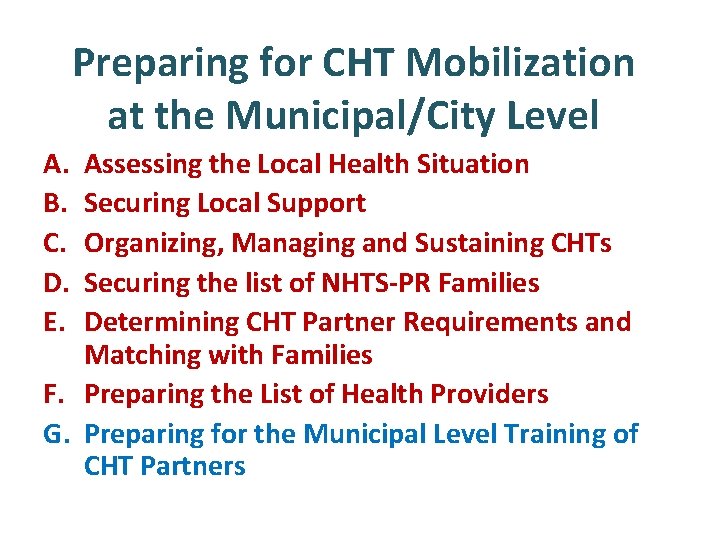
Preparing for CHT Mobilization at the Municipal/City Level A. B. C. D. E. Assessing the Local Health Situation Securing Local Support Organizing, Managing and Sustaining CHTs Securing the list of NHTS-PR Families Determining CHT Partner Requirements and Matching with Families F. Preparing the List of Health Providers G. Preparing for the Municipal Level Training of CHT Partners
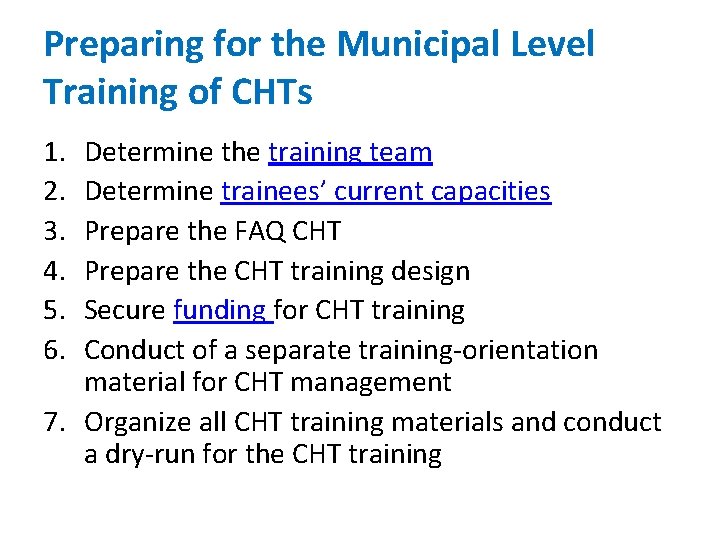
Preparing for the Municipal Level Training of CHTs 1. 2. 3. 4. 5. 6. Determine the training team Determine trainees’ current capacities Prepare the FAQ CHT Prepare the CHT training design Secure funding for CHT training Conduct of a separate training-orientation material for CHT management 7. Organize all CHT training materials and conduct a dry-run for the CHT training
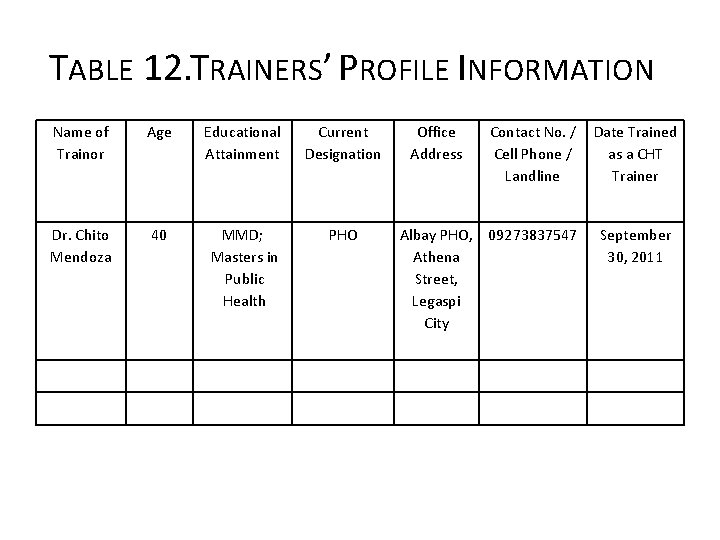
TABLE 12. TRAINERS’ PROFILE INFORMATION Name of Trainor Age Educational Attainment Current Designation Dr. Chito Mendoza 40 MMD; Masters in Public Health PHO Office Address Contact No. / Cell Phone / Landline Albay PHO, 09273837547 Athena Street, Legaspi City Date Trained as a CHT Trainer September 30, 2011
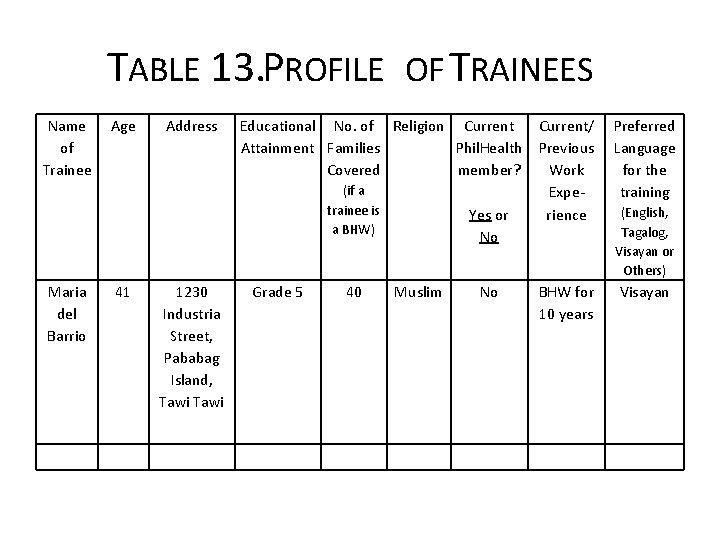
TABLE 13. PROFILE OF TRAINEES Name of Trainee Maria del Barrio Age 41 Address 1230 Industria Street, Pababag Island, Tawi Educational No. of Religion Current/ Attainment Families Phil. Health Previous Covered member? Work (if a Expetrainee is Yes or rience a BHW) No Grade 5 40 Muslim No BHW for 10 years Preferred Language for the training (English, Tagalog, Visayan or Others) Visayan

THANKS!!!
- Slides: 44