
MHMT 13 Momentum Heat Mass Transfer Heat transferradiation
- Slides: 19
MHMT 13 Momentum Heat Mass Transfer Heat transfer-radiation Radiation heat transfer. Boltzmann, Kirchhoff, Lambert’s laws. Radiation exchange between surfaces and in absorbed gases. Rudolf Žitný, Ústav procesní a zpracovatelské techniky ČVUT FS 2010
MHMT 13 Radiation Thermal radiation are electromagnetic waves with wavelengths from 0. 1 to about 10 m (these waves are described by Maxwell equations for electric E and magnetic H field intensity). The radiation can be alternatively represented by discrete massless particles, photons, having energy h (proportional to frequency ) and moving in different directions with the speed of light (3. 108 m/s) in vacuum. It is not possible to find out precise analogy with the heat and momentum transfer, because photons are massless particles colliding with molecules (atoms) but not between themselves. Thus it is difficult to define viscosity, diffusion coefficients etc.
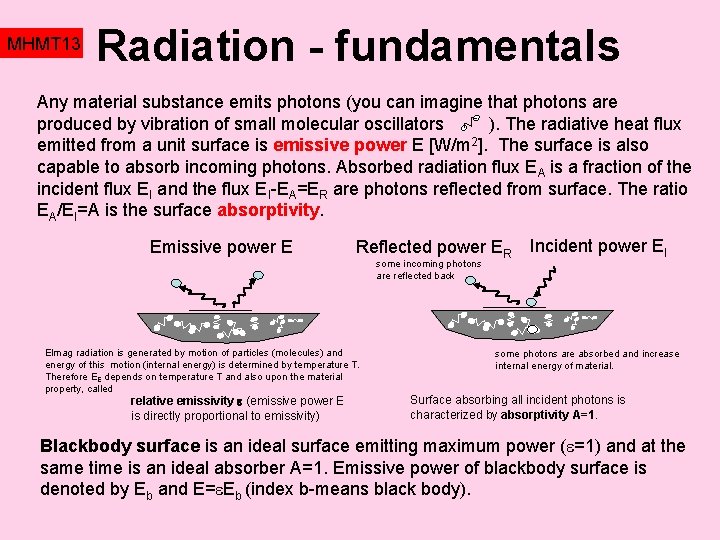
MHMT 13 Radiation - fundamentals Any material substance emits photons (you can imagine that photons are produced by vibration of small molecular oscillators ). The radiative heat flux emitted from a unit surface is emissive power E [W/m 2]. The surface is also capable to absorb incoming photons. Absorbed radiation flux EA is a fraction of the incident flux EI and the flux EI-EA=ER are photons reflected from surface. The ratio EA/EI=A is the surface absorptivity. Emissive power E Reflected power ER some incoming photons are reflected back Elmag radiation is generated by motion of particles (molecules) and energy of this motion (internal energy) is determined by temperature T. Therefore EE depends on temperature T and also upon the material property, called relative emissivity (emissive power E is directly proportional to emissivity) Incident power EI some photons are absorbed and increase internal energy of material. Surface absorbing all incident photons is characterized by absorptivity A=1. Blackbody surface is an ideal surface emitting maximum power ( =1) and at the same time is an ideal absorber A=1. Emissive power of blackbody surface is denoted by Eb and E= Eb (index b-means black body).
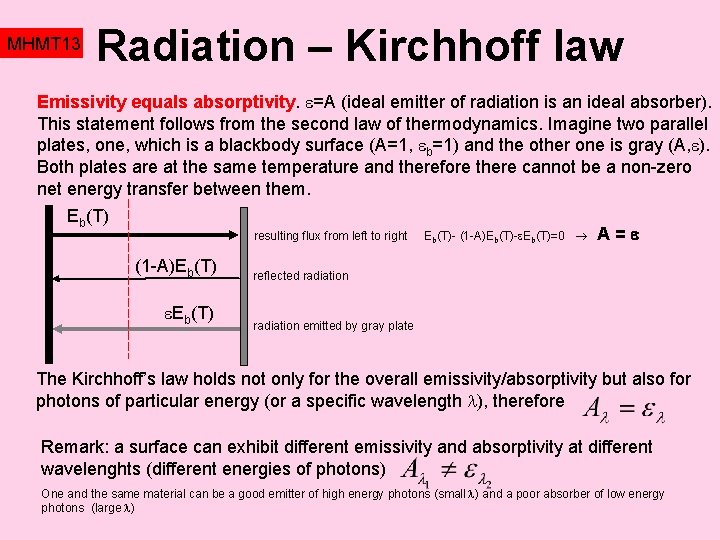
MHMT 13 Radiation – Kirchhoff law Emissivity equals absorptivity. =A (ideal emitter of radiation is an ideal absorber). This statement follows from the second law of thermodynamics. Imagine two parallel plates, one, which is a blackbody surface (A=1, b=1) and the other one is gray (A, ). Both plates are at the same temperature and therefore there cannot be a non-zero net energy transfer between them. Eb(T) resulting flux from left to right (1 -A)Eb(T)- (1 -A)Eb(T)- Eb(T)=0 A= reflected radiation emitted by gray plate The Kirchhoff’s law holds not only for the overall emissivity/absorptivity but also for photons of particular energy (or a specific wavelength ), therefore Remark: a surface can exhibit different emissivity and absorptivity at different wavelenghts (different energies of photons) One and the same material can be a good emitter of high energy photons (small ) and a poor absorber of low energy photons (large )
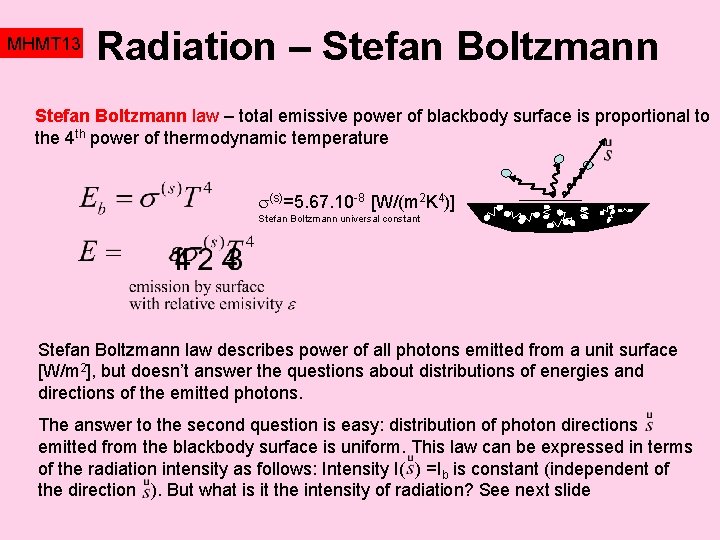
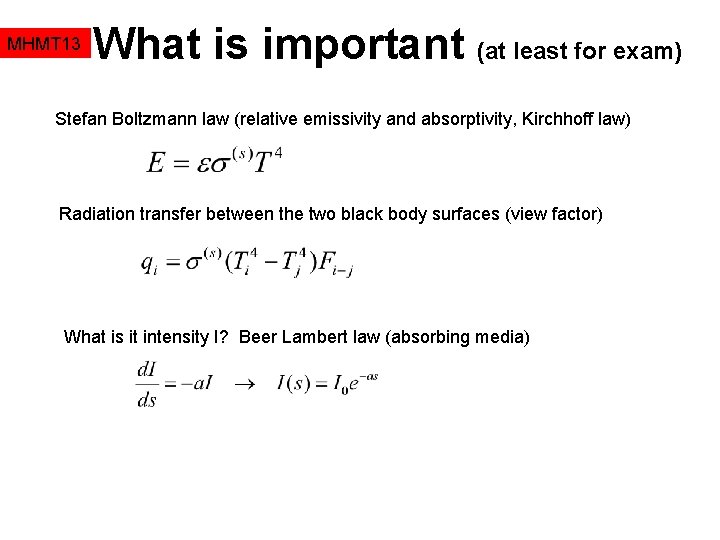
MHMT 13 Radiation – Stefan Boltzmann law – total emissive power of blackbody surface is proportional to the 4 th power of thermodynamic temperature (s)=5. 67. 10 -8 [W/(m 2 K 4)] Stefan Boltzmann universal constant Stefan Boltzmann law describes power of all photons emitted from a unit surface [W/m 2], but doesn’t answer the questions about distributions of energies and directions of the emitted photons. The answer to the second question is easy: distribution of photon directions emitted from the blackbody surface is uniform. This law can be expressed in terms of the radiation intensity as follows: Intensity I( ) =Ib is constant (independent of the direction ). But what is it the intensity of radiation? See next slide
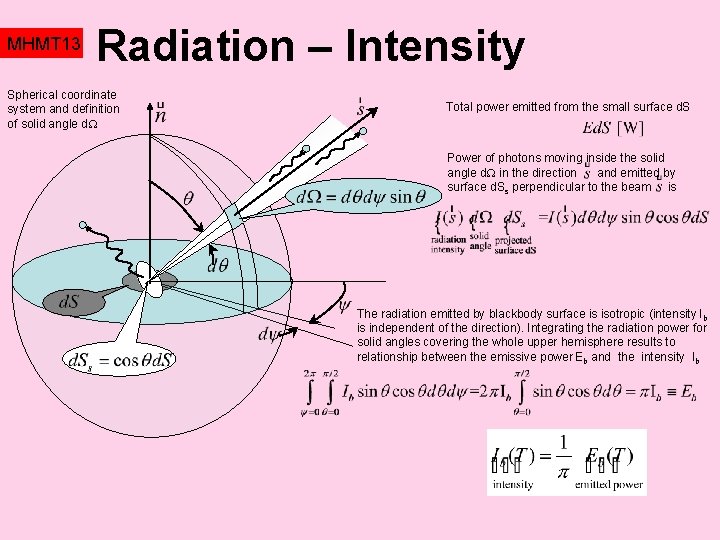
MHMT 13 Radiation – Intensity Spherical coordinate system and definition of solid angle d Total power emitted from the small surface d. S Power of photons moving inside the solid angle d in the direction and emitted by surface d. Ss perpendicular to the beam is The radiation emitted by blackbody surface is isotropic (intensity Ib is independent of the direction). Integrating the radiation power for solid angles covering the whole upper hemisphere results to relationship between the emissive power Eb and the intensity Ib
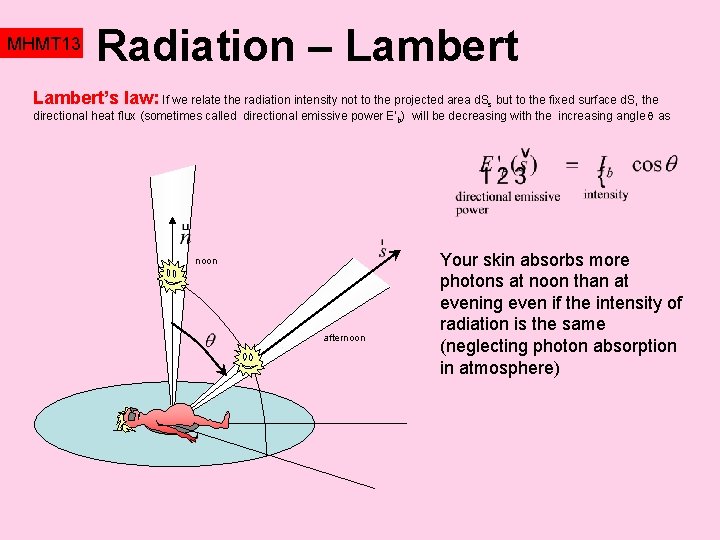
MHMT 13 Radiation – Lambert’s law: If we relate the radiation intensity not to the projected area d. Ss but to the fixed surface d. S, the directional heat flux (sometimes called directional emissive power E’b) will be decreasing with the increasing angle as noon afternoon Your skin absorbs more photons at noon than at evening even if the intensity of radiation is the same (neglecting photon absorption in atmosphere)
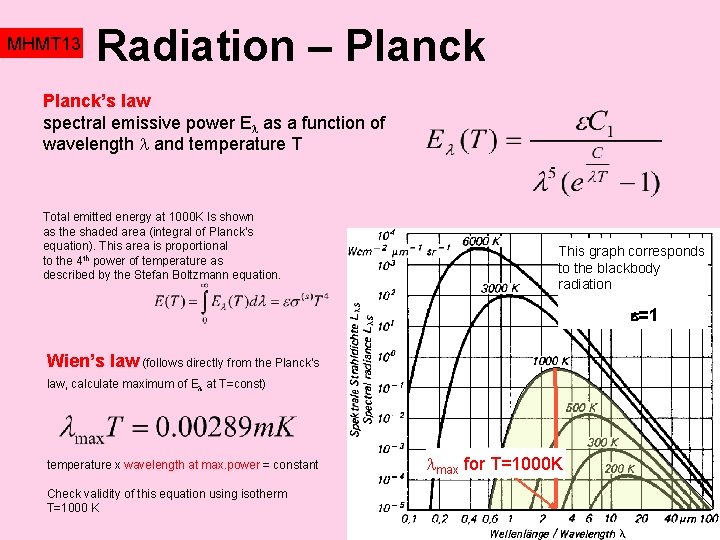
MHMT 13 Radiation – Planck’s law spectral emissive power E as a function of wavelength and temperature T Total emitted energy at 1000 K Is shown as the shaded area (integral of Planck’s equation). This area is proportional to the 4 th power of temperature as described by the Stefan Boltzmann equation. This graph corresponds to the blackbody radiation =1 Wien’s law (follows directly from the Planck’s law, calculate maximum of E at T=const) temperature x wavelength at max. power = constant Check validity of this equation using isotherm T=1000 K max for T=1000 K
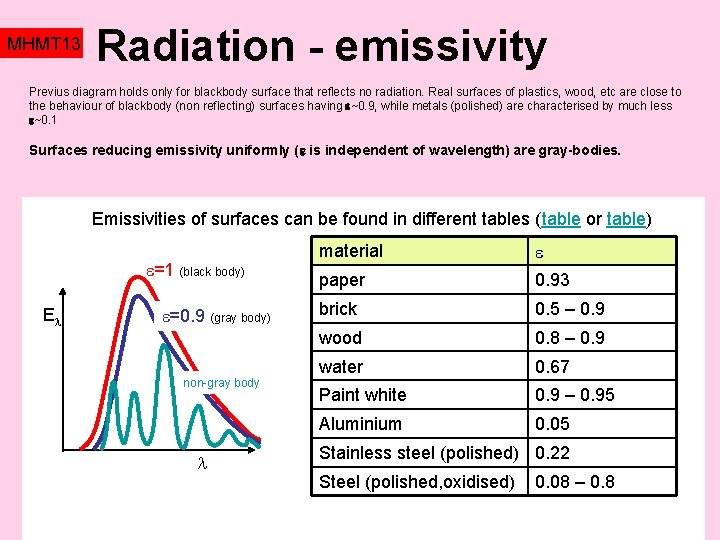
MHMT 13 Radiation - emissivity Previus diagram holds only for blackbody surface that reflects no radiation. Real surfaces of plastics, wood, etc are close to the behaviour of blackbody (non reflecting) surfaces having ~0. 9, while metals (polished) are characterised by much less ~0. 1 Surfaces reducing emissivity uniformly ( is independent of wavelength) are gray-bodies. Emissivities of surfaces can be found in different tables (table or table) =1 (black body) E =0. 9 (gray body) non-gray body material paper 0. 93 brick 0. 5 – 0. 9 wood 0. 8 – 0. 9 water 0. 67 Paint white 0. 9 – 0. 95 Aluminium 0. 05 Stainless steel (polished) 0. 22 Steel (polished, oxidised) 0. 08 – 0. 8
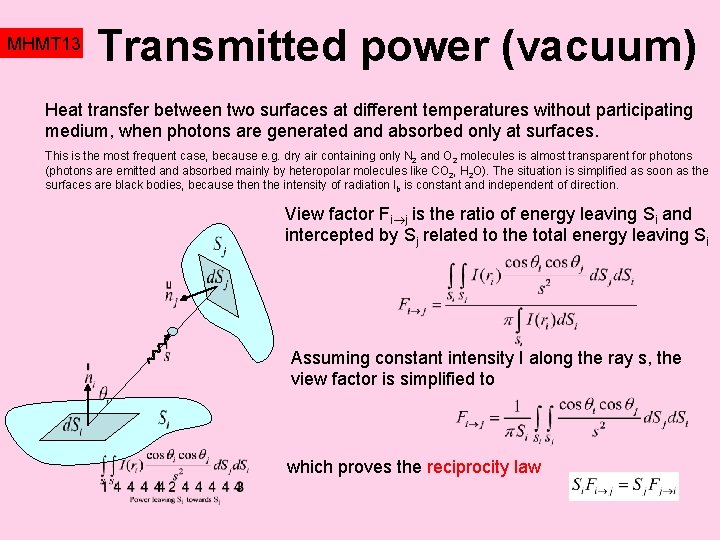
MHMT 13 Transmitted power (vacuum) Heat transfer between two surfaces at different temperatures without participating medium, when photons are generated and absorbed only at surfaces. This is the most frequent case, because e. g. dry air containing only N 2 and O 2 molecules is almost transparent for photons (photons are emitted and absorbed mainly by heteropolar molecules like CO 2, H 2 O). The situation is simplified as soon as the surfaces are black bodies, because then the intensity of radiation Ib is constant and independent of direction. View factor Fi j is the ratio of energy leaving Si and intercepted by Sj related to the total energy leaving Si Assuming constant intensity I along the ray s, the view factor is simplified to which proves the reciprocity law
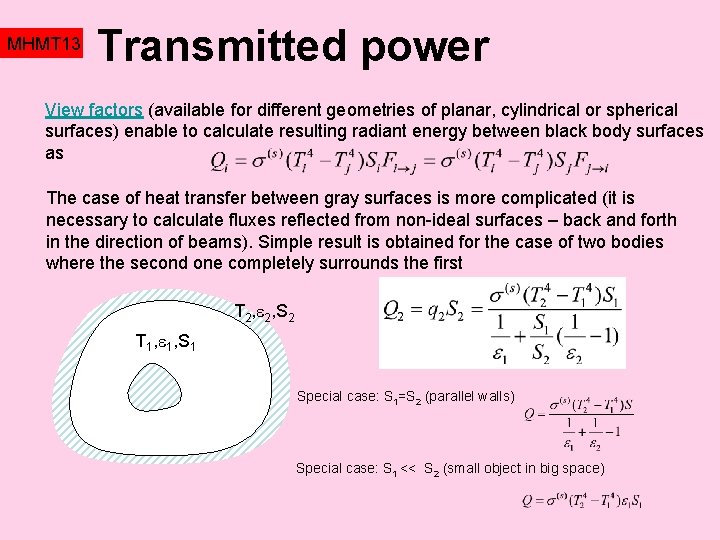
MHMT 13 Transmitted power View factors (available for different geometries of planar, cylindrical or spherical surfaces) enable to calculate resulting radiant energy between black body surfaces as The case of heat transfer between gray surfaces is more complicated (it is necessary to calculate fluxes reflected from non-ideal surfaces – back and forth in the direction of beams). Simple result is obtained for the case of two bodies where the second one completely surrounds the first T 2, 2, S 2 T 1, 1, S 1 Special case: S 1=S 2 (parallel walls) Special case: S 1 << S 2 (small object in big space)
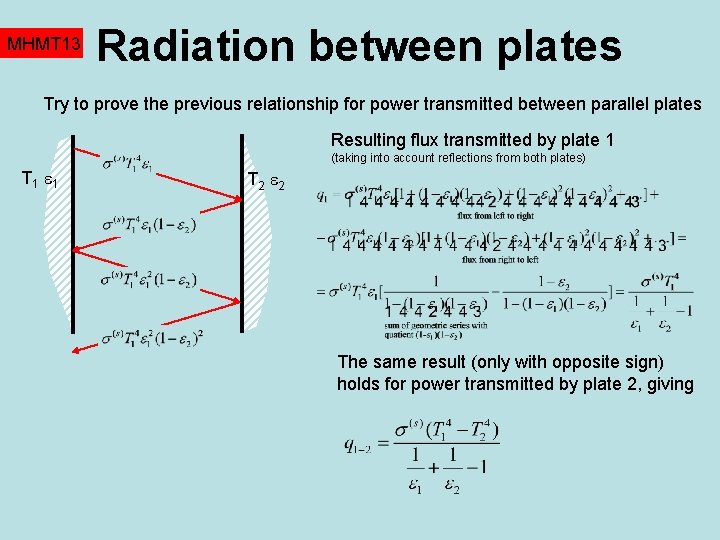
MHMT 13 Radiation between plates Try to prove the previous relationship for power transmitted between parallel plates Resulting flux transmitted by plate 1 (taking into account reflections from both plates) T 1 1 T 2 2 The same result (only with opposite sign) holds for power transmitted by plate 2, giving
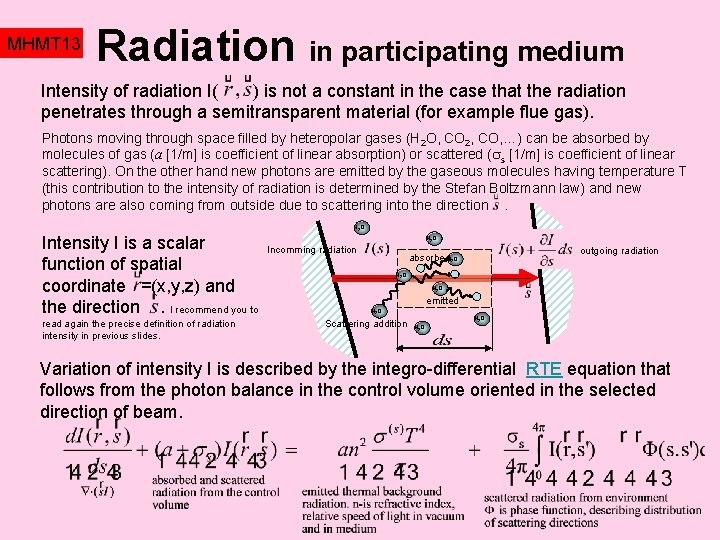
MHMT 13 Radiation in participating medium Intensity of radiation I( ) is not a constant in the case that the radiation penetrates through a semitransparent material (for example flue gas). Photons moving through space filled by heteropolar gases (H 2 O, CO 2, CO, …) can be absorbed by molecules of gas (a [1/m] is coefficient of linear absorption) or scattered ( s [1/m] is coefficient of linear scattering). On the other hand new photons are emitted by the gaseous molecules having temperature T (this contribution to the intensity of radiation is determined by the Stefan Boltzmann law) and new photons are also coming from outside due to scattering into the direction. H 2 O Intensity I is a scalar function of spatial coordinate =(x, y, z) and the direction. I recommend you to read again the precise definition of radiation intensity in previous slides. H 2 O Incomming radiation outgoing radiation absorbed. H O 2 H 2 O emitted H 2 O Scattering addition H 2 O Variation of intensity I is described by the integro-differential RTE equation that follows from the photon balance in the control volume oriented in the selected direction of beam.
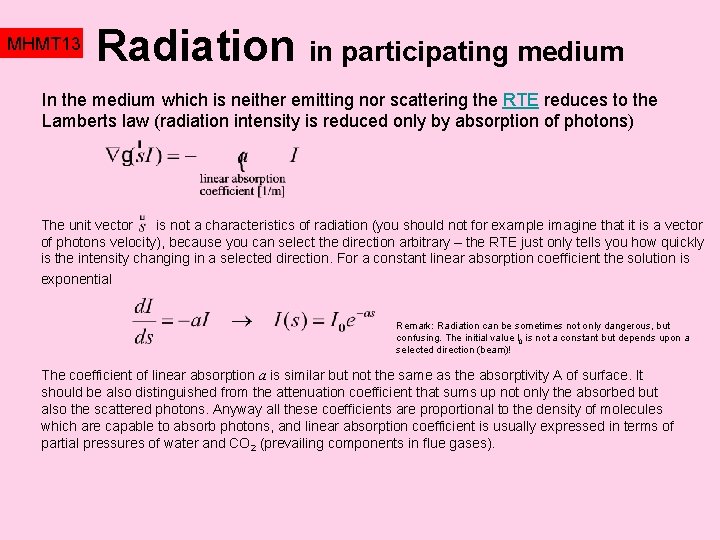
MHMT 13 Radiation in participating medium In the medium which is neither emitting nor scattering the RTE reduces to the Lamberts law (radiation intensity is reduced only by absorption of photons) The unit vector is not a characteristics of radiation (you should not for example imagine that it is a vector of photons velocity), because you can select the direction arbitrary – the RTE just only tells you how quickly is the intensity changing in a selected direction. For a constant linear absorption coefficient the solution is exponential Remark: Radiation can be sometimes not only dangerous, but confusing. The initial value I 0 is not a constant but depends upon a selected direction (beam)! The coefficient of linear absorption a is similar but not the same as the absorptivity A of surface. It should be also distinguished from the attenuation coefficient that sums up not only the absorbed but also the scattered photons. Anyway all these coefficients are proportional to the density of molecules which are capable to absorb photons, and linear absorption coefficient is usually expressed in terms of partial pressures of water and CO 2 (prevailing components in flue gases).
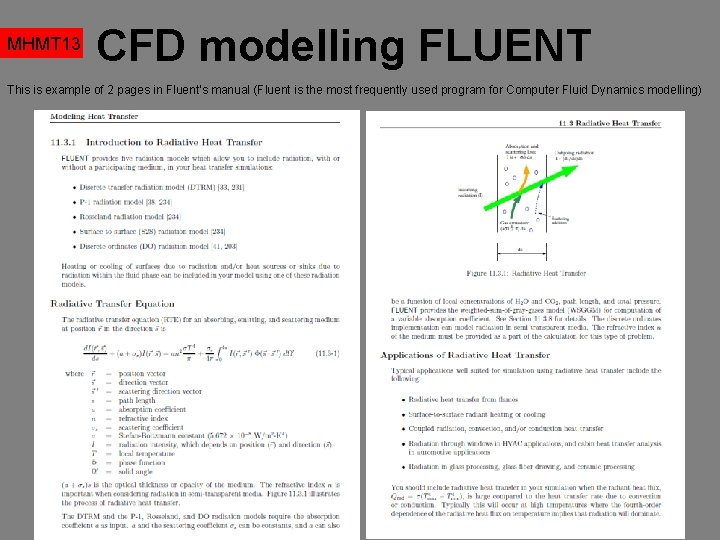
MHMT 13 CFD modelling FLUENT This is example of 2 pages in Fluent’s manual (Fluent is the most frequently used program for Computer Fluid Dynamics modelling)
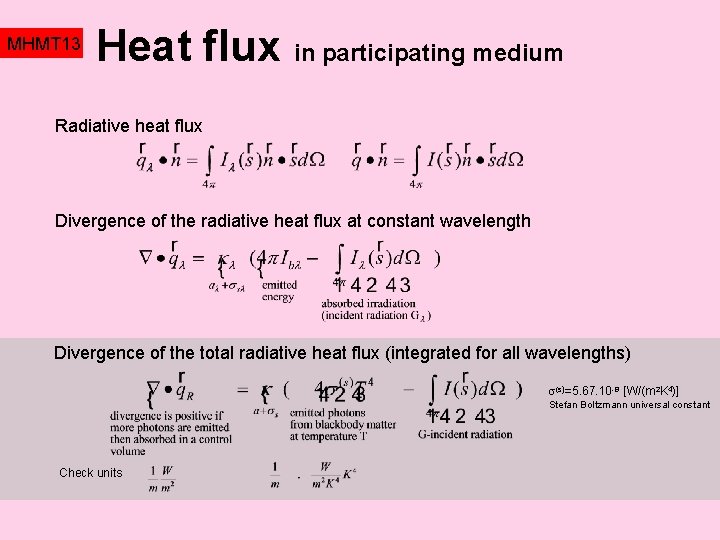
MHMT 13 Heat flux in participating medium Radiative heat flux Divergence of the radiative heat flux at constant wavelength Divergence of the total radiative heat flux (integrated for all wavelengths) (s)=5. 67. 10 -8 [W/(m 2 K 4)] Stefan Boltzmann universal constant Check units
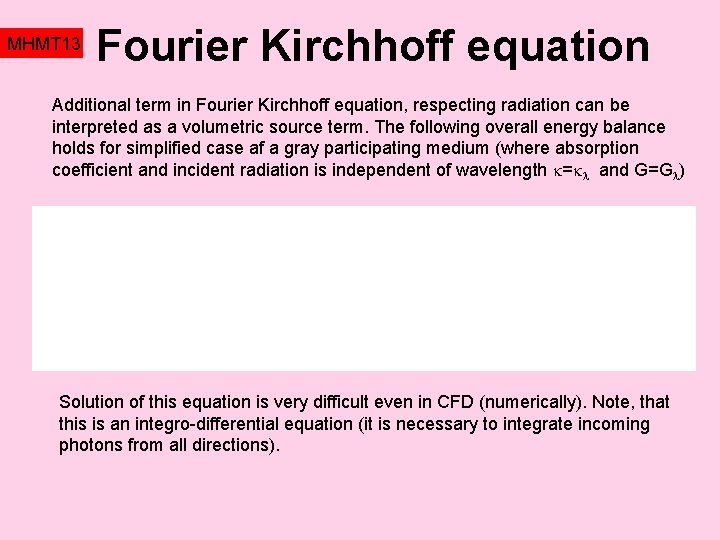
MHMT 13 Fourier Kirchhoff equation Additional term in Fourier Kirchhoff equation, respecting radiation can be interpreted as a volumetric source term. The following overall energy balance holds for simplified case af a gray participating medium (where absorption coefficient and incident radiation is independent of wavelength = and G=G ) Solution of this equation is very difficult even in CFD (numerically). Note, that this is an integro-differential equation (it is necessary to integrate incoming photons from all directions).
MHMT 13 EXAM Radiation
MHMT 13 What is important (at least for exam) Stefan Boltzmann law (relative emissivity and absorptivity, Kirchhoff law) Radiation transfer between the two black body surfaces (view factor) What is it intensity I? Beer Lambert law (absorbing media)