
MHD simulation Astrophysical Journal Simulation MHD Simulation AbstractKeywords
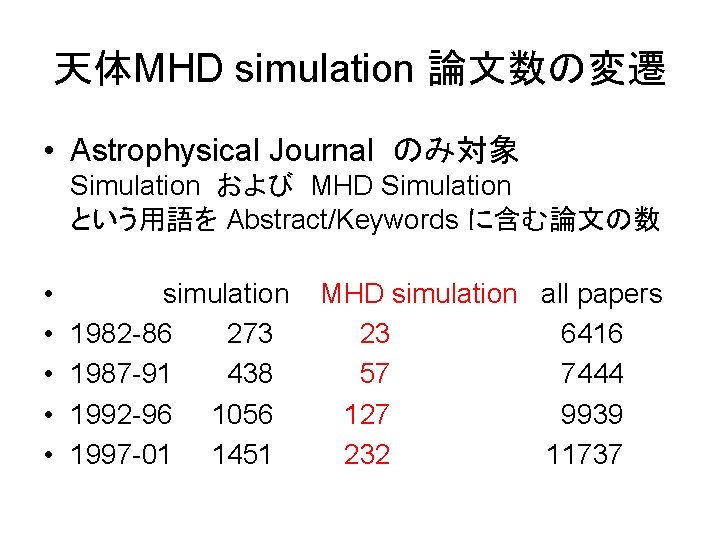
天体MHD simulation 論文数の変遷 • Astrophysical Journal のみ対象 Simulation および MHD Simulation という用語を Abstract/Keywords に含む論文の数 • • • simulation 1982 -86 273 1987 -91 438 1992 -96 1056 1997 -01 1451 MHD simulation all papers 23 6416 57 7444 127 9939 232 11737
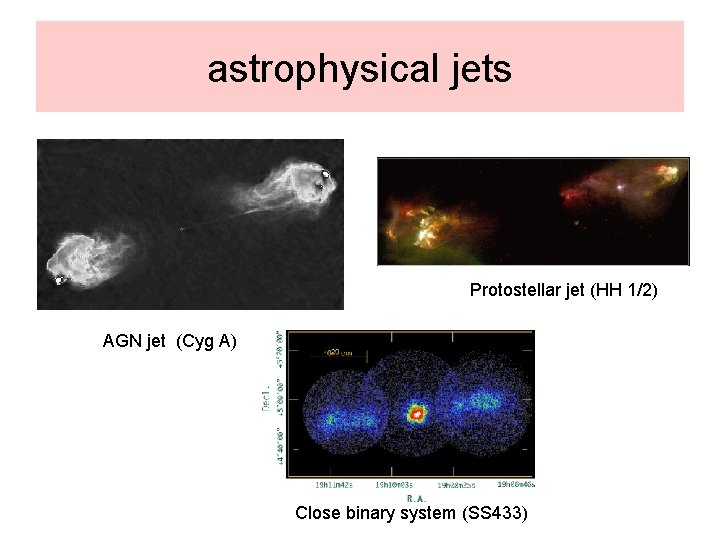
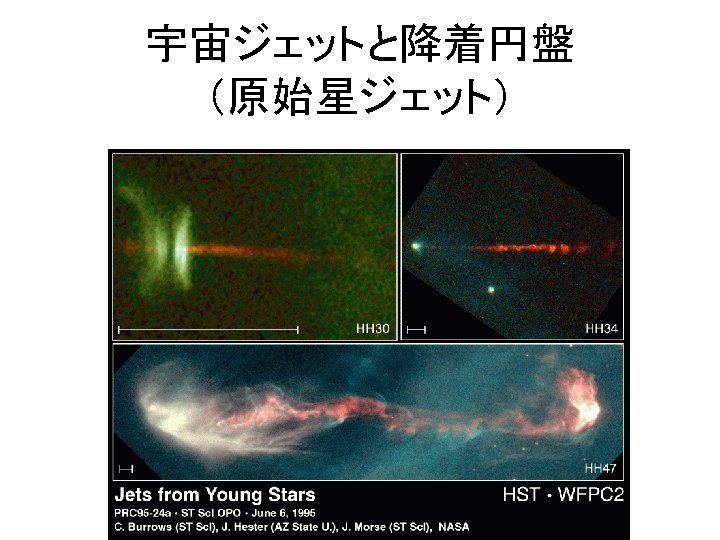
astrophysical jets Protostellar jet (HH 1/2) AGN jet (Cyg A) Close binary system (SS 433)
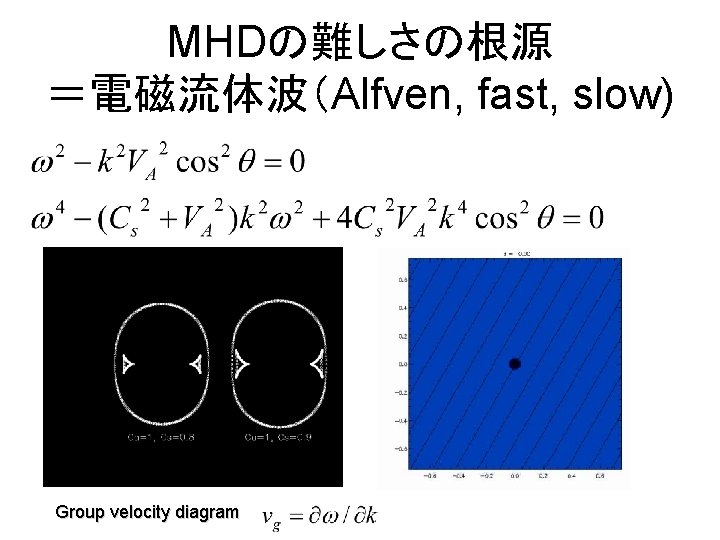
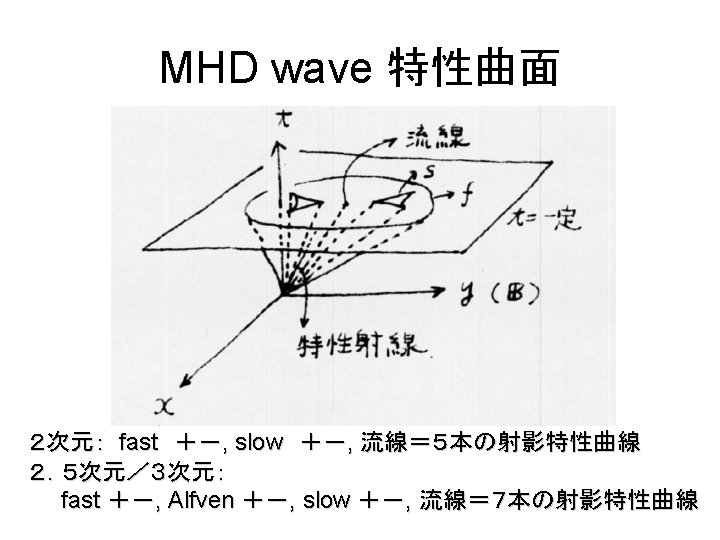
MHDの難しさの根源 =電磁流体波(Alfven, fast, slow) Group velocity diagram
Difficulties in Numerical Astrophysical MHD • • Why difficult ? because there is gravity (self-gravity, external gravity) 1. Large dynamic range in density, gas pressure, and Alfven speed 2. Wave amplification through vertical propagation 3. Various instabilities driven by gravitational energy – Boundary condition is most difficult
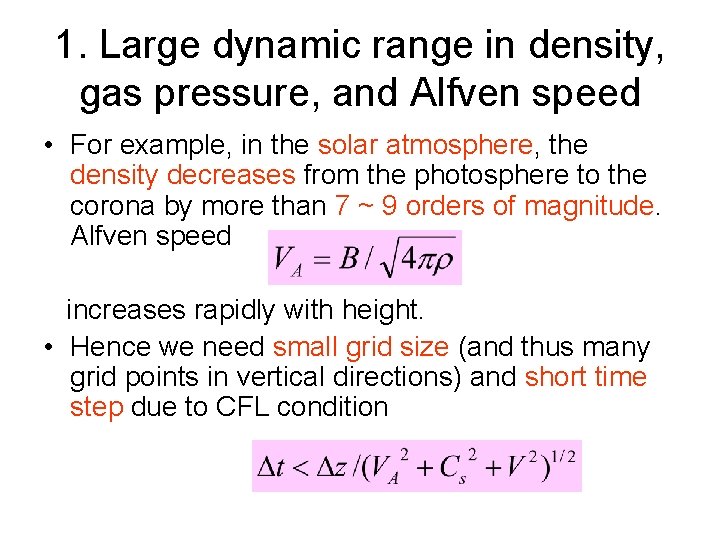
1. Large dynamic range in density, gas pressure, and Alfven speed • For example, in the solar atmosphere, the density decreases from the photosphere to the corona by more than 7 ~ 9 orders of magnitude. Alfven speed increases rapidly with height. • Hence we need small grid size (and thus many grid points in vertical directions) and short time step due to CFL condition
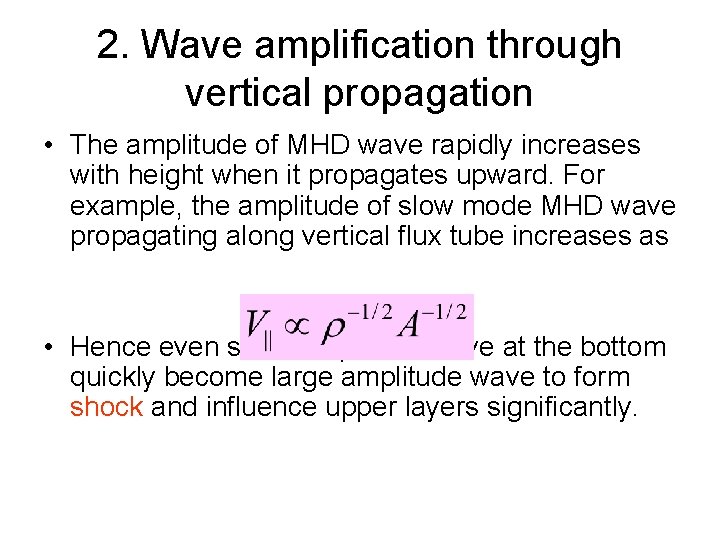
2. Wave amplification through vertical propagation • The amplitude of MHD wave rapidly increases with height when it propagates upward. For example, the amplitude of slow mode MHD wave propagating along vertical flux tube increases as • Hence even small amplitude wave at the bottom quickly become large amplitude wave to form shock and influence upper layers significantly.
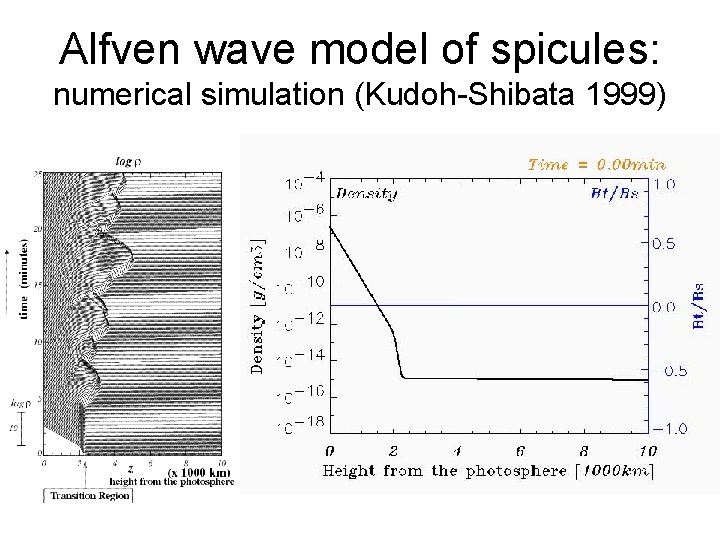
Alfven wave model of spicules: numerical simulation (Kudoh-Shibata 1999)
3. Various instabilities driven by gravitational energy • Various instabilities occur in a gravitationally stratified gas layer, e. g. , – convective instability, Rayleigh-Taylor instability, Magnetic buoyancy instability, Parker instability, etc • These instabilities generate MHD waves and electric currents, which are the source of energy to heat the corona and flares.
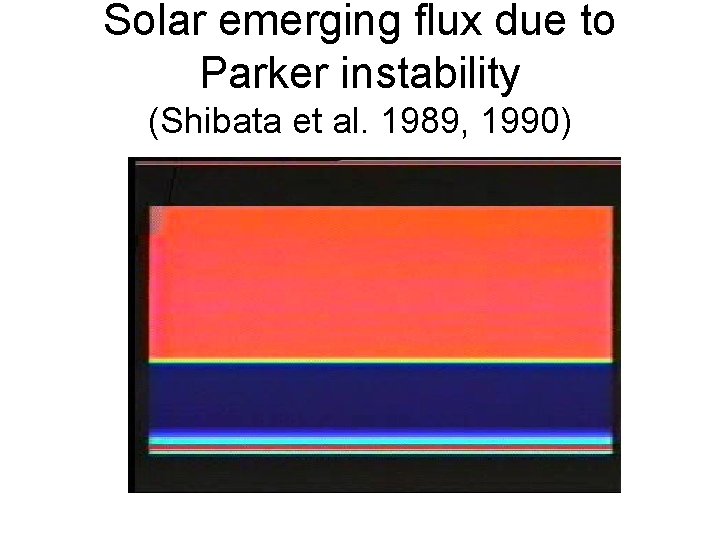
Solar emerging flux due to Parker instability (Shibata et al. 1989, 1990)
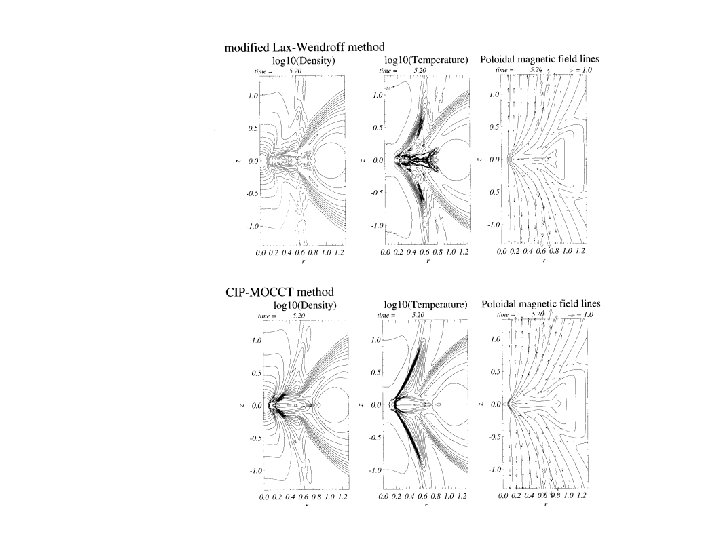
3. Numerical method • Main Newtonian MHD codes in our group – modified Lax-Wendroff code (originally developed in 1978 by myself, and refined and extended by Dr. Matsumoto, Dr. Yokoyama) simple, fast, applicable to many MHD problems, but often unstable and suffers from various numerical errors – CIP-MOCCT code (developed in 1995 by Dr. Kudoh) • Note: Higher order Godunov scheme is becoming popular even in MHD code (Balsara, Ryu, Hanawa, Sano&Inutsuka, , )
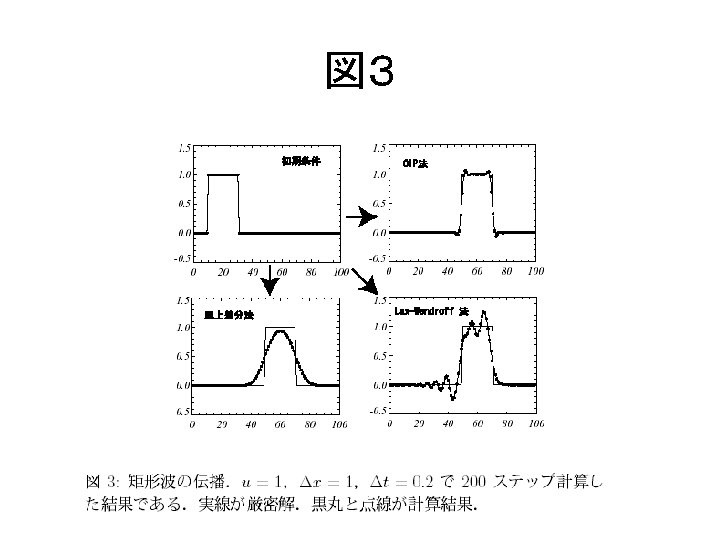
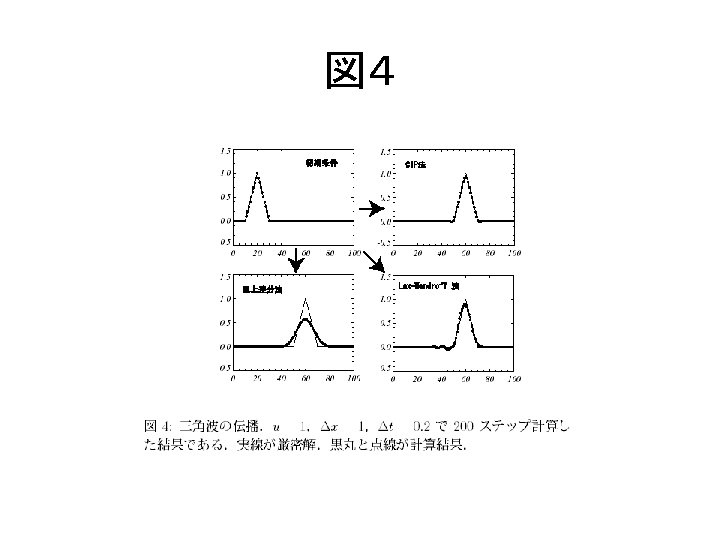
CIP scheme • A universal solver for hyperbolic equations by CIP(Cubic Interpolated Pseudoparticle/Propagation) • Developed by Prof. T. Yabe (Tokyo Institute of Technology) – Yabe and Aoki (1991) Computer Physics Communications, 66, 219 -232 • Good at handling contact discontinuity • Can treat all kind of matter (gas, fluid, solid) simultaneously • Can also be applied to Vlasov equation See Ogata’s poster
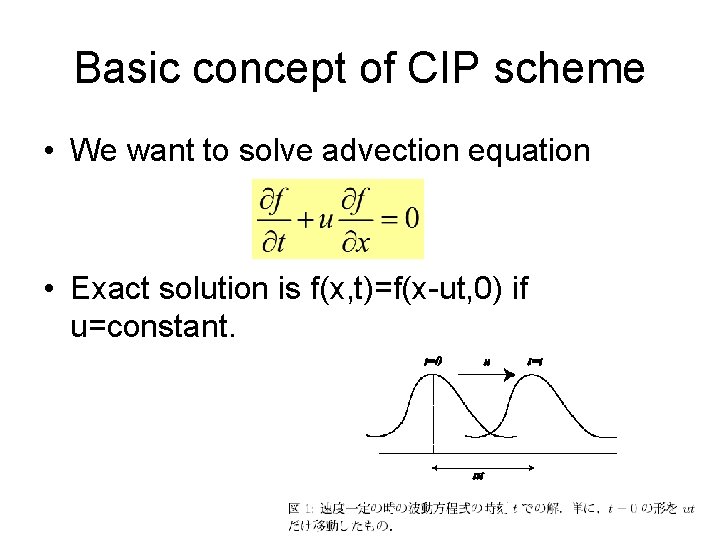
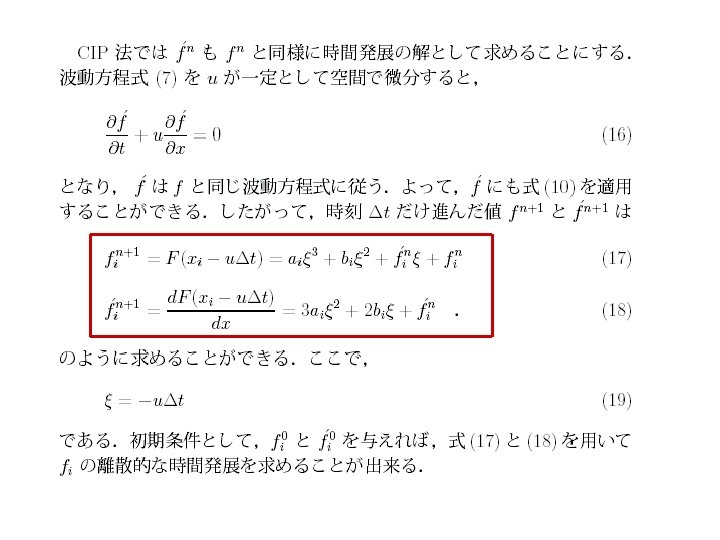
Basic concept of CIP scheme • We want to solve advection equation • Exact solution is f(x, t)=f(x-ut, 0) if u=constant.
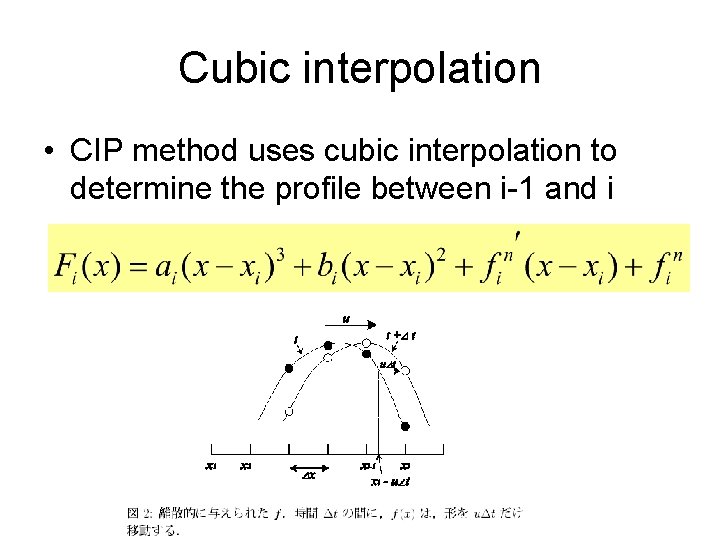
Cubic interpolation • CIP method uses cubic interpolation to determine the profile between i-1 and i
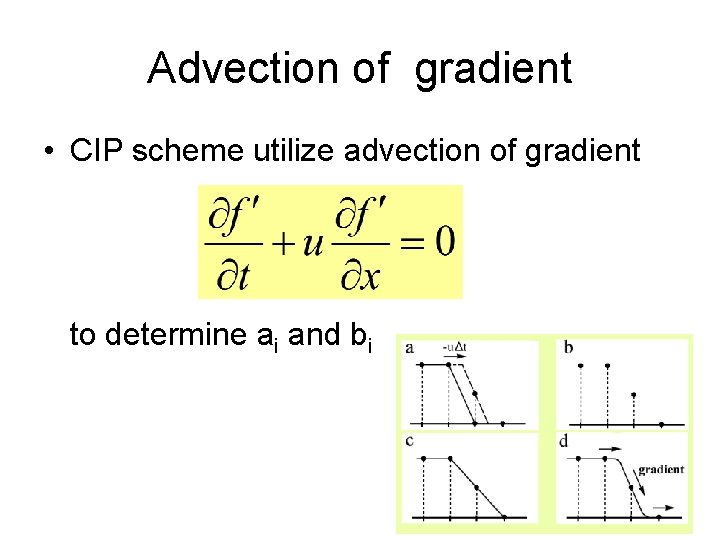
Advection of gradient • CIP scheme utilize advection of gradient to determine ai and bi
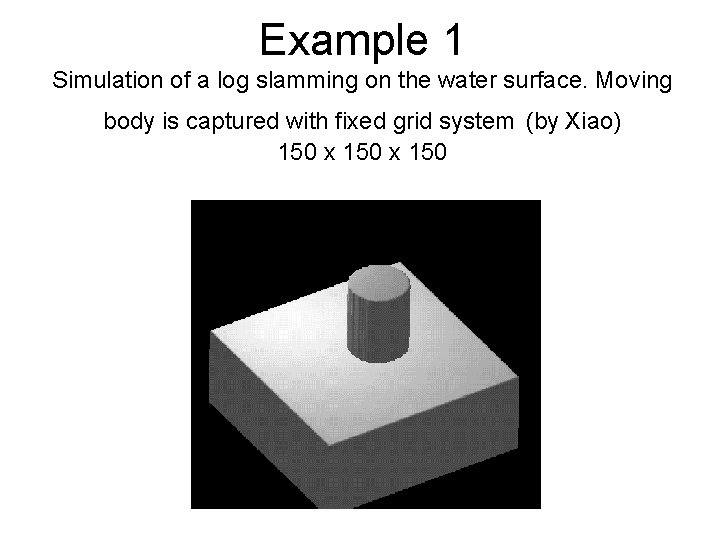
Example 1 Simulation of a log slamming on the water surface. Moving body is captured with fixed grid system (by Xiao) 150 x 150
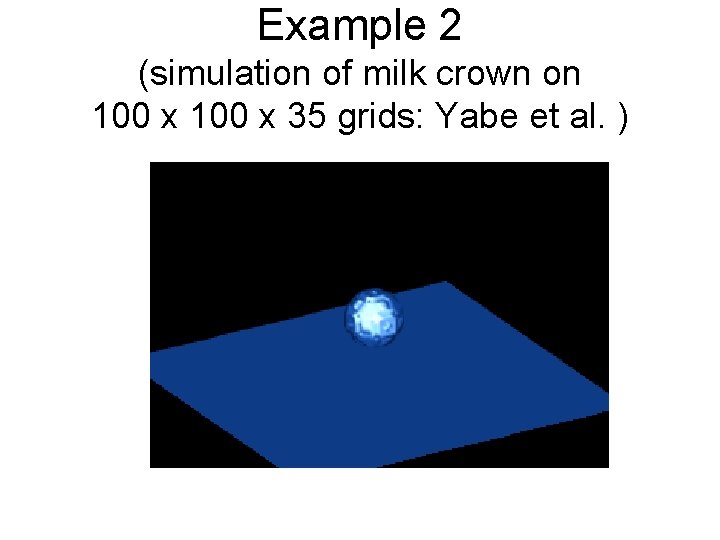
Example 2 (simulation of milk crown on 100 x 35 grids: Yabe et al. )
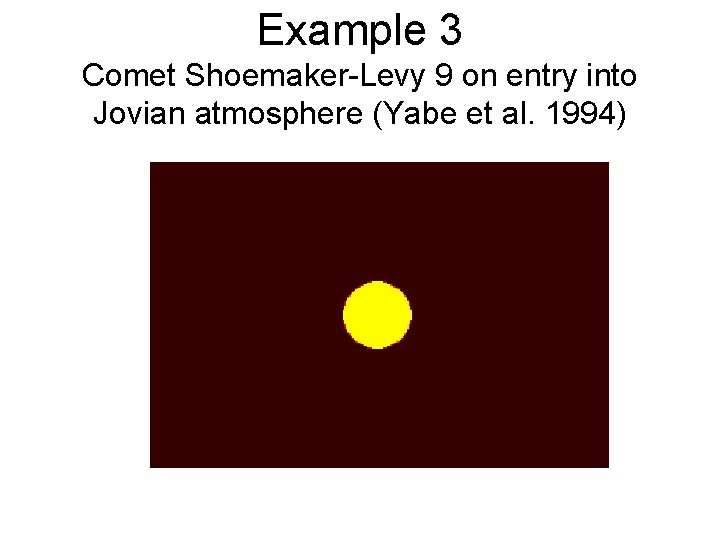
Example 3 Comet Shoemaker-Levy 9 on entry into Jovian atmosphere (Yabe et al. 1994)
CIP-MOCCT scheme • Developed by Kudoh, Matsumoto, Shibata (1999) Computational Fluid Dynamics Journal 8, 56 -68 • For astrophysical MHD problems • Fluid part => CIP scheme • Magnetic field part => MOCCT scheme (Stone and Norman 1992, Evans and Hawley 1988)
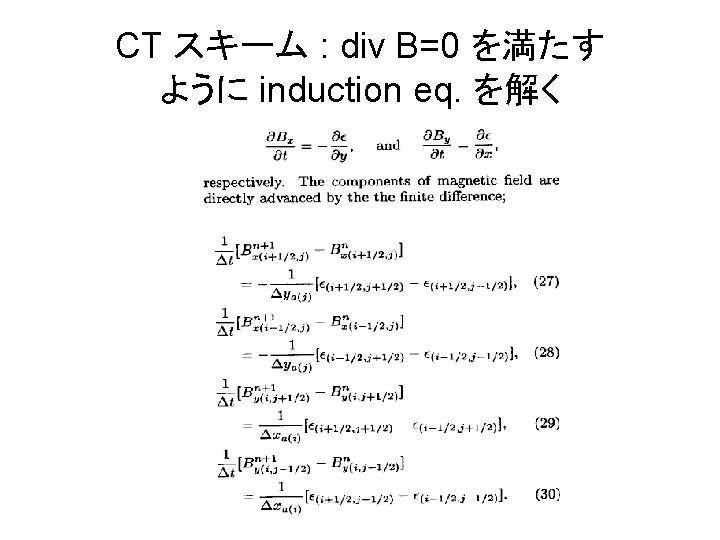
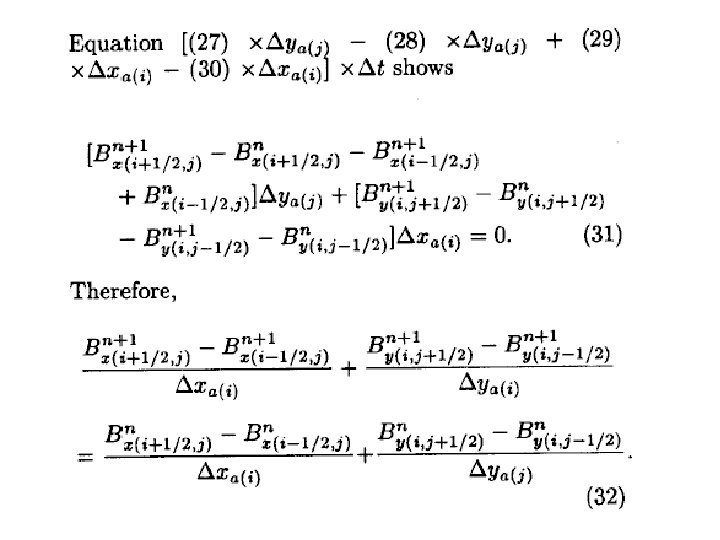
MOCCT scheme • CT (Constrained-Transport) scheme (Evans-Hawley 1988) – satisfy divergence free condition (div B =0) • MOC (Method of Characteristics) scheme (Stone-Norman 1992) – stable for Alfven wave
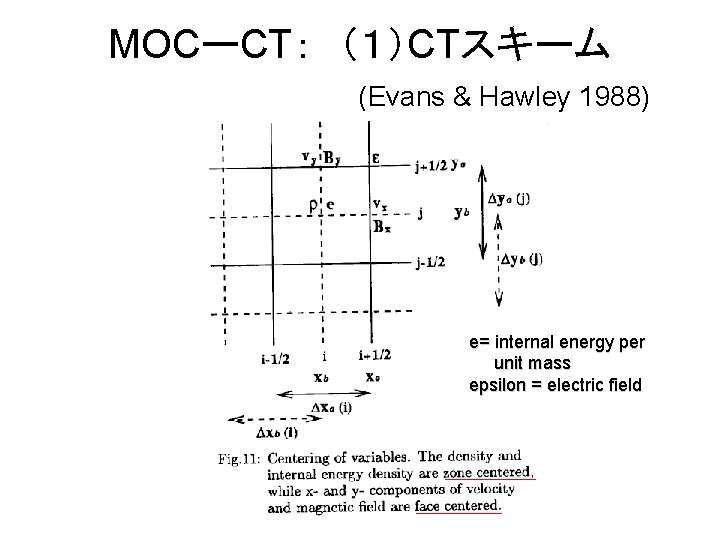
MOCーCT: (1)CTスキーム (Evans & Hawley 1988) e= internal energy per unit mass epsilon = electric field
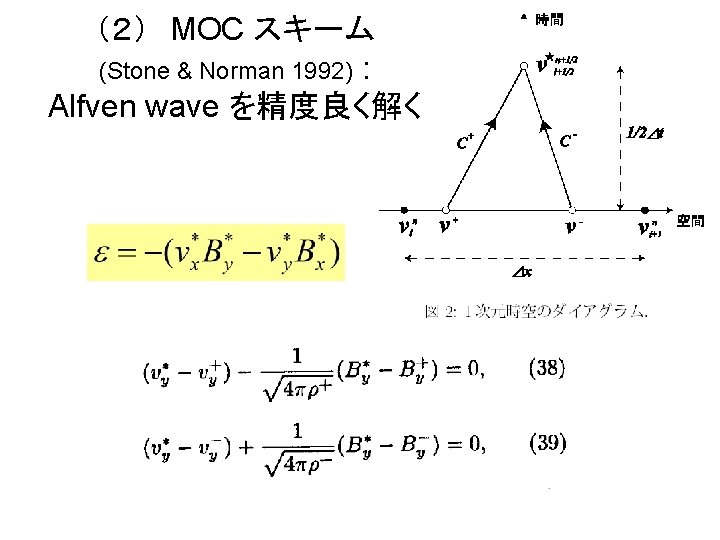
(2) MOC スキーム (Stone & Norman 1992) : Alfven wave を精度良く解く
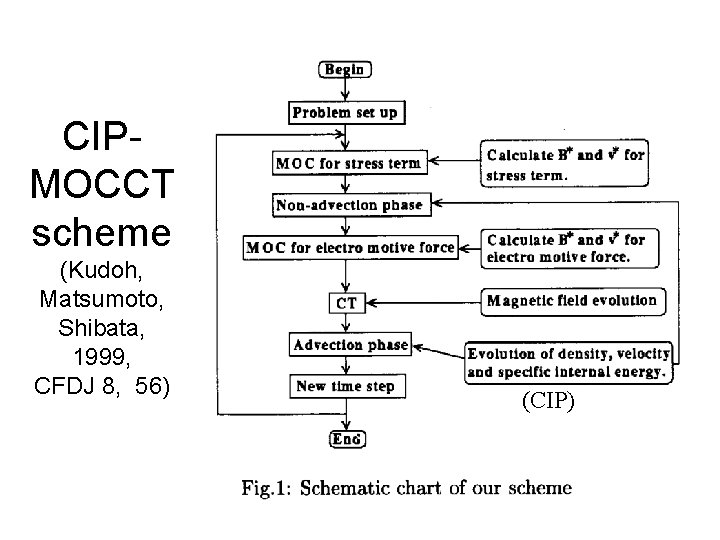
CIPMOCCT scheme (Kudoh, Matsumoto, Shibata, 1999, CFDJ 8, 56) (CIP)
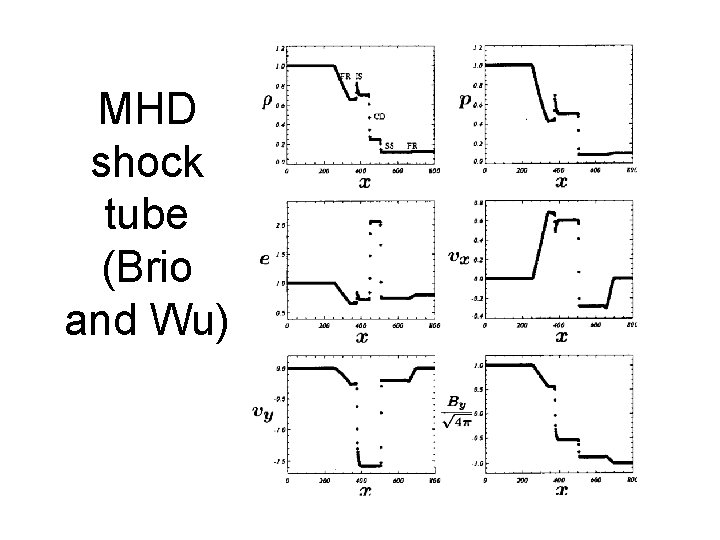
MHD shock tube (Brio and Wu)
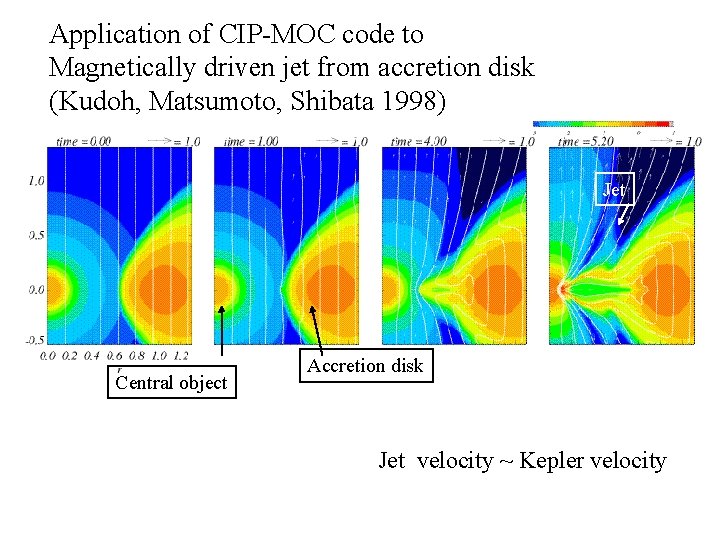
Application of CIP-MOC code to Magnetically driven jet from accretion disk (Kudoh, Matsumoto, Shibata 1998) Jet Central object Accretion disk Jet velocity ~ Kepler velocity
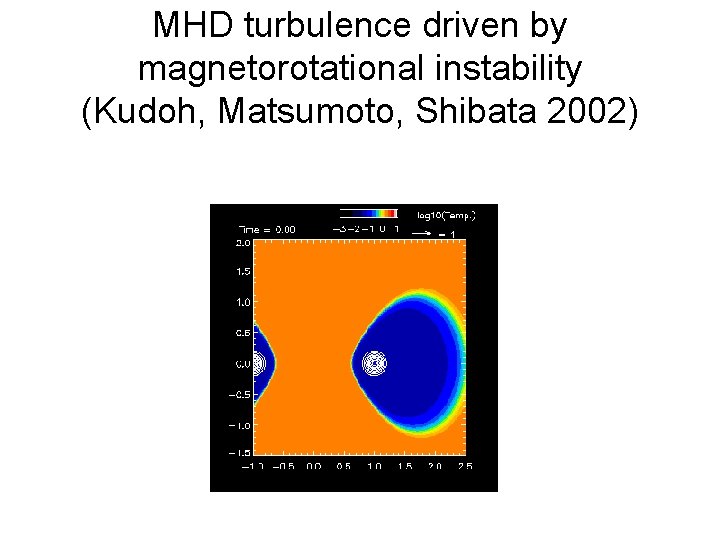
MHD turbulence driven by magnetorotational instability (Kudoh, Matsumoto, Shibata 2002)
Summary of Merits of CIP-MOCCT scheme • To solve contact discontinuity with high accuracy • Applicable to either non-conservative or conservative equations • Applicable to any fluid with complicated physics, such as gas+fluid+solid, etc. • Applicable to very low beta plasma (gas pressure << magnetic pressure) • Simple and fast See Ogata’s poster for astrophysical application


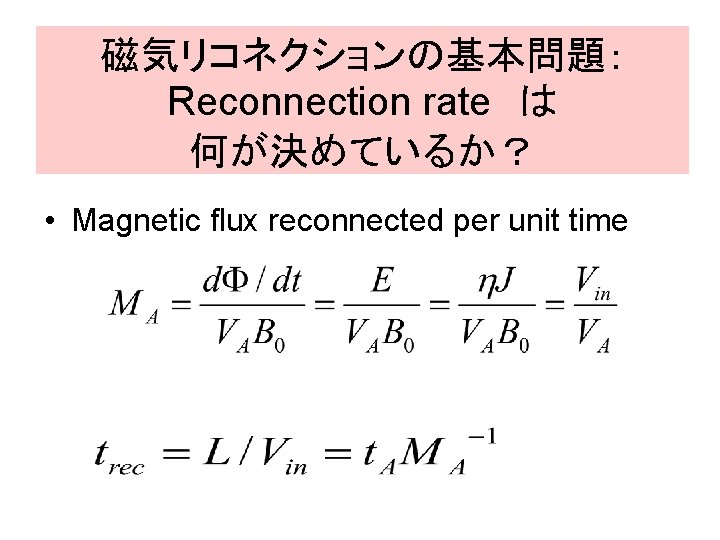
磁気リコネクションの基本問題: Reconnection rate は 何が決めているか? • Magnetic flux reconnected per unit time
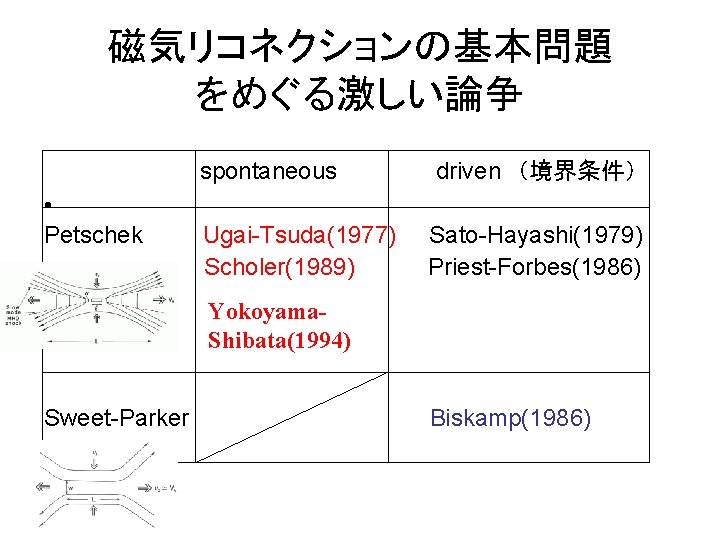
磁気リコネクションの基本問題 をめぐる激しい論争 spontaneous driven (境界条件) • Petschek Ugai-Tsuda(1977) Sato-Hayashi(1979) Scholer(1989) Priest-Forbes(1986) Yokoyama. Shibata(1994) Sweet-Parker Biskamp(1986)
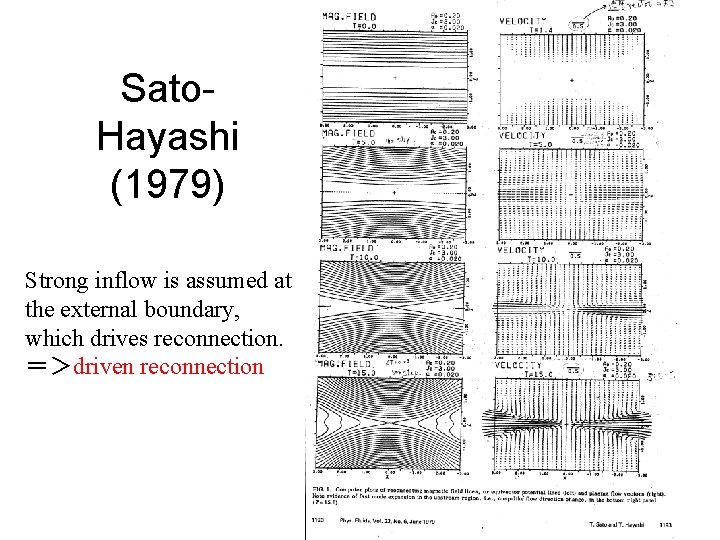
Sato. Hayashi (1979) Strong inflow is assumed at the external boundary, which drives reconnection. =>driven reconnection
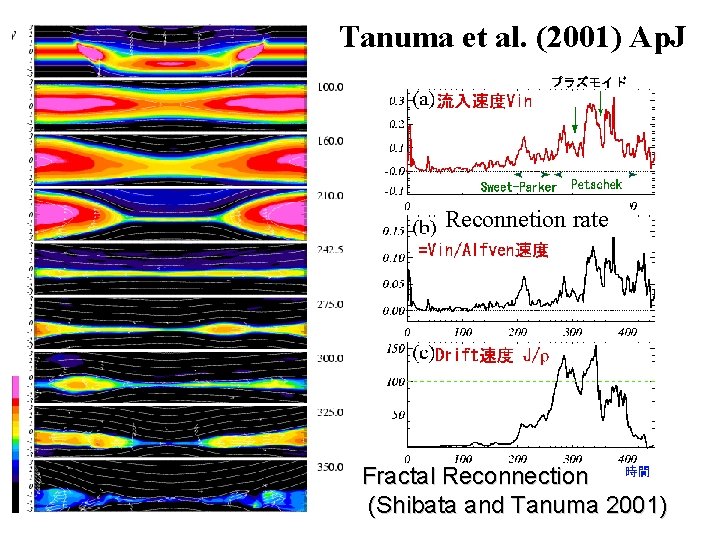
Tanuma et al. (2001) Ap. J Reconnetion rate Fractal Reconnection (Shibata and Tanuma 2001)

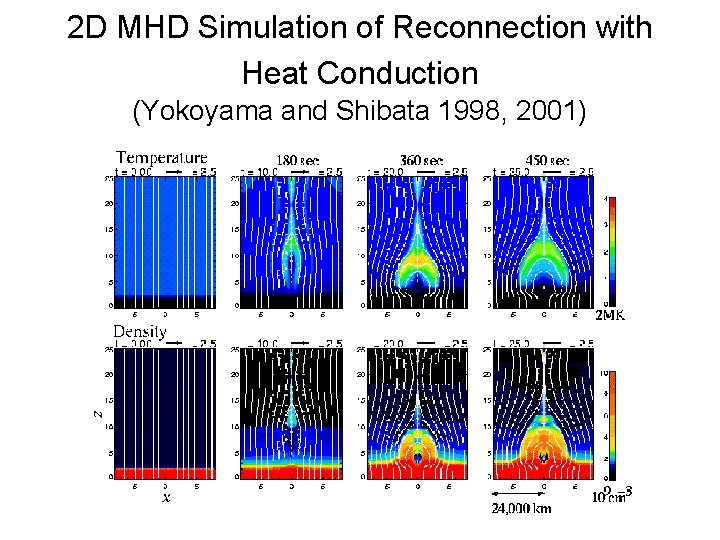
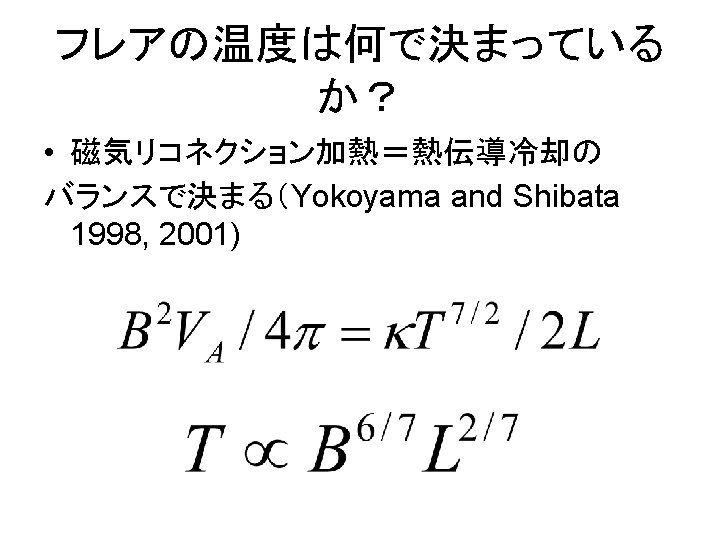
2 D MHD Simulation of Reconnection with Heat Conduction (Yokoyama and Shibata 1998, 2001)
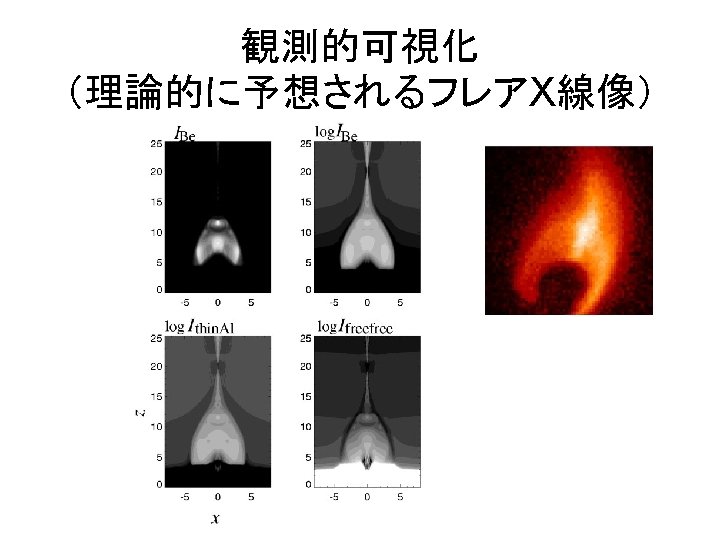
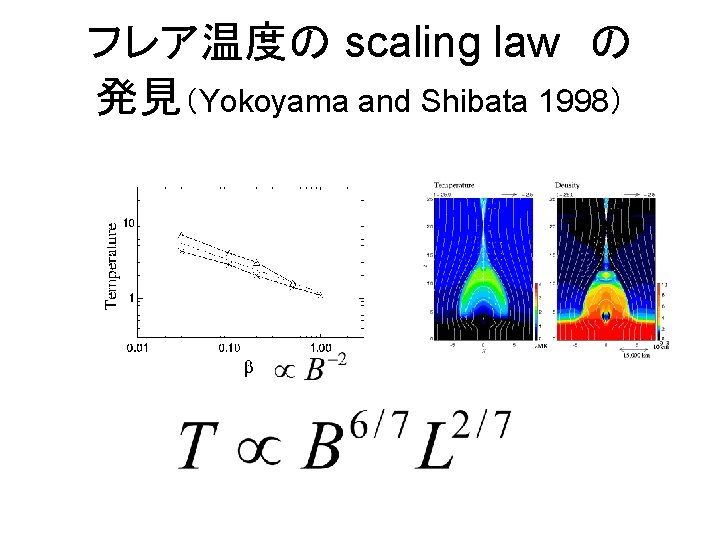
フレア温度の scaling law の 発見(Yokoyama and Shibata 1998)

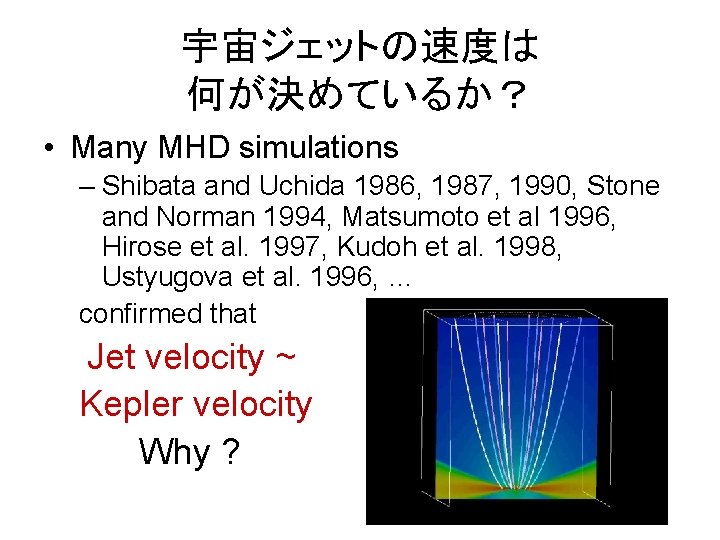
宇宙ジェットの速度は 何が決めているか? • Many MHD simulations – Shibata and Uchida 1986, 1987, 1990, Stone and Norman 1994, Matsumoto et al 1996, Hirose et al. 1997, Kudoh et al. 1998, Ustyugova et al. 1996, … confirmed that Jet velocity ~ Kepler velocity Why ?
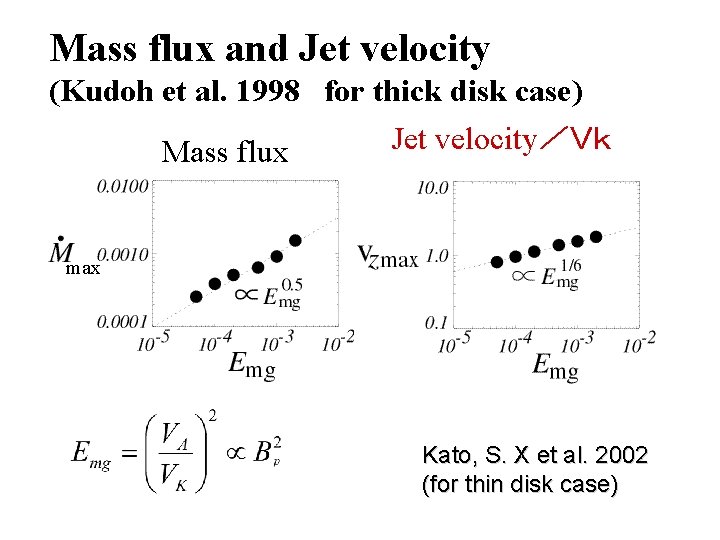
Mass flux and Jet velocity (Kudoh et al. 1998 for thick disk case) Jet velocity/Vk Mass flux max Kato, S. X et al. 2002 (for thin disk case)
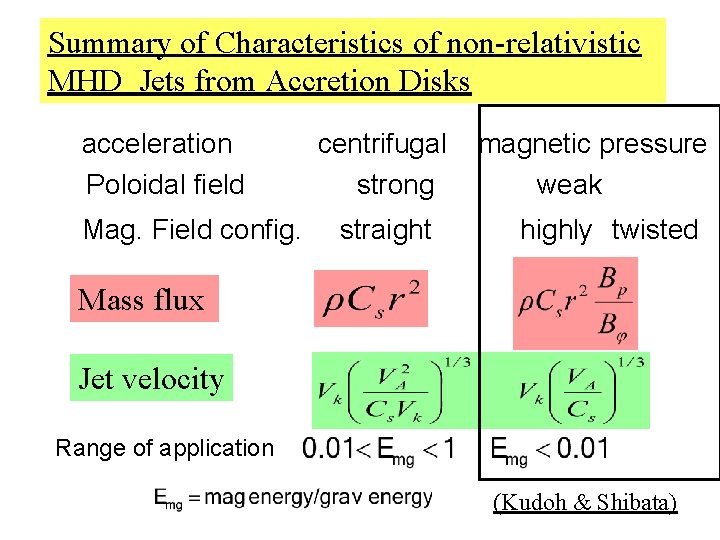
Summary of Characteristics of non-relativistic Jets mag. centrifugal vs mag. pressure MHD from Accretion Disks acceleration centrifugal magnetic pressure Poloidal field strong weak Mag. Field config. straight highly twisted Mass flux Jet velocity Range of application (Kudoh & Shibata)
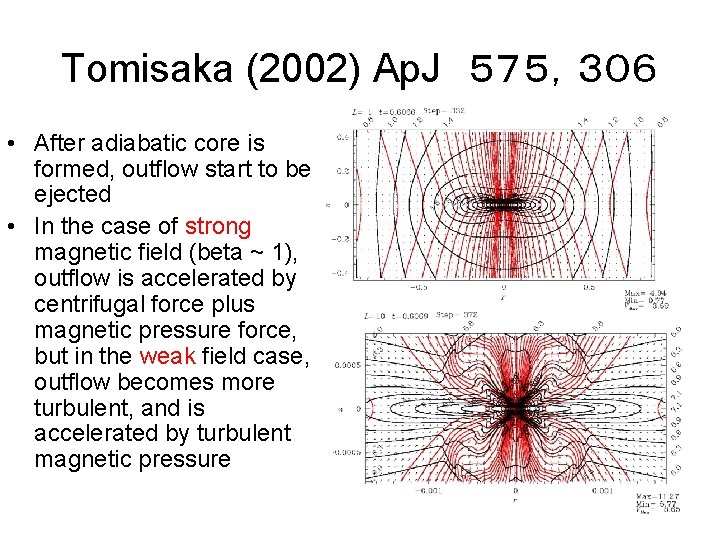
Tomisaka (2002) Ap. J 575,306 • After adiabatic core is formed, outflow start to be ejected • In the case of strong magnetic field (beta ~ 1), outflow is accelerated by centrifugal force plus magnetic pressure force, but in the weak field case, outflow becomes more turbulent, and is accelerated by turbulent magnetic pressure
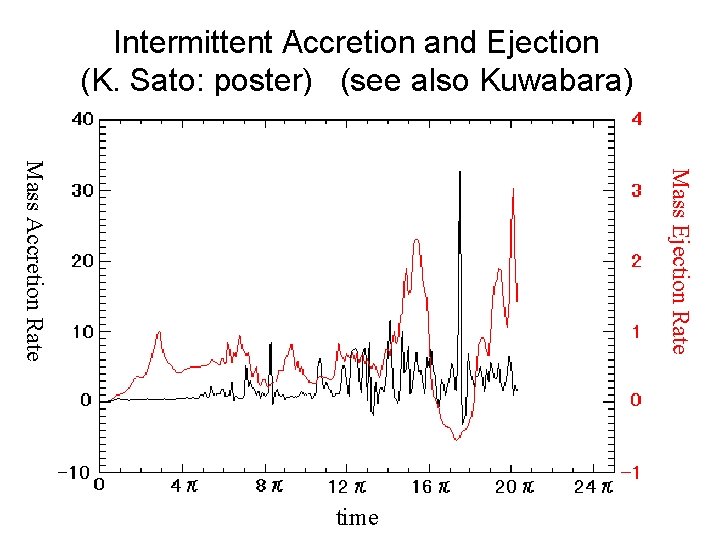
Intermittent Accretion and Ejection (K. Sato: poster) (see also Kuwabara) Mass Ejection Rate Mass Accretion Rate time
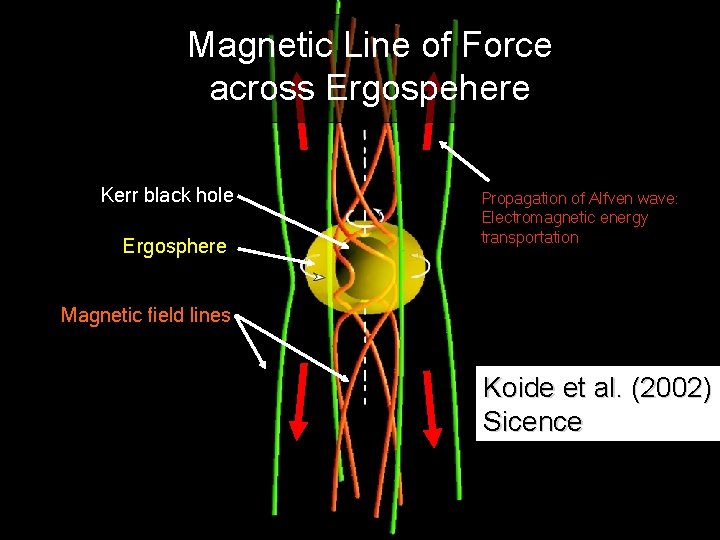
Magnetic Line of Force across Ergospehere Kerr black hole Ergosphere t = 7 t. S Propagation of Alfven wave: Electromagnetic energy transportation Magnetic field lines Koide et al. (2002) Sicence

![Magneto-rotational instability • Balbus-Hawley (1991) • [Chandrasekhar (1961), Velikhov (1959)] • Explains α viscosity of](http://slidetodoc.com/presentation_image_h/d6dfe1c8973309f864a71d659c2b05d1/image-70.jpg "Magneto-rotational instability • Balbus-Hawley (1991) • [Chandrasekhar (1961), Velikhov (1959)] • Explains α viscosity of")
Magneto-rotational instability • Balbus-Hawley (1991) • [Chandrasekhar (1961), Velikhov (1959)] • Explains α viscosity of accretion disks (Hawley-Balbus 1991, Hawley et al. 1995, Brandenburg et al. 1995, Matsumoto-Tajima 1995)
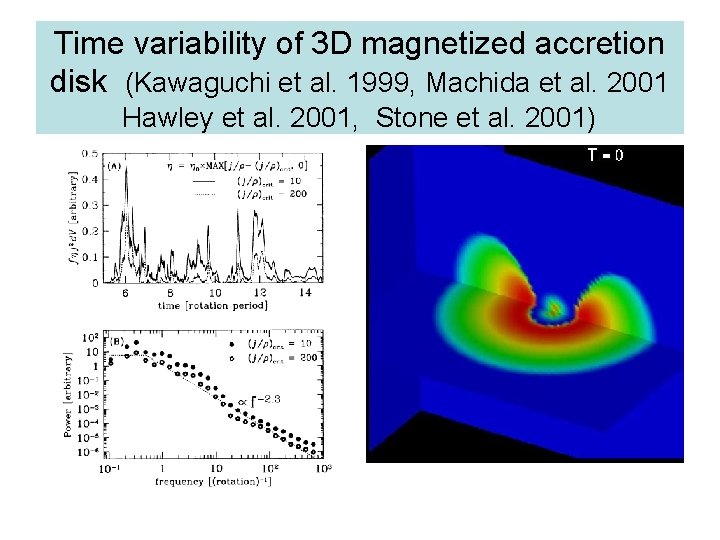
Time variability of 3 D magnetized accretion disk (Kawaguchi et al. 1999, Machida et al. 2001 Hawley et al. 2001, Stone et al. 2001)
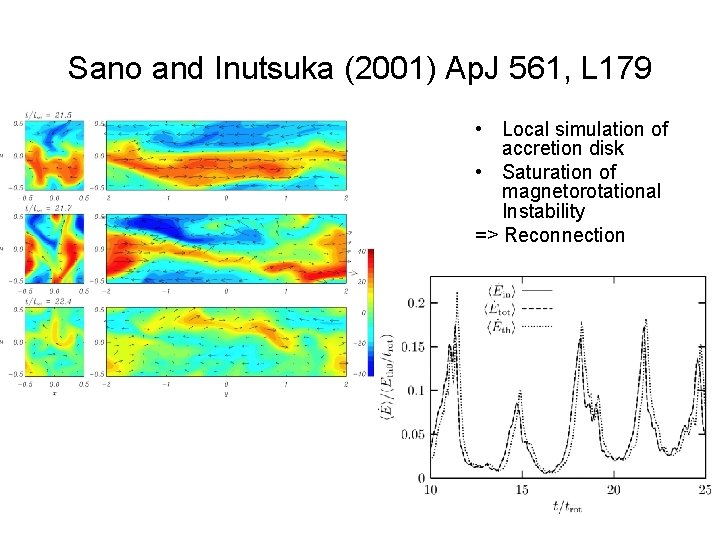
Sano and Inutsuka (2001) Ap. J 561, L 179 • Local simulation of accretion disk • Saturation of magnetorotational Instability => Reconnection
- Slides: 74