
MHAUS GUIDELINES Testing for Malignant Hyperthermia MH Susceptibility
MHAUS GUIDELINES Testing for Malignant Hyperthermia (MH) Susceptibility: How do I counsel my patients?
CONTENTS • • • Diagnostic tests available Eligibility criteria for testing Additional test information, referrals Evaluating your patient Advising your patient MH resources & references

Diagnostic Testing, Preface 1. Diagnostic testing options to evaluate MH susceptibility are not recommended as a screening tool for the general population. 2. Test usefulness depends on the pre-test probability that the patient is MHsusceptible (MHS). 3. Diagnostic tests are most useful when making treatment decisions for surgical patients where there is a high level of suspicion that the patient is susceptible to MH.

Diagnostic Testing, Preface (continued) 4. Before any diagnostic testing is recommended, an evaluation of your patient’s susceptibility to MH should be completed using available medical data. 5. In almost all cases, susceptibility to MH is inherited in an autosomal dominant fashion. Therefore, evaluation of your patient’s susceptibility to MH often depends upon a careful review of both your patient’s and his/her family members’ medical history. Important to remember that MHS patients may not have a documented MH reaction.

Diagnostic Tests Available 1. Muscle Contracture Test: Caffeine Halothane Contracture Test (CHCT)* 2. Genetic Testing: (RYR 1, CACNA 1 S, STAC 3 genes currently available, but other genes may become available in the future) * CHCT refers to the method of contracture testing performed in North America, while IVCT (In Vitro Contracture Testing) is the method of contracture testing performed in Europe and some other countries.

Muscle Contracture Testing (CHCT) Gold Standard Requires skeletal muscle biopsy from patient’s thigh to assess muscle contractile properties upon exposure to ryanodine receptor agonists (e. g. , caffeine, halothane). Must be performed at the MH Muscle Biopsy Center. (Listed at MHAUS. org) Abnormally high levels of contractile force indicate MH susceptibility. Sensitivity: close to 100% (false negatives are rare) Specificity: ~80% (~20% false positives)
Genetic Testing (RYR 1, CACNA 1 S, STAC 3 Genes) 1. Involves isolation of DNA from patient sample (nucleated cells from blood or other tissues) 2. Primary genetic locus associated with MH susceptibility is the ryanodine receptor (RYR 1) gene; a DNA variant in the gene is characterized as: a. Benign/Likely Benign Variants (no significant functional effect) b. Pathogenic, Likely Pathogenic Variants (via functional studies) c. Indeterminate (variants of uncertain significance)
Genetic Testing Causative Mutations 1. Presence of pathogenic variant in RYR 1 gene is diagnostic for MH susceptibility (MHS). 2. At this point, not all proven MHS individuals have been found to carry a pathogenic variant. The sensitivity of the genetic test depends upon several factors, including the population selected and the methodology of the testing utilized. Sensitivity for ideal test candidates (family history of MH plus either positive in vitro contracture test or an MH event) is approximately 60% (Monnier et al. 2005; Levano et al 2009). 3. Once a pathogenic variant is found, family members can have targeted genetic testing for the familial pathogenic variant; if found, the individual is considered MHS and a muscle biopsy for contracture testing can be avoided.

Eligibility Criteria for Testing 1. CHCT Testing Indications 2. Genetic Testing Indications

CHCT Test Indications Patient with known MHS relative (as determined by positive muscle contracture test) Patient with MHS family member (as determined by past suspicious MH episode, but without a known RYR 1 pathogenic genetic mutation) Patient with past suspected MH event (wait 6 months post event, depending upon the degree of rhabdomyolysis) Patient with severe masseter muscle rigidity (MMR) during anesthesia with a triggering agent Patient with moderate to mild MMR with evidence of rhabdomyolysis Continued on next slide

CHCT Test Indications (con’t) • Patient with unexplained rhabdomyolysis during or after surgery (may present as sudden cardiac arrest due to hyperkalemia) • Patient with exercise-induced rhabdomyolysis after a negative rhabdomyolysis workup • Signs suggestive of, but not definitive, for MH • If military service is desired, patients with suspicion of MHS are required to undergo CHCT. Note: Age and weight requirements for muscle biopsy procedure vary by Biopsy Center.

Genetic Testing Indications (U. S. ) The indications for genetic testing are more limited than those for CHCT testing Patient with a confirmed or highly suspicious clinical episode of MH Patient with positive CHCT Patient with MHS relative as determined by a confirmed or highly suspicious clinical episode of MH Patients with relatives with known pathogenic RYR 1 mutation or related genes Note: The index case or proband should always be tested first, if at all possible.

Additional Test Information, Referrals 1. CHCT • Pros & Cons • Costs & Insurance • Referral to MH Muscle Biopsy Centers 2. Genetic Testing • Pros & Cons • Costs & Insurance • Referral to Genetic Testing Centers/Laboratories

CHCT - Pros and Cons Pros: Positive and Negative results establish definitive diagnosis. Negative result allows patient freedom of choice regarding anesthetic use, certain military career opportunities. Cons: Patient must undergo invasive surgical procedure; 2 -7 days relative disability Testing can only be performed in specialized Biopsy Centers – patients must travel to center Expensive Patient must meet weight and age requirements for biopsy
CHCT - Cost, Insurance • Cost: approximately $6, 000 - $10, 000 • Insurance – In the U. S. , CHCT is covered by most insurance companies; however, it is strongly recommended that the patient contact his/her insurance carrier prior to biopsy procedure – In Canada, the cost is covered by each Provincial health plan for Canadian residents

Referral to Muscle Biopsy Center for CHCT Testing • Biopsy Center Director, physician or genetic counselor [GC] may refer patient for diagnostic testing. • Contact the MH Biopsy Center closest (geographically) to your patient’s residence (see next slide) and request the appropriate paperwork.
MH Muscle Biopsy Centers for CHCT Testing U. S. and Canada Toronto General Hospital Malignant Hyperthermia Investigation Unit Toronto, Ontario Canada PH: (416) 340 -3128 Email: Sheila. Riazi@uhn. ca UC Davis MH Biopsy Testing Center Sacramento, CA Timothy Tautz, MD (916) 734 -2431 Email: tjtautz@ucdavis. edu Uniformed Services University of the Health Sciences (USUHS) Bethesda, MD (Military & Civilian) LCDR Michael Lee MC, USN CAPT Dale Szpisjak MC, USN Email: MHLab@usuhs. edu University of Minnesota Minneapolis, MN Paul A. Iaizzo, Ph. D (612) 624 -7912 or -3959 Email: iaizz 001@umn. edu Wake Forest Baptist Medical Center Winston-Salem, NC Sherry Meacham (336) 716 -7194 Email: smeacham@wakehealth. edu

Genetic Testing Pros and Cons Pros: Less expensive than CHCT Less invasive than CHCT (blood or saliva can be tested) No need to travel If causative mutation found in family member, other family members can have predictive testing carried out with a high degree of accuracy, without the need for CHCT, and at a lower cost than the first person tested. Cons: Due to discordance (contracture result ≠ genetic testing result), plus the heterogeneity of MH, absence of a pathogenic mutation does not rule out MH susceptibility; muscle contracture test would be needed to confirm the individual is not susceptible to MH Insurance may/may not cover cost of testing Insurance may require genetic counseling for authorization of testing which will require an appointment with a Genetic Counselor
Genetic Testing - Cost, Insurance Cost: approximately $890 (3 gene panel) but depends on lab and the billing institution charges Insurance: some insurance companies will cover the cost of the test. Insurance companies may request a letter of medical necessity (see examples at MHAUS. org), pedigree and medical records for approval authorization process MHAUS may be able to provide financial assistance for patients who are candidates for genetic testing. Contact MHAUS for more information info@mhaus. org
![Referral for Genetic Testing • Physician or genetic counselor [GC] may refer patient for](http://slidetodoc.com/presentation_image_h/c5a9d8a25d92483653b5ebbfd0fc5f34/image-20.jpg "Referral for Genetic Testing • Physician or genetic counselor [GC] may refer patient for")
Referral for Genetic Testing • Physician or genetic counselor [GC] may refer patient for diagnostic testing. • Contact one of the Genetic Testing Laboratories (see next slide) and request the appropriate paperwork.
Genetic Testing Laboratories Concert. Genetics. com website lists many labs Athena Diagnostics, Inc. Marlborough, MA 01752 Healthcare Professionals call 800 -394 -4493, x 2031 Patients call 800 -394 -4493 x 4 for insurance and Financial assistance information MNG Labs Atlanta, Georgia 844 -837 -8664 (678) 225 -0222 Prevention. Genetics Marshfield, Wisconsin (715) 387 -0484 ext 208 clinicaldnatesting@preventiongenetics. com Robert Guthrie Biochemical & Molecular Genetics Laboratory Genetics Counselor Team Kaleida Health Laboratories Buffalo, New York (716) 859 -7741 pisackson@Kaleida. Health. org University of Minnesota Medical Center Minneapolis, Minnesota Kumar Belani, MD (612) 624 -9990 belan 001@umn. edu

Evaluating your patient 1. Review indicators of MH susceptibility 2. Assess level of suspicion for susceptibility to MH 3. Review eligibility criteria for diagnostic testing 4. Consult with MH expert, if necessary

Indicators of MH Susceptibility 1. 2. Suspicious MH event data in patient/family members Possible predisposing factors to MH in patient/family members

Suspicious MH Event Data Look for the following possible clinical manifestations in association with the use of a triggering anesthetic or the depolarizing agent, succinylcholine: As a result of increased myoplasmic calcium concentration: • Masseter muscle rigidity • Generalized muscle rigidity As a result of hypermetabolism: • Hypercapnia • Hypoxemia • Tachycardia • Acidosis • Increasing temperature As a result of rhabdomyolysis: • Increased serum CK and K+ concentrations • Cardiac arrhythmia • Myoglobinuria • Renal failure
Suspicious MH Event Data (continued) MH Clinical Grading Scale (Larach MG et al, 1994) may be helpful for evaluation of data and is based on assessment of: Criteria within 6 processes 1. Muscle rigidity 2. Muscle breakdown 3. Respiratory acidosis 4. Temperature increase 5. Cardiac involvement 6. Family history Other criteria (not part of a single process) • Base deficit • p. H • Outcome, if dantrolene was used
Suspicious MH Event Data (continued) MH Clinical Grading Scale • Assists in determining if MH episode has occurred • Raw score is calculated based on fulfillment of criteria in each of the processes (noted on previous slide) • Assistance in calculating a raw score is available through MH experts affiliated with MHAUS NOTE: The VALIDITY of the clinical grading scale increases when data is obtained for each process. Thus, the scale may underestimate the probability of MH if certain data are not available. In addition, the appropriateness of a clinical sign should be evaluated within the context of pre-existing medical disease and the surgery/procedure.
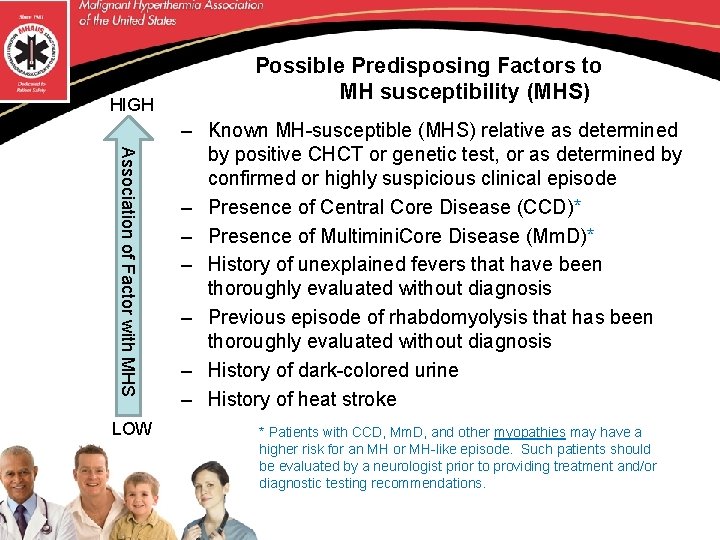
HIGH Association of Factor with MHS LOW Possible Predisposing Factors to MH susceptibility (MHS) – Known MH-susceptible (MHS) relative as determined by positive CHCT or genetic test, or as determined by confirmed or highly suspicious clinical episode – Presence of Central Core Disease (CCD)* – Presence of Multimini. Core Disease (Mm. D)* – History of unexplained fevers that have been thoroughly evaluated without diagnosis – Previous episode of rhabdomyolysis that has been thoroughly evaluated without diagnosis – History of dark-colored urine – History of heat stroke * Patients with CCD, Mm. D, and other myopathies may have a higher risk for an MH or MH-like episode. Such patients should be evaluated by a neurologist prior to providing treatment and/or diagnostic testing recommendations.

Evaluating your patient (con’t) 1. Review indicators of MH susceptibility 2. Assess level of suspicion for susceptibility to MH 3. Review eligibility criteria for diagnostic testing 4. Consult with MH expert, if necessary

Advising your patient 1. Testing 2. Precautions: testing in patients with muscle disorders 3. Lifestyle issues 4. Genetic counseling (GC) 5. Sample cases

Testing • After careful review of medical data, diagnostic test indications, and consultation with an MH expert (if necessary), communicate your recommendations with respect to appropriate testing options to the patient. • Follow up with the patient and appropriate testing center regarding the patient’s test results for future treatment management. • Encourage your patient to seek support from Genetic Counselors, MHAUS and to register with the North American Malignant Hyperthermia Registry of MHAUS (NAMHR) (see Resource section for more information).

Precautions: Testing in patients with muscle disorders Patients with CCD, Mm. D, and other myopathies such as Duchenne’s or Becker’s muscular dystrophies may have a higher risk for an MH or MH-like episode upon exposure to a triggering anesthetic agent. Such patients should be evaluated by a neurologist prior to providing treatment and/or diagnostic testing recommendations Ø CCD, Mm. D associated with MH susceptibility Ø Patients with Duchenne’s or Becker’s muscular dystrophies are at risk for hyperkalemic cardiac arrest with succinylcholine or other MH triggering agents (but this is NOT MH) Ø AVOID succinylcholine in myopathic and myotonic patients
Life Style Issues • • • Muscle cramping and possibly heat stroke may be more common in MHS patients. Further study needed. MHS individuals may be advised to avoid extremes of heat, but NOT to restrict athletic activity unless they have overt rhabdomyolysis. Advice should be personalized to the patient based on consultation with an MH expert.
Genetic Counseling (GC) GC may be a useful adjunct to patient-physician discussions and may help to: » Determine patient’s risk for MHS based on family and medical history » Determine the best person in the family to offer RYR 1 testing » Explain autosomal dominant pattern of inheritance for MHS (see next slide) » Assist in determining insurance coverage for testing. Insurance may require genetic counseling, pedigree and letter of medical necessity for approval process » Discuss potential implications regarding health/life insurance and impact of GINA, a law recently passed which protects patients from discrimination on the basis of genetic testing results » Determine lab requirements for testing, help with collection and shipment of samples » Discuss test results and help communicate with family members » Reinforce availability of MHAUS as resource, importance of communication with HCPs, use of medical-alert ID bracelet
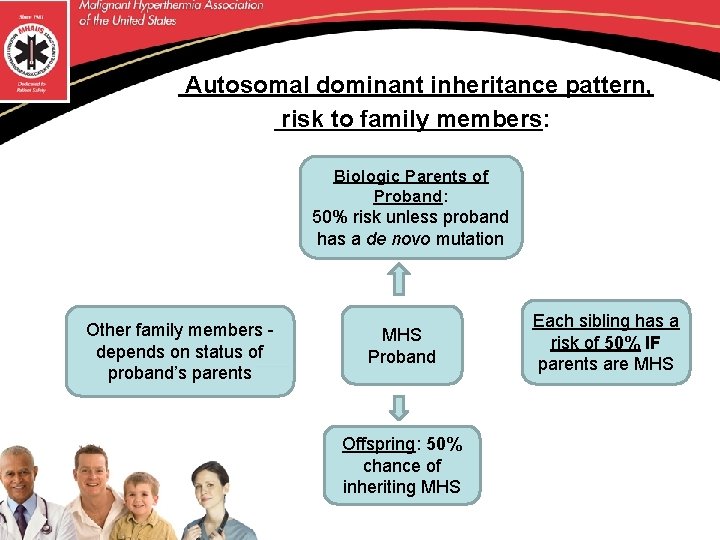
Autosomal dominant inheritance pattern, risk to family members: Biologic Parents of Proband: 50% risk unless proband has a de novo mutation Other family members - depends on status of proband’s parents MHS Proband Offspring: 50% chance of inheriting MHS Each sibling has a risk of 50% IF parents are MHS
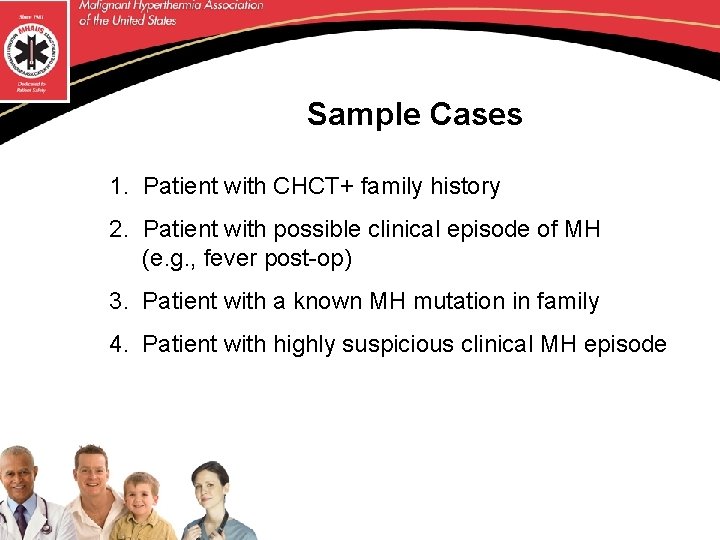
Sample Cases 1. Patient with CHCT+ family history 2. Patient with possible clinical episode of MH (e. g. , fever post-op) 3. Patient with a known MH mutation in family 4. Patient with highly suspicious clinical MH episode
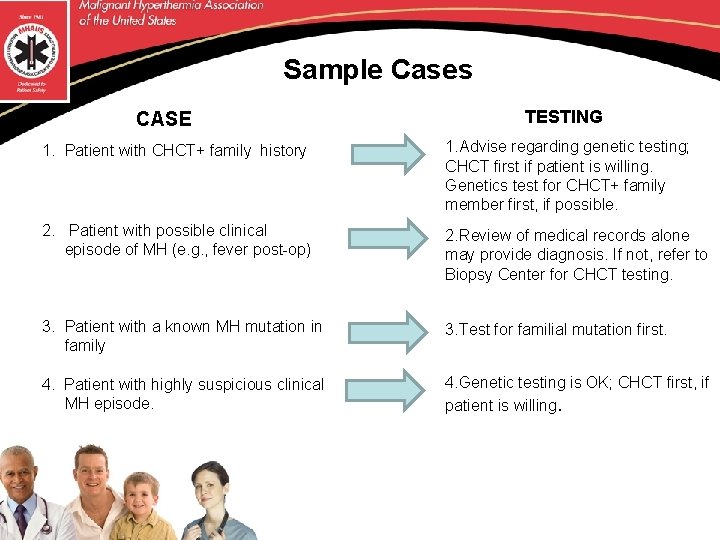
Sample Cases CASE TESTING 1. Patient with CHCT+ family history 1. Advise regarding genetic testing; CHCT first if patient is willing. Genetics test for CHCT+ family member first, if possible. 2. Patient with possible clinical episode of MH (e. g. , fever post-op) 2. Review of medical records alone may provide diagnosis. If not, refer to Biopsy Center for CHCT testing. 3. Patient with a known MH mutation in family 3. Test for familial mutation first. 4. Patient with highly suspicious clinical MH episode. 4. Genetic testing is OK; CHCT first, if patient is willing.
MH Resources & References • Malignant Hyperthermia Association of the United States (MHAUS ) • North American Malignant Hyperthermia Registry of MHAUS (NAMHR) • National Society of Genetic Counselors (NSGC. org) • References
Malignant Hyperthermia Association of the United States (MHAUS) P. O. Box 1069 1 North Main Street Sherburne, NY 13460 – 1069 Phone 1 -800 -986 -4287 or 607 -674 -7901 Fax 607 -674 -7910 Email: info@mhaus. org Website: www. mhaus. org Hotline for Medical Professionals: 1 -800 -644 -9737 (in North America)
The North American Malignant Hyperthermia Registry of MHAUS Director, Dr. Nikolaus Gravenstein 1 -888 -274 -7899 https: //anest. ufl. edu/namhr/ Database which records detailed events surrounding MH episodes as well as clinical correlation between clinical history, genetic, and biopsy test results Approved by the IRB of the University of Florida – Gainesville The Registry holds a certificate of confidentiality, reflective of its commitment to protect subject confidentiality Patients and physicians can provide Registry with clinical history – thus the Registry acts as a service for patients/families and their health care professionals to communicate and store important medical histories relating to the risk for MH.

Genetic Counseling To find a Genetic Counselor in your area, contact: National Society of Genetic Counselors Phone: 312 -321 -6834 Fax: 312 -673 -6972 E-mail: nsgc@nsgc. org Web www. nsgc. org Deanna Steele, LCGC, Genetic Counselor Coordinator Center for Rare Disease Therapy Children’s Hospital of Pittsburgh of UPMC Phone: 412 -692 -7556, email: Deanna. steele@chp. edu Available to discuss genetic testing with interested physicians and to assist families in finding genetic services in their area.
Additional References Allen, Gregory C. MD, FRCPC; Larach, Marilyn Green MD, FAAP; Kunselman, Allen R. MA. The Sensitivity and Specificity of the Caffeine-Halothane Contracture Test: A Report from the North American Malignant Hyperthermia Registry. [Clinical Investigations] 1998 The North American Malignant Hyperthermia Registry of MHAUS. Brandom BW. Genetics of malignant hyperthermia. The Scientific World Journal 2006; 6: 1722 -1730. Dixon BA, O’Donnell JM. Is your patient susceptible to malignant hyperthermia? Nursing 2006; 36(12): 26 -27. Dulhunty AF, Beard NA, Pouliquin P, Kimura J. Novel regulators of Ry. R Ca 2+ release channels: insight into molecular changes in genetically-linked myopathies. Muscle Res Cell Motil 2006; 27: 351 – 365. Girard T, Litman RS. Molecular genetic testing to diagnose malignant hyperthermia susceptibility. Editorial. J Clin Anesthesia 2008; 20: 161 -163. Greenbaum I, Weigl Y, Pras E. The Genetic Basis of Malignant Hyperthermia. IMAJ 2007; 9: 39– 41.
Additional References (continued) Gronert GA, Pessah IN, Muldoon SM, Tautz TJ, Chapter 29: Malignant Hyperthermia, In Miller’s Anesthesia, Sixth Edition. Miller RD (Ed. ) Elsevier, 2005, pp 1169 -1190. Larach MG, Localio AR, Allen GC, Denborough MA, Ellis FR, Gronert GA, Kaplan RF, Muldoon SM, Nelson TE, Ording H, Rosenberg H, Waud BE, Wedel DJ. A clinical grading scale to predict malignant hyperthermia susceptibility. Anesthesiology 1994; 80: 771 -779. Litman RS, Rosenberg H. Malignant hyperthermia: update on susceptibility testing. JAMA 2005; 293: 2918 -2924. Robinson R, Carpenter D, Shaw MA, Halsall J, Hopkins P. Mutations in RYR 1 in malignant hyperthermia and central core disease. Human Mutation 2006; 27(10): 977 -989. Rosenberg H, Davis M, James D, Pollock N, Stowell K. Malignant hyperthermia. Orphanet J Rare Dis 2007; 2: 21 Rosenberg H, Brandom BW, Sambuughin N, Fletcher JE, Chapter 20: Malignant Hyperthermia and other pharmacogenetic disorders, In Clinical Anesthesia, Barash PG, Cullen BF, and Stoelting RK (Eds. ) Lippincott, Williams, and Wilkins, 2006.
Additional References (continued) Rosenberg H, Dirksen RT. Malignant hyperthermia susceptibility. Gene. Reviews. 12 May 2006, www. genetests. org. Rosenberg H. Malignant hyperthermia syndrome: from barnyard to molecular genetics laboratory. APSF Newsletter Summer 2005. Rosenberg H, Antognini JF, Muldoon S. Testing for Malignant Hyperthermia. Anesthesiology 2002; 96: 232 -7. Scacheri C, Redman JB, Pike-Buchanan L, Steenblock K. Molecular testing: improving patient care through partnering with laboratory genetic counselors. Genet Med 2008; 10(5): 337 -342. Treves S, Anderson AA, Ducreux S, Divet A, Bleunven C, Grasso C, Paesante S, Zorzato F. Ryanodine receptor 1 mutations, dysregulation of calcium homeostasis and neuromuscular disorders. Neuromuscular Disorders 2005; 15: 577 -587. Hopkins PM et al, Br J Anaesth. 2015; 115: 531 -539. doi: 10. 1093/bja/aev 225 European MH Group website reference: http: //www. emhg. org for list of mutations
- Slides: 43