
Mgt 613 Project Portfolio Management and the PMO





- Slides: 34
Mgt 613 - Project Portfolio Management and the PMO Module 2 - Project Evaluation & Prioritization / Maximizing Value Dr. Alan C. Maltz Howe School of Technology Management Stevens Institute of Technology Alan. Maltz@stevens. edu 1 © Alan C. Maltz, Ph. D, 2014
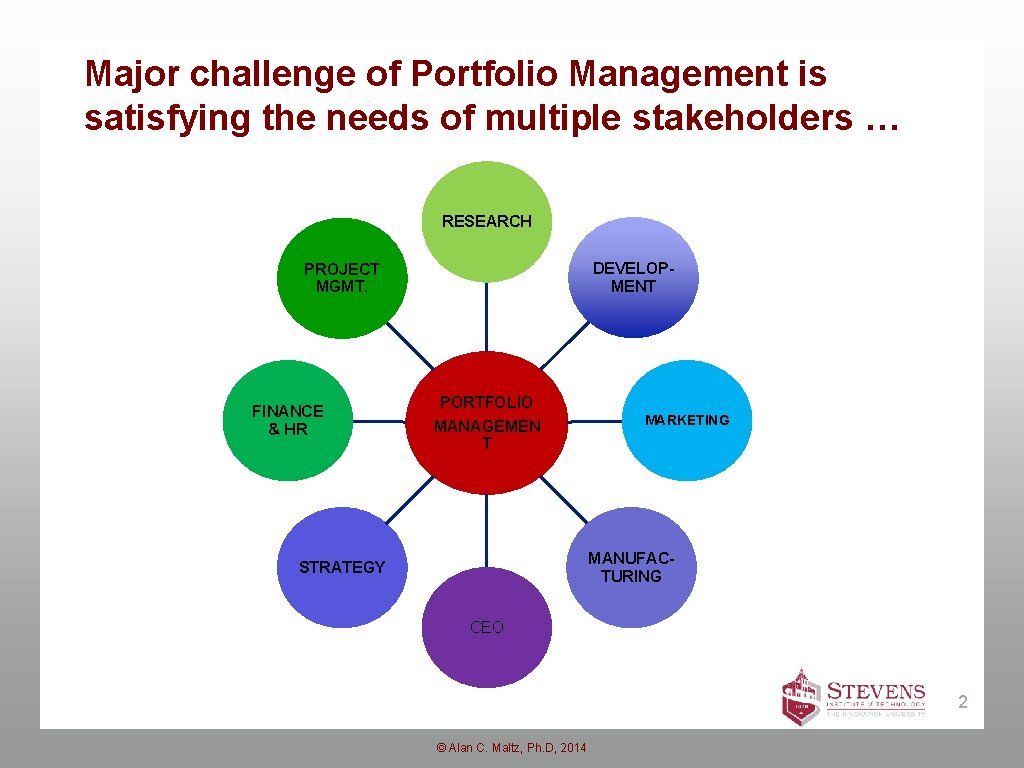
Major challenge of Portfolio Management is satisfying the needs of multiple stakeholders … RESEARCH DEVELOPMENT PROJECT MGMT. FINANCE & HR PORTFOLIO MANAGEMEN T MARKETING MANUFACTURING STRATEGY CEO 2 © Alan C. Maltz, Ph. D, 2014
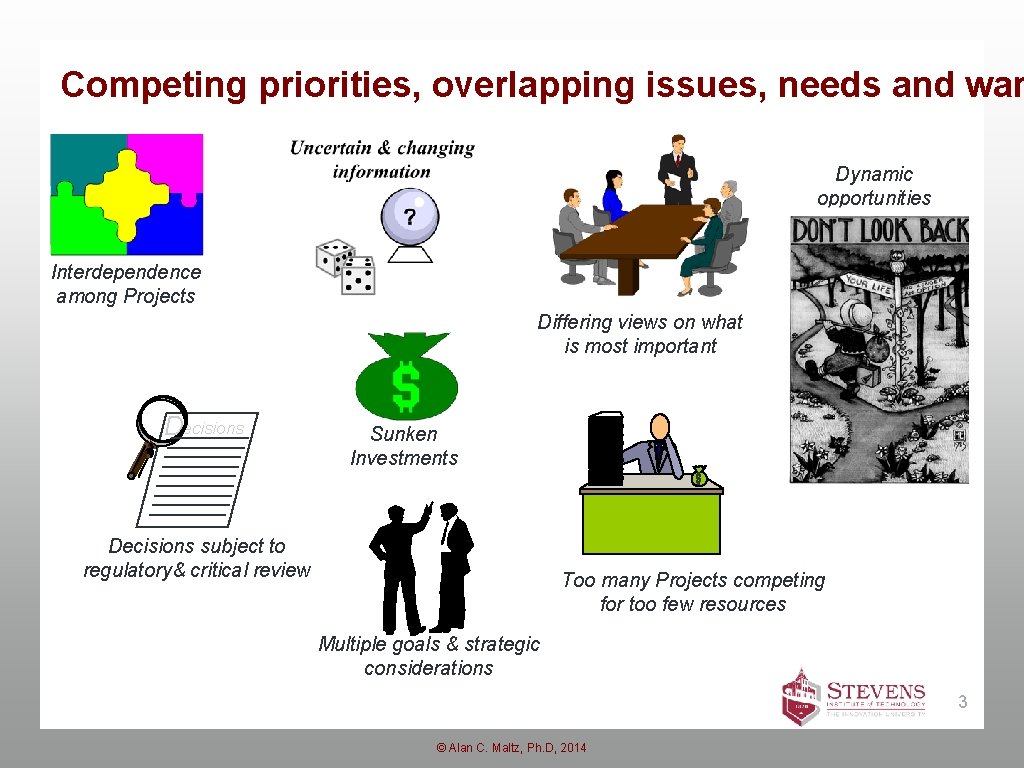
Competing priorities, overlapping issues, needs and wan Dynamic opportunities Interdependence among Projects Differing views on what is most important Decisions Sunken Investments Decisions subject to regulatory& critical review Too many Projects competing for too few resources Multiple goals & strategic considerations 3 © Alan C. Maltz, Ph. D, 2014
Objectives of Portfolio Management… STRATEGIC ALIGNMENT OPTIMAL BALANCE VALUE MAXIMIZATION 4 © Alan C. Maltz, Ph. D, 2014
Critical principle of PPM – clear articulation of mission, vision and value. . MISSION: Who Am I And Why Do I Exist? VISION: Where Do I Want To Be At A Specific Point In Time? VALUES: What Do I Believe In And Defines Who I am? DESIRED STATE 5 © Alan C. Maltz, Ph. D, 2014
Portfolio value maximization – an ongoing activity that must be placed in its relevant temporal context. . DISCOVERY Lo ng - Capabilities for New Products DEVELOPMENT M LINE EXTENSIONS MERGERS LICENSING Te Sh or t- Te rm rm Where am I? rm Go als Te ALLIANCES ACQUISITIONS id - Where do I want to be? Go als Where do I need to get to? - New Potential Market Opportunities © Alan C. Maltz, Ph. D, 2014 6
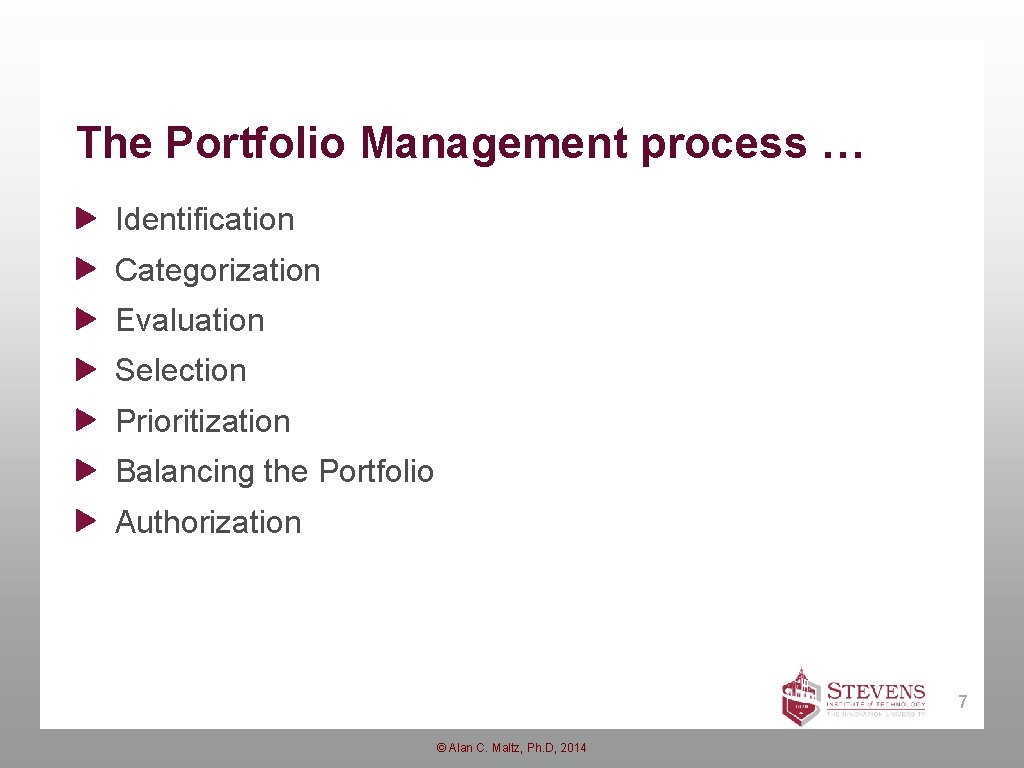
The Portfolio Management process … Identification Categorization Evaluation Selection Prioritization Balancing the Portfolio Authorization 7 © Alan C. Maltz, Ph. D, 2014
Portfolio management process (adapted PMI 2013) Strategic Planning Process Output: Current Strategic Plan Portfolio Management Processes Monitoring and Controlling Aligning Process Group Identification Process Group Component Processes Component Execution and Reporting Prioritization Current Strategic Plan l. Goals Definitions & Categorization Categories Portfolio Reporting and Review (3. 2. 2. 1) Portfolio Balancing l. Key Performance Criteria l. Capacity Definition Evaluation Authorization Strategic Change No Selection Yes v PPM links with strategy v PPM is a continuous business process 8 © Alan C. Maltz, Ph. D, 2014
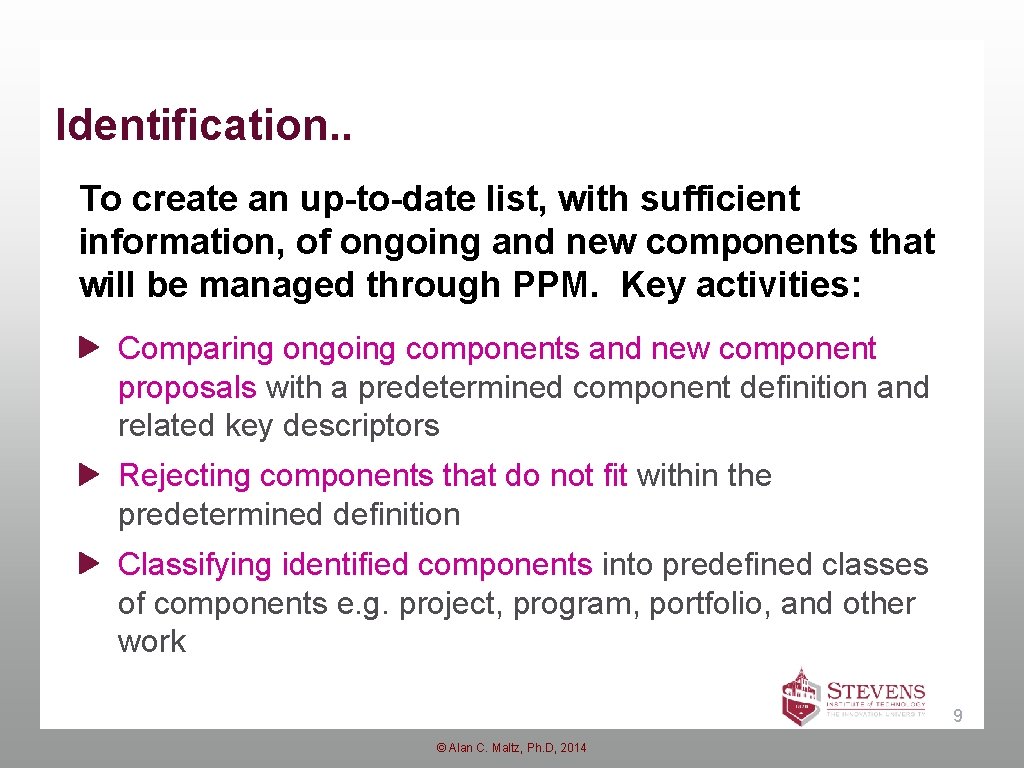
Identification. . To create an up-to-date list, with sufficient information, of ongoing and new components that will be managed through PPM. Key activities: Comparing ongoing components and new component proposals with a predetermined component definition and related key descriptors Rejecting components that do not fit within the predetermined definition Classifying identified components into predefined classes of components e. g. project, program, portfolio, and other work 9 © Alan C. Maltz, Ph. D, 2014
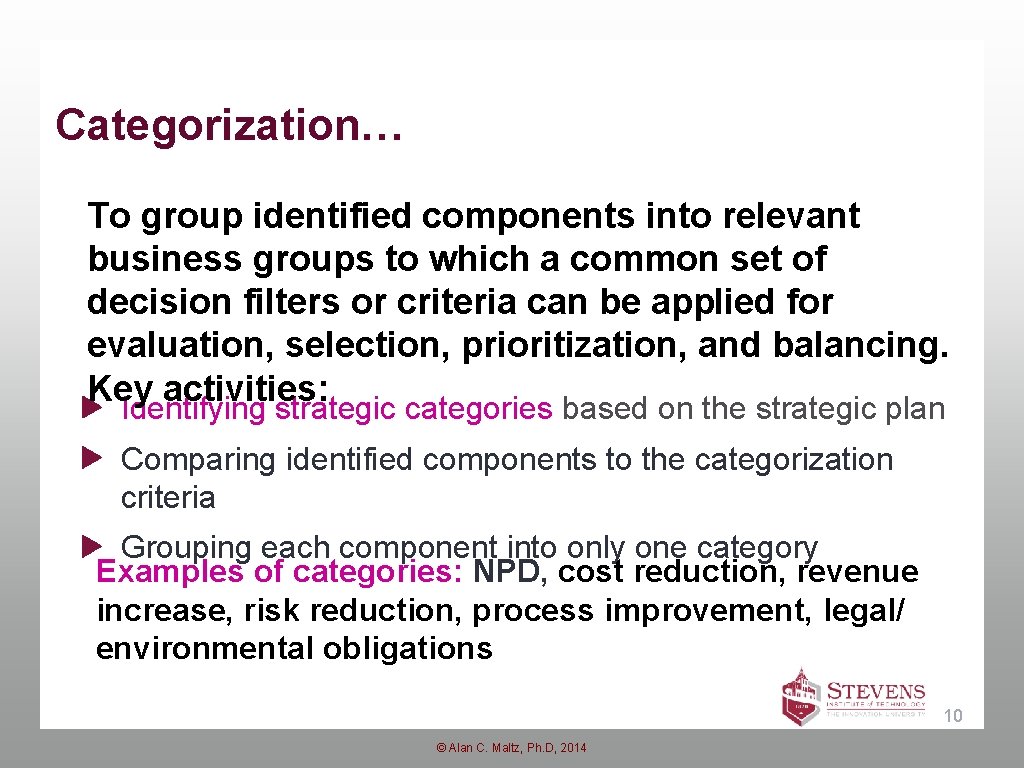
Categorization… To group identified components into relevant business groups to which a common set of decision filters or criteria can be applied for evaluation, selection, prioritization, and balancing. Key activities: Identifying strategic categories based on the strategic plan Comparing identified components to the categorization criteria Grouping each component into only one category Examples of categories: NPD, cost reduction, revenue increase, risk reduction, process improvement, legal/ environmental obligations 10 © Alan C. Maltz, Ph. D, 2014
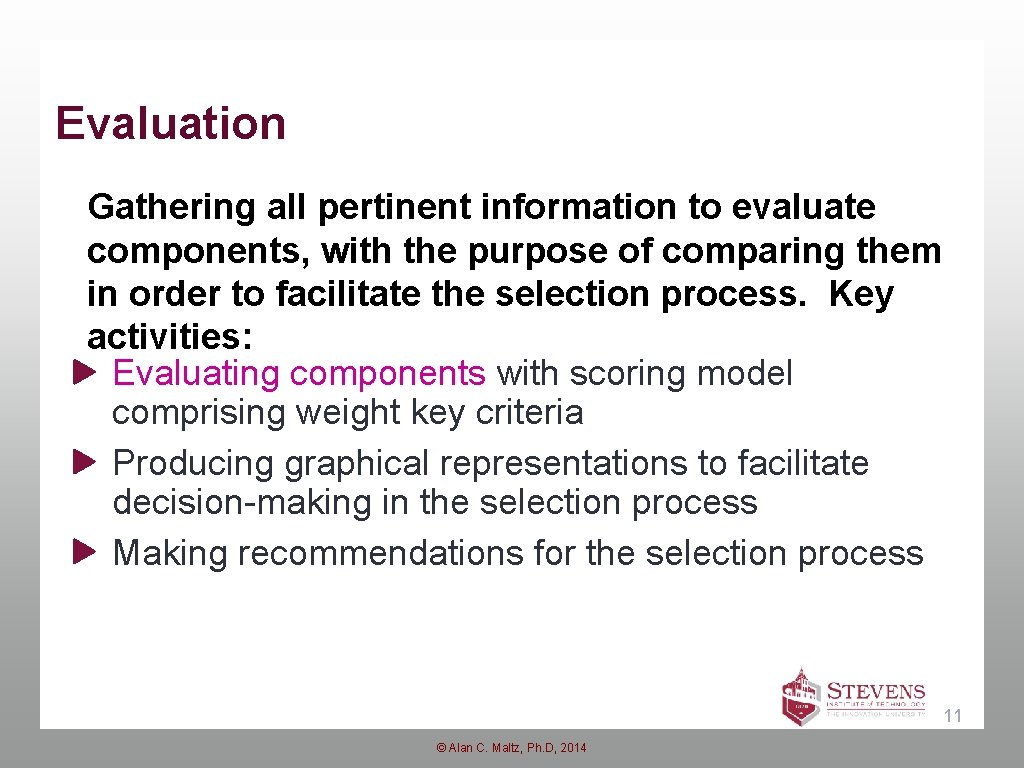
Evaluation Gathering all pertinent information to evaluate components, with the purpose of comparing them in order to facilitate the selection process. Key activities: Evaluating components with scoring model comprising weight key criteria Producing graphical representations to facilitate decision-making in the selection process Making recommendations for the selection process 11 © Alan C. Maltz, Ph. D, 2014
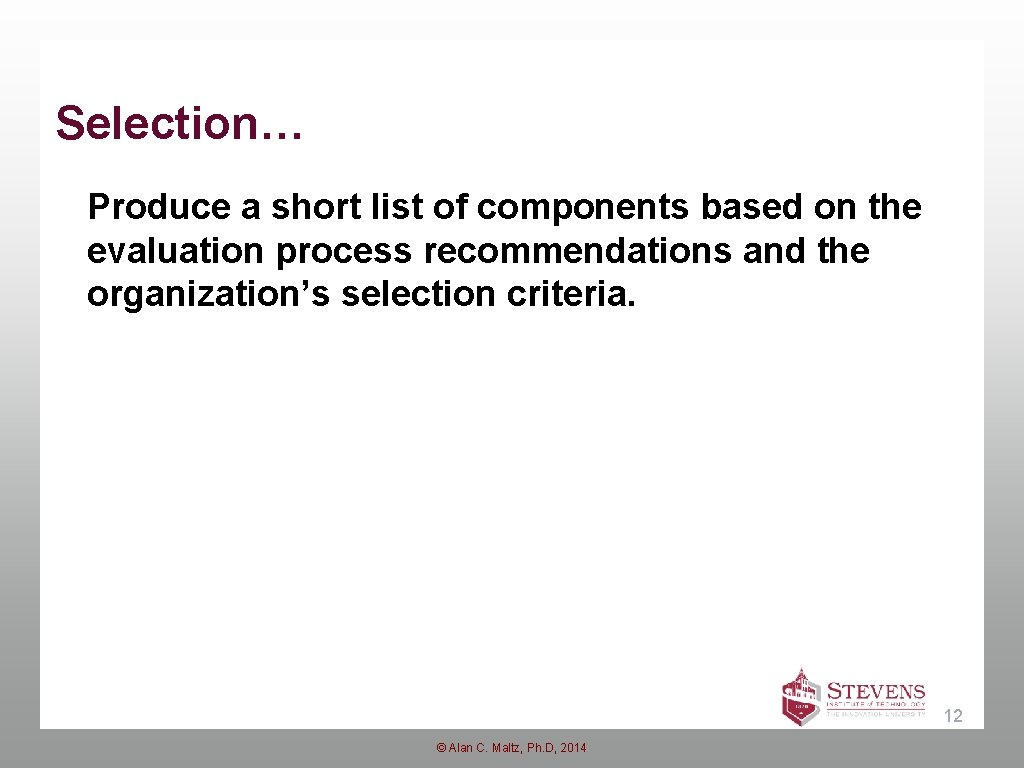
Selection… Produce a short list of components based on the evaluation process recommendations and the organization’s selection criteria. 12 © Alan C. Maltz, Ph. D, 2014
Prioritization… The ranking of components within each strategic or funding category, investment time frame, risk versus return profile, and organizational focus according to establish criteria. 13 © Alan C. Maltz, Ph. D, 2014
Portfolio balancing To develop the portfolio component mix with the greatest potential, to collectively support the organization’s strategic initiatives and achieve strategic objectives. Authorization To formally allocated financial and human resources required to either develop business cases or execute selected components and to formally communicate portfolio-balancing decision 14 © Alan C. Maltz, Ph. D, 2014
Evaluation tools and techniques A ranking of value and benefits An appraisal of risk (in achieving benefits) An inventory of resources availability and allocation An idea of an optimum or acceptable size of the project pipeline 15 © Alan C. Maltz, Ph. D, 2014
Approaches to Project Screening… Financial models Weighted scoring models Analytic hierarchy process (AHP) 16 © Alan C. Maltz, Ph. D, 2014
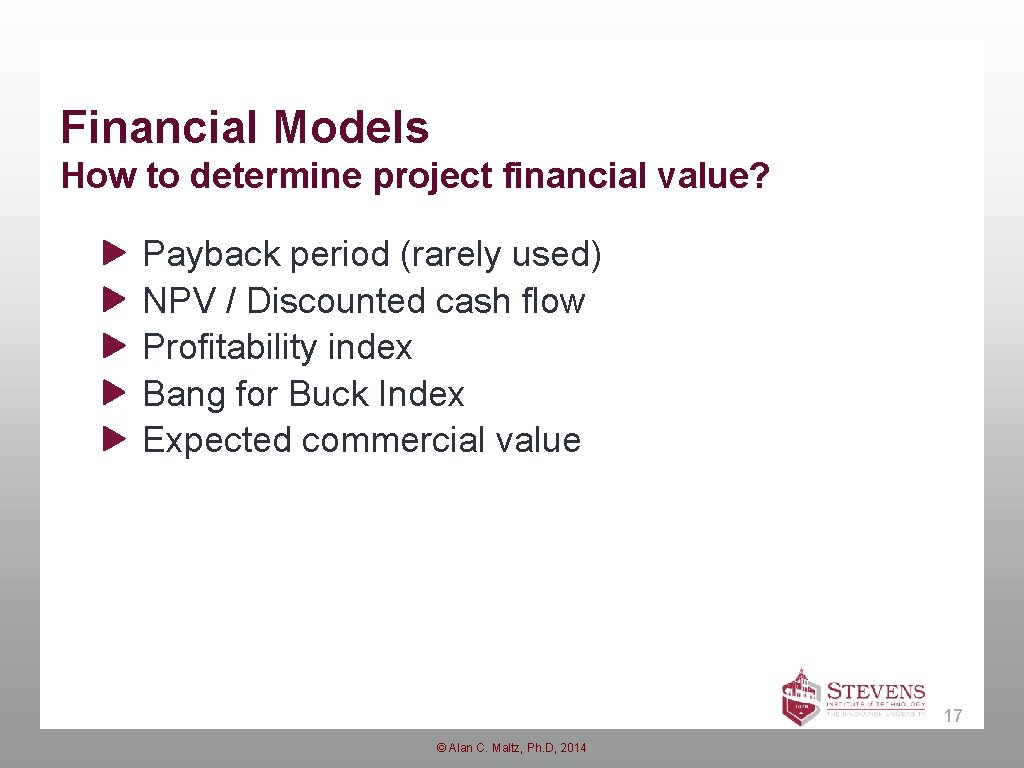
Financial Models How to determine project financial value? Payback period (rarely used) NPV / Discounted cash flow Profitability index Bang for Buck Index Expected commercial value 17 © Alan C. Maltz, Ph. D, 2014
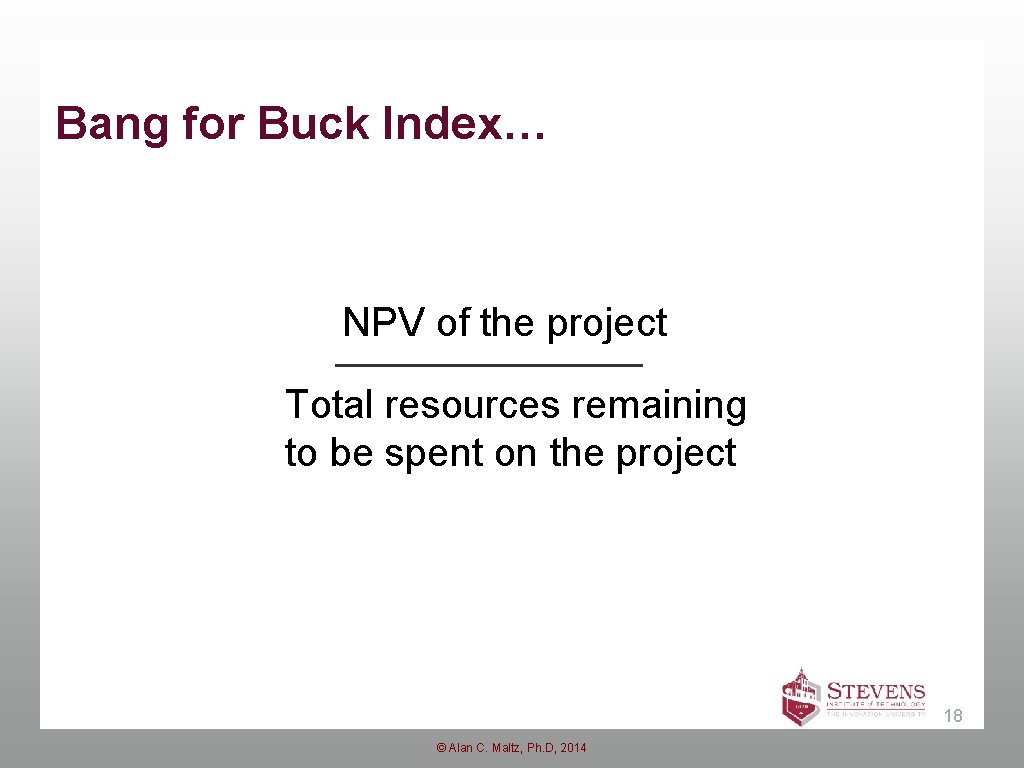
Bang for Buck Index… NPV of the project Total resources remaining to be spent on the project 18 © Alan C. Maltz, Ph. D, 2014
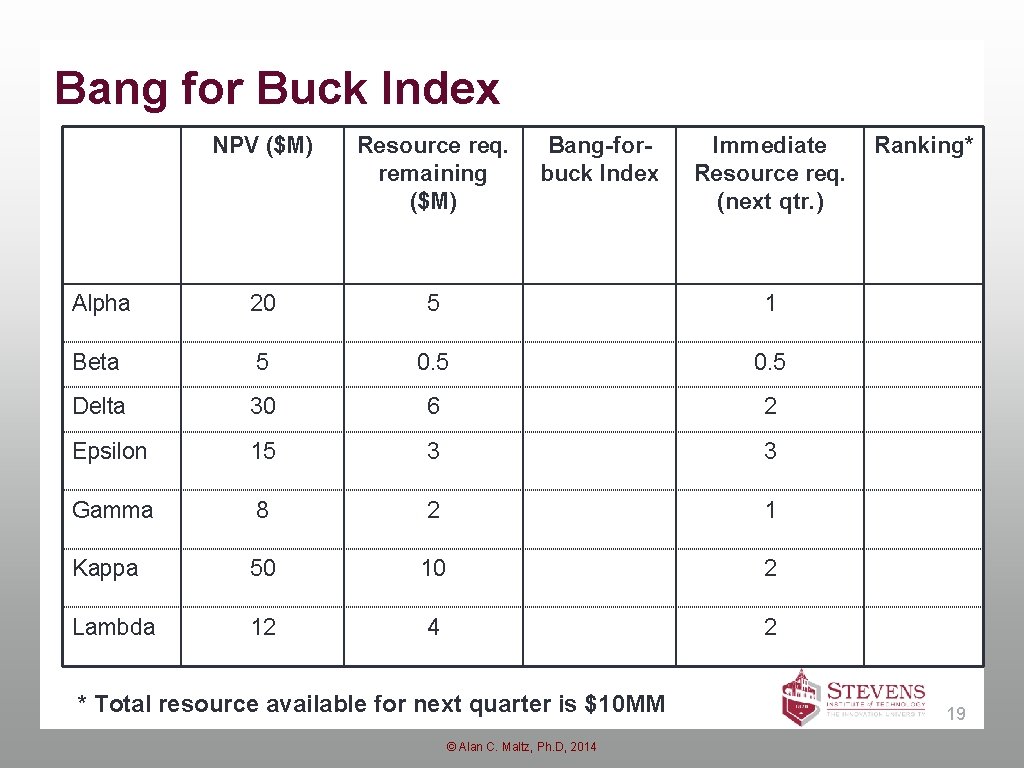
Bang for Buck Index NPV ($M) Resource req. remaining ($M) Bang-forbuck Index Alpha 20 5 1 Beta 5 0. 5 Delta 30 6 2 Epsilon 15 3 3 Gamma 8 2 1 Kappa 50 10 2 Lambda 12 4 2 * Total resource available for next quarter is $10 MM © Alan C. Maltz, Ph. D, 2014 Immediate Resource req. (next qtr. ) Ranking* 19
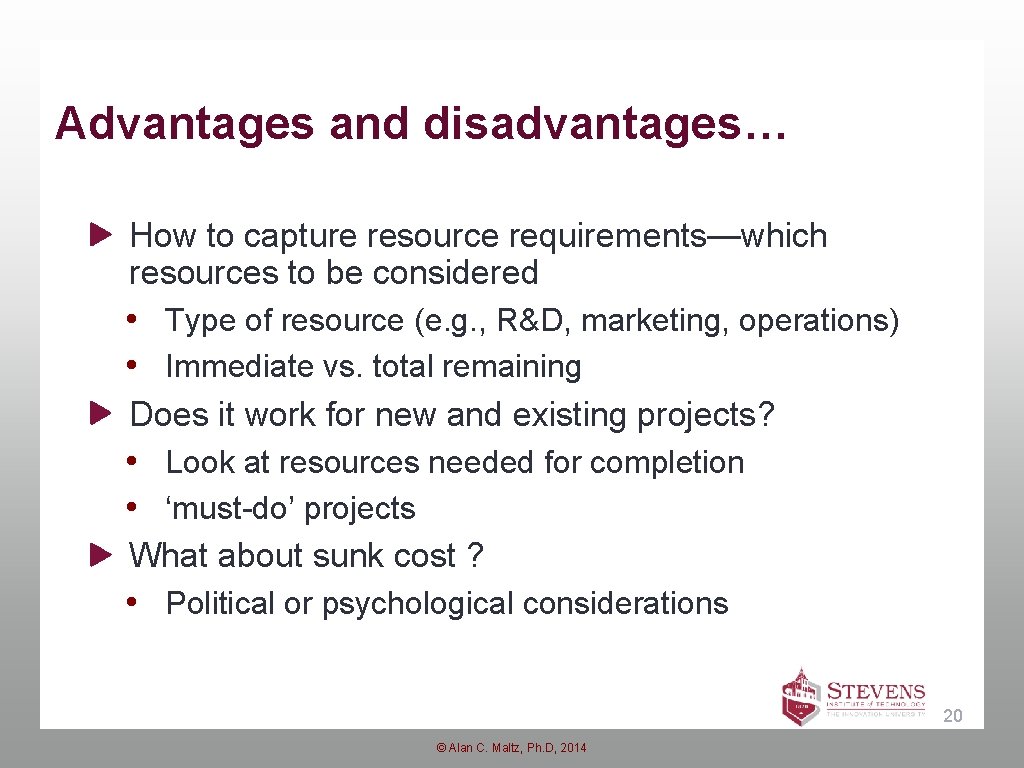
Advantages and disadvantages… How to capture resource requirements—which resources to be considered • Type of resource (e. g. , R&D, marketing, operations) • Immediate vs. total remaining Does it work for new and existing projects? • Look at resources needed for completion • ‘must-do’ projects What about sunk cost ? • Political or psychological considerations 20 © Alan C. Maltz, Ph. D, 2014
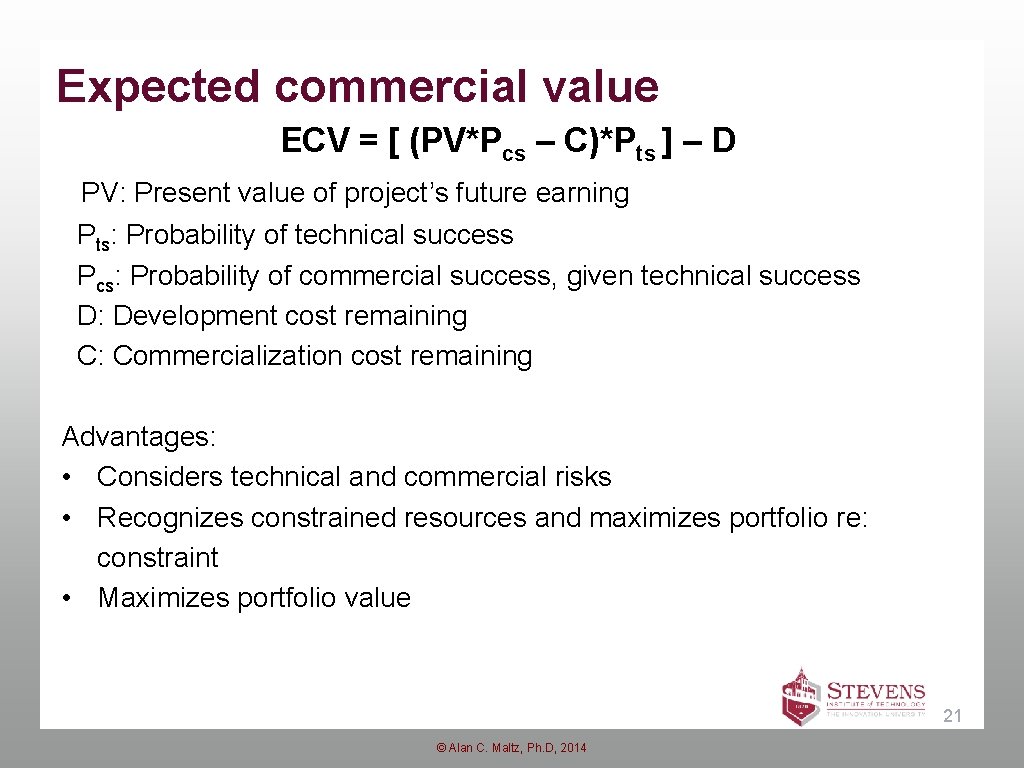
Expected commercial value ECV = [ (PV*Pcs – C)*Pts ] – D PV: Present value of project’s future earning Pts: Probability of technical success Pcs: Probability of commercial success, given technical success D: Development cost remaining C: Commercialization cost remaining Advantages: • Considers technical and commercial risks • Recognizes constrained resources and maximizes portfolio re: constraint • Maximizes portfolio value 21 © Alan C. Maltz, Ph. D, 2014
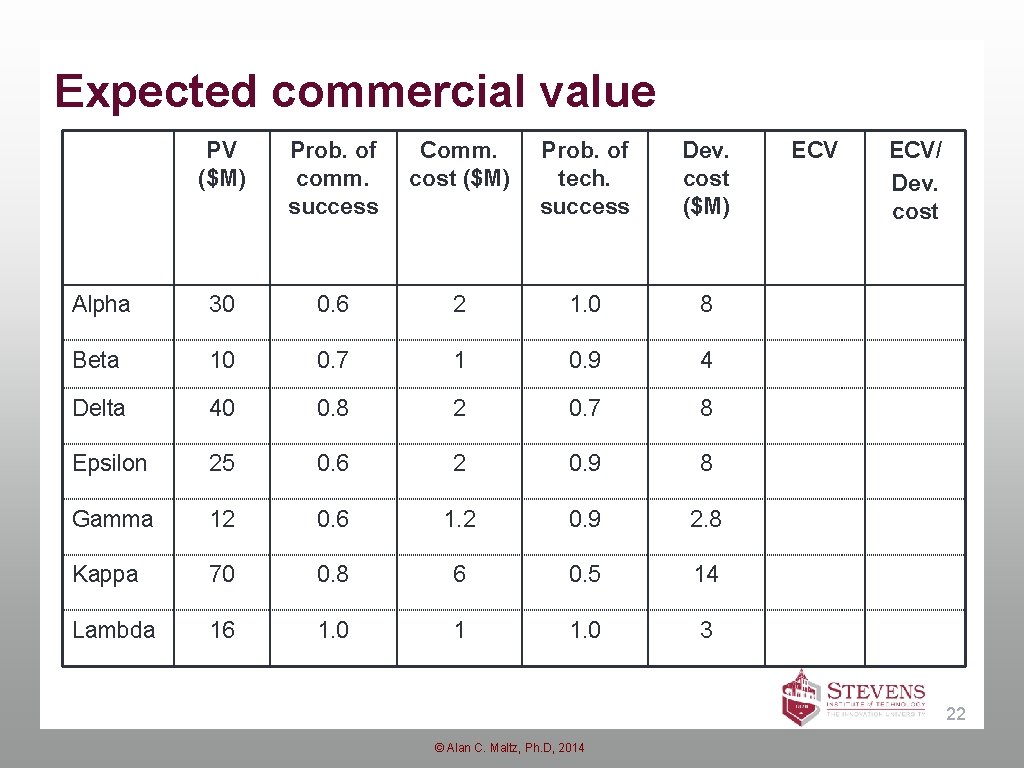
Expected commercial value PV ($M) Prob. of comm. success Comm. cost ($M) Prob. of tech. success Dev. cost ($M) Alpha 30 0. 6 2 1. 0 8 Beta 10 0. 7 1 0. 9 4 Delta 40 0. 8 2 0. 7 8 Epsilon 25 0. 6 2 0. 9 8 Gamma 12 0. 6 1. 2 0. 9 2. 8 Kappa 70 0. 8 6 0. 5 14 Lambda 16 1. 0 1 1. 0 3 ECV/ Dev. cost 22 © Alan C. Maltz, Ph. D, 2014
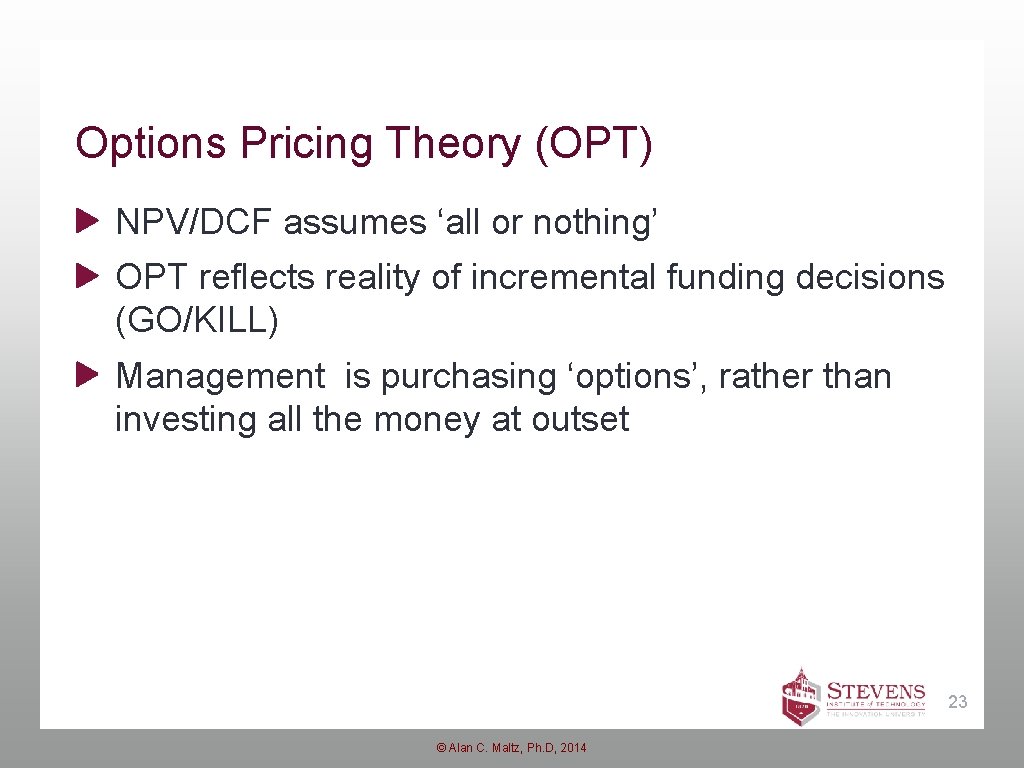
Options Pricing Theory (OPT) NPV/DCF assumes ‘all or nothing’ OPT reflects reality of incremental funding decisions (GO/KILL) Management is purchasing ‘options’, rather than investing all the money at outset 23 © Alan C. Maltz, Ph. D, 2014
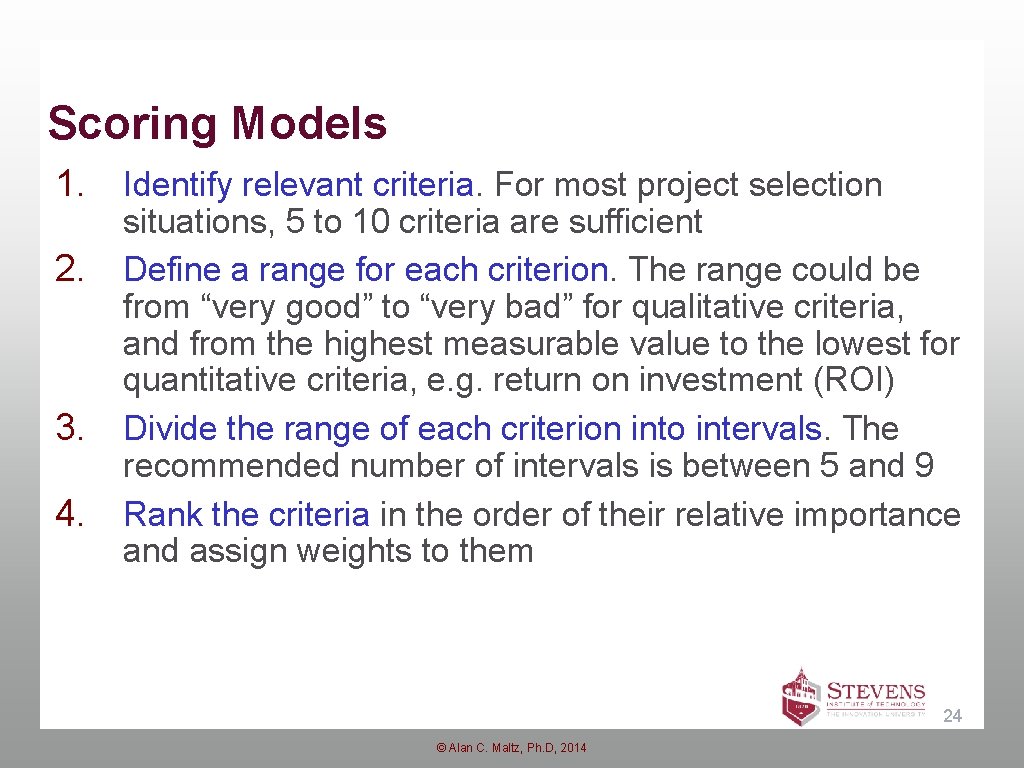
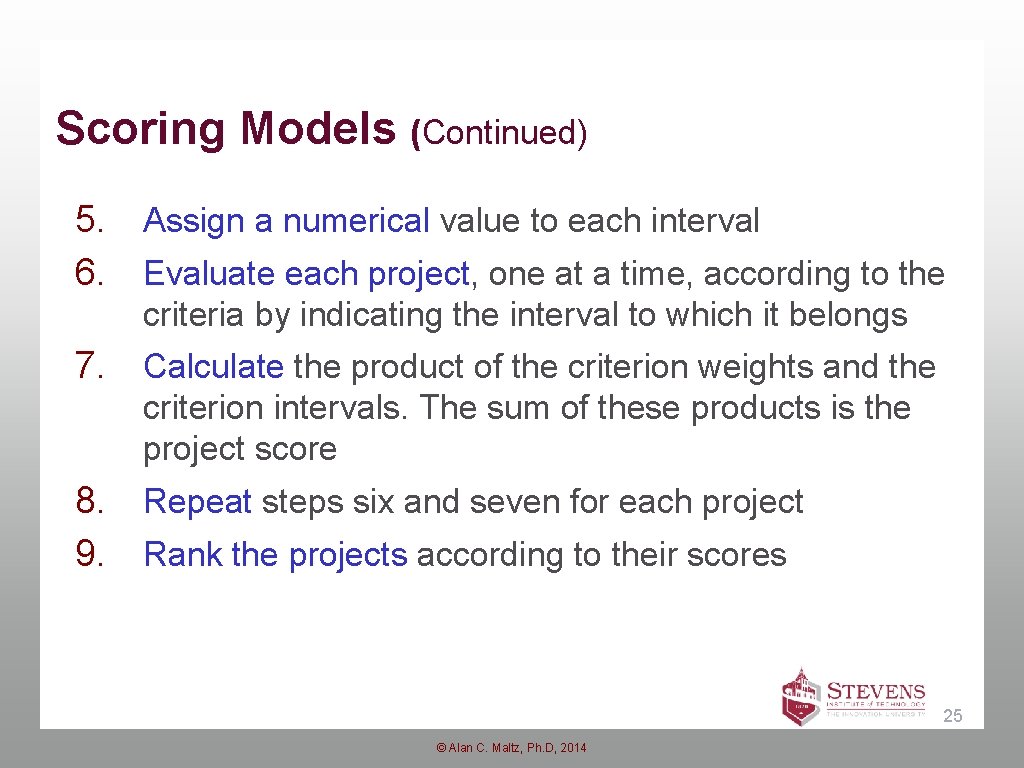
Scoring Models 1. 2. 3. 4. Identify relevant criteria. For most project selection situations, 5 to 10 criteria are sufficient Define a range for each criterion. The range could be from “very good” to “very bad” for qualitative criteria, and from the highest measurable value to the lowest for quantitative criteria, e. g. return on investment (ROI) Divide the range of each criterion into intervals. The recommended number of intervals is between 5 and 9 Rank the criteria in the order of their relative importance and assign weights to them 24 © Alan C. Maltz, Ph. D, 2014
Scoring Models (Continued) 5. 6. Assign a numerical value to each interval 7. Calculate the product of the criterion weights and the criterion intervals. The sum of these products is the project score 8. 9. Repeat steps six and seven for each project Evaluate each project, one at a time, according to the criteria by indicating the interval to which it belongs Rank the projects according to their scores 25 © Alan C. Maltz, Ph. D, 2014
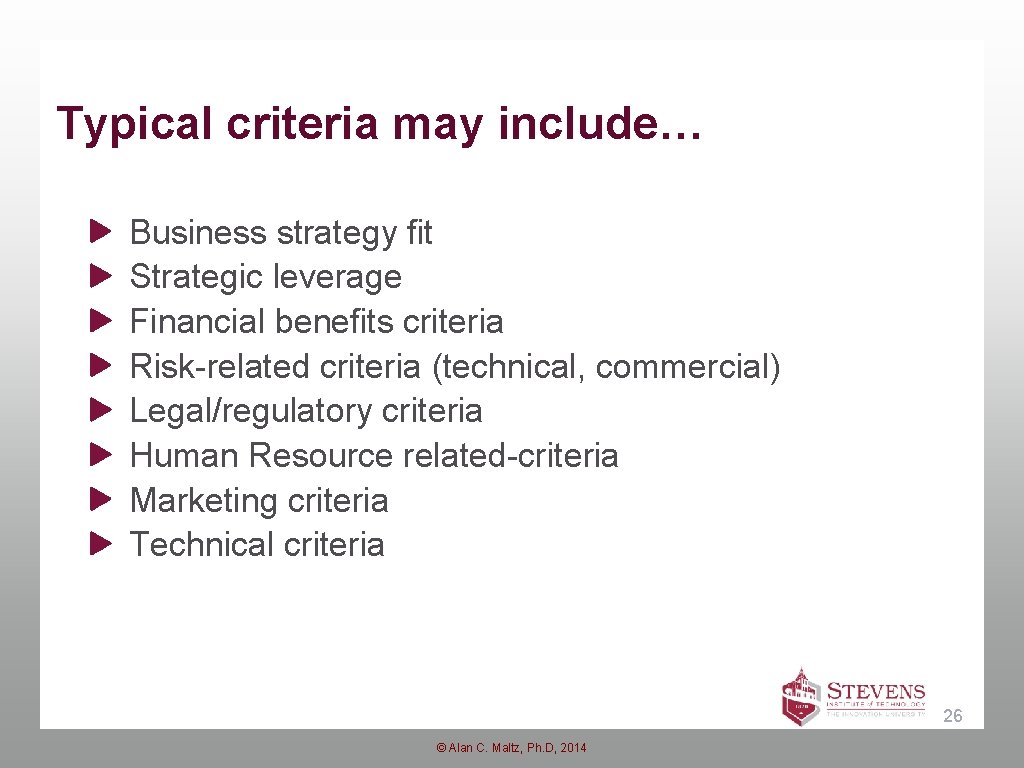
Typical criteria may include… Business strategy fit Strategic leverage Financial benefits criteria Risk-related criteria (technical, commercial) Legal/regulatory criteria Human Resource related-criteria Marketing criteria Technical criteria 26 © Alan C. Maltz, Ph. D, 2014
Project Scoring Model. . Criterion Interval Values (C ) 1. 0 Criterion 0. 8 0. 6 0. 4 Very Weight (W ) Good Medium Poor 0. 2 Very Rating Poor =Wx. C Use of Available Personnel 0. 15 Growth Potential 0. 20 Profitability 0. 30 x x x Competitive Advantage 0. 05 x Consistence with Technical Competence 0. 20 x Compatibility with Existing Project 0. 10 Sum 1. 00 x Project Score: 27 © Alan C. Maltz, Ph. D, 2014
A real project scoring model. . 28 © Alan C. Maltz, Ph. D, 2014
A real project scoring model. . Cont/d. . 29 © Alan C. Maltz, Ph. D, 2014
Advantages and disadvantages 30 © Alan C. Maltz, Ph. D, 2014
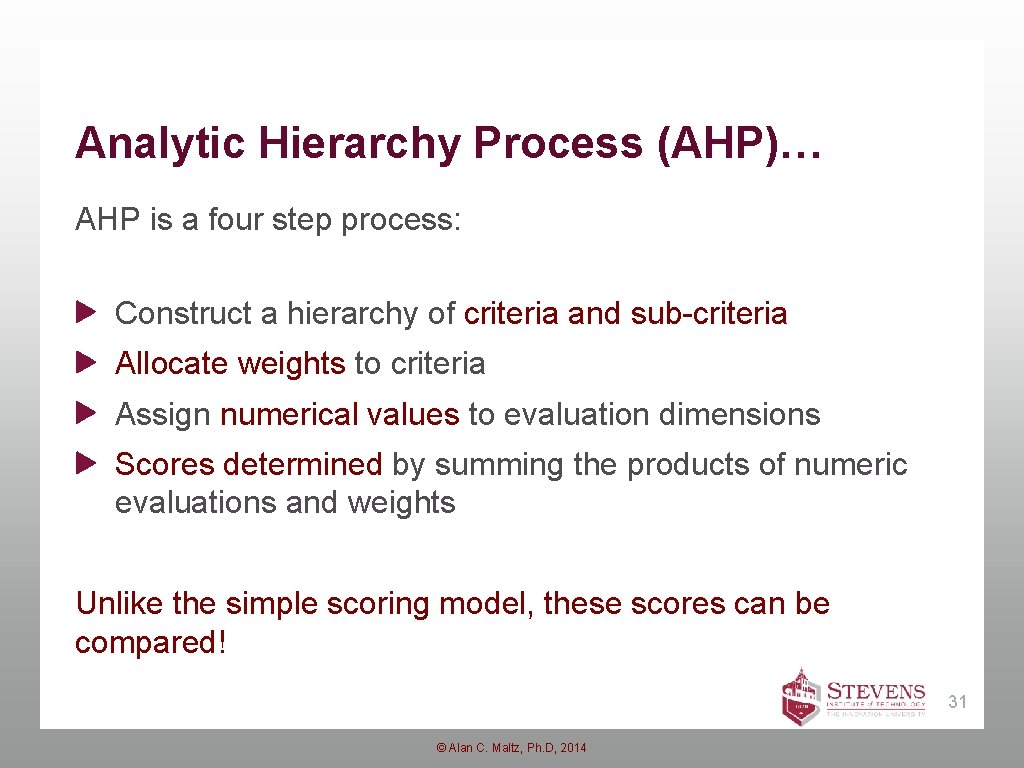
Analytic Hierarchy Process (AHP)… AHP is a four step process: Construct a hierarchy of criteria and sub-criteria Allocate weights to criteria Assign numerical values to evaluation dimensions Scores determined by summing the products of numeric evaluations and weights Unlike the simple scoring model, these scores can be compared! 31 © Alan C. Maltz, Ph. D, 2014
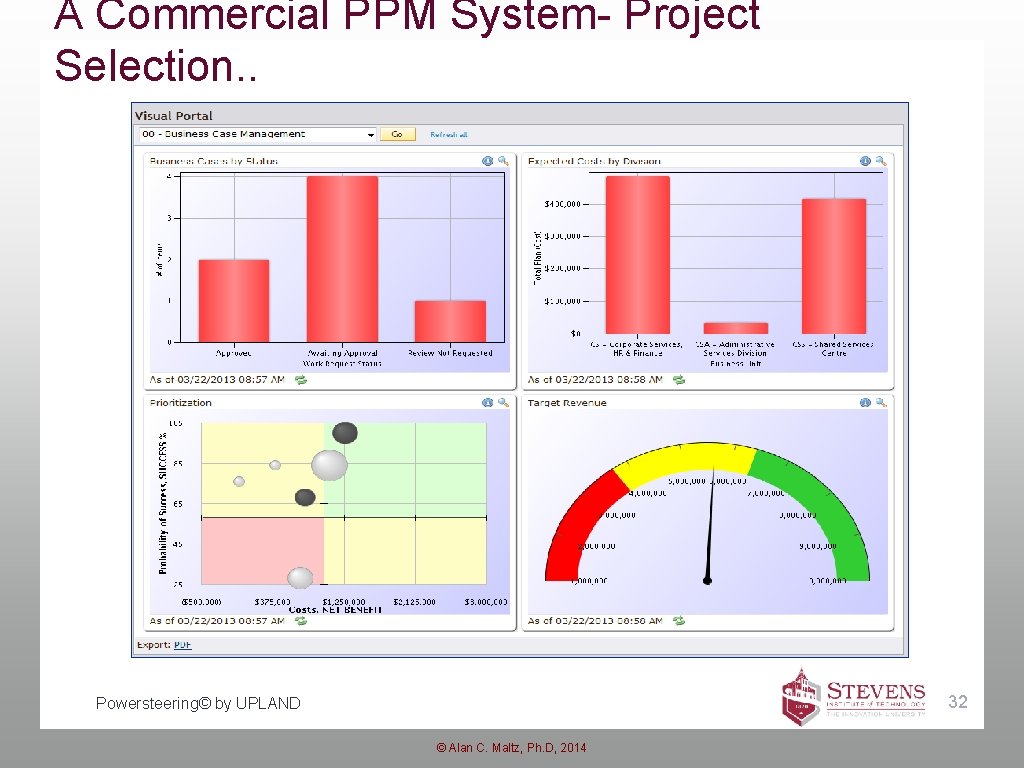
A Commercial PPM System- Project Selection. . 32 Powersteering© by UPLAND © Alan C. Maltz, Ph. D, 2014
Class exercise Develop a project evaluation method for your organization Justify why you propose such a method, including its elements 33 © Alan C. Maltz, Ph. D, 2014
Thank You - Questions? Alan C. Maltz, Ph. D. Howe School of Technology Management Stevens Institute of Technology Castle Point on the Hudson Hoboken, NJ 07030 Phone: +1 (561) 632 -4848 E-mail: alan. maltz@stevens. edu Web: http: //www. stevens. edu/ 34 © Alan C. Maltz, Ph. D, 2014