
MGNREGA Social Audit in Gujarat Rural Development Dept



- Slides: 29
MGNREGA Social Audit in Gujarat Rural Development Dept Government of Gujarat
Key Principles - Social Audit § § To create an environment of transparency and accountability with empowered people’s voice. Overall purpose is to check compliance as per the Act that is made for people. Grievances must be identified and redressed at the GP, Taluka and District level, It is a responsibility of the implementing agency. The purpose is not to haunt for corruption but to make the delivery mechanisms effective. (not fault finding, but fact finding)
Objectives of Social Audit • Environment of transparency and accountability towards public and the stakeholders. • To empower peoples voice. • To provide institutional mechanism to local, state level and stake-holders for people’s centric administration. • To facilitate technical support and services to the local bodies, district and state level institutions. • Identify the areas for change and reform in order to impact positively in improving administrative performance and achievements.
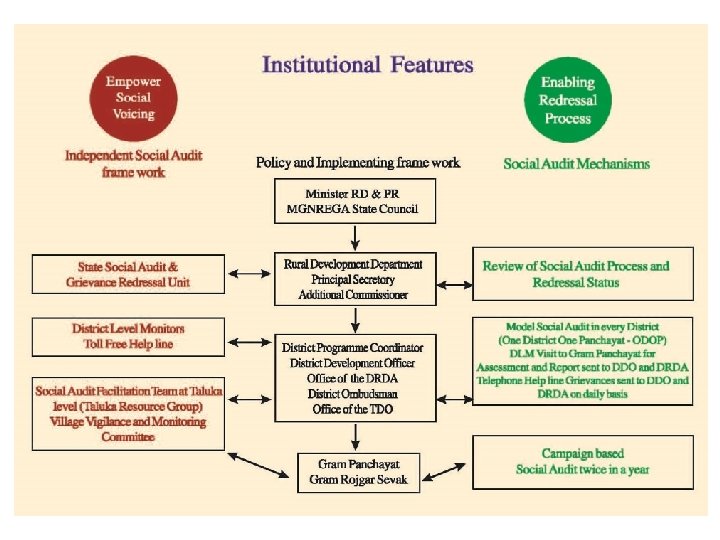
Institutional Structure and Operating Mechanisms § Unnati, a Gujarat based NGO was identified through a competitive process by CRD as Independent Social Audit Unit (a system enabler) for social audit and grievance Redressal § Phase - I (July 2009 – June 2010) worked from the CRD on the areas of demand generation, planning for labour budget and identification of works, monitoring, finance, capacity building, IEC, ICT, and social audit and grievance redressal. § Phase – II ( July 2010 – June 2011) worked independently with a joint governance mode on social audit and grievance redressal. A social audit framework was developed. § § Phase –III (Feb. 2012 – Jan. 2015) Rolling out of the social audit system by working closely with the official system
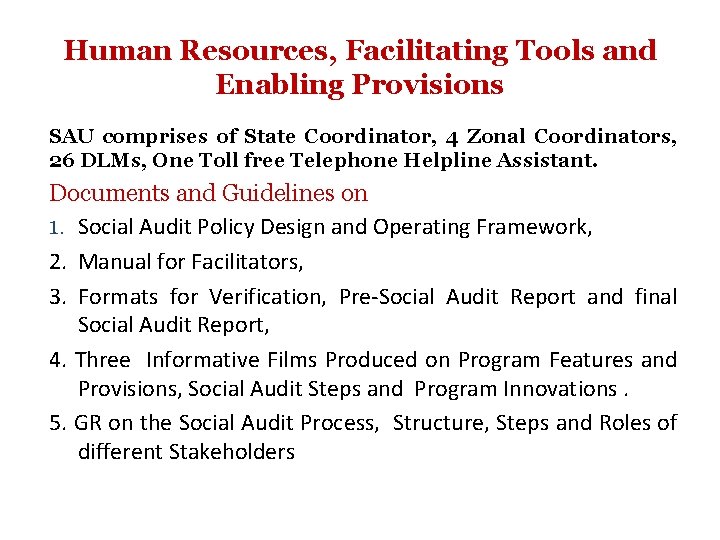
Human Resources, Facilitating Tools and Enabling Provisions SAU comprises of State Coordinator, 4 Zonal Coordinators, 26 DLMs, One Toll free Telephone Helpline Assistant. Documents and Guidelines on 1. Social Audit Policy Design and Operating Framework, 2. Manual for Facilitators, 3. Formats for Verification, Pre-Social Audit Report and final Social Audit Report, 4. Three Informative Films Produced on Program Features and Provisions, Social Audit Steps and Program Innovations. 5. GR on the Social Audit Process, Structure, Steps and Roles of different Stakeholders
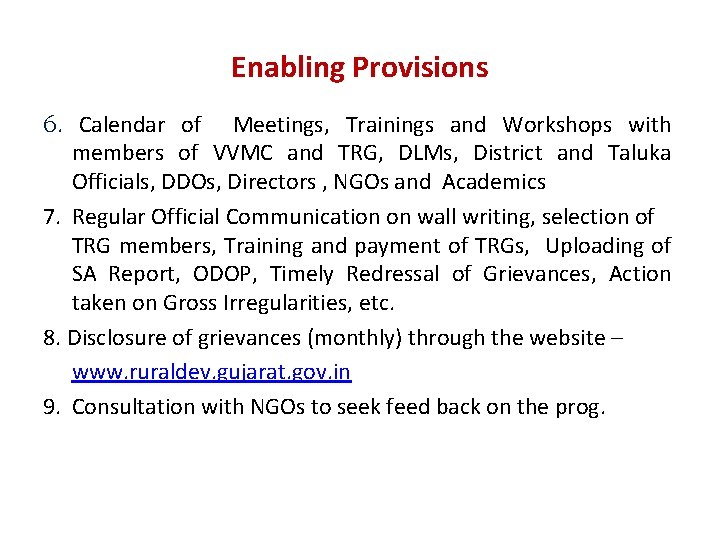
Enabling Provisions 6. Calendar of Meetings, Trainings and Workshops with members of VVMC and TRG, DLMs, District and Taluka Officials, DDOs, Directors , NGOs and Academics 7. Regular Official Communication on wall writing, selection of TRG members, Training and payment of TRGs, Uploading of SA Report, ODOP, Timely Redressal of Grievances, Action taken on Gross Irregularities, etc. 8. Disclosure of grievances (monthly) through the website – www. ruraldev. gujarat. gov. in 9. Consultation with NGOs to seek feed back on the prog.
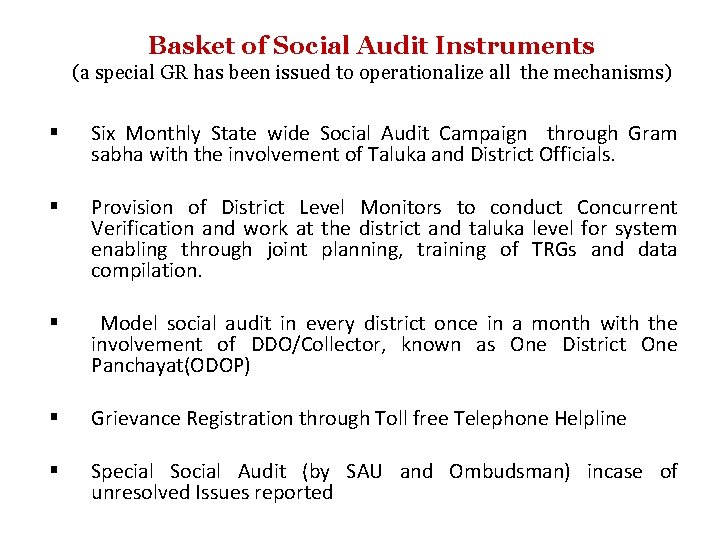
Basket of Social Audit Instruments (a special GR has been issued to operationalize all the mechanisms) § Six Monthly State wide Social Audit Campaign through Gram sabha with the involvement of Taluka and District Officials. § Provision of District Level Monitors to conduct Concurrent Verification and work at the district and taluka level for system enabling through joint planning, training of TRGs and data compilation. § Model social audit in every district once in a month with the involvement of DDO/Collector, known as One District One Panchayat(ODOP) § Grievance Registration through Toll free Telephone Helpline § Special Social Audit (by SAU and Ombudsman) incase of unresolved Issues reported
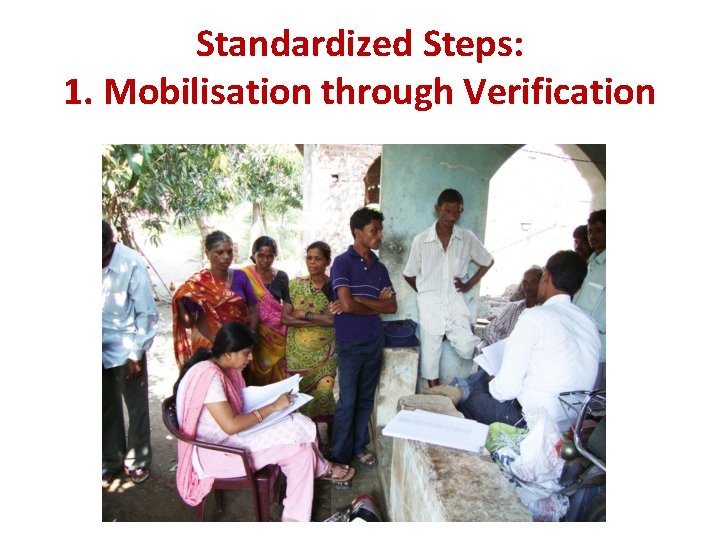
Standardized Steps: 1. Mobilisation through Verification
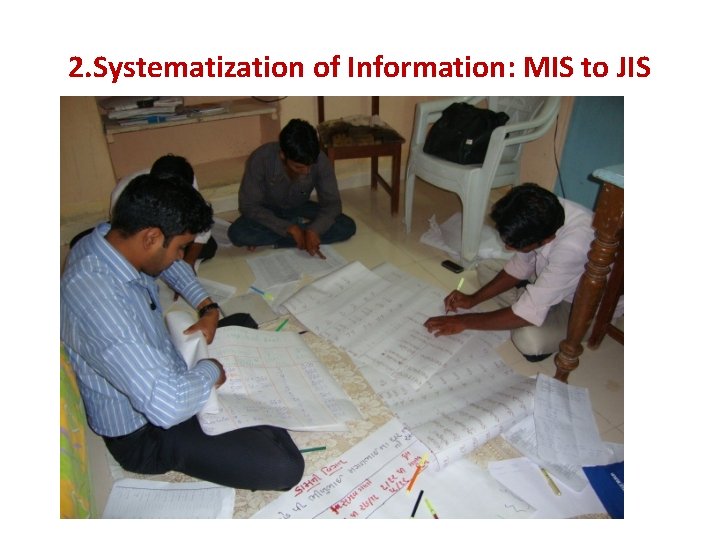
2. Systematization of Information: MIS to JIS
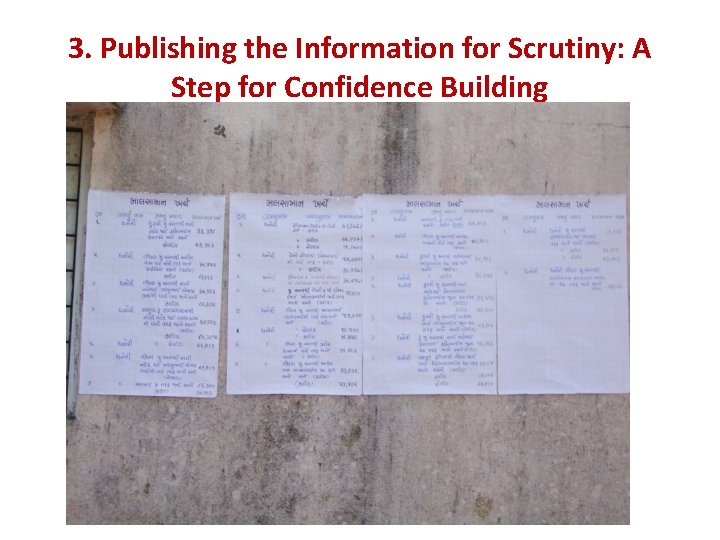
3. Publishing the Information for Scrutiny: A Step for Confidence Building
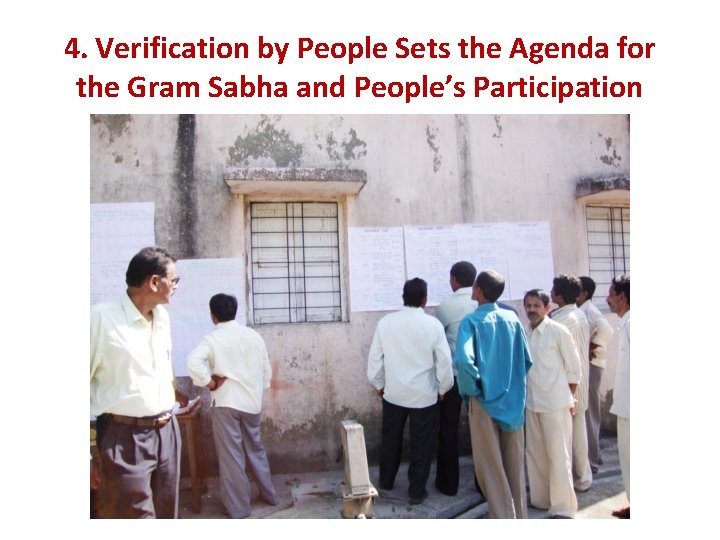
4. Verification by People Sets the Agenda for the Gram Sabha and People’s Participation
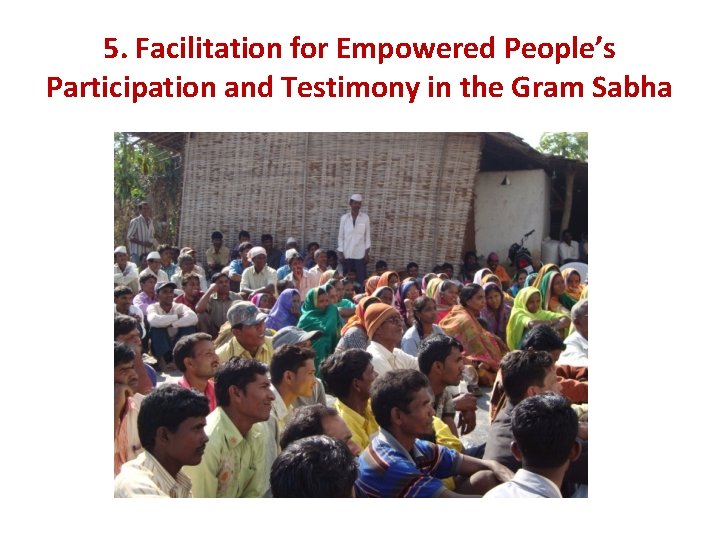
5. Facilitation for Empowered People’s Participation and Testimony in the Gram Sabha
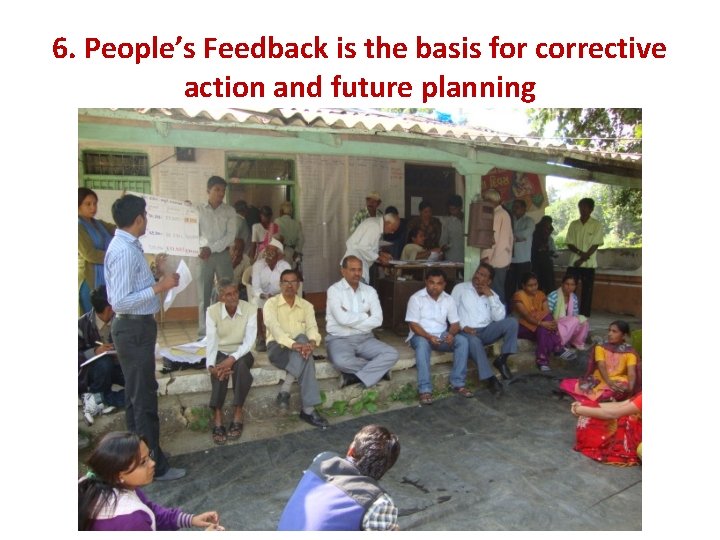
6. People’s Feedback is the basis for corrective action and future planning
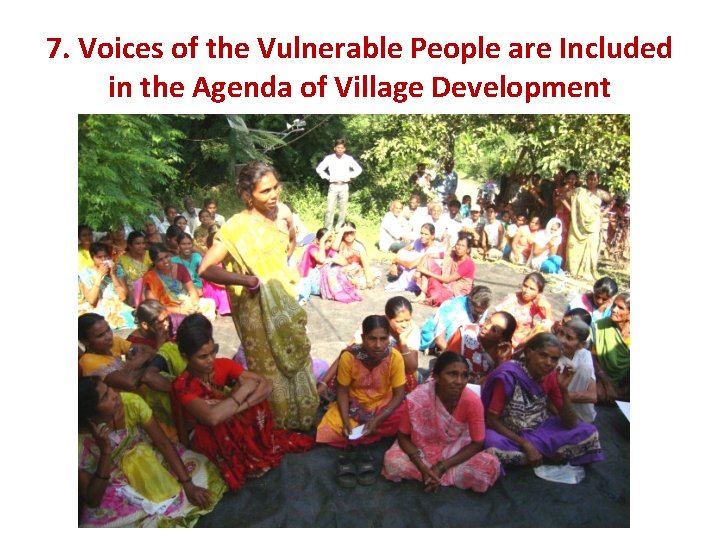
7. Voices of the Vulnerable People are Included in the Agenda of Village Development
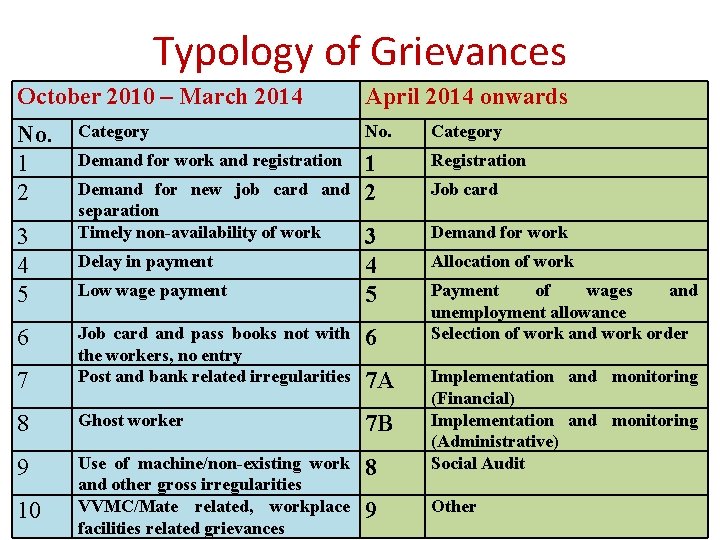
Typology of Grievances October 2010 – March 2014 No. 1 2 3 4 5 April 2014 onwards Category No. Category Demand for work and registration 1 2 Registration 3 4 5 Demand for work Demand for new job card and separation Timely non-availability of work Delay in payment Low wage payment Job card Allocation of work Payment of wages and unemployment allowance Selection of work and work order 6 7 Job card and pass books not with the workers, no entry Post and bank related irregularities 8 Ghost worker 7 B 9 Use of machine/non-existing work and other gross irregularities VVMC/Mate related, workplace facilities related grievances 8 Implementation and monitoring (Financial) Implementation and monitoring (Administrative) Social Audit 9 Other 6 10 7 A
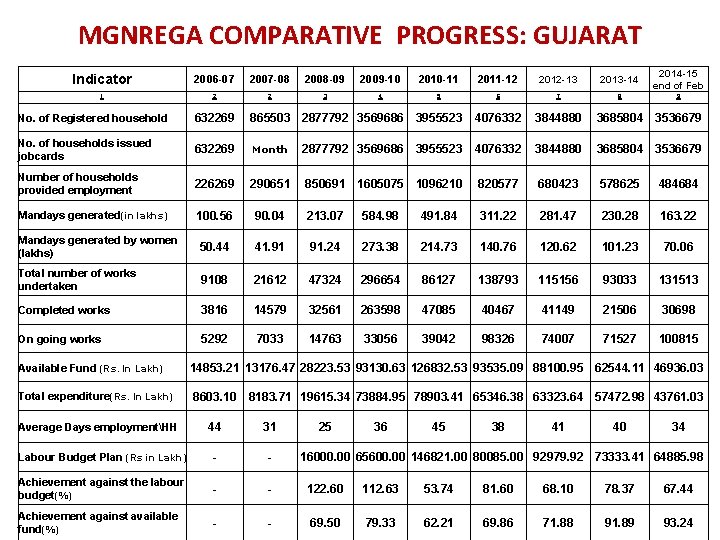
MGNREGA COMPARATIVE PROGRESS: GUJARAT 2014 -15 Indicator 2006 -07 2007 -08 2008 -09 2009 -10 2010 -11 2011 -12 2012 -13 2013 -14 1 2 2 3 4 5 6 7 8 9 end of Feb No. of Registered household 632269 865503 2877792 3569686 3955523 4076332 3844880 3685804 3536679 No. of households issued jobcards 632269 Month 2877792 3569686 3955523 4076332 3844880 3685804 3536679 Number of households provided employment 226269 290651 850691 1605075 1096210 820577 680423 578625 484684 Mandays generated(in lakhs) 100. 56 90. 04 213. 07 584. 98 491. 84 311. 22 281. 47 230. 28 163. 22 Mandays generated by women (lakhs) 50. 44 41. 91 91. 24 273. 38 214. 73 140. 76 120. 62 101. 23 70. 06 Total number of works undertaken 9108 21612 47324 296654 86127 138793 115156 93033 131513 Completed works 3816 14579 32561 263598 47085 40467 41149 21506 30698 On going works 5292 7033 14763 33056 39042 98326 74007 71527 100815 Available Fund (Rs. In Lakh) 14853. 21 13176. 47 28223. 53 93130. 63 126832. 53 93535. 09 88100. 95 62544. 11 46936. 03 Total expenditure(Rs. In Lakh) 8603. 10 8183. 71 19615. 34 73884. 95 78903. 41 65346. 38 63323. 64 57472. 98 43761. 03 Average Days employmentHH 44 31 Labour Budget Plan (Rs in Lakh) - - Achievement against the labour budget(%) - - 122. 60 112. 63 53. 74 81. 60 68. 10 78. 37 67. 44 Achievement against available fund(%) - - 69. 50 79. 33 62. 21 69. 86 71. 88 91. 89 93. 24 25 36 45 38 41 40 34 16000. 00 65600. 00 146821. 00 80085. 00 92979. 92 73333. 41 64885. 98
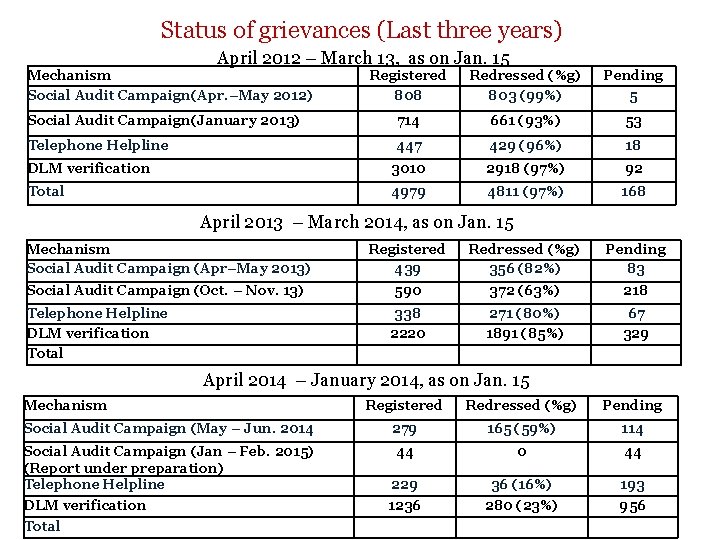
Status of grievances (Last three years) April 2012 – March 13, as on Jan. 15 Mechanism Social Audit Campaign(Apr. –May 2012) Registered 808 Redressed (%g) 803 (99%) Pending 5 Social Audit Campaign(January 2013) 714 661 (93%) 53 Telephone Helpline 447 429 (96%) 18 DLM verification 3010 2918 (97%) 92 Total 4979 4811 (97%) 168 April 2013 – March 2014, as on Jan. 15 Mechanism Social Audit Campaign (Apr–May 2013) Registered 439 Redressed (%g) 356 (82%) Pending 83 Social Audit Campaign (Oct. – Nov. 13) 590 372 (63%) 218 338 2220 271 (80%) 1891 (85%) 67 329 Telephone Helpline DLM verification Total April 2014 – January 2014, as on Jan. 15 Mechanism Registered Redressed (%g) Pending Social Audit Campaign (May – Jun. 2014 279 165 (59%) 114 Social Audit Campaign (Jan – Feb. 2015) (Report under preparation) Telephone Helpline DLM verification Total 44 0 44 229 1236 36 (16%) 280 (23%) 193 956
Social Audit Campaign : Quality Parameters Particular No. of panchayats whose records were available No. of instances where TRG member was present No. of GPs where verification was done No. of instances where SA format was filled Total TRG members Training of TRG members No. of GPs Observed by DLMs and state SAU No. of grievances regd. in the gram sabha Total grievances redressed April – May 2012 Jan 2013 11896 11828 April – May 2013 10334 Oct. Nov. 2013 9380 6762 (72%) 9433 8232 7086 (79%) 9864 (70%) 8842 (69%) 7602 (83%) 9949 (75%) 10013 (74%) 8756 (84%) 1580 (85%) 1442 (85%) 1622 1210 (77%) 312 1075 (75%) 307 1224 (75%) 463 949 (73%) 808 714 803 661 7392 (79%) 8020 (86%) May Jun. 2014 11762 9629 (82%) 9951 (85%) 11055 Jan Feb 2015 Reco rds are being Comp iled (94%) 2000 1840 340 1562 (78%) 361 1418 (77%) 199 439 590 279 44 356 372 165 0 1294
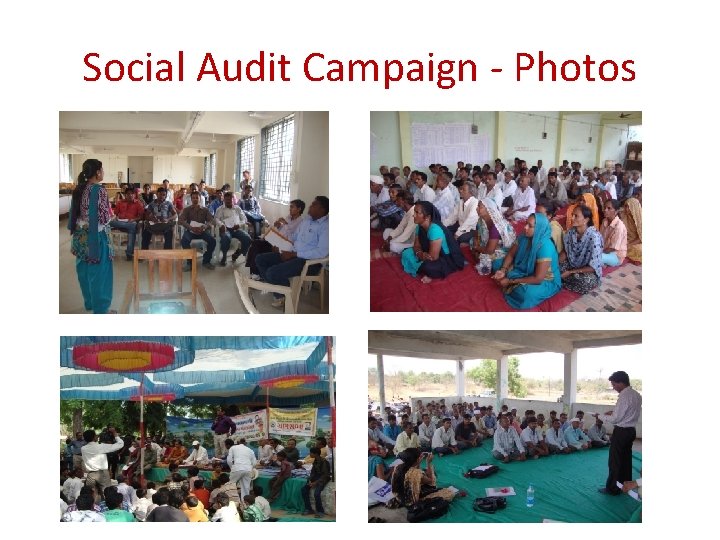
Social Audit Campaign - Photos
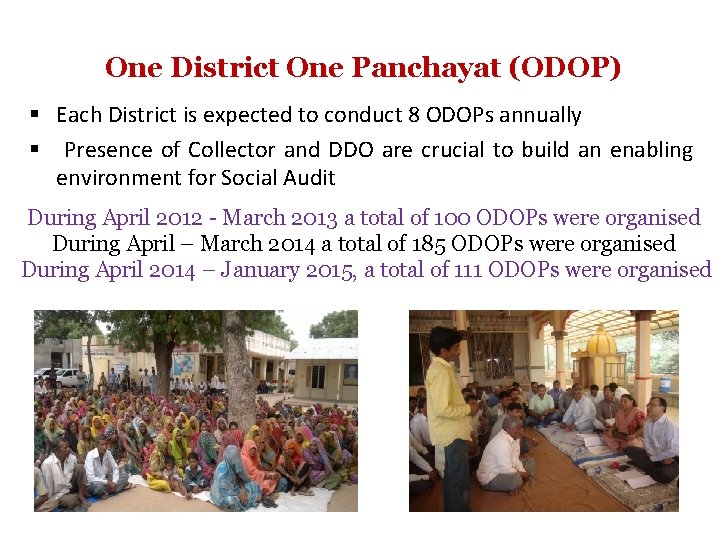
One District One Panchayat (ODOP) § Each District is expected to conduct 8 ODOPs annually § Presence of Collector and DDO are crucial to build an enabling environment for Social Audit During April 2012 - March 2013 a total of 100 ODOPs were organised During April – March 2014 a total of 185 ODOPs were organised During April 2014 – January 2015, a total of 111 ODOPs were organised
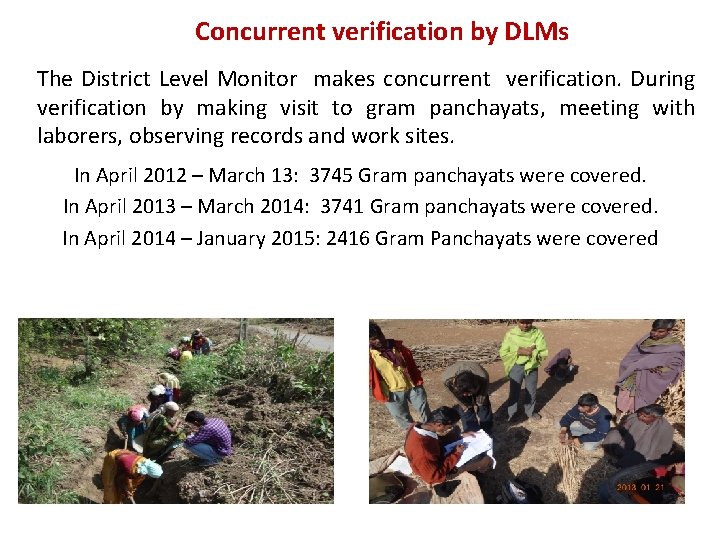
Concurrent verification by DLMs The District Level Monitor makes concurrent verification. During verification by making visit to gram panchayats, meeting with laborers, observing records and work sites. In April 2012 – March 13: 3745 Gram panchayats were covered. In April 2013 – March 2014: 3741 Gram panchayats were covered. In April 2014 – January 2015: 2416 Gram Panchayats were covered
Toll Free. Telephone helpline 1800 233 4567 Operated by SAU § § § Districts have done wall writing of the toll free number. Calls are related to general information regarding the scheme, GRS appointment and salary, grievances related to late payment of wage, demand for work and other serious irregularities like use of machine. On receiving the call on grievance, a receipt is sent to the complainant and the copy is forwarded to the DDO and the Director. In April 12 – March 13: 447 grievances were registered, while 1972 calls were received for information. In April 13 – March 14: 336 grievances were registered, While 1067 calls were received for information In April 14 – January 15: 225 grievances were registered, While 864 calls were received for information
Issues before Effective implementation of Social Audit Collective understanding on role of SAU as system enabler rather than searching irregularities. 2. The social audit campaign has universal coverage, high expenditure and maximum involvement, however the total grievance registered is very low – need for system reform in the context of the 4 th edition of Operational Guidelines. 3. ODOPs (One District One Panchayat) needs more attention as it can build an enabling environment for robust social audit practices. 4. Developing mechanisms so that work is not discontinued after identification and verification of irregularities 5. Time plan of district and taluka MGNREGA staff members for redressal of grievances 1.
Issues before Effective implementation of Social Audit 6. Strengthening of TRG by pre allocation of specific GPs and ensuring their responsibilities and payment. 7. Involvement of VVMC members and their training to make social audit campaign effective. 8. Enhanced attention on those GPs where work is done in the last six months prior to the social audit. 9. Independent functioning of the Social Audit Unit.
Regarding the establishment of SAU by the Dept • Govt of Gujarat after careful consideration has consider approval of a Dept level SAU as per the GOI direction dated 11/06/2014 & 11/08/2014 • The following positions are being approved by Govt of India Director SAU : 1 Post Social Audit Expert : 5 District Social Auditor : 16
Action Plan of the State • Gujarat has well established system of Social Audit implementation across the State. • Core strength of the present system – Well defined method of social audit and supporting components. – Trained TRGs (approx 1840 members ), 26 DLMs and 4 Zonal Coordinators to facilitate – Good feedback and documentation system in place • Previously Dept has assigned the responsibilities to the Unnati (CSO) however as per the new direction of GOI the SAU team will take charge of the responsibilities as it has been advised. • Dept will ensure utilization of the strengths of the existing system and the manpower will be replaced with the new arrangements.
Impact of Social Audit • The entire system became more accountable towards the implementation at the local level. • Participation of the local community in the process of development is ensured. • Created a platform to discuss and resolve the issues of mutual interest. • Greater awareness generation about the programme at the cutting edge level.
THANK YOU