
MGMT 203 Airports Airspace and Air Traffic Control


- Slides: 71
MGMT 203 Airports, Airspace, and Air Traffic Control Management Module 7
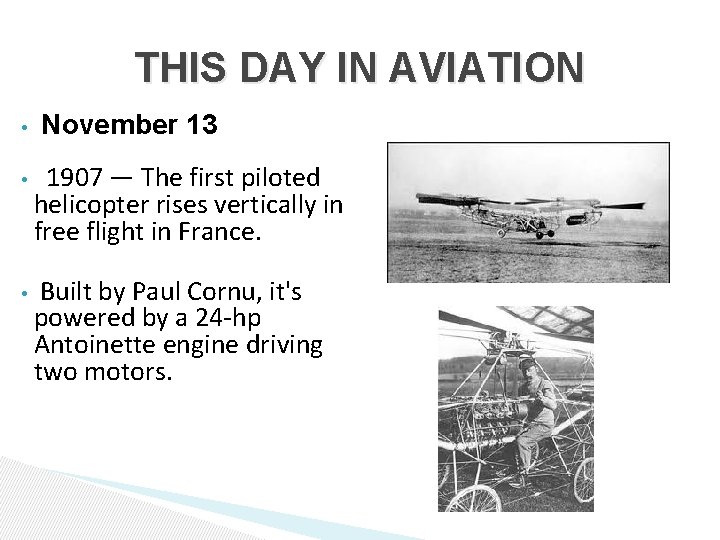
THIS DAY IN AVIATION • November 13 • 1907 — The first piloted helicopter rises vertically in free flight in France. • Built by Paul Cornu, it's powered by a 24 hp Antoinette engine driving two motors.
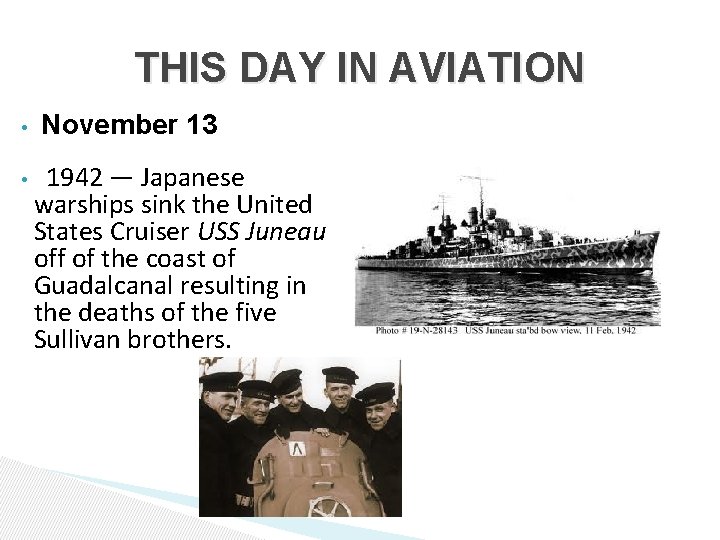
THIS DAY IN AVIATION • • November 13 1942 — Japanese warships sink the United States Cruiser USS Juneau off of the coast of Guadalcanal resulting in the deaths of the five Sullivan brothers.
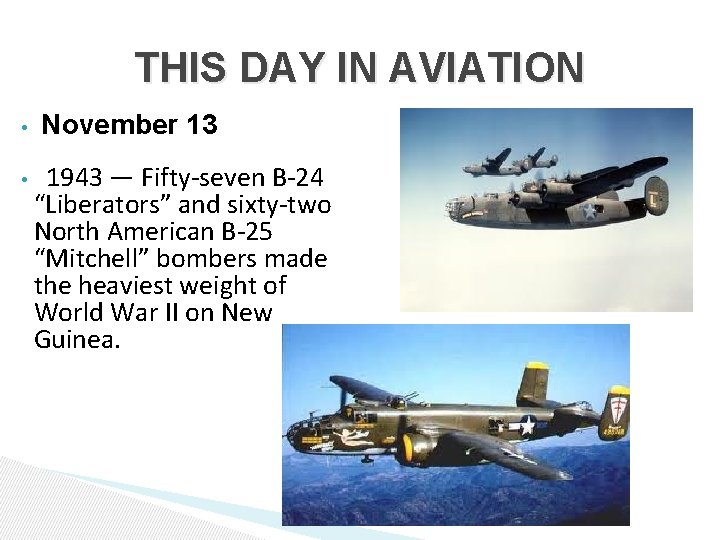
THIS DAY IN AVIATION • • November 13 1943 — Fifty seven B 24 “Liberators” and sixty two North American B 25 “Mitchell” bombers made the heaviest weight of World War II on New Guinea.
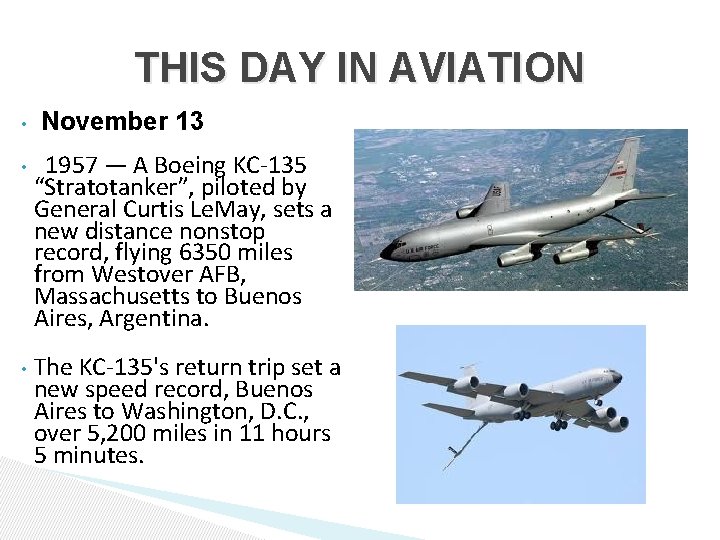
THIS DAY IN AVIATION • November 13 • 1957 — A Boeing KC 135 “Stratotanker”, piloted by General Curtis Le. May, sets a new distance nonstop record, flying 6350 miles from Westover AFB, Massachusetts to Buenos Aires, Argentina. • The KC 135's return trip set a new speed record, Buenos Aires to Washington, D. C. , over 5, 200 miles in 11 hours 5 minutes.
Questions / Comments
Management of Aeronautical Science Learning Objectives – Module 7 (11/13/17 – 11/21/17) Airports, Airspace, and Air Traffic Control Management Mon/Tues/Wed Upon successful completion of this module, you will be able to: 1. Explain the impact of airport design, development, operations, and funding sources on airport systems. 2. Explain the purpose of an airport. 3. Describe Air Traffic Control Towers (ATCTs) and their purpose. 4. Compare air traffic control systems between en route, terminal, tower, and flight service functions. 5. Demonstrate an understanding of the Title 14 CFR Parts that are used to operate airports. 6. Explain the purpose of the Air Traffic System Command Center (ATCSCC) and location. 7. Outline the basic structure of the national airspace system, and describe the impact of the FAA's National Airspace System Plan (NASP). 8. Describe the Flight Service Station (FSS) and its services. 9. Describe the requirements for a reliever airport classification. 10. Critique the Airport Certification Manual. 11. Describe the Airport Emergency Plan (AEP) requirements.
Readings • Refer to Readings on ERAU Website Mod 7 • Pilots Handbook of Aeronautical Knowledge – Chapter 14 – Airport Operations – Chapter 15 – Airspace • Title 14 Code of Federal Regulations (CFR) Please review 14 CFR Parts: – 36, 71, 73, 139, and 150. • Textbook – Business and Corporate Aviation Management – Chapter 5: Flight Department
SUNDAY 5 MONDAY November 2017 TUESDAY WEDNESDAY THURSDAY FRIDAY 6 7 8 9 10 Module 6 Flightline Human Factors and CRM Friday Discussion Due 12 13 14 15 Module 7 16 SATURDAY 11 Review Questions Due 17 18 Beaufort County Airport Intro Airports, Airspace, and Air (ILT) Airports, Traffic Control Airspace, and Air Traffic Control Management Flightline 19 20 21 22 23 24 25 Module 7 NO SCHOOL Airports, Airspace, and Air Traffic Control Management Discussion Due Review Questions Due Friday Thanksgiving
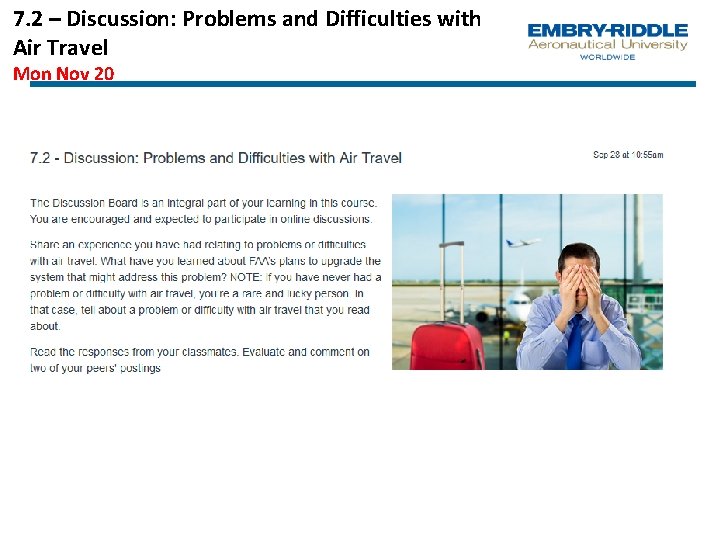
7. 2 – Discussion: Problems and Difficulties with Air Travel Mon Nov 20
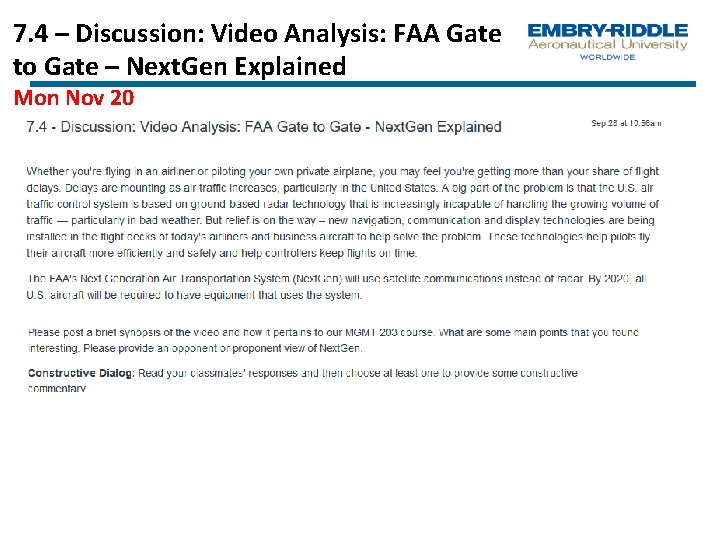
7. 4 – Discussion: Video Analysis: FAA Gate to Gate – Next. Gen Explained Mon Nov 20
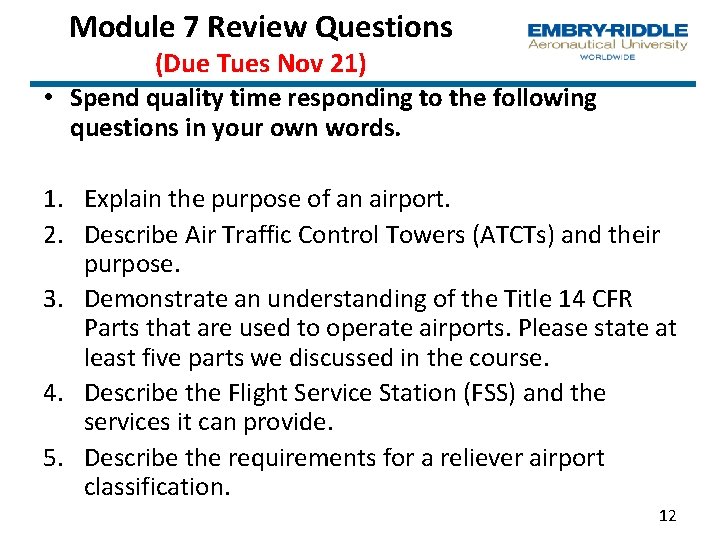
Module 7 Review Questions (Due Tues Nov 21) • Spend quality time responding to the following questions in your own words. 1. Explain the purpose of an airport. 2. Describe Air Traffic Control Towers (ATCTs) and their purpose. 3. Demonstrate an understanding of the Title 14 CFR Parts that are used to operate airports. Please state at least five parts we discussed in the course. 4. Describe the Flight Service Station (FSS) and the services it can provide. 5. Describe the requirements for a reliever airport classification. 12
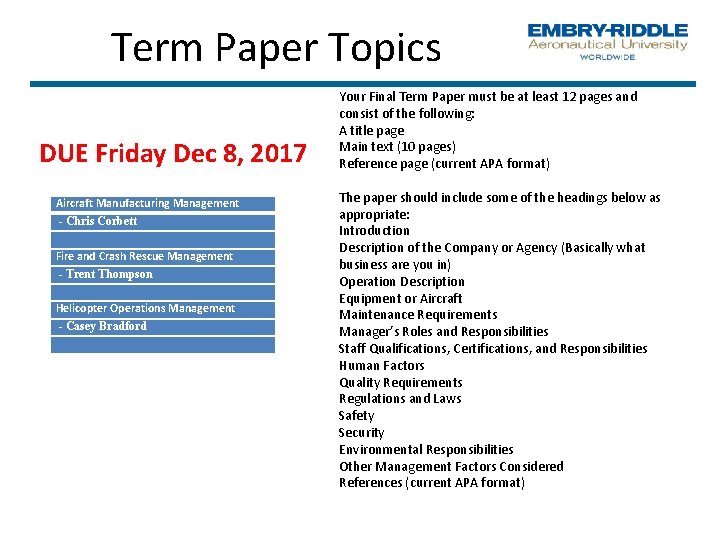
Term Paper Topics DUE Friday Dec 8, 2017 Aircraft Manufacturing Management - Chris Corbett Fire and Crash Rescue Management - Trent Thompson Helicopter Operations Management - Casey Bradford Your Final Term Paper must be at least 12 pages and consist of the following: A title page Main text (10 pages) Reference page (current APA format) The paper should include some of the headings below as appropriate: Introduction Description of the Company or Agency (Basically what business are you in) Operation Description Equipment or Aircraft Maintenance Requirements Manager’s Roles and Responsibilities Staff Qualifications, Certifications, and Responsibilities Human Factors Quality Requirements Regulations and Laws Safety Security Environmental Responsibilities Other Management Factors Considered References (current APA format)
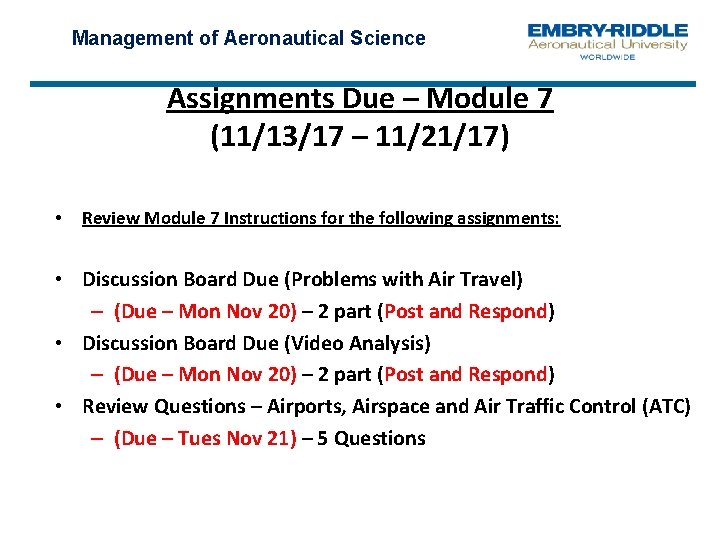
Management of Aeronautical Science Assignments Due – Module 7 (11/13/17 – 11/21/17) • Review Module 7 Instructions for the following assignments: • Discussion Board Due (Problems with Air Travel) – (Due – Mon Nov 20) – 2 part (Post and Respond) • Discussion Board Due (Video Analysis) – (Due – Mon Nov 20) – 2 part (Post and Respond) • Review Questions – Airports, Airspace and Air Traffic Control (ATC) – (Due – Tues Nov 21) – 5 Questions
Questions / Comments
Airports 16
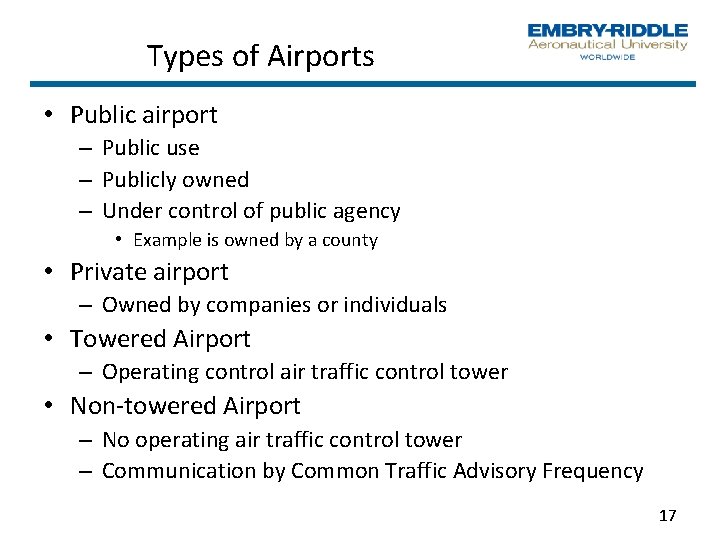
Types of Airports • Public airport – Public use – Publicly owned – Under control of public agency • Example is owned by a county • Private airport – Owned by companies or individuals • Towered Airport – Operating control air traffic control tower • Non towered Airport – No operating air traffic control tower – Communication by Common Traffic Advisory Frequency 17
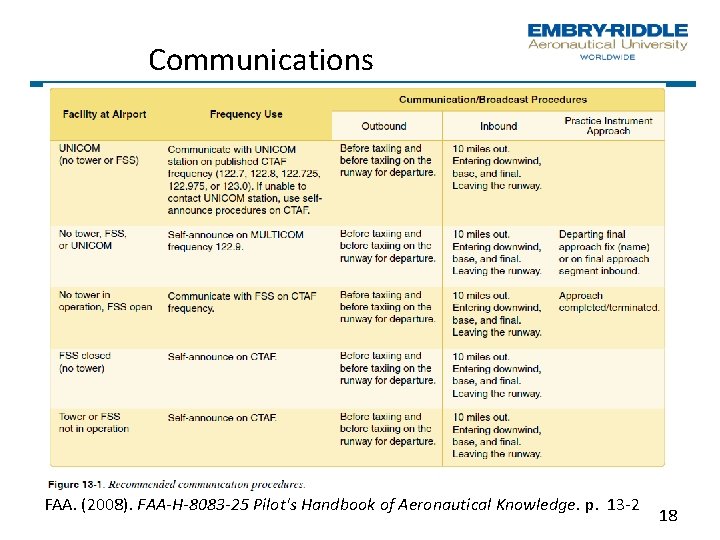
Communications FAA. (2008). FAA H 8083 25 Pilot's Handbook of Aeronautical Knowledge. p. 13 2 18
Types of Airports • Military and Federal Government Airports – National Aeronautics and Space Administration (NASA) • General Aviation (GA) airports – Have fewer than 2, 500 annual enplaned (boarding aircraft) passengers – Private and business aircraft • Reliever airports – General aviation type airports – Relieve congestion or relief for primary commercial airports 19
Airports Components • Landside – Movement of passengers, vehicle parking provisions, and cargo access • Airside – Aircraft, ground handling equipment, airport and airline employees, emergency equipment, and airspace around the airport. – Includes facilities, taxiways, runways, parking areas, communication and navigation aids, and gates. • Terminals and fencing separate the landside and airside. 20
Airports Design and Development • AC 150/5300 13 A: Airport Design • Specific planning guidance on designing civil airports • Provides guidelines for Title 14 CFR 139 Certifications of Airports – Basic design process – Runway design requirements – Taxiway design – Aprons (located near the terminal area) – Navigational aids and Airport ATC facilities – Airfield bridges and tunnels 21
Airport Operating Certificates • Title 14 CFR Part 139 Certification of Airports • Issued by the FAA to airports serving air carrier aircraft with more than 30 passenger seats. – For operation of Class 1 4 airports – Scheduled or unscheduled operations – Must meet minimum safety standards in Part 139 • Must have an Airport Certification Manual approved by FAA. 22
Airport Certification Manual • Title 14 CFR Part 139 Certification of Airports • Required for airports certified for serving air carriers. • Contains airport opera tional procedures • Required for full compliance with FAR Part 139 • Airport Certification Specifications (ACS) – Describe airport opera tional procedures required for limited compliance. 23
Airport Emergency Plan • Part of the Airport Certification Manual or may be a separate document. • Provides detailed response procedures for – Emergencies (accidents, security threats, fires, and national disasters) or abnormal conditions. • Procedures are for all personnel and departments associated with the airport and those outside airport that provide assistance in the event of an emergency. – Aircraft Rescue and Firefighting (ARFF) – Hospitals and ambulances – Law enforcement • Reviewed annually • Emergency exercise is practiced every 3 years • AC 150/5200 31 A, Airport Emergency Plan 24
Airport Operations • Supported and supervised by FAA – Airports serving commercial air carriers – FAA Airport District Office (ADO) are regionally located near airports to assist airport operators. • State and local regulations specific to airport • Each air port may have a published rules, policies, and regulations covering all airport users. • Consider – – – Takeoff and landing operations Ground operations Traffic pattern operations Runway Incursion Avoidance Safety and security requirements 25
Airport Financing • Airport operating revenue – Terminal, landing fees, and other charges • Passenger Facility Charges – Aviation Safety and Capacity Expansion Act of 1990 – Used for financing airport development – Non aeronautical revenue (parking, concessions, and hotel/rental cars) • Airport bonds – Financing available to airports – General (secured by assets and revenue) – Revenue (unsecured) – Municipally issued bonds are exempt from federal taxes 26
Questions / Comments
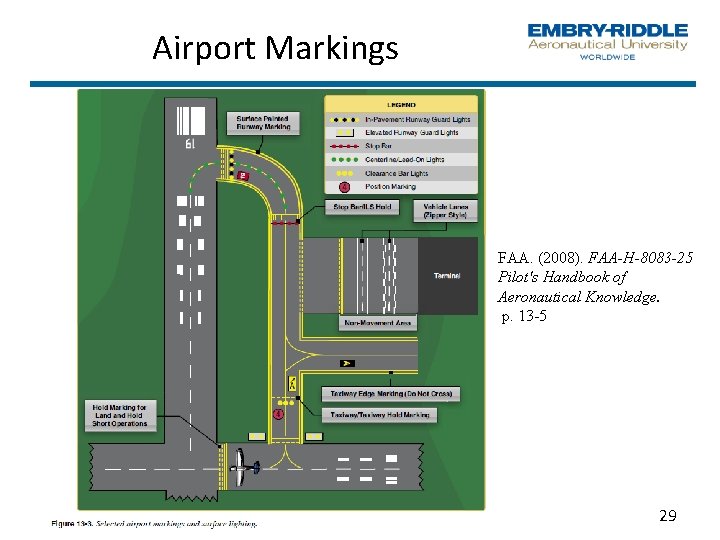
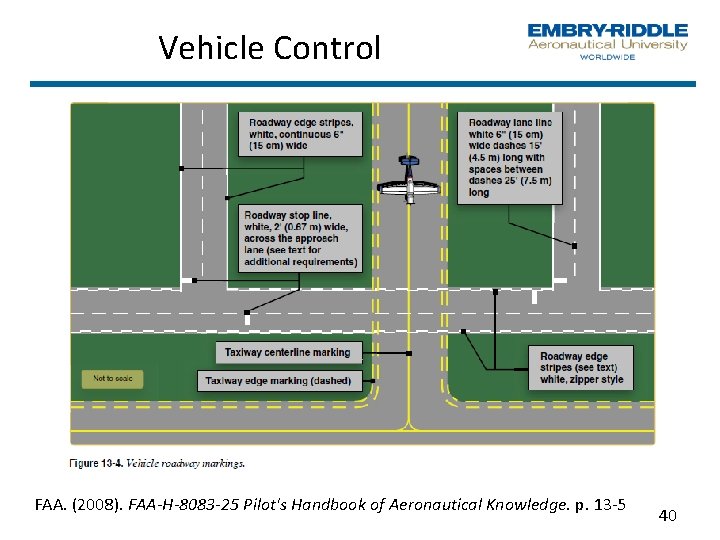
Airport Markings • Used for control and communications • Ground markings and lights – Runway markings • Painted white and white lights at night – Taxiway markings • Painted yellow • Blue lights – Vehicle roadway markings – Boundary markings for non movement areas • Have many types of lights that are dependent upon airport complexity but are standardized. 28
Airport Markings FAA. (2008). FAA-H-8083 -25 Pilot's Handbook of Aeronautical Knowledge. p. 13 -5 29
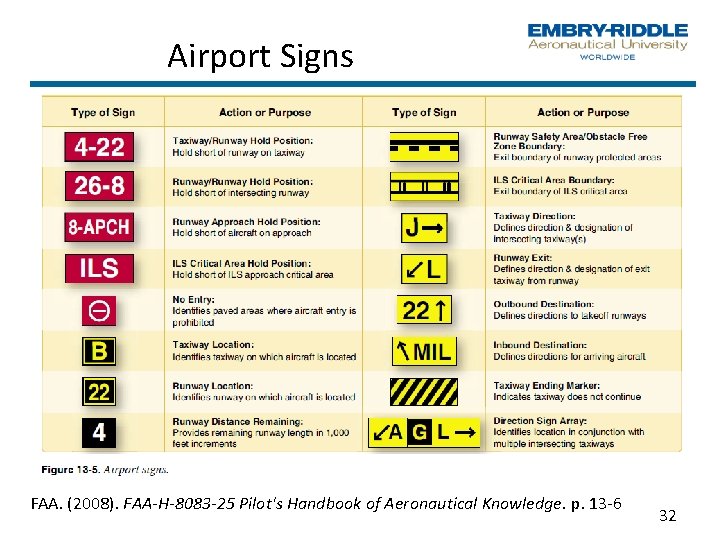
Airport Signs • Used for control and communication • Complexity of airport determines the amount of signs for communication. • Types – Mandatory instruction signs • Runway, critical area, or prohibited area • Example is white letters on red background – Runway holding position – · Location signs • Taxiway or runway location – Direction signs • Black letters on yellow background = Provide directions 30
Airport Signs • Types – Destination signs • • Yellow background with black letters and arrows Terminal Parking area Cargo terminal – Information signs • Yellow background with black letters • Frequencies and noise abatement requirements – Runway distance remaining signs • Black background with white numbers indicating thousands of feet • (FAA, pp. 13 4 13 6, 2008) 31
Airport Signs FAA. (2008). FAA H 8083 25 Pilot's Handbook of Aeronautical Knowledge. p. 13 6 32
Aircraft Rescue and Firefighting (ARFF) • Crash, Fire, and Rescue (CFR) – FAA changed from CFR to ARFF in 14 CFR Part 139 • Different equipment and apparatus – – – ARFF Vehicles Hoses and Nozzles Accessories Personal Protective Equipment (PPE) Extinguishing agents • • • Water Foam Dry Chemicals – Rescue tools and equipment 33
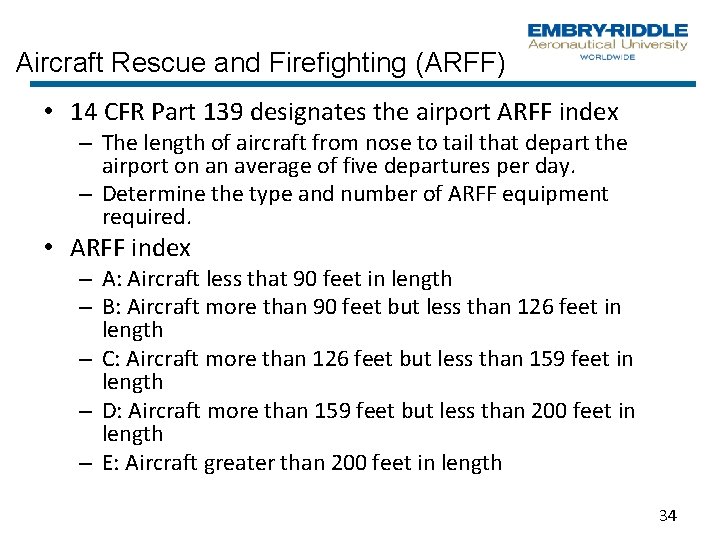
Aircraft Rescue and Firefighting (ARFF) • 14 CFR Part 139 designates the airport ARFF index – The length of aircraft from nose to tail that depart the airport on an average of five departures per day. – Determine the type and number of ARFF equipment required. • ARFF index – A: Aircraft less that 90 feet in length – B: Aircraft more than 90 feet but less than 126 feet in length – C: Aircraft more than 126 feet but less than 159 feet in length – D: Aircraft more than 159 feet but less than 200 feet in length – E: Aircraft greater than 200 feet in length 34
Noise Abatement and Control • Title 14 CFR Part 150 Noise Control Compatibility Planning Program. • AC 150/5020 1 Noise Control and Compatibility Planning for Air ports. • Title 14 CFR Part 36 Noise Standards: Aircraft Type and Airworthiness. • Airport neighbors noise complaints are common especially during 11 pm to 7 am timeframe. • This can be a constraint for maintenance • Airport may have procedures in place to climb as soon as possible to prevent excessive noise. 35
Bird and Wildlife Hazard Management • Birds and other wildlife strikes are common in the vicinity of airport. – There have been reports that indicate aircraft damage and in some cases loss of life. • 14 CFR Part 139 requires airport operators to have policies and procedures for identification, correction and control, and prevention of these hazards. 36
ICAO Airport • U. S. airports serving international operations • Article 68 of the Convention on International Civil Aviation. • AC 150/5000 16 Lists all U. S. international airports, designated airports. • Airports served by scheduled and nonscheduled international air transport and international general aviation flights. 37
Airport Safety Self Inspection Title 14 CFR Part 139 Certification of Airports AC 150/5200 18 B Responsibility of the airport owner or operator. Used to prevent injury and aircraft/ airport damage. • Multiple inspection frequencies. • Inspection results must be documented and kept • • – Follow up and feedback are necessary 38
Management Perspective • Communicate, communicate, and communicate. • Know the airport rules and regulations. • Understand the meaning of signs, lights, and markings. • Situational awareness in a must for safe operations. • Vehicle Control Plan is necessary for safe operations especially on the air side of the airport. 39
Vehicle Control FAA. (2008). FAA H 8083 25 Pilot's Handbook of Aeronautical Knowledge. p. 13 5 40
Questions / Comments
Air Traffic Control 42
Air Traffic Control (ATC) • Promote the safe, orderly, and expeditious flow of air traffic. • Determined by controlled airspace classification – Will discuss classes in airspace slides. 43
Air Traffic Control System • Operated by FAA • Includes – Majority of air traf fic control towers – Visual and electronic navigational aids • At and near airports – Rules and procedures that govern civil aviation and airport operations. – Provides airport improve ment and expansion funding. 44
Air Traffic Control System Command Center (ATCSCC) • Top level of Air Traffic Control System • Manages air traffic and every aircraft within the continental United States. • Balances demand with system capacity within the National Airspace System (NAS). – Maximizes overall operation • Authority to declare ground holds to avoid congestion. • Currently located in Warrenton, VA 45
Air Route Traffic Control Centers (ARTCCs) • Monitor enroute aircraft and aircraft in high altitude cruise. 46
Terminal Radar Approach Control (TRACON) Facilities • Regional air traffic control centers. • Control the movement of air traffic in altitudes un der 18, 000 Mean Sea Level (MSL). • Controller hands over a landing aircraft within 5 miles of an airport and below 2, 500 feet to airport terminal air traffic controllers. 47
Air Traffic Control Towers (ATCTs) • Terminal facility. • Provide services to aircraft operating in the vicinity of an airport or on movement area. • Authorizes aircraft to land or takeoff or to transit the Class D airspace area. • May provide approach control services. • Majority of towers are managed by FAA. • Some are contract managed with restrictions. 48
Flight Service Station (FSS) • Air traffic facility • Provide many services – Pilot briefing – Assistance in emergency situations – Provide Notices to Airmen (NOTAM) – Weather information and observations – Receive and process Instrument Flight Rules (IFR) flight plans – Monitor NAVAIDs – Airport advisories 49
Other ATC Facilities • Automated Flight Service Stations (AFSS) – Subcontracted to the Lockheed Martin Flight Services • FAA oversight – Provides information and services to pilots – Communicate clearances from ATC as required – Do not give ATC instructions, clearances, or separation • Ground Control – Control aircraft during taxi to and from runways. – May have Surface Movement Radar (SMR) to monitor aircraft and vehicles movement on the ground. – Automated Flight Service. 50
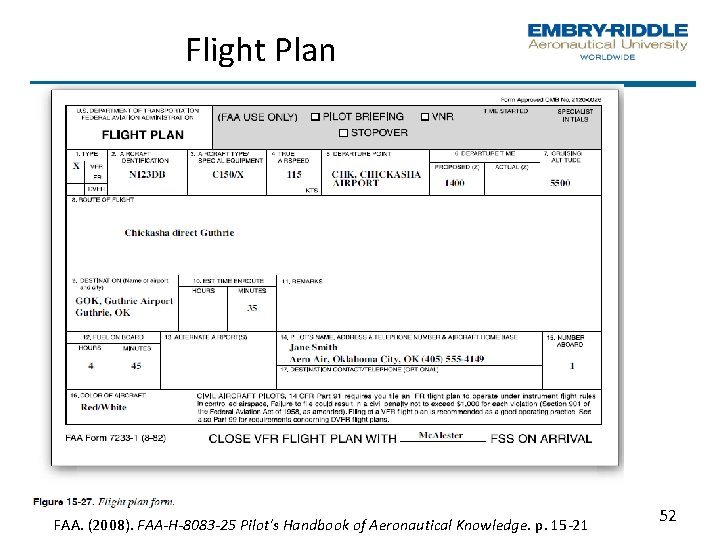
Flight Plan • Provides aircraft intended flight information • Filed with Flight Service Station or an Air Traffic Control facility – Orally or written – Receive and process Instrument Flight Rules (IFR) flight plans • Also special Visual Flight Rule (VFR) procedures – May file, activate, close, or change a flight plan 51
Flight Plan FAA. (2008). FAA H 8083 25 Pilot's Handbook of Aeronautical Knowledge. p. 15 21 52
Airspace 53
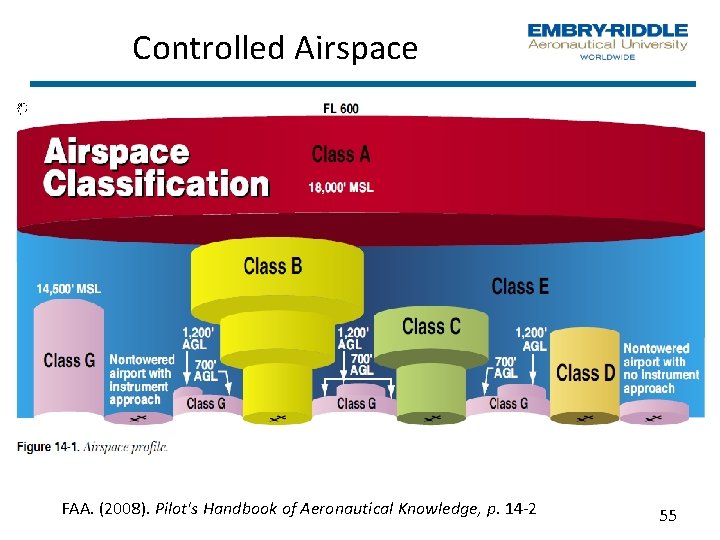
Controlled Airspace • Airspace where aircraft may be sub ject to air traffic control – Considered boundaries above earth’s surface or a specific portion if airspace • There are different classes of controlled airspace • 14 CFR Part 71 Designation of Class A, B, C, D, and E Airspace Areas; Air Traffic Routes; and Reporting Requirements. 54
Controlled Airspace FAA. (2008). Pilot's Handbook of Aeronautical Knowledge, p. 14 2 55
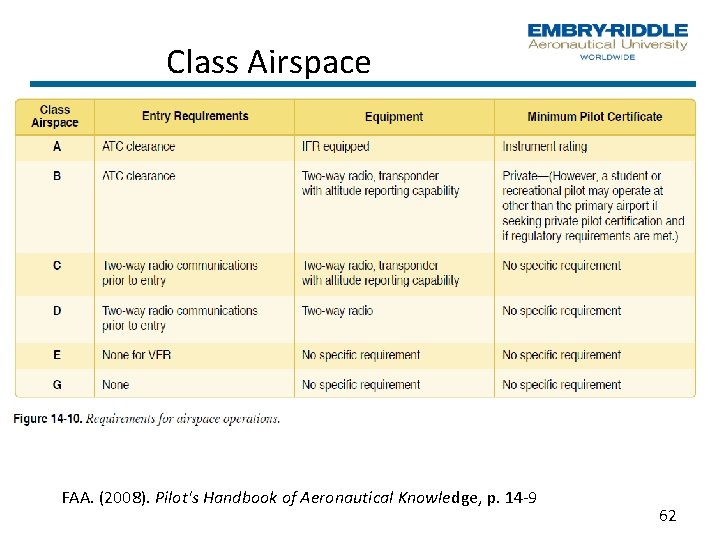
Controlled Airspace • Class A Airspace – Positive control airspace – Airspace located throughout the United States beginning at an altitude of 18, 000 feet Mean Sea Level (MSL) up to 60, 000 MSL. – Conducted under IFR 56
Controlled Airspace • Class B Airspace – Terminal radar service areas. – Airspace surrounding the nation's busiest airports. – Must have ATC clearance to operate in the area. 57
Controlled Airspace • Class C Airspace – Airport radar service areas. – Airspace surrounding airports of moderately high levels of IFR operations or passenger enplanements. – Must establish two way radio communications with the ATC facility prior to entering the airspace and maintain that communication in the airspace. 58
Controlled Airspace • Class D Airspace – Control zones – Airspace surrounding those airports not in Class B or Class C airspace but do have an air traffic control tower in op eration. • Must establish two way radio communications with the ATC facility prior to entering the airspace and maintain that communication in the airspace. 59
Controlled Airspace • Class E airspace – General controlled airspace – Airspace that generally ex ists in the absence of Class A, B, C, or D airspace extending from the sur face to 18, 000 feet MSL within 5 miles or airports without control towers but with instrument approach procedures. 60
Controlled Airspace • Class G airspace – Uncontrolled airspace – Airspace in the absence of Class A, B, C, D, or E airspace – Maintain visual flight rules (VFR) minimums 61
Class Airspace FAA. (2008). Pilot's Handbook of Aeronautical Knowledge, p. 14 9 62
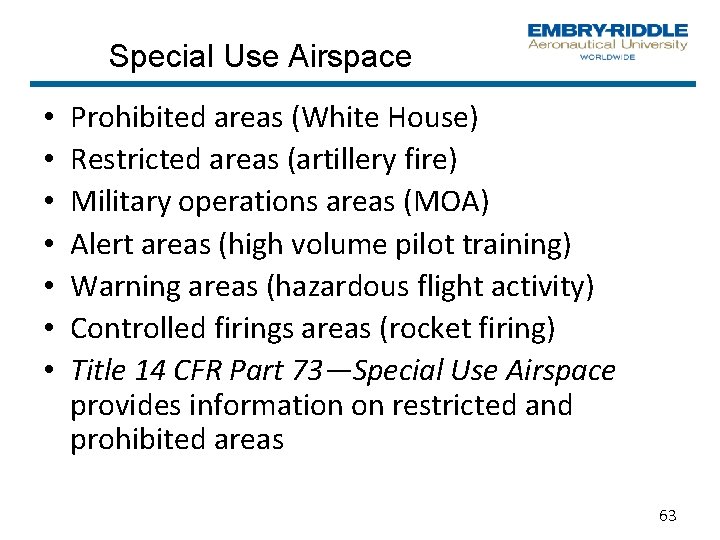
Special Use Airspace • • Prohibited areas (White House) Restricted areas (artillery fire) Military operations areas (MOA) Alert areas (high volume pilot training) Warning areas (hazardous flight activity) Controlled firings areas (rocket firing) Title 14 CFR Part 73—Special Use Airspace provides information on restricted and prohibited areas 63
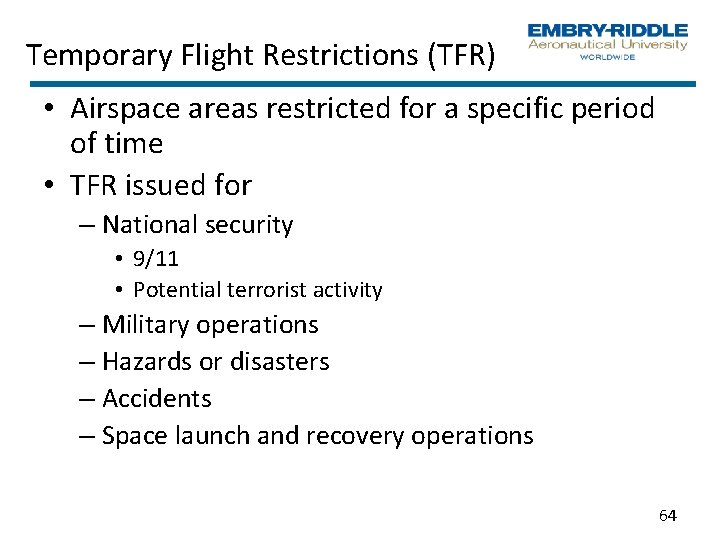
Temporary Flight Restrictions (TFR) • Airspace areas restricted for a specific period of time • TFR issued for – National security • 9/11 • Potential terrorist activity – Military operations – Hazards or disasters – Accidents – Space launch and recovery operations 64
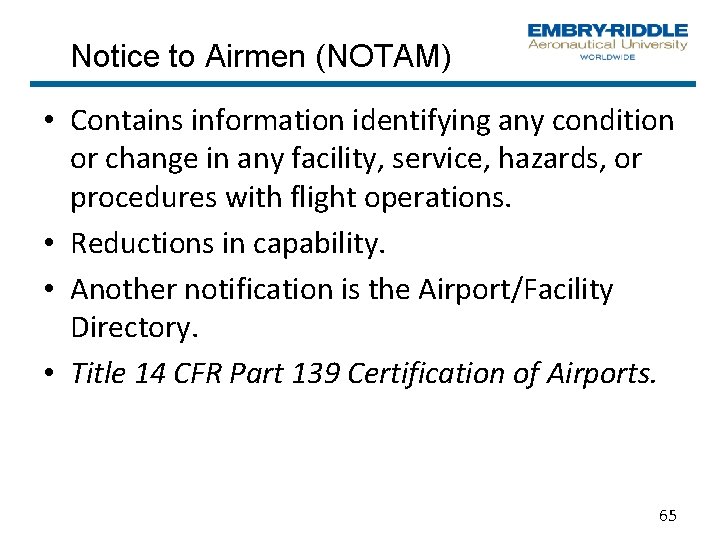
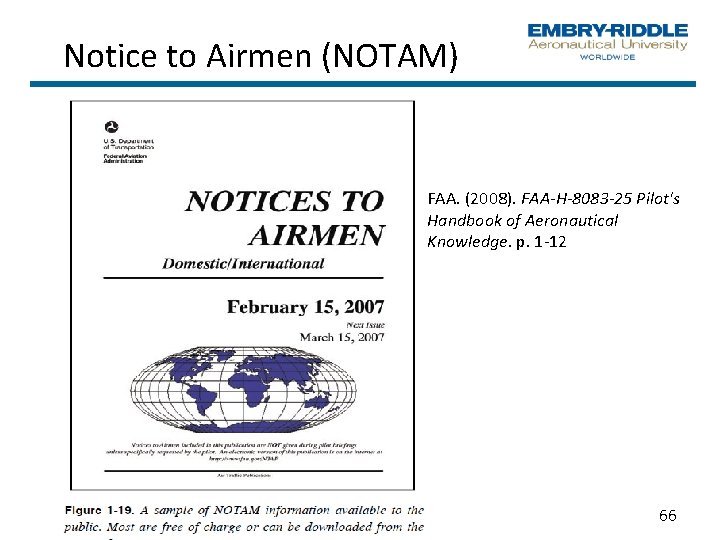
Notice to Airmen (NOTAM) • Contains information identifying any condition or change in any facility, service, hazards, or procedures with flight operations. • Reductions in capability. • Another notification is the Airport/Facility Directory. • Title 14 CFR Part 139 Certification of Airports. 65
Notice to Airmen (NOTAM) FAA. (2008). FAA H 8083 25 Pilot's Handbook of Aeronautical Knowledge. p. 1 12 66
National Airspace System (NAS) • Consists of organization of airports, facilities, airspace, and air traffic control. – Integration of equipment, processes and procedures, and systems. • Provides a safe and systematic flying environment. • Consist of United States civil aviation system. • Consider the classes of controlled airspace. 67
National Airspace System Plan (NASP) • Specifies development projects required to improve public airports to meet the demands of civil aviation. • Includes strategic goals for NAS • Specifies NAS modernization – Communication – Navigation – Surveillance – Weather Automation Systems – Avionics – Operations – Free Flight (Next. Gen) 68
Free Flight (Next. Gen) • ATC and National Airspace System (NAS) modernization. • Global Positioning System (GPS) navigation that allows direct routes between airports. • ATC controllers monitor and perform surveillance • Consists of – Aeronautical data link systems communication • Controller to pilot data link – – GPS navigation system Traffic Alert and Collision Avoidance System (TCAS) Automated Dependent Surveillance (ADS) Weather • Integrated Terminal Weather System (ITWS) • Weather and Radar Processor – Enroute enhancements 69
NAS Capital Investment Plan (CIP) • Appendix B For Fiscal Years 2014 to 2018. • Provides metrics (measures) to link to Department of Transportation and Federal Aviation Administration strategic plans. • Contains budget line items for specific programs and schedules. – Next Generation Air Transportation System (Next. Gen) – Runway Incursion Reduction Program, etc. 70
Questions / Comments