
MFDA Update on Continuing Education CE and Signature



- Slides: 35
MFDA Update on Continuing Education (CE) and Signature Falsification Independent Financial Brokers of Canada 2017 IFB Toronto Fall Summit November 7, 2017
Continuing Education – Background • Member Working Group – March 2015 • 1 st Discussion Paper - June 22, 2015 (MFDA Bulletin #0644 -P) § Solicit feedback on various components of a CE program § 21 submissions were received § Summary of these comments issued December 1, 2015 (MFDA Bulletin #0666 -P) 1
Continuing Education – Background • 2 nd Discussion Paper – January 12, 2017 (MFDA Bulletin #0711 -P) § Solicit feedback on draft Rules and Policy § 24 submissions were received § Summary of these comments issued September 14, 2017 (MFDA Bulletin #0730 -P) 2
2 nd Discussion Paper Proposed Structure • 2 year cycle beginning on December 1 st of an oddnumbered year • 3 components: Business Conduct, Professional Development and MFDA Compliance • MFDA accreditation • MFDA system for tracking and reporting • Non-compliance penalties 3
2 nd Discussion Paper Proposed Requirements • For Dealing Representatives § 10 Business Conduct credits per cycle § 20 Professional Development credits per cycle § 2 MFDA Compliance credits per cycle • For CCOs, UDPs, BMs and Alternate CCOs/BMs (who are not Dealing Reps) § 2 MFDA Compliance credits per cycle 4
Business Conduct • Ethics (minimum of 1 credit) – content that examines ethical principles and moral or ethical problems • Other Business Conduct topics include: § Conflicts of interests, personal financial dealings § Regulatory requirements and initiatives that affect Member operations § Disclosure of information to clients § Documentation standards § Know-Your-Client standard and suitability § Anti-money laundering § Security and privacy of information § Complaint handling 5
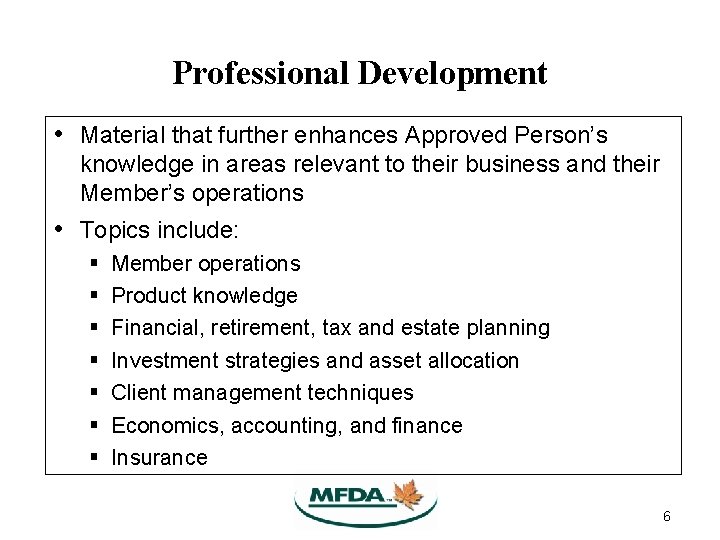
Professional Development • Material that further enhances Approved Person’s knowledge in areas relevant to their business and their Member’s operations • Topics include: § § § § Member operations Product knowledge Financial, retirement, tax and estate planning Investment strategies and asset allocation Client management techniques Economics, accounting, and finance Insurance 6
MFDA Compliance • MFDA designated material • To be released at least annually (e. g. a webcast) • Content will be priority items of MFDA that have applicability across all or a majority of Members (e. g. suitability, KYC, supervision) • Will include update on examination findings, enforcement investigations, policy initiatives etc. • Will be delivered via a variety of platforms 7
2 nd Discussion Paper Summary of Comments • Credits • Content and Delivery • Accreditation • Tracking and Reporting • Non-compliance 8
Continuing Education Next Steps • Consider the comments received, prepare and publish proposed Rules and Policy for a formal public comment period (part of regular Rule development process) • Continue to develop the processes and systems that will administer the CE program 9
Signature Falsification
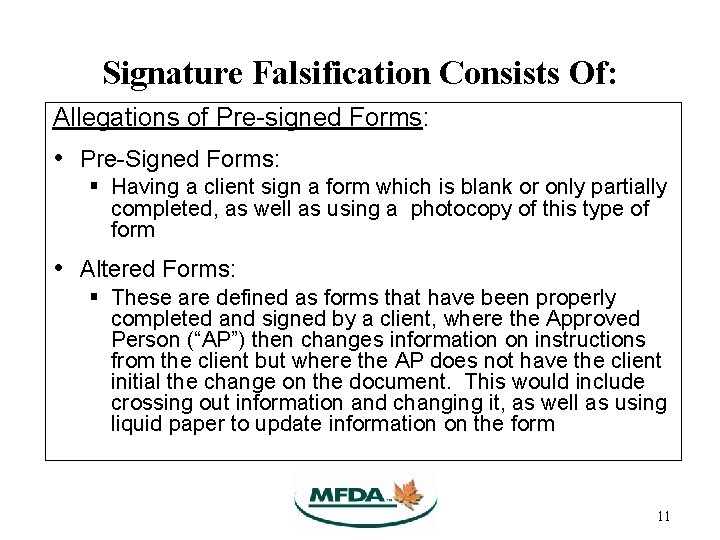
Signature Falsification Consists Of: Allegations of Pre-signed Forms: • Pre-Signed Forms: § Having a client sign a form which is blank or only partially completed, as well as using a photocopy of this type of form • Altered Forms: § These are defined as forms that have been properly completed and signed by a client, where the Approved Person (“AP”) then changes information on instructions from the client but where the AP does not have the client initial the change on the document. This would include crossing out information and changing it, as well as using liquid paper to update information on the form 11
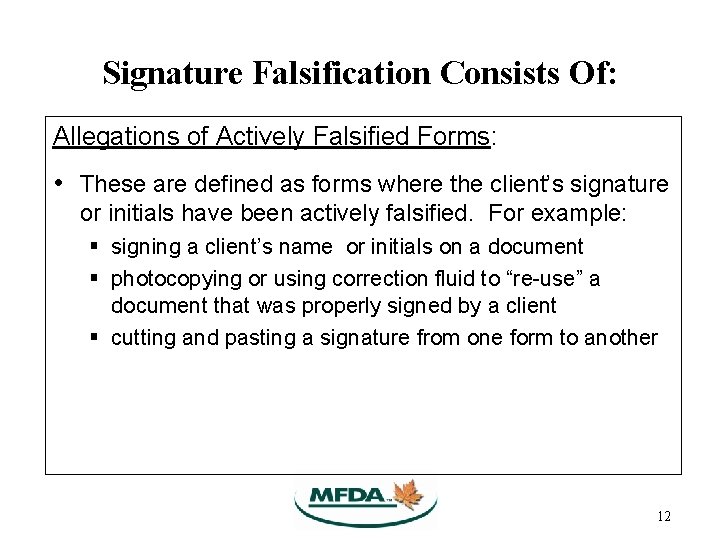
Signature Falsification Consists Of: Allegations of Actively Falsified Forms: • These are defined as forms where the client’s signature or initials have been actively falsified. For example: § signing a client’s name or initials on a document § photocopying or using correction fluid to “re-use” a document that was properly signed by a client § cutting and pasting a signature from one form to another 12
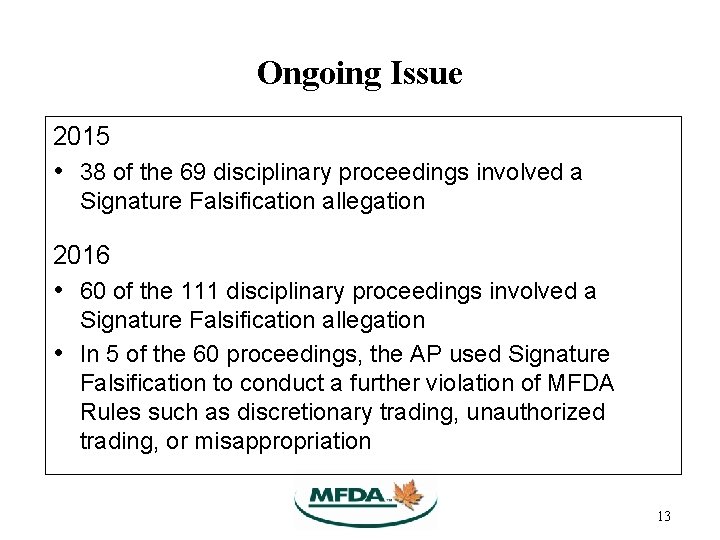
Ongoing Issue 2015 • 38 of the 69 disciplinary proceedings involved a Signature Falsification allegation 2016 • 60 of the 111 disciplinary proceedings involved a Signature Falsification allegation • In 5 of the 60 proceedings, the AP used Signature Falsification to conduct a further violation of MFDA Rules such as discretionary trading, unauthorized trading, or misappropriation 13
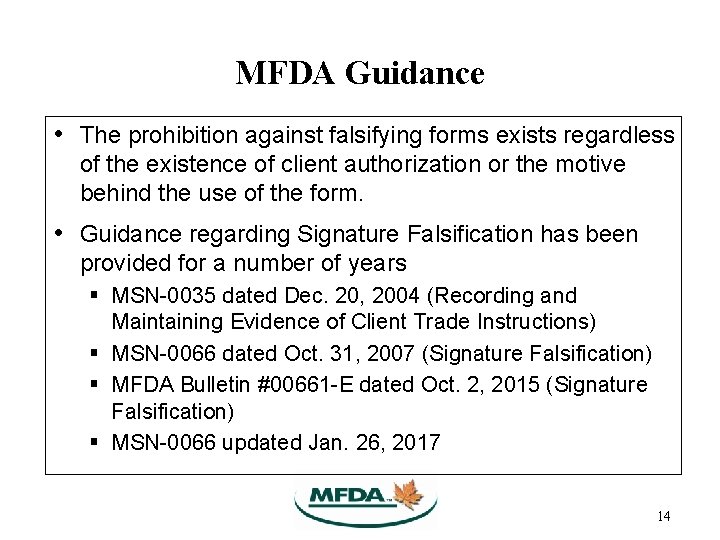
MFDA Guidance • The prohibition against falsifying forms exists regardless of the existence of client authorization or the motive behind the use of the form. • Guidance regarding Signature Falsification has been provided for a number of years § MSN-0035 dated Dec. 20, 2004 (Recording and Maintaining Evidence of Client Trade Instructions) § MSN-0066 dated Oct. 31, 2007 (Signature Falsification) § MFDA Bulletin #00661 -E dated Oct. 2, 2015 (Signature Falsification) § MSN-0066 updated Jan. 26, 2017 14
Recent Policy and Regulation Efforts • October 2, 2015, MDFA published Bulletin #0661 -E on Signature Falsification • January 26, 2017, MFDA published updated MSN-0066 (Signature Falsification) • Both documents outline: § § Examples of Signature Falsification Examples of Aggravating Factors What Signature Falsification can result in That the MFDA will seek enhanced penalties for Signature Falsification occurring after the publication of the Bulletin 15
Examples of Signature Falsification Identified in Hearing Panel Decisions • Cutting and pasting a signature from one form to another • Keeping a Pre-Signed Form, even where there is no intention of submitting the form for processing • Photocopying a previously-submitted account form and altering the trade details in order to process a new trade • Altering any information on a signed document without the client initialing the document to show the change was approved • Signing a client’s name or initial to a document 16
Signature Falsification can violate MFDA Rule 2. 1. 1 • Under MFDA Rule 2. 1. 1 (Standard of Conduct), Members and APs are obligated to deal fairly, honestly and in good faith with their clients and observe high standards of ethics and conduct in the transaction of business. 17
Signature Falsification can violate MFDA Rule 2. 1. 1 whether or not: • It is done for the purposes of client convenience • The client instructs or otherwise consents to the AP falsifying the document • The client complains or there is financial harm to the client • It is the AP’s intention to deceive a client or another person • The document is used to commit a further breach of requirements under MFDA By-laws, Rules and Policies and applicable securities regulation 18
Falsification By Other Persons • Signature Falsification is still a violation of MFDA Rule 2. 1. 1 if your assistant does it or if you instruct an assistant to do it • APs must not instruct or permit others to create, use or possess falsified documents • APs must ensure that in their supervision of support persons they pro-actively address the issue of Signature Falsification 19
Signature Falsification can: • Adversely affect the integrity and reliability of documents • Destroy the audit trail • Impact the ability of APs to produce valid documentation to support transactions that come into question • Prejudice a client by making it appear that they executed a particular document when they did not • • Mislead Member supervisory personnel Negatively affect the credibility of the AP Negatively affect Member complaint handling Facilitate other misconduct such as unauthorized trading, fraud and misappropriation of funds 20
Aggravating Factors • • • Client financial harm or client complaint Number of incidents Previous history of Signature Falsification AP misled Member or MFDA during its investigation AP is Branch Manager Conduct occurred in response to a Member supervisory inquiry • Conduct occurred after publication of Bulletin 0661 -E • Conflicts with annual compliance questionnaire or other attestation about compliance with Member’s policies and procedures 21
Member’s Response (as per MSN-0066) • Once Signature Falsification is found by a Member, it is to: § Report on METS (and update as appropriate) § Review the AP’s files § Complete an RSI (Reasonable Supervisory Investigation) § May include contacting clients • The Member may also impose internal discipline including a fine, close or strict supervision, other conditions, or terminate the AP 22
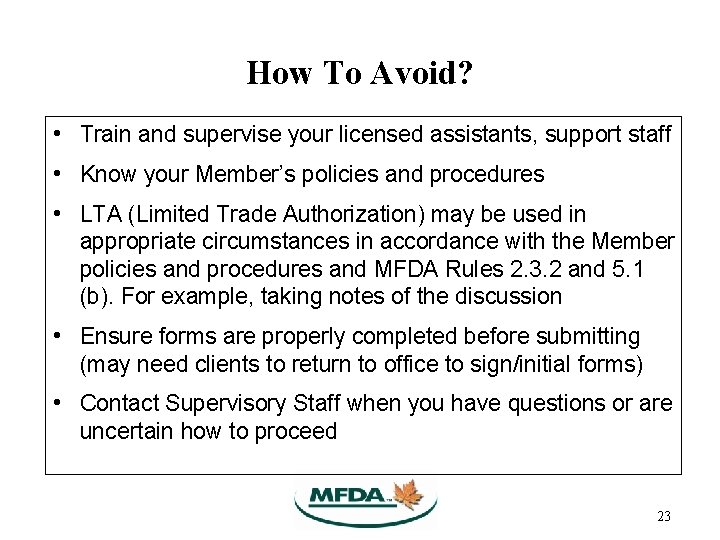
How To Avoid? • Train and supervise your licensed assistants, support staff • Know your Member’s policies and procedures • LTA (Limited Trade Authorization) may be used in appropriate circumstances in accordance with the Member policies and procedures and MFDA Rules 2. 3. 2 and 5. 1 (b). For example, taking notes of the discussion • Ensure forms are properly completed before submitting (may need clients to return to office to sign/initial forms) • Contact Supervisory Staff when you have questions or are uncertain how to proceed 23
Recent Signature Falsification Cases
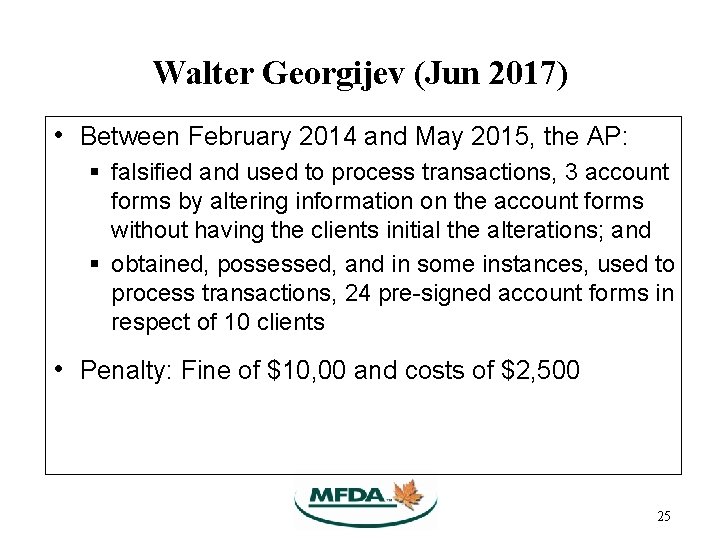
Walter Georgijev (Jun 2017) • Between February 2014 and May 2015, the AP: § falsified and used to process transactions, 3 account forms by altering information on the account forms without having the clients initial the alterations; and § obtained, possessed, and in some instances, used to process transactions, 24 pre-signed account forms in respect of 10 clients • Penalty: Fine of $10, 00 and costs of $2, 500 25
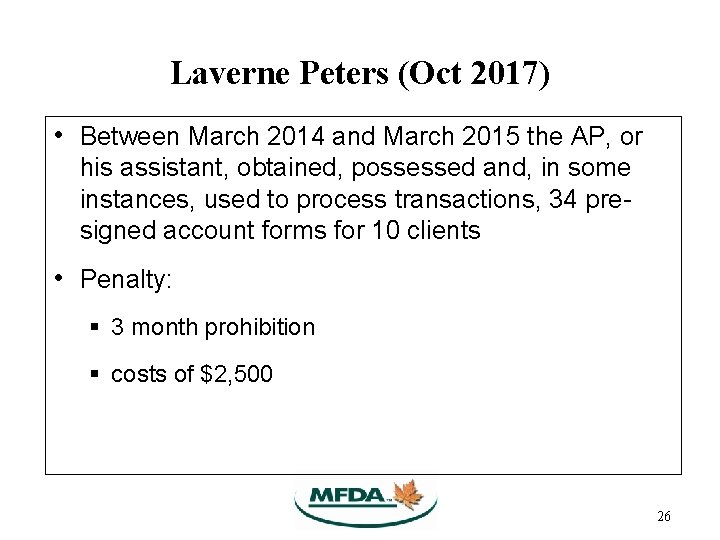
Laverne Peters (Oct 2017) • Between March 2014 and March 2015 the AP, or his assistant, obtained, possessed and, in some instances, used to process transactions, 34 presigned account forms for 10 clients • Penalty: § 3 month prohibition § costs of $2, 500 26
Giuseppe Cichello (Jan 2017) • Between May 11, 2015 and May 13, 2015 the AP falsified 3 client signatures on account forms and used the forms to process transactions • Penalty: § 5 month prohibition § costs of $1, 000 27
Michael Charles Nisbet (Apr 2017) • Between June 2011 and February 2015 the AP obtained, possessed and used to process transactions, 3 pre-signed forms • Between June 2011 and March 2014 the AP signed 3 forms, as an Approved Person, falsely stating he had reviewed the details with the client • Penalty: § 6 month prohibition from acting as a BM § fine of $6, 500 and costs of $2, 500 28
Annaji Kumar (Apr 2017) • Branch Manager • On or about June 19, 2015, the AP falsified a client signature on an account form • Between 2004 and June 2015, the AP: § falsified and used to process transactions, 2 account forms in respect of 2 clients, by altering information on the account forms without obtaining client initials authorizing the alterations § obtained, possessed, and used to process transactions, 2 pre-signed account forms in respect of 2 clients 29
Annaji Kumar (Apr 2017) • Between October 2009 and June 2015, acting in his capacity as branch manager, the AP reviewed and approved the use of 3 of these forms. • Penalty: § 6 month prohibition § must successfully complete a BM course prior to being re-designated as a BM § fine of $1, 500 30
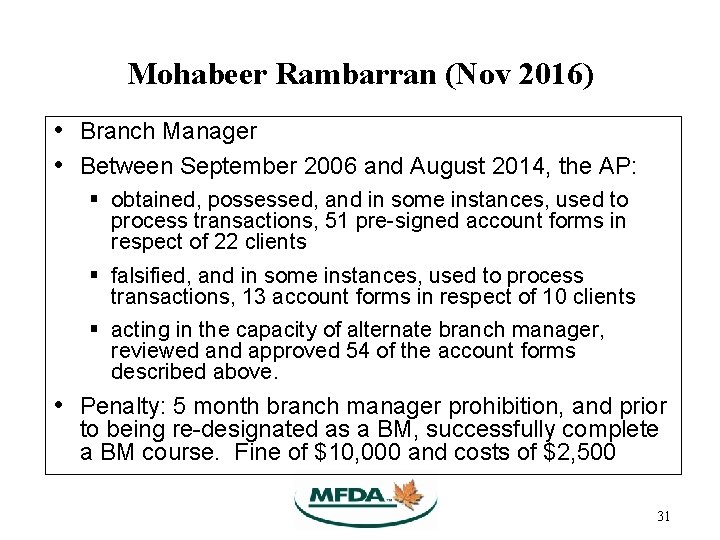
Mohabeer Rambarran (Nov 2016) • Branch Manager • Between September 2006 and August 2014, the AP: § obtained, possessed, and in some instances, used to process transactions, 51 pre-signed account forms in respect of 22 clients § falsified, and in some instances, used to process transactions, 13 account forms in respect of 10 clients § acting in the capacity of alternate branch manager, reviewed and approved 54 of the account forms described above. • Penalty: 5 month branch manager prohibition, and prior to being re-designated as a BM, successfully complete a BM course. Fine of $10, 000 and costs of $2, 500 31
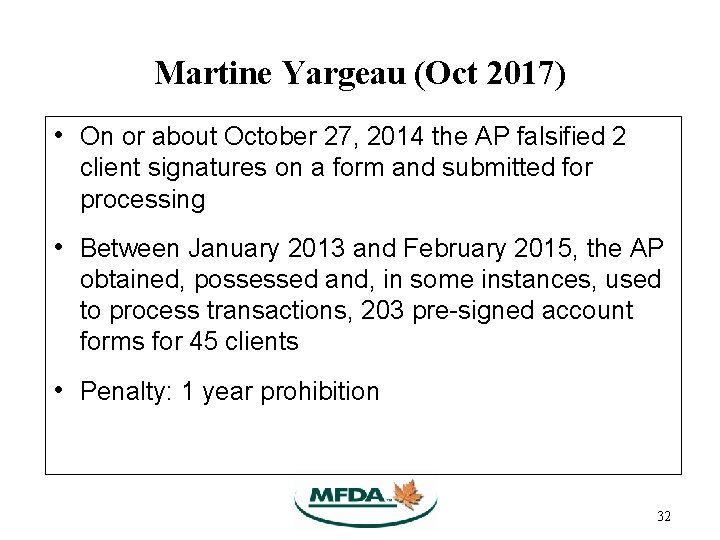
Martine Yargeau (Oct 2017) • On or about October 27, 2014 the AP falsified 2 client signatures on a form and submitted for processing • Between January 2013 and February 2015, the AP obtained, possessed and, in some instances, used to process transactions, 203 pre-signed account forms for 45 clients • Penalty: 1 year prohibition 32
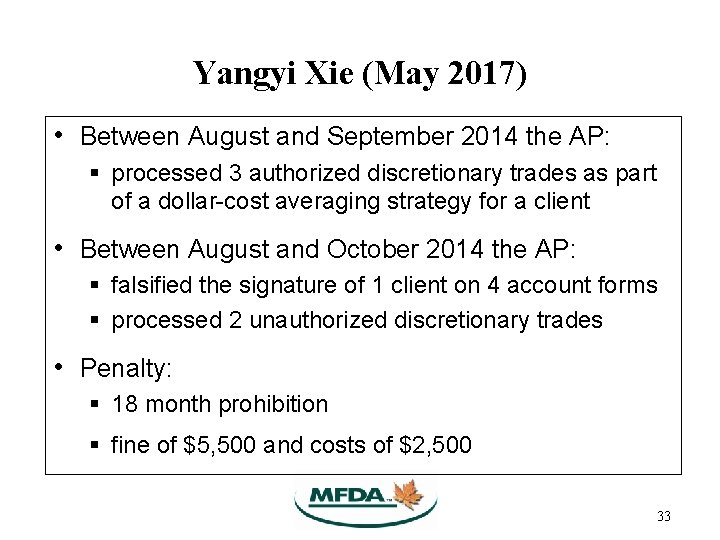
Yangyi Xie (May 2017) • Between August and September 2014 the AP: § processed 3 authorized discretionary trades as part of a dollar-cost averaging strategy for a client • Between August and October 2014 the AP: § falsified the signature of 1 client on 4 account forms § processed 2 unauthorized discretionary trades • Penalty: § 18 month prohibition § fine of $5, 500 and costs of $2, 500 33
Questions?