
MEZONANOPOROUS MATERIALS According to IUPAC all porous materials



- Slides: 14
MEZO-NANO-POROUS MATERIALS According to IUPAC, all porous materials can be subdivided into 3 categories – microporous materials with pore diameters of less than 2 nm, mesoporous materials with pore diameter that lies between 2 and 50 nm, and macroporous materials with pore diameters greater than 50 nm. The term nanoporous materials is usually used for those porous materials with pore diameters of less than 100 nm, but in certain cases materials with little greater pore size can be considered as nanoporous as well. 1
Pores itself are classified into two types: open pores which connect to the surface of the material, and closed pores which are isolated from the outside. In separation, catalysis, filtration or membranes, often penetrating open pores are required. Materials with closed pores are useful in sonic and thermal insulation, or lightweight structural applications. Pores have various shapes and morphology such as cylindrical, spherical, slit types and also more complex shapes such a hexagonal shape. Pores can be straight or curved or with many turns and twists thus having a high tortuosity. Generally porous materials have porosity (volume ratio of pore space to the total volume of the material) between 0. 2– 0. 95. 2
1. Nanoporous materials Like many other nanostructured materials, nanoporous materials are widely distributed in nature, both in natural minerals and in biological systems, and have been used industrially for a long time. But with development of nanotechnologies the need of synthesizing materials with precisely controlled pore size and geometry has arisen. The most important properties of nanoporous materials, distinguishing them from other materials and determining most of their applications, are the large internal surface area and highly ordered, uniform pore structure. Despite the fact that some amorphous microporous materials also have important industrial applications, most of microporous materials are the crystalline solids with micropores of strictly regular dimensions. 3
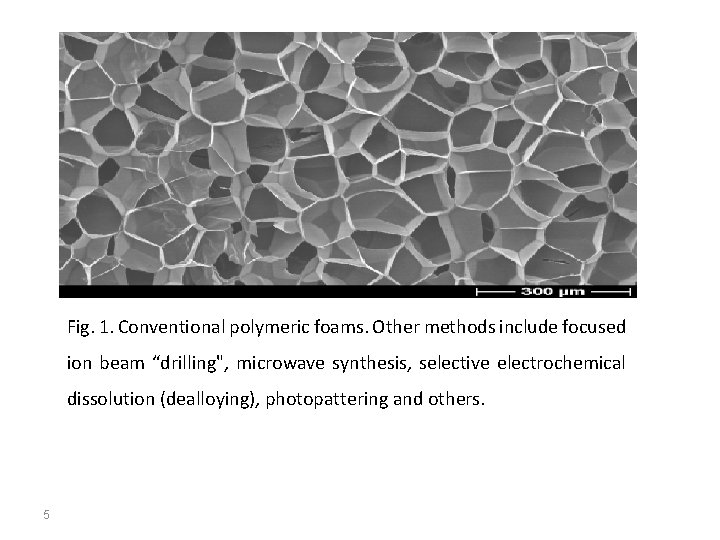
Syntheses of nanoporous materials are usually based on templateassisted bottom-up processes, including soft and hard templating methods. One of the most common methods is a liquid crystal templating. It is based on the use of surfactant micelles as structure directing agents in a sol-gel process. Amphiphillic surfactants self assemble into cylindrical micelles, which are encapsulated by an inorganic material, which balances the charge on the micellular surfaces. Calcination, a thermal processing technique in which surfactant is burnt out, is then used to remove the organic surfactant, leaving a hexagonal arrangement of mesopores. Sol-gel methods are also used for making aerogels, in which a gas is dispersed in a gel, producing a very light-weight solid (sometimes only few times denser than air). The example is shown in fig. 1. 4
Fig. 1. Conventional polymeric foams. Other methods include focused ion beam “drilling", microwave synthesis, selective electrochemical dissolution (dealloying), photopattering and others. 5
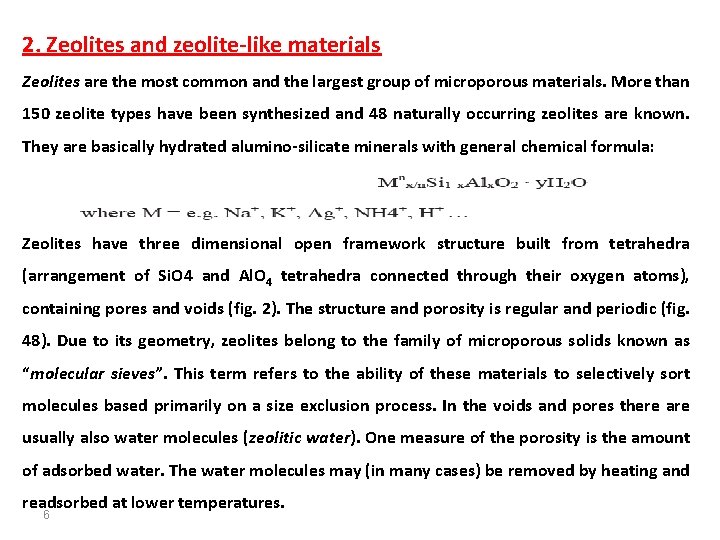
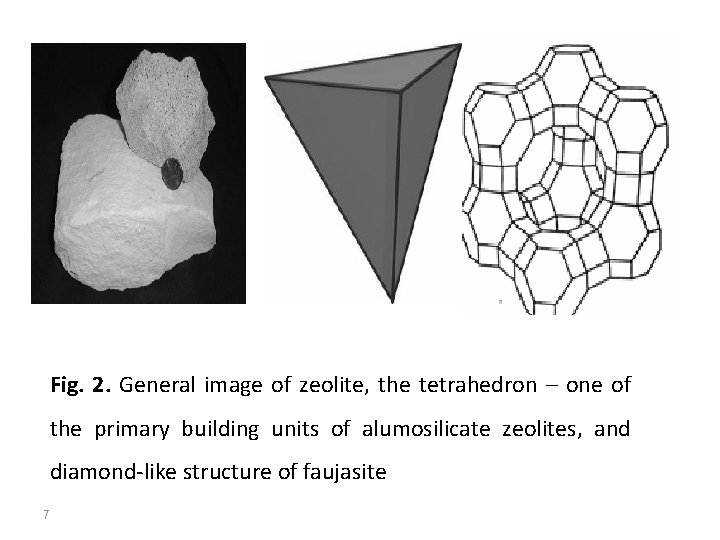
2. Zeolites and zeolite-like materials Zeolites are the most common and the largest group of microporous materials. More than 150 zeolite types have been synthesized and 48 naturally occurring zeolites are known. They are basically hydrated alumino-silicate minerals with general chemical formula: Zeolites have three dimensional open framework structure built from tetrahedra (arrangement of Si. O 4 and Al. O 4 tetrahedra connected through their oxygen atoms), containing pores and voids (fig. 2). The structure and porosity is regular and periodic (fig. 48). Due to its geometry, zeolites belong to the family of microporous solids known as “molecular sieves”. This term refers to the ability of these materials to selectively sort molecules based primarily on a size exclusion process. In the voids and pores there are usually also water molecules (zeolitic water). One measure of the porosity is the amount of adsorbed water. The water molecules may (in many cases) be removed by heating and readsorbed at lower temperatures. 6
Fig. 2. General image of zeolite, the tetrahedron – one of the primary building units of alumosilicate zeolites, and diamond-like structure of faujasite 7
Zeolites are widely used in domestic and commercial water purification, softening, and other applications. In chemistry, zeolites are frequently used to separate molecules. Zeolites have the potential of providing precise and specific separation of gases including the removal of H 2 O, CO 2 and SO 2 from low-grade natural gas streams. Synthetic zeolites are widely used as catalysts in the petrochemical industry. Zeolites confine molecules in small spaces, which cause changes in their structure and reactivity. The hydrogen forms of zeolites are powerful solid-state acids, and can facilitate a host of acid-catalyzed reaction, such as isomerisation, alkylation, and cracking. But the largest outlet for synthetic zeolite is the global laundry detergent market. 8
High heat of adsorption and ability to hydrate and dehydrate while maintaining structural stability make possible to use zeolites as solar thermal collectors and for adsorption refrigeration. Their hygroscopic properties coupled with an inherent exothermic reaction when transitioning from a dehydrated to a hydrated form (heat adsorption), make natural zeolites effective in the storage of solar and waste heat energy. Synthetic zeolite is also being used as an additive in the production process of warm mix asphalt concrete. It helps decreasing the temperature level during manufacture and lying of asphalt concrete, resulting in lower consumption of fossil fuels, thus releasing less carbon dioxide, aerosols and vapours. In agriculture, clinoptilolite (a naturally occurring zeolite) is used as a soil treatment. It provides a source of slowly released potassium. If previously loaded with ammonium, the zeolite can serve a similar function in the slow release of nitrogen. Zeolite-based oxygen generation systems are widely used to produce medical grade oxygen. The zeolite is used as a molecular sieve, which extracts oxygen from air, in a process involving the absorbing of atmospheric nitrogen. 9
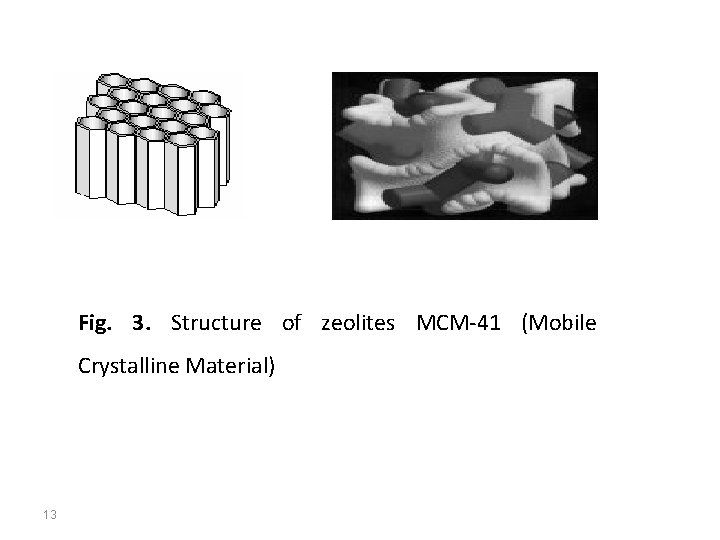
The second largest known group of microporous materials is the aluminophosphate family. The aluminophosphate Al. PO 4 frameworks are formed from vertex-sharing Al. O 4 and PO 4 tetrahedra. Other common microporous materials include silicoaluminophosphates, gallophosphates, or recently discovered inorganic-organic hybrids. 3. Mesoporous materials Materials similar to zeolites in their properties but with greater pore size are always seemed to be very attractive, since the feasibility to obtain pores of different size and geometries offers a wide range of possibilities for hosting molecules larger than the ones exhibited for classic microporous materials. But such materials are hard to be synthesized since material with greater pores becomes instable – the nature abhors an empty space. Only in 1992 this problem was overcome when Mobil Oil scientists discovered MS 41 family of silicate amorphous mesoporous materials with narrow pore size distribution. Their most known and studied material is MCM-41 (Mobile Crystalline Material) – mesoporous silicate with one-dimensional hexagonal arrangement of the 10
In contrast to MCM-41, the other well-known mesoporous material, MCM 48, (fig. 3) exhibits three-dimensional pore system (two independent and intricately inter woven networks of mesoporous channels) that is more resistant to pore blocking and allow faster diffusion of reactants than a 1 D array of pores. The long-range ordering of the pores and the potential for isomorphous substitution with transition metals, enabling formation of catalytically-active centers, have incited applications in areas such as adsorption, separation and catalysis, especially in processes where bulkier molecules are used. 11
There is a lot of other mesoporous materials were synthesized since then. In general, these materials include some kinds of silica and alumina that have similarly-sized fine mesopores. Mesoporous oxides of niobium, tantalum, titanium, zirconium, and tin have also been reported. It is important to note, that a material that contains mesopores in part but is not regular, like silica gel, is not considered a mesoporous material. 12
Fig. 3. Structure of zeolites MCM-41 (Mobile Crystalline Material) 13
One of the most promising applications for mesoporous materials is hydrogen storage. Due to huge surface areas (up to 5900 m 2/g), mesoporous materials provide a vast number of sites where sorption processes can occur – potential to store a lot of hydrogen – each pore is a potential home for several hydrogen molecules. Catalytical applications of mesoporous materials are very common in chemistry. Mesostructured and mesoporous materials are also emerging as a new class of optical materials. The corresponding regularly arranged pores found in mesoporous materials (inorganic only) provide a high surface area to better disperse optically active components and allow for rapid diffusion for optical sensor applications. Since 2001 the behaviour of mesoporous materials as drug delivery systems has been developed. It is based on the ability of mesoporous matrixes to absorb molecules, of pharmacological interest, followed by a potentially controlled release. 14