
Metropolis The City as a Text Urban System
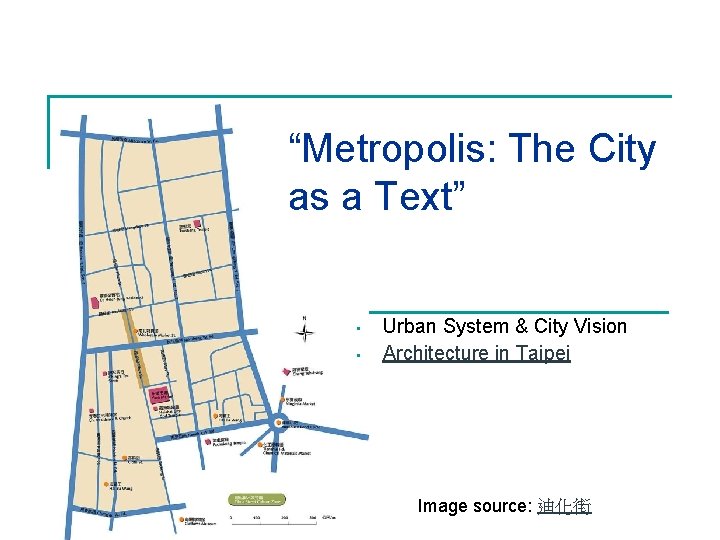
“Metropolis: The City as a Text” • • Urban System & City Vision Architecture in Taipei Image source: 迪化街
Outline Starting Questions 2. “Metropolis: The City as Text” (1) 3. Taipei’s Architectural Examples 4. Reference 1.
Starting Questions What have we learned so far? n n n Physical and Cultural Definitions of City Urbanization, Modern City and Postmodern City/Global City Organic City vs. Planned City (with utilitarian purposes) Today: Concept City vs. Lived City Not yet: the concept of urbanism
Starting Questions What are we discussing today? n Concept city: modernist vision planning q Different visions or interpretation of a city since the 19 th century n n urban planning: social welfare, landscaping and domicile registration (census), urban designers such as Haussmann, etc. Concept city Lived City Their relevance to our cities and our texts? q n n religious [divine order], naturalist [body], M. Foucaultian [grid], Engels --Marxist [dynamic structure] M. De Certeau, W. Benjamin, Geoge Simmel
Starting Questions on “The City as Text” n n n Why is city an “imagined” environment (422)? Why can a city be a text (written with signs, to be interpreted)? How do city planners ‘imagine’ a city? With what metaphors and charts? What could be their limitations? What could be the limitations they place on city-dwellers? (e. g. pedestrian areas) How about us? What metaphors or images do we have in mind about a city? Can we ‘map’ a city? How do we walk in a city such as Taipei?
“The City as Text” • City as a reflection of Modernity • Urban Design vs. • Lived Experience (Flâneur)
Metropolis: The City as Text: Outline n n n Focus: representations of cities from 19 th century till now. (human body, machine, [Paris], [Vienna], labyrinth, modern city and mental life, flows; p. 423) 1. 1 Prologue: excerpts from Bleak House and The Asphalt Jungle – (422) q Similarities: effect of the weather on the cities; the industrial city as alien; civilization – sophisticated but fragile; technologies and forces constituting the life of a city q Asphalt Jungle – city as a machine and a strange and magical place; with awareness of the class and ethnic differences ★ 1. 2 The city as imagined environment – organic and mechanical “movement and flows” (424) Chapter Summary 423 -34 2. 1 Capitalist City – “Police” ★ 2. 2 Concept vs. Experience
Urban Design: Idealism & Control System A. Two paradigms in the 19 th century: (425 -29) n The divine order “the invisible hand” of the market in giving order to a city like a body with ‘the instincts of brute creation. ” poverty as inevitable n The medical paradigm: using an organic imagery; city’s ills attributed less to commercial systems than to urbanization (427). urban welfare system q Develop social welfare system through both investigation and administration systems. q 428 -29 Urban government. . . Includes surveillance and discipline. concrete, quantifiable and precise info. n n n e. g. 〈系統的多重關係〉 (黃凡). e. g. 〈馬桶〉(林耀德)-- urban system of sanitation//body’s digestion 腔腸動物 (Coelenterata) e. g. The last SARS epidemic –multiple systems of surveillance
Urban Police System: City as a statistical grid of investigation and surveillance n n 429 -- B. Grid (surveillance + welfare) (Michel Foucault) the police: q q 1. political, 2. pastoral (of pastor’s; confession) a technology of government which defined the domains, techniques and targets of state intervention. It involved 1. 2. n cataloguing the resources of a state, both material and human, in minute detail. Identified a new object: population (429 -30) e. g. District Offices (domicile registration) + District Health Center
Urban System (2): Dynamic structure Structural determination n Engel’s Marxist view: relations between the have’s and have-not’s as a complex, concrete totality, and whose parts have meanings that are only decipherable in relation to all its other parts. (433) n n Parallel relations between city’s macrostructure and its microstructures; determined by modes of production Summary: pp. 433 -34
“The City as Text” 2. 2: Concept vs. Experience n n 1. Example: Doris Lessing’s The Four-Gated City (434) Michel de Certeau: p. 435 Concept city (435)– in utopian or urbanistic discourse; with a perspective both ‘god-like’ and voyeuristic that can encompass all the diversity, randomness and dynamism of urban life in a single panorama (statistics). a proper space, a pure space, a space of rational organization. urban and human ills repressed
“The City as Text” 2. 2: Concept vs. Experience (2) Michel de Certeau: p. 435 2. Lived city –beneath the discourses, the grids and combinations of powers or a fixed pattern of statistical relationships. The people, who are ‘unpredictable, inventive and devious. ’ Who have ‘illegible improvisations’ of the spaces on the streets or at home. (435 -34) n
“The City as Text” 2. 2: Concept vs. Experience (3) Rational city vs. mythic experience: Max Weber vs. Walter Benjamin (436) n q q Max Weber – 18 th, 19 th centuries –abstract, formal rationality as the organizing principle of structures of production, market, state bureaucracies, and arts secularization, rationalization, disenchantment of the social world The new urban-industrial world –fully re-enchanted. --in the new shopping arcades.
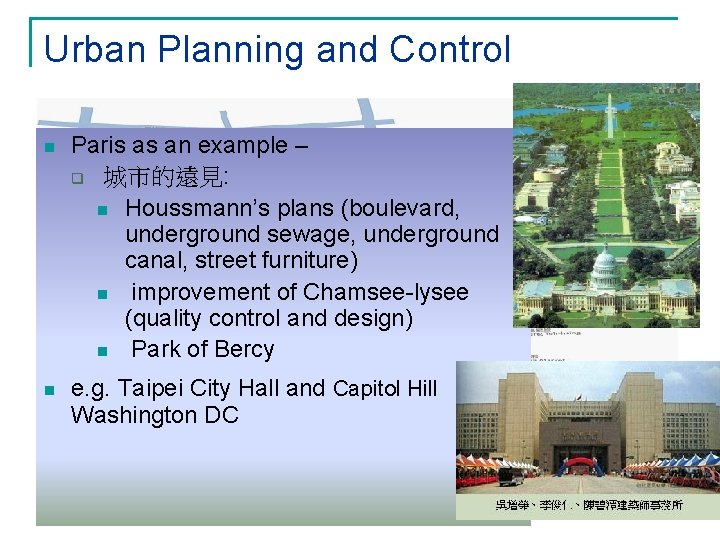
Urban Planning and Control n Paris as an example – q 城市的遠見: n Houssmann’s plans (boulevard, underground sewage, underground canal, street furniture) n improvement of Chamsee-lysee (quality control and design) n Park of Bercy n e. g. Taipei City Hall and Capitol Hill Washington DC
Rational organization vs. flâneur n n n Houssmann vs. Baudelaire (438 -39) Baudelaire – representational spaces which are transitory, fleeting and contingent (e. g. shopping arcade) Baudelaire’s Flâneur: poet as painter of modernity, also dandy, whore, rag-picker, and vendors on the street(? ) q n “To be away from home and yet to feel oneself everywhere at home; to see the world, to be at the center of the world, and yet to remain hidden from the world…” (Baudelaire qtd in Donald 439) Benjamin’s Flâneur: in arcades– shopping area turning urban experience into that of phantasmagoria or spectacles.
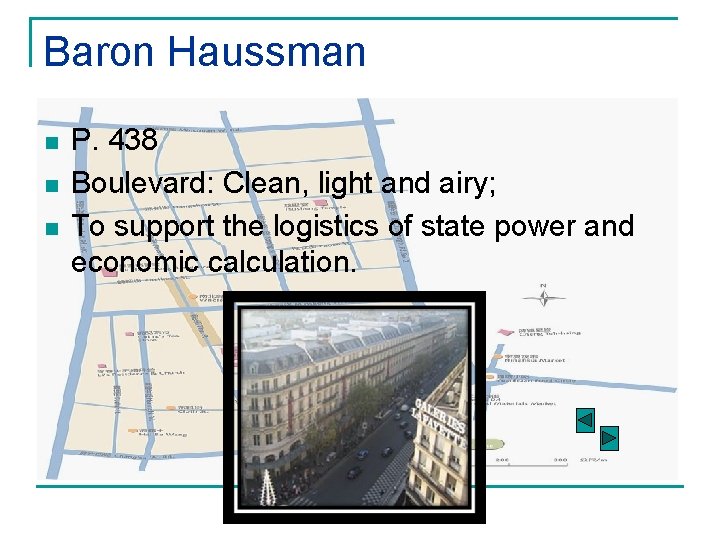
Baron Haussman n P. 438 Boulevard: Clean, light and airy; To support the logistics of state power and economic calculation.
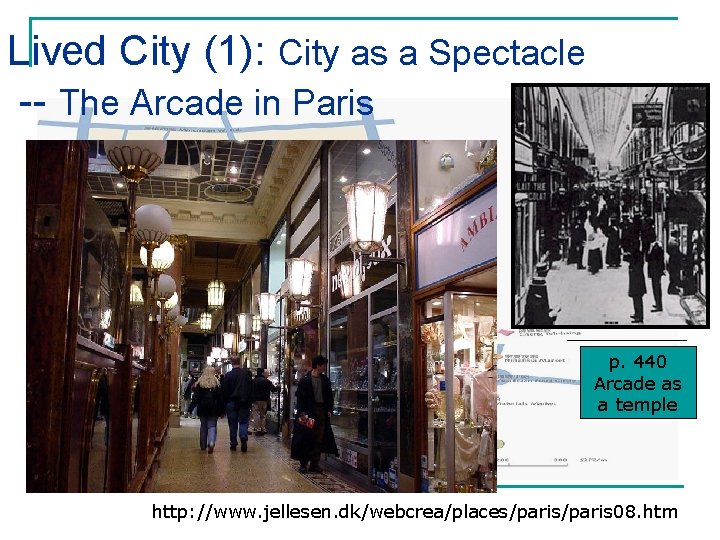
Lived City (1): City as a Spectacle -- The Arcade in Paris p. 440 Arcade as a temple http: //www. jellesen. dk/webcrea/places/paris 08. htm
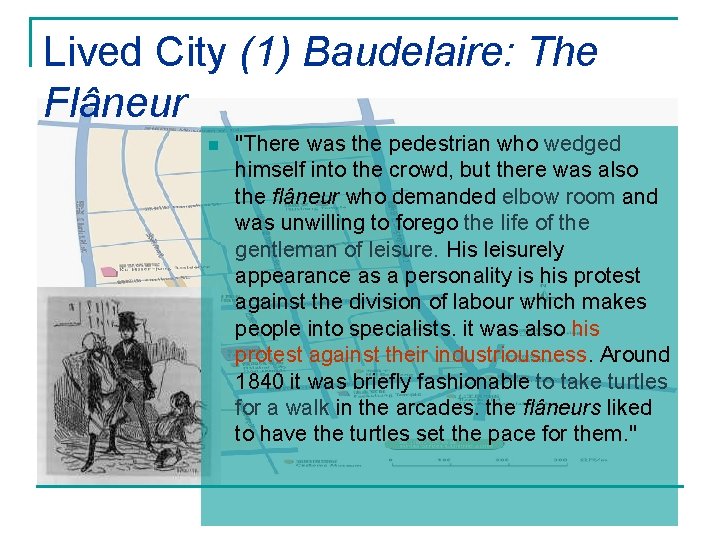
Lived City (1) Baudelaire: The Flâneur n "There was the pedestrian who wedged himself into the crowd, but there was also the flâneur who demanded elbow room and was unwilling to forego the life of the gentleman of leisure. His leisurely appearance as a personality is his protest against the division of labour which makes people into specialists. it was also his protest against their industriousness. Around 1840 it was briefly fashionable to take turtles for a walk in the arcades. the flâneurs liked to have the turtles set the pace for them. "
Responses to Modernity: Baudelaire and Benjamin 1. Baudelaire: the modern heroes: the poet, the flâneur, the dandy, the collector, the gambler, the worker, the rag-picker and the prostitute; give voice to the paradoxes and illusions of modernity. 1. Benjamin: as a walking commodity; is no hero; he acts heroes empty commodity forms; Flâneur in a text can be a character (Mermaid) or narrative device (camera angle--Rispondetemi). One which is apparently unorganized and thus de-centering (non-traditional). In life, can we be flâneurs nowdays? And what kinds of flâneurs are we? n n
Flnâeur: Results of and Responses to Modernity A. Results n Fast development in industrialization, capitalism and modernization of city spaces. increasing spectacles and human mobility. Spectacles: Arcades Exhibition such as Crystal Palaces fairs, gardens, statues, etc Turning indoor: in department stores, shopping malls, Cinema city and internet. Virtualized: ‘phantasmagoria’ – 浮光幻影 , or kaleidoscope 萬花筒 q n Is flâneur an artist or a shopper?
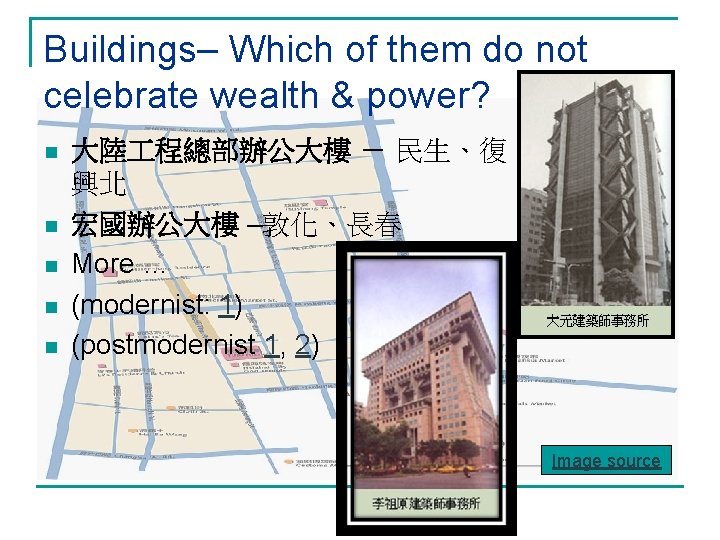
Buildings– Which of them do not celebrate wealth & power? n n n 大陸 程總部辦公大樓 - 民生、復 興北 宏國辦公大樓 –敦化、長春 More … (modernist: 1) (postmodernist 1, 2) Image source
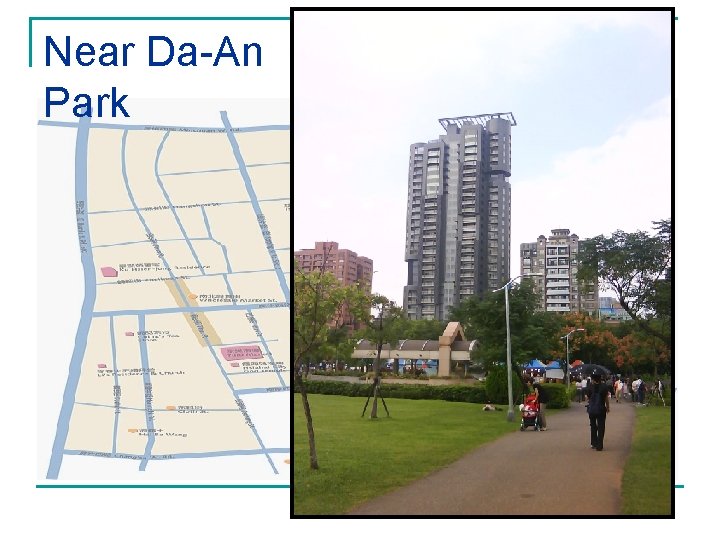
Near Da-An Park
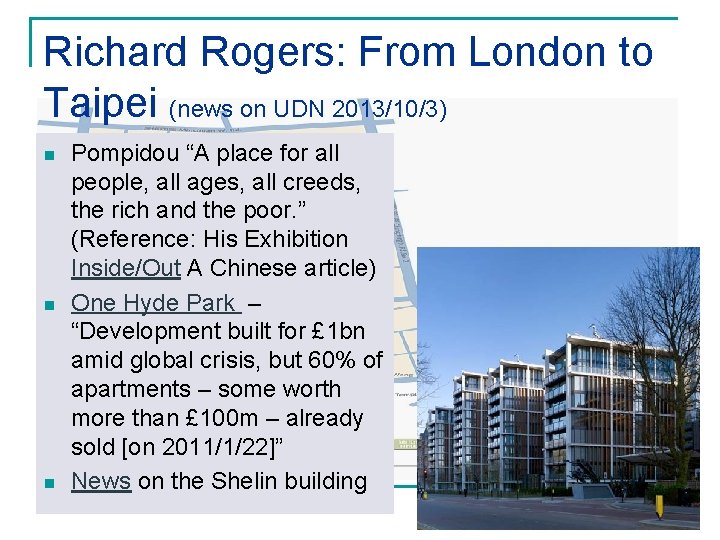
Richard Rogers: From London to Taipei (news on UDN 2013/10/3) n n n Pompidou “A place for all people, all ages, all creeds, the rich and the poor. ” (Reference: His Exhibition Inside/Out A Chinese article) One Hyde Park – “Development built for £ 1 bn amid global crisis, but 60% of apartments – some worth more than £ 100 m – already sold [on 2011/1/22]” News on the Shelin building
Conclusion? n n A city can be variously defined, imagined, desired for, and connected to the past. Concept City does not just belong to the city planners. We also develop our concepts of the city in our use of signs, through our walking and living, desiring and recollections in a city.
- Slides: 25