
MetroHaul Project Second Review WP 3 Emilio Riccardi







- Slides: 53
Metro-Haul Project Second Review WP 3 Emilio Riccardi emilio. riccardi@telecomitalia. it Brussels, October 2 th , 2019 METRO-HAUL: METRO High bandwidth, 5 G Application-aware optical network, with edge storage, compute and low Latency http: //metro-haul. eu H 2020 -ICT-2016 -2 Metro-Haul Grant No. 761727
Presentation Outline v WP 3 Overview v Deliverables and Milestones v Objectives discussion (including technical description of activities) v Conclusions v Next steps 02/10/2019 WP 3 Status - Metro-Haul Second Report Period Review (Brussels) 2
WP 3: “Metro Node and Optical Transmission solutions” v The investigation and design of efficient and flexible data plane architectures for Metro Access, Metro Core Nodes and optical metro-wide networks, supporting both filtered and (semi )filterless optical solutions and fully exploiting the Elastic Optical Network paradigm. q Optical DWDM systems and node architectural aspects (e. g. Central Offices as Data Centers; Optical disaggregation…) ü In collaboration with WP 2 q Prototypes (HW + control SW): Switching Optical Network Elements; flexible interfaces; flexible transponders; SDN OLT… q and Transmission technological solutions (e. g. Filterless/filtered…. )… ü ü Design and specifications developed within WP 3 Stand alone testing within WP 3 Testing and system assessment in dedicated transmission test beds within WP 3 Final evaluation and integration with control plane (WP 4) in joint experiments in WP 5 q Models, SBI specification and local (at node level) agents and analytics to interface with control/management and monitoring systems ü In tight cooperation with WP 4 v Structured into tasks q Task T 3. 1: Metro Node and Optical Infrastructure Elements architecture (TIM) q Task T 3. 2: Optical solutions for switching and interconnection of the Access and Core Metro Edge Nodes (Tu. E, UNIBRIS) q Task T 3. 3: Optical Transmission solutions (TEI, CORIANT) q Task T 3. 4: Monitoring and Control Interfaces (UPC, CNIT) 02/10/2019 WP 3 Status - Metro-Haul Second Report Period Review (Brussels) 3
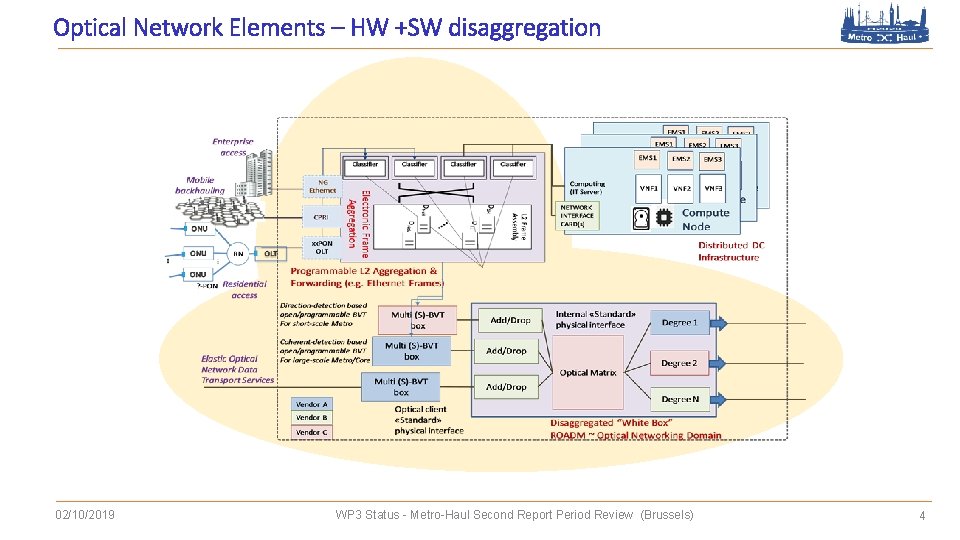
Optical Network Elements – HW +SW disaggregation 02/10/2019 WP 3 Status - Metro-Haul Second Report Period Review (Brussels) 4
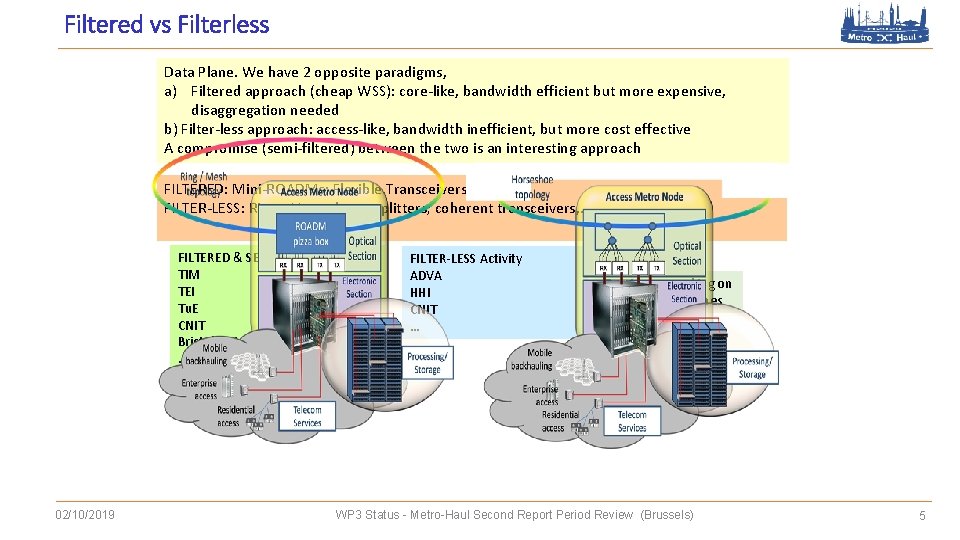
Filtered vs Filterless Data Plane. We have 2 opposite paradigms, a) Filtered approach (cheap WSS): core-like, bandwidth efficient but more expensive, disaggregation needed b) Filter-less approach: access-like, bandwidth inefficient, but more cost effective A compromise (semi-filtered) between the two is an interesting approach FILTERED: Mini-ROADMs; Flexible Transceivers; S-BVT, … FILTER-LESS: Rings; Horseshoes; splitters; coherent transceivers, … FILTERED & SEMI-FILTERED Activity TIM TEI Tu. E CNIT Bristol University … 02/10/2019 FILTER-LESS Activity ADVA HHI CNIT … Two teams working on different approaches WP 3 Status - Metro-Haul Second Report Period Review (Brussels) 5
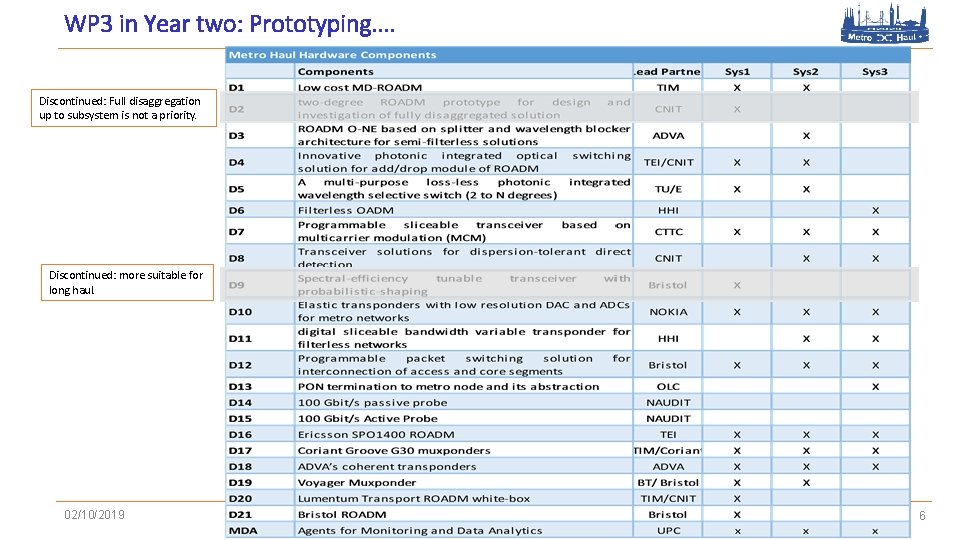
WP 3 in Year two: Prototyping…. Discontinued: Full disaggregation up to subsystem is not a priority. Discontinued: more suitable for long haul. 02/10/2019 6
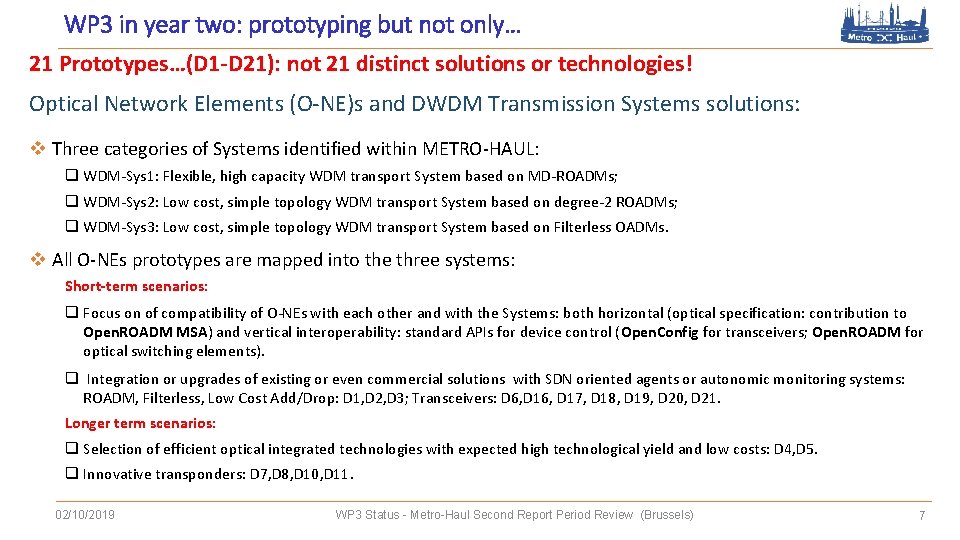
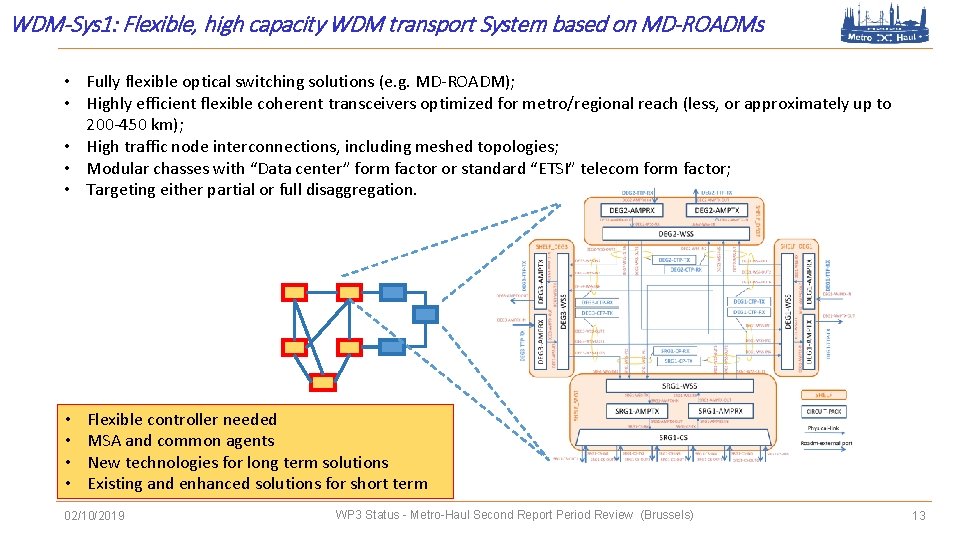
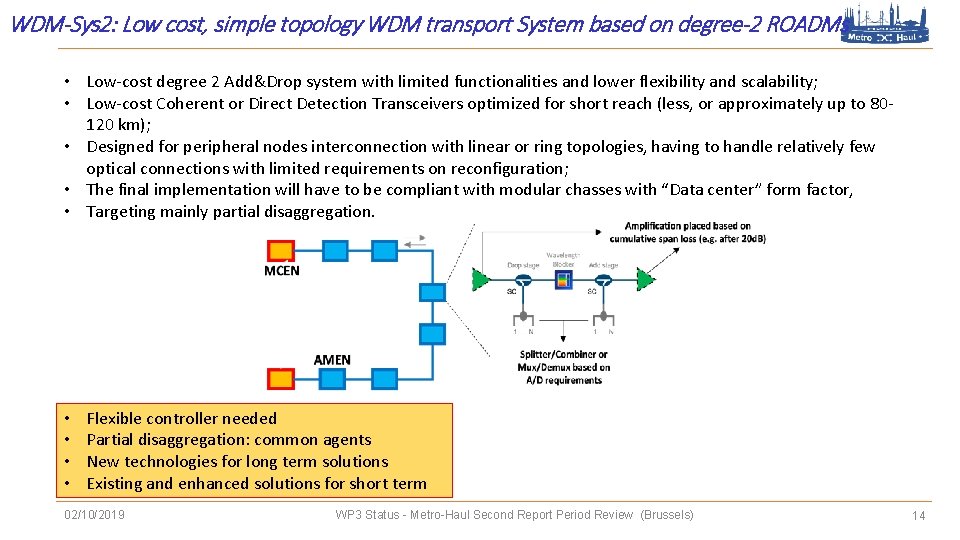
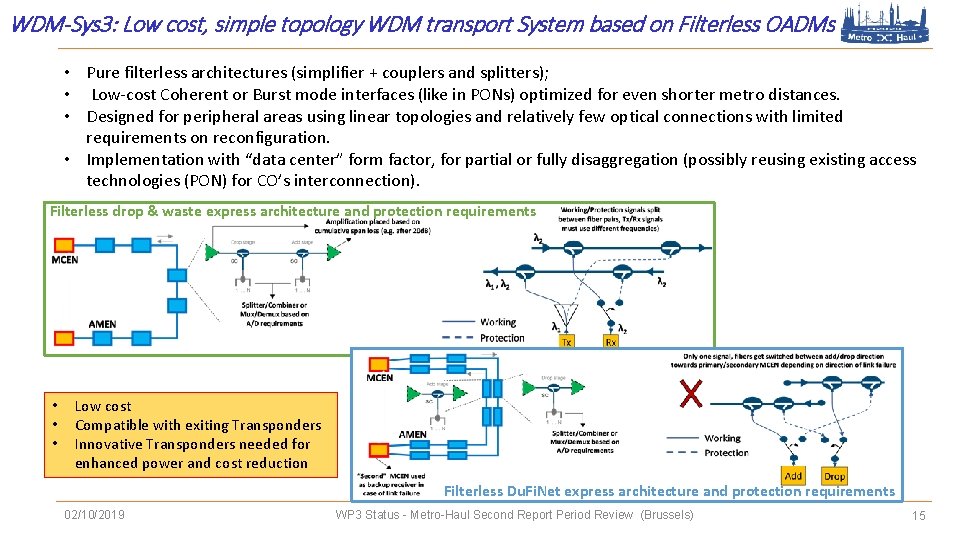
WP 3 in year two: prototyping but not only… 21 Prototypes…(D 1 -D 21): not 21 distinct solutions or technologies! Optical Network Elements (O-NE)s and DWDM Transmission Systems solutions: v Three categories of Systems identified within METRO-HAUL: q WDM-Sys 1: Flexible, high capacity WDM transport System based on MD-ROADMs; q WDM-Sys 2: Low cost, simple topology WDM transport System based on degree-2 ROADMs; q WDM-Sys 3: Low cost, simple topology WDM transport System based on Filterless OADMs. v All O-NEs prototypes are mapped into the three systems: Short-term scenarios: q Focus on of compatibility of O-NEs with each other and with the Systems: both horizontal (optical specification: contribution to Open. ROADM MSA) and vertical interoperability: standard APIs for device control (Open. Config for transceivers; Open. ROADM for optical switching elements). q Integration or upgrades of existing or even commercial solutions with SDN oriented agents or autonomic monitoring systems: ROADM, Filterless, Low Cost Add/Drop: D 1, D 2, D 3; Transceivers: D 6, D 17, D 18, D 19, D 20, D 21. Longer term scenarios: q Selection of efficient optical integrated technologies with expected high technological yield and low costs: D 4, D 5. q Innovative transponders: D 7, D 8, D 10, D 11. 02/10/2019 WP 3 Status - Metro-Haul Second Report Period Review (Brussels) 7
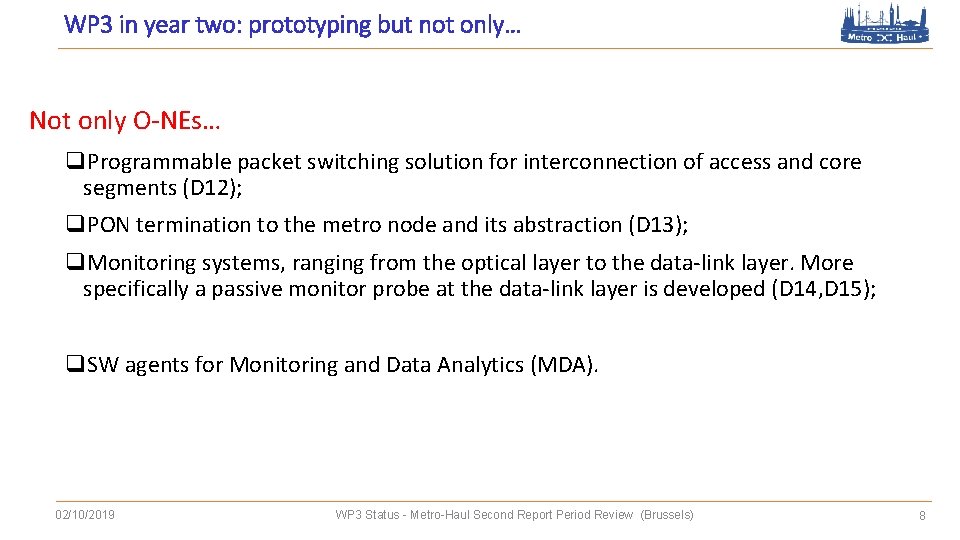
WP 3 in year two: prototyping but not only… Not only O-NEs… q. Programmable packet switching solution for interconnection of access and core segments (D 12); q. PON termination to the metro node and its abstraction (D 13); q. Monitoring systems, ranging from the optical layer to the data-link layer. More specifically a passive monitor probe at the data-link layer is developed (D 14, D 15); q. SW agents for Monitoring and Data Analytics (MDA). 02/10/2019 WP 3 Status - Metro-Haul Second Report Period Review (Brussels) 8
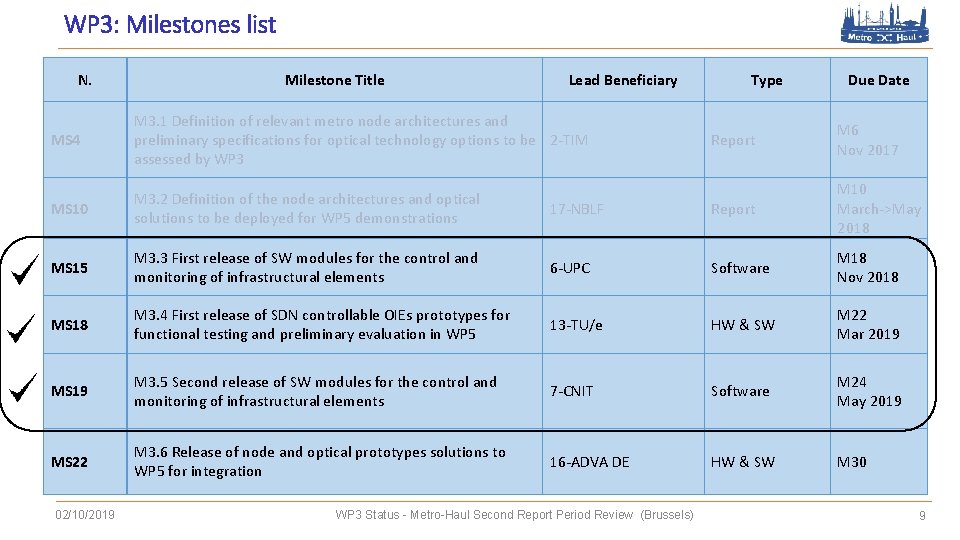
WP 3: Milestones list N. Milestone Title Lead Beneficiary MS 4 M 3. 1 Definition of relevant metro node architectures and preliminary specifications for optical technology options to be 2 -TIM assessed by WP 3 MS 10 M 3. 2 Definition of the node architectures and optical solutions to be deployed for WP 5 demonstrations MS 15 Type Due Date Report M 6 Nov 2017 17 -NBLF Report M 10 March->May 2018 M 3. 3 First release of SW modules for the control and monitoring of infrastructural elements 6 -UPC Software M 18 Nov 2018 MS 18 M 3. 4 First release of SDN controllable OIEs prototypes for functional testing and preliminary evaluation in WP 5 13 -TU/e HW & SW M 22 Mar 2019 MS 19 M 3. 5 Second release of SW modules for the control and monitoring of infrastructural elements 7 -CNIT Software M 24 May 2019 MS 22 M 3. 6 Release of node and optical prototypes solutions to WP 5 for integration 16 -ADVA DE HW & SW M 30 02/10/2019 WP 3 Status - Metro-Haul Second Report Period Review (Brussels) 9
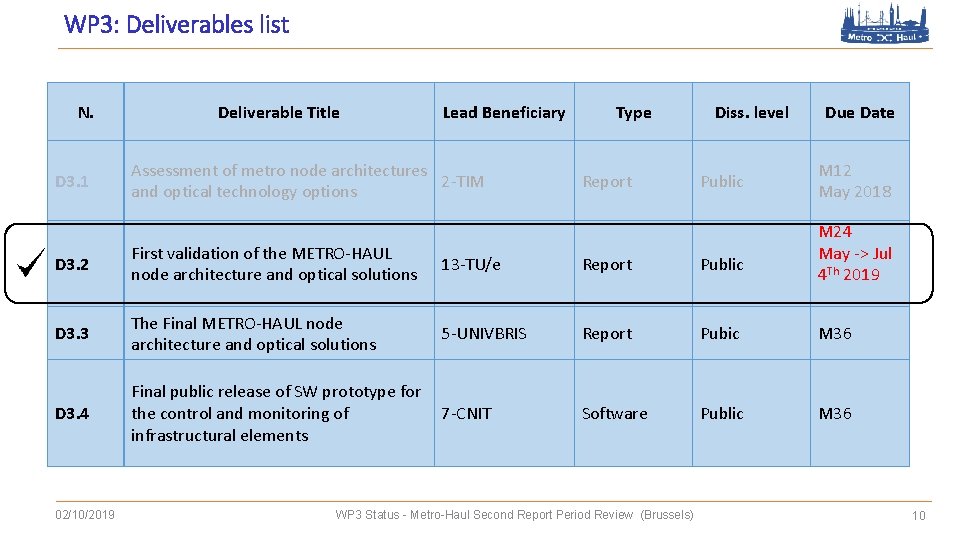
WP 3: Deliverables list N. D 3. 1 Deliverable Title Lead Beneficiary Assessment of metro node architectures 2 -TIM and optical technology options Type Report Diss. level Public Due Date M 12 May 2018 M 24 May -> Jul 4 Th 2019 D 3. 2 First validation of the METRO-HAUL node architecture and optical solutions 13 -TU/e Report Public D 3. 3 The Final METRO-HAUL node architecture and optical solutions 5 -UNIVBRIS Report Pubic M 36 D 3. 4 Final public release of SW prototype for the control and monitoring of 7 -CNIT infrastructural elements Software Public M 36 02/10/2019 WP 3 Status - Metro-Haul Second Report Period Review (Brussels) 10
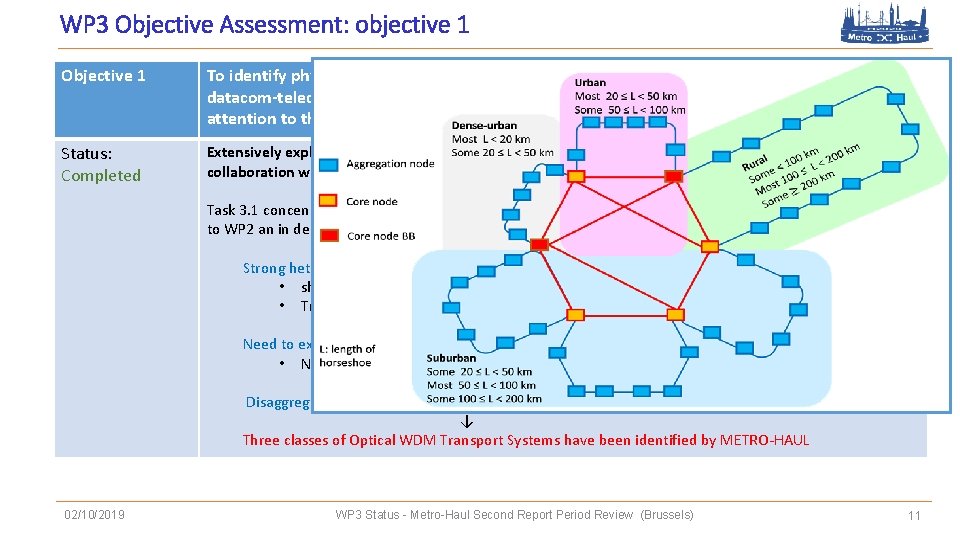
WP 3 Objective Assessment: objective 1 Objective 1 To identify physical architectures for Metro Nodes supporting flexible 5 G access requirements, datacom-telecom convergence and disaggregation of network functionalities with particular attention to the optical layer Status: Completed Extensively explored in the first year of the project and consolidated in a reference architecture in collaboration with WP 2 during the second year (see D 2. 3) Task 3. 1 concentrated mainly on the optical infrastructure subsystem of both AMEN and MCEN nodes leaving to WP 2 an in depth analysis of the options for the intra node L 2/L 3 and overlay networks. Strong heterogeneity in metro network use cases (D 2. 3)! • short/medium and even long reach (topologies: linear, meshed; both, etc. ) • Trade-offs: flexibility vs cost vs capacity vs expandability, … ↓ Need to explore several optical transmission and switching technologies! • Need for modularity ↓ Disaggregation, white boxes (Objective 2) ↓ Three classes of Optical WDM Transport Systems have been identified by METRO-HAUL 02/10/2019 WP 3 Status - Metro-Haul Second Report Period Review (Brussels) 11
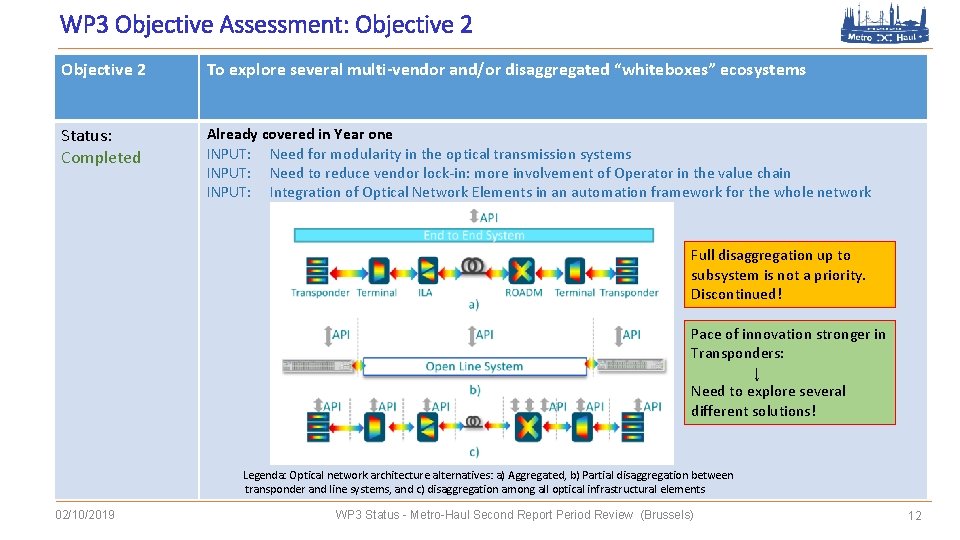
WP 3 Objective Assessment: Objective 2 To explore several multi-vendor and/or disaggregated “whiteboxes” ecosystems Status: Completed Already covered in Year one INPUT: Need for modularity in the optical transmission systems INPUT: Need to reduce vendor lock-in: more involvement of Operator in the value chain INPUT: Integration of Optical Network Elements in an automation framework for the whole network Full disaggregation up to subsystem is not a priority. Discontinued! Pace of innovation stronger in Transponders: ↓ Need to explore several different solutions! Legenda: Optical network architecture alternatives: a) Aggregated, b) Partial disaggregation between transponder and line systems, and c) disaggregation among all optical infrastructural elements 02/10/2019 WP 3 Status - Metro-Haul Second Report Period Review (Brussels) 12
WDM-Sys 1: Flexible, high capacity WDM transport System based on MD-ROADMs • Fully flexible optical switching solutions (e. g. MD-ROADM); • Highly efficient flexible coherent transceivers optimized for metro/regional reach (less, or approximately up to 200 -450 km); • High traffic node interconnections, including meshed topologies; • Modular chasses with “Data center” form factor or standard “ETSI” telecom form factor; • Targeting either partial or full disaggregation. • • Flexible controller needed MSA and common agents New technologies for long term solutions Existing and enhanced solutions for short term 02/10/2019 WP 3 Status - Metro-Haul Second Report Period Review (Brussels) 13
WDM-Sys 2: Low cost, simple topology WDM transport System based on degree-2 ROADMs • Low-cost degree 2 Add&Drop system with limited functionalities and lower flexibility and scalability; • Low-cost Coherent or Direct Detection Transceivers optimized for short reach (less, or approximately up to 80120 km); • Designed for peripheral nodes interconnection with linear or ring topologies, having to handle relatively few optical connections with limited requirements on reconfiguration; • The final implementation will have to be compliant with modular chasses with “Data center” form factor, • Targeting mainly partial disaggregation. • • Flexible controller needed Partial disaggregation: common agents New technologies for long term solutions Existing and enhanced solutions for short term 02/10/2019 WP 3 Status - Metro-Haul Second Report Period Review (Brussels) 14
WDM-Sys 3: Low cost, simple topology WDM transport System based on Filterless OADMs • Pure filterless architectures (simplifier + couplers and splitters); • Low-cost Coherent or Burst mode interfaces (like in PONs) optimized for even shorter metro distances. • Designed for peripheral areas using linear topologies and relatively few optical connections with limited requirements on reconfiguration. • Implementation with “data center” form factor, for partial or fully disaggregation (possibly reusing existing access technologies (PON) for CO’s interconnection). Filterless drop & waste express architecture and protection requirements • • • Low cost Compatible with exiting Transponders Innovative Transponders needed for enhanced power and cost reduction Filterless Du. Fi. Net express architecture and protection requirements 02/10/2019 WP 3 Status - Metro-Haul Second Report Period Review (Brussels) 15
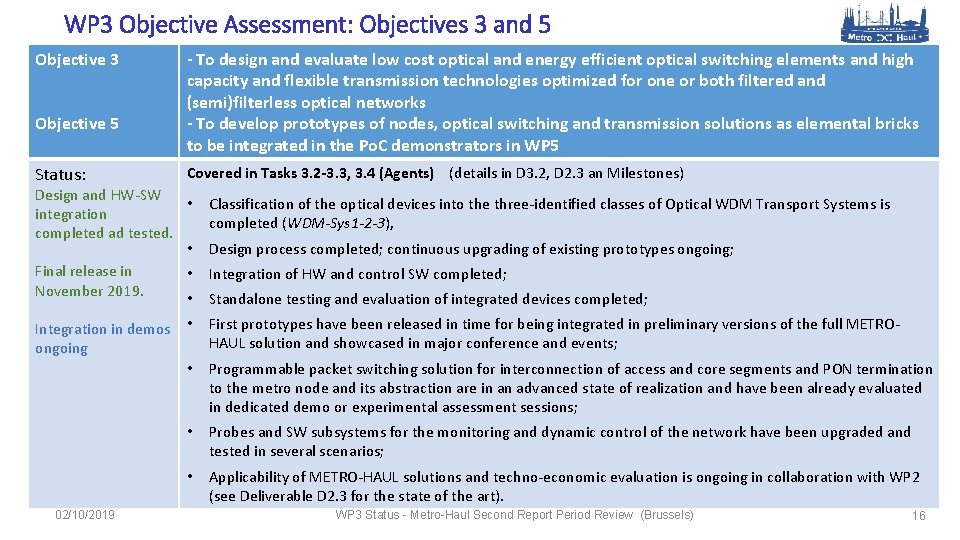
WP 3 Objective Assessment: Objectives 3 and 5 Objective 3 Objective 5 Status: - To design and evaluate low cost optical and energy efficient optical switching elements and high capacity and flexible transmission technologies optimized for one or both filtered and (semi)filterless optical networks - To develop prototypes of nodes, optical switching and transmission solutions as elemental bricks to be integrated in the Po. C demonstrators in WP 5 Covered in Tasks 3. 2 -3. 3, 3. 4 (Agents) (details in D 3. 2, D 2. 3 an Milestones) Design and HW-SW • integration completed ad tested. • Final release in • November 2019. • Integration in demos • ongoing • 02/10/2019 Classification of the optical devices into the three-identified classes of Optical WDM Transport Systems is completed (WDM-Sys 1 -2 -3), Design process completed; continuous upgrading of existing prototypes ongoing; Integration of HW and control SW completed; Standalone testing and evaluation of integrated devices completed; First prototypes have been released in time for being integrated in preliminary versions of the full METROHAUL solution and showcased in major conference and events; Programmable packet switching solution for interconnection of access and core segments and PON termination to the metro node and its abstraction are in an advanced state of realization and have been already evaluated in dedicated demo or experimental assessment sessions; • Probes and SW subsystems for the monitoring and dynamic control of the network have been upgraded and tested in several scenarios; • Applicability of METRO-HAUL solutions and techno-economic evaluation is ongoing in collaboration with WP 2 (see Deliverable D 2. 3 for the state of the art). WP 3 Status - Metro-Haul Second Report Period Review (Brussels) 16
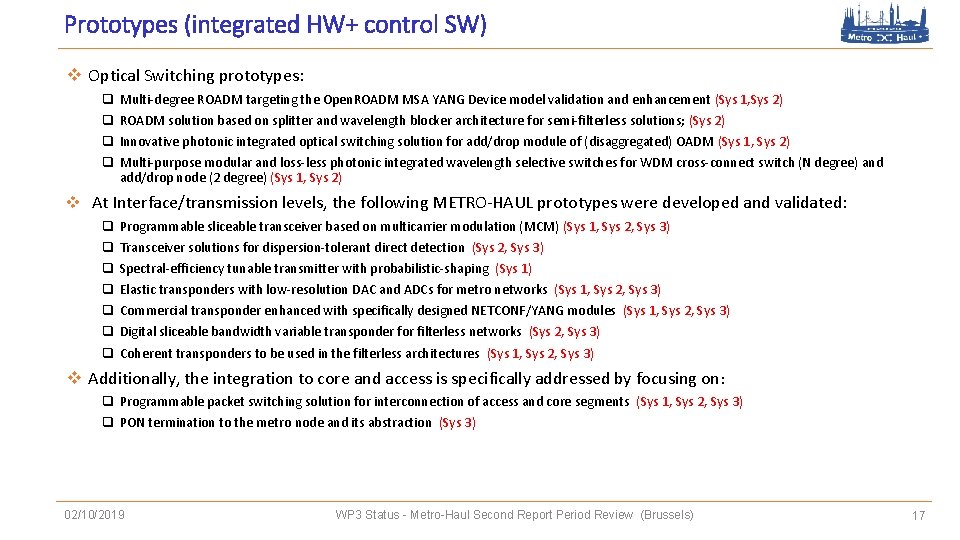
Prototypes (integrated HW+ control SW) v Optical Switching prototypes: q q Multi-degree ROADM targeting the Open. ROADM MSA YANG Device model validation and enhancement (Sys 1, Sys 2) ROADM solution based on splitter and wavelength blocker architecture for semi-filterless solutions; (Sys 2) Innovative photonic integrated optical switching solution for add/drop module of (disaggregated) OADM (Sys 1, Sys 2) Multi-purpose modular and loss-less photonic integrated wavelength selective switches for WDM cross-connect switch (N degree) and add/drop node (2 degree) (Sys 1, Sys 2) v At Interface/transmission levels, the following METRO-HAUL prototypes were developed and validated: q q q q Programmable sliceable transceiver based on multicarrier modulation (MCM) (Sys 1, Sys 2, Sys 3) Transceiver solutions for dispersion-tolerant direct detection (Sys 2, Sys 3) Spectral-efficiency tunable transmitter with probabilistic-shaping (Sys 1) Elastic transponders with low-resolution DAC and ADCs for metro networks (Sys 1, Sys 2, Sys 3) Commercial transponder enhanced with specifically designed NETCONF/YANG modules (Sys 1, Sys 2, Sys 3) Digital sliceable bandwidth variable transponder for filterless networks (Sys 2, Sys 3) Coherent transponders to be used in the filterless architectures (Sys 1, Sys 2, Sys 3) v Additionally, the integration to core and access is specifically addressed by focusing on : q Programmable packet switching solution for interconnection of access and core segments (Sys 1, Sys 2, Sys 3) q PON termination to the metro node and its abstraction (Sys 3) 02/10/2019 WP 3 Status - Metro-Haul Second Report Period Review (Brussels) 17
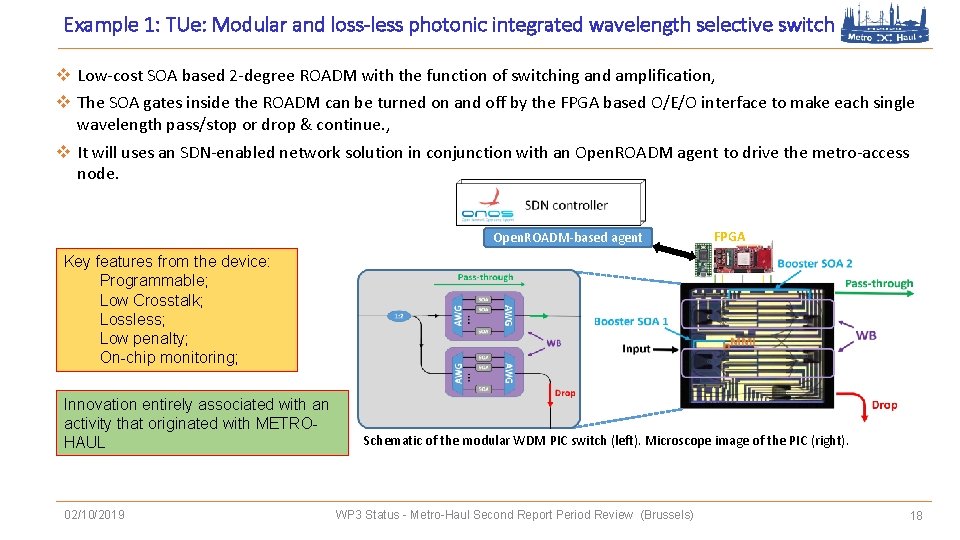
Example 1: TUe: Modular and loss-less photonic integrated wavelength selective switch v Low-cost SOA based 2 -degree ROADM with the function of switching and amplification, v The SOA gates inside the ROADM can be turned on and off by the FPGA based O/E/O interface to make each single wavelength pass/stop or drop & continue. , v It will uses an SDN-enabled network solution in conjunction with an Open. ROADM agent to drive the metro-access node. Open. ROADM-based agent FPGA Key features from the device: Programmable; Low Crosstalk; Lossless; Low penalty; On-chip monitoring; Innovation entirely associated with an activity that originated with METROHAUL 02/10/2019 Schematic of the modular WDM PIC switch (left). Microscope image of the PIC (right). WP 3 Status - Metro-Haul Second Report Period Review (Brussels) 18
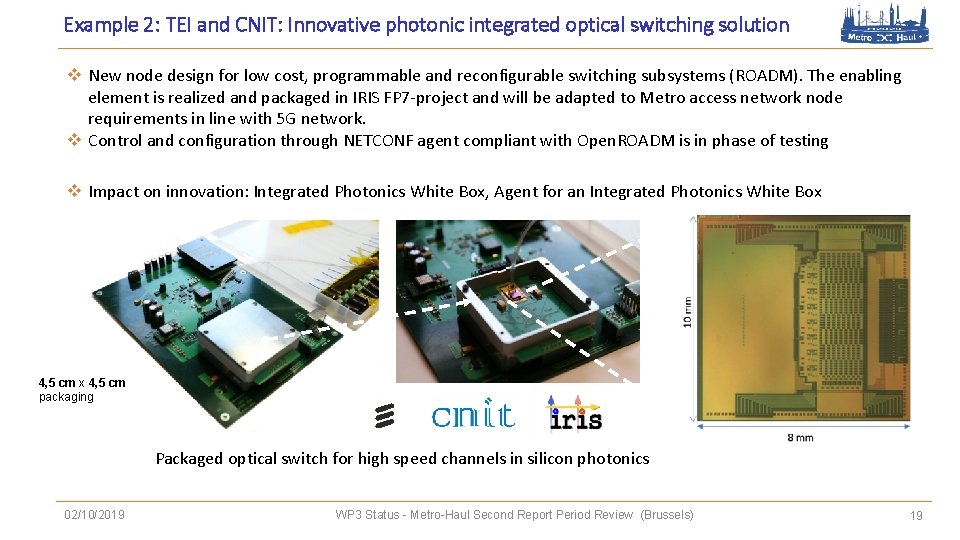
Example 2: TEI and CNIT: Innovative photonic integrated optical switching solution v New node design for low cost, programmable and reconfigurable switching subsystems (ROADM). The enabling element is realized and packaged in IRIS FP 7 -project and will be adapted to Metro access network node requirements in line with 5 G network. v Control and configuration through NETCONF agent compliant with Open. ROADM is in phase of testing v Impact on innovation: Integrated Photonics White Box, Agent for an Integrated Photonics White Box 4, 5 cm x 4, 5 cm packaging Packaged optical switch for high speed channels in silicon photonics 02/10/2019 WP 3 Status - Metro-Haul Second Report Period Review (Brussels) 19
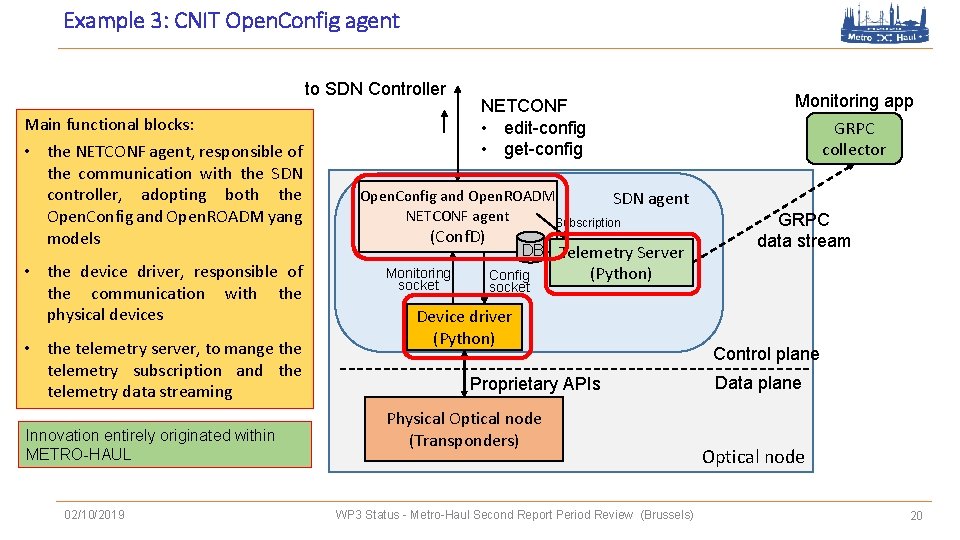
Example 3: CNIT Open. Config agent to SDN Controller Main functional blocks: • the NETCONF agent, responsible of the communication with the SDN controller, adopting both the Open. Config and Open. ROADM yang models • the device driver, responsible of the communication with the physical devices • the telemetry server, to mange the telemetry subscription and the telemetry data streaming Innovation entirely originated within METRO-HAUL 02/10/2019 Monitoring app GRPC collector NETCONF • edit-config • get-config Open. Config and Open. ROADM SDN agent NETCONF agent Subscription (Conf. D) Monitoring socket DB Telemetry Server Config socket GRPC data stream (Python) Device driver (Python) Proprietary APIs Physical Optical node (Transponders) WP 3 Status - Metro-Haul Second Report Period Review (Brussels) Control plane Data plane Optical node 20
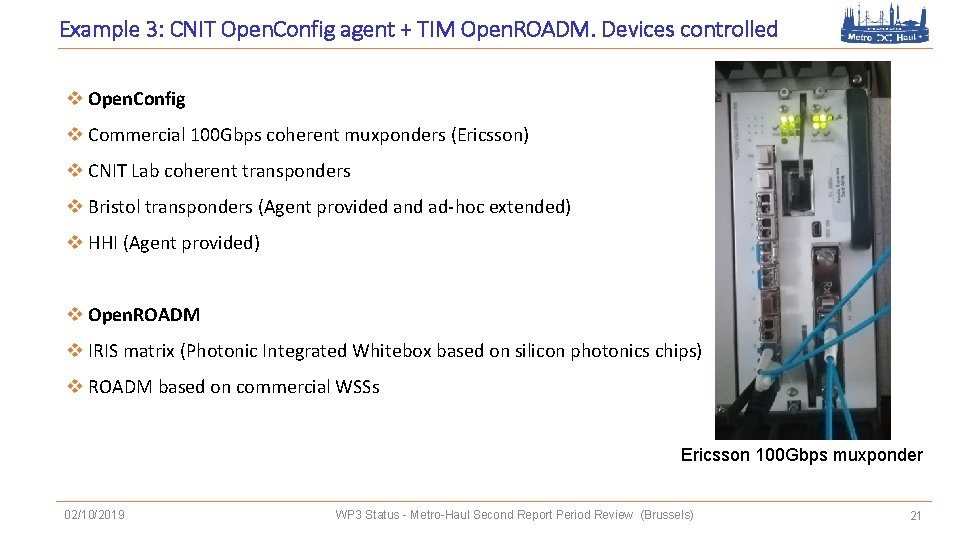
Example 3: CNIT Open. Config agent + TIM Open. ROADM. Devices controlled v Open. Config v Commercial 100 Gbps coherent muxponders (Ericsson) v CNIT Lab coherent transponders v Bristol transponders (Agent provided and ad-hoc extended) v HHI (Agent provided) v Open. ROADM v IRIS matrix (Photonic Integrated Whitebox based on silicon photonics chips) v ROADM based on commercial WSSs Ericsson 100 Gbps muxponder 02/10/2019 WP 3 Status - Metro-Haul Second Report Period Review (Brussels) 21
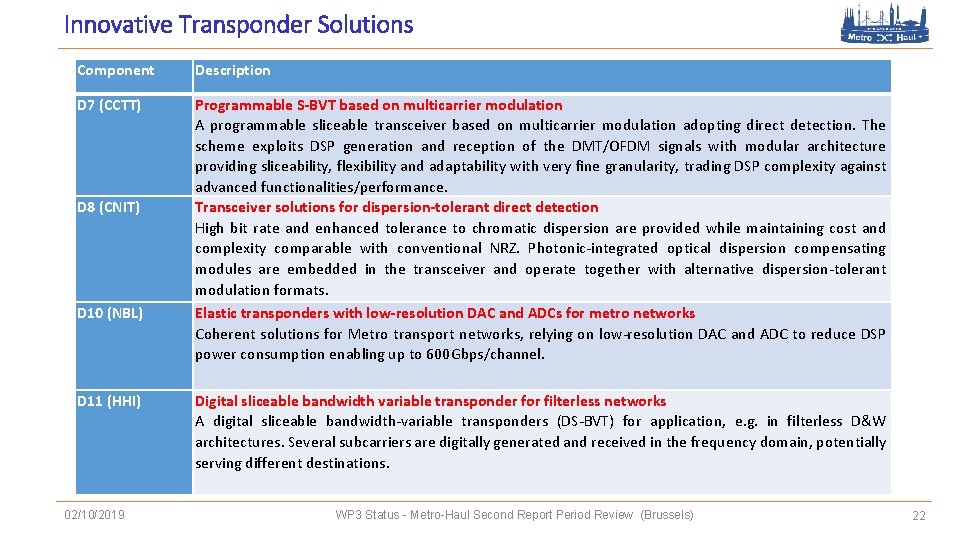
Innovative Transponder Solutions Component Description D 7 (CCTT) Programmable S-BVT based on multicarrier modulation A programmable sliceable transceiver based on multicarrier modulation adopting direct detection. The scheme exploits DSP generation and reception of the DMT/OFDM signals with modular architecture providing sliceability, flexibility and adaptability with very fine granularity, trading DSP complexity against advanced functionalities/performance. Transceiver solutions for dispersion-tolerant direct detection High bit rate and enhanced tolerance to chromatic dispersion are provided while maintaining cost and complexity comparable with conventional NRZ. Photonic-integrated optical dispersion compensating modules are embedded in the transceiver and operate together with alternative dispersion-tolerant modulation formats. Elastic transponders with low-resolution DAC and ADCs for metro networks Coherent solutions for Metro transport networks, relying on low-resolution DAC and ADC to reduce DSP power consumption enabling up to 600 Gbps/channel. D 8 (CNIT) D 10 (NBL) D 11 (HHI) 02/10/2019 Digital sliceable bandwidth variable transponder for filterless networks A digital sliceable bandwidth-variable transponders (DS-BVT) for application, e. g. in filterless D&W architectures. Several subcarriers are digitally generated and received in the frequency domain, potentially serving different destinations. WP 3 Status - Metro-Haul Second Report Period Review (Brussels) 22
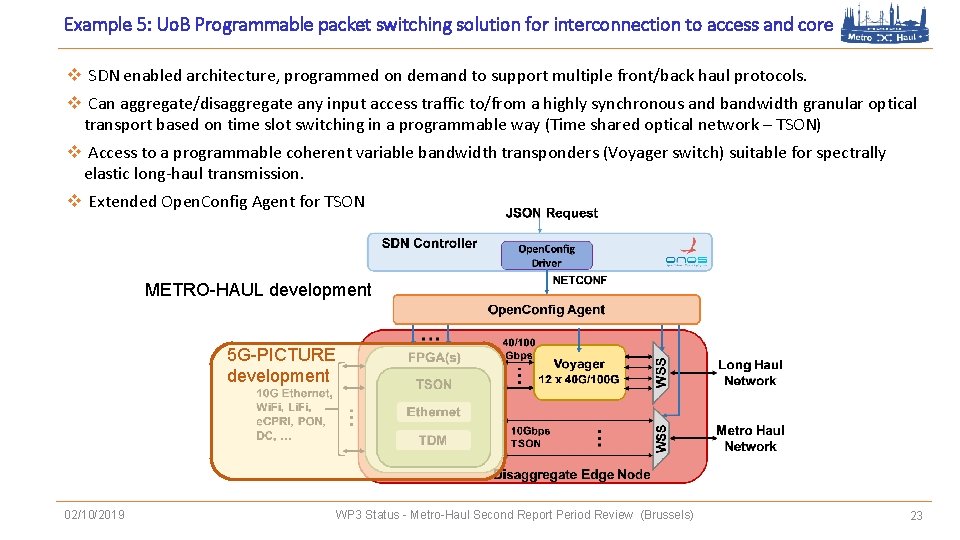
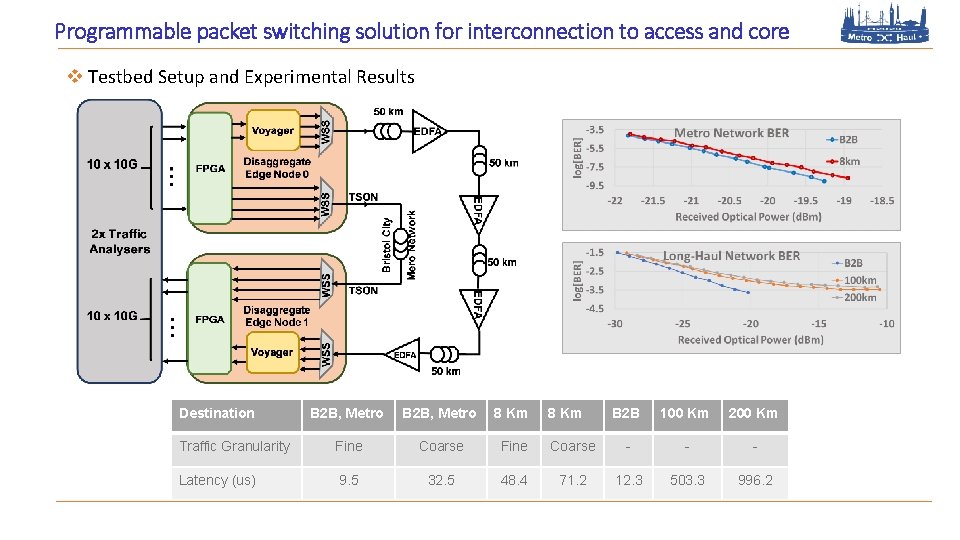
Example 5: Uo. B Programmable packet switching solution for interconnection to access and core v SDN enabled architecture, programmed on demand to support multiple front/back haul protocols. v Can aggregate/disaggregate any input access traffic to/from a highly synchronous and bandwidth granular optical transport based on time slot switching in a programmable way (Time shared optical network – TSON) v Access to a programmable coherent variable bandwidth transponders (Voyager switch) suitable for spectrally elastic long-haul transmission. v Extended Open. Config Agent for TSON METRO-HAUL development 5 G-PICTURE development 02/10/2019 WP 3 Status - Metro-Haul Second Report Period Review (Brussels) 23
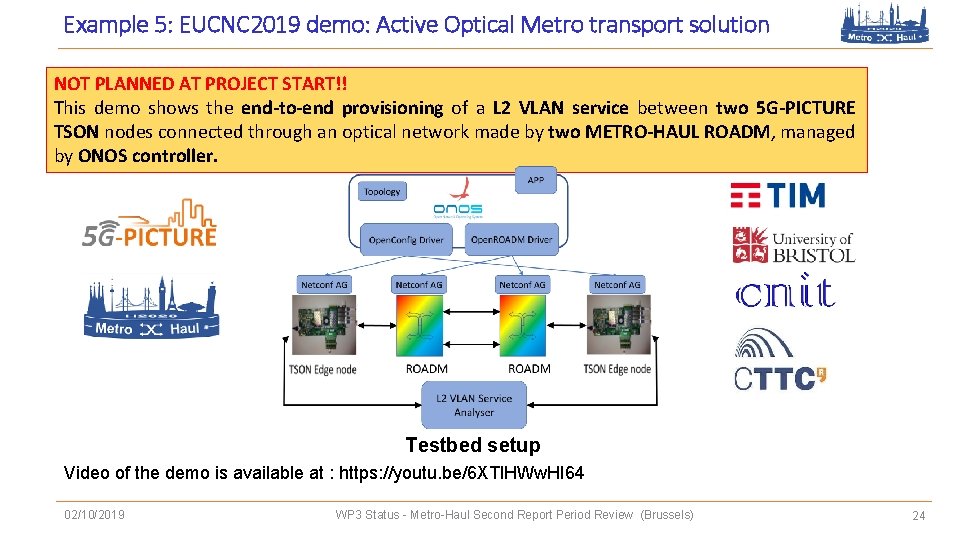
Example 5: EUCNC 2019 demo: Active Optical Metro transport solution NOT PLANNED AT PROJECT START!! This demo shows the end-to-end provisioning of a L 2 VLAN service between two 5 G-PICTURE TSON nodes connected through an optical network made by two METRO-HAUL ROADM, managed by ONOS controller. Testbed setup Video of the demo is available at : https: //youtu. be/6 XTl. HWw. HI 64 02/10/2019 WP 3 Status - Metro-Haul Second Report Period Review (Brussels) 24
Objective Assessment: Objective 4 To investigate and demonstrate an integrated monitoring and control architecture ranging from probes on optical infrastructure elements to Metro Node, packet and service monitoring with local analytics evaluation Covered in Tasks 3. 4 (details in D 3. 2, M 3. 3, M 3. 4, M 3. 5) Status: Design and Modeling, node Agents and interfaces toward control/ management system second release of • Strong collaboration with WP 4 SW completed • Modeling of optical network elements and subsystems addressing transponders, ROADMs, and Final release at the end of the project. • • optical amplifiers (Open. ROADM , Open. Config) Agents for controlling ROADM, X-ponders and amplifies developed and used in several devices and assessed in demos; Open. ROADM contribution. Monitoring and Data Analytics (MDA) • 02/10/2019 Strong collaboration with WP 4 • The specification of the interfaces toward the higher hierarchical order monitoring systems; • The definition of the MDA agent architecture; • The study and development of methodologies and probes for monitoring at the optical layer; • The study and development of methodologies and probes for monitoring at packet layer; • Several (often joint) assessment experimental activities of the proposed solutions and developed probe WP 3 Status - Metro-Haul Second Report Period Review (Brussels) 25
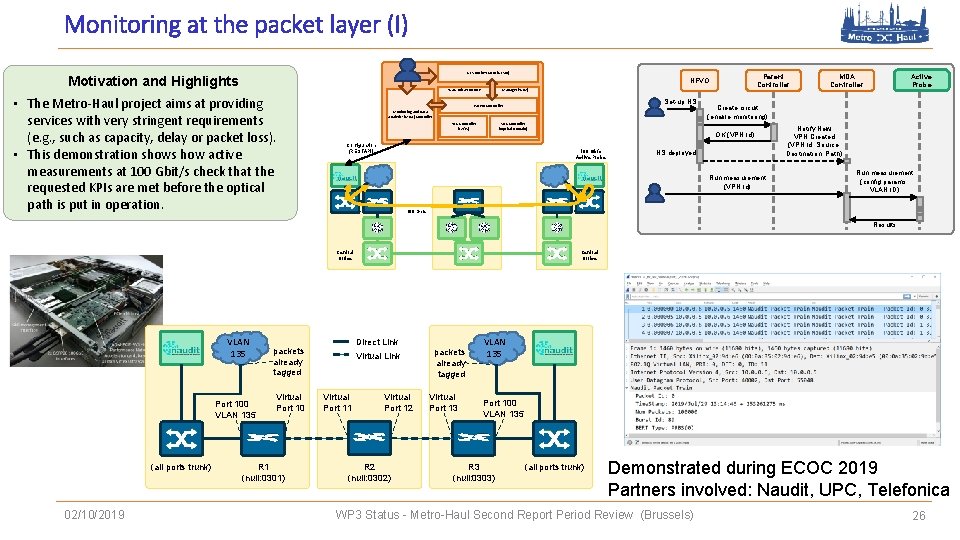
Monitoring at the packet layer (I) NFV Orchestrator (NFVO) Motivation and Highlights Parent Controller NFVO WAN Infrastructure • The Metro-Haul project aims at providing services with very stringent requirements (e. g. , such as capacity, delay or packet loss). • This demonstration shows how active measurements at 100 Gbit/s check that the requested KPIs are met before the optical path is put in operation. Manager (WIM) Set-up NS Parent Controller Monitoring and Data Analytics (MDA) Controller SDN Controller (L 2/L 3) SDN Controller (Optical Domain) Configuration (RESTAPI) Active Probe Create circuit (enable monitoring) OK (VPN Id) 100 Gb/s Active Probe MDA Controller NS deployed Run measurement (VPN Id) Notify New VPN Created (VPN Id, Source, Destination, Path) Run measurement (config params, VLAN ID) 100 Gb/s Results Central Office VLAN 135 Port 100 VLAN 135 (all ports trunk) 02/10/2019 Direct Link packets already tagged Virtual Port 10 R 1 (null: 0301) Virtual Link Virtual Port 11 Virtual Port 12 R 2 (null: 0302) packets already tagged Virtual Port 13 VLAN 135 Port 100 VLAN 135 R 3 (null: 0303) (all ports trunk) Demonstrated during ECOC 2019 Partners involved: Naudit, UPC, Telefonica WP 3 Status - Metro-Haul Second Report Period Review (Brussels) 26
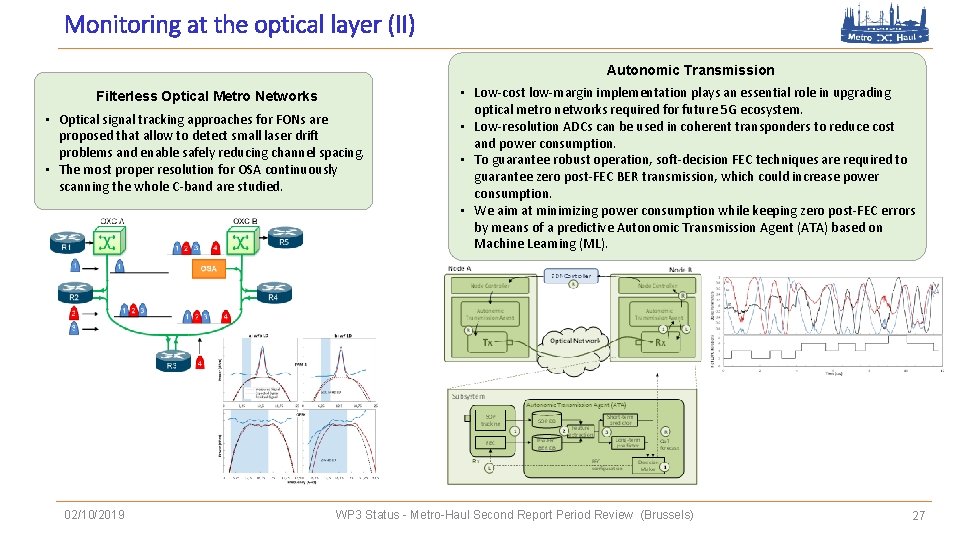
Monitoring at the optical layer (II) Autonomic Transmission Filterless Optical Metro Networks • Optical signal tracking approaches for FONs are proposed that allow to detect small laser drift problems and enable safely reducing channel spacing. • The most proper resolution for OSA continuously scanning the whole C-band are studied. 02/10/2019 • Low-cost low-margin implementation plays an essential role in upgrading optical metro networks required for future 5 G ecosystem. • Low-resolution ADCs can be used in coherent transponders to reduce cost and power consumption. • To guarantee robust operation, soft-decision FEC techniques are required to guarantee zero post-FEC BER transmission, which could increase power consumption. • We aim at minimizing power consumption while keeping zero post-FEC errors by means of a predictive Autonomic Transmission Agent (ATA) based on Machine Learning (ML). WP 3 Status - Metro-Haul Second Report Period Review (Brussels) 27
Second Report Period Summary and conclusions v WP 3 tasks are progressing as expected, addressing all the objectives in the right time and to the expected extent. q Deviations in terms of effort or time reflects the internal planning of each partner in order to achieve its own objectives and intermediate milestones. q All milestone released in time. Small delay in D 3. 2. q No critical issues are emerged and no corrective actions are needed. v Notable progress of the work done in WP 3 q DWDM System classification q Optical disaggregation q Advanced Status of prototypes testing and assessment of transmission technologies q Integration of HW and control SW q Second release of MDA and probe prototypes v Large number of dissemination actions q Including High impact joint papers with key aspects of Metro-Haul Technologies q Demos at key events, ECOC 2018 (September 2018), EUCNC 2019 and q Contribution to Open. Source projects: Open. ROADM 02/10/2019 WP 3 Status - Metro-Haul Second Report Period Review (Brussels) 28
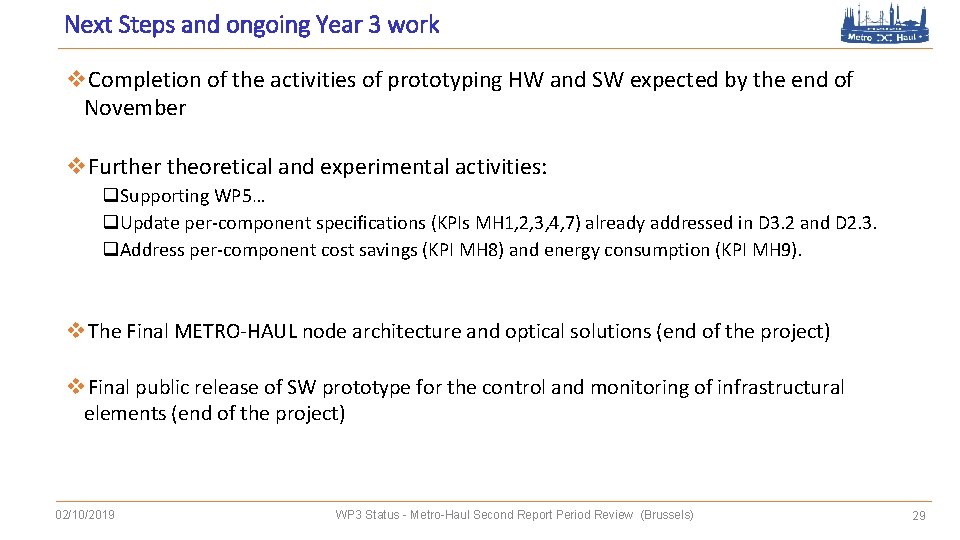
Next Steps and ongoing Year 3 work v Completion of the activities of prototyping HW and SW expected by the end of November v Further theoretical and experimental activities: q. Supporting WP 5… q. Update per-component specifications (KPIs MH 1, 2, 3, 4, 7) already addressed in D 3. 2 and D 2. 3. q. Address per-component cost savings (KPI MH 8) and energy consumption (KPI MH 9). v The Final METRO-HAUL node architecture and optical solutions (end of the project) v Final public release of SW prototype for the control and monitoring of infrastructural elements (end of the project) 02/10/2019 WP 3 Status - Metro-Haul Second Report Period Review (Brussels) 29
Grazie Metro-Haul First Report Period Review – WP 3 Status http: //metro-haul. eu 02/10/2019 WP 3 Status - Metro-Haul Second Report Period Review (Brussels) 30
Additional slides METRO-HAUL: METRO High bandwidth, 5 G Application-aware optical network, with edge storage, compute and low Latency http: //metro-haul. eu 02/10/2019 H 2020 -ICT-2016 -2 Metro-Haul Grant No. 761727 WP 3 Status - Metro-Haul Second Report Period Review (Brussels)
CCTC
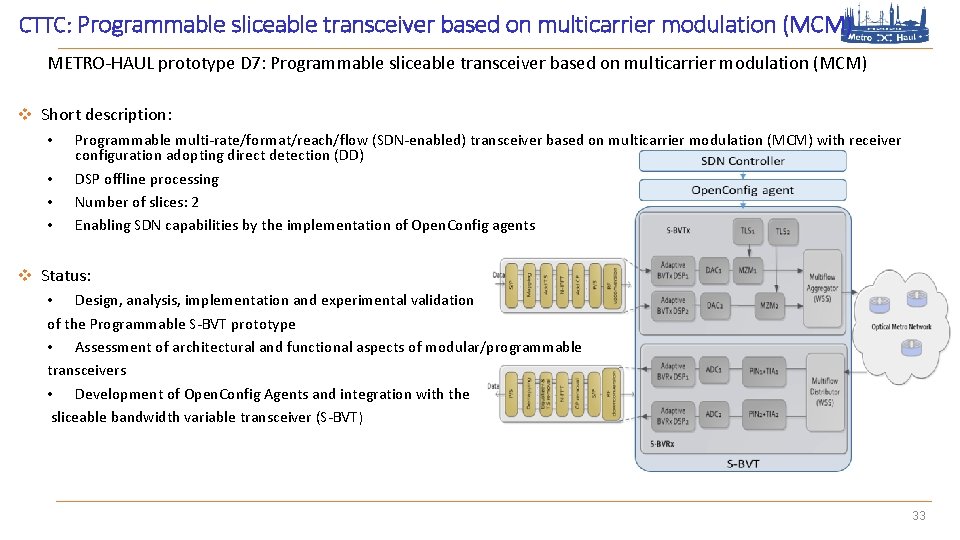
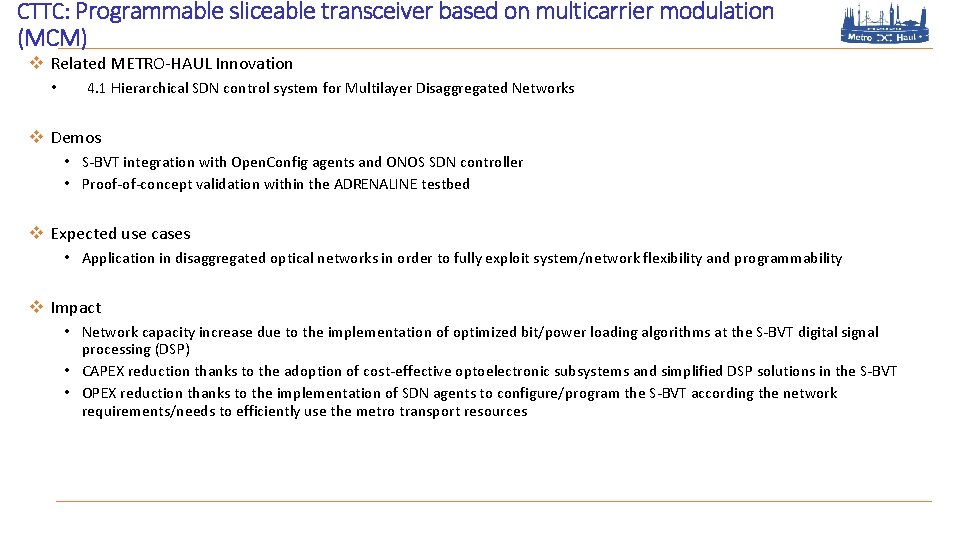
CTTC: Programmable sliceable transceiver based on multicarrier modulation (MCM) METRO-HAUL prototype D 7: Programmable sliceable transceiver based on multicarrier modulation (MCM) v Short description: • Programmable multi-rate/format/reach/flow (SDN-enabled) transceiver based on multicarrier modulation (MCM) with receiver configuration adopting direct detection (DD) • DSP offline processing • Number of slices: 2 • Enabling SDN capabilities by the implementation of Open. Config agents v Status: • Design, analysis, implementation and experimental validation of the Programmable S-BVT prototype • Assessment of architectural and functional aspects of modular/programmable transceivers • Development of Open. Config Agents and integration with the sliceable bandwidth variable transceiver (S-BVT) 33
CTTC: Programmable sliceable transceiver based on multicarrier modulation (MCM) v Related METRO-HAUL Innovation • 4. 1 Hierarchical SDN control system for Multilayer Disaggregated Networks v Demos • S-BVT integration with Open. Config agents and ONOS SDN controller • Proof-of-concept validation within the ADRENALINE testbed v Expected use cases • Application in disaggregated optical networks in order to fully exploit system/network flexibility and programmability v Impact • Network capacity increase due to the implementation of optimized bit/power loading algorithms at the S-BVT digital signal processing (DSP) • CAPEX reduction thanks to the adoption of cost-effective optoelectronic subsystems and simplified DSP solutions in the S-BVT • OPEX reduction thanks to the implementation of SDN agents to configure/program the S-BVT according the network requirements/needs to efficiently use the metro transport resources
ADVA and HHI
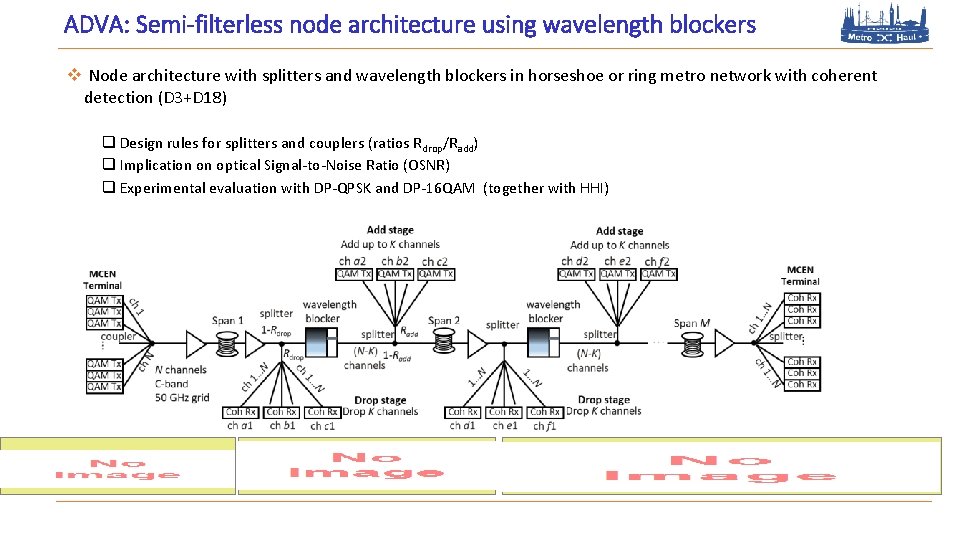
ADVA: Semi-filterless node architecture using wavelength blockers v Node architecture with splitters and wavelength blockers in horseshoe or ring metro network with coherent detection (D 3+D 18) q Design rules for splitters and couplers (ratios Rdrop/Radd) q Implication on optical Signal-to-Noise Ratio (OSNR) q Experimental evaluation with DP-QPSK and DP-16 QAM (together with HHI)
ADVA: Semi-filterless node architecture using wavelength blockers v Software interfaces: ADVA OLS: TAPI 2. 1 NBI interface will be provided to connect with optical SDN, ADVA coherent transponders: Open. Config for optical SDN control v ROADM nodes and coherent transponders will be used in real-time low-latency object tracking demo (Berlin) v Final hardware installation and software integration for demo with other partners started v Paper “Flexible metro network architecture based on wavelength blockers and coherent transmission” is accepted for ECOC 2019 as extended talk and Journal paper will be prepared The results and findings are useful in future system designs by ADVA using wavelength blockers and coherent transmission
OLC
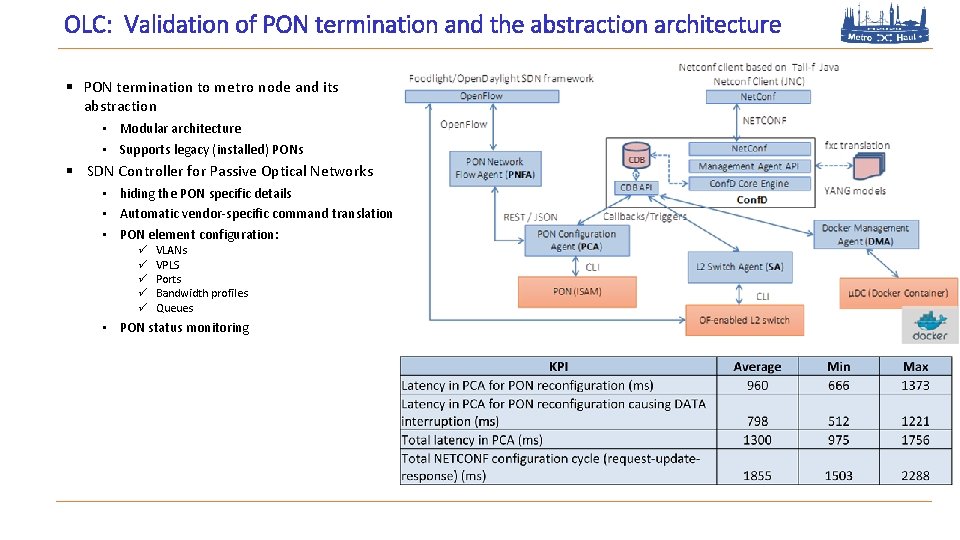
OLC: Validation of PON termination and the abstraction architecture § PON termination to metro node and its abstraction • Modular architecture • Supports legacy (installed) PONs § SDN Controller for Passive Optical Networks • hiding the PON specific details • Automatic vendor-specific command translation • PON element configuration: ü ü ü VLANs VPLS Ports Bandwidth profiles Queues • PON status monitoring
TIM
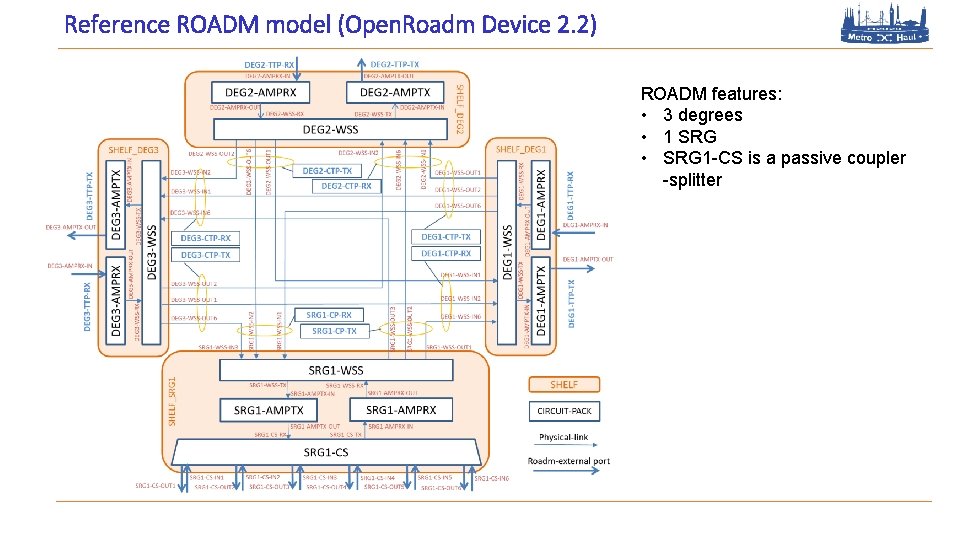
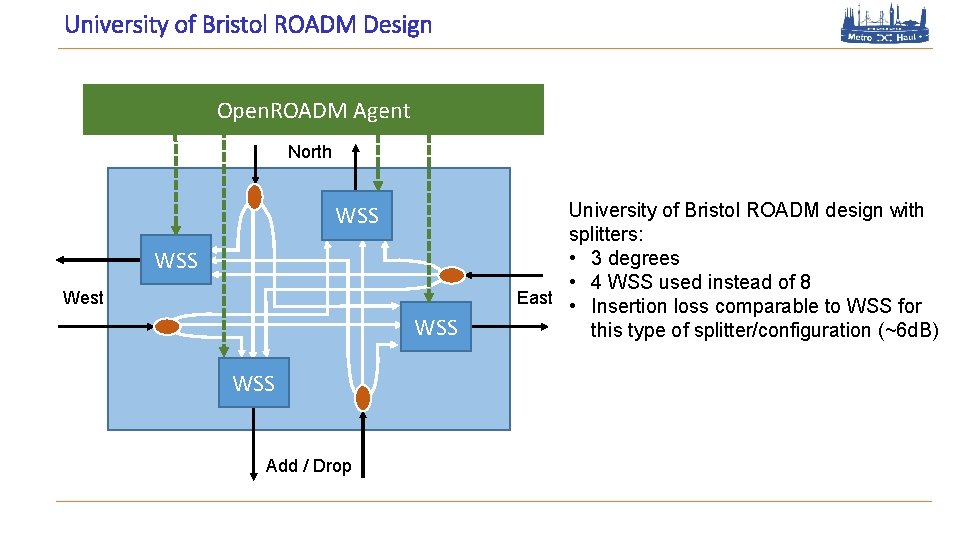
Reference ROADM model (Open. Roadm Device 2. 2) ROADM features: • 3 degrees • 1 SRG • SRG 1 -CS is a passive coupler -splitter
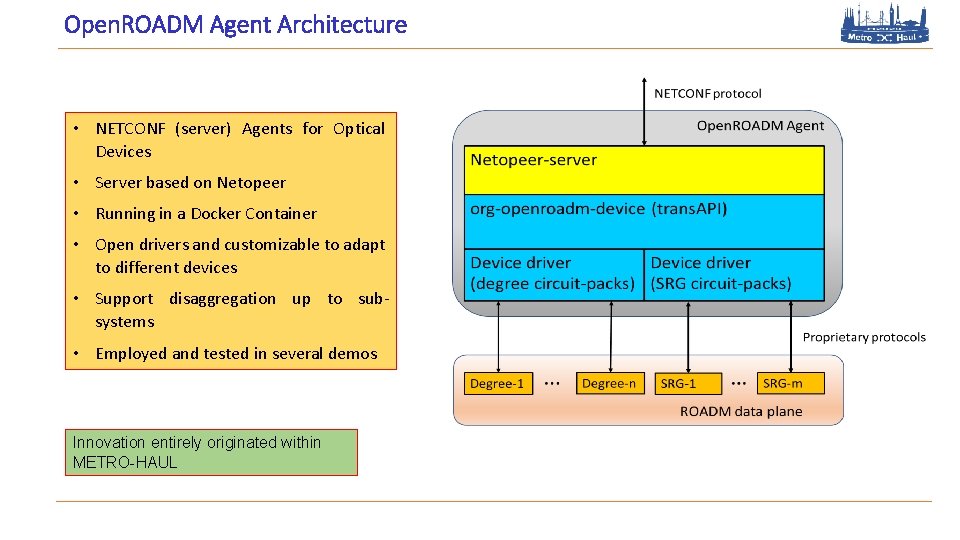
Open. ROADM Agent Architecture • NETCONF (server) Agents for Optical Devices • Server based on Netopeer • Running in a Docker Container • Open drivers and customizable to adapt to different devices • Support disaggregation up to subsystems • Employed and tested in several demos Innovation entirely originated within METRO-HAUL
TEI/CNIT
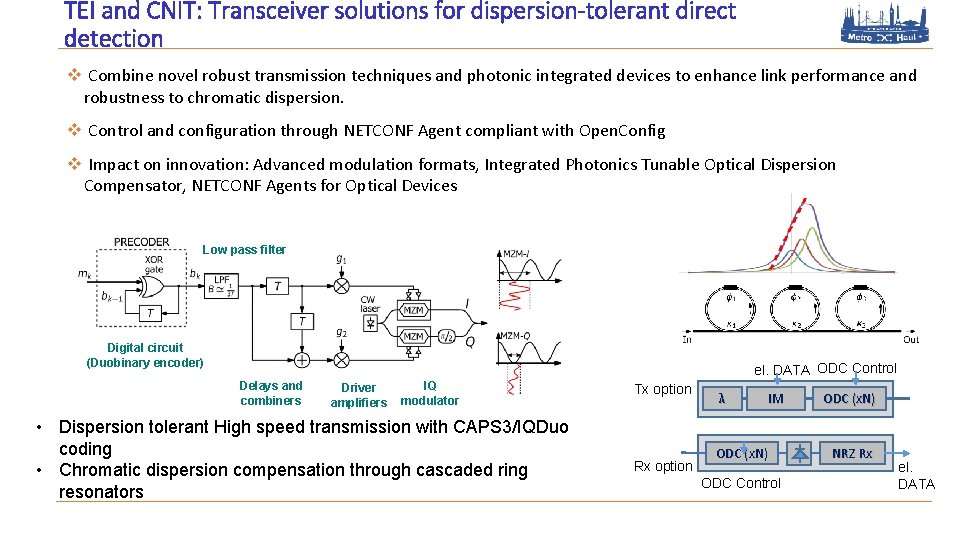
TEI and CNIT: Transceiver solutions for dispersion-tolerant direct detection v Combine novel robust transmission techniques and photonic integrated devices to enhance link performance and robustness to chromatic dispersion. v Control and configuration through NETCONF Agent compliant with Open. Config v Impact on innovation: Advanced modulation formats, Integrated Photonics Tunable Optical Dispersion Compensator, NETCONF Agents for Optical Devices Low pass filter Digital circuit (Duobinary encoder) el. DATA ODC Control Delays and combiners Driver amplifiers IQ modulator • Dispersion tolerant High speed transmission with CAPS 3/IQDuo coding • Chromatic dispersion compensation through cascaded ring resonators Tx option Rx option λ IM ODC (x. N) ODC Control ODC (x. N) NRZ Rx el. DATA
NETCONF Agents based on Conf. D tool NETCONF agent based on Conf. D tool modeling a transponder device compliant with the standard Open. Config Terminal Device. v - Open. Config agent has been used in several demonstrations (e. g. , OFC 2019, Eu. CNC control plane demo) with both real (e. g. , Ericsson commercial transponders) and emulated devices. v Open. Config agent is in phase of integration with CNIT/TEI transceiver for dispersion-tolerant direct detection v Other partners are using the agent to control several devices (Bristol experimental TSON in collaboration with 5 G PICTURE project, Voyager transpoder at Zeetta Networks, Nokia transponder, Adva transponder). NETCONF agent based on Conf. D tool modeling a ROADM device compliant with the Open. ROADM standard. v - Open. ROADM agent is in phase of testing for controlling a physical ROADM implemented with a photonic integrated switching matrix developed within the IRIS project.
University of Bristol
Programmable packet switching solution for interconnection to access and core v Testbed Setup and Experimental Results Destination B 2 B, Metro 8 Km Traffic Granularity Fine Coarse Fine Latency (us) 9. 5 32. 5 48. 4 8 Km B 2 B 100 Km 200 Km Coarse - - - 71. 2 12. 3 503. 3 996. 2
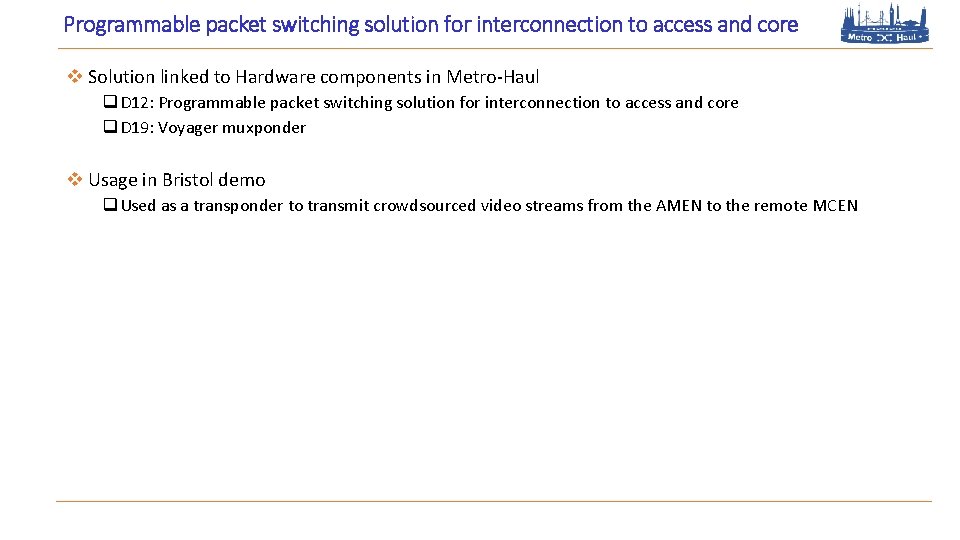
Programmable packet switching solution for interconnection to access and core v Solution linked to Hardware components in Metro-Haul q D 12: Programmable packet switching solution for interconnection to access and core q D 19: Voyager muxponder v Usage in Bristol demo q Used as a transponder to transmit crowdsourced video streams from the AMEN to the remote MCEN
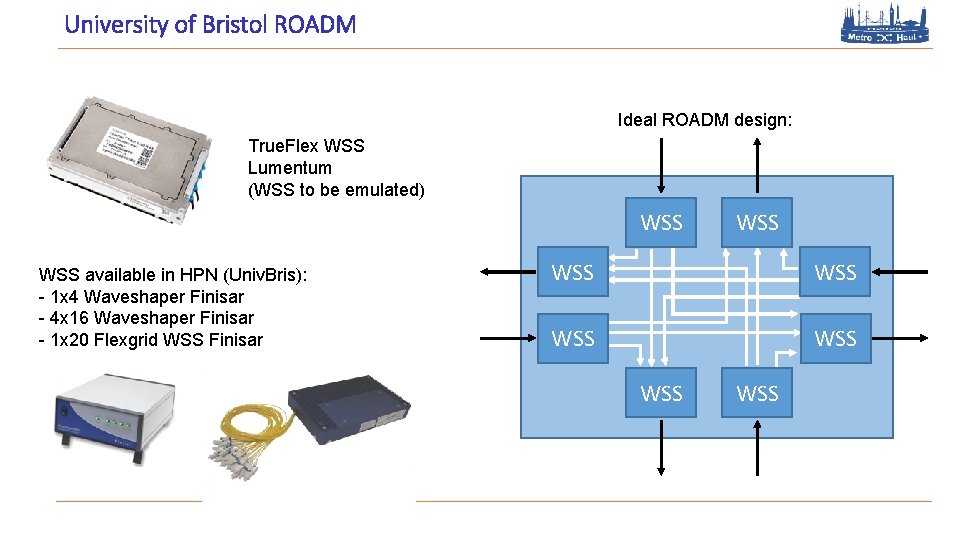
University of Bristol ROADM Ideal ROADM design: True. Flex WSS Lumentum (WSS to be emulated) WSS available in HPN (Univ. Bris): - 1 x 4 Waveshaper Finisar - 4 x 16 Waveshaper Finisar - 1 x 20 Flexgrid WSS Finisar WSS WSS
University of Bristol ROADM Design Open. ROADM Agent North WSS West WSS Add / Drop University of Bristol ROADM design with splitters: • 3 degrees • 4 WSS used instead of 8 East • Insertion loss comparable to WSS for this type of splitter/configuration (~6 d. B)
University of Bristol ROADM v Solution linked to Hardware components in Metro-Haul q D 21: Bristol ROADM v Usage in Bristol demo q Used as the ROADM to switch lightpaths carrying crowdsourced video streams from the AMEN to the remote MCEN and vice versa
UPC
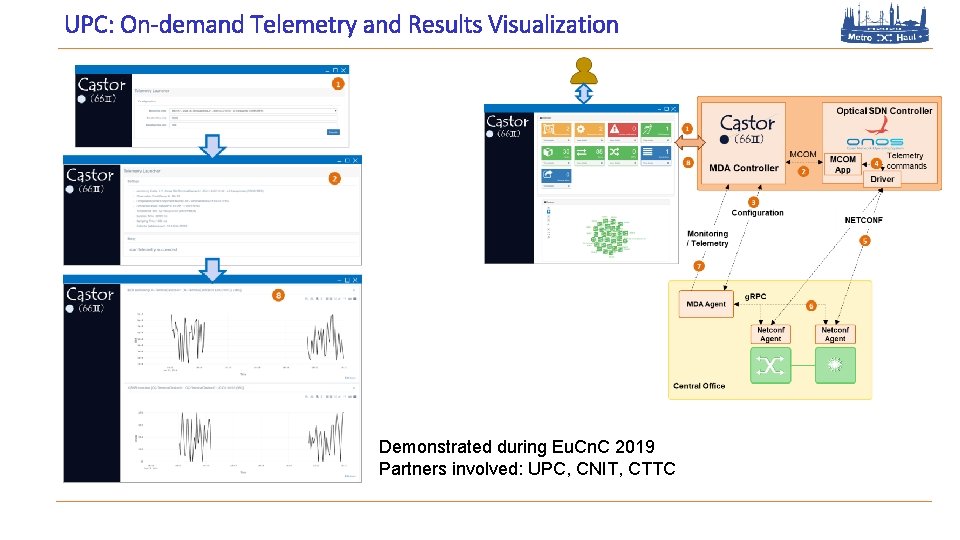
UPC: On-demand Telemetry and Results Visualization Demonstrated during Eu. Cn. C 2019 Partners involved: UPC, CNIT, CTTC