
METRO BABY PROJECT Click to edit Master subtitle

METRO BABY PROJECT Click to edit Master subtitle style New York University Psychology Department Dr. Catherine Tamis-Le. Monda Eden Lipke (HCS 2009) Farzana Ahmed (HCS 2009) Lorena Nicol (HCS 2008)
OVERVIEW of TALK ØMetro ØOur baby project research activities
Metro baby project
GOAL To understand the influence of… � families, schools, peers, work, and the media on development of young children � parents’ views and practices from the first days of infants’ lives � culture on infants’ early learning, development, and school readiness.
BACKGROUND � Started in 2004 � Mothers and their newborns were recruited from Bellevue Hospital, Harlem Hospital, and Allen Pavillion � Initial sample: 324 families Ø African American Ø Dominican Ø Mexican
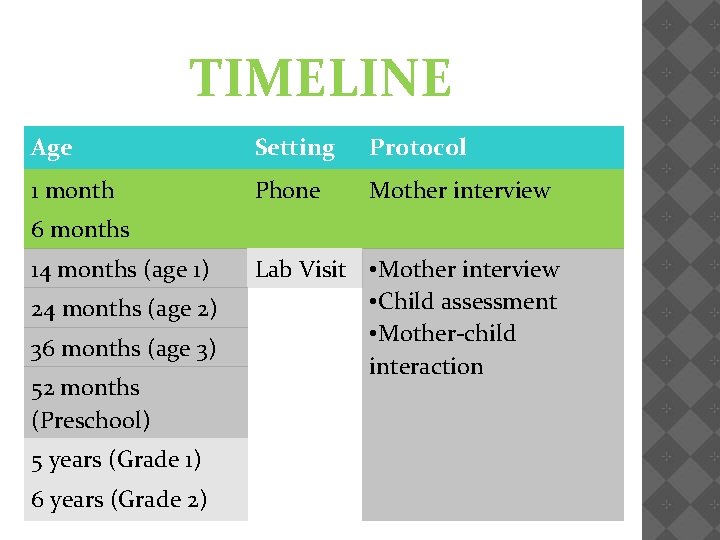
TIMELINE Age Setting Protocol 1 month Phone Mother interview 6 months 14 months (age 1) 24 months (age 2) 36 months (age 3) 52 months (Preschool) 5 years (Grade 1) 6 years (Grade 2) Lab Visit • Mother interview • Child assessment • Mother-child interaction
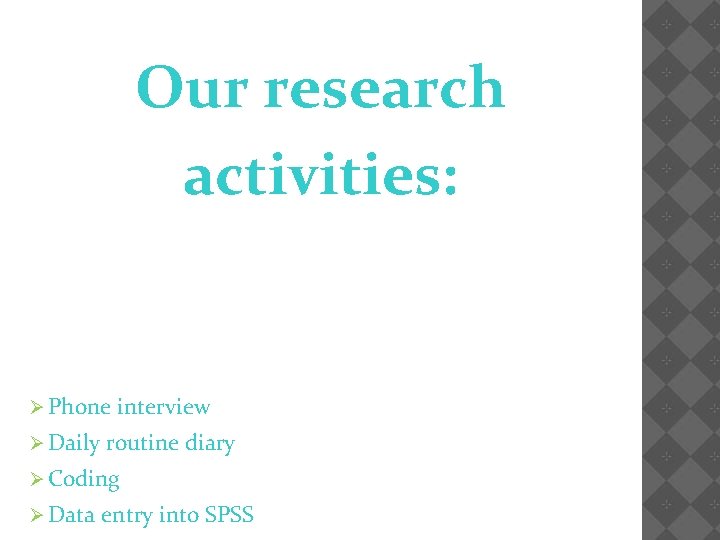
Our research activities: Ø Phone Ø Daily interview routine diary Ø Coding Ø Data entry into SPSS

Our research activities: ØPhone interview Ø Daily routine diary Ø Coding
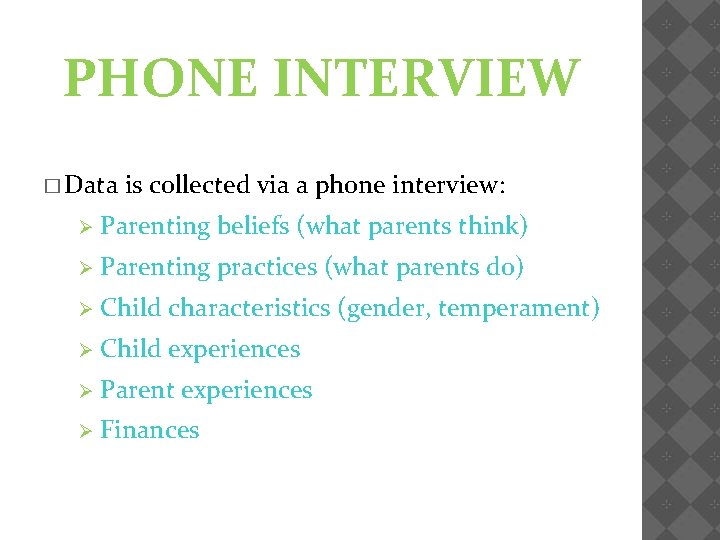
PHONE INTERVIEW � Data is collected via a phone interview: Ø Parenting beliefs (what parents think) Ø Parenting practices (what parents do) Ø Child characteristics (gender, temperament) Ø Child experiences Ø Parent experiences Ø Finances

Our research activities: Ø Phone interview ØDaily routine diary Ø Coding
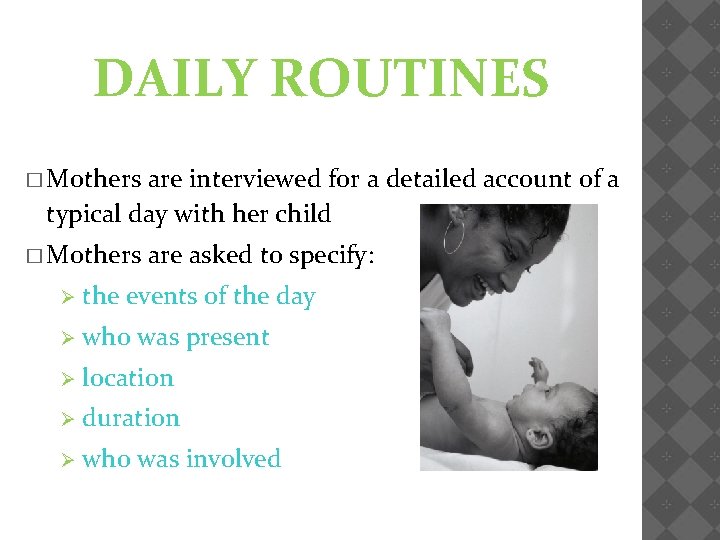
DAILY ROUTINES � Mothers are interviewed for a detailed account of a typical day with her child � Mothers are asked to specify: Ø the events of the day Ø who was present Ø location Ø duration Ø who was involved
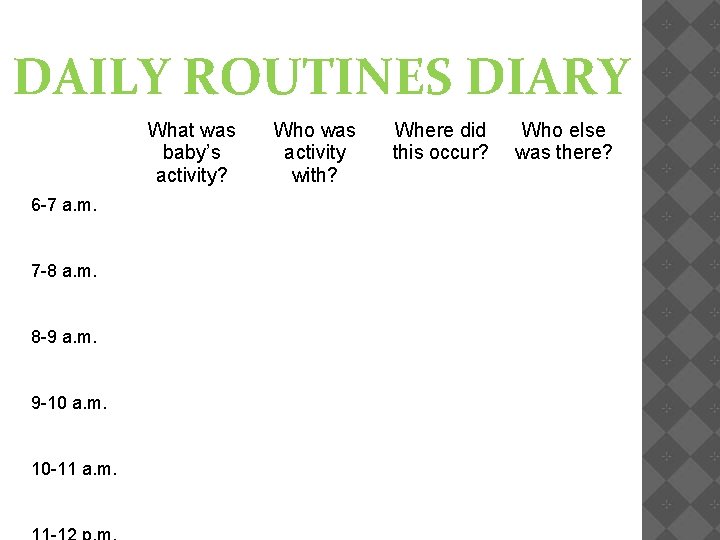
DAILY ROUTINES DIARY What was baby’s activity? 6 -7 a. m. 7 -8 a. m. 8 -9 a. m. 9 -10 a. m. 10 -11 a. m. Who was activity with? Where did this occur? Who else was there?

Our research activities: Ø Phone Ø Daily interview routine diary ØCoding
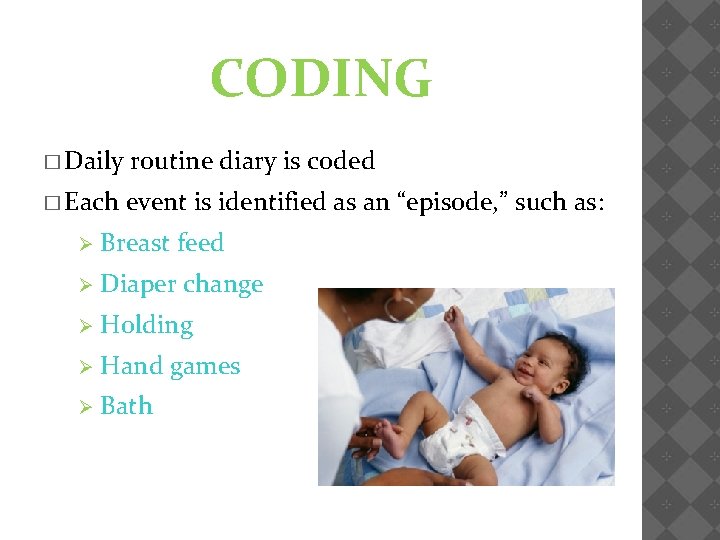
CODING � Daily routine diary is coded � Each event is identified as an “episode, ” such as: Ø Breast feed Ø Diaper change Ø Holding Ø Hand games Ø Bath
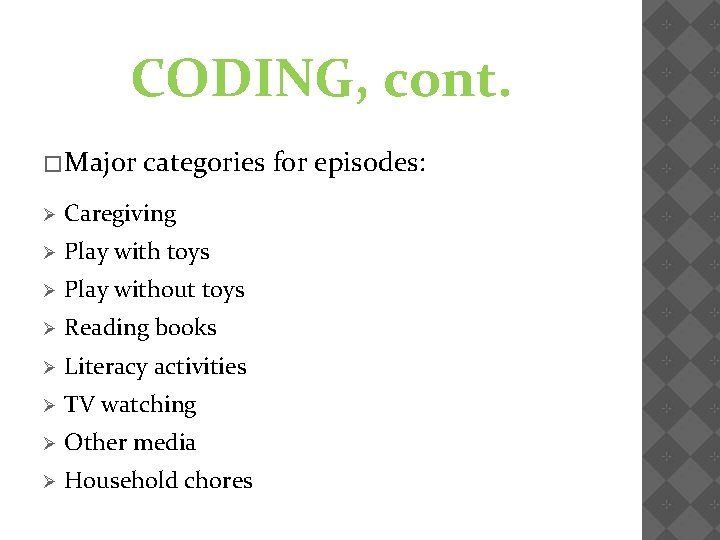
CODING, cont. �Major categories for episodes: Ø Caregiving Ø Play with toys Ø Play without toys Ø Reading books Ø Literacy activities Ø TV watching Ø Other media Ø Household chores
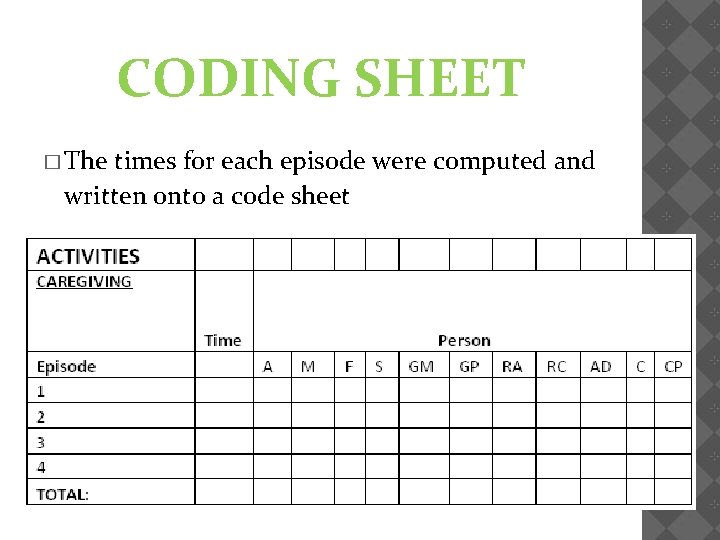
CODING SHEET � The times for each episode were computed and written onto a code sheet
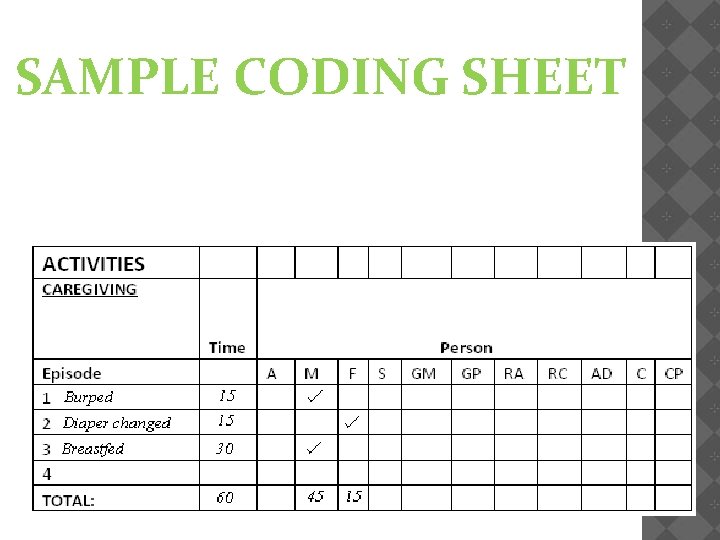
SAMPLE CODING SHEET

Our research activities: Ø Phone Ø Daily interview routine diary Ø Coding ØData entry into SPSS
Data entry into SPSS � Statistical � Software Package for the Social Sciences used to analyze data collected from diaries Ø Focus: time distribution Ø Condenses wide range of information into statistics, trends
Our research activities: Ø Phone Ø Daily interview routine diary Ø Coding Ø SPSS
FUTURE PLANS � Complete � Identify SPSS data entry and checking trends in statistical results Ø Differences between cultures Ø Breakdown of time spent in different types of activities Ø Child network (who engages in activities) � Move on to code 6 month diaries
BIBLIOGRAPHY � Tamis-Le. Monda, C. S. , Shannon, J. D. , Cabrera, N. J. , & Lamb, M. E. (2004). “Fathers and Mothers at Play with their 2 - and 3 Year-Olds: Contributions to Language and Cognitive Development”, Child Development. � Guillette, Elizabeth A. "Examining Childhood Development in Contaminated Urban Settings. " Environmental Health Perspectives. Vol 108. June 2008, pg. 389 -393. 6 Aug 2009. � Chuang, Susan S, and Robert P. Moreno. On New Shores: Understanding Immigrant Fathers in North America. 1 st ed. Rowman & Littlefield, 2008. � Bremner, Gavin, and Alan Fogel. Blackwell Handbook of Infant Development. Oxford, UK: Wiley-Blackwell, March 5, 2004.

ACKNOWLEDGEMENTS � Professor � Ryann � NYU � Dr. Catherine Tamis-Lemonda Mc. Neil and Emily Ho (Co-mentors) staff and CRCDE Sat Bhattacharya � Professor Ross � HCS staff � Our audience
THA NK YOU !

Questio
- Slides: 25