
Metrics for Evaluating Classifier Performance Model Evaluation and

- Slides: 34
Metrics for Evaluating Classifier Performance
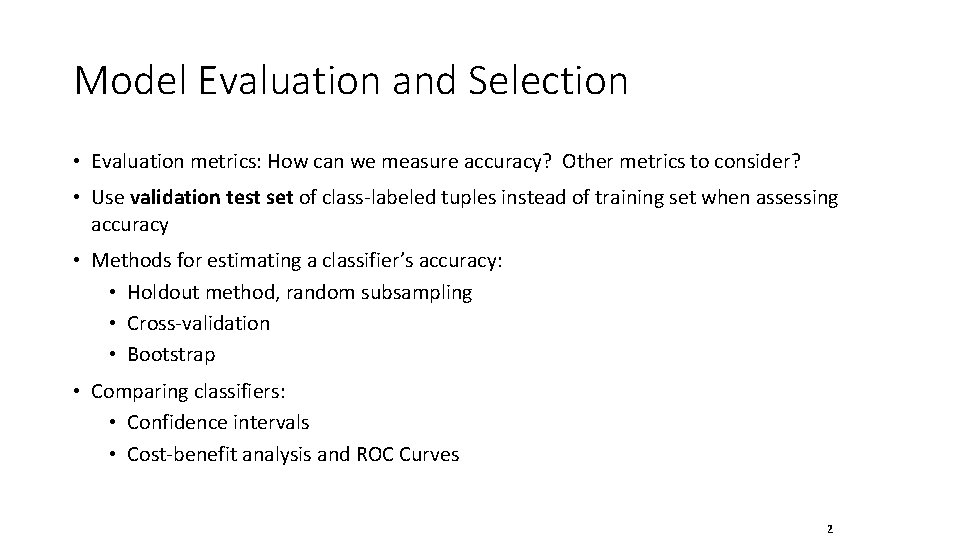
Model Evaluation and Selection • Evaluation metrics: How can we measure accuracy? Other metrics to consider? • Use validation test set of class-labeled tuples instead of training set when assessing accuracy • Methods for estimating a classifier’s accuracy: • Holdout method, random subsampling • Cross-validation • Bootstrap • Comparing classifiers: • Confidence intervals • Cost-benefit analysis and ROC Curves 2
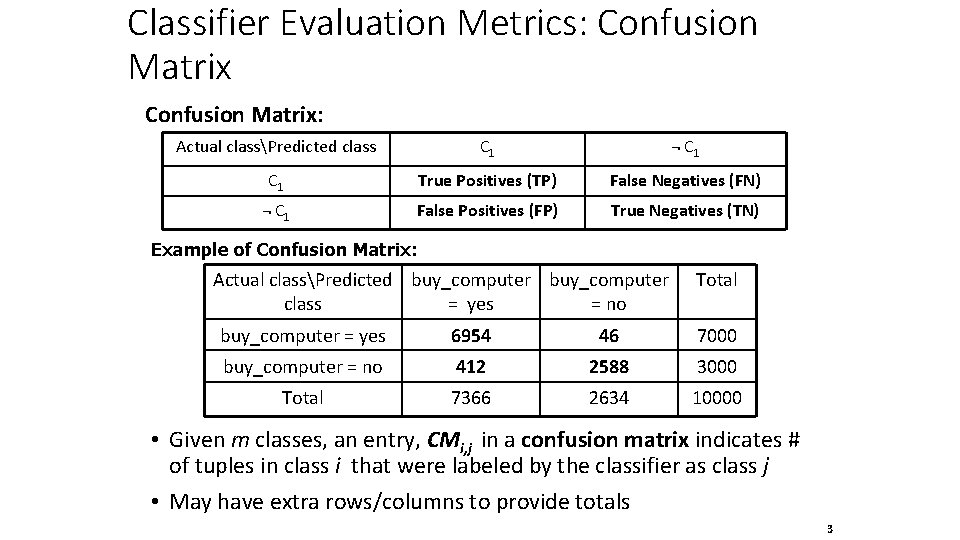
Classifier Evaluation Metrics: Confusion Matrix: Actual classPredicted class C 1 ¬ C 1 True Positives (TP) False Negatives (FN) ¬ C 1 False Positives (FP) True Negatives (TN) Example of Confusion Matrix: Actual classPredicted buy_computer class = yes = no Total buy_computer = yes 6954 46 7000 buy_computer = no 412 2588 3000 Total 7366 2634 10000 • Given m classes, an entry, CMi, j in a confusion matrix indicates # of tuples in class i that were labeled by the classifier as class j • May have extra rows/columns to provide totals 3
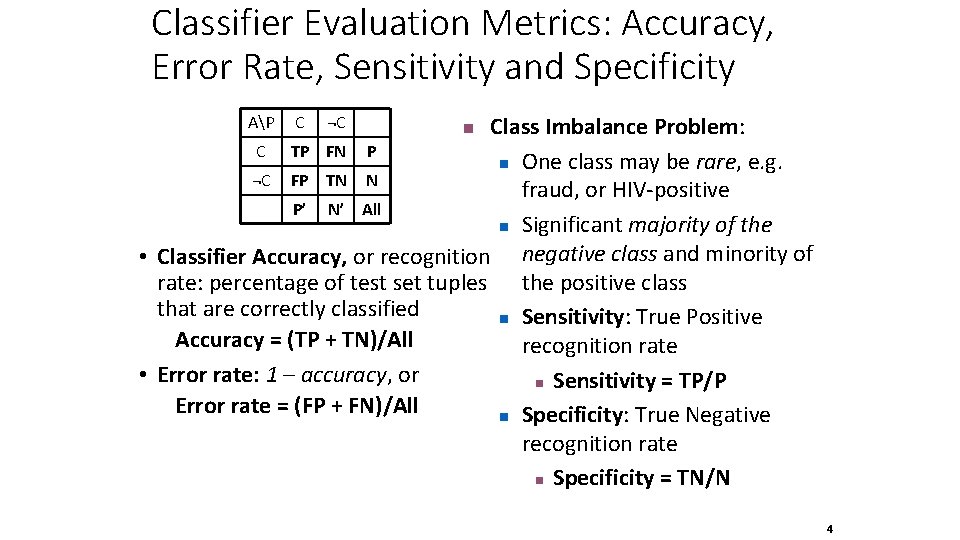
Classifier Evaluation Metrics: Accuracy, Error Rate, Sensitivity and Specificity Class Imbalance Problem: C TP FN P n One class may be rare, e. g. ¬C FP TN N fraud, or HIV-positive P’ N’ All n Significant majority of the • Classifier Accuracy, or recognition negative class and minority of rate: percentage of test set tuples the positive class that are correctly classified n Sensitivity: True Positive Accuracy = (TP + TN)/All recognition rate • Error rate: 1 – accuracy, or n Sensitivity = TP/P Error rate = (FP + FN)/All n Specificity: True Negative recognition rate n Specificity = TN/N AP C ¬C n 4
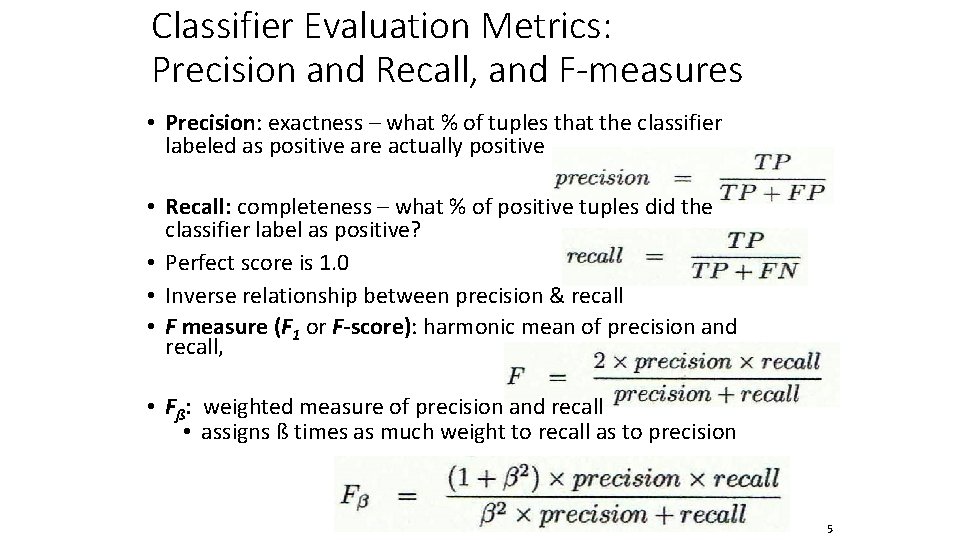
Classifier Evaluation Metrics: Precision and Recall, and F-measures • Precision: exactness – what % of tuples that the classifier labeled as positive are actually positive • Recall: completeness – what % of positive tuples did the classifier label as positive? • Perfect score is 1. 0 • Inverse relationship between precision & recall • F measure (F 1 or F-score): harmonic mean of precision and recall, • Fß: weighted measure of precision and recall • assigns ß times as much weight to recall as to precision 5
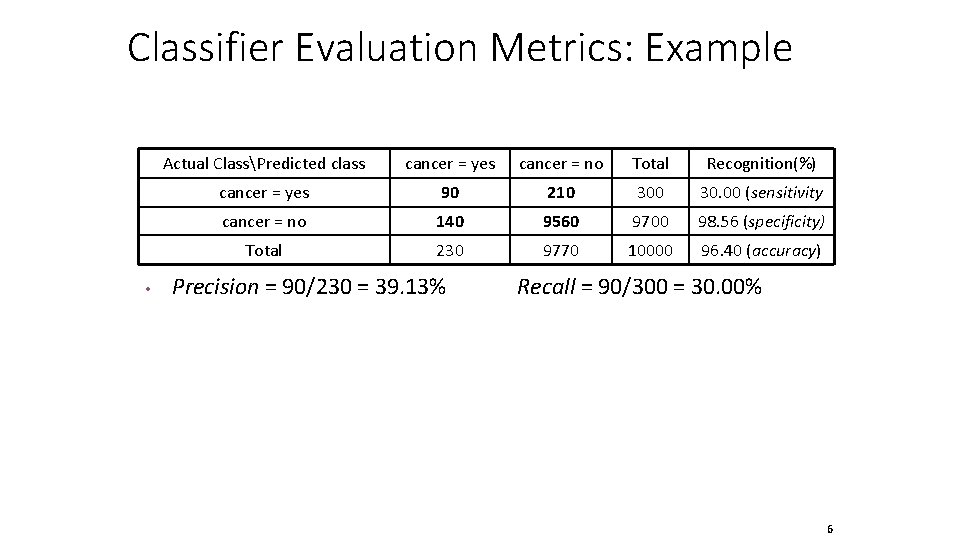
Classifier Evaluation Metrics: Example • Actual ClassPredicted class cancer = yes cancer = no Total Recognition(%) cancer = yes 90 210 30. 00 (sensitivity cancer = no 140 9560 9700 98. 56 (specificity) Total 230 9770 10000 96. 40 (accuracy) Precision = 90/230 = 39. 13% Recall = 90/300 = 30. 00% 6
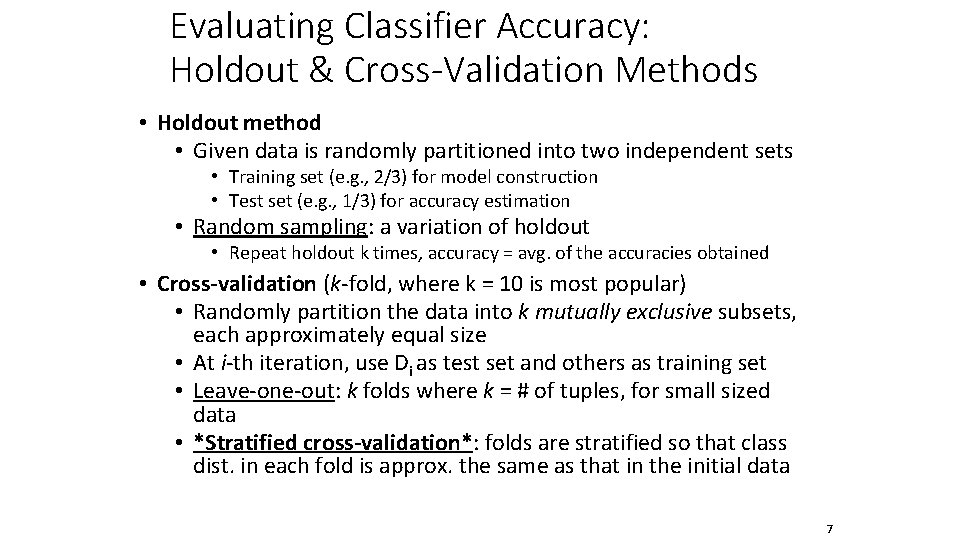
Evaluating Classifier Accuracy: Holdout & Cross-Validation Methods • Holdout method • Given data is randomly partitioned into two independent sets • Training set (e. g. , 2/3) for model construction • Test set (e. g. , 1/3) for accuracy estimation • Random sampling: a variation of holdout • Repeat holdout k times, accuracy = avg. of the accuracies obtained • Cross-validation (k-fold, where k = 10 is most popular) • Randomly partition the data into k mutually exclusive subsets, each approximately equal size • At i-th iteration, use Di as test set and others as training set • Leave-one-out: k folds where k = # of tuples, for small sized data • *Stratified cross-validation*: folds are stratified so that class dist. in each fold is approx. the same as that in the initial data 7
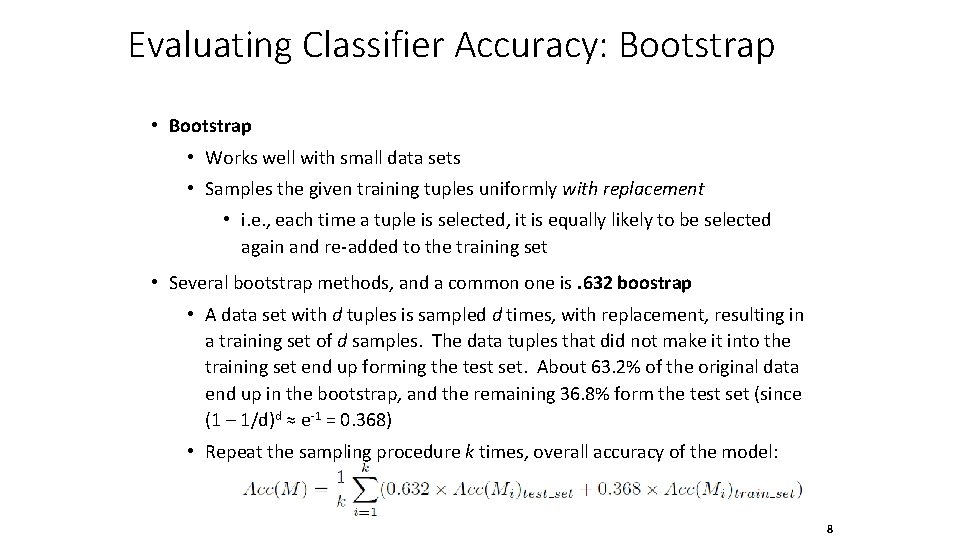
Evaluating Classifier Accuracy: Bootstrap • Works well with small data sets • Samples the given training tuples uniformly with replacement • i. e. , each time a tuple is selected, it is equally likely to be selected again and re-added to the training set • Several bootstrap methods, and a common one is. 632 boostrap • A data set with d tuples is sampled d times, with replacement, resulting in a training set of d samples. The data tuples that did not make it into the training set end up forming the test set. About 63. 2% of the original data end up in the bootstrap, and the remaining 36. 8% form the test set (since (1 – 1/d)d ≈ e-1 = 0. 368) • Repeat the sampling procedure k times, overall accuracy of the model: 8
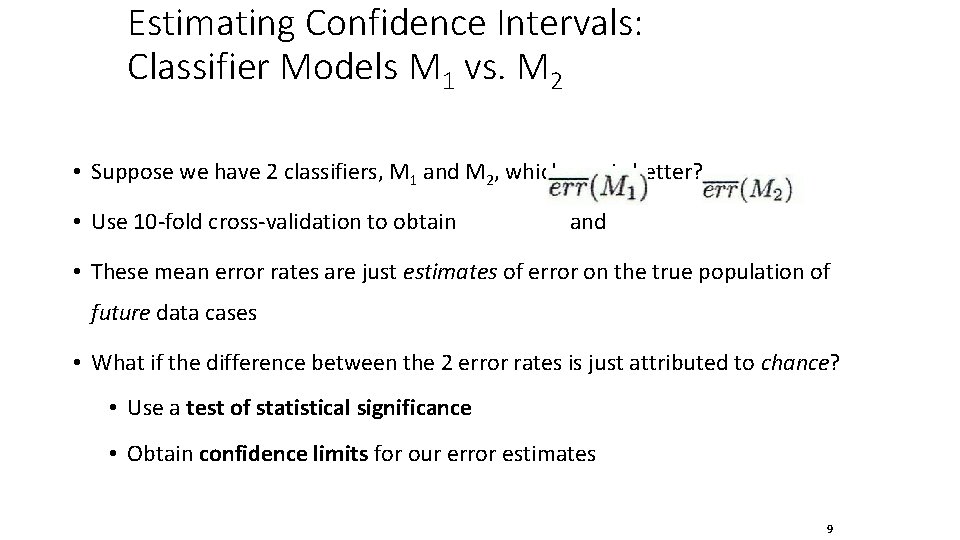
Estimating Confidence Intervals: Classifier Models M 1 vs. M 2 • Suppose we have 2 classifiers, M 1 and M 2, which one is better? • Use 10 -fold cross-validation to obtain and • These mean error rates are just estimates of error on the true population of future data cases • What if the difference between the 2 error rates is just attributed to chance? • Use a test of statistical significance • Obtain confidence limits for our error estimates 9
Estimating Confidence Intervals: Null Hypothesis • Perform 10 -fold cross-validation • Assume samples follow a t distribution with k– 1 degrees of freedom (here, k=10) • Use t-test (or Student’s t-test) • Null Hypothesis: M 1 & M 2 are the same • If we can reject null hypothesis, then • we conclude that the difference between M 1 & M 2 is statistically significant • Chose model with lower error rate 10
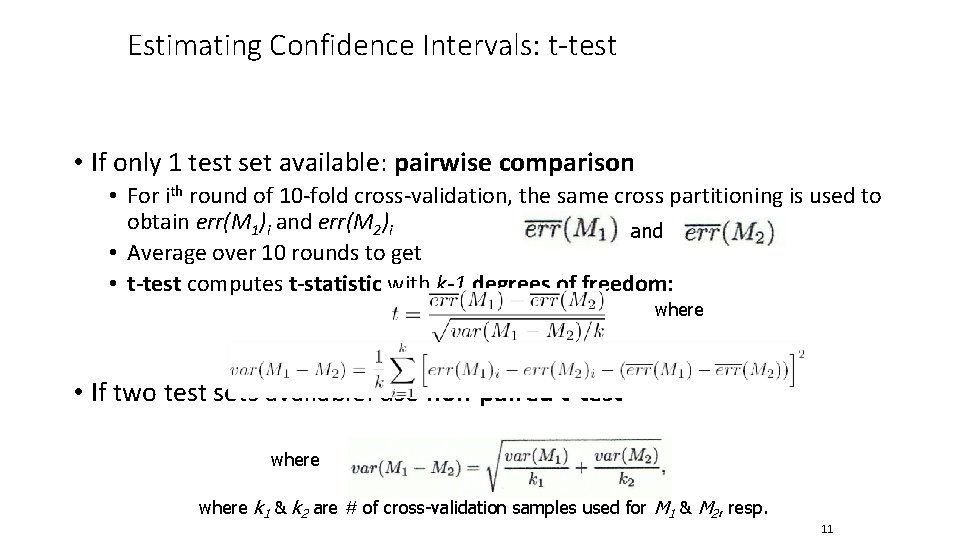
Estimating Confidence Intervals: t-test • If only 1 test set available: pairwise comparison • For ith round of 10 -fold cross-validation, the same cross partitioning is used to obtain err(M 1)i and err(M 2)i and • Average over 10 rounds to get • t-test computes t-statistic with k-1 degrees of freedom: where • If two test sets available: use non-paired t-test where k 1 & k 2 are # of cross-validation samples used for M 1 & M 2, resp. 11
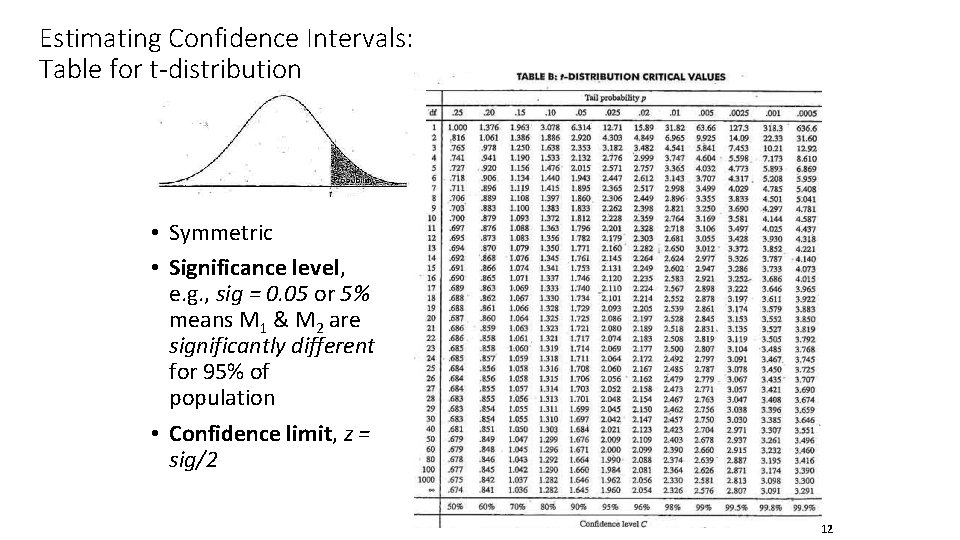
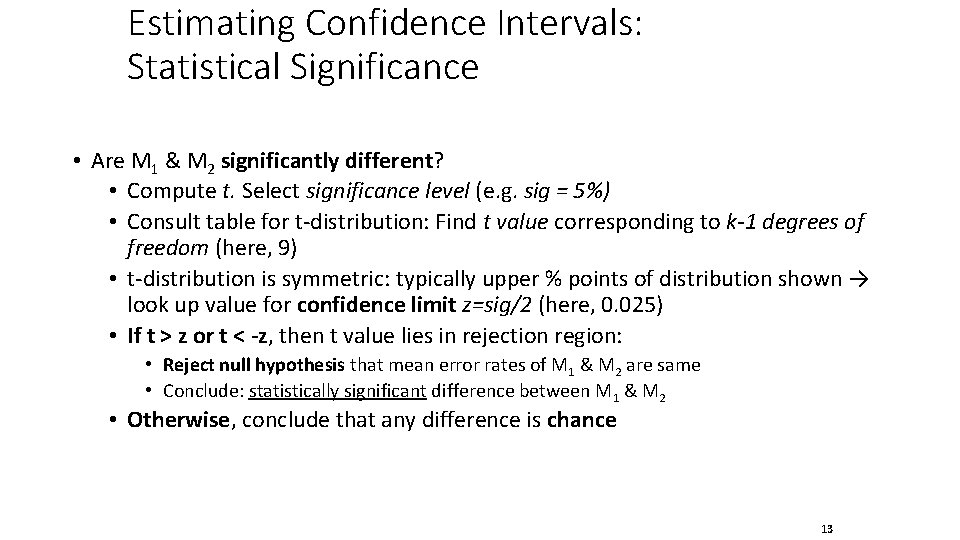
Estimating Confidence Intervals: Table for t-distribution • Symmetric • Significance level, e. g. , sig = 0. 05 or 5% means M 1 & M 2 are significantly different for 95% of population • Confidence limit, z = sig/2 12
Estimating Confidence Intervals: Statistical Significance • Are M 1 & M 2 significantly different? • Compute t. Select significance level (e. g. sig = 5%) • Consult table for t-distribution: Find t value corresponding to k-1 degrees of freedom (here, 9) • t-distribution is symmetric: typically upper % points of distribution shown → look up value for confidence limit z=sig/2 (here, 0. 025) • If t > z or t < -z, then t value lies in rejection region: • Reject null hypothesis that mean error rates of M 1 & M 2 are same • Conclude: statistically significant difference between M 1 & M 2 • Otherwise, conclude that any difference is chance 13
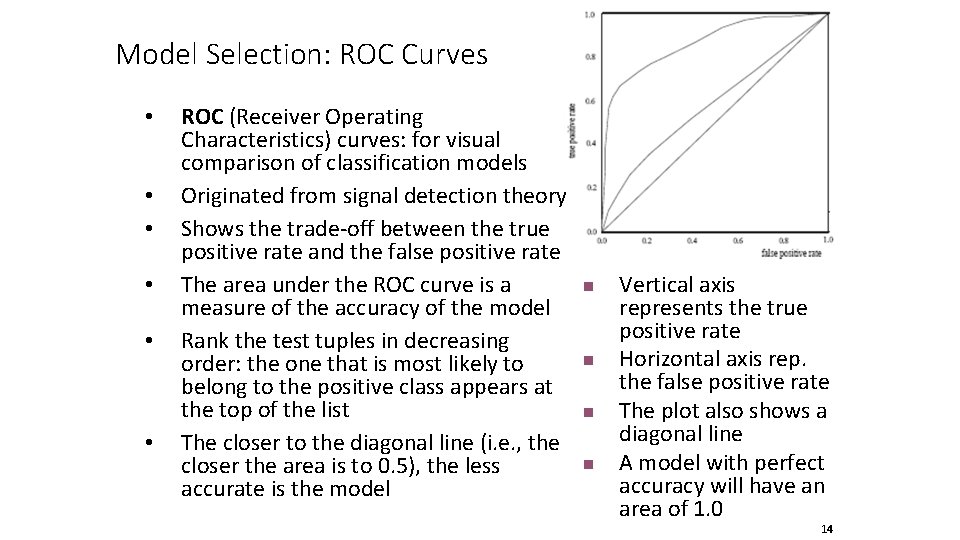
Model Selection: ROC Curves • • • ROC (Receiver Operating Characteristics) curves: for visual comparison of classification models Originated from signal detection theory Shows the trade-off between the true positive rate and the false positive rate The area under the ROC curve is a measure of the accuracy of the model Rank the test tuples in decreasing order: the one that is most likely to belong to the positive class appears at the top of the list The closer to the diagonal line (i. e. , the closer the area is to 0. 5), the less accurate is the model n n Vertical axis represents the true positive rate Horizontal axis rep. the false positive rate The plot also shows a diagonal line A model with perfect accuracy will have an area of 1. 0 14
Issues Affecting Model Selection • Accuracy • classifier accuracy: predicting class label • Speed • time to construct the model (training time) • time to use the model (classification/prediction time) • Robustness: handling noise and missing values • Scalability: efficiency in disk-resident databases • Interpretability • understanding and insight provided by the model • Other measures, e. g. , goodness of rules, such as decision tree size or compactness of classification rules 15
Chapter 8. Classification: Basic Concepts • Decision Tree Induction • Bayes Classification Methods • Rule-Based Classification • Model Evaluation and Selection • Techniques to Improve Classification Accuracy: Ensemble Methods • Summary 16
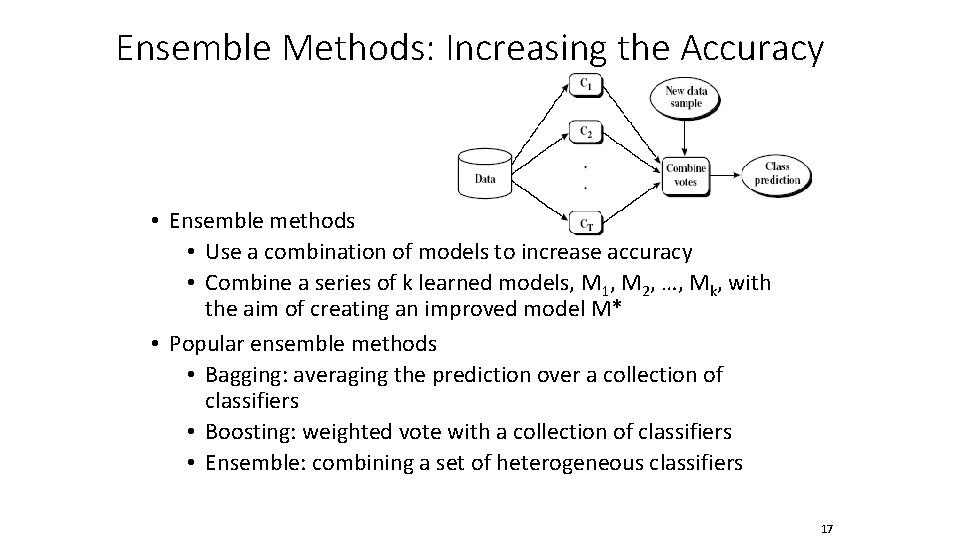
Ensemble Methods: Increasing the Accuracy • Ensemble methods • Use a combination of models to increase accuracy • Combine a series of k learned models, M 1, M 2, …, Mk, with the aim of creating an improved model M* • Popular ensemble methods • Bagging: averaging the prediction over a collection of classifiers • Boosting: weighted vote with a collection of classifiers • Ensemble: combining a set of heterogeneous classifiers 17
Bagging: Boostrap Aggregation • Analogy: Diagnosis based on multiple doctors’ majority vote • Training • Given a set D of d tuples, at each iteration i, a training set Di of d tuples is sampled with replacement from D (i. e. , bootstrap) • A classifier model Mi is learned for each training set Di • Classification: classify an unknown sample X • Each classifier Mi returns its class prediction • The bagged classifier M* counts the votes and assigns the class with the most votes to X • Prediction: can be applied to the prediction of continuous values by taking the average value of each prediction for a given test tuple • Accuracy • Often significantly better than a single classifier derived from D • For noise data: not considerably worse, more robust • Proved improved accuracy in prediction 18
Boosting • • Analogy: Consult several doctors, based on a combination of weighted diagnoses—weight assigned based on the previous diagnosis accuracy How boosting works? • Weights are assigned to each training tuple • A series of k classifiers is iteratively learned • After a classifier Mi is learned, the weights are updated to allow the subsequent classifier, Mi+1, to pay more attention to the training tuples that were misclassified by Mi • The final M* combines the votes of each individual classifier, where the weight of each classifier's vote is a function of its accuracy Boosting algorithm can be extended for numeric prediction Comparing with bagging: Boosting tends to have greater accuracy, but it also risks overfitting the model to misclassified data 19
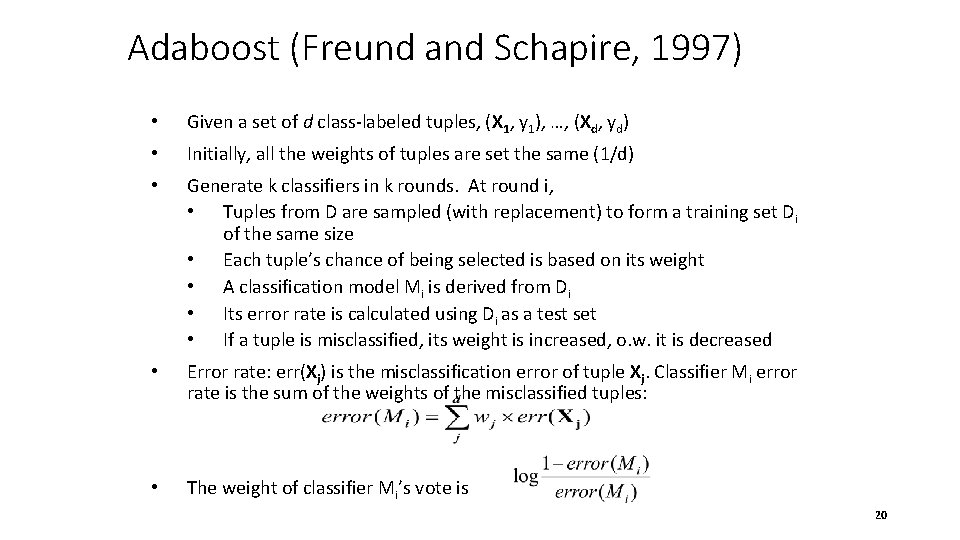
Adaboost (Freund and Schapire, 1997) • Given a set of d class-labeled tuples, (X 1, y 1), …, (Xd, yd) • Initially, all the weights of tuples are set the same (1/d) • Generate k classifiers in k rounds. At round i, • Tuples from D are sampled (with replacement) to form a training set Di of the same size • Each tuple’s chance of being selected is based on its weight • A classification model Mi is derived from Di • Its error rate is calculated using Di as a test set • If a tuple is misclassified, its weight is increased, o. w. it is decreased • Error rate: err(Xj) is the misclassification error of tuple Xj. Classifier Mi error rate is the sum of the weights of the misclassified tuples: • The weight of classifier Mi’s vote is 20
Random Forest ( Breiman 2001) • Random Forest: • Each classifier in the ensemble is a decision tree classifier and is generated using a random selection of attributes at each node to determine the split • During classification, each tree votes and the most popular class is returned • Two Methods to construct Random Forest: • Forest-RI (random input selection): Randomly select, at each node, F attributes as candidates for the split at the node. The CART methodology is used to grow the trees to maximum size • Forest-RC (random linear combinations): Creates new attributes (or features) that are a linear combination of the existing attributes (reduces the correlation between individual classifiers) • Comparable in accuracy to Adaboost, but more robust to errors and outliers • Insensitive to the number of attributes selected for consideration at each split, and faster than bagging or boosting 21
Classification of Class-Imbalanced Data Sets • Class-imbalance problem: Rare positive example but numerous negative ones, e. g. , medical diagnosis, fraud, oil-spill, fault, etc. • Traditional methods assume a balanced distribution of classes and equal error costs: not suitable for class-imbalanced data • Typical methods for imbalance data in 2 -classification: • Oversampling: re-sampling of data from positive class • Under-sampling: randomly eliminate tuples from negative class • Threshold-moving: moves the decision threshold, t, so that the rare class tuples are easier to classify, and hence, less chance of costly false negative errors • Ensemble techniques: Ensemble multiple classifiers introduced above • Still difficult for class imbalance problem on multiclass tasks 22
Summary (I) • Classification is a form of data analysis that extracts models describing important data classes. • Effective and scalable methods have been developed for decision tree induction, Naive Bayesian classification, rule-based classification, and many other classification methods. • Evaluation metrics include: accuracy, sensitivity, specificity, precision, recall, F measure, and Fß measure. • Stratified k-fold cross-validation is recommended for accuracy estimation. Bagging and boosting can be used to increase overall accuracy by learning and combining a series of individual models. 23
Summary (II) • Significance tests and ROC curves are useful for model selection. • There have been numerous comparisons of the different classification methods; the matter remains a research topic • No single method has been found to be superior over all others for all data sets • Issues such as accuracy, training time, robustness, scalability, and interpretability must be considered and can involve trade-offs, further complicating the quest for an overall superior method 24
References (1) • C. Apte and S. Weiss. Data mining with decision trees and decision rules. Future Generation Computer Systems, 13, 1997 • C. M. Bishop, Neural Networks for Pattern Recognition. Oxford University Press, 1995 • L. Breiman, J. Friedman, R. Olshen, and C. Stone. Classification and Regression Trees. Wadsworth International Group, 1984 • C. J. C. Burges. A Tutorial on Support Vector Machines for Pattern Recognition. Data Mining and Knowledge Discovery, 2(2): 121 -168, 1998 • P. K. Chan and S. J. Stolfo. Learning arbiter and combiner trees from partitioned data for scaling machine learning. KDD'95 • H. Cheng, X. Yan, J. Han, and C. -W. Hsu, Discriminative Frequent Pattern Analysis for Effective Classification, ICDE'07 • H. Cheng, X. Yan, J. Han, and P. S. Yu, Direct Discriminative Pattern Mining for Effective Classification, ICDE'08 • • W. Cohen. Fast effective rule induction. ICML'95 G. Cong, K. -L. Tan, A. K. H. Tung, and X. Xu. Mining top-k covering rule groups for gene expression data. SIGMOD'05 25
References (2) • A. J. Dobson. An Introduction to Generalized Linear Models. Chapman & Hall, 1990. • G. Dong and J. Li. Efficient mining of emerging patterns: Discovering trends and differences. KDD'99. • R. O. Duda, P. E. Hart, and D. G. Stork. Pattern Classification, 2 ed. John Wiley, 2001 • U. M. Fayyad. Branching on attribute values in decision tree generation. AAAI’ 94. • Y. Freund and R. E. Schapire. A decision-theoretic generalization of on-line learning and an application to boosting. J. Computer and System Sciences, 1997. • J. Gehrke, R. Ramakrishnan, and V. Ganti. Rainforest: A framework for fast decision tree construction of large datasets. VLDB’ 98. • J. Gehrke, V. Gant, R. Ramakrishnan, and W. -Y. Loh, BOAT -- Optimistic Decision Tree Construction. SIGMOD'99. • T. Hastie, R. Tibshirani, and J. Friedman. The Elements of Statistical Learning: Data Mining, Inference, and Prediction. Springer-Verlag, 2001. • D. Heckerman, D. Geiger, and D. M. Chickering. Learning Bayesian networks: The combination of knowledge and statistical data. Machine Learning, 1995. • W. Li, J. Han, and J. Pei, CMAR: Accurate and Efficient Classification Based on Multiple Class-Association Rules, ICDM'01. 26
References (3) • T. -S. Lim, W. -Y. Loh, and Y. -S. Shih. A comparison of prediction accuracy, complexity, and training time of thirty-three old and new classification algorithms. Machine Learning, 2000. • J. Magidson. The Chaid approach to segmentation modeling: Chi-squared automatic interaction detection. In R. P. Bagozzi, editor, Advanced Methods of Marketing Research, Blackwell Business, 1994. • M. Mehta, R. Agrawal, and J. Rissanen. SLIQ : A fast scalable classifier for data mining. EDBT'96. • T. M. Mitchell. Machine Learning. Mc. Graw Hill, 1997. • S. K. Murthy, Automatic Construction of Decision Trees from Data: A Multi. Disciplinary Survey, Data Mining and Knowledge Discovery 2(4): 345 -389, 1998 • J. R. Quinlan. Induction of decision trees. Machine Learning, 1: 81 -106, 1986. • J. R. Quinlan and R. M. Cameron-Jones. FOIL: A midterm report. ECML’ 93. • J. R. Quinlan. C 4. 5: Programs for Machine Learning. Morgan Kaufmann, 1993. • J. R. Quinlan. Bagging, boosting, and c 4. 5. AAAI'96. 27
References (4) • R. Rastogi and K. Shim. Public: A decision tree classifier that integrates building and pruning. VLDB’ 98. • J. Shafer, R. Agrawal, and M. Mehta. SPRINT : A scalable parallel classifier for data mining. VLDB’ 96. • J. W. Shavlik and T. G. Dietterich. Readings in Machine Learning. Morgan Kaufmann, 1990. • P. Tan, M. Steinbach, and V. Kumar. Introduction to Data Mining. Addison Wesley, 2005. • S. M. Weiss and C. A. Kulikowski. Computer Systems that Learn: Classification and Prediction Methods from Statistics, Neural Nets, Machine Learning, and Expert Systems. Morgan Kaufman, 1991. • S. M. Weiss and N. Indurkhya. Predictive Data Mining. Morgan Kaufmann, 1997. • I. H. Witten and E. Frank. Data Mining: Practical Machine Learning Tools and Techniques, 2 ed. Morgan Kaufmann, 2005. • X. Yin and J. Han. CPAR: Classification based on predictive association rules. SDM'03 • H. Yu, J. Yang, and J. Han. Classifying large data sets using SVM with hierarchical clusters. KDD'03. 28
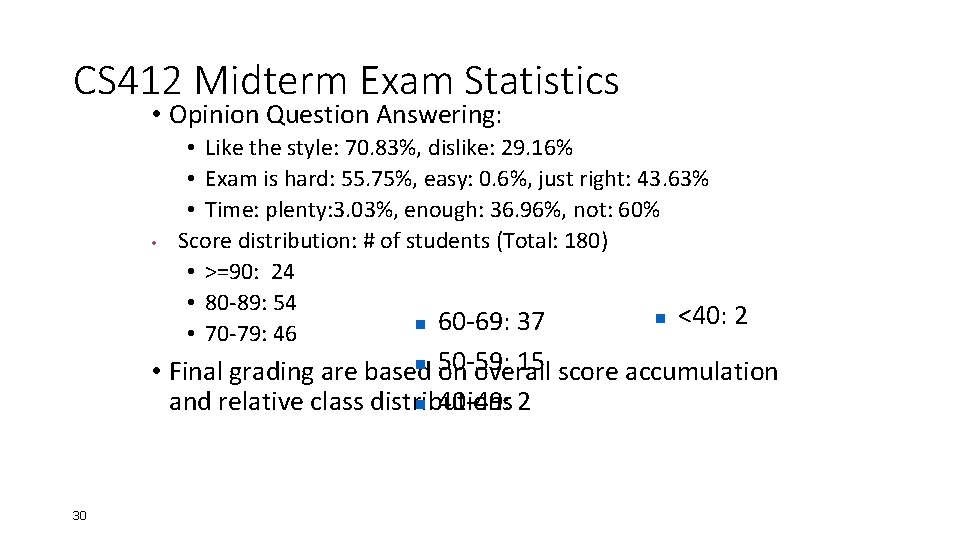
CS 412 Midterm Exam Statistics • Opinion Question Answering: • • Like the style: 70. 83%, dislike: 29. 16% • Exam is hard: 55. 75%, easy: 0. 6%, just right: 43. 63% • Time: plenty: 3. 03%, enough: 36. 96%, not: 60% Score distribution: # of students (Total: 180) • >=90: 24 • 80 -89: 54 n <40: 2 n 60 -69: 37 • 70 -79: 46 n 50 -59: 15 • Final grading are based on overall score accumulation and relative class distributions n 40 -49: 2 30
Issues: Evaluating Classification Methods • Accuracy • classifier accuracy: predicting class label • predictor accuracy: guessing value of predicted attributes • Speed • time to construct the model (training time) • time to use the model (classification/prediction time) • Robustness: handling noise and missing values • Scalability: efficiency in disk-resident databases • Interpretability • understanding and insight provided by the model • Other measures, e. g. , goodness of rules, such as decision tree size or compactness of classification rules 31
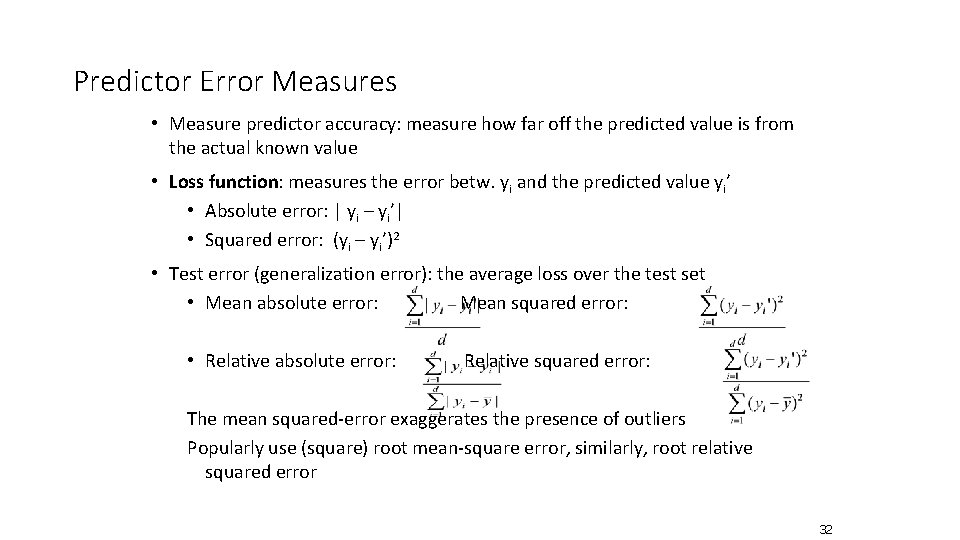
Predictor Error Measures • Measure predictor accuracy: measure how far off the predicted value is from the actual known value • Loss function: measures the error betw. yi and the predicted value yi’ • Absolute error: | yi – yi’| • Squared error: (yi – yi’)2 • Test error (generalization error): the average loss over the test set • Mean absolute error: Mean squared error: • Relative absolute error: Relative squared error: The mean squared-error exaggerates the presence of outliers Popularly use (square) root mean-square error, similarly, root relative squared error 32
Scalable Decision Tree Induction Methods • SLIQ (EDBT’ 96 — Mehta et al. ) • Builds an index for each attribute and only class list and the current attribute list reside in memory • SPRINT (VLDB’ 96 — J. Shafer et al. ) • Constructs an attribute list data structure • PUBLIC (VLDB’ 98 — Rastogi & Shim) • Integrates tree splitting and tree pruning: stop growing the tree earlier • Rain. Forest (VLDB’ 98 — Gehrke, Ramakrishnan & Ganti) • Builds an AVC-list (attribute, value, class label) • BOAT (PODS’ 99 — Gehrke, Ganti, Ramakrishnan & Loh) • Uses bootstrapping to create several small samples 33
Data Cube-Based Decision-Tree Induction • Integration of generalization with decision-tree induction (Kamber et al. ’ 97) • Classification at primitive concept levels • E. g. , precise temperature, humidity, outlook, etc. • Low-level concepts, scattered classes, bushy classificationtrees • Semantic interpretation problems • Cube-based multi-level classification • Relevance analysis at multi-levels • Information-gain analysis with dimension + level 34