
METRIC MEASUREMENT BACKGROUND The metric system also referred
METRIC MEASUREMENT

BACKGROUND • The metric system, also referred to as SI, was developed to standardize units of measurement in Europe. • Primary system of measurement used through much of the world and in science. • Used to collect, record, analyze, and report data in scientific investigations. • Each type of measurement has a base unit with prefixes to indicate multiples of ten.
LENGTH • Distance • How far from end to end • Basic unit is a meter and represented by a lowercase m – 1 m = 100 centimeters (cm) – 1 cm = 10 millimeters (mm) – 1 m = 1000 mm – 1000 m = 1 kilometer (km)

LENGTH • In science, length is commonly measured using a meter stick or ruler
MASS • A measure of how much matter (“stuff”) is in an object • Commonly measured by how much something weighs • But, weight and mass are not really the same thing • Mass does not change (unless you remove some!) but weight can change (think of gravity)

MASS CONTINUED • Basic unit of mass is the gram and is represented by g – 1 kg = 1000 grams (g) – 1 g = 1000 milligrams (mg) • In science, mass is commonly measured using a triple beam balance
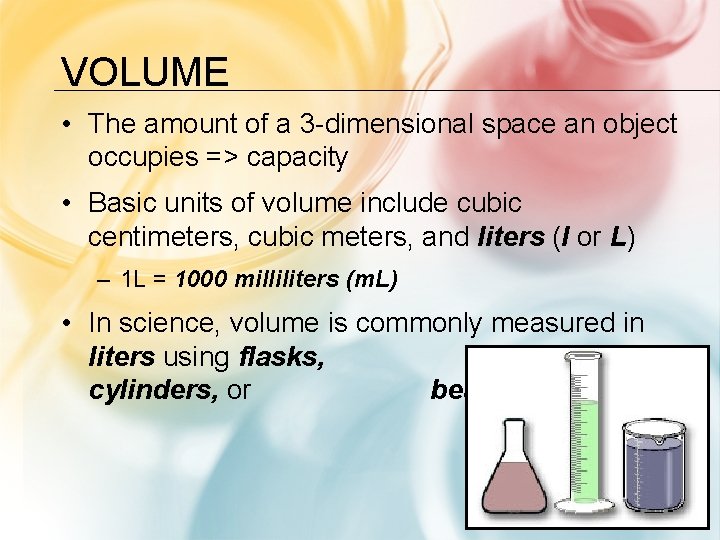
VOLUME • The amount of a 3 -dimensional space an object occupies => capacity • Basic units of volume include cubic centimeters, cubic meters, and liters (l or L) – 1 L = 1000 milliliters (m. L) • In science, volume is commonly measured in liters using flasks, graduated cylinders, or beakers
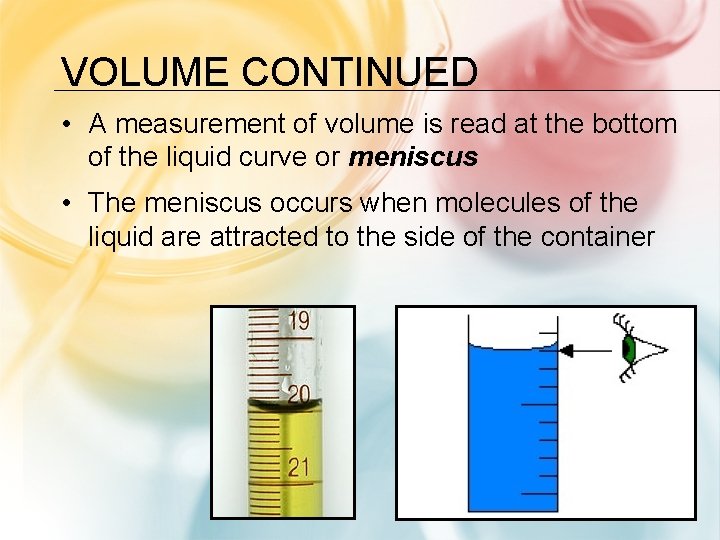
VOLUME CONTINUED • A measurement of volume is read at the bottom of the liquid curve or meniscus • The meniscus occurs when molecules of the liquid are attracted to the side of the container
DENSITY • A measure of how much matter (“stuff”) is in a certain volume • Density = Mass/Volume • An object that floats has lower density than an object that sinks
- Slides: 9