
Metonymy in Grammar Wordformation Laura A Janda Universitetet
![Jakobson [1956] 1980 • Metonymy is based on contiguity. • “Also, as a rule,](https://slidetodoc.com/presentation_image/002bf4e69c566fc882afa8e4e417de5b/image-12.jpg "Jakobson [1956] 1980 • Metonymy is based on contiguity. • “Also, as a rule,")
- Slides: 42
“Metonymy in Grammar: Wordformation” Laura A. Janda Universitetet i Tromsø
Main Idea • Role of metonymy in grammar – Metonymy as the main motivating force for word-formation – Metonymy is more diverse in grammar than in lexicon • Why this has been previously ignored – Most linguistic research on metonymy has focused on • lexical phenomena • languages with relatively little wordformation 2
Overview 1. The Big Picture: why metonymy in grammar? • Cognitive structure of information 2. Relevant Previous Scholarship 3. Databases: Russian, Czech, Norwegian • • • Size & structure of databases Metonymy & Word class patterns Specificity of suffixes 4. Observations • • • Comparison across domains (lexicon vs. grammar) Directionality of metonymy Comparison across languages 5. Conclusions 3
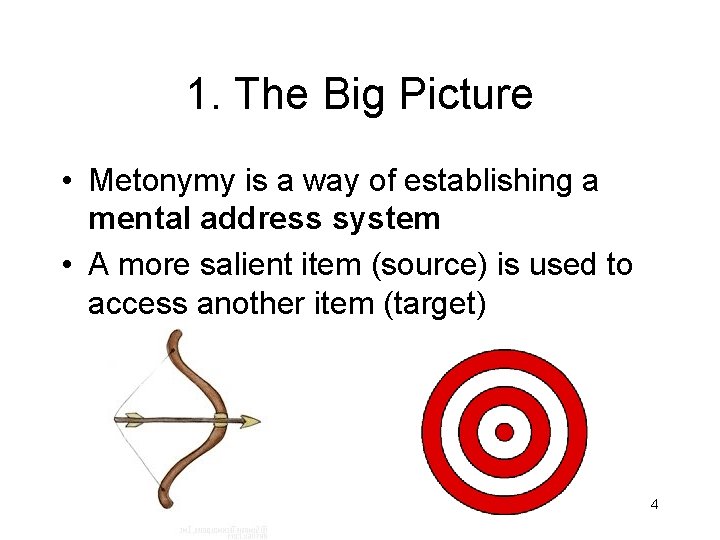
1. The Big Picture • Metonymy is a way of establishing a mental address system • A more salient item (source) is used to access another item (target) 4
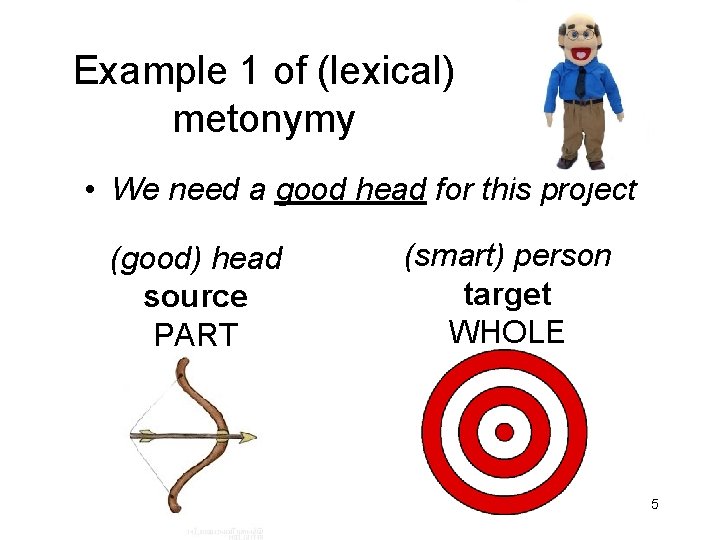
Example 1 of (lexical) metonymy • We need a good head for this project (good) head source PART (smart) person target WHOLE 5
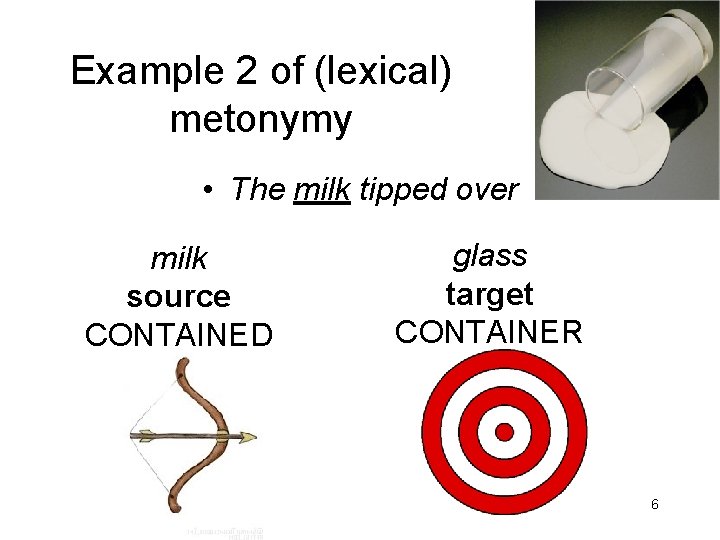
Example 2 of (lexical) metonymy • The milk tipped over milk source CONTAINED glass target CONTAINER 6
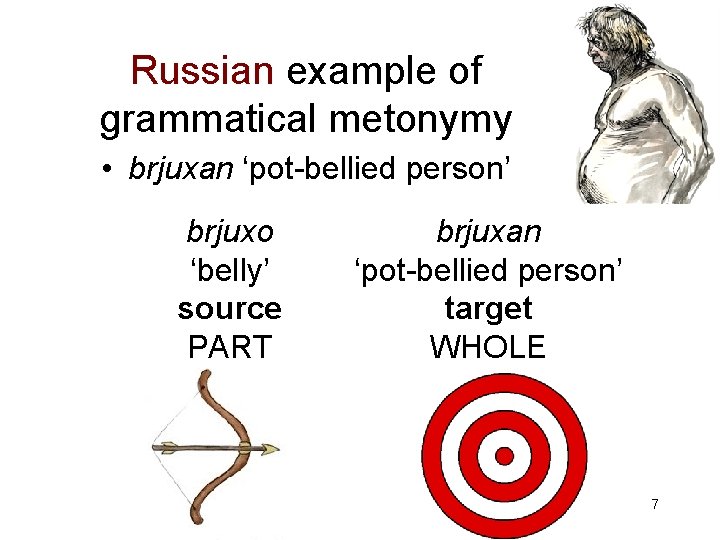
Russian example of grammatical metonymy • brjuxan ‘pot-bellied person’ brjuxo ‘belly’ source PART brjuxan ‘pot-bellied person’ target WHOLE 7
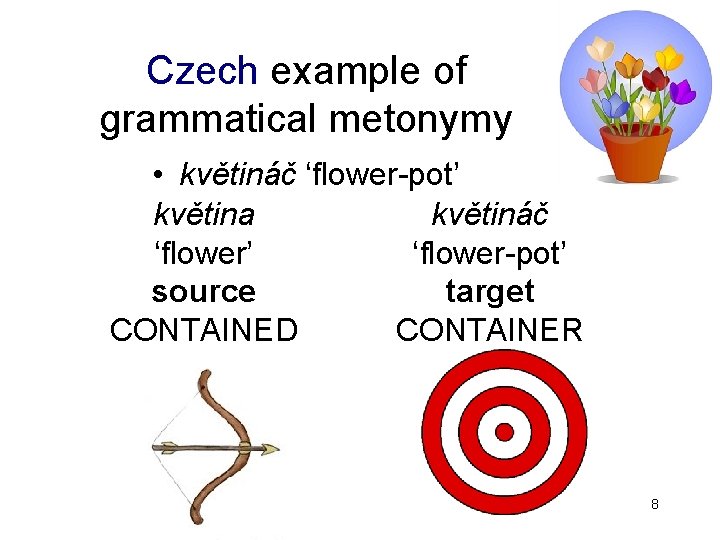
Czech example of grammatical metonymy • květináč ‘flower-pot’ květina květináč ‘flower’ ‘flower-pot’ source target CONTAINED CONTAINER 8
Why study grammatical metonymy? • Grammatical structures are more systematic, more indicative of information structure than lexical structures • Compare lexical vs. grammatical metonymy • Compare grammatical metonymy across languages • May indicate information structure in brain • May indicate cultural differences 9
2. Relevant Previous Scholarship • Works on metonymy – say almost nothing about word-formation • Works on wordformation – say almost nothing about metonymy 10
Works on metonymy • Focus on lexical metonymy and on describing difference between metonymy and metaphor: Jakobson [1956] 1980, Lakoff & Johnson 1980 • Domains/Dominions: Langacker 1993, 2009; Croft 1993 • ICMs & Frames: Kövecses & Radden 1998; Radden & Kövecses 1999; Seto 1999; Panther & Thornburg 1999, 2007; Barcelona 2002, Kövecses 2002 • Contiguity: Peirsman & Geeraerts 2006 11
Jakobson [1956] 1980 • Metonymy is based on contiguity. • “Also, as a rule, words derived from the same root, such as grant -- grantor -- grantee are semantically related by contiguity. ” • “Thus the Russian word mokr-ica signifies ‘woodlouse’, but a Russian aphasic interpreted it as ‘something humid’, especially ‘humid weather’, since the root mokr- means ‘humid’ and the suffix -ica designates a carrier of the given property, as in nelepica ‘something absurd’, svetlica ‘light room’, temnica ‘dungeon’ (literally ‘dark room’). ” • Scholarship has neglected metonymy 12
Langacker 1993, 2009 • “Metonymy is prevalent because our reference-point ability is fundamental and ubiquitous, and it occurs in the first place because it serves a useful cognitive and communicative function. ” • “By virtue of our reference-point ability, a well-chosen metonymic expression lets us mention one entity that is salient and easily coded, and thereby evoke -- essentially automatically -- a target that is either of lesser interest or harder to name. ” • “Cases where grammatical relationships involve approximations rather than exact connections, or rely on general or contextual knowledge, are neither atypical nor pathological. . metonymy in grammar should not be seen as a problem but as part of the solution. ” 13
Works on metonymy that mention word-formation • Panther & Thornburg 2002 (Eng -er), Basilio 2006 (B Port -dor, -nte, -ista), Koch 1999 (Fr ier), Warren 1999 (Eng denominal verbs), Dirven 1999 (Eng verbs by conversion), Benczes 2005 (Eng compounds), Blank 2001, Radden 2005 (Eng -able) • Padučeva 2004: Shows that the same metonymic semantic relation can be lexical in one language, but marked by word-formation in another 14
Peirsman & Geeraerts 2006 • Most comprehensive inventory of metonymy patterns • Focuses primarily on lexical metonymy; grammatical uses do not involve word formation • Serves as the basis for the system used in my databases • Will serve as basis for comparisons also (henceforth “P&G”) 15
Works on word-formation • Mainly lists of suffixes and/or relationships • 3 Reference Grammars: Švedova 1980, Dokulil 1986, Faarlund et al. 1997 • Metonymy is almost never mentioned (exceptions: Araeva 2009, Štekauer 2005) • But note similarities to Dokulil’s (1962) onomasiology and Mel’chuk’s lexical functions 16
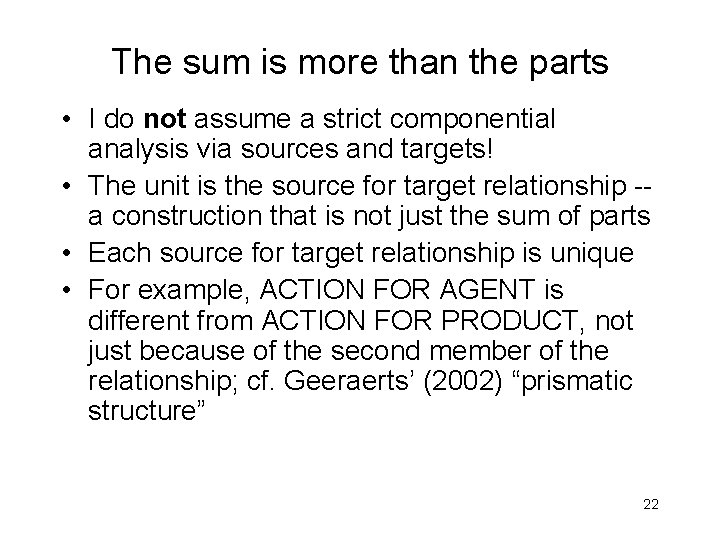
3. Databases: Russian, Czech, Norwegian • Based on data culled from Academy/Reference Grammar of each language • Suffixal word-formation signalling metonymy – includes conversion (zero-suffixation) • Each database is an inventory of types – no duplicates (examples are merely illustrative!) 17
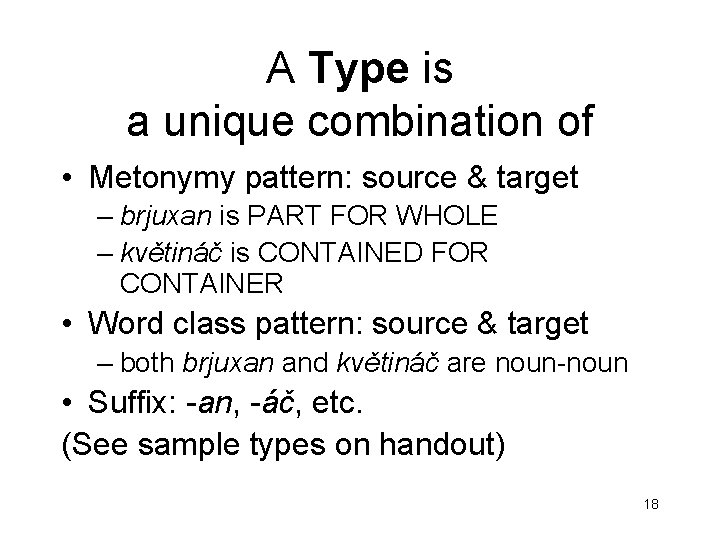
A Type is a unique combination of • Metonymy pattern: source & target – brjuxan is PART FOR WHOLE – květináč is CONTAINED FOR CONTAINER • Word class pattern: source & target – both brjuxan and květináč are noun-noun • Suffix: -an, -áč, etc. (See sample types on handout) 18
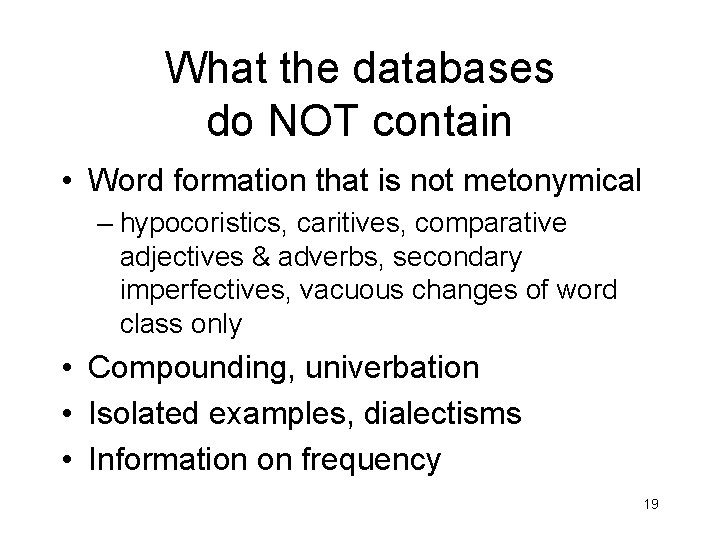
What the databases do NOT contain • Word formation that is not metonymical – hypocoristics, caritives, comparative adjectives & adverbs, secondary imperfectives, vacuous changes of word class only • Compounding, univerbation • Isolated examples, dialectisms • Information on frequency 19
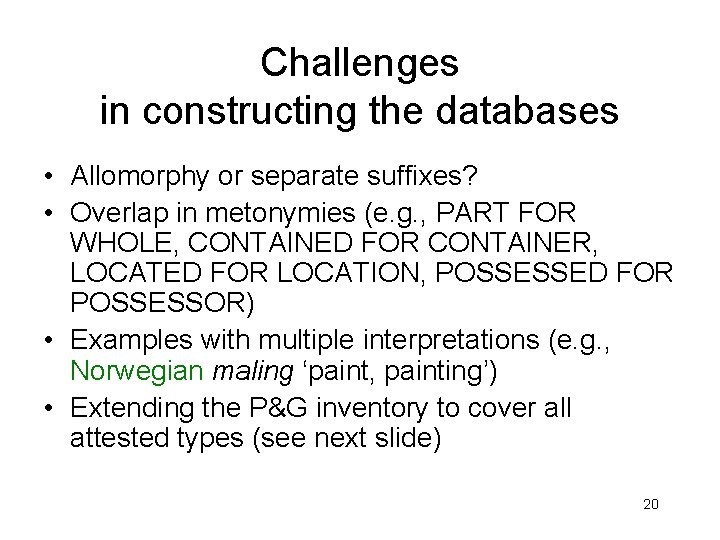
Challenges in constructing the databases • Allomorphy or separate suffixes? • Overlap in metonymies (e. g. , PART FOR WHOLE, CONTAINED FOR CONTAINER, LOCATED FOR LOCATION, POSSESSED FOR POSSESSOR) • Examples with multiple interpretations (e. g. , Norwegian maling ‘paint, painting’) • Extending the P&G inventory to cover all attested types (see next slide) 20
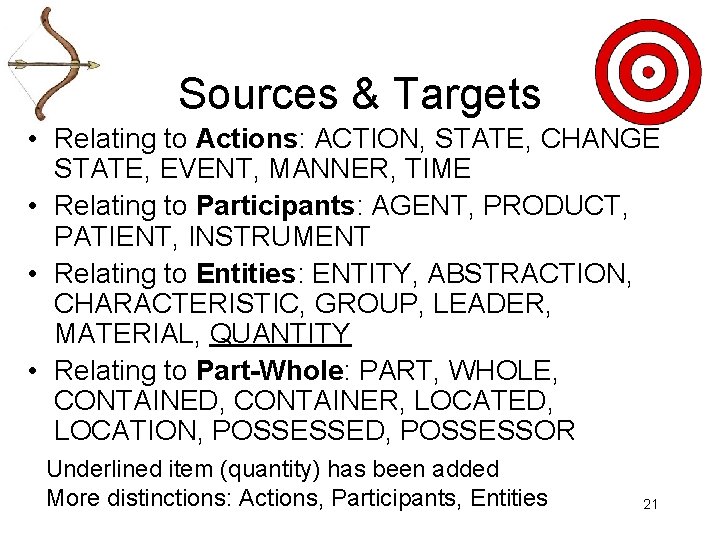
Sources & Targets • Relating to Actions: ACTION, STATE, CHANGE STATE, EVENT, MANNER, TIME • Relating to Participants: AGENT, PRODUCT, PATIENT, INSTRUMENT • Relating to Entities: ENTITY, ABSTRACTION, CHARACTERISTIC, GROUP, LEADER, MATERIAL, QUANTITY • Relating to Part-Whole: PART, WHOLE, CONTAINED, CONTAINER, LOCATED, LOCATION, POSSESSED, POSSESSOR Underlined item (quantity) has been added More distinctions: Actions, Participants, Entities 21
The sum is more than the parts • I do not assume a strict componential analysis via sources and targets! • The unit is the source for target relationship -a construction that is not just the sum of parts • Each source for target relationship is unique • For example, ACTION FOR AGENT is different from ACTION FOR PRODUCT, not just because of the second member of the relationship; cf. Geeraerts’ (2002) “prismatic structure” 22
23
24
25
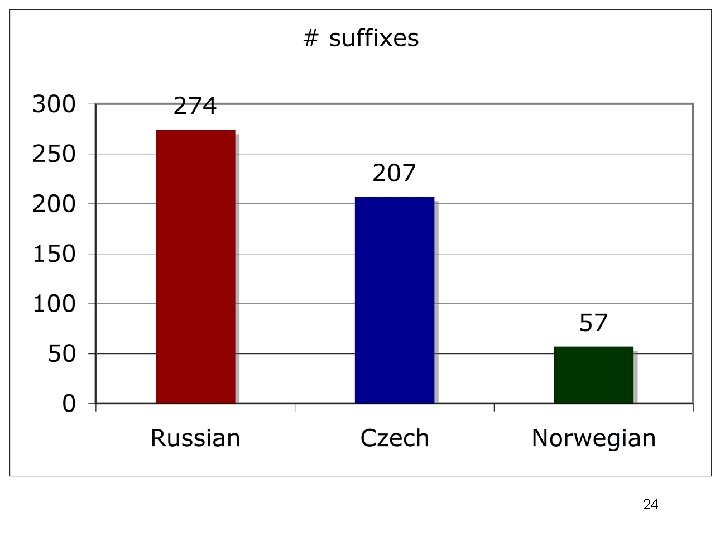
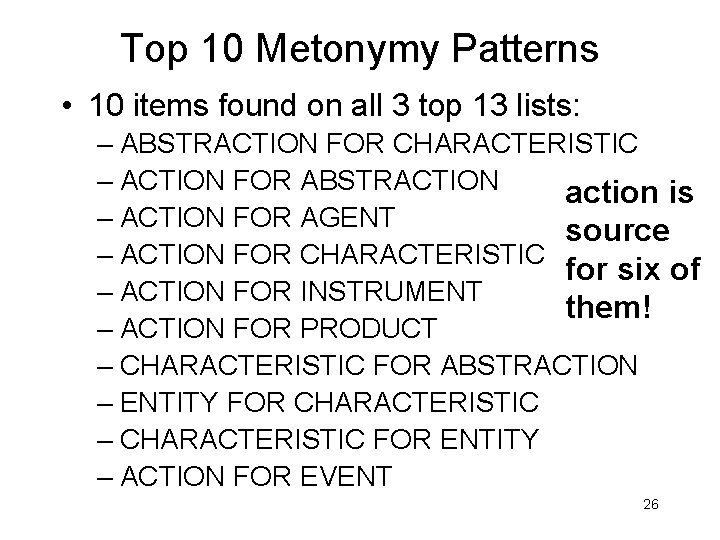
Top 10 Metonymy Patterns • 10 items found on all 3 top 13 lists: – ABSTRACTION FOR CHARACTERISTIC – ACTION FOR ABSTRACTION action is – ACTION FOR AGENT source – ACTION FOR CHARACTERISTIC for six of – ACTION FOR INSTRUMENT them! – ACTION FOR PRODUCT – CHARACTERISTIC FOR ABSTRACTION – ENTITY FOR CHARACTERISTIC – CHARACTERISTIC FOR ENTITY – ACTION FOR EVENT 26
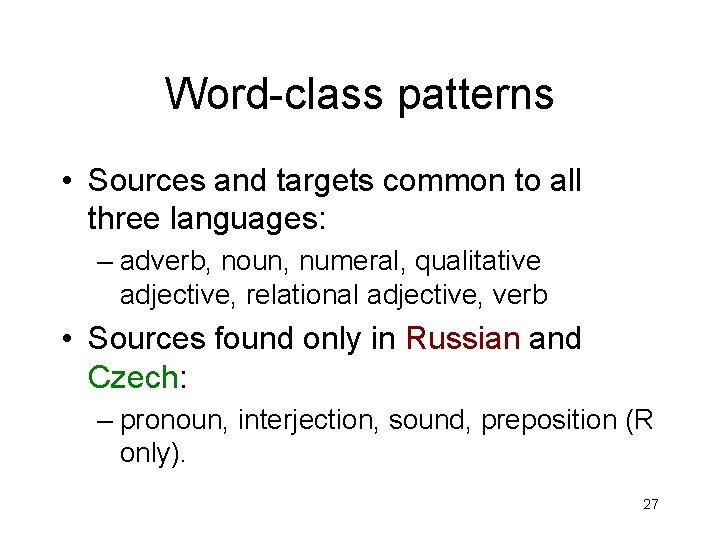
Word-class patterns • Sources and targets common to all three languages: – adverb, noun, numeral, qualitative adjective, relational adjective, verb • Sources found only in Russian and Czech: – pronoun, interjection, sound, preposition (R only). 27
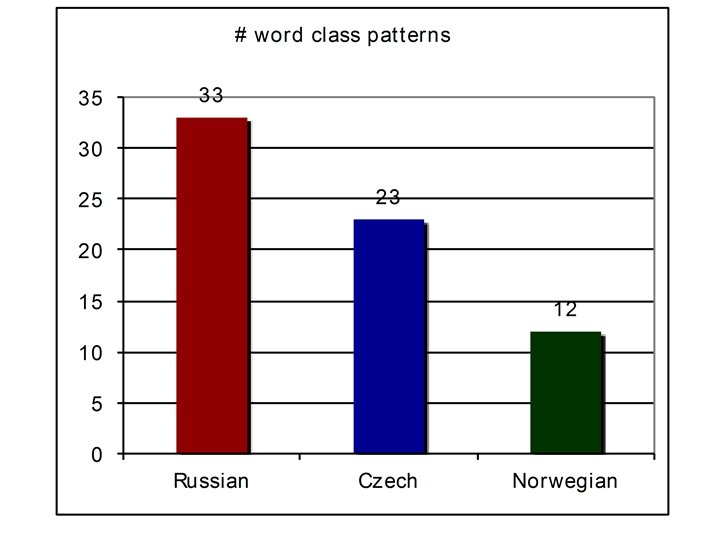
28
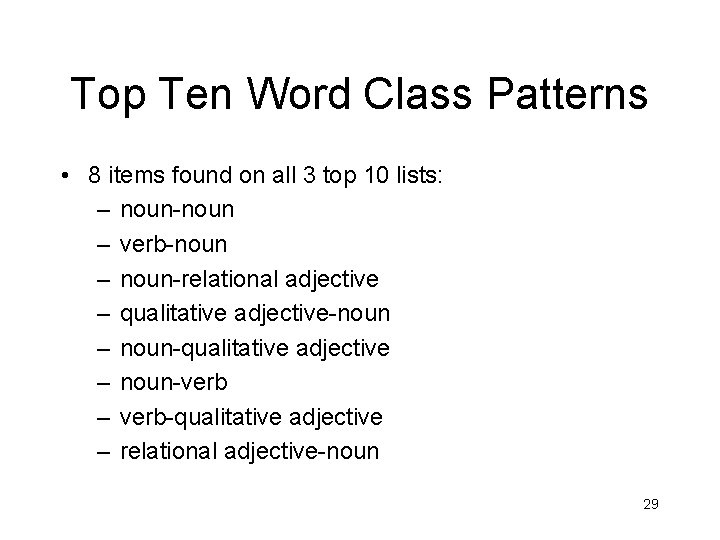
Top Ten Word Class Patterns • 8 items found on all 3 top 10 lists: – noun-noun – verb-noun – noun-relational adjective – qualitative adjective-noun – noun-qualitative adjective – noun-verb – verb-qualitative adjective – relational adjective-noun 29
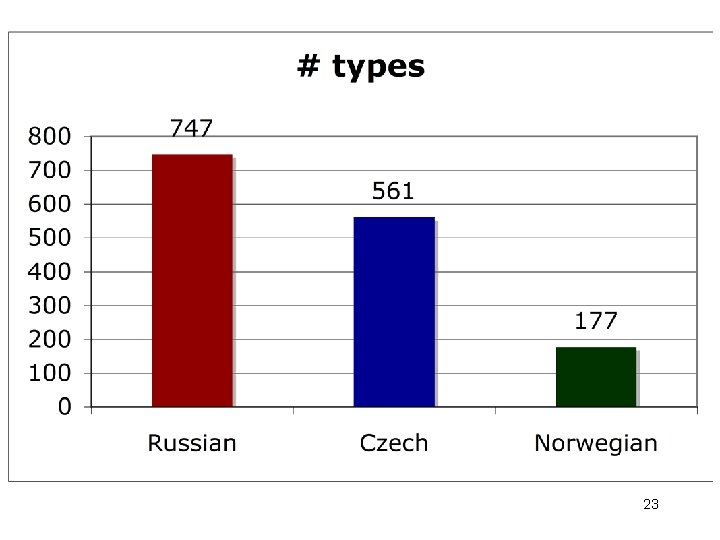
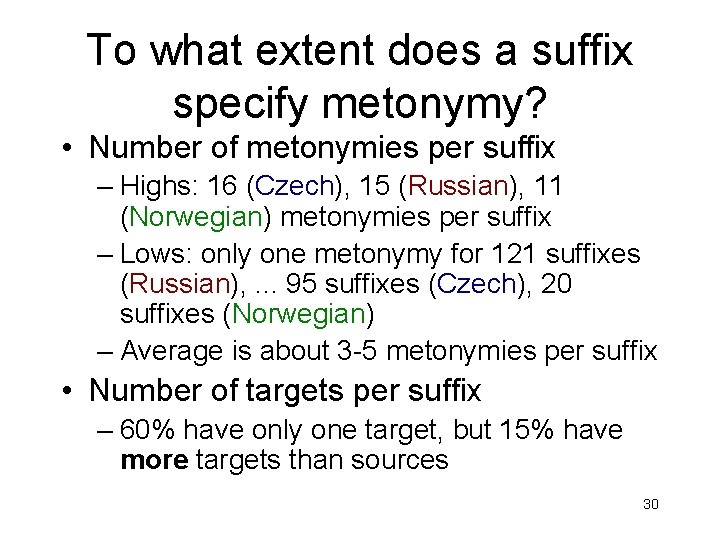
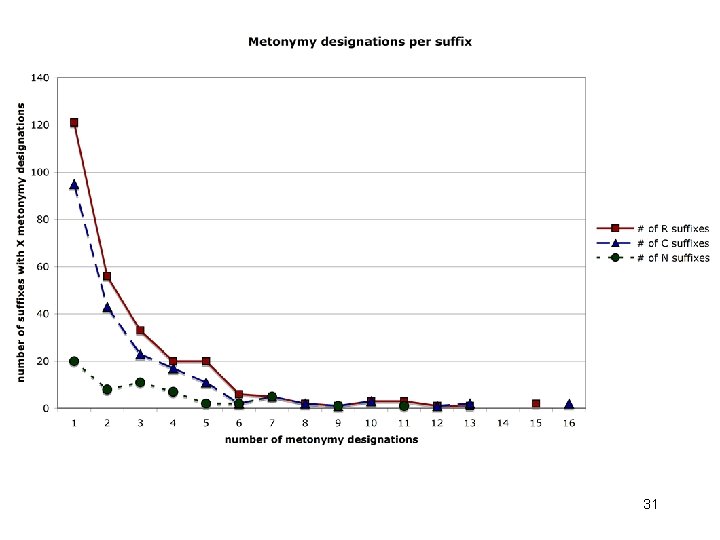
To what extent does a suffix specify metonymy? • Number of metonymies per suffix – Highs: 16 (Czech), 15 (Russian), 11 (Norwegian) metonymies per suffix – Lows: only one metonymy for 121 suffixes (Russian), . . . 95 suffixes (Czech), 20 suffixes (Norwegian) – Average is about 3 -5 metonymies per suffix • Number of targets per suffix – 60% have only one target, but 15% have more targets than sources 30
31
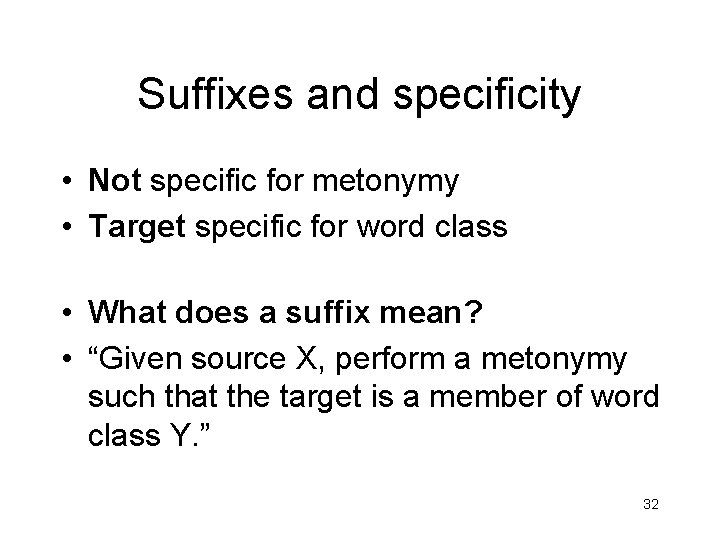
Suffixes and specificity • Not specific for metonymy • Target specific for word class • What does a suffix mean? • “Given source X, perform a metonymy such that the target is a member of word class Y. ” 32
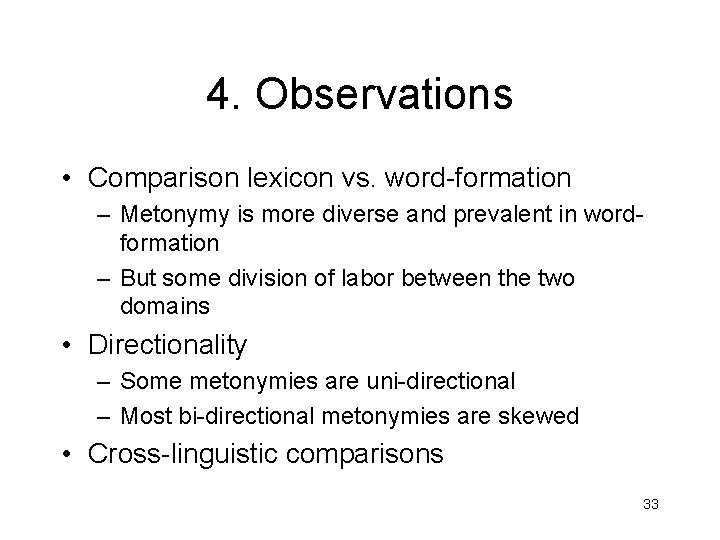
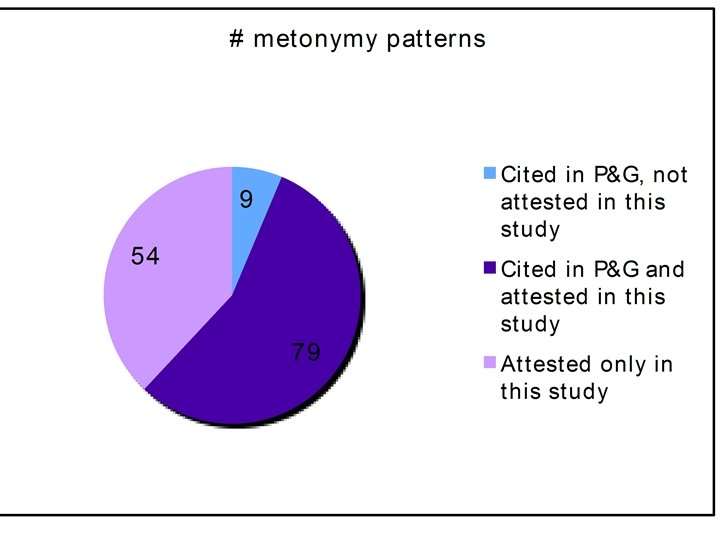
4. Observations • Comparison lexicon vs. word-formation – Metonymy is more diverse and prevalent in wordformation – But some division of labor between the two domains • Directionality – Some metonymies are uni-directional – Most bi-directional metonymies are skewed • Cross-linguistic comparisons 33
34
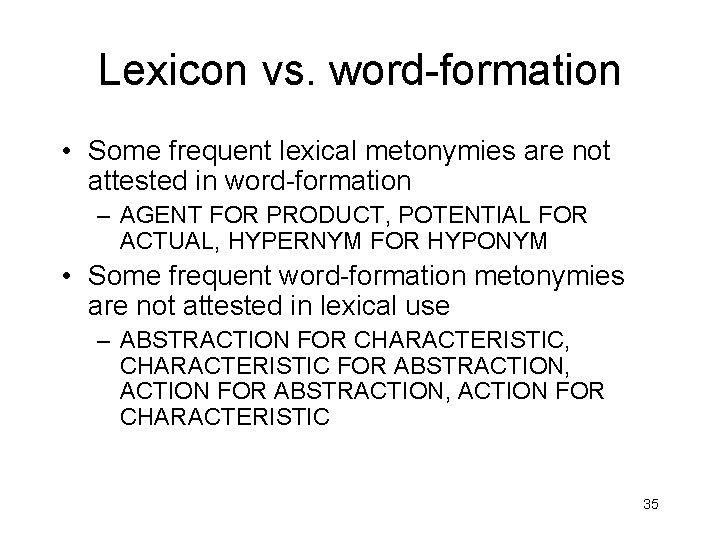
Lexicon vs. word-formation • Some frequent lexical metonymies are not attested in word-formation – AGENT FOR PRODUCT, POTENTIAL FOR ACTUAL, HYPERNYM FOR HYPONYM • Some frequent word-formation metonymies are not attested in lexical use – ABSTRACTION FOR CHARACTERISTIC, CHARACTERISTIC FOR ABSTRACTION, ACTION FOR CHARACTERISTIC 35
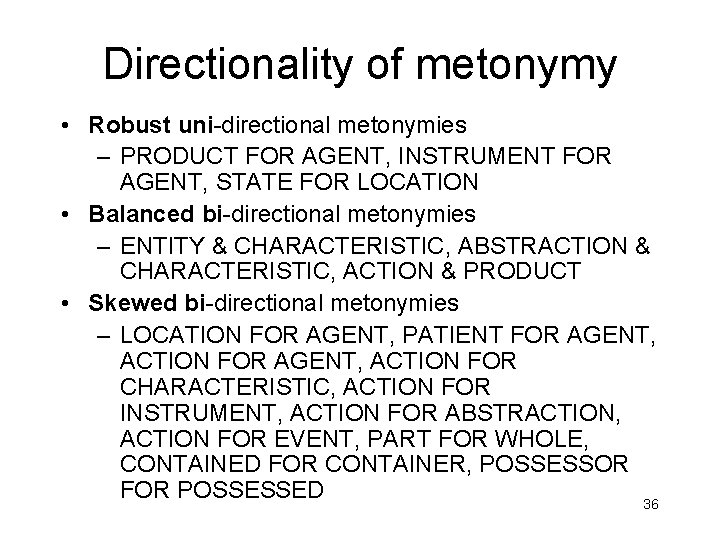
Directionality of metonymy • Robust uni-directional metonymies – PRODUCT FOR AGENT, INSTRUMENT FOR AGENT, STATE FOR LOCATION • Balanced bi-directional metonymies – ENTITY & CHARACTERISTIC, ABSTRACTION & CHARACTERISTIC, ACTION & PRODUCT • Skewed bi-directional metonymies – LOCATION FOR AGENT, PATIENT FOR AGENT, ACTION FOR CHARACTERISTIC, ACTION FOR INSTRUMENT, ACTION FOR ABSTRACTION, ACTION FOR EVENT, PART FOR WHOLE, CONTAINED FOR CONTAINER, POSSESSOR FOR POSSESSED 36
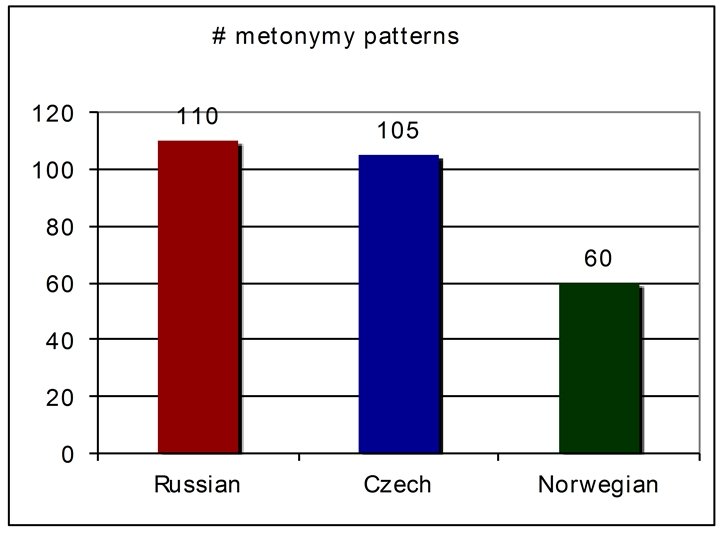
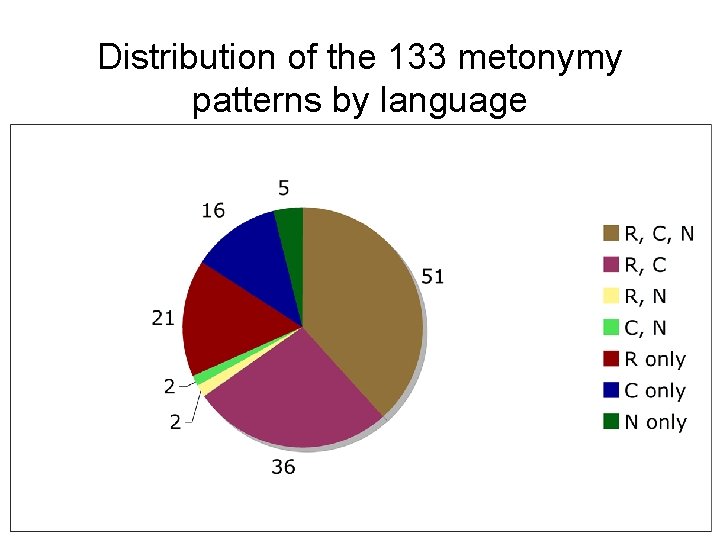
Distribution of the 133 metonymy patterns by language 37
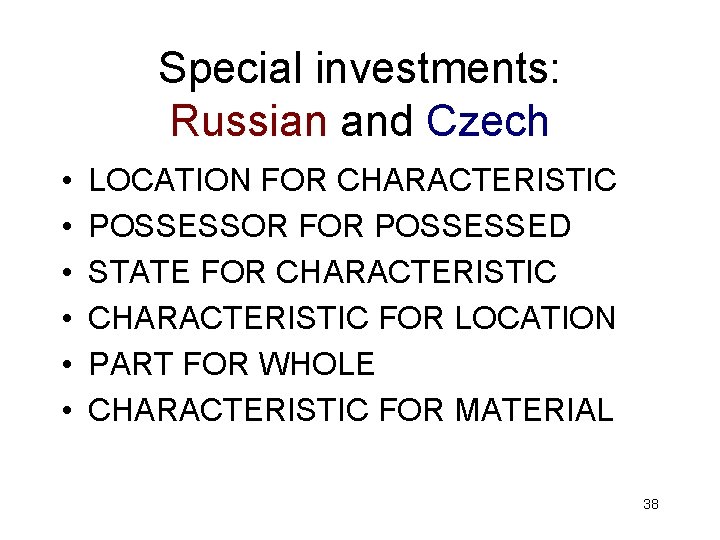
Special investments: Russian and Czech • • • LOCATION FOR CHARACTERISTIC POSSESSOR FOR POSSESSED STATE FOR CHARACTERISTIC FOR LOCATION PART FOR WHOLE CHARACTERISTIC FOR MATERIAL 38
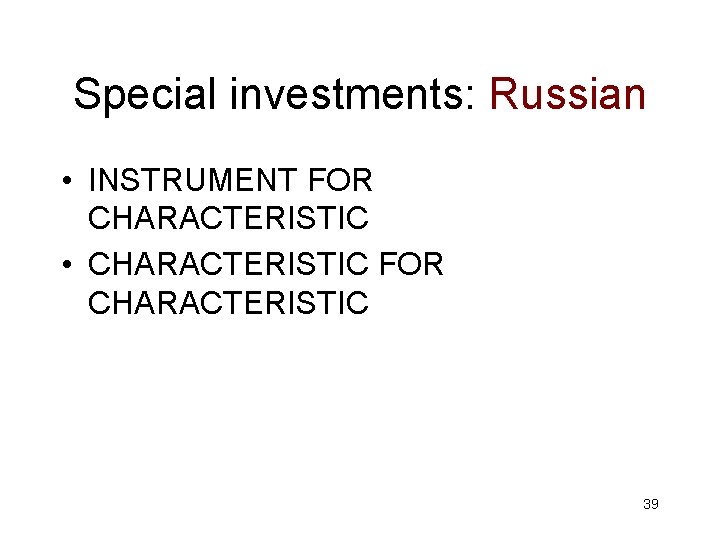
Special investments: Russian • INSTRUMENT FOR CHARACTERISTIC • CHARACTERISTIC FOR CHARACTERISTIC 39
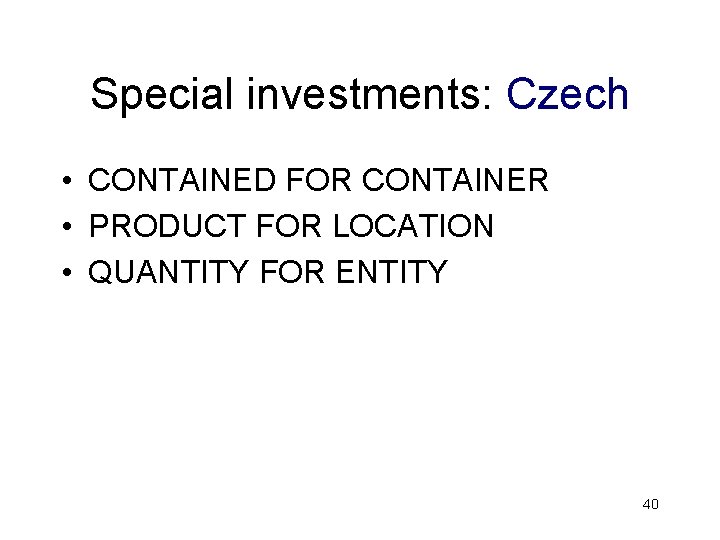
Special investments: Czech • CONTAINED FOR CONTAINER • PRODUCT FOR LOCATION • QUANTITY FOR ENTITY 40
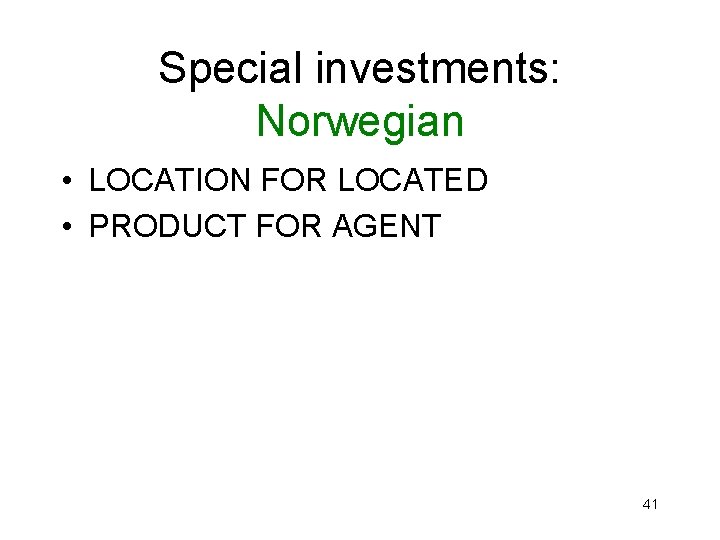
Special investments: Norwegian • LOCATION FOR LOCATED • PRODUCT FOR AGENT 41
5. Conclusions • The main purpose of word-formation is to signal metonymy • Metonymy in word-formation is more diverse than in lexical use • Different languages make different investments in word-formation to signal metonymy 42