
Methods of Training TASK Complete the missing words
- Slides: 3
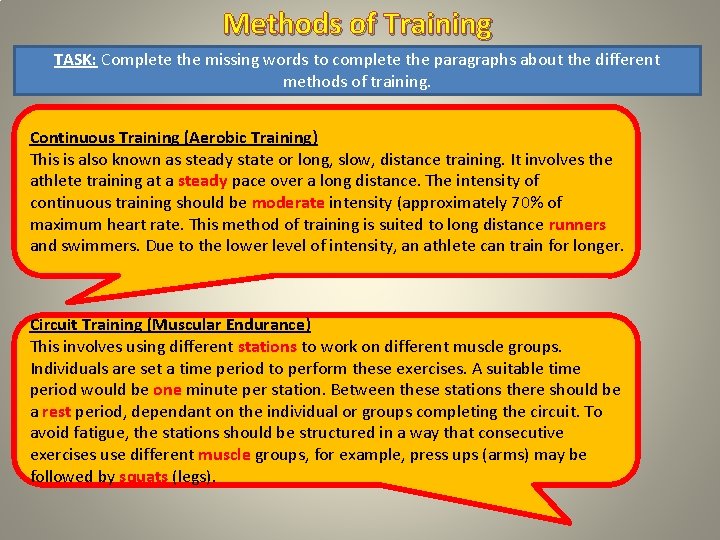
Methods of Training TASK: Complete the missing words to complete the paragraphs about the different methods of training. Continuous Training (Aerobic Training) This is also known as steady state or long, slow, distance training. It involves the athlete training at a steady pace over a long distance. The intensity of continuous training should be moderate intensity (approximately 70% of maximum heart rate. This method of training is suited to long distance runners and swimmers. Due to the lower level of intensity, an athlete can train for longer. Circuit Training (Muscular Endurance) This involves using different stations to work on different muscle groups. Individuals are set a time period to perform these exercises. A suitable time period would be one minute per station. Between these stations there should be a rest period, dependant on the individual or groups completing the circuit. To avoid fatigue, the stations should be structured in a way that consecutive exercises use different muscle groups, for example, press ups (arms) may be followed by squats (legs).
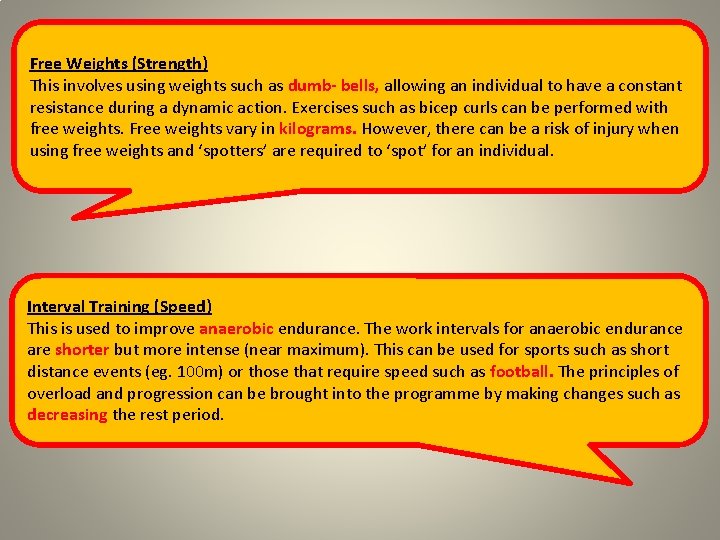
Free Weights (Strength) This involves using weights such as dumb- bells, allowing an individual to have a constant resistance during a dynamic action. Exercises such as bicep curls can be performed with free weights. Free weights vary in kilograms. However, there can be a risk of injury when using free weights and ‘spotters’ are required to ‘spot’ for an individual. Interval Training (Speed) This is used to improve anaerobic endurance. The work intervals for anaerobic endurance are shorter but more intense (near maximum). This can be used for sports such as short distance events (eg. 100 m) or those that require speed such as football. The principles of overload and progression can be brought into the programme by making changes such as decreasing the rest period.
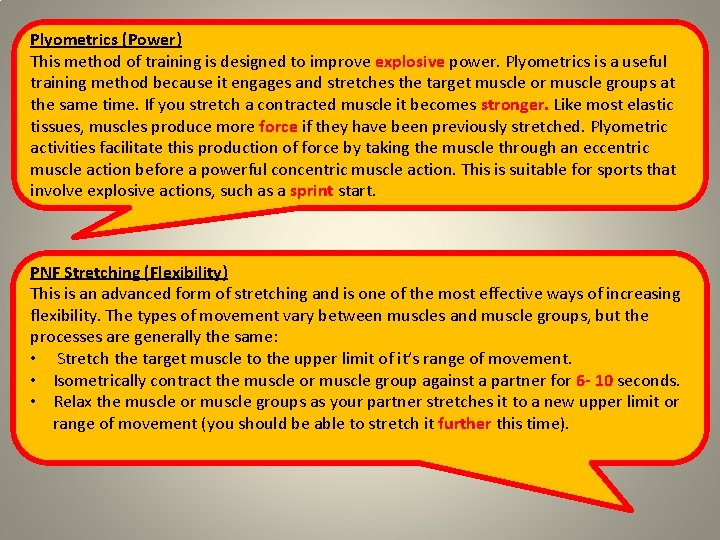
Plyometrics (Power) This method of training is designed to improve explosive power. Plyometrics is a useful training method because it engages and stretches the target muscle or muscle groups at the same time. If you stretch a contracted muscle it becomes stronger. Like most elastic tissues, muscles produce more force if they have been previously stretched. Plyometric activities facilitate this production of force by taking the muscle through an eccentric muscle action before a powerful concentric muscle action. This is suitable for sports that involve explosive actions, such as a sprint start. PNF Stretching (Flexibility) This is an advanced form of stretching and is one of the most effective ways of increasing flexibility. The types of movement vary between muscles and muscle groups, but the processes are generally the same: • Stretch the target muscle to the upper limit of it’s range of movement. • Isometrically contract the muscle or muscle group against a partner for 6 - 10 seconds. • Relax the muscle or muscle groups as your partner stretches it to a new upper limit or range of movement (you should be able to stretch it further this time).