
METHODS OF TRAINING CIRCUIT TRAINING Circuit Training Instructor
- Slides: 14
METHODS OF TRAINING CIRCUIT TRAINING
Circuit Training Instructor led multi-activity workout “the planned execution of a series of exercises, in a predetermined sequence, for an allocated time or number of repetitions” (Dalgleish &Dollery 2001)
Benefits �Full body workout �Can train all components of fitness (x Training) �Multi-level challenging workout for everyone �Space and time efficient �Requires little co-ordination �Can be sports specific
Types of Circuit Training �Studio based = circle �Gym based = using CV & resistance machines �Outdoor = ‘bootcamp’
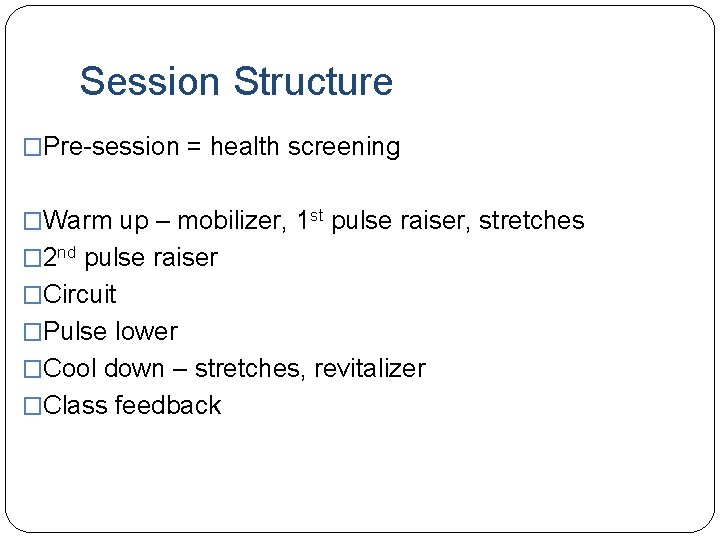
Session Structure �Pre-session = health screening �Warm up – mobilizer, 1 st pulse raiser, stretches � 2 nd pulse raiser �Circuit �Pulse lower �Cool down – stretches, revitalizer �Class feedback
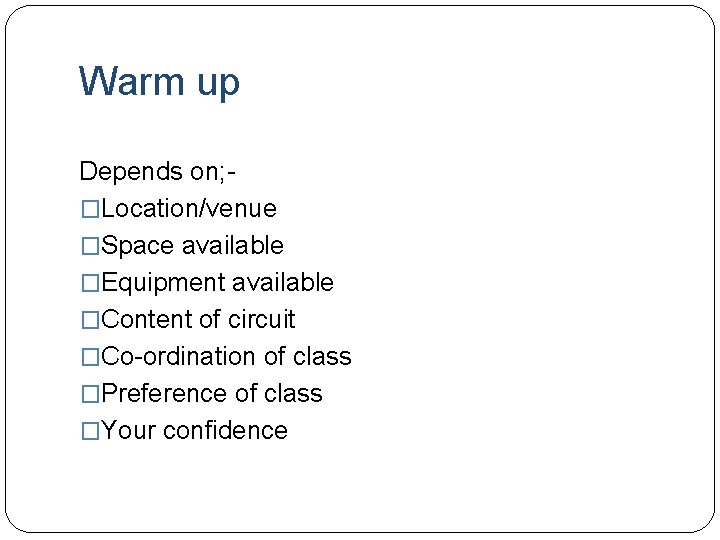
Warm up Depends on; �Location/venue �Space available �Equipment available �Content of circuit �Co-ordination of class �Preference of class �Your confidence
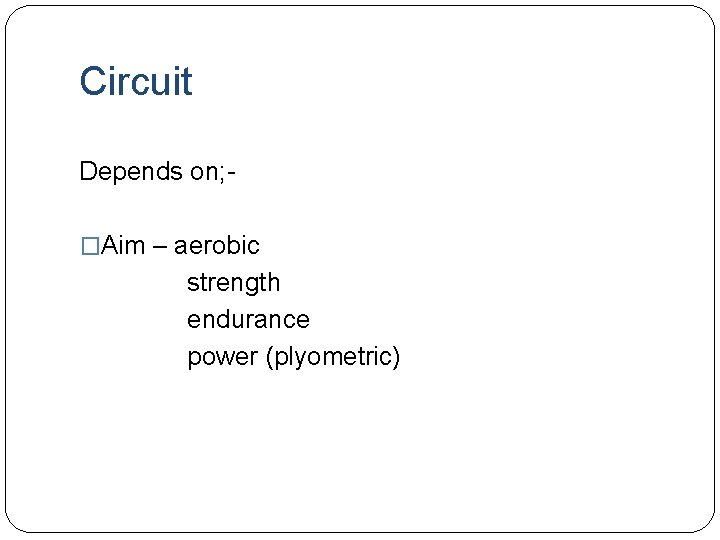
Circuit Depends on; �Aim – aerobic strength endurance power (plyometric)
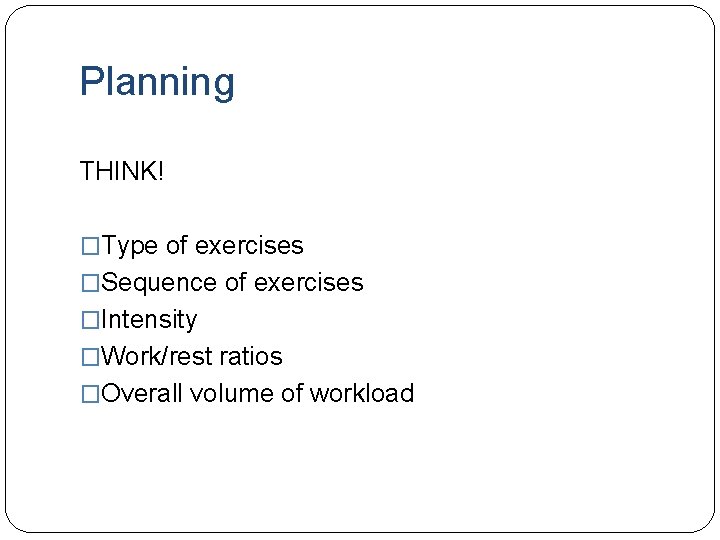
Planning THINK! �Type of exercises �Sequence of exercises �Intensity �Work/rest ratios �Overall volume of workload
Exercises/activities THINK! �Space �Equipment �Training aim �Muscle balance �Fitness & skill level of the group
Sequence THINK! �Even distribution �Alternate upper body / lower body �Opposite muscle groups
Progression of Exercises To increase CV intensity; �Increase speed of the exercise �Increase the pattern of movement �Add arm movements �Add travel �Add impact
Progression of Exercises To increase strength of exercises; �Use full range of movement (ROM) �Increase the resistance �Decrease the speed of the exercise �Emphasize eccentric phase
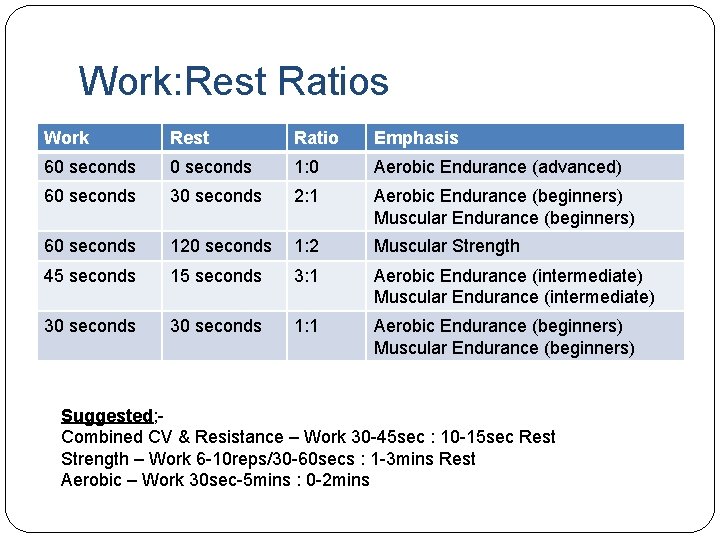
Work: Rest Ratios Work Rest Ratio Emphasis 60 seconds 1: 0 Aerobic Endurance (advanced) 60 seconds 30 seconds 2: 1 Aerobic Endurance (beginners) Muscular Endurance (beginners) 60 seconds 120 seconds 1: 2 Muscular Strength 45 seconds 15 seconds 3: 1 Aerobic Endurance (intermediate) Muscular Endurance (intermediate) 30 seconds 1: 1 Aerobic Endurance (beginners) Muscular Endurance (beginners) Suggested; Combined CV & Resistance – Work 30 -45 sec : 10 -15 sec Rest Strength – Work 6 -10 reps/30 -60 secs : 1 -3 mins Rest Aerobic – Work 30 sec-5 mins : 0 -2 mins
Active Recovery �Aerobic stations in between Muscular Strength Endurance (MSE) stations �Alternate upper/lower body or muscle group exercises