
Methods of Studying Human Behavior What do Psychologists

Methods of Studying Human Behavior
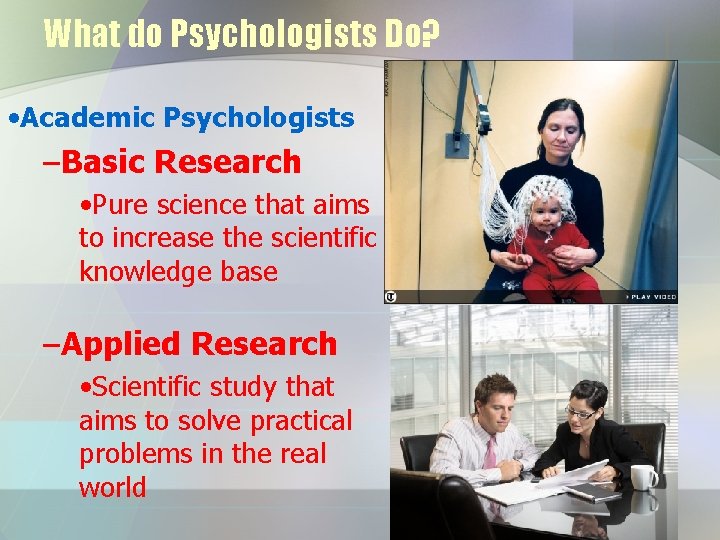
What do Psychologists Do? • Academic Psychologists –Basic Research • Pure science that aims to increase the scientific knowledge base –Applied Research • Scientific study that aims to solve practical problems in the real world
The Scientific Method • A method of learning about the world through the application of critical thinking and tools such as observation, experimentation, and statistical analysis • Research that employs the scientific method leads to logical, supported conclusions that allow us to make informed decisions • Well-designed research produces more reliable answers than do conclusions based on common sense, which tend to vary from one person to another
Bias in Research • Researcher Bias – A tendency for researchers to engage in behaviors and selectively notice evidence that supports their hypothesis or expectations (they see what they want to see) • Participant bias – A tendency for research participants to respond in a certain way because they know they are being observed or they believe that know what the researcher wants (they do what they think the researchers want them to do)
Methods for Studying Behavior • Naturalistic Observation • Case Study • Survey • Longitudinal • Cross-Sectional • Correlational • “Other” • THE EXPERIMENT
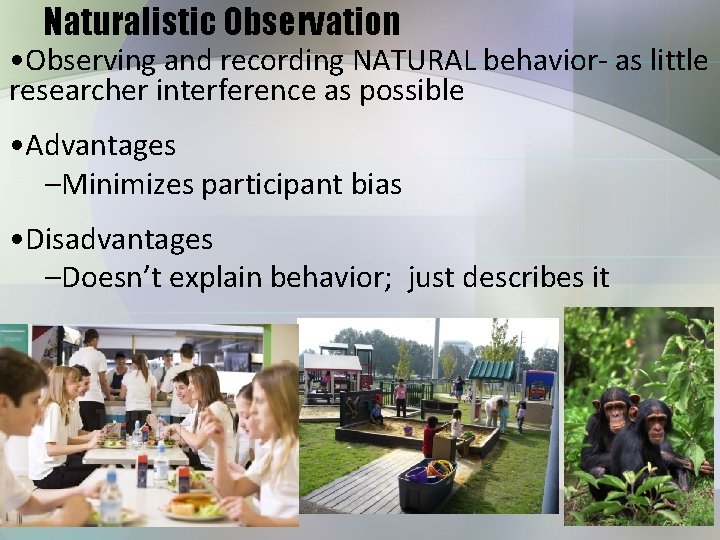
Naturalistic Observation • Observing and recording NATURAL behavior- as little researcher interference as possible • Advantages –Minimizes participant bias • Disadvantages –Doesn’t explain behavior; just describes it
Case Study • One person is studied in depth in the hope of revealing universal principles • Advantages –In depth information –Sometimes only ethical option • Disadvantages –Not necessarily representative –Prone to bias
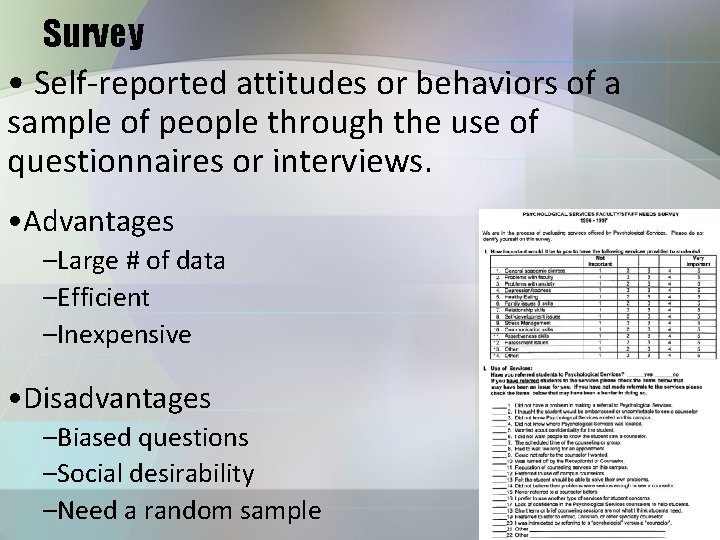
Survey • Self-reported attitudes or behaviors of a sample of people through the use of questionnaires or interviews. • Advantages –Large # of data –Efficient –Inexpensive • Disadvantages –Biased questions –Social desirability –Need a random sample
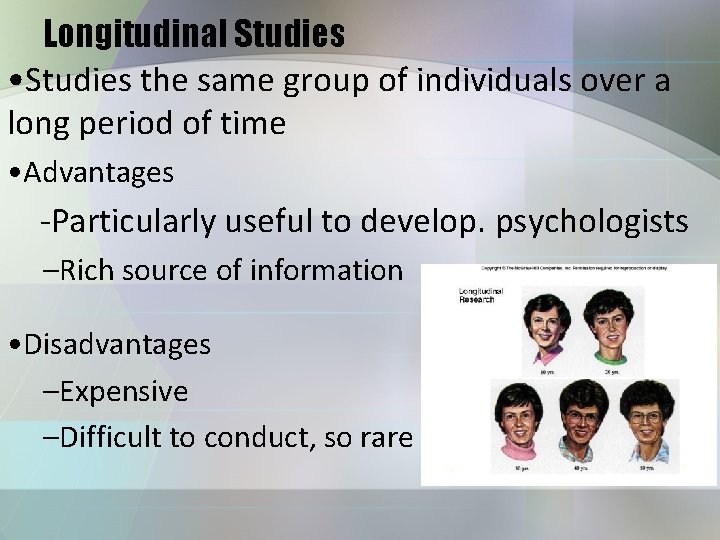
Longitudinal Studies • Studies the same group of individuals over a long period of time • Advantages -Particularly useful to develop. psychologists –Rich source of information • Disadvantages –Expensive –Difficult to conduct, so rare
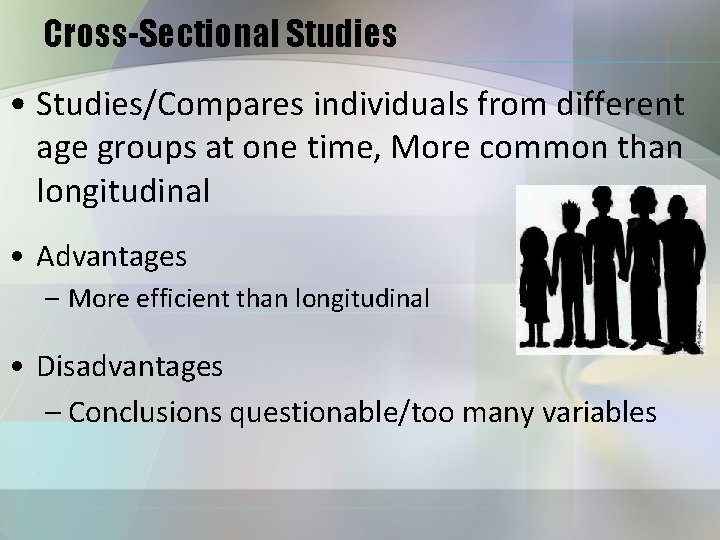
Cross-Sectional Studies • Studies/Compares individuals from different age groups at one time, More common than longitudinal • Advantages – More efficient than longitudinal • Disadvantages – Conclusions questionable/too many variables
Correlational Study Research project designed to discover the degree to which two variables are related to each other • VERY IMPORTANT: The discovery of a correlation does not prove that a cause and effect relationship exists. • May, however, be predictive • The ONLY way to prove causation is with a carefully controlled experiment
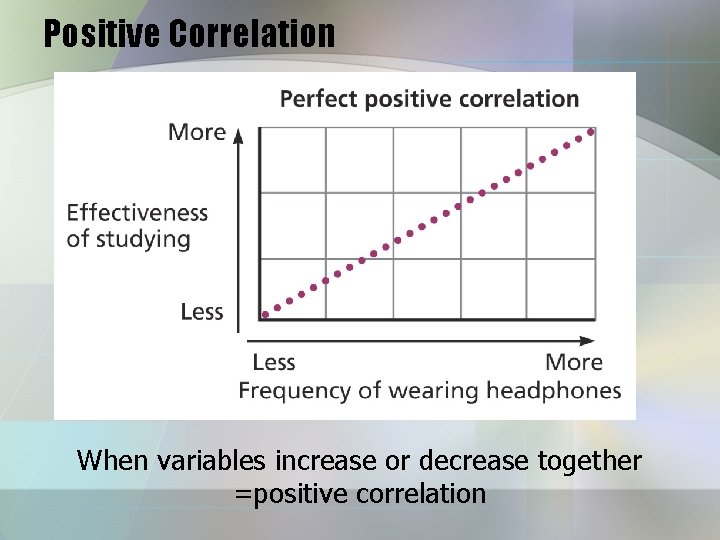
Positive Correlation When variables increase or decrease together =positive correlation
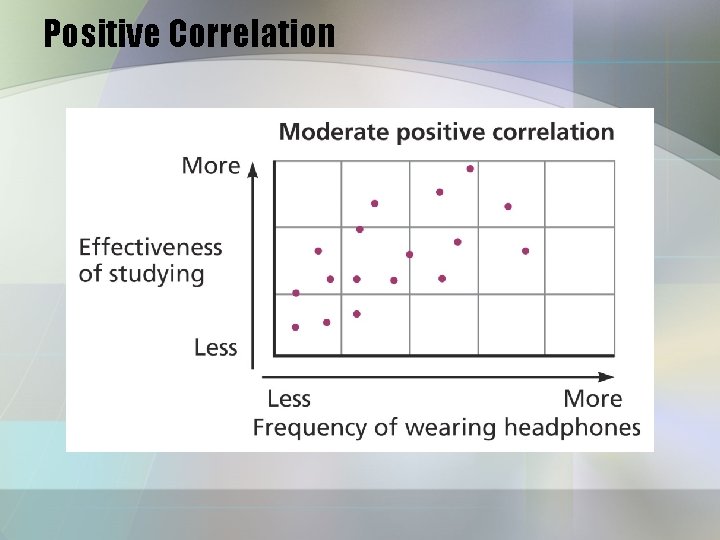
Positive Correlation

Negative Correlation One variable increases while the other decreases =negative correlation
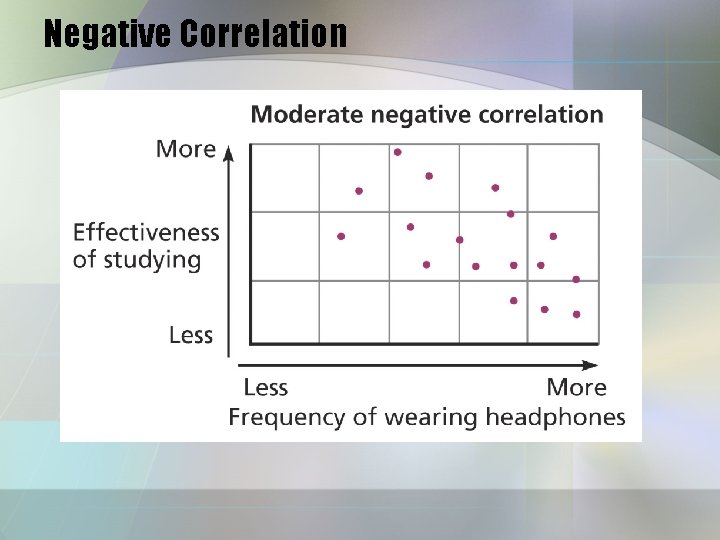
Negative Correlation
Experiment • Only method that allows us to draw conclusions about cause & effect • A method in which the researcher manipulates one or more factors (independent variable) to observe the effect on other variables (dependent variables) while controlling the confounding variables
Experimentation—Terms • • • Hypothesis IV DV Operational Definition Control Group Random Sample Random Assignment Placebo Double-blind procedure
- Slides: 17