
Methods of Retrieval To start recall as many
- Slides: 18
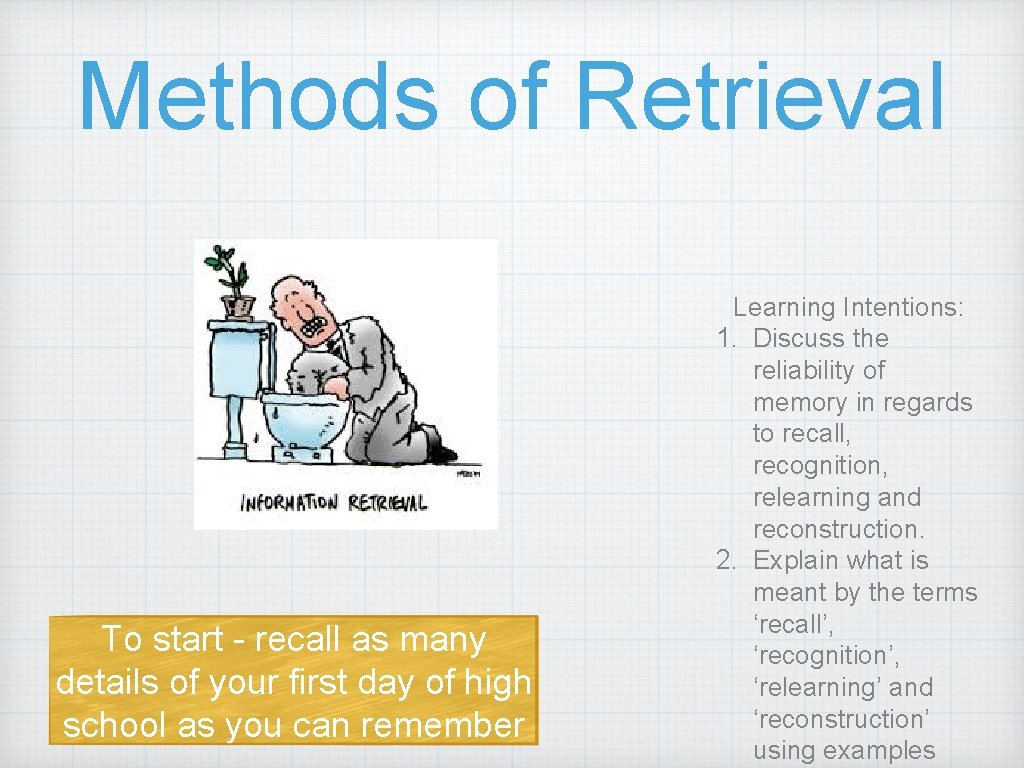
Methods of Retrieval To start - recall as many details of your first day of high school as you can remember Learning Intentions: 1. Discuss the reliability of memory in regards to recall, recognition, relearning and reconstruction. 2. Explain what is meant by the terms ‘recall’, ‘recognition’, ‘relearning’ and ‘reconstruction’ using examples
The 4 Rs of Retrieval Much of the information we retrieve from long-term memory is not an entirely accurate reproduction of what actually happened when encoding. Why do you think this is? What can influence the retrieval of information from LTM?
The 4 Rs of Retrieval Just because you cannot remember a piece of information does not mean that it is not in your long-term memory. The type of retrieval method used can have an impact on the amount of information that is retrieved. The 4 Rs of retrieval are Recall, Recognition, Relearning and Reconstruction. What do you think these might mean?
Retrieval Treasure Hunt Recall is under the jacket Recognition is on target Relearning wants to learn Vietnamese Reconstruction is doing a pirouette
Recall This involves reproducing information stored in your long-term memory. Recall can be done with or without cues to help the process. There are 3 main types of recall: Free recall Serial recall Cued recall
Recall Free recall is the process in which a person is given a list of items to remember and then is asked to recall them in any order (hence the name “free”). This type of recall often displays evidence of either the primacy effect (when the person recalls items presented at the beginning of the list earlier and more often) or the recency effect (when the person recalls items presented at the end of the list earlier and more often). Cued recall is the process in which a person is given a list of items to remember and is then tested with the use of cues or guides. When cues are provided to a person, they tend to remember items on the list that they did not originally recall without a cue, and which were thought to be lost to memory. This can also take the form of stimulus-response recall, as when words, pictures and numbers are presented together in a pair, and the resulting associations between the two items cues the recall of the second item in the pair. Serial recall refers to our ability to recall items or events in the order in which they occurred, whether chronological events in our autobiographical memories, or the order of the different parts of a sentence (or phonemes in a word) in order to make sense of them. Serial recall in long-term memory appears to differ from serial recall in short-term memory, in that a sequence in long-term memory is represented in memory as a whole, rather than as a series of
Recognition is the association of an event or physical object with one previously experienced or encountered, and involves a process of comparison of information with memory, e. g. recognising a known face, true/false or multiple choice questions, etc. Recognition is a largely unconscious process, and the brain even has a dedicated face-recognition area.
Recognition usually involved identification of the correct information from among alternatives that include incorrect information. We are more likely to retrieve information when using the recognition method that recall.
Relearning involved learning information again that has previously been learnt. The information is learnt more quickly and with less effort the second time around, indicating that some information has been retained from the initial learning.
Relearning is also called the ‘method of savings’ because it is a way of measuring retention by measuring how much faster one relearns material that has been previously learned and then forgotten.
Reconstruction What we retrieve is not always a perfect reproduction of what happened at the time of encoding we reconstruct our memories during retrieval. Reconstruction involves the process of assembling information from stored knowledge when a clear or coherent memory of specific events does not exist.
Reconstruction Our memories are a combination of specific traces encoded at the time of the event, along with our knowledge, expectations, beliefs and experiences of such an event, making reconstruction an active process. Memory reconstructions are often accurate, but also contain errors and distortions. With repeated retrieval, our memories can become like Chinese whispers phrases - more distorted with each retrieval.
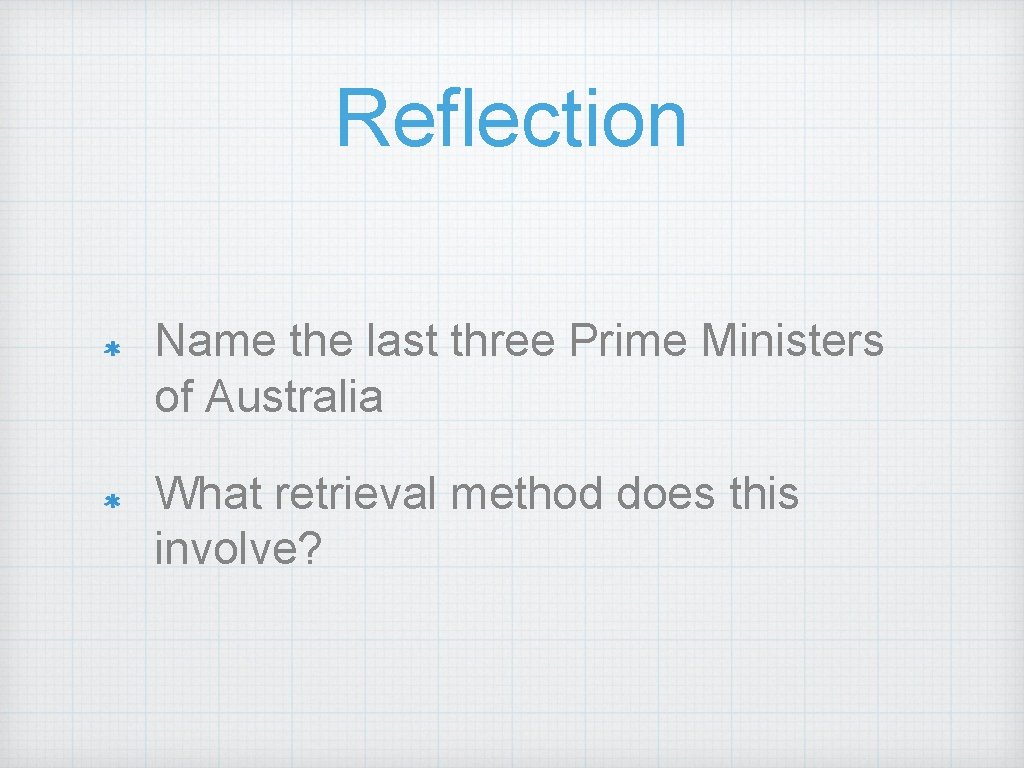
Reflection Name the last three Prime Ministers of Australia What retrieval method does this involve?
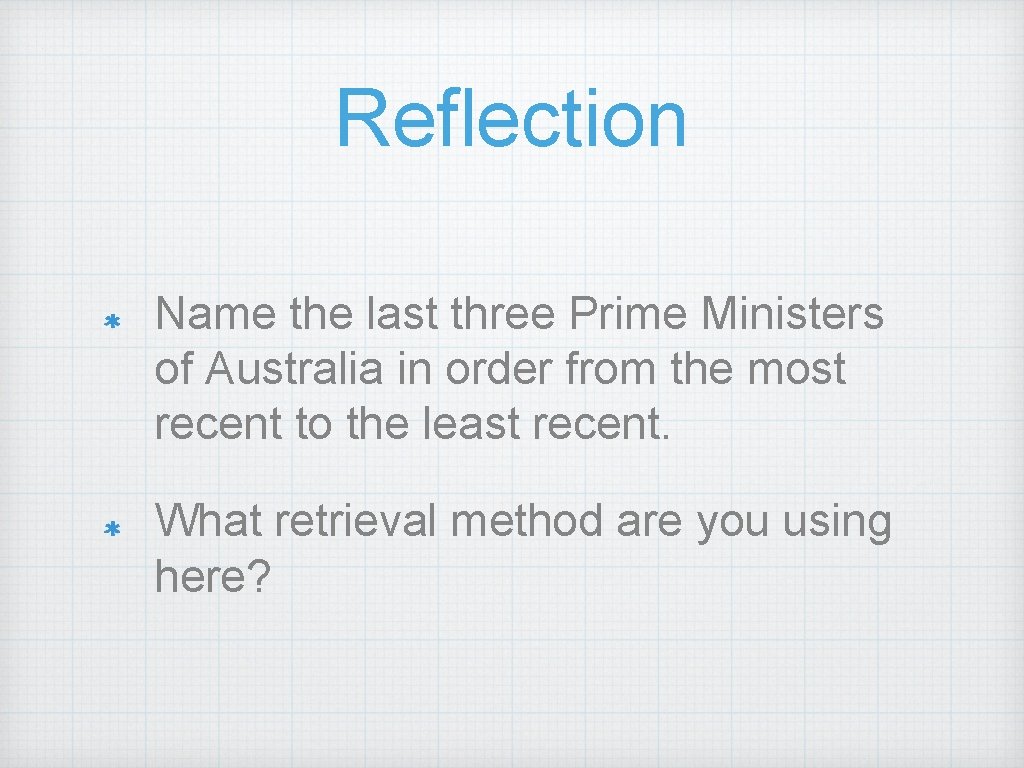
Reflection Name the last three Prime Ministers of Australia in order from the most recent to the least recent. What retrieval method are you using here?
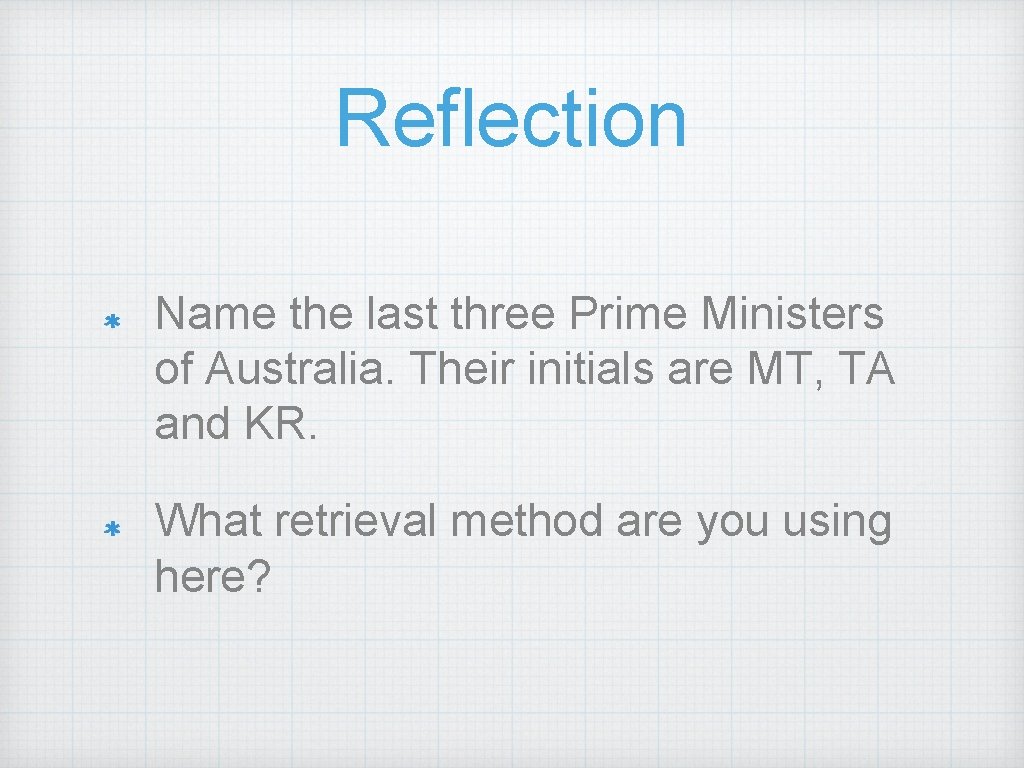
Reflection Name the last three Prime Ministers of Australia. Their initials are MT, TA and KR. What retrieval method are you using here?
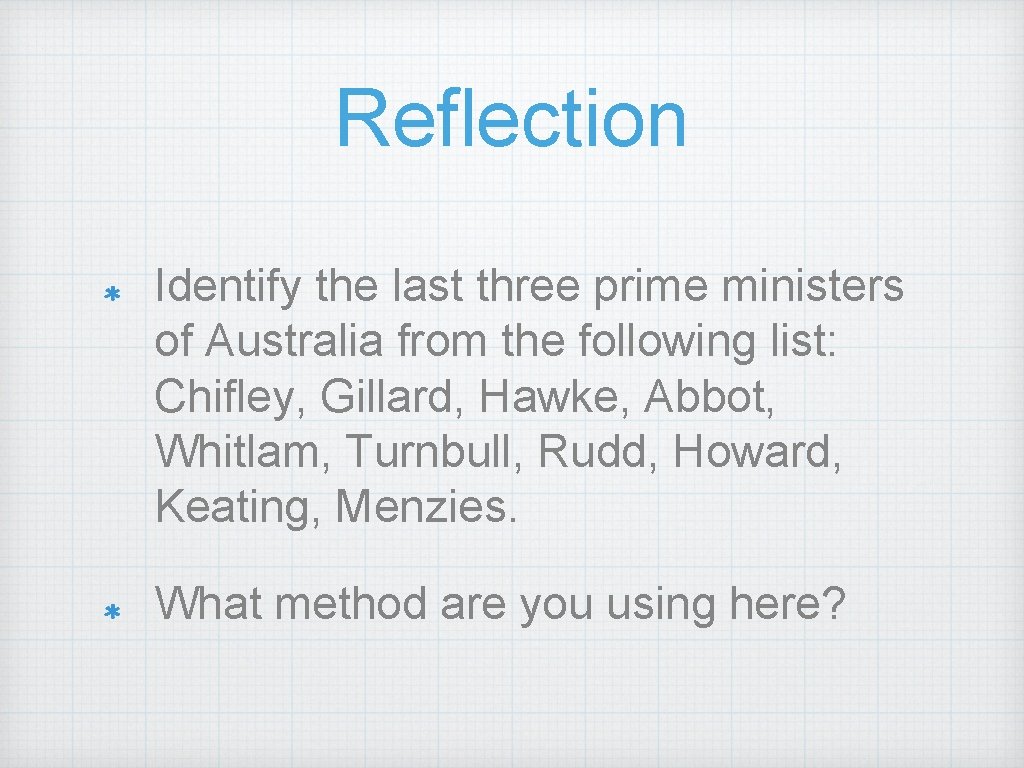
Reflection Identify the last three prime ministers of Australia from the following list: Chifley, Gillard, Hawke, Abbot, Whitlam, Turnbull, Rudd, Howard, Keating, Menzies. What method are you using here?
Homework Learning activity 7. 1 - Questions 2, 4, 6, 7 and 10
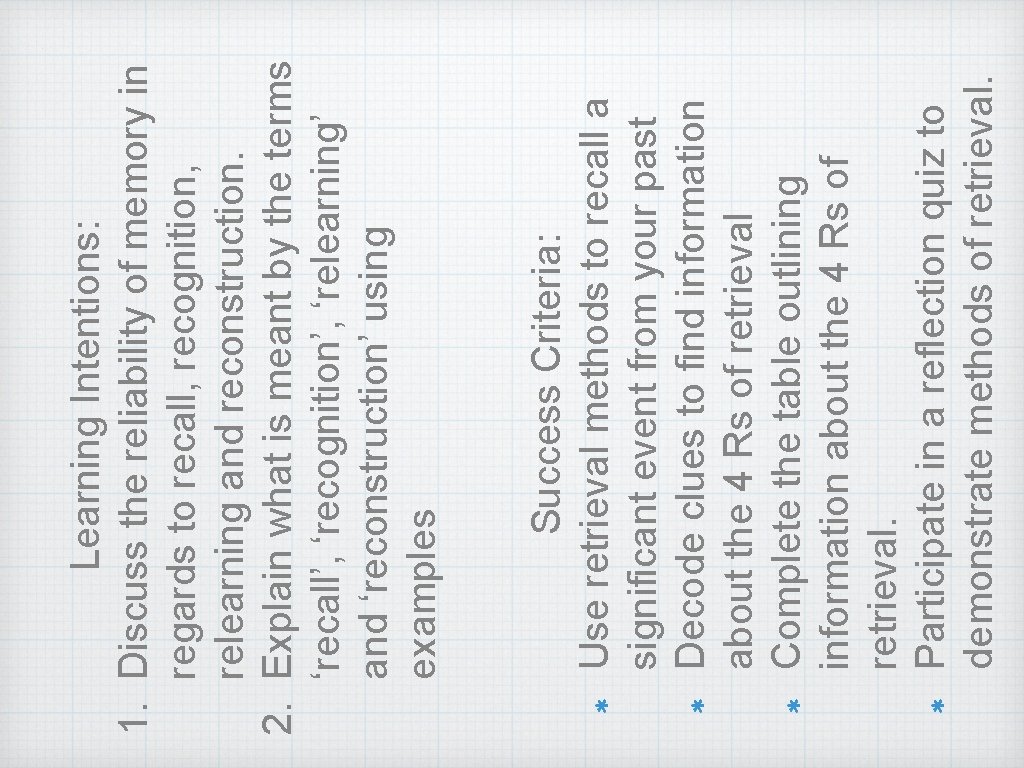
Success Criteria: Use retrieval methods to recall a significant event from your past Decode clues to find information about the 4 Rs of retrieval Complete the table outlining information about the 4 Rs of retrieval. Participate in a reflection quiz to demonstrate methods of retrieval. Learning Intentions: 1. Discuss the reliability of memory in regards to recall, recognition, relearning and reconstruction. 2. Explain what is meant by the terms ‘recall’, ‘recognition’, ‘relearning’ and ‘reconstruction’ using examples