
METHODS OF PSYCHOLOGY Presented by Ms Mariya Oliver
METHODS OF PSYCHOLOGY Presented by. Ms. Mariya Oliver Associate professor College of Nursing Kishtwar
INTROSPECTION METHOD
INTROSPECTION METHOD • Introspection in defined as the process of directly examining one’s own conscious mental states and processes or an examination of one’s own conscious thoughts and feelings. • Introduced by EB Titchener • Also known as self-observation method
Stages of Introspection a) During the observation of an external object, the person beings to think over his own mental state. b) The person begins to question the working of his own mind c) He tries to frame the laws and conditions of mental processes.
Characteristics of introspection a) The subject gets direct, immediate and intuitive knowledge about the mind. b) The subject has actually to observe his own mental processes. He cannot speculate about them.
Advantages of introspection Ø Cheap. Ø Economical. Ø Can be used anytime, anywhere. Ø Easiest methods available. Ø Gives first – hand information. Ø It helps in the development of methods like observation and experimentation.
Disadvantages of introspection Ø The state of one’s mental processes is continuously changing. Ø Data collected cannot be verified. Ø Data is highly subjective. Ø Cannot be used on children, animals and persons suffering form mental disorders.
OBSERVATION METHOD
OBSERVATION METHOD Observation method is defined as human or mechanical observation of what people actually do or what events take place during a buying or consumption situation. Observation is the objective method of studying the behaviour of individuals.
STEPS OF OBSERVATION a) Observation of behaviour. b) Noting of behaviour. c) Interpretation and analysis of behaviour. d) Generalization.
TYPES OF OBSERVATION Ø Covert observation. Ø Overt observation. Ø Controlled observation. Ø Natural observation. Ø Participant observation. Ø Non – participant observation.
Advantages of Observation Ø Economical, natural and flexible. Ø Data can be analyzed, measured, classified and interpreted. Ø Data can be verified and is reliable. Ø Useful in observing developmental characteristics. Ø Can be used on animals, children, mentally ill and unconscious patients.
Disadvantages of observation Ø Problems of the past cannot be studied. Ø Equipments required can be costly. Ø Requires more time, energy and money. Ø Lacks repeatability. Ø Cannot study opinions and attitudes.

Interview Method
Interview Method Interview method is defined as a close face to face conversation or a dialogue between the investigator or interviewer and interviewee. It is a process of social interaction between interviewer and interviewee. Interview is a verbal communication or two way conversation between two persons to get information’s about a problematic situation.
Types of Interview Ø Structured / Formal Interview Ø Unstructured / Informal Interview Ø Focussed Interview Ø Clinical Interview Ø Non – directive Interview
Advantages of Interview Ø More personal in nature. Ø Have more validity and reliability. Ø Can gather in depth information. Ø Unstructured interview is more flexible and adaptive.
Disadvantages of Interview Ø Very expensive Ø Require certain skills Ø Confidential information may get misused Ø Relatively time consuming Ø Interviewer bias Ø Training of field staff is complex
Experimental Method
Experimental Method The word “experiment” comes from a Latin word meaning “To try” or “To put to test. ” In psychology, experimental study is used to study the cause – and – effect relationship regarding the nature of human behaviour (eg: the effect of anxiety on behaviour. )
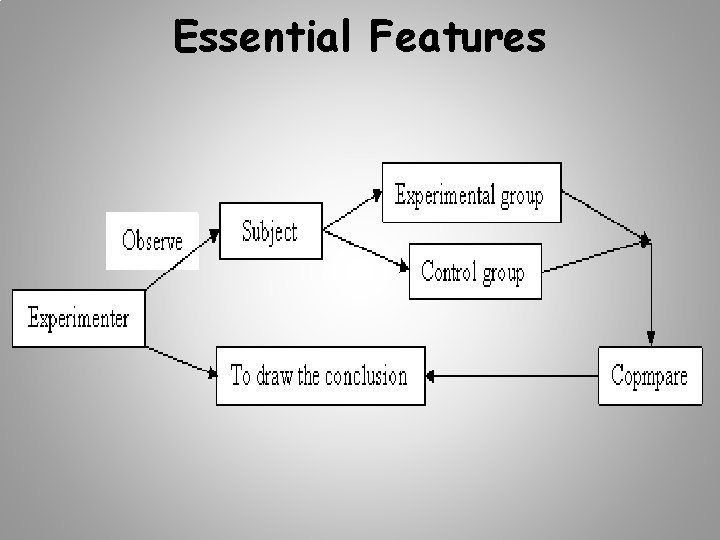
Essential Features
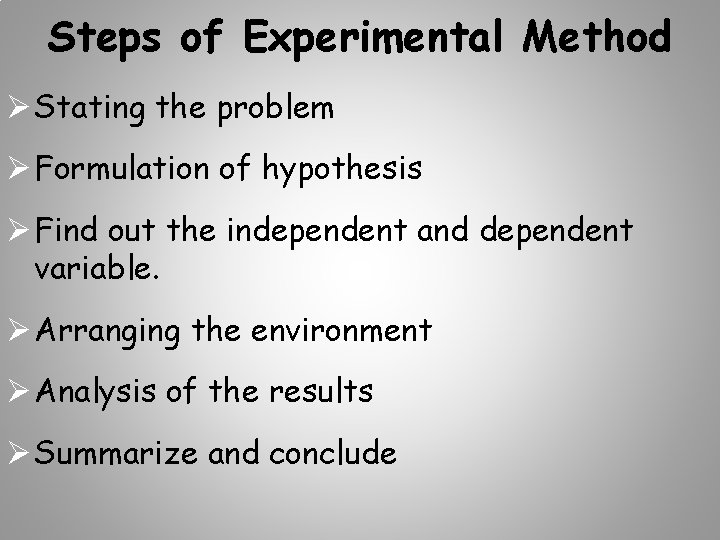
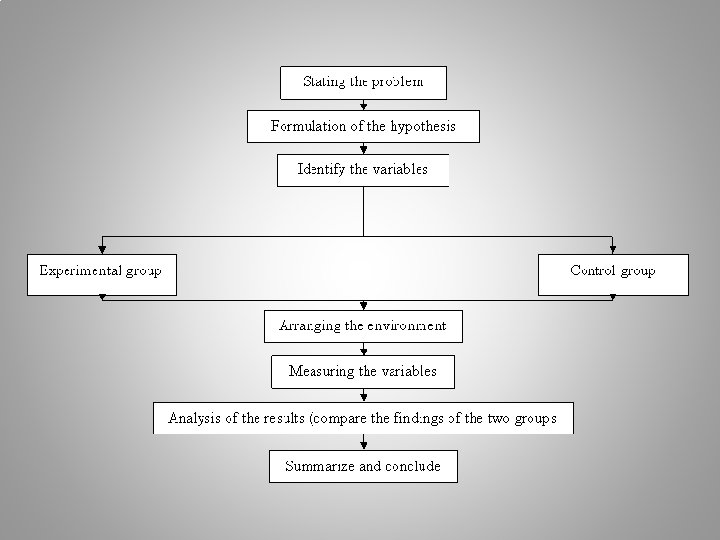
Steps of Experimental Method Ø Stating the problem Ø Formulation of hypothesis Ø Find out the independent and dependent variable. Ø Arranging the environment Ø Analysis of the results Ø Summarize and conclude
Advantages of Experimental Method Ø It follows scientific principles. Ø Replication and repetition can be done. Ø Finds out cause and effect relationship. Ø Data is reliable and verifiable.
Disadvantages of Experimental Method Ø All problems of psychology can not be studied. Ø Costly. Ø Time consuming Ø Fails to study behaviour in natural conditions Ø Experiments may harm the subjects.

Ø. Ø Ø Clinical Ø Ø or Case History Method
Clinical or Case History Method Case studies are in-depth investigations of a single person, group, event or community. Case studies provide rich qualitative data and have high levels of ecological validity. It aims at studying the cause and basis of people’s anxieties, fears and personal maladjustments.
Components of Case Study Ø Patient profile Ø Chief complaints Ø Present history (psychiatric, medical and surgical) Ø Past history (psychiatric, medical and surgical) Ø Family history Ø Nutritional history Ø Personal history Ø Socio – economic history
Goals of case study method Ø Patient assessment Ø To perform various tests Ø To provide proper treatment Ø Identify the cause and basis of patient’s illness
Ø Advantages – Find out the actual cause of illness – Acts as a baseline data – Useful for further investigation – Helps understand patient better Ø Disadvantages – Conditions may not permit proper history collection – Patient may not be cooperative.
Genetic or Developmental Method
Genetic or Developmental Method Ø Most of our behaviours are the result of earlier experiences. In some cases when we need to understand some behaviour we need to know their developmental aspects also. Ø The two ways of study are: § Cross – sectional study § Longitudinal study
Ø Advantages v. Helps assess genetic or hereditary influences on behaviour. v. Helps in treatment. v. Helps identify the associated problems. Ø Disadvantages v. Time consuming. v. Needs good research basis.
Survey Method
Survey Method This is used to gather the information from large number of people. This method is usually used to gather information about political opinion, customers’ preferences, etc. Also used to to know the information pertaining to medical profession—like awareness about diseases and remedial programmes, malnutrition, opinions about health needs, health facilities available, etc.
Tools & Methods used in Survey Tools Ø Questionnaires Methods Ø By post Ø Checklists Ø Face – to – face Ø Rating scales Ø By telephone Ø Inventories Ø Videophone Ø Through the internet
Ø Advantages v. Easy to administer v. Less time consuming v. Cost effective v. Data collected from large group at a time v. Broad range of data can be collected Ø Disadvantages v. Respondents may not give honest answers v. Poor reliability and validity
Comparative Method
Comparative Method In comparative method, the study of similarities and differences in behavioural organization among living beings, from bacteria to plants to humans. In comparative study, any two subjects or aspects of an individual are compared and studied to understand human behaviour
Ø Advantages v. Humans are similar to other species in some aspects. v. Can study problems with ethical problems Ø Disadvantages v. Human differ from other species in some aspects v. Conducting experiments on animals is also ethically wrong
Statistical Method
Statistical Method This method is used in the analysis of collected data to make an interpretation. This helps to make a generalization and take information from a smaller group to a larger group. It is the application of formulas, theorems, numbers and laws to psychology
Psychoanalytic Method
Psychoanalytic Method Ø Founded by Sigmund Freud Ø The aim of psychoanalysis therapy is to release repressed emotions and experiences, i. e. make the unconscious.

- Slides: 45