
Methods of Mineral Potential Assessment A Mineral Systems

- Slides: 18
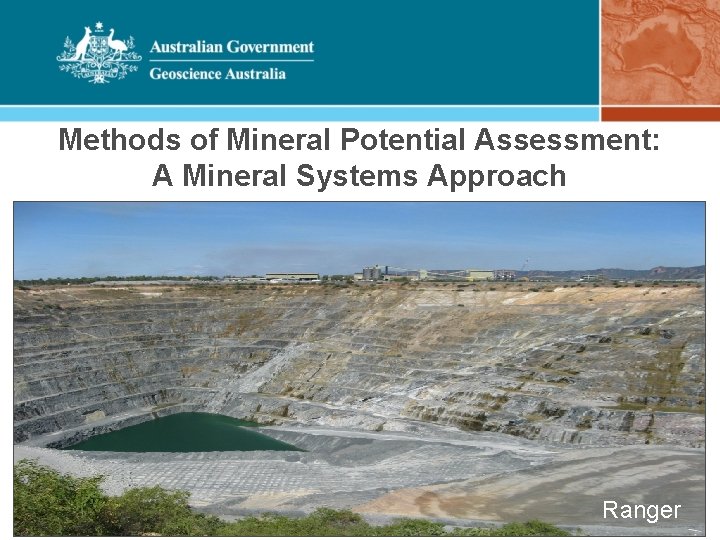
Methods of Mineral Potential Assessment: A Mineral Systems Approach Ranger
Outline • Mineral potential assessment • Methods of assessment (mineral potential, prospectivity, and favourability maps) • Mineral-systems approach • definition, advantages and disadvantages • Lessons learnt and not learnt URAM 2014
Mineral potential • Likelihood that an economic mineral deposits could have formed in the area • Probabilistic approach to mineral deposits instead of deterministic • Probabilities are conditional • on geological processes occurring in an area • on geological features indicative of those processes • Probability of sandstone-hosted uranium deposits in an area • process: transport of U Mineral potential assessment
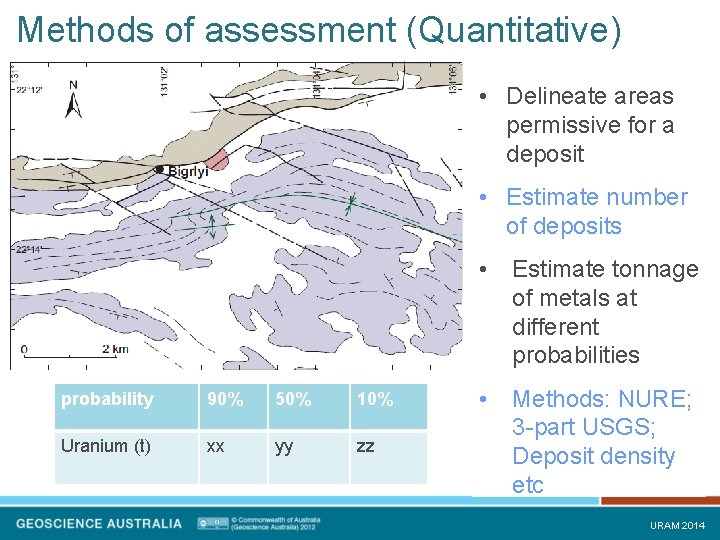
Methods of assessment (Quantitative) • Delineate areas permissive for a deposit • Estimate number of deposits • Estimate tonnage of metals at different probabilities probability 90% 50% 10% Uranium (t) xx yy zz • Methods: NURE; 3 -part USGS; Deposit density etc URAM 2014
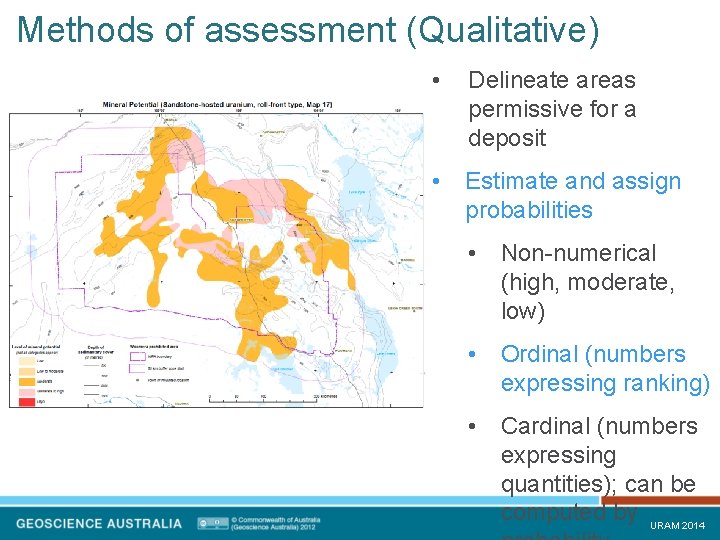
Methods of assessment (Qualitative) • Delineate areas permissive for a deposit • Estimate and assign probabilities • Non-numerical (high, moderate, low) • Ordinal (numbers expressing ranking) • Cardinal (numbers expressing quantities); can be computed by URAM 2014
GIS methods of assessment • Methods are not quantitative but the method of visualisation is quantitative • Produce favourability or prospectivity maps by estimating probabilities • Dominantly data-driven and ‘objective’ • Techniques (see Bonham-Carter, 1994): • Boolean logic • Index overlay • Bayesian (Weights of evidence) • Fuzzy logic Mineral potential assessment
Which method and why • Depends on the purpose/aim/objective Prospectivity • For regional-scale exploration targeting map – qualitative (GIS-based) Favourability • For local-scale brown-fields exploration map – qualitative (GIS-based) • Competing land-use decisions – quantitative Mineral potential – qualitative map • For mineral endowment and inventory – quantitative Mineral potential assessment
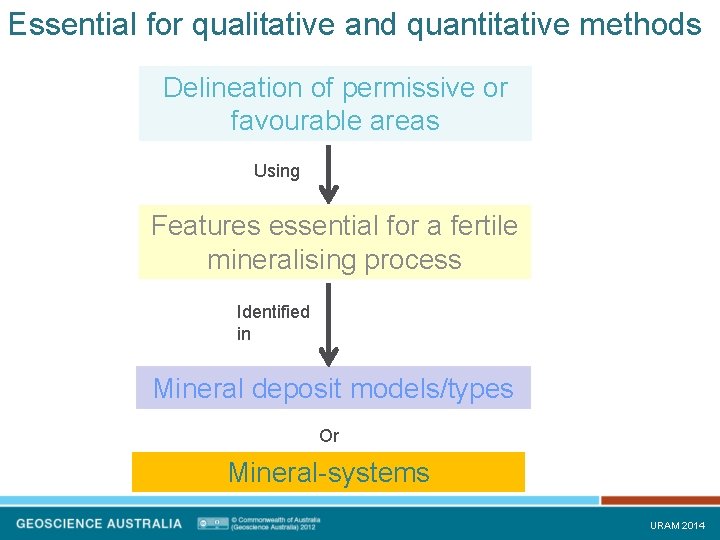
Essential for qualitative and quantitative methods Delineation of permissive or favourable areas Using Features essential for a fertile mineralising process Identified in Mineral deposit models/types Or Mineral-systems URAM 2014
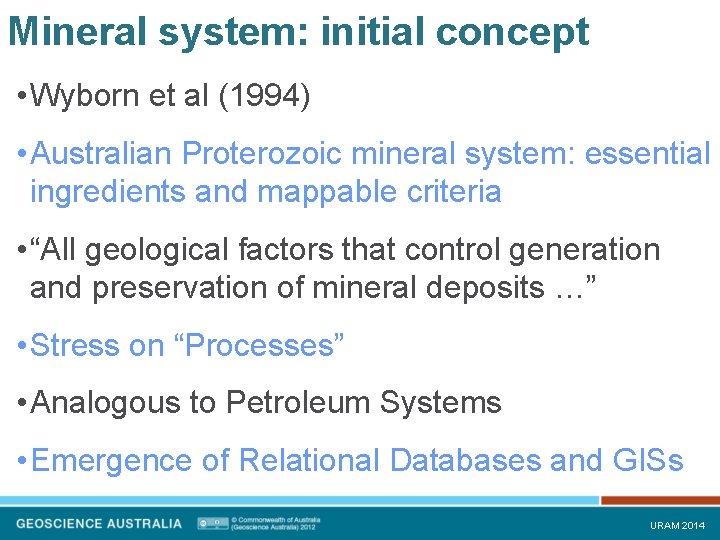
Mineral system: initial concept • Wyborn et al (1994) • Australian Proterozoic mineral system: essential ingredients and mappable criteria • “All geological factors that control generation and preservation of mineral deposits …” • Stress on “Processes” • Analogous to Petroleum Systems • Emergence of Relational Databases and GISs URAM 2014
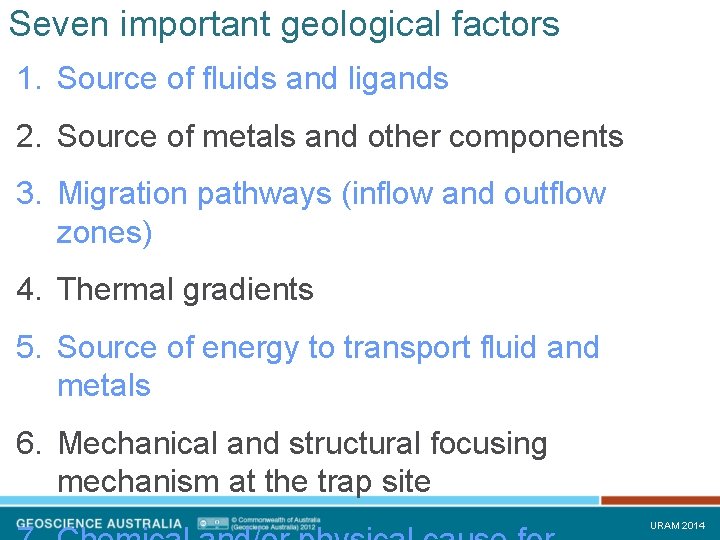
Seven important geological factors 1. Source of fluids and ligands 2. Source of metals and other components 3. Migration pathways (inflow and outflow zones) 4. Thermal gradients 5. Source of energy to transport fluid and metals 6. Mechanical and structural focusing mechanism at the trap site URAM 2014
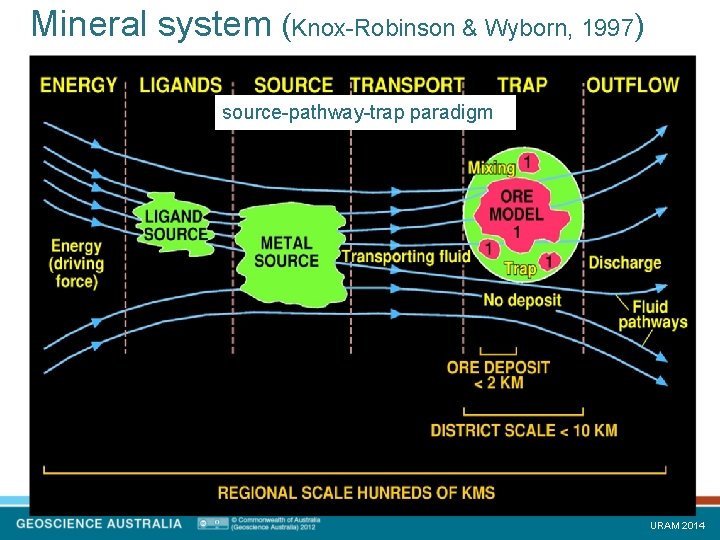
Mineral system (Knox-Robinson & Wyborn, 1997) source-pathway-trap paradigm URAM 2014
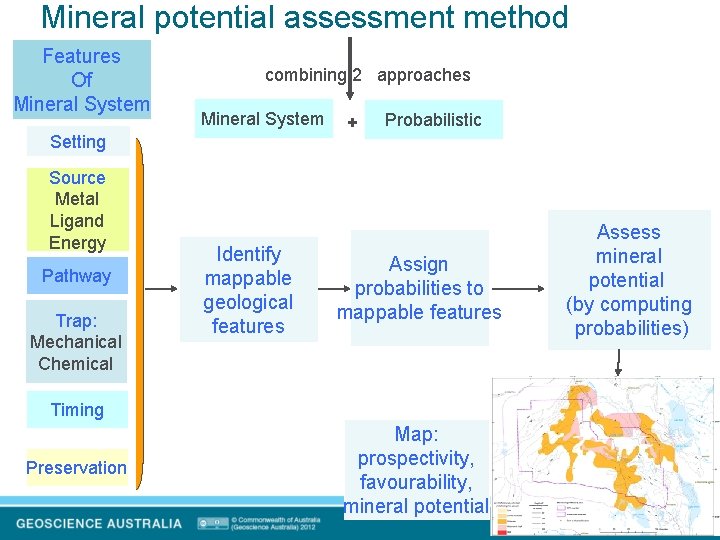
Mineral potential assessment method Features Of Mineral System combining 2 approaches Mineral System Setting Source Metal Ligand Energy Pathway Trap: Mechanical Chemical Identify mappable geological features + Probabilistic Assign probabilities to mappable features Timing Preservation Map: prospectivity, favourability, mineral potential Assess mineral potential (by computing probabilities)
Assessments at various scales http: //www. ga. gov. au/minerals/projects/conclude d-projects/mineral-potential. html http: //www. ga. gov. au/minerals/projects/conclude d-projects/uranium-systems. html URAM 2014
Limitations of mineral-systems approach • Preservation considered important but listed factors do not include features critical for preservation • Age, duration and relative timing of events in a mineral system do not receive adequate attention • Requires change to focus on ‘giant’ instead of average-size deposits • Requires rethinking to take into account clustering of deposits URAM 2014
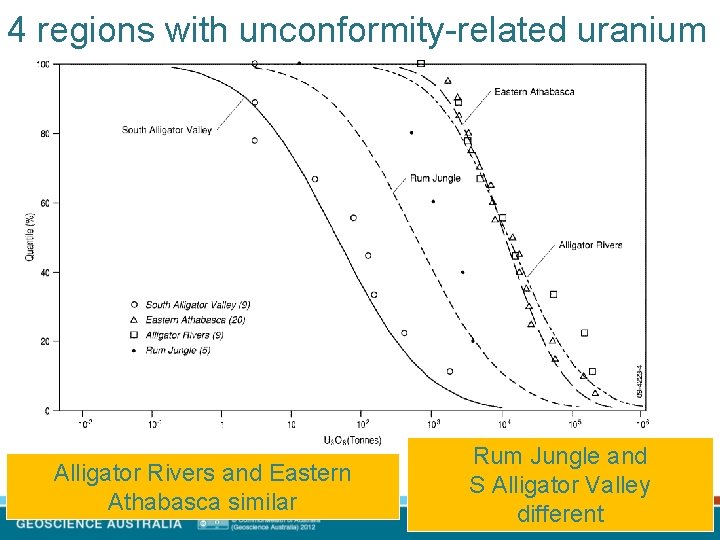
4 regions with unconformity-related uranium Alligator Rivers and Eastern Athabasca similar Rum Jungle and S Alligator Valley different URAM 2014
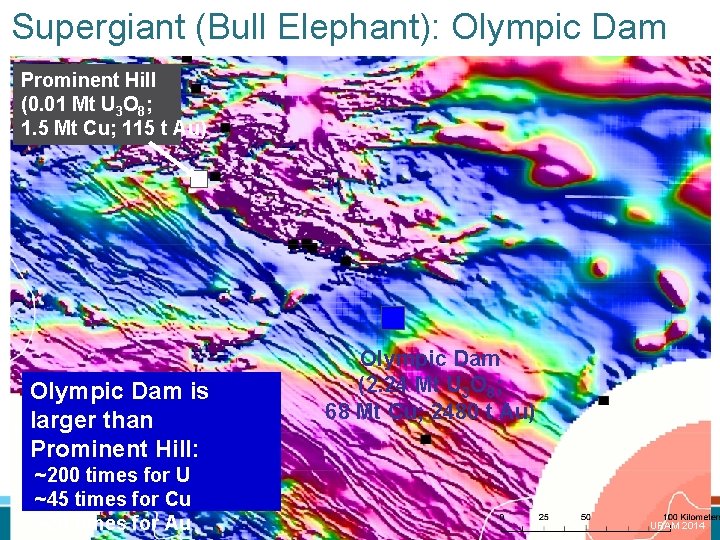
Supergiant (Bull Elephant): Olympic Dam Prominent Hill (0. 01 Mt U 3 O 8; 1. 5 Mt Cu; 115 t Au) Olympic Dam is larger than Prominent Hill: ~200 times for U ~45 times for Cu ~20 times for Au Olympic Dam (2. 24 Mt U 3 O 8; 68 Mt Cu; 2480 t Au) URAM 2014
Reliability or robustness of assessment Depends on • Knowledge of mineral systems/deposit styles (their critical features) • Identification of mappable signatures in datasets which correspond to critical features of mineral systems • Extent and quality of datasets Mineral potential assessment
Conclusions • Choice of methods depends on the objective • Basics: – Know your mineral system (deposit-type): SCIENCE – Create useful datasets: A MUST • Mineral system approach can be rewarding. For successful examples visit GA’s website: http: //www. ga. gov. au/minerals/projects/concluded-projects/mineralpotential. html; and http: //www. ga. gov. au/minerals/projects/concludedprojects/uranium-systems. html • Don’t overdo or oversell it (only detailed exploration such as drilling can find a deposit) URAM 2014