
METHODS OF GENETIC MODIFICATION IN PLANTS NATURAL SELECTION
- Slides: 11
METHODS OF GENETIC MODIFICATION IN PLANTS
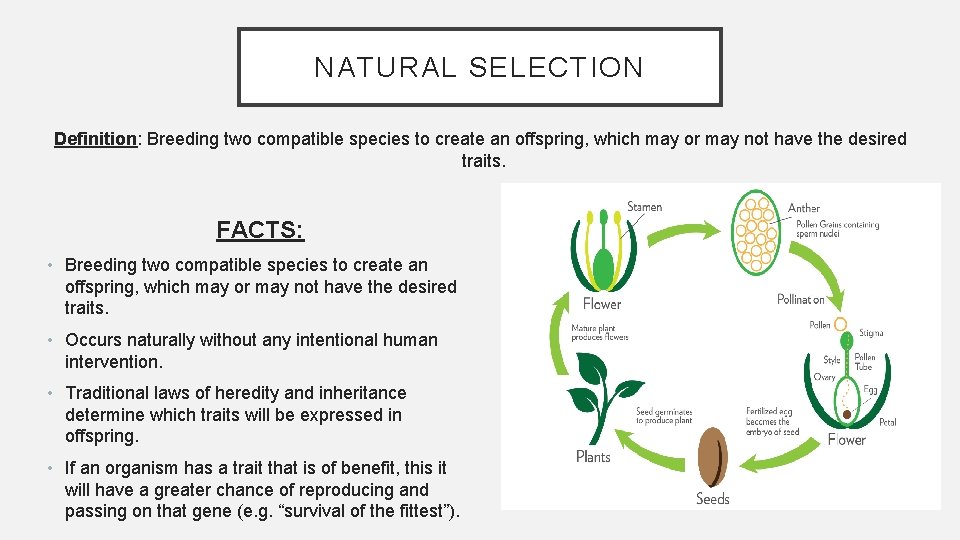
NATURAL SELECTION Definition: Breeding two compatible species to create an offspring, which may or may not have the desired traits. FACTS: • Breeding two compatible species to create an offspring, which may or may not have the desired traits. • Occurs naturally without any intentional human intervention. • Traditional laws of heredity and inheritance determine which traits will be expressed in offspring. • If an organism has a trait that is of benefit, this it will have a greater chance of reproducing and passing on that gene (e. g. “survival of the fittest”).
NATURAL SELECTION ADVANTAGES: CONSIDERATIONS: • Occurs naturally without any intentional human intervention. • Not able to target specific traits to be carried forward to the next generation. • Low cost - does not require special equipment or knowledge • Multiple generations required. • Limited to the genes already found in the genome of the species. • Laws of inheritance may limit the inheritance of a trait, especially if it is recessive. • Future generations may not retain the trait if it isn't genetically based.
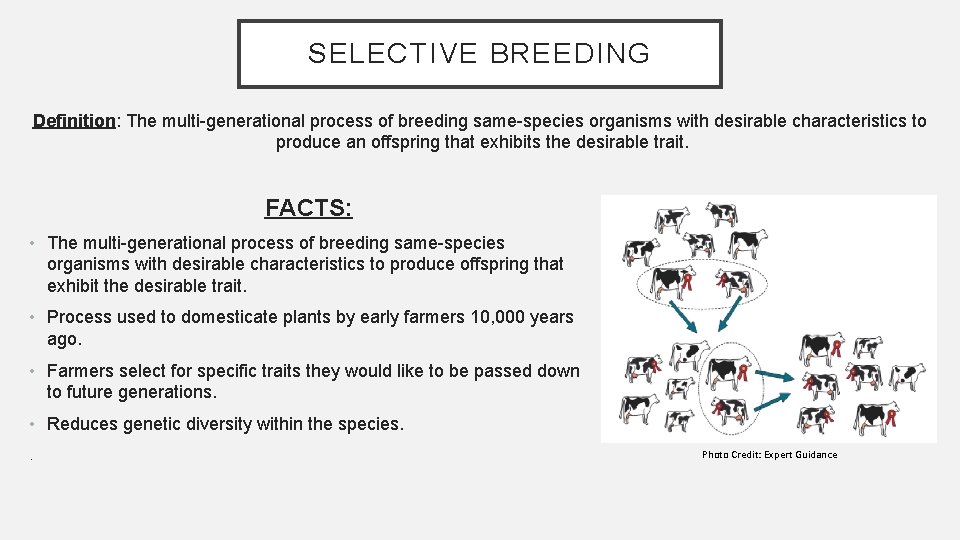
SELECTIVE BREEDING Definition: The multi-generational process of breeding same-species organisms with desirable characteristics to produce an offspring that exhibits the desirable trait. FACTS: • The multi-generational process of breeding same-species organisms with desirable characteristics to produce offspring that exhibit the desirable trait. • Process used to domesticate plants by early farmers 10, 000 years ago. • Farmers select for specific traits they would like to be passed down to future generations. • Reduces genetic diversity within the species. . Photo Credit: Expert Guidance
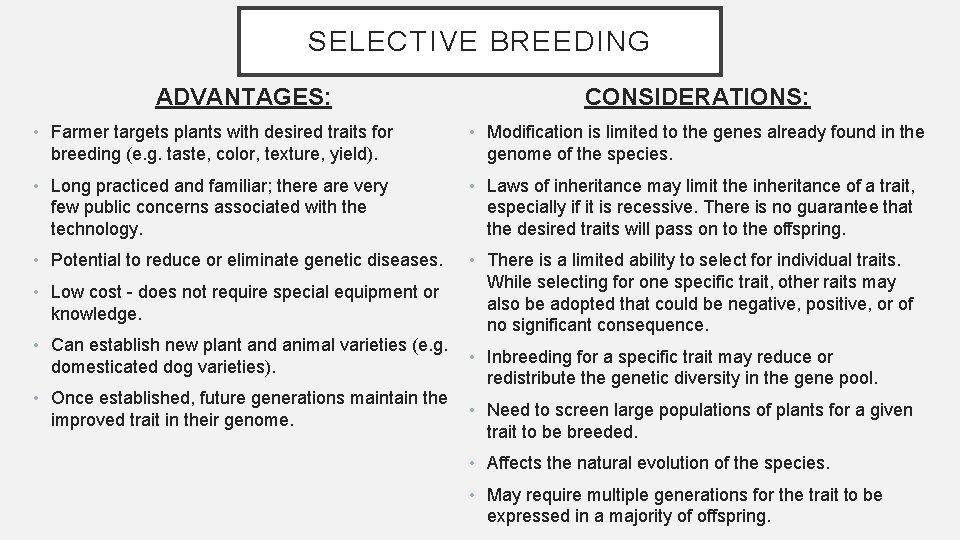
SELECTIVE BREEDING ADVANTAGES: CONSIDERATIONS: • Farmer targets plants with desired traits for breeding (e. g. taste, color, texture, yield). • Modification is limited to the genes already found in the genome of the species. • Long practiced and familiar; there are very few public concerns associated with the technology. • Laws of inheritance may limit the inheritance of a trait, especially if it is recessive. There is no guarantee that the desired traits will pass on to the offspring. • Potential to reduce or eliminate genetic diseases. • There is a limited ability to select for individual traits. While selecting for one specific trait, other raits may also be adopted that could be negative, positive, or of no significant consequence. • Low cost - does not require special equipment or knowledge. • Can establish new plant and animal varieties (e. g. domesticated dog varieties). • Once established, future generations maintain the improved trait in their genome. • Inbreeding for a specific trait may reduce or redistribute the genetic diversity in the gene pool. • Need to screen large populations of plants for a given trait to be breeded. • Affects the natural evolution of the species. • May require multiple generations for the trait to be expressed in a majority of offspring.
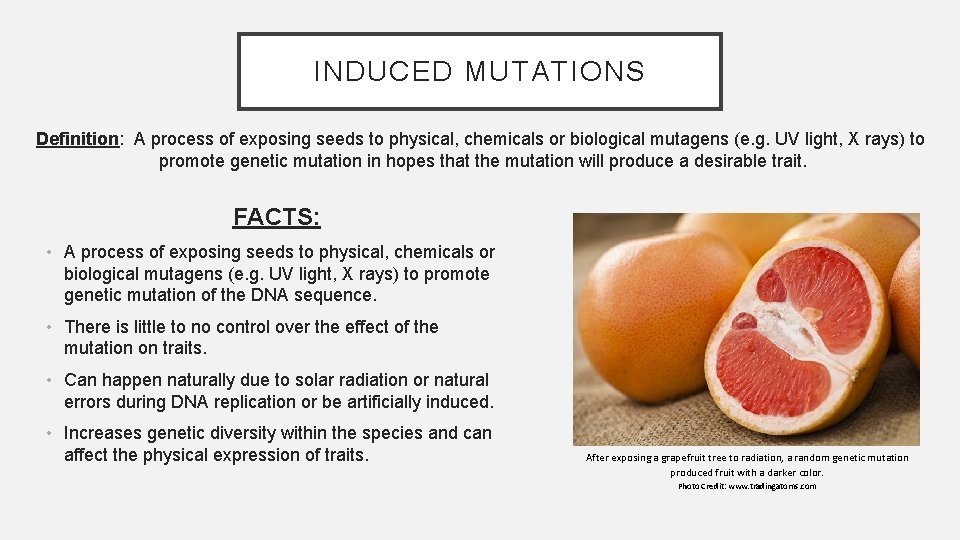
INDUCED MUTATIONS Definition: A process of exposing seeds to physical, chemicals or biological mutagens (e. g. UV light, X rays) to promote genetic mutation in hopes that the mutation will produce a desirable trait. FACTS: • A process of exposing seeds to physical, chemicals or biological mutagens (e. g. UV light, X rays) to promote genetic mutation of the DNA sequence. • There is little to no control over the effect of the mutation on traits. • Can happen naturally due to solar radiation or natural errors during DNA replication or be artificially induced. • Increases genetic diversity within the species and can affect the physical expression of traits. After exposing a grapefruit tree to radiation, a random genetic mutation produced fruit with a darker color. Photo Credit: www. tradingatoms. com
INDUCED MUTATIONS ADVANTAGES: CONSIDERATIONS: • Creates random variation in the genes by promoting gene mutations. • Traits produced are random, not selected in any way. There is little to no control over the traits that are produced. • Need to screen large populations of plants for a given trait to find a desired mutation. • Do not know how many mutations have actually been made in the genome.
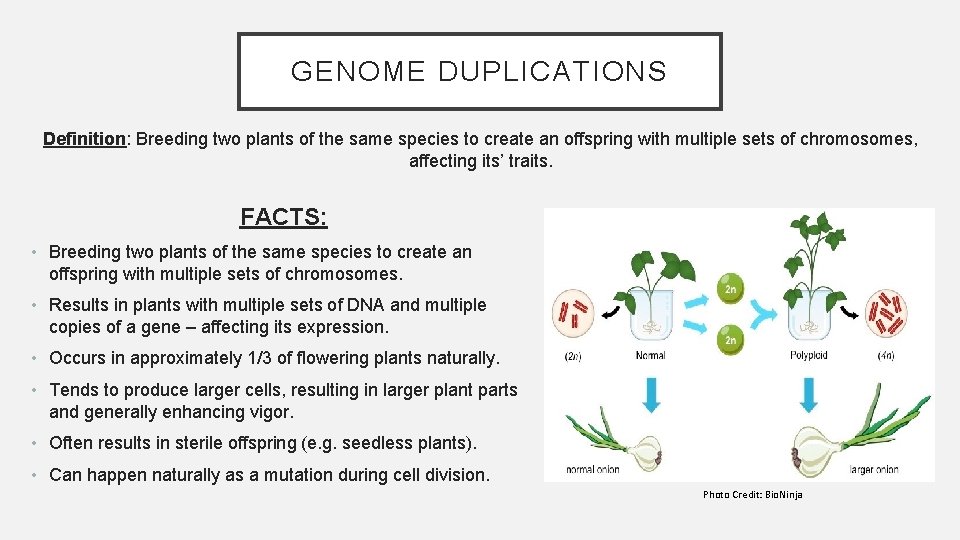
GENOME DUPLICATIONS Definition: Breeding two plants of the same species to create an offspring with multiple sets of chromosomes, affecting its’ traits. FACTS: • Breeding two plants of the same species to create an offspring with multiple sets of chromosomes. • Results in plants with multiple sets of DNA and multiple copies of a gene – affecting its expression. • Occurs in approximately 1/3 of flowering plants naturally. • Tends to produce larger cells, resulting in larger plant parts and generally enhancing vigor. • Often results in sterile offspring (e. g. seedless plants). • Can happen naturally as a mutation during cell division. Photo Credit: Bio. Ninja
GENOME DUPLICATIONS ADVANTAGES: • Plants have the general advantage of heterosis and gene redundancy. • Plants can become sterile. In the case of a seedless watermelon, this is a desired trait. • Increases species genetic diversity, providing additional DNA and genes for evolution. • Polyploid plants tend to be larger. CONSIDERATIONS: • If plants are sterile (do not produce viable seeds), extra time and money is required by farmer to produce the plants.
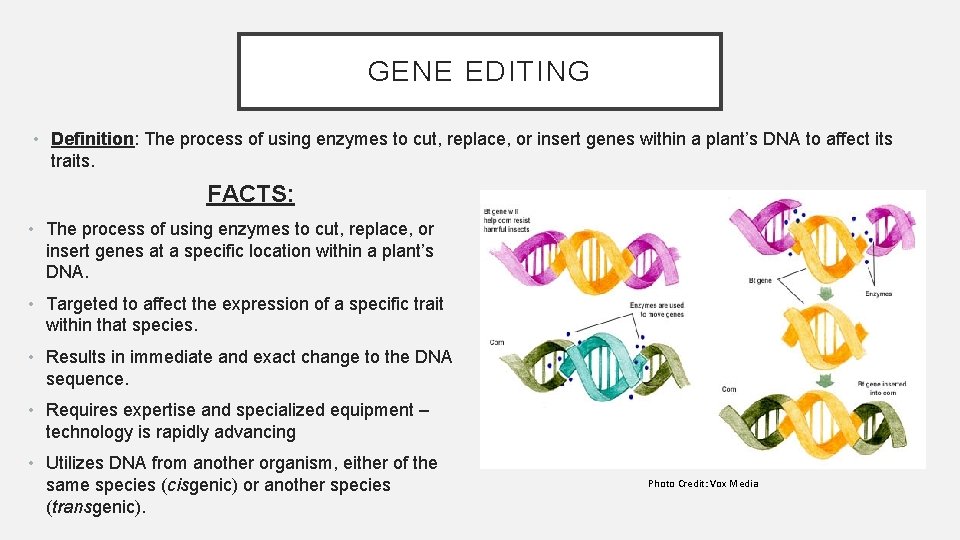
GENE EDITING • Definition: The process of using enzymes to cut, replace, or insert genes within a plant’s DNA to affect its traits. FACTS: • The process of using enzymes to cut, replace, or insert genes at a specific location within a plant’s DNA. • Targeted to affect the expression of a specific trait within that species. • Results in immediate and exact change to the DNA sequence. • Requires expertise and specialized equipment – technology is rapidly advancing • Utilizes DNA from another organism, either of the same species (cisgenic) or another species (transgenic). Photo Credit: Vox Media
GENE EDITING ADVANTAGES: • Allows specific and exact changes to a genome by making additions, deletions, or specific changes to DNA sequence, which affects the expressed trait. • Faster than conventional breathing • Can use cisgenes (from the same or an infertile species) or transgenes from another species). • Allows scientists to specifically target the gene associated with the trait they are trying to produce in the plant (e. g. insect resistance, drought tolerance, yield, nutritional value). • Trait is immediately inserted and able to be passed on to offspring. • May reduce environmental impacts associated with farming (increased yield requiring less land to be farmed, CONSIDERATIONS: • Requires skill, knowledge, and special equipment to be effective. • Some consumers are concerned about the concept and the lack of understanding about the various long-term effects and unintended consequences. • May contribute to increased populations of pesticideand herbicide-resistant pests and weeds. • Need to screen large populations of organisms to identify the gene associated with a given trait. • May be an increased risk of allergies or food intolerance. • Monoculture farming reduces biodiversity.