
METHODS OF DRUG ADMINISTRATION Drug Routes Drugs may




- Slides: 40
METHODS OF DRUG ADMINISTRATION
Drug Routes Drugs may be administered in various ways. The route chosen depends on the part of the body the drug needs to affect, how quickly the drug needs to work, and the ability of the owner to give the drug.
Factors effecting administration Physicochemical properties of drug Onset of action required Type of response required Site of desired reaction Nature and formulation of drug Circulation at the site of absorption Biotransformation Condition of patient the route of drug
Routes of drug administration There are two classes � � Enteral Parenteral
Enteral routes Enteral drug placed directly in the GI tract: � Oral swallowing � Sublingual placed under the tongue � Rectum Absorption through rectum.
Routes of enteral liquid Drenching method By stomach tube
Drenching Method When the drug such as fluid applied in thick plastic bottle oe special drench machine or drench gun or drench injectors and given though mouth commeasure with avoided to make aspiration or drenching pneumonia Do not give drench drug to animals suffer from severe respiratory disease
Stomach Tube Method If the medicines are irritant to the mouth cavity such as chloral hydrate When the administrated drugs are too much expensive Note: stomach tube will inserted through nose in horses because of long soft palate.
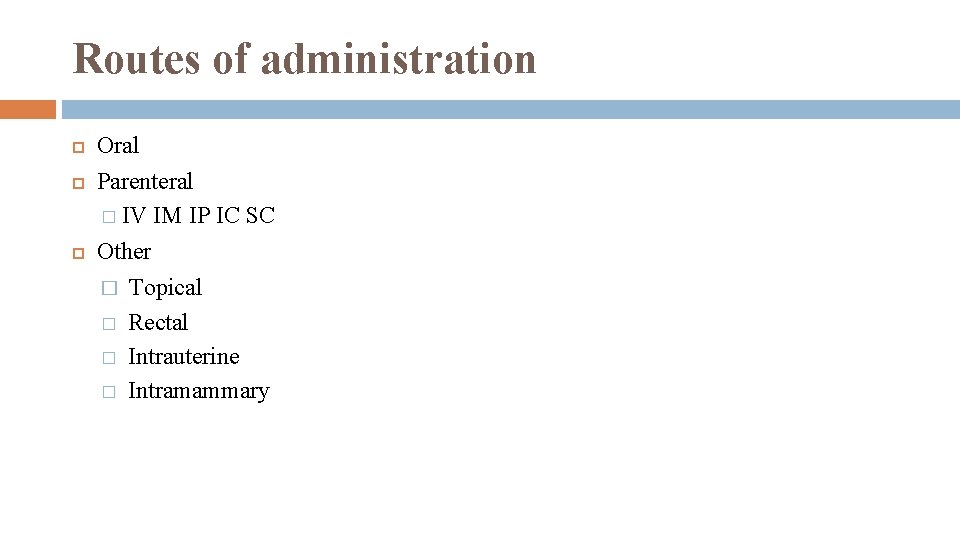
Routes of administration Oral Parenteral � IV IM IP IC SC Other � � Topical Rectal Intrauterine Intramammary
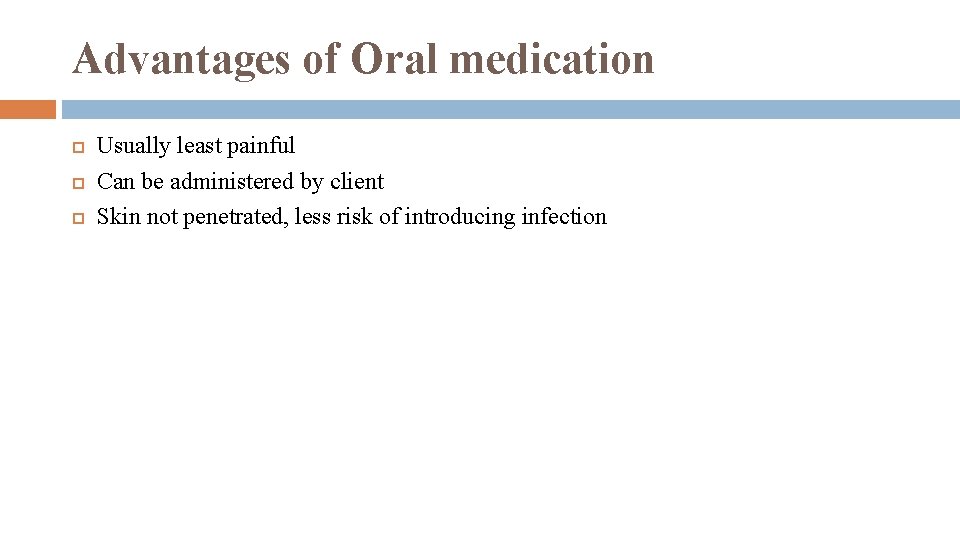
Advantages of Oral medication Usually least painful Can be administered by client Skin not penetrated, less risk of introducing infection
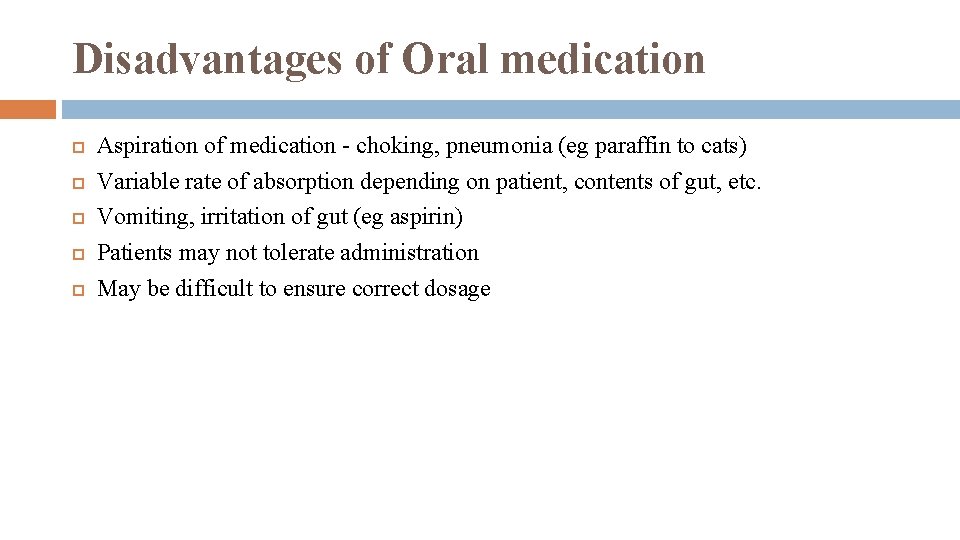
Disadvantages of Oral medication Aspiration of medication - choking, pneumonia (eg paraffin to cats) Variable rate of absorption depending on patient, contents of gut, etc. Vomiting, irritation of gut (eg aspirin) Patients may not tolerate administration May be difficult to ensure correct dosage
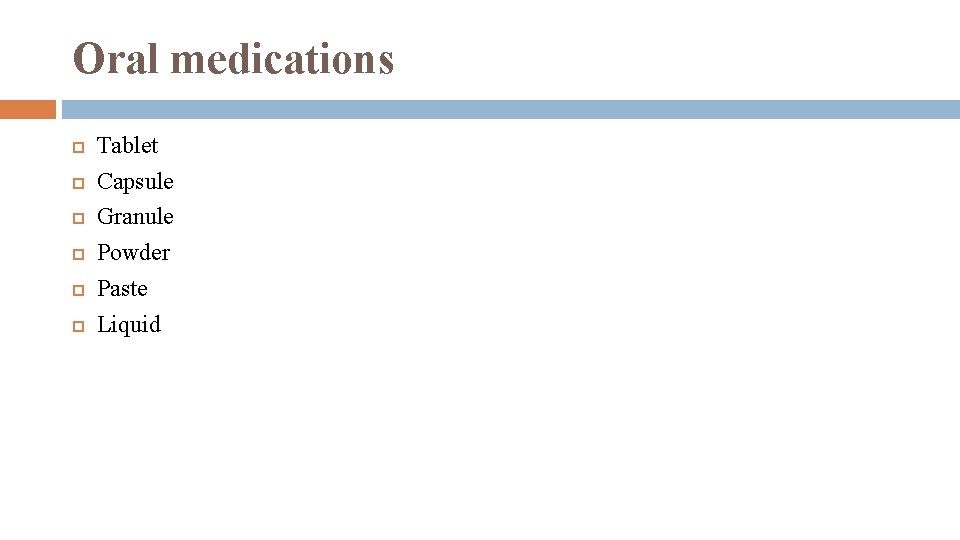
Oral medications Tablet Capsule Granule Powder Paste Liquid
Tablet Compressed drug in a carrier such as chalk or sugar Often coated � to protect drug inside from moisture � to disguise unpleasant tastes � to protect from gastric juices, slow down the breakdown of the drug for a slower release � to avoid irritation � to give the tablet a recognizable colour Usually scored into halves or quarters for ease of breakage for more accurate dosing Most common form of medication
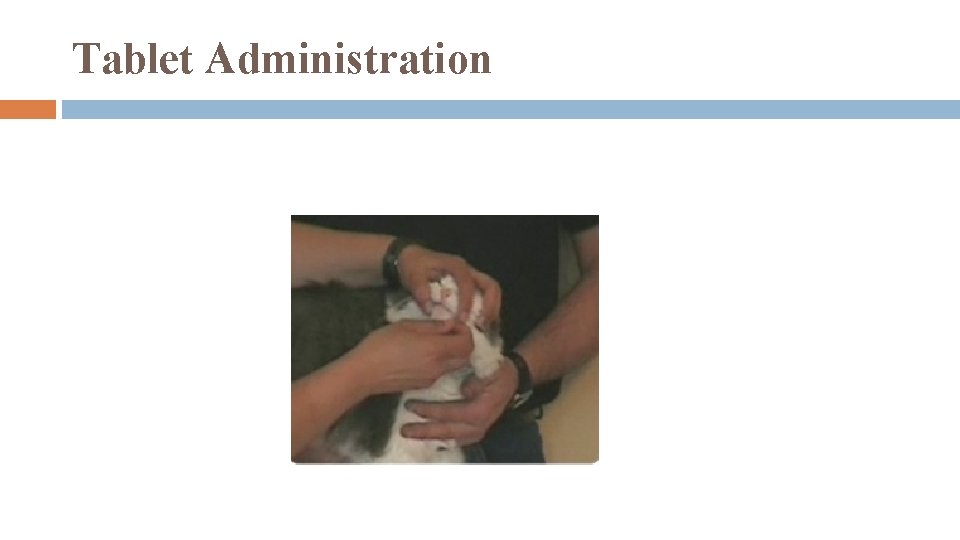
Tablet Administration
Capsule Bullet-shaped, gelatin container � Contains powder, granules or liquid � Easier to swallow (smooth) � No need for 'carrier' � Gelatin dissolves in stomach
Granules/Powder Solid preparations Dissolved in water � eg Vytrate® , Lectade® Mixed with feed
Paste Semi solid preparation � Usually in a water soluble base Via syringe Easy for owner to use � Rabbit, guinea pig � Horse (worming paste) � Cat (worming paste)
Liquid Syrup � Drugs contained in a concentrated sugar solution. � Good for young animals/small doses (eg Clavulox drops). Solution � Drug in liquid form or dissolved in water (eg glucose solution). Suspension � Insoluble particles float in liquid but settle when standing � Needs to be mixed before use (shaken) Emulsion � Two immiscible liquids (eg water and paraffin).
Routes of enteral liquids Directly into the mouth By crop needle (birds) By stomach tube � Drugs which burn the mouth � Very young animals, to reduce the risk of aspiration � Large volumes of fluid.
Parenteral Preparations These are drugs that can be given by injection. All drugs in this form must be sterile. The most common routes of injection of drugs in small animal practice are iv , im, ip, sc, ic Usually taken to mean ‘by injection’ Strictly, par-enteral = ‘adjacent the gut’
Injection Route depends on Type of drug Condition and temperament of patient Volume of the drug, Required speed of action
Systemic Drugs Some drugs cannot be applied directly where they are needed. Instead they need to travel through the animal’s system until they get to where they are needed. These drugs are said to be given SYSTEMICALLY. Examples include oral preparations and injections
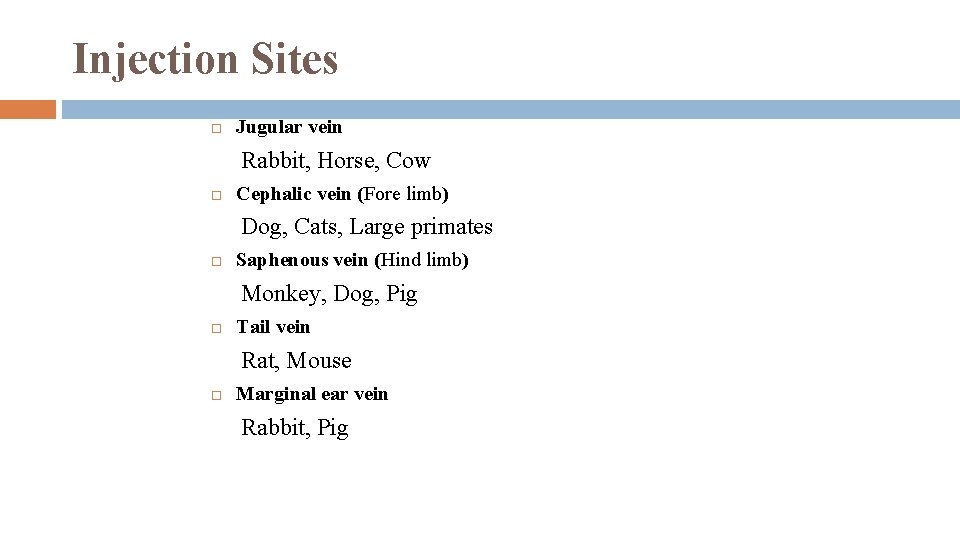
Injection Sites Jugular vein Rabbit, Horse, Cow Cephalic vein (Fore limb) Dog, Cats, Large primates Saphenous vein (Hind limb) Monkey, Dog, Pig Tail vein Rat, Mouse Marginal ear vein Rabbit, Pig
Routes of injection Intradermal Intramuscular Intravenous Intraperitoneal Intracardiac Intrapleural Intra-articular Epidural Subconjunctival
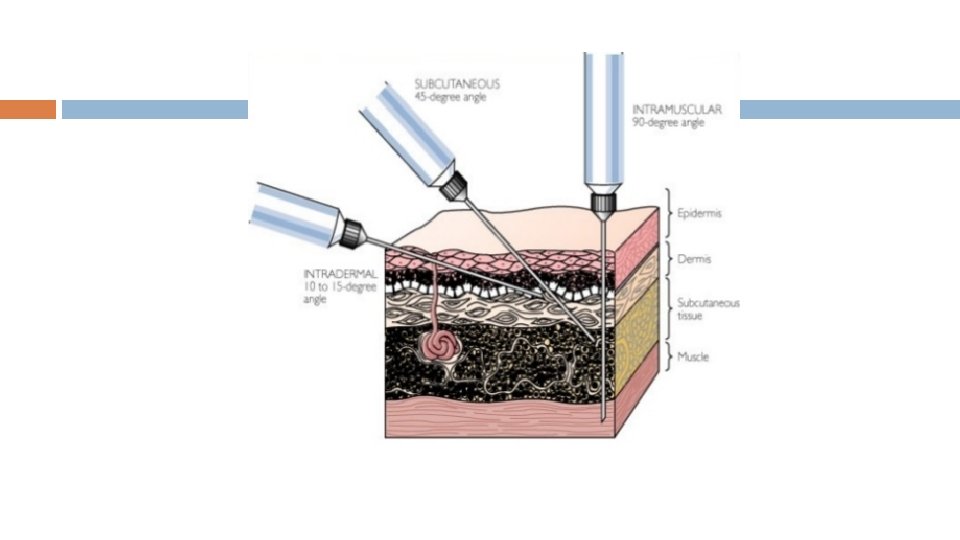
Intradermal (ID) Into the dermis � The living part of the surface layer Needs a very fine needle Causes a blister like appearance (bleb) if performed correctly � allergy testing � tuberculin testing
Subcutaneous (SC) Under the skin Most common site Loose skin over shoulder blades a good site Less painful than intramuscular injections Only for low irritant drugs Slow absorption if dehydrated Used for most vaccines
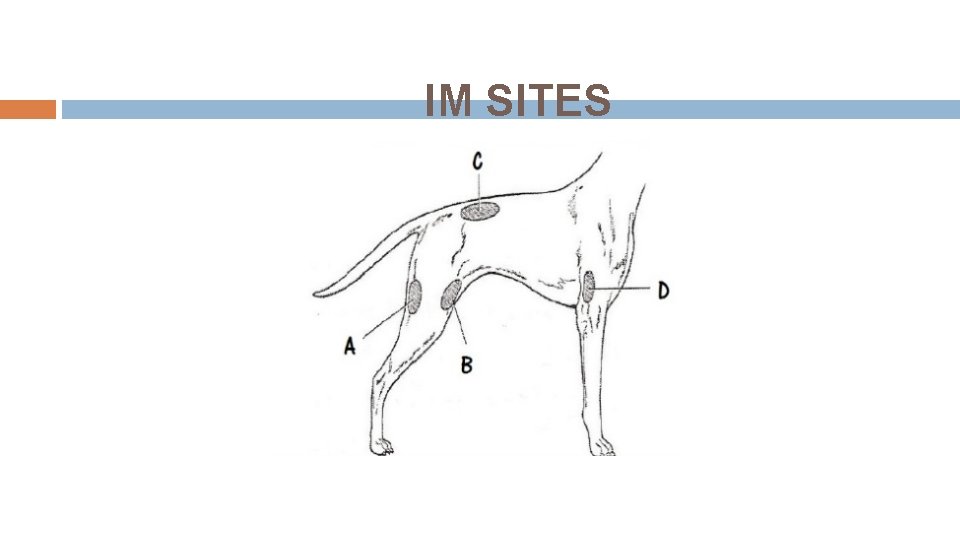
Intramuscular Injected deep into the body of a muscle Less likely to cause an overt tissue reaction Insert needle at right angles to the skin Larger volumes may be injected in the one site than with other routes Faster absorption than s/c
IM SITES
Intravenous (IV) Into the vein directly Fastest onset of action Can give irritant solutions into the vein which cannot be given IM or SC � Irritant drugs should be given via an intravenous catheter, (caparsolate, thiopentone, guifenasin)
Peri-vascular Necrosis When irritant solution leaks from a vein and enters � area may 'slough‘ Immediately inject the area with saline (isotonic i. e. 0. 9% Na. Cl) to dilute the drug
Intra-peritoneal (IP) Into peritoneal cavity Usually near umbilicus � Or half way between umbilicus & pubis Used for � Rodents � Birds � Euthanasia of young difficult patients
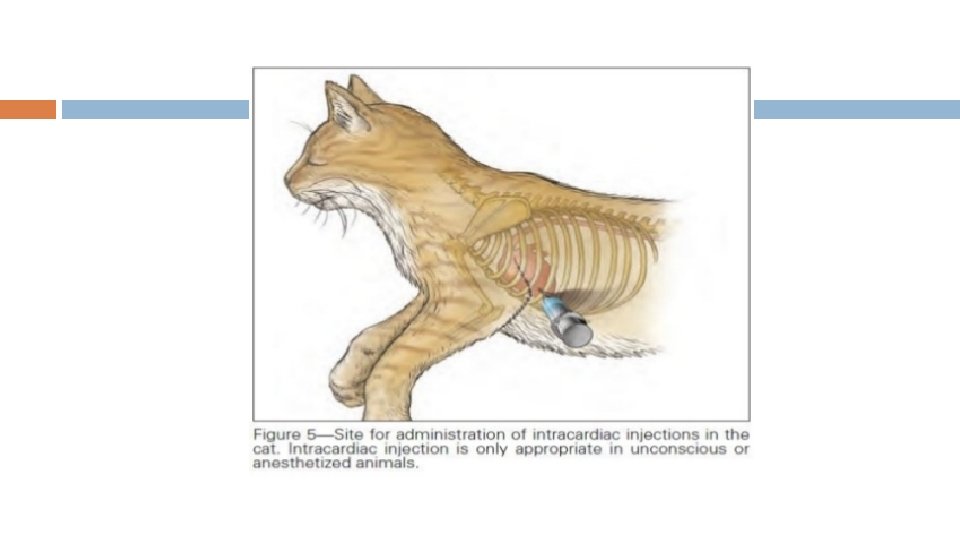
Intra-cardiac (IC) Injection through the chest wall into the heart Emergency administration of drugs during cardiac resuscitation � e. g. adrenaline Euthanasia � Moribund animals
Intrapleural Injection into the pleural space through the chest wall Not commonly used
Intra-articular Injection into the joint space Needs full surgical preparation � � should also wear gloves and draw drug up in a sterile manner, new unused bottle, etc, to avoid introduction of infection. Used for � Dogs (eg cortisone with greyhounds, Cartrophen)
Epidural Injection into the epidural space surrounding the spinal cord usually in the lumbar site Full sterile prep needed � Animal positioned on sternum, with back legs drawn forwards Used for � Before an orthopaedic procedure on spine or hindquarters Pain relief (eg morphine, local anaesthetic for dog) Stops straining and gives pain relief, (lignocaine, xylazine).
Subconjunctival Into the conjunctiva of the eye Use a fine needle Needs good restraint Used for � Ocular conditions
What are the risks administering medicines? Overdose Allergic reaction Wrong administration route selected Animal stressed Animal gets injured to animals when
How can these risks be minimised Follow instructions carefully Make sure that the animal is adequately restrained Use sprays in a well ventilated area Wear appropriate PPEs (e. g. gloves, mask etc)