
Methods of Community Research Chapter 4 1 Community
- Slides: 26
Methods of Community Research Chapter 4 1 Community Research Methods (Chapter 4) Fall 2010
Research Methods Procedures used to gather data 2 types 2 Qualitative Quantitative Each provides different kinds of knowledge Community Research Methods (Chapter 4) Fall 2010
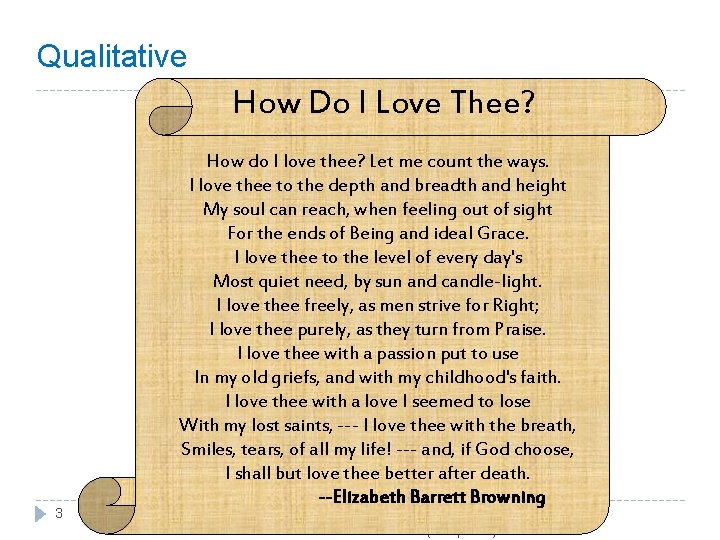
Qualitative How Do I Love Thee? 3 How do I love thee? Let me count the ways. I love thee to the depth and breadth and height My soul can reach, when feeling out of sight For the ends of Being and ideal Grace. I love thee to the level of every day's Most quiet need, by sun and candle-light. I love thee freely, as men strive for Right; I love thee purely, as they turn from Praise. I love thee with a passion put to use In my old griefs, and with my childhood's faith. I love thee with a love I seemed to lose With my lost saints, --- I love thee with the breath, Smiles, tears, of all my life! --- and, if God choose, I shall but love thee better after death. --Elizabeth Barrett Browning The Aims of Community Research (Chapter 3)
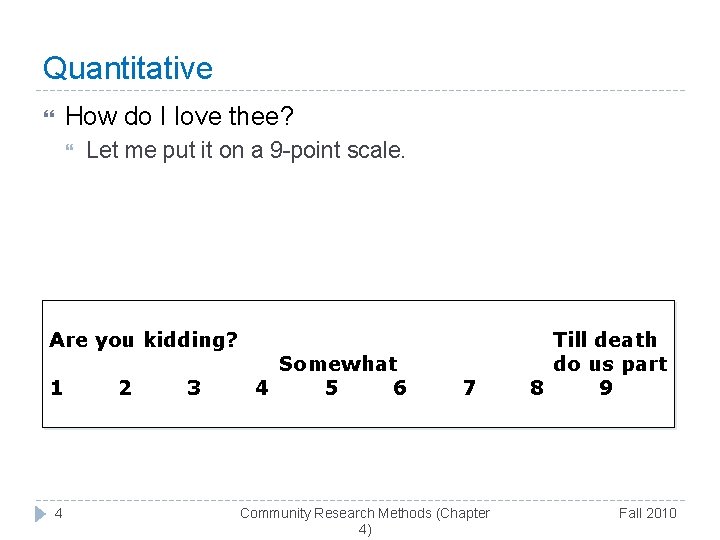
Quantitative How do I love thee? Let me put it on a 9 -point scale. Are you kidding? 1 4 2 3 Somewhat 4 5 6 7 Community Research Methods (Chapter 4) Till death do us part 8 9 Fall 2010
Qualitative Methods Chapter 4 5 Community Research Methods (Chapter 4) Fall 2010
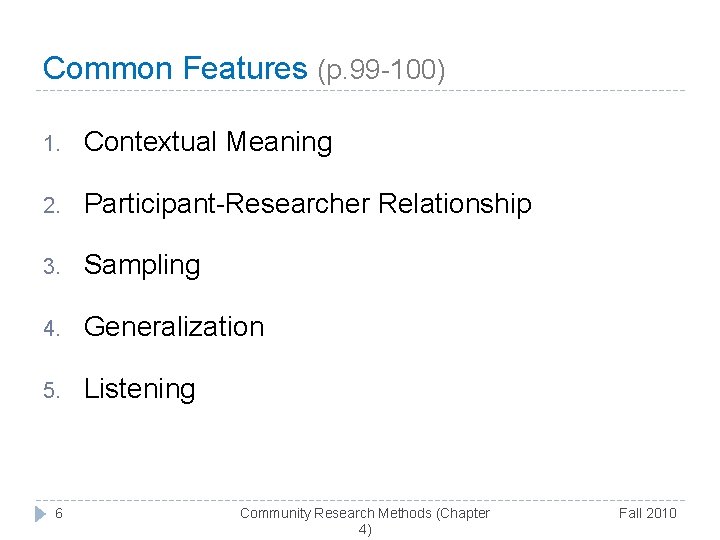
Common Features (p. 99 -100) 1. Contextual Meaning 2. Participant-Researcher Relationship 3. Sampling 4. Generalization 5. Listening 6 Community Research Methods (Chapter 4) Fall 2010
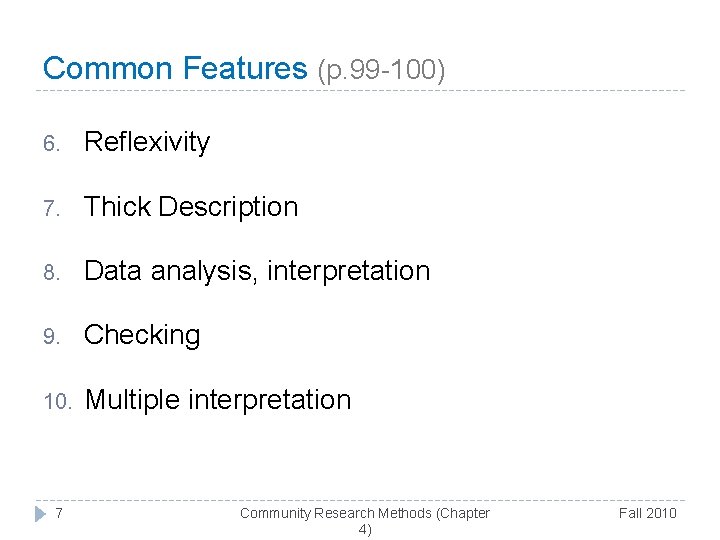
Common Features (p. 99 -100) 6. Reflexivity 7. Thick Description 8. Data analysis, interpretation 9. Checking 10. Multiple interpretation 7 Community Research Methods (Chapter 4) Fall 2010
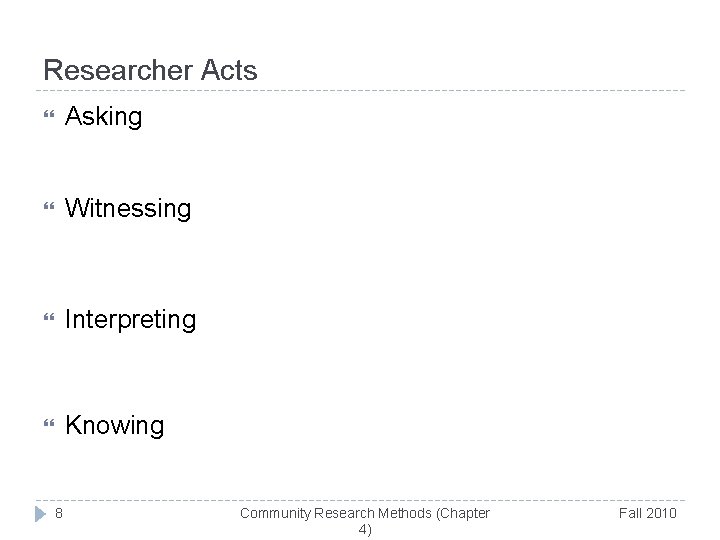
Researcher Acts Asking Witnessing Interpreting Knowing 8 Community Research Methods (Chapter 4) Fall 2010
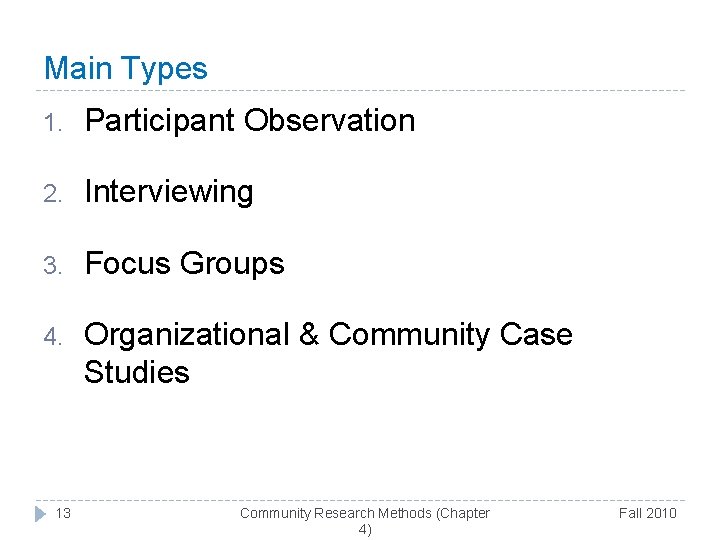
Main Types 1. Participant Observation 2. Qualitative Interviewing 3. Focus Groups 4. Organizational & Community Case Studies 9 Community Research Methods (Chapter 4) Fall 2010
(1) Participant Observation • Participant observation: • Researcher as social actor in community 10 Community Research Methods (Chapter 4) Fall 2010
Demonstration 11 Community Research Methods (Chapter 4) Fall 2010
Participant Observation & Gathering Valid Information Value of 2+ participant observer Selective perception Selective recall Selective interpretation Totally unstandardized Hard to repeat/replicate 12 Community Research Methods (Chapter 4) Fall 2010
Main Types 1. Participant Observation 2. Interviewing 3. Focus Groups 4. Organizational & Community Case Studies 13 Community Research Methods (Chapter 4) Fall 2010
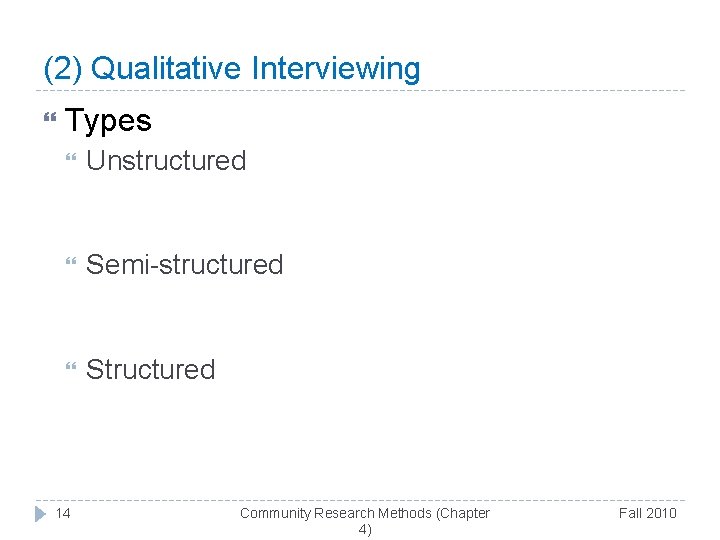
(2) Qualitative Interviewing Types Unstructured Semi-structured Structured 14 Community Research Methods (Chapter 4) Fall 2010
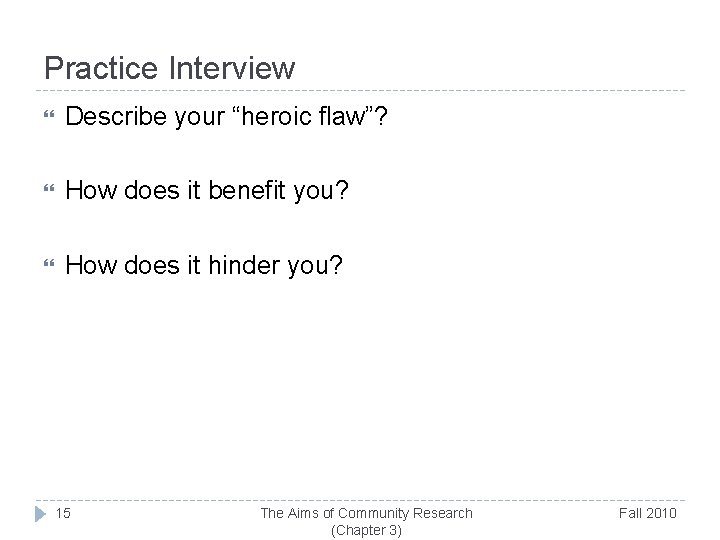
Practice Interview Describe your “heroic flaw”? How does it benefit you? How does it hinder you? 15 The Aims of Community Research (Chapter 3) Fall 2010
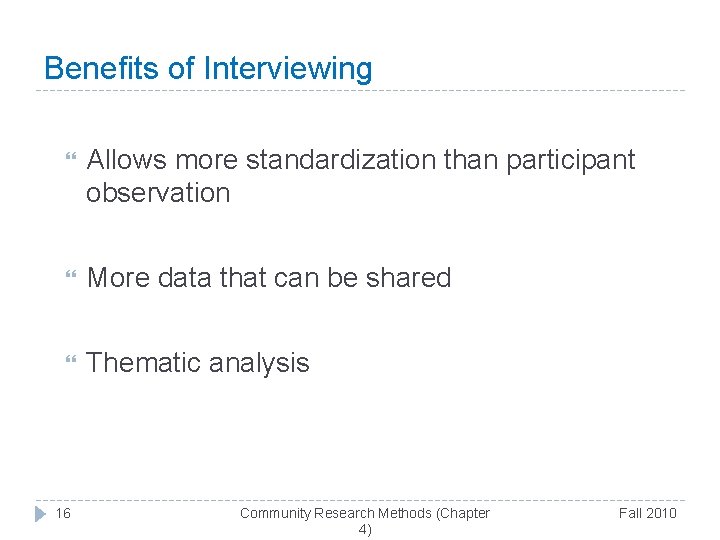
Benefits of Interviewing Allows more standardization than participant observation More data that can be shared Thematic analysis 16 Community Research Methods (Chapter 4) Fall 2010
Limits of Interviewing 17 Relies on what people can verbalize Depends on relationship w/ interviewee Some topics are off limits Community Research Methods (Chapter 4) Fall 2010
(3) Focus Groups brought together to focus discussion on particular issue 18 Gather 6 -12 representatives of relevant constituencies Usually groups who do not know each other Why? Priming Effects Trained moderator Community Research Methods (Chapter 4) Fall 2010
(4) Organizational & Community Case Studies – Intensive study of one instance or case – Use any methods available • Participant observation • Interviewing • Focus groups • Archival data (e. g. , minutes, yearbooks) – Piece together data into a coherent story 19 Community Research Methods (Chapter 4) Fall 2010
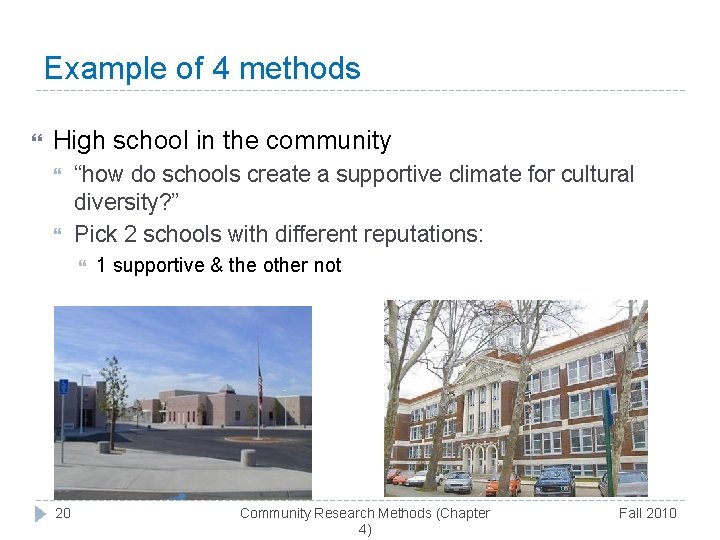
Example of 4 methods High school in the community “how do schools create a supportive climate for cultural diversity? ” Pick 2 schools with different reputations: 20 1 supportive & the other not Community Research Methods (Chapter 4) Fall 2010
Example of 4 methods (1) Participant Observation (2) Qualitative interviewing 21 Community Research Methods (Chapter 4) Fall 2010
Example of 4 methods (3) Focus group (4) Organizational case study 22 Community Research Methods (Chapter 4) Fall 2010
Practice • How could you use the 4 methods to study this research question? • How are people affected by raising unemployment rates? • Methods: – – 23 Participant Observation Qualitative Interviews Focus Group Case Study Community Research Methods (Chapter 4) Fall 2010
Strengths _____________________________ 24 Community Research Methods (Chapter 4) Fall 2010
Weaknesses _____________________________ 25 Community Research Methods (Chapter 4) Fall 2010
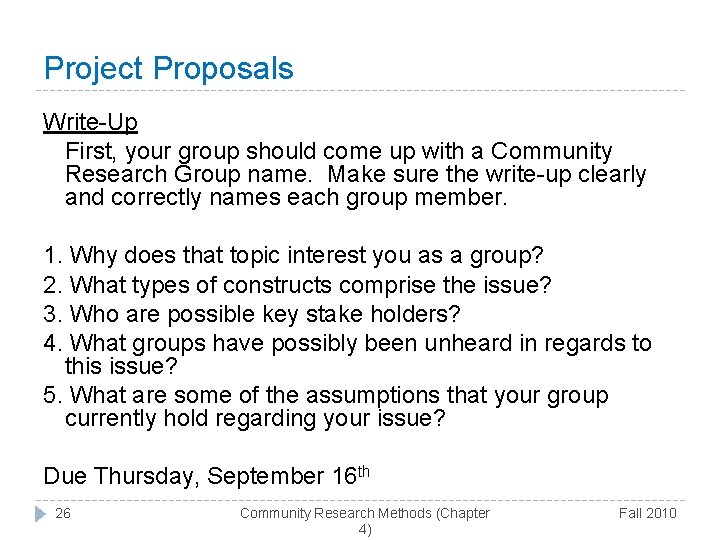
Project Proposals Write-Up First, your group should come up with a Community Research Group name. Make sure the write-up clearly and correctly names each group member. 1. Why does that topic interest you as a group? 2. What types of constructs comprise the issue? 3. Who are possible key stake holders? 4. What groups have possibly been unheard in regards to this issue? 5. What are some of the assumptions that your group currently hold regarding your issue? Due Thursday, September 16 th 26 Community Research Methods (Chapter 4) Fall 2010